Contemporary architecture
Neoclassical
By abhishek anpat
Introduction
1. The revival of classical style or treatment in art, literature,
architecture, or music
2. It is dated from 1660-1780
3. Also called the “Augustan” period
4. Art produced in Europe and north America
5. More than just an antique revival – a reaction against the surviving
baroque and rococo styles
6. Is a conservative movement
7. Believed that humans were fallen
8. Observed a disparity between the past & the present
9. The era is also called historic eclecticism
Timeline
•1660-1785 the neoclassical period
1. 1660-1700 the restoration
2. 1700-1745 the Augustan age (or age of pope)
3. 1745-1785 the age of sensibility (or age of Johnson)
•1785-1830 the romantic period
•1660-1800
1. Augustan age – return to classical Rome
2. Neoclassical period – writing like the Latin classics
3. Enlightenment – the rise of science
4. Age of reason – the divine watchmaker
Social and political conditions of society
• Social conditions
1. Secularization of European culture
2. Social democracy and scientific progress
3. Internationalism( global economy)
4. Art is an open market
5. new models of the human being
6. defeat of the aristocracy and rise of the middle class
7. Science and natural philosophy would replace religion as a way of
understanding nature , with the majority of people now becoming
committed to secular views
8. 50% of males are functionally literate
9. Coffee houses – where educated men spend evenings with literary
and political associates
Political conditions
• Linked to contemporary political events :
1. Revolutions established republics in France and America
2. Association with democracy of Greece and the
republication of Rome
• Two political revolutions :
1. American and French
• Napoleon- used the style of propaganda
`
Art
1. inspired by French revolution
2. It was the official art of the revolutions
3. It has a deep moral sense.
Painting
1. Compositions are more simple than Baroque
2. Subjects inspired in mythology
3. The style was successful and imitated
•Characteristics
1. sharp color with chiaroscuro
2. Manifests the classical ideals
1. Chiaroscuro ("light-dark") in art is characterized by strong contrasts
between light and dark, usually bold contrasts affecting a whole
composition.
• Styles of painting introduced
1. Historicism refers to artistic styles that draw their inspiration from
copying historic styles or artisans.
2. Genre works, also called genre scenes or genre views are pictorial
representations in any of various media that represent scenes or events
from everyday life, such as markets, domestic settings, interiors, parties,
inn scenes, and street scenes.
• Famous neoclassical artists
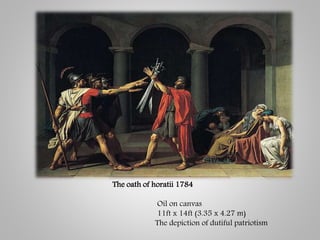
1. Jacques-Louis David
2. Benjamin west
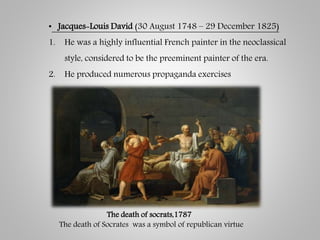
• Jacques-Louis David (30 August 1748 – 29 December 1825)
1. He was a highly influential French painter in the neoclassical
style, considered to be the preeminent painter of the era.
2. He produced numerous propaganda exercises
The death of socrats,1787
The death of Socrates was a symbol of republican virtue
Oil on canvas
11ft x 14ft (3.35 x 4.27 m)
The depiction of dutiful patriotism
The oath of horatii 1784
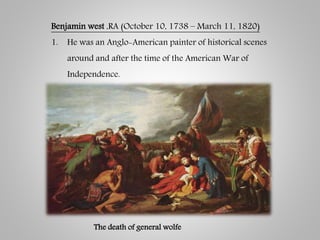
Benjamin west ,RA (October 10, 1738 – March 11, 1820)
1. He was an Anglo-American painter of historical scenes
around and after the time of the American War of
Independence.
The death of general wolfe
sculpture
1. Profoundly influenced by ancient art since the Renaissance.
2. Neo-Classical sculptors avoided the dramatic twisting poses and
colored marble surfaces characteristic of late Baroque and
Rococo sculpture.
3. They preferred:
1. Crisp contours.
2. A noble stillness.
3. Idealized white marble forms.
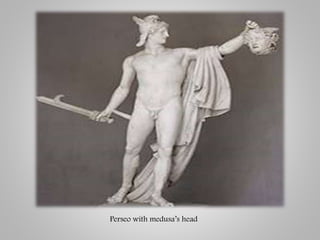
•Canova:
1. His works have exquisite finishing and near resemblance to real life
2. Images are attractive, full of grace, elegant
3. Men deficient in dignity
4. Female faces pleasing
Perseo with medusa’s head
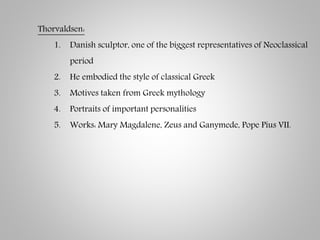
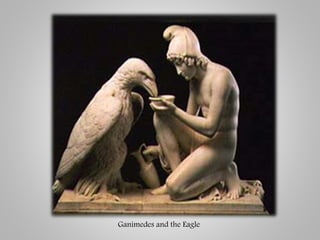
Thorvaldsen:
1. Danish sculptor, one of the biggest representatives of Neoclassical
period
2. He embodied the style of classical Greek
3. Motives taken from Greek mythology
4. Portraits of important personalities
5. Works: Mary Magdalene, Zeus and Ganymede, Pope Pius VII.
Ganimedes and the Eagle
Venus with an AppleEve
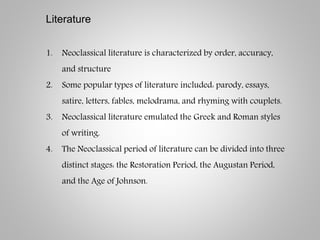
Literature
1. Neoclassical literature is characterized by order, accuracy,
and structure
2. Some popular types of literature included: parody, essays,
satire, letters, fables, melodrama, and rhyming with couplets.
3. Neoclassical literature emulated the Greek and Roman styles
of writing.
4. The Neoclassical period of literature can be divided into three
distinct stages: the Restoration Period, the Augustan Period,
and the Age of Johnson.
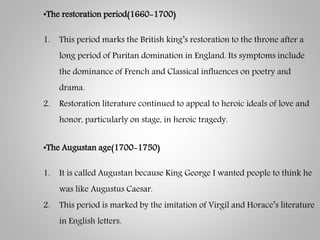
•The restoration period(1660-1700)
1. This period marks the British king’s restoration to the throne after a
long period of Puritan domination in England. Its symptoms include
the dominance of French and Classical influences on poetry and
drama.
2. Restoration literature continued to appeal to heroic ideals of love and
honor, particularly on stage, in heroic tragedy.
•The Augustan age(1700-1750)
1. It is called Augustan because King George I wanted people to think he
was like Augustus Caesar.
2. This period is marked by the imitation of Virgil and Horace’s literature
in English letters.
The age of Johnson(1750-1790)
1. This period marks the transition toward the upcoming Romanticism
through the period is still largely Neoclassical. Much was happening
around the world politically, such as both the American and French
Revolutions. This time marked a transition in English literature from
the structure and formality of the Neoclassical writers to the
emotional, ungoverned writings of the Romantics.
Some Neoclassical Writers and their Works
1. John Milton (1608 - 1674), Paradise Los
2. John Dryden (1631 - 1700), To My Lord Chancellor
3. Alexander Pope (1688 - 1744), Translation of the Iliad, Pastorals
4. Samuel Johnson (1709 - 1784), A Dictionary of the English
Language
Architecture
1. Neoclassical architecture is an architectural style produced by the
neoclassical movement that began in the mid-18th century. In its
purest form it is a style principally derived from the architecture
of classical antiquity , the Vitruvius principles, and the
architecture of the Italian architect Andrea Palladio
2. In Central and Eastern Europe, the style is usually referred to as
Classicism (German: Klassizismus), while the newer revival styles
of the 19th century until today are called Neoclassical
3. Two types- a. Synthetic architecture
b. associational architecture
•Characteristics of neoclassical architecture
1. Revisions of classical principles to include contemporary living
requirements
2. Sources – Palladio and Jones
3. Symmetry, balance , composition , order
4. Greek/roman columns
5. Pediments over entrances and windows
6. Domes
7. Interior layout symmetrical
8. Rooms themes from ancient worlds or colors
•Famous architects and their works
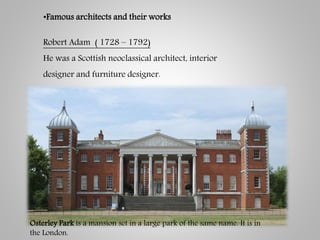
Robert Adam ( 1728 – 1792)
He was a Scottish neoclassical architect, interior
designer and furniture designer.
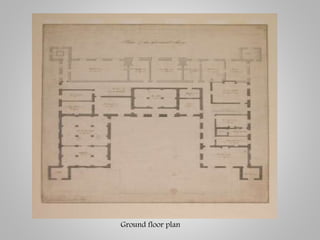
Osterley Park is a mansion set in a large park of the same name. It is in
the London.
Ground floor plan
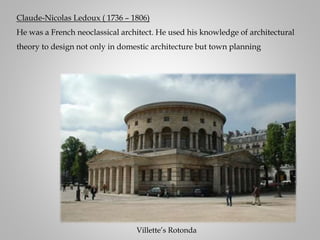
Claude-Nicolas Ledoux ( 1736 – 1806)
He was a French neoclassical architect. He used his knowledge of architectural
theory to design not only in domestic architecture but town planning
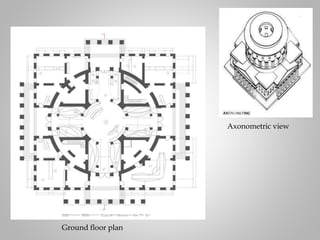
Villette’s Rotonda
Ground floor plan
Axonometric view
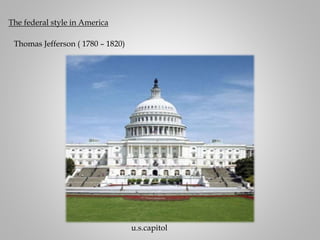
The federal style in America
Thomas Jefferson ( 1780 – 1820)
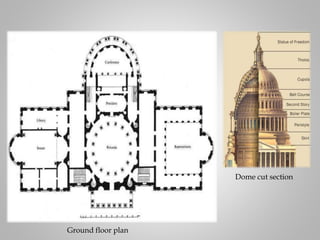
u.s.capitol
Ground floor plan
Dome cut section
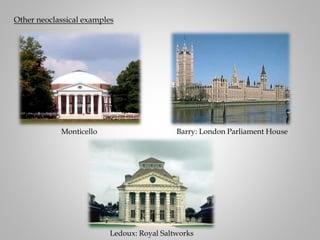
Other neoclassical examples
Monticello Barry: London Parliament House
Ledoux: Royal Saltworks
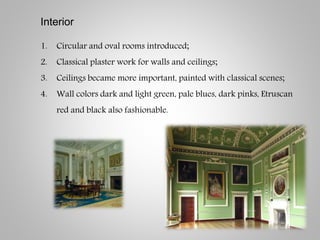
Interior
1. Circular and oval rooms introduced;
2. Classical plaster work for walls and ceilings;
3. Ceilings became more important, painted with classical scenes;
4. Wall colors dark and light green, pale blues, dark pinks, Etruscan
red and black also fashionable.
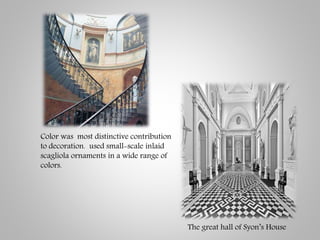
Color was most distinctive contribution
to decoration. used small-scale inlaid
scagliola ornaments in a wide range of
colors.
The great hall of Syon’s House
Conclusion
1. Neoclassicism art focuses on the painting idealized subjects
or objects, with absolute perfection of its figure and the
complexion, that focus more on the subjective story than the
background, with great emphasis on use of dramatic
lighting, soft brush strokes.
2. subjects taken from history that highlighted morality,
patriotism, and courage
3. use of the Classical architectural orders in painting,
and of course in architecture
Thank you

Neoclassical

  • 1.
  • 2.
    Introduction 1. The revivalof classical style or treatment in art, literature, architecture, or music 2. It is dated from 1660-1780 3. Also called the “Augustan” period 4. Art produced in Europe and north America 5. More than just an antique revival – a reaction against the surviving baroque and rococo styles 6. Is a conservative movement 7. Believed that humans were fallen 8. Observed a disparity between the past & the present 9. The era is also called historic eclecticism
  • 3.
    Timeline •1660-1785 the neoclassicalperiod 1. 1660-1700 the restoration 2. 1700-1745 the Augustan age (or age of pope) 3. 1745-1785 the age of sensibility (or age of Johnson) •1785-1830 the romantic period •1660-1800 1. Augustan age – return to classical Rome 2. Neoclassical period – writing like the Latin classics 3. Enlightenment – the rise of science 4. Age of reason – the divine watchmaker
  • 4.
    Social and politicalconditions of society • Social conditions 1. Secularization of European culture 2. Social democracy and scientific progress 3. Internationalism( global economy) 4. Art is an open market 5. new models of the human being 6. defeat of the aristocracy and rise of the middle class 7. Science and natural philosophy would replace religion as a way of understanding nature , with the majority of people now becoming committed to secular views 8. 50% of males are functionally literate 9. Coffee houses – where educated men spend evenings with literary and political associates
  • 5.
    Political conditions • Linkedto contemporary political events : 1. Revolutions established republics in France and America 2. Association with democracy of Greece and the republication of Rome • Two political revolutions : 1. American and French • Napoleon- used the style of propaganda `
  • 6.
    Art 1. inspired byFrench revolution 2. It was the official art of the revolutions 3. It has a deep moral sense. Painting 1. Compositions are more simple than Baroque 2. Subjects inspired in mythology 3. The style was successful and imitated •Characteristics 1. sharp color with chiaroscuro 2. Manifests the classical ideals
  • 7.
    1. Chiaroscuro ("light-dark")in art is characterized by strong contrasts between light and dark, usually bold contrasts affecting a whole composition. • Styles of painting introduced 1. Historicism refers to artistic styles that draw their inspiration from copying historic styles or artisans. 2. Genre works, also called genre scenes or genre views are pictorial representations in any of various media that represent scenes or events from everyday life, such as markets, domestic settings, interiors, parties, inn scenes, and street scenes. • Famous neoclassical artists 1. Jacques-Louis David 2. Benjamin west
  • 8.
    • Jacques-Louis David(30 August 1748 – 29 December 1825) 1. He was a highly influential French painter in the neoclassical style, considered to be the preeminent painter of the era. 2. He produced numerous propaganda exercises The death of socrats,1787 The death of Socrates was a symbol of republican virtue
  • 9.
    Oil on canvas 11ftx 14ft (3.35 x 4.27 m) The depiction of dutiful patriotism The oath of horatii 1784
  • 10.
    Benjamin west ,RA(October 10, 1738 – March 11, 1820) 1. He was an Anglo-American painter of historical scenes around and after the time of the American War of Independence. The death of general wolfe
  • 11.
    sculpture 1. Profoundly influencedby ancient art since the Renaissance. 2. Neo-Classical sculptors avoided the dramatic twisting poses and colored marble surfaces characteristic of late Baroque and Rococo sculpture. 3. They preferred: 1. Crisp contours. 2. A noble stillness. 3. Idealized white marble forms. •Canova: 1. His works have exquisite finishing and near resemblance to real life 2. Images are attractive, full of grace, elegant 3. Men deficient in dignity 4. Female faces pleasing
  • 12.
  • 13.
    Thorvaldsen: 1. Danish sculptor,one of the biggest representatives of Neoclassical period 2. He embodied the style of classical Greek 3. Motives taken from Greek mythology 4. Portraits of important personalities 5. Works: Mary Magdalene, Zeus and Ganymede, Pope Pius VII.
  • 14.
  • 15.
    Venus with anAppleEve
  • 16.
    Literature 1. Neoclassical literatureis characterized by order, accuracy, and structure 2. Some popular types of literature included: parody, essays, satire, letters, fables, melodrama, and rhyming with couplets. 3. Neoclassical literature emulated the Greek and Roman styles of writing. 4. The Neoclassical period of literature can be divided into three distinct stages: the Restoration Period, the Augustan Period, and the Age of Johnson.
  • 17.
    •The restoration period(1660-1700) 1.This period marks the British king’s restoration to the throne after a long period of Puritan domination in England. Its symptoms include the dominance of French and Classical influences on poetry and drama. 2. Restoration literature continued to appeal to heroic ideals of love and honor, particularly on stage, in heroic tragedy. •The Augustan age(1700-1750) 1. It is called Augustan because King George I wanted people to think he was like Augustus Caesar. 2. This period is marked by the imitation of Virgil and Horace’s literature in English letters.
  • 18.
    The age ofJohnson(1750-1790) 1. This period marks the transition toward the upcoming Romanticism through the period is still largely Neoclassical. Much was happening around the world politically, such as both the American and French Revolutions. This time marked a transition in English literature from the structure and formality of the Neoclassical writers to the emotional, ungoverned writings of the Romantics. Some Neoclassical Writers and their Works 1. John Milton (1608 - 1674), Paradise Los 2. John Dryden (1631 - 1700), To My Lord Chancellor 3. Alexander Pope (1688 - 1744), Translation of the Iliad, Pastorals 4. Samuel Johnson (1709 - 1784), A Dictionary of the English Language
  • 19.
    Architecture 1. Neoclassical architectureis an architectural style produced by the neoclassical movement that began in the mid-18th century. In its purest form it is a style principally derived from the architecture of classical antiquity , the Vitruvius principles, and the architecture of the Italian architect Andrea Palladio 2. In Central and Eastern Europe, the style is usually referred to as Classicism (German: Klassizismus), while the newer revival styles of the 19th century until today are called Neoclassical 3. Two types- a. Synthetic architecture b. associational architecture
  • 20.
    •Characteristics of neoclassicalarchitecture 1. Revisions of classical principles to include contemporary living requirements 2. Sources – Palladio and Jones 3. Symmetry, balance , composition , order 4. Greek/roman columns 5. Pediments over entrances and windows 6. Domes 7. Interior layout symmetrical 8. Rooms themes from ancient worlds or colors
  • 21.
    •Famous architects andtheir works Robert Adam ( 1728 – 1792) He was a Scottish neoclassical architect, interior designer and furniture designer. Osterley Park is a mansion set in a large park of the same name. It is in the London.
  • 22.
  • 23.
    Claude-Nicolas Ledoux (1736 – 1806) He was a French neoclassical architect. He used his knowledge of architectural theory to design not only in domestic architecture but town planning Villette’s Rotonda
  • 24.
  • 25.
    The federal stylein America Thomas Jefferson ( 1780 – 1820) u.s.capitol
  • 26.
  • 27.
    Other neoclassical examples MonticelloBarry: London Parliament House Ledoux: Royal Saltworks
  • 28.
    Interior 1. Circular andoval rooms introduced; 2. Classical plaster work for walls and ceilings; 3. Ceilings became more important, painted with classical scenes; 4. Wall colors dark and light green, pale blues, dark pinks, Etruscan red and black also fashionable.
  • 29.
    Color was mostdistinctive contribution to decoration. used small-scale inlaid scagliola ornaments in a wide range of colors. The great hall of Syon’s House
  • 30.
    Conclusion 1. Neoclassicism artfocuses on the painting idealized subjects or objects, with absolute perfection of its figure and the complexion, that focus more on the subjective story than the background, with great emphasis on use of dramatic lighting, soft brush strokes. 2. subjects taken from history that highlighted morality, patriotism, and courage 3. use of the Classical architectural orders in painting, and of course in architecture
  • 31.