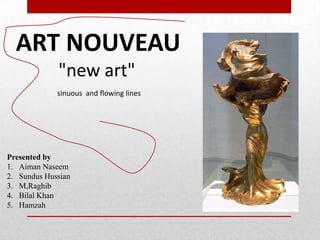
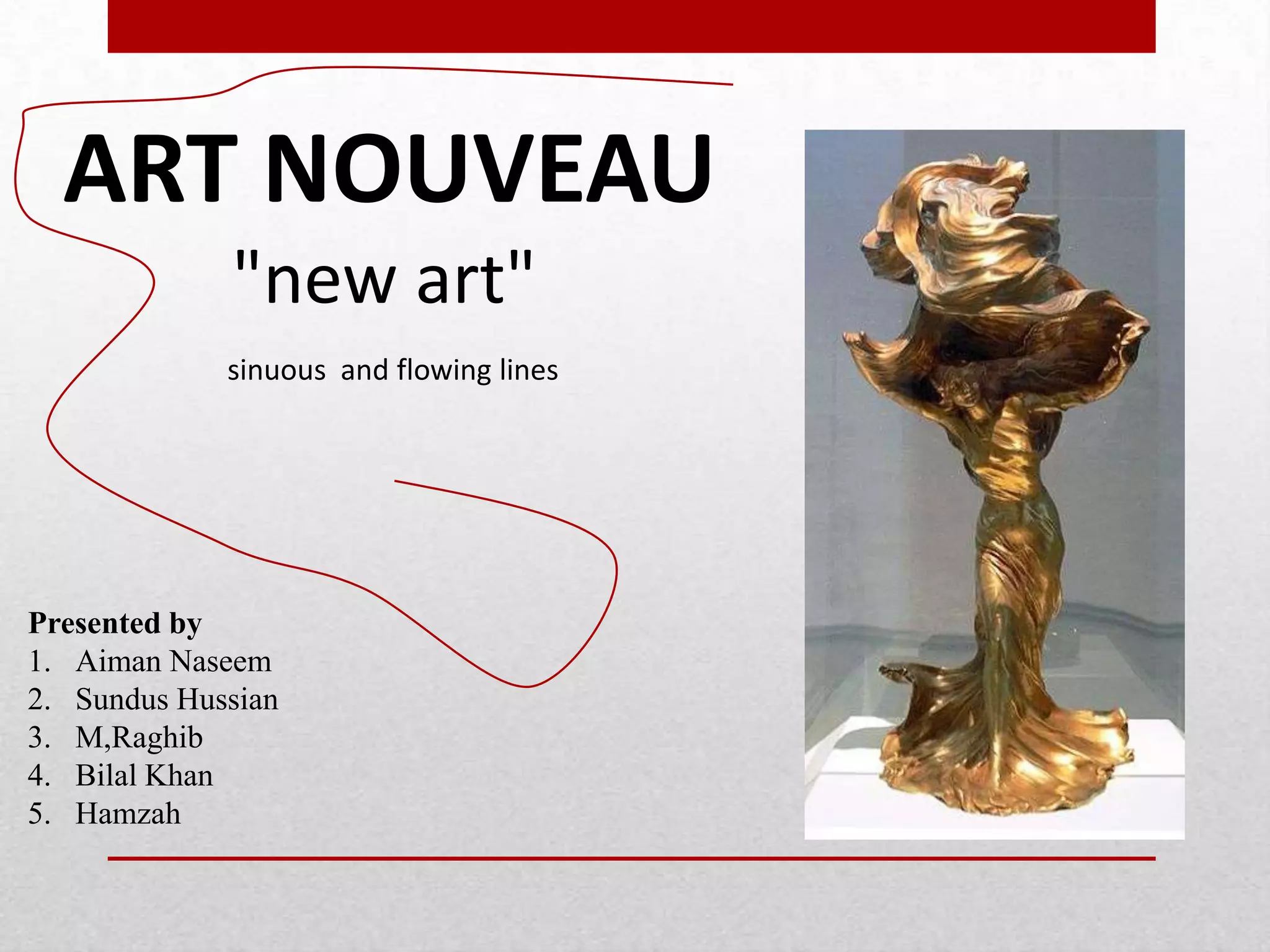
ART NOUVEAU
"new art"
sinuous and flowing lines

Presented by
1. Aiman Naseem
2. Sundus Hussian
3. M,Raghib
4. Bilal Khan
5. Hamzah
CONTENTS
1. Introduction
2. Architectural features
3. Elements
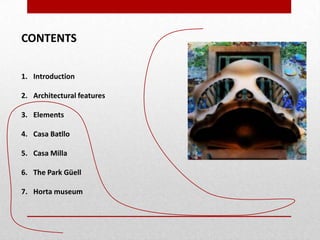
4. Casa Batllo
5. Casa Milla

6. The Park Güell
7. Horta museum
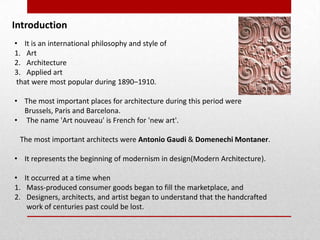
Introduction
• It is an international philosophy and style of
1. Art
2. Architecture
3. Applied art
that were most popular during 1890–1910.
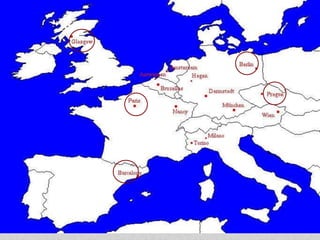
• The most important places for architecture during this period were
Brussels, Paris and Barcelona.
• The name 'Art nouveau' is French for 'new art'.
The most important architects were Antonio Gaudi & Domenechi Montaner.
• It represents the beginning of modernism in design(Modern Architecture).
• It occurred at a time when
1. Mass-produced consumer goods began to fill the marketplace, and
2. Designers, architects, and artist began to understand that the handcrafted
work of centuries past could be lost.
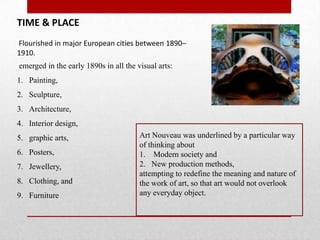
TIME & PLACE
Flourished in major European cities between 1890–
1910.
emerged in the early 1890s in all the visual arts:

1. Painting,
2. Sculpture,
3. Architecture,
4. Interior design,
5. graphic arts,
6. Posters,
7. Jewellery,
8. Clothing, and
9. Furniture

Art Nouveau was underlined by a particular way
of thinking about
1. Modern society and
2. New production methods,
attempting to redefine the meaning and nature of
the work of art, so that art would not overlook
any everyday object.
ART NOUVEAU ARCHITECTURE
FEATURES
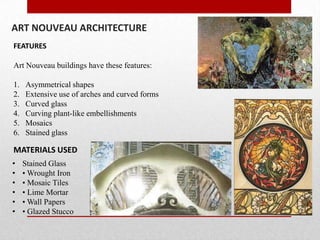
Art Nouveau buildings have these features:
1.
2.
3.
4.
5.
6.

Asymmetrical shapes
Extensive use of arches and curved forms
Curved glass
Curving plant-like embellishments
Mosaics
Stained glass

MATERIALS USED
•
•
•
•
•
•

Stained Glass
• Wrought Iron
• Mosaic Tiles
• Lime Mortar
• Wall Papers
• Glazed Stucco
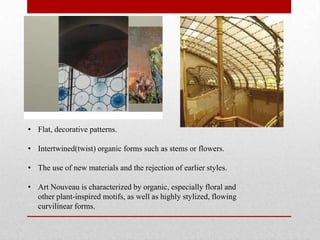
• Flat, decorative patterns.
• Intertwined(twist) organic forms such as stems or flowers.
• The use of new materials and the rejection of earlier styles.
• Art Nouveau is characterized by organic, especially floral and
other plant-inspired motifs, as well as highly stylized, flowing
curvilinear forms.
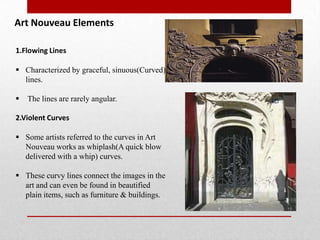
Art Nouveau Elements
1.Flowing Lines
 Characterized by graceful, sinuous(Curved)
lines.


The lines are rarely angular.

2.Violent Curves
 Some artists referred to the curves in Art
Nouveau works as whiplash(A quick blow
delivered with a whip) curves.

 These curvy lines connect the images in the
art and can even be found in beautified
plain items, such as furniture & buildings.
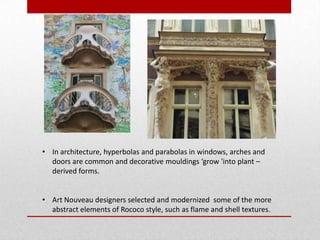
• In architecture, hyperbolas and parabolas in windows, arches and
doors are common and decorative mouldings ‘grow 'into plant –
derived forms.
• Art Nouveau designers selected and modernized some of the more
abstract elements of Rococo style, such as flame and shell textures.
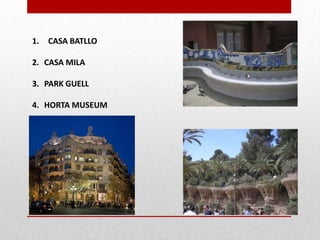
1.

CASA BATLLO

2. CASA MILA
3. PARK GUELL
4. HORTA MUSEUM
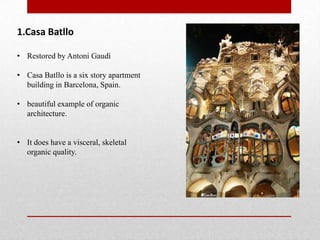
1.Casa Batllo
• Restored by Antoni Gaudí
• Casa Batllo is a six story apartment
building in Barcelona, Spain.
• beautiful example of organic
architecture.
• It does have a visceral, skeletal
organic quality.
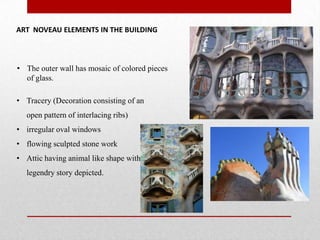
ART NOVEAU ELEMENTS IN THE BUILDING

• The outer wall has mosaic of colored pieces
of glass.
• Tracery (Decoration consisting of an
open pattern of interlacing ribs)
• irregular oval windows
• flowing sculpted stone work
• Attic having animal like shape with a
legendry story depicted.
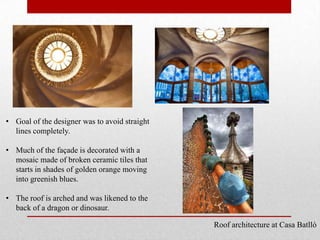
• Goal of the designer was to avoid straight
lines completely.
• Much of the façade is decorated with a
mosaic made of broken ceramic tiles that
starts in shades of golden orange moving
into greenish blues.
• The roof is arched and was likened to the
back of a dragon or dinosaur.
Roof architecture at Casa Batlló
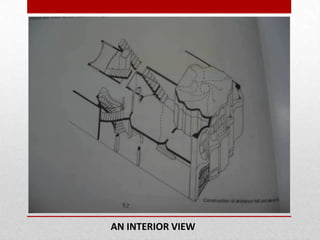
AN INTERIOR VIEW
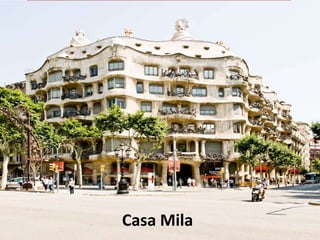
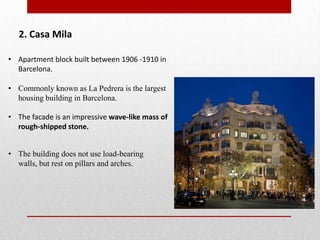
Casa Mila
2. Casa Mila
• Apartment block built between 1906 -1910 in
Barcelona.
• Commonly known as La Pedrera is the largest
housing building in Barcelona.
• The facade is an impressive wave-like mass of
rough-shipped stone.
• The building does not use load-bearing
walls, but rest on pillars and arches.
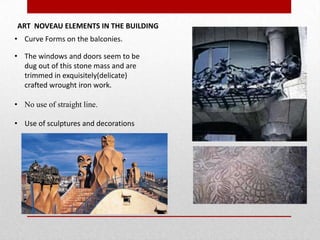
ART NOVEAU ELEMENTS IN THE BUILDING
• Curve Forms on the balconies.
• The windows and doors seem to be
dug out of this stone mass and are
trimmed in exquisitely(delicate)
crafted wrought iron work.
• No use of straight line.
• Use of sculptures and decorations
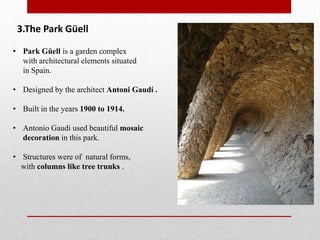
3.The Park Güell
• Park Güell is a garden complex
with architectural elements situated
in Spain.
• Designed by the architect Antoni Gaudí .
• Built in the years 1900 to 1914.
• Antonio Gaudi used beautiful mosaic
decoration in this park.

• Structures were of natural forms,
with columns like tree trunks .
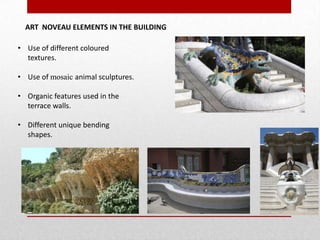
ART NOVEAU ELEMENTS IN THE BUILDING

• Use of different coloured
textures.
• Use of mosaic animal sculptures.
• Organic features used in the
terrace walls.
• Different unique bending
shapes.
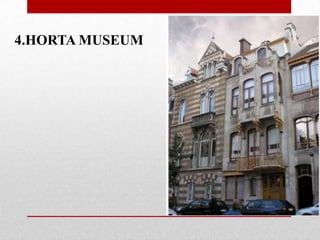
4.HORTA MUSEUM
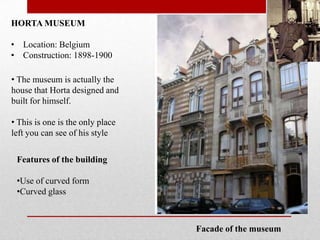
HORTA MUSEUM
• Location: Belgium
• Construction: 1898-1900
• The museum is actually the
house that Horta designed and
built for himself.

• This is one is the only place
left you can see of his style
Features of the building
•Use of curved form
•Curved glass

Facade of the museum
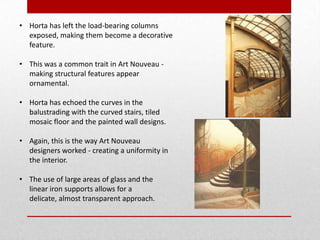
• Horta has left the load-bearing columns
exposed, making them become a decorative
feature.
• This was a common trait in Art Nouveau making structural features appear
ornamental.
• Horta has echoed the curves in the
balustrading with the curved stairs, tiled
mosaic floor and the painted wall designs.
• Again, this is the way Art Nouveau
designers worked - creating a uniformity in
the interior.
• The use of large areas of glass and the
linear iron supports allows for a
delicate, almost transparent approach.
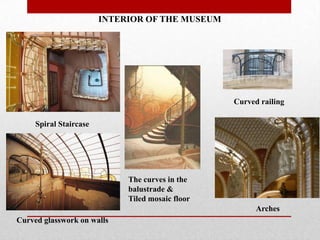
INTERIOR OF THE MUSEUM

Curved railing
Spiral Staircase

The curves in the
balustrade &
Tiled mosaic floor
Arches
Curved glasswork on walls
THANK YOU…

Art nouveau...

  • 1.
    ART NOUVEAU "new art" sinuousand flowing lines Presented by 1. Aiman Naseem 2. Sundus Hussian 3. M,Raghib 4. Bilal Khan 5. Hamzah
  • 2.
    CONTENTS 1. Introduction 2. Architecturalfeatures 3. Elements 4. Casa Batllo 5. Casa Milla 6. The Park Güell 7. Horta museum
  • 3.
    Introduction • It isan international philosophy and style of 1. Art 2. Architecture 3. Applied art that were most popular during 1890–1910. • The most important places for architecture during this period were Brussels, Paris and Barcelona. • The name 'Art nouveau' is French for 'new art'. The most important architects were Antonio Gaudi & Domenechi Montaner. • It represents the beginning of modernism in design(Modern Architecture). • It occurred at a time when 1. Mass-produced consumer goods began to fill the marketplace, and 2. Designers, architects, and artist began to understand that the handcrafted work of centuries past could be lost.
  • 5.
    TIME & PLACE Flourishedin major European cities between 1890– 1910. emerged in the early 1890s in all the visual arts: 1. Painting, 2. Sculpture, 3. Architecture, 4. Interior design, 5. graphic arts, 6. Posters, 7. Jewellery, 8. Clothing, and 9. Furniture Art Nouveau was underlined by a particular way of thinking about 1. Modern society and 2. New production methods, attempting to redefine the meaning and nature of the work of art, so that art would not overlook any everyday object.
  • 6.
    ART NOUVEAU ARCHITECTURE FEATURES ArtNouveau buildings have these features: 1. 2. 3. 4. 5. 6. Asymmetrical shapes Extensive use of arches and curved forms Curved glass Curving plant-like embellishments Mosaics Stained glass MATERIALS USED • • • • • • Stained Glass • Wrought Iron • Mosaic Tiles • Lime Mortar • Wall Papers • Glazed Stucco
  • 7.
    • Flat, decorativepatterns. • Intertwined(twist) organic forms such as stems or flowers. • The use of new materials and the rejection of earlier styles. • Art Nouveau is characterized by organic, especially floral and other plant-inspired motifs, as well as highly stylized, flowing curvilinear forms.
  • 8.
    Art Nouveau Elements 1.FlowingLines  Characterized by graceful, sinuous(Curved) lines.  The lines are rarely angular. 2.Violent Curves  Some artists referred to the curves in Art Nouveau works as whiplash(A quick blow delivered with a whip) curves.  These curvy lines connect the images in the art and can even be found in beautified plain items, such as furniture & buildings.
  • 9.
    • In architecture,hyperbolas and parabolas in windows, arches and doors are common and decorative mouldings ‘grow 'into plant – derived forms. • Art Nouveau designers selected and modernized some of the more abstract elements of Rococo style, such as flame and shell textures.
  • 10.
    1. CASA BATLLO 2. CASAMILA 3. PARK GUELL 4. HORTA MUSEUM
  • 11.
    1.Casa Batllo • Restoredby Antoni Gaudí • Casa Batllo is a six story apartment building in Barcelona, Spain. • beautiful example of organic architecture. • It does have a visceral, skeletal organic quality.
  • 12.
    ART NOVEAU ELEMENTSIN THE BUILDING • The outer wall has mosaic of colored pieces of glass. • Tracery (Decoration consisting of an open pattern of interlacing ribs) • irregular oval windows • flowing sculpted stone work • Attic having animal like shape with a legendry story depicted.
  • 13.
    • Goal ofthe designer was to avoid straight lines completely. • Much of the façade is decorated with a mosaic made of broken ceramic tiles that starts in shades of golden orange moving into greenish blues. • The roof is arched and was likened to the back of a dragon or dinosaur. Roof architecture at Casa Batlló
  • 14.
  • 15.
  • 16.
    2. Casa Mila •Apartment block built between 1906 -1910 in Barcelona. • Commonly known as La Pedrera is the largest housing building in Barcelona. • The facade is an impressive wave-like mass of rough-shipped stone. • The building does not use load-bearing walls, but rest on pillars and arches.
  • 17.
    ART NOVEAU ELEMENTSIN THE BUILDING • Curve Forms on the balconies. • The windows and doors seem to be dug out of this stone mass and are trimmed in exquisitely(delicate) crafted wrought iron work. • No use of straight line. • Use of sculptures and decorations
  • 18.
    3.The Park Güell •Park Güell is a garden complex with architectural elements situated in Spain. • Designed by the architect Antoni Gaudí . • Built in the years 1900 to 1914. • Antonio Gaudi used beautiful mosaic decoration in this park. • Structures were of natural forms, with columns like tree trunks .
  • 19.
    ART NOVEAU ELEMENTSIN THE BUILDING • Use of different coloured textures. • Use of mosaic animal sculptures. • Organic features used in the terrace walls. • Different unique bending shapes.
  • 20.
  • 21.
    HORTA MUSEUM • Location:Belgium • Construction: 1898-1900 • The museum is actually the house that Horta designed and built for himself. • This is one is the only place left you can see of his style Features of the building •Use of curved form •Curved glass Facade of the museum
  • 22.
    • Horta hasleft the load-bearing columns exposed, making them become a decorative feature. • This was a common trait in Art Nouveau making structural features appear ornamental. • Horta has echoed the curves in the balustrading with the curved stairs, tiled mosaic floor and the painted wall designs. • Again, this is the way Art Nouveau designers worked - creating a uniformity in the interior. • The use of large areas of glass and the linear iron supports allows for a delicate, almost transparent approach.
  • 23.
    INTERIOR OF THEMUSEUM Curved railing Spiral Staircase The curves in the balustrade & Tiled mosaic floor Arches Curved glasswork on walls
  • 24.