ART DECO
ART DECO 
ART DECO OR DECO, IS AN INFLUENTIAL VISUAL 
ARTS DESIGN STYLE THAT FIRST APPEARED 
IN FRANCE AFTER WORLD WAR I AND BEGAN 
FLOURISHING INTERNATIONALLY IN THE 1920S, 1930S 
AND 1940S. 
THE STYLE IS OFTEN CHARACTERIZED BY RICH 
COLOURS, BOLD GEOMETRIC SHAPES AND LAVISH 
ORNAMENTATION. 
DURING ITS HEYDAY, ART DECO REPRESENTED LUXURY, 
GLAMOUR, EXUBERANCE AND FAITH IN SOCIAL AND 
TECHNOLOGICAL PROGRESS.
INFLUENCE 
• ART DECO WAS A GLOBALLY POPULAR STYLE AND AFFECTED MANY 
AREAS OF DESIGN. IT WAS USED WIDELY IN CONSUMER PRODUCTS 
SUCH AS FURNITURE, COOKWARE, PORCELAIN, AND JEWELRY. 
• DURING THE 1930S, ART DECO WAS USED EXTENSIVELY FOR PUBLIC 
WORKS PROJECTS, RAILWAY STATIONS, ARCHITECTURE, INTERIOR 
DESIGN, AND AMUSEMENT PARKS. 
• WORLD WAR II CAUSED ART DECO TO DECLINE IN POPULARITY: IT 
WAS PERCEIVED BY SOME AS GAUDY AND INAPPROPRIATELY 
LUXURIOUS DURING THE 1960S.
CHARACTERISTICS 
MATERIALS 
• ART DECO MATERIALS INCLUDED STUCCO, 
CONCRETE, AND SMOOTH-FACED STONE. 
STEEL AND ALUMINUM WERE OFTEN USED 
ALONG WITH GLASS BLOCKS AND 
DECORATIVE OPAQUE PLATE GLASS. 
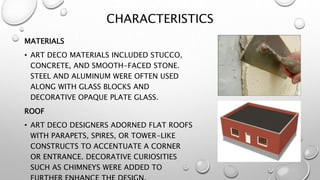
ROOF 
• ART DECO DESIGNERS ADORNED FLAT ROOFS 
WITH PARAPETS, SPIRES, OR TOWER-LIKE 
CONSTRUCTS TO ACCENTUATE A CORNER 
OR ENTRANCE. DECORATIVE CURIOSITIES 
SUCH AS CHIMNEYS WERE ADDED TO 
FURTHER ENHANCE THE DESIGN.
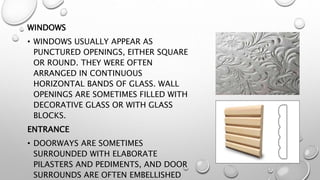
WINDOWS 
• WINDOWS USUALLY APPEAR AS 
PUNCTURED OPENINGS, EITHER SQUARE 
OR ROUND. THEY WERE OFTEN 
ARRANGED IN CONTINUOUS 
HORIZONTAL BANDS OF GLASS. WALL 
OPENINGS ARE SOMETIMES FILLED WITH 
DECORATIVE GLASS OR WITH GLASS 
BLOCKS. 
ENTRANCE 
• DOORWAYS ARE SOMETIMES 
SURROUNDED WITH ELABORATE 
PILASTERS AND PEDIMENTS, AND DOOR 
SURROUNDS ARE OFTEN EMBELLISHED
SURVIVING EXAMPLES 
• UNITED STATE 
• CANADA 
• EUROPE 
• LATIN AMERICA 
• ASIA 
• AFRICA 
• OCEANIA
ART DECO ARCHITECTURE IN UNITED STATE 
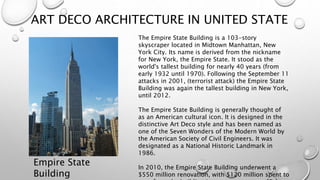
Empire State 
Building 
The Empire State Building is a 103-story 
skyscraper located in Midtown Manhattan, New 
York City. Its name is derived from the nickname 
for New York, the Empire State. It stood as the 
world's tallest building for nearly 40 years (from 
early 1932 until 1970). Following the September 11 
attacks in 2001, (terrorist attack) the Empire State 
Building was again the tallest building in New York, 
until 2012. 
The Empire State Building is generally thought of 
as an American cultural icon. It is designed in the 
distinctive Art Deco style and has been named as 
one of the Seven Wonders of the Modern World by 
the American Society of Civil Engineers. It was 
designated as a National Historic Landmark in 
1986. 
In 2010, the Empire State Building underwent a 
$550 million renovation, with $120 million spent to 
transform the building into a more energy efficient
ART DECO ARCHITECTURE IN UNITED 
KINGDOM 
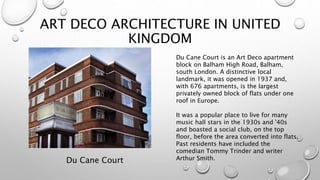
Du Cane Court 
Du Cane Court is an Art Deco apartment 
block on Balham High Road, Balham, 
south London. A distinctive local 
landmark, it was opened in 1937 and, 
with 676 apartments, is the largest 
privately owned block of flats under one 
roof in Europe. 
It was a popular place to live for many 
music hall stars in the 1930s and '40s 
and boasted a social club, on the top 
floor, before the area converted into flats. 
Past residents have included the 
comedian Tommy Trinder and writer 
Arthur Smith.
ART DECO ARCHITECTURE IN GERMANY 
Express 
building 
The Daily Express Building, located on Great 
Ancoats Street, Manchester, is a Grade II listed 
building which was designed by engineer, Sir 
Owen Williams. It was built in 1939; the other two 
similar buildings are located in London and 
Glasgow. 
The building is futurist art deco, specifically 
streamline modern with its horizontal lines and 
curved corners. It is clad in a combination of 
opaque and vitrolite glass. It was considered 
highly radical at the time and incorporated a 
growing technology, curtain walling. 
It is considered the best of the three of the 
Express Buildings, and is admired by architects 
such as Norman Foster and Mancunians alike. The 
building was Grade II listed in 1974 - just thirty-five 
years after its initial construction and 
remains Greater Manchester's youngest II listed
ART DECO ARCHITECTURE IN CANADA 
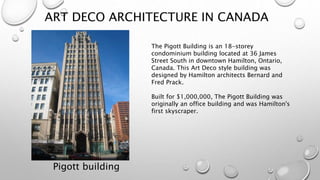
Pigott building 
The Pigott Building is an 18-storey 
condominium building located at 36 James 
Street South in downtown Hamilton, Ontario, 
Canada. This Art Deco style building was 
designed by Hamilton architects Bernard and 
Fred Prack. 
Built for $1,000,000, The Pigott Building was 
originally an office building and was Hamilton's 
first skyscraper.
ART DECO INTERIOR 
DESIGN 
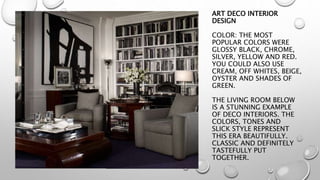
COLOR: THE MOST 
POPULAR COLORS WERE 
GLOSSY BLACK, CHROME, 
SILVER, YELLOW AND RED. 
YOU COULD ALSO USE 
CREAM, OFF WHITES, BEIGE, 
OYSTER AND SHADES OF 
GREEN. 
THE LIVING ROOM BELOW 
IS A STUNNING EXAMPLE 
OF DECO INTERIORS. THE 
COLORS, TONES AND 
SLICK STYLE REPRESENT 
THIS ERA BEAUTIFULLY. 
CLASSIC AND DEFINITELY 
TASTEFULLY PUT 
TOGETHER.
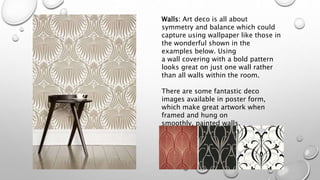
Walls: Art deco is all about 
symmetry and balance which could 
capture using wallpaper like those in 
the wonderful shown in the 
examples below. Using 
a wall covering with a bold pattern 
looks great on just one wall rather 
than all walls within the room. 
There are some fantastic deco 
images available in poster form, 
which make great artwork when 
framed and hung on 
smoothly, painted walls.
ART DECO ARTIST 
• TAMARA DE LEMPICKA 
• PABLO PICASSO 
• PIERRE BRISSAUD 
• JOSEPH CSAKY 
• JOHN AUSTEN 
• ROLAND ANSIEAU 
• ALEKSANDRA EKSTER
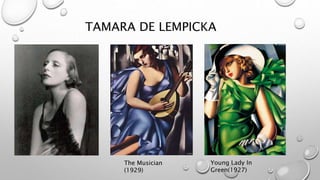
TAMARA DE LEMPICKA 
The Musician 
(1929) 
Young Lady In 
Green(1927)
PABLO PICASSO
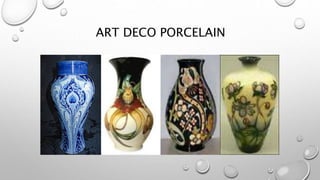
ART DECO PORCELAIN
Art Deco 
Cookwar 
e
Art Deco 
Earrings Rin 
Jewelry 
Bracelet 
gs 
Hair clips
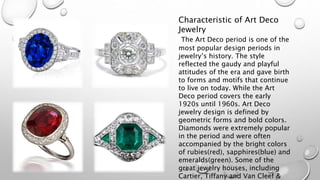
Characteristic of Art Deco 
Jewelry 
The Art Deco period is one of the 
most popular design periods in 
jewelry’s history. The style 
reflected the gaudy and playful 
attitudes of the era and gave birth 
to forms and motifs that continue 
to live on today. While the Art 
Deco period covers the early 
1920s until 1960s. Art Deco 
jewelry design is defined by 
geometric forms and bold colors. 
Diamonds were extremely popular 
in the period and were often 
accompanied by the bright colors 
of rubies(red), sapphires(blue) and 
emeralds(green). Some of the 
great jewelry houses, including 
Cartier, Tiffany and Van Cleef &
Art Deco 
Furniture
CHARACTERISTIC OF ART DECO FURNITURE 
CHAIRS 
• ART DECO CHAIRS TYPICALLY FEATURE 
CURVED LINES AND ORGANIC, HUMANLIKE 
FORMS. THESE CURVES ARE OFTEN 
JUXTAPOSED AGAINST ANGULAR LINES, 
CREATING THE ATTRACTIVE CONTRAST THAT 
WAS CHARACTERISTIC OF ART DECO DESIGN. 
CABINETS 
• ART DECO CABINETS ARE GENERALLY VERY 
LARGE, RIGID, AND OFTEN COMPOSED OF 
LACQUERED WOOD. MANY CRAFTSMEN LEFT 
THE WOOD NATURAL TO SHOW THE 
DISTINCTIVE GRAINS OF EXOTIC TIMBERS.
THANK YOU

Art deco

  • 1.
  • 2.
    ART DECO ARTDECO OR DECO, IS AN INFLUENTIAL VISUAL ARTS DESIGN STYLE THAT FIRST APPEARED IN FRANCE AFTER WORLD WAR I AND BEGAN FLOURISHING INTERNATIONALLY IN THE 1920S, 1930S AND 1940S. THE STYLE IS OFTEN CHARACTERIZED BY RICH COLOURS, BOLD GEOMETRIC SHAPES AND LAVISH ORNAMENTATION. DURING ITS HEYDAY, ART DECO REPRESENTED LUXURY, GLAMOUR, EXUBERANCE AND FAITH IN SOCIAL AND TECHNOLOGICAL PROGRESS.
  • 3.
    INFLUENCE • ARTDECO WAS A GLOBALLY POPULAR STYLE AND AFFECTED MANY AREAS OF DESIGN. IT WAS USED WIDELY IN CONSUMER PRODUCTS SUCH AS FURNITURE, COOKWARE, PORCELAIN, AND JEWELRY. • DURING THE 1930S, ART DECO WAS USED EXTENSIVELY FOR PUBLIC WORKS PROJECTS, RAILWAY STATIONS, ARCHITECTURE, INTERIOR DESIGN, AND AMUSEMENT PARKS. • WORLD WAR II CAUSED ART DECO TO DECLINE IN POPULARITY: IT WAS PERCEIVED BY SOME AS GAUDY AND INAPPROPRIATELY LUXURIOUS DURING THE 1960S.
  • 4.
    CHARACTERISTICS MATERIALS •ART DECO MATERIALS INCLUDED STUCCO, CONCRETE, AND SMOOTH-FACED STONE. STEEL AND ALUMINUM WERE OFTEN USED ALONG WITH GLASS BLOCKS AND DECORATIVE OPAQUE PLATE GLASS. ROOF • ART DECO DESIGNERS ADORNED FLAT ROOFS WITH PARAPETS, SPIRES, OR TOWER-LIKE CONSTRUCTS TO ACCENTUATE A CORNER OR ENTRANCE. DECORATIVE CURIOSITIES SUCH AS CHIMNEYS WERE ADDED TO FURTHER ENHANCE THE DESIGN.
  • 5.
    WINDOWS • WINDOWSUSUALLY APPEAR AS PUNCTURED OPENINGS, EITHER SQUARE OR ROUND. THEY WERE OFTEN ARRANGED IN CONTINUOUS HORIZONTAL BANDS OF GLASS. WALL OPENINGS ARE SOMETIMES FILLED WITH DECORATIVE GLASS OR WITH GLASS BLOCKS. ENTRANCE • DOORWAYS ARE SOMETIMES SURROUNDED WITH ELABORATE PILASTERS AND PEDIMENTS, AND DOOR SURROUNDS ARE OFTEN EMBELLISHED
  • 6.
    SURVIVING EXAMPLES •UNITED STATE • CANADA • EUROPE • LATIN AMERICA • ASIA • AFRICA • OCEANIA
  • 7.
    ART DECO ARCHITECTUREIN UNITED STATE Empire State Building The Empire State Building is a 103-story skyscraper located in Midtown Manhattan, New York City. Its name is derived from the nickname for New York, the Empire State. It stood as the world's tallest building for nearly 40 years (from early 1932 until 1970). Following the September 11 attacks in 2001, (terrorist attack) the Empire State Building was again the tallest building in New York, until 2012. The Empire State Building is generally thought of as an American cultural icon. It is designed in the distinctive Art Deco style and has been named as one of the Seven Wonders of the Modern World by the American Society of Civil Engineers. It was designated as a National Historic Landmark in 1986. In 2010, the Empire State Building underwent a $550 million renovation, with $120 million spent to transform the building into a more energy efficient
  • 8.
    ART DECO ARCHITECTUREIN UNITED KINGDOM Du Cane Court Du Cane Court is an Art Deco apartment block on Balham High Road, Balham, south London. A distinctive local landmark, it was opened in 1937 and, with 676 apartments, is the largest privately owned block of flats under one roof in Europe. It was a popular place to live for many music hall stars in the 1930s and '40s and boasted a social club, on the top floor, before the area converted into flats. Past residents have included the comedian Tommy Trinder and writer Arthur Smith.
  • 9.
    ART DECO ARCHITECTUREIN GERMANY Express building The Daily Express Building, located on Great Ancoats Street, Manchester, is a Grade II listed building which was designed by engineer, Sir Owen Williams. It was built in 1939; the other two similar buildings are located in London and Glasgow. The building is futurist art deco, specifically streamline modern with its horizontal lines and curved corners. It is clad in a combination of opaque and vitrolite glass. It was considered highly radical at the time and incorporated a growing technology, curtain walling. It is considered the best of the three of the Express Buildings, and is admired by architects such as Norman Foster and Mancunians alike. The building was Grade II listed in 1974 - just thirty-five years after its initial construction and remains Greater Manchester's youngest II listed
  • 10.
    ART DECO ARCHITECTUREIN CANADA Pigott building The Pigott Building is an 18-storey condominium building located at 36 James Street South in downtown Hamilton, Ontario, Canada. This Art Deco style building was designed by Hamilton architects Bernard and Fred Prack. Built for $1,000,000, The Pigott Building was originally an office building and was Hamilton's first skyscraper.
  • 11.
    ART DECO INTERIOR DESIGN COLOR: THE MOST POPULAR COLORS WERE GLOSSY BLACK, CHROME, SILVER, YELLOW AND RED. YOU COULD ALSO USE CREAM, OFF WHITES, BEIGE, OYSTER AND SHADES OF GREEN. THE LIVING ROOM BELOW IS A STUNNING EXAMPLE OF DECO INTERIORS. THE COLORS, TONES AND SLICK STYLE REPRESENT THIS ERA BEAUTIFULLY. CLASSIC AND DEFINITELY TASTEFULLY PUT TOGETHER.
  • 12.
    Walls: Art decois all about symmetry and balance which could capture using wallpaper like those in the wonderful shown in the examples below. Using a wall covering with a bold pattern looks great on just one wall rather than all walls within the room. There are some fantastic deco images available in poster form, which make great artwork when framed and hung on smoothly, painted walls.
  • 13.
    ART DECO ARTIST • TAMARA DE LEMPICKA • PABLO PICASSO • PIERRE BRISSAUD • JOSEPH CSAKY • JOHN AUSTEN • ROLAND ANSIEAU • ALEKSANDRA EKSTER
  • 14.
    TAMARA DE LEMPICKA The Musician (1929) Young Lady In Green(1927)
  • 15.
  • 16.
  • 17.
  • 18.
    Art Deco EarringsRin Jewelry Bracelet gs Hair clips
  • 19.
    Characteristic of ArtDeco Jewelry The Art Deco period is one of the most popular design periods in jewelry’s history. The style reflected the gaudy and playful attitudes of the era and gave birth to forms and motifs that continue to live on today. While the Art Deco period covers the early 1920s until 1960s. Art Deco jewelry design is defined by geometric forms and bold colors. Diamonds were extremely popular in the period and were often accompanied by the bright colors of rubies(red), sapphires(blue) and emeralds(green). Some of the great jewelry houses, including Cartier, Tiffany and Van Cleef &
  • 20.
  • 21.
    CHARACTERISTIC OF ARTDECO FURNITURE CHAIRS • ART DECO CHAIRS TYPICALLY FEATURE CURVED LINES AND ORGANIC, HUMANLIKE FORMS. THESE CURVES ARE OFTEN JUXTAPOSED AGAINST ANGULAR LINES, CREATING THE ATTRACTIVE CONTRAST THAT WAS CHARACTERISTIC OF ART DECO DESIGN. CABINETS • ART DECO CABINETS ARE GENERALLY VERY LARGE, RIGID, AND OFTEN COMPOSED OF LACQUERED WOOD. MANY CRAFTSMEN LEFT THE WOOD NATURAL TO SHOW THE DISTINCTIVE GRAINS OF EXOTIC TIMBERS.
  • 22.