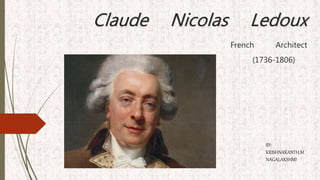
Claude Nicolas Ledoux
French Architect
(1736-1806)
BY:
KRISHNAKANTH.M
NAGALAKSHMI
Contents
 Biography
 About
 Works & Design criteria
 List of works
 Principal works:
1. Chateau of Maupertuis
2. The Royal Salt works at Arc-et-Senans
3. Theatre of Besancon
4. Toll houses
 Salient Features
 Sources
Biography
 Claude Ledoux was born in Dorman's, France in 1736. He was educated at a private
architectural school in Paris.
 At an early age his mother, Francoise Domino, and godmother, Francoise Piloy,
encouraged him to develop his drawing skills. Later the Abbey of Sassenage funded
his studies in Paris (1749–1753) at the College de Beauvais, where he followed a course
in Classics.
 The school emphasized native Baroque tradition but exposed students to English
architecture.
 Ledoux' dramatic style owes much to the fact that he never visited Rome. His
concepts of Roman architecture were accordingly warped by the engravings of
Piranesi from which he derived his knowledge.
About
 Claude was one of the earliest exponents of French Neoclassical Architecture.
 He used his knowledge of Architectural theory to design domestic
Architecture & also town planning ; as consequence of his visionary plan for
The ideal city of ‘Chaux’, he became know as a Utopian.
 His greatest works were funded by the French monarchy and came to be perceived as
symbols of the Ancient Regime rather than UTOPIA. { aiming for a state in which
everything is perfect}.
 He published a collections of his designs as book under the title Architecture considered
in relation to art, morals & legislation.
 In this book he took the opportunity of revising his earlier designs, making them more
rigorously Neoclassical.
Works & Design criteria
 Ledoux's architecture is quite practical and functional, the "visionary" aspects of his
work are better known.
 His designs became symbols of the ancient regime and their exaggerated use of
classical elements seems to anticipate post-modern classicism.
 Ledoux began working for the Department of Water and Forests preparing plans,
deciding on repairs, and designing everything from cemeteries. Thus increased his
aristocratic connections, and he soon became the leading architect in Paris.
 He designed simplified, powerful geometric forms. Towards the end, his private
houses became more eccentric, with odd layouts & uneven elevations throughout
his life.
Shafts are broken up by square blocks
List of His Works
 His most ambitious work was Royal Salt works at Arc-et-Senans, an idealistic &
visionary town showing many examples of architecture Parlance, which was found to be
uncompleted.
 Chateau of Mauritius.
 Theatre of Besancon
 Hotel of Mlle Guimard, Chaussee –D-Antin, Paris (destroyed).
 Pavilion Saint-Lambert, Eaubonne (destroyed)
 Pavilion d'Attilly, faubourg Poissonniere, Paris, 1771 (destroyed)
 Pavilion de musique de Mime du Barry, Louveciennes, 1770–1771
 Project for the prison and law courts of Aix-en-Provence, 1785–1786.
 The French revolution hampered his carrier, much of his work was destroyed in 19th
centaury.
CHATEAU OF MAUPERTUIS
 The chateau of Maupertuis was designed by architect
 Owner- Anne-Pierra de Montesquiou
Fezenzac.
 It was like horseshoe 292.3 meters
 The circumferences crowned with balustrades, pierced with square and round
niches, arriving at a gentle
 incline at the door of the vestibule.
 Reconstructed later.
 Now nothing remains of Ledoux’s.
 He gave priority to the natural setting
 Of the building .
 His giant Doric orders and the famous
spherical house of the
‘garden agricoles’ were
unforgettable elements.
CHATEAU OF MAUPERTUIS
The Royal Salt works at
Arc-et-Senans
The Royal Salt works at Arc-et-Senans
 The project was something of an abstraction as he had no site in mind. This also
freed him give free rein to his imagination.
 He presented the resulting project with 2 site plan options for the King Louis.
 Keeping the practical considerations, the project was ambitious, innovative, and a
break with traditional approaches.
Aerial view of Royal salt work
The entrance facade
First plan of Royal salt work
 The buildings were placed around the edges of
an immense square, and linked to each other
by porticoes; no building stood in isolation.
 To establish the connections between
buildings, Ledoux introduced covered arcades
that linked the midpoints of adjacent sides,
forming a square within the square.
 Columns abounded. The buildings themselves
were replete with them, and 144 Doric columns
supported the covered arcades
Second plan of Royal salt work
 He designed the semicircular complex to reflect a hierarchical organization of
work. The complete plan included the building of an ideal city forming a perfect
circle, like that of the sun.
 Construction began in 1775. The city was never started, however. All that was
completed was the diameter and a semicircle of buildings of the salt works.
 The entrance building sits at the midpoint
of the semicircle and contains on one side
guardrooms and on the other a prison
and a forge.
Second Plan of Royal salt
• Other buildings on the semicircle include on the
left, as one faces the entrance, quarters for
carpenters and laborers, and on the right,
marshals and coopers.
• At the center of the circle is the house of the
Director, which has a belvedere on top. A
monumental staircase led to a chapel that was
destroyed by fire in , following a lightning strike.
• These two buildings are 80 meters long, 28
meters wide, and 20 meters high.
• At each intersection of the diameter and the
semicircle sit buildings that housed the works'
clerks.
Entrance
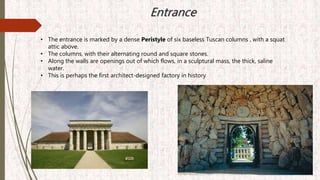
• The entrance is marked by a dense Peristyle of six baseless Tuscan columns , with a squat
attic above.
• The columns, with their alternating round and square stones.
• Along the walls are openings out of which flows, in a sculptural mass, the thick, saline
water.
• This is perhaps the first architect-designed factory in history
The Royal Salt work at Arc-et-Senans
 The interiors of the portico
 The rusticated archway contains a grotto
Of natural rock.
Detail of decoration
The windows of the entrance portico are
framed as urns spilling forth petrified water,
and the entrance grotto has imitation
springs to each side.
Theatre of Besancon
Theatre of Besancon
 It was constructed 1784, France.
 The exterior of the building was designed as a severe Palladian cube, adorned only by
an almost Grecian neoclassical portico of six Ionic columns.
 However, to the exterior followed the neoclassical style which was regarded as modern
then the interior was a revolution.
 The seating was not the only innovation at the theatre.
 It was decided that the social classes would
still be segregated thus while the theatre
of was the first to have a ground floor
amphitheater furnished with seats for
the ordinary paying public.
Theatre of Besancon
 Above them was a raised terrace or balcony for state employers.
 Directly above was the first tier of boxes reserved for the aristocracy, and above
this a tier of smaller boxes occupied by the middle-class the second.
 Besançon was the first theatre to screen
the musicians in an orchestra pit.
AMPHITHEATRE, BOXES AND OTHER PARTS AS
DESCRIBED IN PREVIOUS SLIDE
Toll houses
Toll houses
 Ledoux’s tollhouses run the gamut of neoclassical combinations. They are basically
cube like and they make use of temple fronts, the actuated “Pa
 He designed 42 tollhouses for the city of Paris lladian window, peristyles, domes ,
and other familiar elements.
 Plan and elevation are uniformly massive and overlaid with Doric or Tuscan orders
of heavily rusticated columns. ,
 He also followed a style of completely foreign to the delicacy of the dying rococo
manner.
 Eg:Rotonde de la villette
Rotonde de la villette
Plan
 The rotunda is made of stone facade.
 Plan combines simple figures inspired by the
classical antiquity with an outer square in
Greek cross and a vast internal cylinder wells zenith.
 On the ground floor, each facade consists of
eight pillars Doric short and topped with
a massive entablature and a pediment
low triangular.
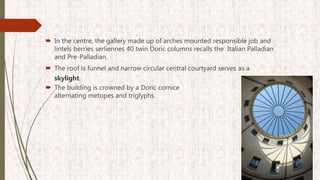
 In the centre, the gallery made up of arches mounted responsible job and
lintels berries serliennes 40 twin Doric columns recalls the Italian Palladian
and Pre-Palladian.
 The roof is funnel and narrow circular central courtyard serves as a
skylight.
 The building is crowned by a Doric cornice
alternating metopes and triglyphs.
ROTONDE DE LA VILLETTE
Design aspects
 The rotunda is built in the neo-classical style.
 The rotunda is made of stone façade.
 His plan combines simple figures, with an
outer square in Greek cross and
a large inner cylinder
Entrance of the building
Salient Features
 Though the structures May be seen as most decorated, fanciful, even by today’s
standards,
 Ledoux aimed to make the ideals of classicism available to a brader Spectrum of
the social strata.
 The form of each building was directly themed to the occupation of its
inhabitant.
 The head of a water canal system, for example, lived in a house that is shaped
like a tube.
Source
 Encylopedia.
Websites
googleweblight.com
www.britannica.com

Ledoux by krishnakanth

  • 1.
    Claude Nicolas Ledoux FrenchArchitect (1736-1806) BY: KRISHNAKANTH.M NAGALAKSHMI
  • 2.
    Contents  Biography  About Works & Design criteria  List of works  Principal works: 1. Chateau of Maupertuis 2. The Royal Salt works at Arc-et-Senans 3. Theatre of Besancon 4. Toll houses  Salient Features  Sources
  • 3.
    Biography  Claude Ledouxwas born in Dorman's, France in 1736. He was educated at a private architectural school in Paris.  At an early age his mother, Francoise Domino, and godmother, Francoise Piloy, encouraged him to develop his drawing skills. Later the Abbey of Sassenage funded his studies in Paris (1749–1753) at the College de Beauvais, where he followed a course in Classics.  The school emphasized native Baroque tradition but exposed students to English architecture.  Ledoux' dramatic style owes much to the fact that he never visited Rome. His concepts of Roman architecture were accordingly warped by the engravings of Piranesi from which he derived his knowledge.
  • 4.
    About  Claude wasone of the earliest exponents of French Neoclassical Architecture.  He used his knowledge of Architectural theory to design domestic Architecture & also town planning ; as consequence of his visionary plan for The ideal city of ‘Chaux’, he became know as a Utopian.  His greatest works were funded by the French monarchy and came to be perceived as symbols of the Ancient Regime rather than UTOPIA. { aiming for a state in which everything is perfect}.  He published a collections of his designs as book under the title Architecture considered in relation to art, morals & legislation.  In this book he took the opportunity of revising his earlier designs, making them more rigorously Neoclassical.
  • 5.
    Works & Designcriteria  Ledoux's architecture is quite practical and functional, the "visionary" aspects of his work are better known.  His designs became symbols of the ancient regime and their exaggerated use of classical elements seems to anticipate post-modern classicism.  Ledoux began working for the Department of Water and Forests preparing plans, deciding on repairs, and designing everything from cemeteries. Thus increased his aristocratic connections, and he soon became the leading architect in Paris.  He designed simplified, powerful geometric forms. Towards the end, his private houses became more eccentric, with odd layouts & uneven elevations throughout his life.
  • 6.
    Shafts are brokenup by square blocks
  • 7.
    List of HisWorks  His most ambitious work was Royal Salt works at Arc-et-Senans, an idealistic & visionary town showing many examples of architecture Parlance, which was found to be uncompleted.  Chateau of Mauritius.  Theatre of Besancon  Hotel of Mlle Guimard, Chaussee –D-Antin, Paris (destroyed).  Pavilion Saint-Lambert, Eaubonne (destroyed)  Pavilion d'Attilly, faubourg Poissonniere, Paris, 1771 (destroyed)  Pavilion de musique de Mime du Barry, Louveciennes, 1770–1771  Project for the prison and law courts of Aix-en-Provence, 1785–1786.  The French revolution hampered his carrier, much of his work was destroyed in 19th centaury.
  • 8.
  • 9.
    CHATEAU OF MAUPERTUIS The chateau of Maupertuis was designed by architect  Owner- Anne-Pierra de Montesquiou Fezenzac.  It was like horseshoe 292.3 meters  The circumferences crowned with balustrades, pierced with square and round niches, arriving at a gentle  incline at the door of the vestibule.
  • 10.
     Reconstructed later. Now nothing remains of Ledoux’s.  He gave priority to the natural setting  Of the building .  His giant Doric orders and the famous spherical house of the ‘garden agricoles’ were unforgettable elements.
  • 11.
  • 12.
    The Royal Saltworks at Arc-et-Senans
  • 13.
    The Royal Saltworks at Arc-et-Senans  The project was something of an abstraction as he had no site in mind. This also freed him give free rein to his imagination.  He presented the resulting project with 2 site plan options for the King Louis.  Keeping the practical considerations, the project was ambitious, innovative, and a break with traditional approaches.
  • 14.
    Aerial view ofRoyal salt work The entrance facade
  • 15.
    First plan ofRoyal salt work  The buildings were placed around the edges of an immense square, and linked to each other by porticoes; no building stood in isolation.  To establish the connections between buildings, Ledoux introduced covered arcades that linked the midpoints of adjacent sides, forming a square within the square.  Columns abounded. The buildings themselves were replete with them, and 144 Doric columns supported the covered arcades
  • 16.
    Second plan ofRoyal salt work  He designed the semicircular complex to reflect a hierarchical organization of work. The complete plan included the building of an ideal city forming a perfect circle, like that of the sun.  Construction began in 1775. The city was never started, however. All that was completed was the diameter and a semicircle of buildings of the salt works.  The entrance building sits at the midpoint of the semicircle and contains on one side guardrooms and on the other a prison and a forge.
  • 17.
    Second Plan ofRoyal salt • Other buildings on the semicircle include on the left, as one faces the entrance, quarters for carpenters and laborers, and on the right, marshals and coopers. • At the center of the circle is the house of the Director, which has a belvedere on top. A monumental staircase led to a chapel that was destroyed by fire in , following a lightning strike. • These two buildings are 80 meters long, 28 meters wide, and 20 meters high. • At each intersection of the diameter and the semicircle sit buildings that housed the works' clerks.
  • 18.
    Entrance • The entranceis marked by a dense Peristyle of six baseless Tuscan columns , with a squat attic above. • The columns, with their alternating round and square stones. • Along the walls are openings out of which flows, in a sculptural mass, the thick, saline water. • This is perhaps the first architect-designed factory in history
  • 19.
    The Royal Saltwork at Arc-et-Senans  The interiors of the portico  The rusticated archway contains a grotto Of natural rock. Detail of decoration The windows of the entrance portico are framed as urns spilling forth petrified water, and the entrance grotto has imitation springs to each side.
  • 20.
  • 21.
    Theatre of Besancon It was constructed 1784, France.  The exterior of the building was designed as a severe Palladian cube, adorned only by an almost Grecian neoclassical portico of six Ionic columns.  However, to the exterior followed the neoclassical style which was regarded as modern then the interior was a revolution.  The seating was not the only innovation at the theatre.  It was decided that the social classes would still be segregated thus while the theatre of was the first to have a ground floor amphitheater furnished with seats for the ordinary paying public.
  • 22.
    Theatre of Besancon Above them was a raised terrace or balcony for state employers.  Directly above was the first tier of boxes reserved for the aristocracy, and above this a tier of smaller boxes occupied by the middle-class the second.  Besançon was the first theatre to screen the musicians in an orchestra pit.
  • 23.
    AMPHITHEATRE, BOXES ANDOTHER PARTS AS DESCRIBED IN PREVIOUS SLIDE
  • 24.
  • 25.
    Toll houses  Ledoux’stollhouses run the gamut of neoclassical combinations. They are basically cube like and they make use of temple fronts, the actuated “Pa  He designed 42 tollhouses for the city of Paris lladian window, peristyles, domes , and other familiar elements.  Plan and elevation are uniformly massive and overlaid with Doric or Tuscan orders of heavily rusticated columns. ,  He also followed a style of completely foreign to the delicacy of the dying rococo manner.  Eg:Rotonde de la villette
  • 26.
    Rotonde de lavillette
  • 27.
    Plan  The rotundais made of stone facade.  Plan combines simple figures inspired by the classical antiquity with an outer square in Greek cross and a vast internal cylinder wells zenith.  On the ground floor, each facade consists of eight pillars Doric short and topped with a massive entablature and a pediment low triangular.
  • 28.
     In thecentre, the gallery made up of arches mounted responsible job and lintels berries serliennes 40 twin Doric columns recalls the Italian Palladian and Pre-Palladian.  The roof is funnel and narrow circular central courtyard serves as a skylight.  The building is crowned by a Doric cornice alternating metopes and triglyphs.
  • 29.
    ROTONDE DE LAVILLETTE
  • 30.
    Design aspects  Therotunda is built in the neo-classical style.  The rotunda is made of stone façade.  His plan combines simple figures, with an outer square in Greek cross and a large inner cylinder
  • 31.
  • 32.
    Salient Features  Thoughthe structures May be seen as most decorated, fanciful, even by today’s standards,  Ledoux aimed to make the ideals of classicism available to a brader Spectrum of the social strata.  The form of each building was directly themed to the occupation of its inhabitant.  The head of a water canal system, for example, lived in a house that is shaped like a tube.
  • 33.