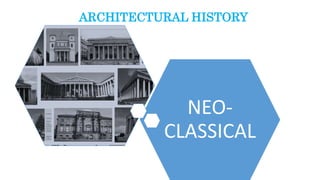
NEO-
CLASSICAL
ARCHITECTURAL HISTORY
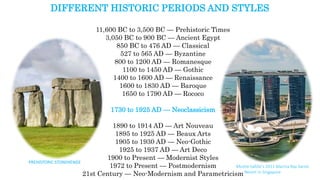
11,600 BC to 3,500 BC — Prehistoric Times
3,050 BC to 900 BC — Ancient Egypt
850 BC to 476 AD — Classical
527 to 565 AD — Byzantine
800 to 1200 AD — Romanesque
1100 to 1450 AD — Gothic
1400 to 1600 AD — Renaissance
1600 to 1830 AD — Baroque
1650 to 1790 AD — Rococo
1730 to 1925 AD — Neoclassicism
1890 to 1914 AD — Art Nouveau
1895 to 1925 AD — Beaux Arts
1905 to 1930 AD — Neo-Gothic
1925 to 1937 AD — Art Deco
1900 to Present — Modernist Styles
1972 to Present — Postmodernism
21st Century — Neo-Modernism and Parametricism
PREHISTORIC STONEHENGE
Moshe Safdie's 2011 Marina Bay Sands
Resort in Singapore
DIFFERENT HISTORIC PERIODS AND STYLES
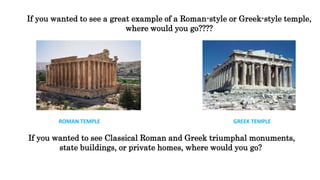
If you wanted to see a great example of a Roman-style or Greek-style temple,
where would you go????
ROMAN TEMPLE GREEK TEMPLE
If you wanted to see Classical Roman and Greek triumphal monuments,
state buildings, or private homes, where would you go?
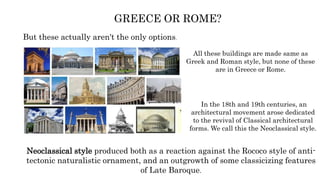
GREECE OR ROME?
But these actually aren't the only options.
All these buildings are made same as
Greek and Roman style, but none of these
are in Greece or Rome.
In the 18th and 19th centuries, an
architectural movement arose dedicated
to the revival of Classical architectural
forms. We call this the Neoclassical style.
Neoclassical style produced both as a reaction against the Rococo style of anti-
tectonic naturalistic ornament, and an outgrowth of some classicizing features
of Late Baroque.
FACTORS LED TO REVIVAL OF ROMAN AND GREEK
ARCHITECTURE IN NEO-CLASSICAL MOVEMENT
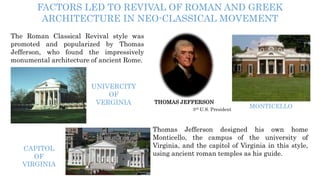
The Roman Classical Revival style was
promoted and popularized by Thomas
Jefferson, who found the impressively
monumental architecture of ancient Rome.
THOMAS JEFFERSON
3rd U.S. President
Thomas Jefferson designed his own home
Monticello, the campus of the university of
Virginia, and the capitol of Virginia in this style,
using ancient roman temples as his guide.
MONTICELLO
UNIVERCITY
OF
VERGINIA
CAPITOL
OF
VIRGINIA
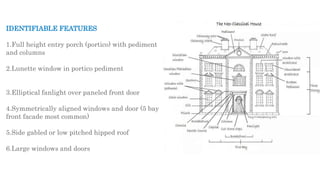
IDENTIFIABLE FEATURES
1.Full height entry porch (portico) with pediment
and columns
2.Lunette window in portico pediment
3.Elliptical fanlight over paneled front door
4.Symmetrically aligned windows and door (5 bay
front facade most common)
5.Side gabled or low pitched hipped roof
6.Large windows and doors
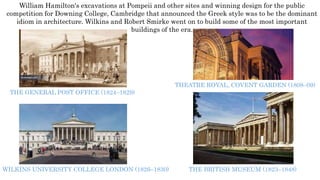
William Hamilton's excavations at Pompeii and other sites and winning design for the public
competition for Downing College, Cambridge that announced the Greek style was to be the dominant
idiom in architecture. Wilkins and Robert Smirke went on to build some of the most important
buildings of the era.
THE GENERAL POST OFFICE (1824–1829)
THEATRE ROYAL, COVENT GARDEN (1808–09)
THE BRITISH MUSEUM (1823–1848)WILKINS UNIVERSITY COLLEGE LONDON (1826–1830)
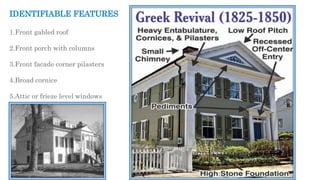
IDENTIFIABLE FEATURES
1.Front gabled roof
2.Front porch with columns
3.Front facade corner pilasters
4.Broad cornice
5.Attic or frieze level windows
NEOCLASSICAL BUILDING CHARACTERISTICS
• 1 - 2 1/2 stories in height – generally low buildings
• Symmetrical: balance and symmetry are the most predominant characteristic of
neoclassicism
• Porticos (porches) featuring Doric or Ionic columns
• Building’s facade is flat and long, often having a screen of free-standing columns.
• May feature domes or towers
• Dentil molding and frieze band beneath the cornice are common
• Decorative pediments on doorways and windows
• Multiple windows; upper and lower levels
•Wide variety of different window configurations including basic, arched, Palladian
and Norman Wheel
• Ornamental detail includes broken or unbroken pediments and side lights
(windows) surrounding the entry
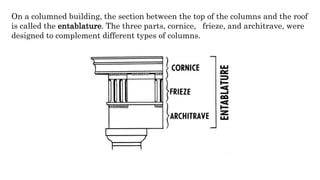
On a columned building, the section between the top of the columns and the roof
is called the entablature. The three parts, cornice, frieze, and architrave, were
designed to complement different types of columns.
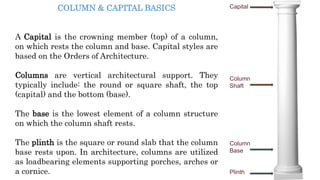
Capital
Column
Shaft
Column
Base
Plinth
COLUMN & CAPITAL BASICS
A Capital is the crowning member (top) of a column,
on which rests the column and base. Capital styles are
based on the Orders of Architecture.
Columns are vertical architectural support. They
typically include: the round or square shaft, the top
(capital) and the bottom (base).
The base is the lowest element of a column structure
on which the column shaft rests.
The plinth is the square or round slab that the column
base rests upon. In architecture, columns are utilized
as loadbearing elements supporting porches, arches or
a cornice.
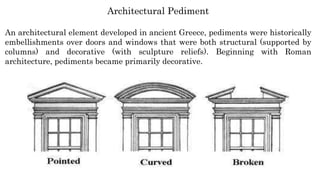
Architectural Pediment
An architectural element developed in ancient Greece, pediments were historically
embellishments over doors and windows that were both structural (supported by
columns) and decorative (with sculpture reliefs). Beginning with Roman
architecture, pediments became primarily decorative.
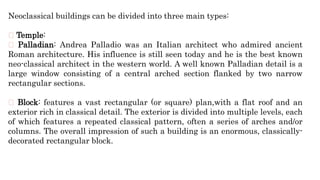
Neoclassical buildings can be divided into three main types:
Temple:
Palladian: Andrea Palladio was an Italian architect who admired ancient
Roman architecture. His influence is still seen today and he is the best known
neo-classical architect in the western world. A well known Palladian detail is a
large window consisting of a central arched section flanked by two narrow
rectangular sections.
Block: features a vast rectangular (or square) plan,with a flat roof and an
exterior rich in classical detail. The exterior is divided into multiple levels, each
of which features a repeated classical pattern, often a series of arches and/or
columns. The overall impression of such a building is an enormous, classically-
decorated rectangular block.
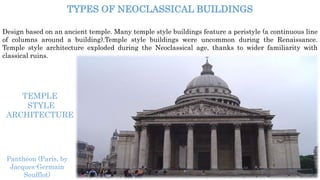
Design based on an ancient temple. Many temple style buildings feature a peristyle (a continuous line
of columns around a building).Temple style buildings were uncommon during the Renaissance.
Temple style architecture exploded during the Neoclassical age, thanks to wider familiarity with
classical ruins.
Panthéon (Paris, by
Jacques-Germain
Soufflot)
TEMPLE
STYLE
ARCHITECTURE
TYPES OF NEOCLASSICAL BUILDINGS
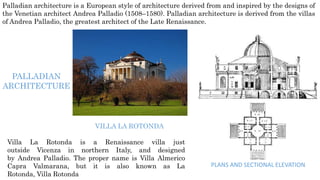
Palladian architecture is a European style of architecture derived from and inspired by the designs of
the Venetian architect Andrea Palladio (1508–1580). Palladian architecture is derived from the villas
of Andrea Palladio, the greatest architect of the Late Renaissance.
PALLADIAN
ARCHITECTURE
Villa La Rotonda is a Renaissance villa just
outside Vicenza in northern Italy, and designed
by Andrea Palladio. The proper name is Villa Almerico
Capra Valmarana, but it is also known as La
Rotonda, Villa Rotonda
VILLA LA ROTONDA
PLANS AND SECTIONAL ELEVATION
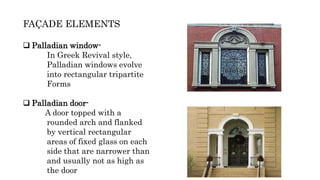
FAÇADE ELEMENTS
 Palladian window-
In Greek Revival style,
Palladian windows evolve
into rectangular tripartite
Forms
 Palladian door-
A door topped with a
rounded arch and flanked
by vertical rectangular
areas of fixed glass on each
side that are narrower than
and usually not as high as
the door
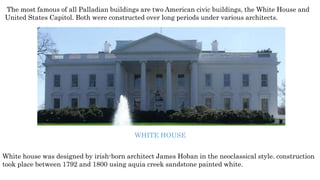
The most famous of all Palladian buildings are two American civic buildings, the White House and
United States Capitol. Both were constructed over long periods under various architects.
WHITE HOUSE
White house was designed by irish-born architect James Hoban in the neoclassical style. construction
took place between 1792 and 1800 using aquia creek sandstone painted white.
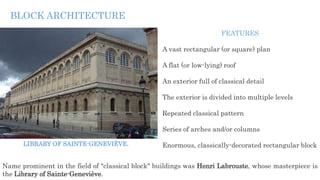
Name prominent in the field of "classical block" buildings was Henri Labrouste, whose masterpiece is
the Library of Sainte-Geneviève.
FEATURES
A vast rectangular (or square) plan
A flat (or low-lying) roof
An exterior full of classical detail
The exterior is divided into multiple levels
Repeated classical pattern
Series of arches and/or columns
Enormous, classically-decorated rectangular block
BLOCK ARCHITECTURE
LIBRARY OF SAINTE-GENEVIÈVE.
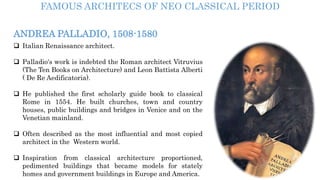
ANDREA PALLADIO, 1508-1580
 Italian Renaissance architect.
 Palladio's work is indebted the Roman architect Vitruvius
(The Ten Books on Architecture) and Leon Battista Alberti
( De Re Aedificatoria).
 He published the first scholarly guide book to classical
Rome in 1554. He built churches, town and country
houses, public buildings and bridges in Venice and on the
Venetian mainland.
 Often described as the most influential and most copied
architect in the Western world.
 Inspiration from classical architecture proportioned,
pedimented buildings that became models for stately
homes and government buildings in Europe and America.
FAMOUS ARCHITECS OF NEO CLASSICAL PERIOD
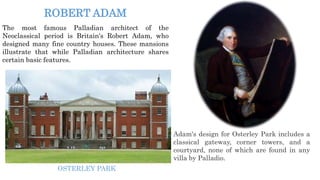
The most famous Palladian architect of the
Neoclassical period is Britain's Robert Adam, who
designed many fine country houses. These mansions
illustrate that while Palladian architecture shares
certain basic features.
ROBERT ADAM
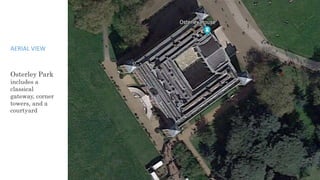
Adam's design for Osterley Park includes a
classical gateway, corner towers, and a
courtyard, none of which are found in any
villa by Palladio.
OSTERLEY PARK
AERIAL VIEW
Osterley Park
includes a
classical
gateway, corner
towers, and a
courtyard
ADAM STYLE (ADAMESQUE)
Based on the work of Robert Adam (1728-1792) and his brothers
Basically Neoclassical; it also adapted Gothic, Egyptian and Etruscan motifs.
His decorative motifs -- medallions, urns, vine scrolls, sphinxes, and tripods -- were
taken from Roman art and, as in Roman stucco work, are arranged sparsely within
broad, neutral spaces and slender margins.
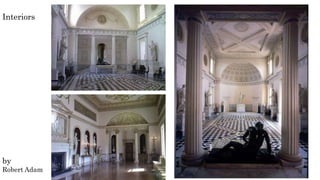
Robert Adam's interior/exterior decorative approach also included the following:
Flat grotesque panels
Pilasters
Elaborate color schemes
Delicate painted ornament, including
Swags
Ribbons
Interiors
by
Robert Adam
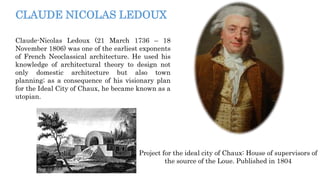
CLAUDE NICOLAS LEDOUX
Claude-Nicolas Ledoux (21 March 1736 – 18
November 1806) was one of the earliest exponents
of French Neoclassical architecture. He used his
knowledge of architectural theory to design not
only domestic architecture but also town
planning; as a consequence of his visionary plan
for the Ideal City of Chaux, he became known as a
utopian.
Project for the ideal city of Chaux: House of supervisors of
the source of the Loue. Published in 1804
DETAILS OF SOME
NEOCLASSICAL BUILDINGS
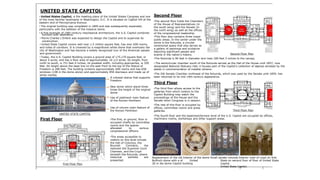
UNITED STATE CAPITOL
Second Floor• United States Capitol, is the meeting place of the United States Congress and one
of the most familiar landmarks in Washington, D.C. It is situated on Capitol Hill at the
eastern end of Pennsylvania Avenue.
• The original building was completed in 1800 and was subsequently expanded,
particularly with the addition of the massive dome.
• A fine example of 19th-century neoclassical architecture, the U.S. Capitol combines
•The second floor holds the Chambers
of the House of Representatives (in
the south wing) and the Senate (in
the north wing) as well as the offices
of the congressional leadership.
function with aesthetics.
•This floor also contains three major
public areas. In the center under the
dome is the Rotunda, a circular
ceremonial space that also serves as
a gallery of paintings and sculpture
depicting significant people and
events in the nation's history.
• Pierre Charles L'Enfant was expected to design the Capitol and to supervise its
construction.
• United State Capitol covers well over 1.5 million square feet, has over 600 rooms,
and miles of corridors. It is crowned by a magnificent white dome that overlooks the
city of Washington and has become a widely recognized icon of the American people
and government.
• Today, the U.S. Capitol Building covers a ground area of 175,170 square feet, or
about 4 acres, and has a floor area of approximately 16-1/2 acres. Its length, from
north to south, is 751 feet 4 inches; its greatest width, including approaches, is 350
feet. Its height above the base line on the east front to the top of the Statue of
Freedom is 288 feet. The building contains approximately 600 rooms and has 658
windows (108 in the dome alone) and approximately 850 doorways and made up of
white marble.
Second Floor Plan
•The Rotunda is 96 feet in diameter and rises 180 feet 3 inches to the canopy.
• The semicircular chamber south of the Rotunda served as the Hall of the House until 1857; now
designated National Statuary Hall, it houses part of the Capitol's collection of statues donated by the
states in commemoration of notable citizens.
'.
•The Old Senate Chamber northeast of the Rotunda, which was used by the Senate until 1859, has
been returned to its mid-19th-century appearance.A colossal statue that supports
Freedom
Third Floor
New dome which stand three
times the height of the original
dome
•The third floor allows access to the
galleries from which visitors to the
Capitol Building may watch the
proceedings of the House and the
Senate when Congress is in session.
Use of pediment main feature
of the Roman Pantheon
•The rest of this floor is occupied by
offices, committee rooms and press
galleries.
Use of column main feature of
the Roman Pantheon Third Floor Plan
UNITED STATE CAPITOL
•The fourth floor and the basement/terrace level of the U.S. Capitol are occupied by offices,
First Floor machinery rooms, workshops and other support areas.•The first, or ground, floor is
occupied chiefly by committee
rooms and the spaces
allocated to various
congressional officers.
•The areas accessible to
visitors on this level include
the Hall of Columns, the
Brumidi Corridors, the
restored Old Supreme Court
Chamber, and the Crypt
beneath the Rotunda, where
historical
presented.
exhibits are Replacement of the old Interior of the dome Small senate rotunda Interior view of crypt on first
Bulfinch dome with a of United State on second floor of floor of United State
Capitol.
United State Capitol.
30 m dia dome Capitol buildingFirst Floor Plan
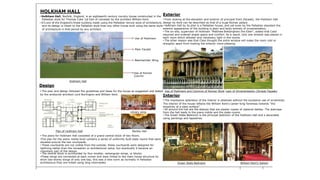
HOLKHAM HALL
Exterior• Holkham Hall, Norfolk, England, is an eighteenth century country house constructed in the
Palladian style for Thomas Coke 1st Earl of Leicester by the architect William Kent. • From looking at the elevation and exterior of principal front (facade), the Holkham Hall
• It’s one of the England’s finest building made using the Palladian revival style of architecture, design by Kent can be described as that of a huge Roman palace..
and its design is closer to the Palladian style than any other house built using the same style
of architecture in that period by any architect.
• Holkham Hall by its plan is a Palladian house, and yet even by the Palladian standard the
exterior appearance of the building is plain and lacks entirely of ornamentation.
• The on-site, supervisor of Holkham “Matthew Brettingham the Elder”, stated that Coke
required and ordered ample space and comfort. As a result, only one window was placed in
each room which allowed only necessary light in the rooms.
• The other reason was that Coke thought the extra window will make the room cold or
draughty apart from making the exterior more pleasing.
Use of Pediment
Plain Facade
Bedchamber Wing
'.
Use of Roman
Column
Holkham Hall
Design
• The plan and design followed the guidelines and ideas for the house as suggested and stated Use of Pediment and Columns of Roman Style Lack of Ornamentation (Simple Façade)
by the aristocrat architect Lord Burlington and William Kent.
Interior
• The impressive splendour of the interior is obtained without the excessive use of ornaments.
The interior of the house reflects the William Kent’s career-long fondness towards “the
simplicity of a plain surface”.
• All around the hall are the statues that are plaster copies of classical deities. The staircase
from the hall leads to the piano nobile and the state-rooms.Library wing
• The Green State Bedroom is the principal bedroom of the Holkham Hall and s decorated
using paintings and tapestries.
Plan of Holkham Hall Marble Hall
• The plans for Holkham Hall consisted of a grand central block of two floors.
•The plan for the piano nobile level contains a series of uniformly built state rooms that were
situated around the two courtyards.
• These courtyards are not visible from the outside; these courtyards were designed for
lightning rather than the recreation or architectural value, but eventually it became an
important part of the design.
• The central block is surrounded by four smaller, rectangular wings, or blocks.
•These wings are connected at each corner and were linked to the main house structure by
short two-storey wings of only one bay, this was a new norm as normally in Palladian
architecture they are linked using long colonnades. Green State Bedroom William Kent's Saloon
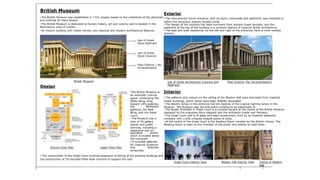
British Museum
Exterior
• The British Museum was established in 1753, largely based on the collections of the physician
and scientist Sir Hans Sloane.
• The British Museum is dedicated to human history, art and culture, and is located in the
Bloomsbury area of London.
• An historic building with Greek revival, neo-classical and modern architectural features.
• The monumental South entrance, with its stairs, colonnade and pediment, was intended to
reflect the wondrous objects housed inside.
.• The design of the columns has been borrowed from ancient Greek temples, and the
pediment at the top of the building is a common feature of classical Greek architecture.
• The east and west residences (to the left and right of the entrance) have a more modest
exterior.
Use of Greek
Style Pediment
Use of Greek
Style Columns
Plain Exterior / No
Ornamentation '.
British Museum Use of Greek Architecture Columns and Plain Exterior (No Ornamentation)
Pediment
Design
Interior•The British Museum is
an exemplar cultural
space, comprising the
White Wing, King
Edward VII’s galleries,
• The patterns and colours on the ceiling of the Weston Hall were borrowed from classical
Greek buildings, which would have been brightly decorated.
• The electric lamps in the entrance hall are replicas of the original lighting lamps in the
Museum. The Museum was the first public building to be electrically lit.the Parthenon
galleries, the New
Wing, and the Great
Court.
• The Museum has a
total of 94 gallery
spaces and public
services, including a
restaurant and an
• The Queen Elizabeth II Great Court is a covered square at the centre of the British Museum
designed by the engineers Buro Happold and the architects Foster and Partners.
• The Great Court roof is of glass and steel construction, built by an Austrian steelwork
company with 1,656 uniquely shaped panes of glass.
• At the centre of the Great Court is the Reading Room vacated by the British Library. The
Reading Room is open to any member of the public who wishes to read there.
education centre,
which is located below
the courtyard.
• It included galleries
for classical sculpture
Ground Floor Plan Upper Floor Plan and
antiquities
Assyrian
• The construction of the Great Court involved extensive re-facing of the existing buildings and
the construction of 20 concrete-filled steel columns to support the roof.
Great Court Interior View Weston Hall Interior View Ceiling of Weston
Hall

Neoclassical architecture

  • 1.
  • 2.
    11,600 BC to3,500 BC — Prehistoric Times 3,050 BC to 900 BC — Ancient Egypt 850 BC to 476 AD — Classical 527 to 565 AD — Byzantine 800 to 1200 AD — Romanesque 1100 to 1450 AD — Gothic 1400 to 1600 AD — Renaissance 1600 to 1830 AD — Baroque 1650 to 1790 AD — Rococo 1730 to 1925 AD — Neoclassicism 1890 to 1914 AD — Art Nouveau 1895 to 1925 AD — Beaux Arts 1905 to 1930 AD — Neo-Gothic 1925 to 1937 AD — Art Deco 1900 to Present — Modernist Styles 1972 to Present — Postmodernism 21st Century — Neo-Modernism and Parametricism PREHISTORIC STONEHENGE Moshe Safdie's 2011 Marina Bay Sands Resort in Singapore DIFFERENT HISTORIC PERIODS AND STYLES
  • 3.
    If you wantedto see a great example of a Roman-style or Greek-style temple, where would you go???? ROMAN TEMPLE GREEK TEMPLE If you wanted to see Classical Roman and Greek triumphal monuments, state buildings, or private homes, where would you go?
  • 4.
    GREECE OR ROME? Butthese actually aren't the only options. All these buildings are made same as Greek and Roman style, but none of these are in Greece or Rome. In the 18th and 19th centuries, an architectural movement arose dedicated to the revival of Classical architectural forms. We call this the Neoclassical style. Neoclassical style produced both as a reaction against the Rococo style of anti- tectonic naturalistic ornament, and an outgrowth of some classicizing features of Late Baroque.
  • 5.
    FACTORS LED TOREVIVAL OF ROMAN AND GREEK ARCHITECTURE IN NEO-CLASSICAL MOVEMENT The Roman Classical Revival style was promoted and popularized by Thomas Jefferson, who found the impressively monumental architecture of ancient Rome. THOMAS JEFFERSON 3rd U.S. President Thomas Jefferson designed his own home Monticello, the campus of the university of Virginia, and the capitol of Virginia in this style, using ancient roman temples as his guide. MONTICELLO UNIVERCITY OF VERGINIA CAPITOL OF VIRGINIA
  • 6.
    IDENTIFIABLE FEATURES 1.Full heightentry porch (portico) with pediment and columns 2.Lunette window in portico pediment 3.Elliptical fanlight over paneled front door 4.Symmetrically aligned windows and door (5 bay front facade most common) 5.Side gabled or low pitched hipped roof 6.Large windows and doors
  • 7.
    William Hamilton's excavationsat Pompeii and other sites and winning design for the public competition for Downing College, Cambridge that announced the Greek style was to be the dominant idiom in architecture. Wilkins and Robert Smirke went on to build some of the most important buildings of the era. THE GENERAL POST OFFICE (1824–1829) THEATRE ROYAL, COVENT GARDEN (1808–09) THE BRITISH MUSEUM (1823–1848)WILKINS UNIVERSITY COLLEGE LONDON (1826–1830)
  • 8.
    IDENTIFIABLE FEATURES 1.Front gabledroof 2.Front porch with columns 3.Front facade corner pilasters 4.Broad cornice 5.Attic or frieze level windows
  • 9.
    NEOCLASSICAL BUILDING CHARACTERISTICS •1 - 2 1/2 stories in height – generally low buildings • Symmetrical: balance and symmetry are the most predominant characteristic of neoclassicism • Porticos (porches) featuring Doric or Ionic columns • Building’s facade is flat and long, often having a screen of free-standing columns. • May feature domes or towers • Dentil molding and frieze band beneath the cornice are common • Decorative pediments on doorways and windows • Multiple windows; upper and lower levels •Wide variety of different window configurations including basic, arched, Palladian and Norman Wheel • Ornamental detail includes broken or unbroken pediments and side lights (windows) surrounding the entry
  • 10.
    On a columnedbuilding, the section between the top of the columns and the roof is called the entablature. The three parts, cornice, frieze, and architrave, were designed to complement different types of columns.
  • 11.
    Capital Column Shaft Column Base Plinth COLUMN & CAPITALBASICS A Capital is the crowning member (top) of a column, on which rests the column and base. Capital styles are based on the Orders of Architecture. Columns are vertical architectural support. They typically include: the round or square shaft, the top (capital) and the bottom (base). The base is the lowest element of a column structure on which the column shaft rests. The plinth is the square or round slab that the column base rests upon. In architecture, columns are utilized as loadbearing elements supporting porches, arches or a cornice.
  • 12.
    Architectural Pediment An architecturalelement developed in ancient Greece, pediments were historically embellishments over doors and windows that were both structural (supported by columns) and decorative (with sculpture reliefs). Beginning with Roman architecture, pediments became primarily decorative.
  • 13.
    Neoclassical buildings canbe divided into three main types: Temple: Palladian: Andrea Palladio was an Italian architect who admired ancient Roman architecture. His influence is still seen today and he is the best known neo-classical architect in the western world. A well known Palladian detail is a large window consisting of a central arched section flanked by two narrow rectangular sections. Block: features a vast rectangular (or square) plan,with a flat roof and an exterior rich in classical detail. The exterior is divided into multiple levels, each of which features a repeated classical pattern, often a series of arches and/or columns. The overall impression of such a building is an enormous, classically- decorated rectangular block.
  • 14.
    Design based onan ancient temple. Many temple style buildings feature a peristyle (a continuous line of columns around a building).Temple style buildings were uncommon during the Renaissance. Temple style architecture exploded during the Neoclassical age, thanks to wider familiarity with classical ruins. Panthéon (Paris, by Jacques-Germain Soufflot) TEMPLE STYLE ARCHITECTURE TYPES OF NEOCLASSICAL BUILDINGS
  • 15.
    Palladian architecture isa European style of architecture derived from and inspired by the designs of the Venetian architect Andrea Palladio (1508–1580). Palladian architecture is derived from the villas of Andrea Palladio, the greatest architect of the Late Renaissance. PALLADIAN ARCHITECTURE Villa La Rotonda is a Renaissance villa just outside Vicenza in northern Italy, and designed by Andrea Palladio. The proper name is Villa Almerico Capra Valmarana, but it is also known as La Rotonda, Villa Rotonda VILLA LA ROTONDA PLANS AND SECTIONAL ELEVATION
  • 16.
    FAÇADE ELEMENTS  Palladianwindow- In Greek Revival style, Palladian windows evolve into rectangular tripartite Forms  Palladian door- A door topped with a rounded arch and flanked by vertical rectangular areas of fixed glass on each side that are narrower than and usually not as high as the door
  • 17.
    The most famousof all Palladian buildings are two American civic buildings, the White House and United States Capitol. Both were constructed over long periods under various architects. WHITE HOUSE White house was designed by irish-born architect James Hoban in the neoclassical style. construction took place between 1792 and 1800 using aquia creek sandstone painted white.
  • 18.
    Name prominent inthe field of "classical block" buildings was Henri Labrouste, whose masterpiece is the Library of Sainte-Geneviève. FEATURES A vast rectangular (or square) plan A flat (or low-lying) roof An exterior full of classical detail The exterior is divided into multiple levels Repeated classical pattern Series of arches and/or columns Enormous, classically-decorated rectangular block BLOCK ARCHITECTURE LIBRARY OF SAINTE-GENEVIÈVE.
  • 19.
    ANDREA PALLADIO, 1508-1580 Italian Renaissance architect.  Palladio's work is indebted the Roman architect Vitruvius (The Ten Books on Architecture) and Leon Battista Alberti ( De Re Aedificatoria).  He published the first scholarly guide book to classical Rome in 1554. He built churches, town and country houses, public buildings and bridges in Venice and on the Venetian mainland.  Often described as the most influential and most copied architect in the Western world.  Inspiration from classical architecture proportioned, pedimented buildings that became models for stately homes and government buildings in Europe and America. FAMOUS ARCHITECS OF NEO CLASSICAL PERIOD
  • 20.
    The most famousPalladian architect of the Neoclassical period is Britain's Robert Adam, who designed many fine country houses. These mansions illustrate that while Palladian architecture shares certain basic features. ROBERT ADAM Adam's design for Osterley Park includes a classical gateway, corner towers, and a courtyard, none of which are found in any villa by Palladio. OSTERLEY PARK
  • 21.
    AERIAL VIEW Osterley Park includesa classical gateway, corner towers, and a courtyard
  • 22.
    ADAM STYLE (ADAMESQUE) Basedon the work of Robert Adam (1728-1792) and his brothers Basically Neoclassical; it also adapted Gothic, Egyptian and Etruscan motifs. His decorative motifs -- medallions, urns, vine scrolls, sphinxes, and tripods -- were taken from Roman art and, as in Roman stucco work, are arranged sparsely within broad, neutral spaces and slender margins. Robert Adam's interior/exterior decorative approach also included the following: Flat grotesque panels Pilasters Elaborate color schemes Delicate painted ornament, including Swags Ribbons
  • 23.
  • 24.
    CLAUDE NICOLAS LEDOUX Claude-NicolasLedoux (21 March 1736 – 18 November 1806) was one of the earliest exponents of French Neoclassical architecture. He used his knowledge of architectural theory to design not only domestic architecture but also town planning; as a consequence of his visionary plan for the Ideal City of Chaux, he became known as a utopian. Project for the ideal city of Chaux: House of supervisors of the source of the Loue. Published in 1804
  • 25.
  • 26.
    UNITED STATE CAPITOL SecondFloor• United States Capitol, is the meeting place of the United States Congress and one of the most familiar landmarks in Washington, D.C. It is situated on Capitol Hill at the eastern end of Pennsylvania Avenue. • The original building was completed in 1800 and was subsequently expanded, particularly with the addition of the massive dome. • A fine example of 19th-century neoclassical architecture, the U.S. Capitol combines •The second floor holds the Chambers of the House of Representatives (in the south wing) and the Senate (in the north wing) as well as the offices of the congressional leadership. function with aesthetics. •This floor also contains three major public areas. In the center under the dome is the Rotunda, a circular ceremonial space that also serves as a gallery of paintings and sculpture depicting significant people and events in the nation's history. • Pierre Charles L'Enfant was expected to design the Capitol and to supervise its construction. • United State Capitol covers well over 1.5 million square feet, has over 600 rooms, and miles of corridors. It is crowned by a magnificent white dome that overlooks the city of Washington and has become a widely recognized icon of the American people and government. • Today, the U.S. Capitol Building covers a ground area of 175,170 square feet, or about 4 acres, and has a floor area of approximately 16-1/2 acres. Its length, from north to south, is 751 feet 4 inches; its greatest width, including approaches, is 350 feet. Its height above the base line on the east front to the top of the Statue of Freedom is 288 feet. The building contains approximately 600 rooms and has 658 windows (108 in the dome alone) and approximately 850 doorways and made up of white marble. Second Floor Plan •The Rotunda is 96 feet in diameter and rises 180 feet 3 inches to the canopy. • The semicircular chamber south of the Rotunda served as the Hall of the House until 1857; now designated National Statuary Hall, it houses part of the Capitol's collection of statues donated by the states in commemoration of notable citizens. '. •The Old Senate Chamber northeast of the Rotunda, which was used by the Senate until 1859, has been returned to its mid-19th-century appearance.A colossal statue that supports Freedom Third Floor New dome which stand three times the height of the original dome •The third floor allows access to the galleries from which visitors to the Capitol Building may watch the proceedings of the House and the Senate when Congress is in session. Use of pediment main feature of the Roman Pantheon •The rest of this floor is occupied by offices, committee rooms and press galleries. Use of column main feature of the Roman Pantheon Third Floor Plan UNITED STATE CAPITOL •The fourth floor and the basement/terrace level of the U.S. Capitol are occupied by offices, First Floor machinery rooms, workshops and other support areas.•The first, or ground, floor is occupied chiefly by committee rooms and the spaces allocated to various congressional officers. •The areas accessible to visitors on this level include the Hall of Columns, the Brumidi Corridors, the restored Old Supreme Court Chamber, and the Crypt beneath the Rotunda, where historical presented. exhibits are Replacement of the old Interior of the dome Small senate rotunda Interior view of crypt on first Bulfinch dome with a of United State on second floor of floor of United State Capitol. United State Capitol. 30 m dia dome Capitol buildingFirst Floor Plan
  • 27.
    HOLKHAM HALL Exterior• HolkhamHall, Norfolk, England, is an eighteenth century country house constructed in the Palladian style for Thomas Coke 1st Earl of Leicester by the architect William Kent. • From looking at the elevation and exterior of principal front (facade), the Holkham Hall • It’s one of the England’s finest building made using the Palladian revival style of architecture, design by Kent can be described as that of a huge Roman palace.. and its design is closer to the Palladian style than any other house built using the same style of architecture in that period by any architect. • Holkham Hall by its plan is a Palladian house, and yet even by the Palladian standard the exterior appearance of the building is plain and lacks entirely of ornamentation. • The on-site, supervisor of Holkham “Matthew Brettingham the Elder”, stated that Coke required and ordered ample space and comfort. As a result, only one window was placed in each room which allowed only necessary light in the rooms. • The other reason was that Coke thought the extra window will make the room cold or draughty apart from making the exterior more pleasing. Use of Pediment Plain Facade Bedchamber Wing '. Use of Roman Column Holkham Hall Design • The plan and design followed the guidelines and ideas for the house as suggested and stated Use of Pediment and Columns of Roman Style Lack of Ornamentation (Simple Façade) by the aristocrat architect Lord Burlington and William Kent. Interior • The impressive splendour of the interior is obtained without the excessive use of ornaments. The interior of the house reflects the William Kent’s career-long fondness towards “the simplicity of a plain surface”. • All around the hall are the statues that are plaster copies of classical deities. The staircase from the hall leads to the piano nobile and the state-rooms.Library wing • The Green State Bedroom is the principal bedroom of the Holkham Hall and s decorated using paintings and tapestries. Plan of Holkham Hall Marble Hall • The plans for Holkham Hall consisted of a grand central block of two floors. •The plan for the piano nobile level contains a series of uniformly built state rooms that were situated around the two courtyards. • These courtyards are not visible from the outside; these courtyards were designed for lightning rather than the recreation or architectural value, but eventually it became an important part of the design. • The central block is surrounded by four smaller, rectangular wings, or blocks. •These wings are connected at each corner and were linked to the main house structure by short two-storey wings of only one bay, this was a new norm as normally in Palladian architecture they are linked using long colonnades. Green State Bedroom William Kent's Saloon
  • 28.
    British Museum Exterior • TheBritish Museum was established in 1753, largely based on the collections of the physician and scientist Sir Hans Sloane. • The British Museum is dedicated to human history, art and culture, and is located in the Bloomsbury area of London. • An historic building with Greek revival, neo-classical and modern architectural features. • The monumental South entrance, with its stairs, colonnade and pediment, was intended to reflect the wondrous objects housed inside. .• The design of the columns has been borrowed from ancient Greek temples, and the pediment at the top of the building is a common feature of classical Greek architecture. • The east and west residences (to the left and right of the entrance) have a more modest exterior. Use of Greek Style Pediment Use of Greek Style Columns Plain Exterior / No Ornamentation '. British Museum Use of Greek Architecture Columns and Plain Exterior (No Ornamentation) Pediment Design Interior•The British Museum is an exemplar cultural space, comprising the White Wing, King Edward VII’s galleries, • The patterns and colours on the ceiling of the Weston Hall were borrowed from classical Greek buildings, which would have been brightly decorated. • The electric lamps in the entrance hall are replicas of the original lighting lamps in the Museum. The Museum was the first public building to be electrically lit.the Parthenon galleries, the New Wing, and the Great Court. • The Museum has a total of 94 gallery spaces and public services, including a restaurant and an • The Queen Elizabeth II Great Court is a covered square at the centre of the British Museum designed by the engineers Buro Happold and the architects Foster and Partners. • The Great Court roof is of glass and steel construction, built by an Austrian steelwork company with 1,656 uniquely shaped panes of glass. • At the centre of the Great Court is the Reading Room vacated by the British Library. The Reading Room is open to any member of the public who wishes to read there. education centre, which is located below the courtyard. • It included galleries for classical sculpture Ground Floor Plan Upper Floor Plan and antiquities Assyrian • The construction of the Great Court involved extensive re-facing of the existing buildings and the construction of 20 concrete-filled steel columns to support the roof. Great Court Interior View Weston Hall Interior View Ceiling of Weston Hall