N E OC L A S S I C I S M
ACTIVITY #1 (1/4 sheet of paper)
Re-arrange the jumbled letters.
- G R E E K word: 1.“seon” = new
- LATIN word: 2.“ssicuscla” = “first class”
- Western movement in 3. coradetive & 4. isualv art
- Also applies to 5. telirature, 6. teahter, 7. cmusi, &
8.archiateturec influenced by Classical 9. rAt &
culture of Ancient Greece & Rome
- Coincided with 18th century Age of 10. eaRson
known as the Age of Enlightenment
- Generally portrayed Roman history
especially Roman heroes
3.
NeoClassic Period
NEOCLASSICISM (1780-
1840)
-GREEK word: “neos” = new
- LATIN word: “classicus” = “first class”
- Western movement in decorative & visual
art
- Also applies to literature, theater, music,
& architecture influenced by Classical
Art & culture of Ancient Greece & Rome
- Coincided with 18th century Age of
Reason known as the Age of
Enlightenment
- Generally portrayed Roman
history especially Roman heroes
NeoClassic Period
NEOCLASSIC PAINTING
-Embraced the ideals of order
& moderation
- History restored to
realistic portrayals
- Gave importance to costume,
settings, & details without
adding distractions
NEOCLASSICAL ARTISTS
JEAN-AUGUSTE-DOMINIQUE INGRES
(1780-1867)FRANCE - Pupil of DAVID
- Influenced by
Italian Renaissance
painters
- One of the great
exemplar of
academic art
- One of the finest
Old Master
- Subject: nudes,
portraits & NeoClassic Period
NeoClassic Period
NEOCLASSIC SCULPTURES
-Great ages of public sculpture
- Artists looked to ROMAN
styles during the time of
Alexander the Great for
inspiration as well as to mimic
their style
14.
NEOCLASSICAL SCULPTORS
ANTONIO CANOVA(1757-1822) ITALY
- Prolific Italian artist
& sculptor
- Famous for his
marble sculptures
that delicately
rendered nude flesh
- Opened idea of
discrete sexual
pleasures with his
mythological
NeoClassic Period
NEOCLASSICAL SCULPTORS
BERTHEL THORVALDSEN(1789-1838) DENMARK
- First
internationally
acclaimed Danish
artist
- Subjects:
mythological &
religious characters
NeoClassic Period
NeoClassic Period
NEOCLASSICAL ARCHITECTURE
-Started in the mid-18th century
- Derived from Classical Greece and
Rome & designs of Italian
Architect Andrea Palladio
- NOT grandeur like ROCOCO
style and late BAROQUE
21.
NeoClassic Period
TEMPLE PALLADIAN
CLASSIC
BLOCK
-Based on
ancient
temples
- PERISTY
LE
(a continuous line
of columns around
a building
- Based on
Andrea
Palladio’s style
of villas
- BALUSTERs
or SPINDLES
(vertical
supports along
the edge of
the roof)
- Rectangular or
square with
flat roof &
exterior rich in
classical
details
- BEAUX-ARTS
style (French
Ecole des
Beaux Arts)
NeoClassic Period
CLASSIC BLOCK
-Rectangular or square with
flat roof & exterior rich in
classical details
- BEAUX-ARTS style (French
Ecole des Beaux Arts)
Romantic Period
ROMANTICISM (1800-1810)
-A movement Neoclassical period wants:
to break new grounds in the expression
of emotion, both subtle & stormy
- Themes: longing for history,
supernatural elements, social injustice
& nature
- Landscape painting became
popular because of their adoration
of nature
- ROMANTICISM was a reaction to
the classical, contemplative nature
of NEOCLASSICAL pieces
PAINTERS of theROMANTIC PERIOD
(Portraits/Figures)
JEAN LOUIS THEODORE GERICAULT
(1791-1824) FRANCE
- First French master
& leader of the
French
realistic
school
- Artworks:
energetic,
powerful, brilliantly
Romantic Period
PAINTERS of theROMANTIC PERIOD
(Portraits/Figures)
EUGENE DELACROIX (1798-1863) FRANCE
- Greatest French
Romantic painter
- Brilliant effects
using small,
adjacent strokes
of contrasting
colors
- His technique
was adapted by
50.
EUGENE
DELECROIX
FAMOUS WO RK S
LIBERTY
LEADING
THE
PEOPLE
PAINTERS of the ROMANTIC PERIOD
(Portraits/Figures)
Romantic Period
51.
PAINTERS of theROMANTIC PERIOD
(Portraits/Figures)
FRANCISCO GOYA (1746-1828) SPAIN
- Commissioned
Romantic painter
by the King of
Spain
- Last of the “Old
Masters” and first
of the “Moderns”
printmakers
Romantic Period
Romantic Period
ROMANTIC PAINTING
(Landscape)
-Depicts physical world that
surrounds us and includes
features such as the sky,
mountains, valleys, vegetation,
and bodies of water
- Ranges from highly detailed &
realistic impressionistic,
romantic, and idealized
56.
PAINTERS of theROMANTIC PERIOD
(Landscape Painting)
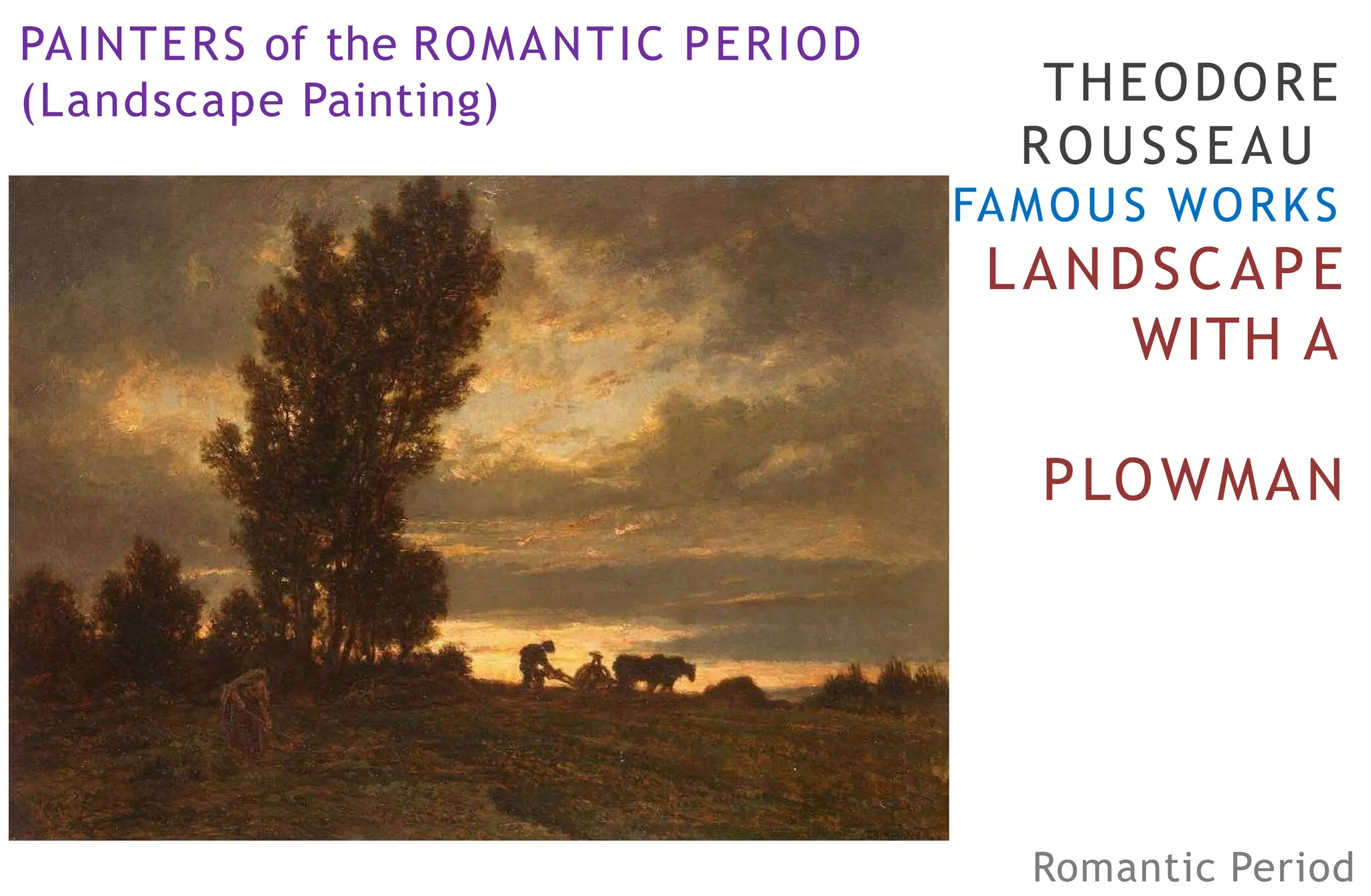
THEODORE ROUSSEAU FRANCE
-
Member of the
Barbizon School (a
circle of artists who
held meetings in
the village of
Barbizon) that led
Romantic
landscape painting
Romantic Period
PAINTERS of theROMANTIC PERIOD
(Landscape Painting)
JEAN-BAPTISTE-CAMILLE COROT FRANCE
-
Member of the
Barbizon School (a
circle of artists who
held meetings in
the village of
Barbizon) that led
Romantic
landscape painting
Romantic Period
Romantic Period
ROMANTIC SCULPTURE
-Romantic Sculpture can be
divided into works that concern
about the HUMAN WORLD and
those that concern the NATURAL
WORLD
63.
SCULPTORS of theROMANTIC PERIOD
FRANCOIS RUDE (1784-1855)
FRANCE - Known for his social
art which aimed to
inspire and
capture the
interest of broad
public
- Created many
monuments that
stirred the public
SCULPTORS of theROMANTIC PERIOD
ANTOINE-LOUIS BARYE (1796-1875) FRANCE
- Most famous
animal sculptor of
all time
- Studied the
anatomy of his
subjects by
sketching residents
of the Paris zoo
Romantic Period
Gothic Revival Architecture(Neogothic)
GOTHIC REVIVAL
- Also referred to as Victorian Gothic or
Neo- Gothic, is an architectural
movement that begun in the late 1740s in
England
- CASTELLATION – walls & towers are
crenellated in imitation to medieval
castles
- Became widely used for churches and
civic buildings throughout the West,
especially in Britain and the United States
- Bricks and stones were commonly used
71.
ARCHITECTS who usedNEOGOTHIC STYLES
CHARLES
BARRY
FAMOUS WORKS
WESTMINSTER
PALACE (LONDON)
Gothic Revival Architecture (Neogothic)
Gothic Revival Architecture(Neogothic)
NEO-CLASSICISM & ROMANITICISM
in the PHILIPPINES
- It can be seen through various major
artworks such as paintings, sculptures,
and architectural structures
- The artists expressed their skills and ideas
in their own respective field of
specialization
75.
NEO-CLASSICISM & ROMANTICISM
FELIZRESURRECCION HIDALGO y PADILLA
(1855-1913)
-
Great Filipino
painter of the late
19th century who
inspired members of
the Philippine
reform movement
PHILIPPINES
PHILIPPINES
NEO-CLASSICISM & ROMANTICISM
JUANLUNA y NOVICIO (1857-
1899)
- A painter and
sculptor who
became one of
the first
recognized
Philippine artists
- A political activist of
the Philippine
Revolution in the
late
19th century
NEO-CLASSICISM & ROMANTICISM
FERNANDOCUETO AMORSOLO (1892-1972)
- A National Artist
in Painting
- A portraitist
and painter of
rural Philippine
landscapes
- He mastered the
use of light in his
work PHILIPPINES
NEO-CLASSICISM & ROMANTICISM
GUILLERMOESTRELLA TOLENTINO (1890-1976)
- Named as a
National Artist for
the Visual Art
(Sculptor) in 1973
- “Father of Philippine
Arts”
PHILIPPINES
ELEMENTS NEOCLASSICISM ROMANTICISM
ValuesOrder, solemnity Intuition, emotion, imagination
Inspiration Classical Rome, patriotism,
courage, honor
Medieval & Baroque eras,
Middle & Far East
Tone Calm, rational Subjective, spontaneous, non-conformist
Subjects Greek & Roman history Legends, exotica, nature, violence
Technique Stressed drawings with lines,
not color; no trace of
brushstroke
Unrestrained, rich color, visible
brushstrokes
Role of art Morally uplifting, inspirational Dramatic, carry viewer away
Composition Most figures in foreground Use of diagonal, crowded
compositions
Lines Linear style Painterly style
Texture Smooth, no brushstrokes can be seen Often has visible brushstrokes
107.
Neoclassicism: REASON Romanticism:PASSION
Nature is defined as human nature Nature is defined as natural
environment (woods,
mountains,..)
Society is more important than the
individual
The individual is more important than
society
Imitation Originality
Tradition Experimentation
Rules and order Freedom
Mechanical Form (imposed from outside) Organic Form
Logic Intuition
Reason Imagination, Emotion
Attempted Objectivity Accepted subjectivity
Town or cultivated landscape Country, preferably untouched nature
Constraint Spontaneity
Conformity Independence, Rebellion
Cultivated, formal, social The primitive becomes focus
NeoClassic Period
TEMPLE PALLADIAN
CLASSIC
BLOCK
-Based on
ancient
temples
- PERISTY
LE
(a continuous line
of columns around
a building
- Based on
Andrea
Palladio’s style
of villas
- BALUSTERs
or SPINDLES
(vertical
supports along
the edge of
the roof)
- Rectangular or
square with
flat roof &
exterior rich in
classical
details
- BEAUX-ARTS
style (French
Ecole des
Beaux Arts)
137.
Gothic Revival Architecture(Neogothic)
GOTHIC REVIVAL
- Also referred to as Victorian Gothic or
Neo- Gothic, is an architectural
movement that begun in the late 1740s in
England
- CASTELLATION – walls & towers are
crenellated in imitation to medieval
castles
- Became widely used for churches and
civic buildings throughout the West,
especially in Britain and the United States
- Bricks and stones were commonly used
ACTIVITY #1
COMPARING ART
Lookfor a similar art from
the NeoClassical Era and
the Romantic Era
Write how similar or different they are.
(INDIVIDUAL)
Short Bond Paper
Deadline: DECEMBER
ACTIVITY #2
CLAY SCULPTURE
Researchfor a Roman god or
goddess and create a clay sculpture.
It should depict the characteristic of
your Roman Hero.
(Individual)
2-4 inches
tall
DEADLINE: DECEMBER
PROJECT
Choose from the3 techniques of Architecture
TEMPLE
PALLADIAN
CLASSIC BLOCK
with the pieces of woods, create your own
house (dream house) using the Temple,
Palladian or Classic Block architectural
design, add details and color to your output