1

General Pathology Notes (Robbins)
By Dr. Ashish Jawarkar
Chapter 1 : CELLULAR RESPONES TO STRESS AND TOXIC INSULTS:
ADAPTATION, INJURY AND CELL DEATH

TOPIC 2. CELL INJURY AND NECROSIS
Overview
1. definition
2. types – reversible, irreversible (necrosis,apoptosis)
3. causes
4. timeline
5. Mechanisms of cell injury (necrosis)
6. morphology
7. necrosis vs apoptosis
8. patterns of necrosis
9. molecular basis

*definition and types
Cells exposed to stress

Adaptation (hypertrophy/hyperplasia/atrophy/metaplasia)

Continued stress, no more adaptation possible

Cell injury

Reversible cell injury

Irreversible cell injury
(necrosis & apoptosis)

Notes on General Pathology – Apoptosis….By Dr. Ashish V. Jawarkar
Contact: pathologybasics@gmail.com Website: pathologybasics.wix.com/notes
2

*Causes of cell injury
1. O2 deprivation, nutritional imbalances
2. Physical agents – trauma, heat, cold, UV light, shock
3. Chemical agents – cyanide, arsenic, pollutants
4. Infectious agents
5. Deranged immunity
*Timeline

Reversible
Injury

Biochemical
alterations

effect

cell
function

irreversible cell injury

Minutes
Ultrastructural
changes

Days
Light
Microscopic
Changes

Gross
Morphologic
Changes

*Mechanisms of Cell injury (Necrosis)
1. Damage to membranes (plasma, lysosomal,mitochondrial)
2. Failure of calcium pump
3. Accumulation of free radicals
4. Mitochondrial membrane damage and depletion of ATP
5. Protein misfolding and DNA damage
1. Damage to membranes
Plasma membrane damage

Lysosomal membrane damage

Osmotic imbalance
Leakage of metabolites

leakage of
(DNAases, RNAases, Proteases etc.)

Notes on General Pathology – Apoptosis….By Dr. Ashish V. Jawarkar
Contact: pathologybasics@gmail.com Website: pathologybasics.wix.com/notes
3

2. Failure of Ca2+ pump

Calcium influx

Activation of leaked enzymes (DNAases, RNAases)

Alteration of mitochrondrial
Membrane permeability

3. Accumulation of free radicals
Generation of free radicals
ROS
1. Redox rns in
Normal metabol
2. Radiation
3. Inflammn
4. CCl4
5. Transition metals
(Fenton rn#)
6. NO

FENTON RN
H202 + Fe2+

O2Super
Oxide

Fe3+ + OH + OH-

SOD

H2O2

fenton rn
+Fe2+

Hydrogen
Peroxide

OH
Hydroxyl
Radical

MITOCHONDRIA

Removal of free radicals done by
1. SOD (superoxide dismutase) – mitochondria
2. Glutathione peroxidase – mitochondria
3. Catalase – peroxisome
Pathologic effects of ROS
1. Fatty acid oxidation and disruption of membranes, organelles
2. Protein oxidation and loss of enzyme activity, protein misfolding
3. DNA oxidation and mutations and breaks

Notes on General Pathology – Apoptosis….By Dr. Ashish V. Jawarkar
Contact: pathologybasics@gmail.com Website: pathologybasics.wix.com/notes
4

4. Mitochondrial membrane damage and depletion of ATP
Mitochondrial membrane damaged by
1. increased cytosolic calcium
2. ROS
3. hypoxia
4. mutations in mito genes
Activation of caspases
(apoptosis)
Due to leakage of cyto c

Alteration of mitochondrial membrane permeability
Due to leakage of H+

H+ leakage and Loss of membrane potential

Decreased Oxidative Phosphorylation

Decreased ATP generation

Detachment of Ribosomes

Failure of Na+ pump

Increased anaerobic
Glycolysis

Decreased protein synthesis

Influx of Na +, Ca2+
H2O

Lactic acidosis

Increased lipid deposition

Cellular swelling
ER swelling

Clumping of nuclear
chromatin

Notes on General Pathology – Apoptosis….By Dr. Ashish V. Jawarkar
Contact: pathologybasics@gmail.com Website: pathologybasics.wix.com/notes
5

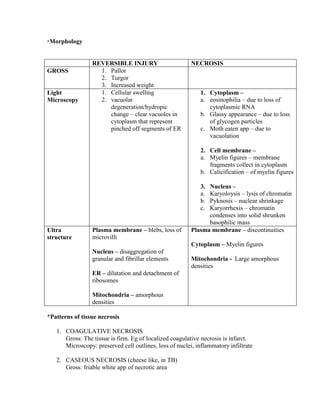
*Morphology

GROSS

Light
Microscopy

REVERSIBLE INJURY
1. Pallor
2. Turgor
3. Increased weight
1. Cellular swelling
2. vacuolar
degeneration/hydropic
change – clear vacuoles in
cytoplasm that represent
pinched off segments of ER

NECROSIS

1. Cytoplasm –
a. eosinophilia – due to loss of
cytoplasmic RNA
b. Glassy appearance – due to loss
of glycogen particles
c. Moth eaten app – due to
vacuolation
2. Cell membrane –
a. Myelin figures – membrane
fragments collect in cytoplasm
b. Calicification – of myelin figures
3.
a.
b.
c.

Ultra
structure

Plasma membrane – blebs, loss of
microvilli

Nucleus –
Karyoloysis – lysis of chromatin
Pyknosis – nuclear shrinkage
Karyorrhexis – chromatin
condenses into solid shrunken
basophilic mass
Plasma membrane – discontinuities
Cytoplasm – Myelin figures

Nucleus – disaggregation of
granular and fibrillar elements

Mitochondria - Large amorphous
densities

ER – dilatation and detachment of
ribosomes
Mitochondria – amorphous
densities
*Patterns of tissue necrosis
1. COAGULATIVE NECROSIS
Gross: The tissue is firm. Eg of localized coagulative necrosis is infarct.
Microscopy: preserved cell outlines, loss of nuclei, inflammatory infiltrate
2. CASEOUS NECROSIS (cheese like, in TB)
Gross: friable white app of necrotic area
Notes on General Pathology – Apoptosis….By Dr. Ashish V. Jawarkar
Contact: pathologybasics@gmail.com Website: pathologybasics.wix.com/notes
6

Microscopy: Granuloma – central necrosis with lysed cells forming amorphous
debris, surrounded by inflammatory cells and epithelioid cells
3. LIQUEFACTIVE NECROSIS (necrosis in CNS)
Characterized by digestion of dead tissue – transformation into liquid viscous
mass
Gross: Abscess cavity formation with ragged margins
Microscopy: Necrotic material is creamy yellow containing dead leucocytes
4. GANGRENOUS NECROSIS
1. coagulative necrosis occurring in a limb that has lost its blood supply
2. occurs in multiple tissue planes
3. superimposed bacterial infection causes liquifactive necrosis – wet
gangrene
5. FAT NECROSIS
Refers to focal areas of fat destruction occurring due to release of pancreatic
enzymes into substance of pancreas and peritoneal cavity
Seen in acute pancreatitis
Gross: Pancreatic enzymes liquefy membranes of fat cells in peritoneum, split
triglycerides, produce saponification and deposition of calcium, chalky white
areas
Microscopy: shadowy outlines of fat cells, basophilic calcium deposits,
inflammatory reaction
6. FIBRINOID NECROSIS
Seen in immune reactions like SLE and other vasculitic syndromes
Seen in the wall of blood vessels
Microscopy: The wall of the vessels show circumferential bright pink areas of
necrosis and inflammation. Its basically immune complex deposition with
extravasated fibrin.

Notes on General Pathology – Apoptosis….By Dr. Ashish V. Jawarkar
Contact: pathologybasics@gmail.com Website: pathologybasics.wix.com/notes

Necrosis

  • 1.
    1 General Pathology Notes(Robbins) By Dr. Ashish Jawarkar Chapter 1 : CELLULAR RESPONES TO STRESS AND TOXIC INSULTS: ADAPTATION, INJURY AND CELL DEATH TOPIC 2. CELL INJURY AND NECROSIS Overview 1. definition 2. types – reversible, irreversible (necrosis,apoptosis) 3. causes 4. timeline 5. Mechanisms of cell injury (necrosis) 6. morphology 7. necrosis vs apoptosis 8. patterns of necrosis 9. molecular basis *definition and types Cells exposed to stress Adaptation (hypertrophy/hyperplasia/atrophy/metaplasia) Continued stress, no more adaptation possible Cell injury Reversible cell injury Irreversible cell injury (necrosis & apoptosis) Notes on General Pathology – Apoptosis….By Dr. Ashish V. Jawarkar Contact: pathologybasics@gmail.com Website: pathologybasics.wix.com/notes
  • 2.
    2 *Causes of cellinjury 1. O2 deprivation, nutritional imbalances 2. Physical agents – trauma, heat, cold, UV light, shock 3. Chemical agents – cyanide, arsenic, pollutants 4. Infectious agents 5. Deranged immunity *Timeline Reversible Injury Biochemical alterations effect cell function irreversible cell injury Minutes Ultrastructural changes Days Light Microscopic Changes Gross Morphologic Changes *Mechanisms of Cell injury (Necrosis) 1. Damage to membranes (plasma, lysosomal,mitochondrial) 2. Failure of calcium pump 3. Accumulation of free radicals 4. Mitochondrial membrane damage and depletion of ATP 5. Protein misfolding and DNA damage 1. Damage to membranes Plasma membrane damage Lysosomal membrane damage Osmotic imbalance Leakage of metabolites leakage of (DNAases, RNAases, Proteases etc.) Notes on General Pathology – Apoptosis….By Dr. Ashish V. Jawarkar Contact: pathologybasics@gmail.com Website: pathologybasics.wix.com/notes
  • 3.
    3 2. Failure ofCa2+ pump Calcium influx Activation of leaked enzymes (DNAases, RNAases) Alteration of mitochrondrial Membrane permeability 3. Accumulation of free radicals Generation of free radicals ROS 1. Redox rns in Normal metabol 2. Radiation 3. Inflammn 4. CCl4 5. Transition metals (Fenton rn#) 6. NO FENTON RN H202 + Fe2+ O2Super Oxide Fe3+ + OH + OH- SOD H2O2 fenton rn +Fe2+ Hydrogen Peroxide OH Hydroxyl Radical MITOCHONDRIA Removal of free radicals done by 1. SOD (superoxide dismutase) – mitochondria 2. Glutathione peroxidase – mitochondria 3. Catalase – peroxisome Pathologic effects of ROS 1. Fatty acid oxidation and disruption of membranes, organelles 2. Protein oxidation and loss of enzyme activity, protein misfolding 3. DNA oxidation and mutations and breaks Notes on General Pathology – Apoptosis….By Dr. Ashish V. Jawarkar Contact: pathologybasics@gmail.com Website: pathologybasics.wix.com/notes
  • 4.
    4 4. Mitochondrial membranedamage and depletion of ATP Mitochondrial membrane damaged by 1. increased cytosolic calcium 2. ROS 3. hypoxia 4. mutations in mito genes Activation of caspases (apoptosis) Due to leakage of cyto c Alteration of mitochondrial membrane permeability Due to leakage of H+ H+ leakage and Loss of membrane potential Decreased Oxidative Phosphorylation Decreased ATP generation Detachment of Ribosomes Failure of Na+ pump Increased anaerobic Glycolysis Decreased protein synthesis Influx of Na +, Ca2+ H2O Lactic acidosis Increased lipid deposition Cellular swelling ER swelling Clumping of nuclear chromatin Notes on General Pathology – Apoptosis….By Dr. Ashish V. Jawarkar Contact: pathologybasics@gmail.com Website: pathologybasics.wix.com/notes
  • 5.
    5 *Morphology GROSS Light Microscopy REVERSIBLE INJURY 1. Pallor 2.Turgor 3. Increased weight 1. Cellular swelling 2. vacuolar degeneration/hydropic change – clear vacuoles in cytoplasm that represent pinched off segments of ER NECROSIS 1. Cytoplasm – a. eosinophilia – due to loss of cytoplasmic RNA b. Glassy appearance – due to loss of glycogen particles c. Moth eaten app – due to vacuolation 2. Cell membrane – a. Myelin figures – membrane fragments collect in cytoplasm b. Calicification – of myelin figures 3. a. b. c. Ultra structure Plasma membrane – blebs, loss of microvilli Nucleus – Karyoloysis – lysis of chromatin Pyknosis – nuclear shrinkage Karyorrhexis – chromatin condenses into solid shrunken basophilic mass Plasma membrane – discontinuities Cytoplasm – Myelin figures Nucleus – disaggregation of granular and fibrillar elements Mitochondria - Large amorphous densities ER – dilatation and detachment of ribosomes Mitochondria – amorphous densities *Patterns of tissue necrosis 1. COAGULATIVE NECROSIS Gross: The tissue is firm. Eg of localized coagulative necrosis is infarct. Microscopy: preserved cell outlines, loss of nuclei, inflammatory infiltrate 2. CASEOUS NECROSIS (cheese like, in TB) Gross: friable white app of necrotic area Notes on General Pathology – Apoptosis….By Dr. Ashish V. Jawarkar Contact: pathologybasics@gmail.com Website: pathologybasics.wix.com/notes
  • 6.
    6 Microscopy: Granuloma –central necrosis with lysed cells forming amorphous debris, surrounded by inflammatory cells and epithelioid cells 3. LIQUEFACTIVE NECROSIS (necrosis in CNS) Characterized by digestion of dead tissue – transformation into liquid viscous mass Gross: Abscess cavity formation with ragged margins Microscopy: Necrotic material is creamy yellow containing dead leucocytes 4. GANGRENOUS NECROSIS 1. coagulative necrosis occurring in a limb that has lost its blood supply 2. occurs in multiple tissue planes 3. superimposed bacterial infection causes liquifactive necrosis – wet gangrene 5. FAT NECROSIS Refers to focal areas of fat destruction occurring due to release of pancreatic enzymes into substance of pancreas and peritoneal cavity Seen in acute pancreatitis Gross: Pancreatic enzymes liquefy membranes of fat cells in peritoneum, split triglycerides, produce saponification and deposition of calcium, chalky white areas Microscopy: shadowy outlines of fat cells, basophilic calcium deposits, inflammatory reaction 6. FIBRINOID NECROSIS Seen in immune reactions like SLE and other vasculitic syndromes Seen in the wall of blood vessels Microscopy: The wall of the vessels show circumferential bright pink areas of necrosis and inflammation. Its basically immune complex deposition with extravasated fibrin. Notes on General Pathology – Apoptosis….By Dr. Ashish V. Jawarkar Contact: pathologybasics@gmail.com Website: pathologybasics.wix.com/notes