IMMUNOHISTOCHEMISTRY IN BREAST
LESIONS
Dr. Ashish Jawarkar, MD
APPLICATIONS
OF IHC IN
BREAST
LESIONS
1. Myoepithelial cell staining and assessment of stromal
invasion
2. Differentiating papillary lesions
3. Tumor type identification (Ductal vs lobular)
4. Role in Paget’s disease
5. Detection of lymphatic space invasion
6. Sentinel lymph node evaluation
7. Identifying systemic metastasis of breast carcinoma
8. Fibroepithelial tumors
9. Theranostic applications
Myoepithelial
Markers
1
Myoepithelial
cells
Proliferative vs
malignant
In situ vs invasive
Pseudo invasive
(adenosis, radial scar,
sclerosing papillary
tumor) vs invasive
IHC profile of myoepithelial cells
Case 1
35/F with mass in left breast
Case 1
35/F with mass in left breast
SMMHC/calponin
Case 1
35/F with mass in left breast
p63
Most specific, present in nucleus
Problems with SMA
• Stains myofibroblasts, may give
false assurance of presence of
myoepithelial cells in dcis vs in situ
• In DCIS there is periductal stromal
desmoplasia
Problems with SMA
• SMMHC specifically stains MEC and
not myofibroblasts
Ideal panel Combination of SMMHC
and p63
Case 2
Breast core biopsy demonstrating
abundant intra and peritumoral
lymphocytic infiltrates
AE1/AE3
p63
Internal
controls
For SMMHC and calponin
Pitfalls of p63 and
SMMHC
• A p63 stain demonstrates apparent
gaps in staining around the luminal
epithelium of a duct within a radial
scar
• The same duct shows intense
continuous staining with smooth
muscle myosin heavy chain, but
myofibroblastic cells in the
background are also positive
• A p63 stain on core biopsy shows
staining of a few tumor cells
• A rare example of diffuse p63
staining of tumor cells
Caveat – DCIS
with papillary
config
Approximately 5% DCIS with a
papillary configuration may not
show myoepithelial cells
p63 negSMMHC neg• Collagen type IV
demonstrates strong
continuous staining around
tumor nests, confirming the
in situ nature of the lesion
Benign sclerosing lesions vs malignancy
Case 3
42/F vague lump in right breast
Sclerosing adenosis
Case 4
28/F with vague breast lumpRadial scar
Case 5
Cribriform growth pattern – In situ or invasive?
Caveat
SMMHC
PAPILLARY
LESIONS
2
PAPILLARY
LESIONS
• Papilloma
• Atypical papilloma (papilloma with ADH)
• Papilloma with DCIS
• Papillary DCIS (Encapsulated papillary carcinoma)
• Solid papillary carcinoma
IMMUNOPROFILE OF PAPILLARY LESIONS
Papilloma
with ADH
vs
Papilloma
with DCIS
Both show absent MEC
markers within
Both show present MEC
around the ducts
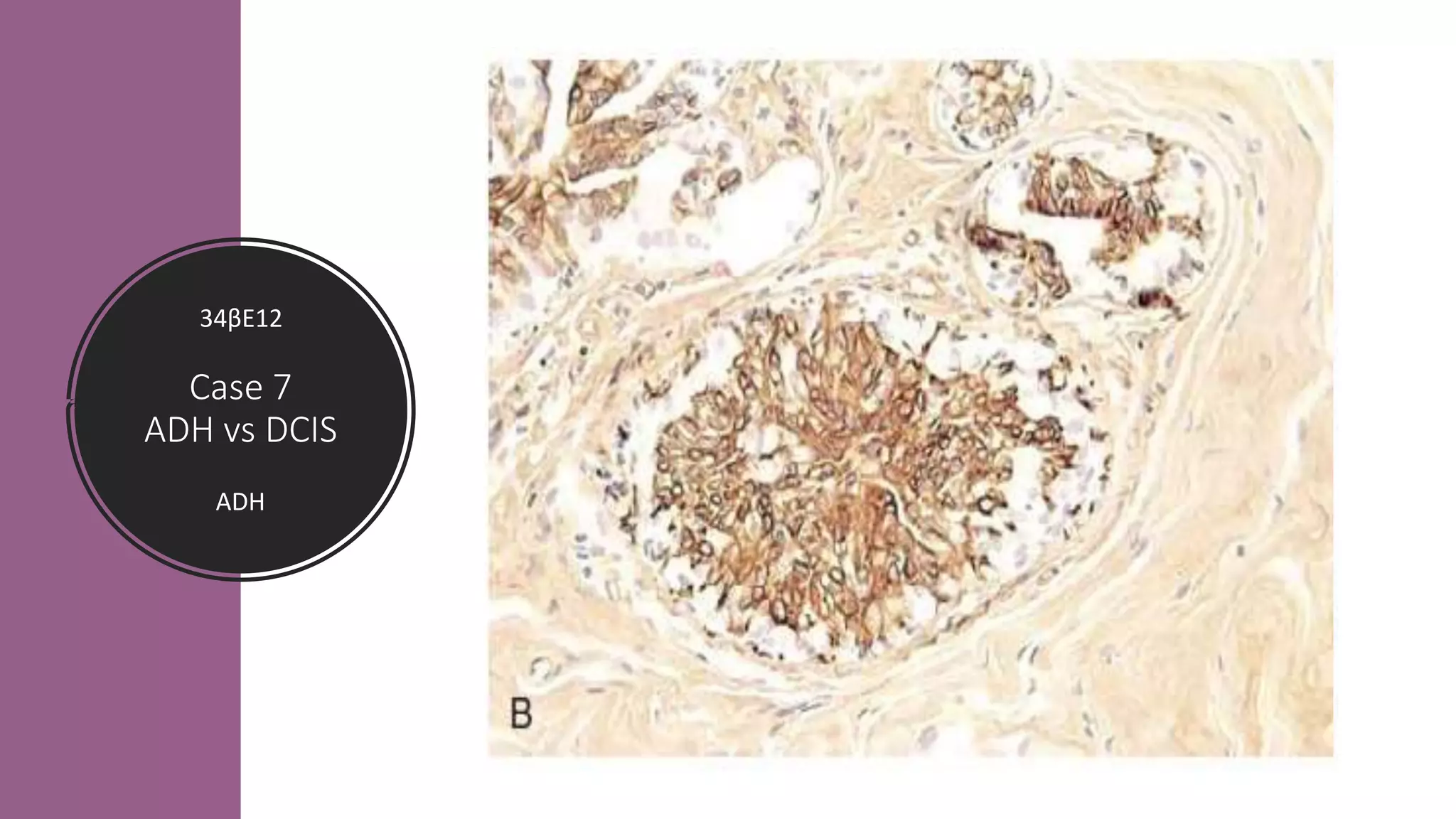
Positive 34βE12, CK5/6 is
within proliferative
component is indicative of
ADH
Intracystic
papillary
carcinoma vs
Solid papillary
carcinoma
Both show absent
MEC around ducts
Intracystic papillary
ca shows positive
staining by Collagen
IV around ducts
Case 6
• Papilloma
• Atypical papilloma
• Papilloma with DCIS
• Intracystic papillary
carcinoma
• Solid papillary carcinoma
Diagnostic Rationale
• MEC – SMMHC or p63
• Collagen type IV
• Intracystic papillary carcinoma
Case 7
ADH vs DCIS
34βE12
ADH
Case 8
ADH vs DCIS
34βE12
DCIS
DUCTAL
VS
LOBULAR
3
Ductal vs Lobular
• This classification is based on cell cohesiveness
• Invasive ductal carcinomas (IDCs) are often unifocal lesions,
compared with invasive lobular carcinomas (ILCs), which are
often multifocal
• Distant metastases from ductal carcinoma preferentially
involve lung and brain, whereas metastases from lobular
carcinoma more often involve the peritoneum, bone, bone
marrow, and visceral organs of the gastrointestinal (GI) and
gynaecologic tracts
• In spite of the above differences, at present, with combined
multimodality therapy, no difference in disease-free or
overall survival is apparent between ductal and lobular
carcinomas.
E cadherin
and p120ctn
E cadherin
• Strong E-cadherin (ECAD) membranous staining has been long used to
define ductal carcinoma
• Ductal carcinomas, both in situ and invasive, retain membranous
ECAD
• Lobular carcinomas studied at the genetic level have often shown
mutation that accounts for the loss of cohesiveness
• This correlates with either a complete absence of the ECAD protein or
abnormal localization (apical or perinuclear)
Case 9
Insitu ca
DCIS? LCIS?
E cadherin
ILC
aberrant staining with E cad
p120ctn
• When ECAD is absent, the cytoplasmic pool of p120 increases.
• Therefore in normal ducts and in ductal carcinomas, p120 shows a
membranous pattern of staining
• In contrast, lobular carcinomas, with absent or non functional E-
cadherin, show strong cytoplasmic p120 immunoreactivity
Case 10
Ecad – brown
p120 - pink
Membranous for
both
Ductal
Case 11
P120 cytoplasmic, Invasive and ILC
Paget’s disease
4
Paget’s disease
• The presence of malignant epithelium with breast cancer
immunophenotype (CK-7+) within the nipple epidermis
• The majority (>90%) of the underlying breast carcinomas are high
grade ductal carcinoma in situ with apocrine differentiation and
comedo-necrosis, they are her 2 neu positive and ER PR negative
• Accordingly the Paget cells are also her 2 neu positive and ER, PR
negative
• The differential for Paget disease includes melanoma and squamous
cell carcinoma in situ aka (Bowen disease)
Case 12
CK 7
Her 2
Pitfalls – Toker cells
• They are CK 7 positive cells present in skin of normal
nipple, however they are cytologically bland and
usually do not cause diagnostic problems
Pitfalls – Pseudo
Paget
• Large histiocytes infiltrate the epithelium
and impart a picture that simulates Paget
disease
• Cells are CK7 negative and are strongly
positive for CD68
Detection of
lymphatic space
invasion
5
Lymphatic space invasion
• Peritumoral lymphatic space invasion, is a known determinant of
lymph node metastasis
• However the interpretation in paraffin sections is complicated by
• Retraction artefacts
• Ducts with misplaced epithelium
• Artefactual displacement of cells
________ shows high sensitivity and specificity for normal lymphatic endothelium
D2-40
Prominent staining
around lymphatic,
smudgy around
duct
Identify the
stain
CD31
Sentinel lymph
node invasion
a soldier or guard whose job is to stand and keep watch
6
Rationale
• Historically, complete axillary lymph node dissection was performed with
lumpectomy or mastectomy specimen, primarily for staging purposes,
providing information that was used to determine adjuvant chemotherapy
• The morbidity associated with this procedure is substantial in terms of arm
pain, limitation of arm motion, and chronic lymphedema
• The SLN is identified by injecting a radioisotope and blue dye before
planned surgical excision, Identified by a combination of visual inspection
for blue dye and intraoperative scanning for radioactivity
• The rationale for this approach is that for patients who are SLN negative, a
further morbid procedure of axillary cleanout is unnecessary
SLN invasion
• SLNs are histologically examined on multiple
levels and by cytokeratin stains (AE1/AE3) on at
least two levels
• If the primary breast carcinoma is of the ductal
type, most pathologists would agree that they
would be able to identify micro metastases (0.2-
2mm) on HE. Therefore cytokeratin stains on
SLN do not add any significant information in a
primary ductal cancer
• However, when the primary breast tumor shows
a lobular morphology; Because of single-cell
infiltration, small metastases (micro metastases)
of lobular carcinoma require IHC
Systemic
metastases of
breast carcinoma
7
To know whether breast is the primary
• GCDFP-15
• PPV 99%
• Also stains includes acinar structures in salivary glands, apocrine glands, and sweat
glands and in Paget disease of skin, vulva, and prostate
• ER and PR
• Mullerian tumors may be positive
• MAMMAGLOBIN
• Endometrioid carcinomas and melanomas may be positive
• PAX-8
• Useful negative marker for breast carcinomas
• Positive in tumors of Mullerian origin
Case 12
60/F, sections from peritoneal
mass
CK - 7 GCDFP-15MAMMAGLOBIN
Fibro epithelial
tumors
8
Fibroadenoma vs
Phyllode’s
• Phyllode’s expresses CD34 in stromal cells
indicating fibroblastic/myofibroblastic
origin, fibroadenoma does not
Benign vs malignant
phyllode’s
• Ki67 labelling indices range
from
• Benign – 1-5%
• Borderline – 6-16%
• Malignant – 12-50%
Theranostics
Theranostics is a new
field of medicine which
combines specific
targeted therapy based
on specific targeted
diagnostic tests
9
Theranostics
• Pathologic features of breast carcinoma that have prognostic value
include
1. tumor size, grade, and histologic type
2. lymph node status
3. expression of HRs
4. HER2 expression
ER/PR
• Recognition that estrogen ablation had an impact on groups of
patients with breast cancer and that clinical responsiveness
correlated with the expression of ER is the rationale behind testing for
ER and PR
• One of the effects of estrogen is to induce the PR (ER and PR + tumors
form 99% of receptor positive tumors) and ER-negative, PR-positive
tumors account for fewer than 1% of all breast cancers
• Nuclear immunostaining for both receptor proteins can be
demonstrated in normal breast acini (15-20%), which serve as
internal controls for the testing procedure
ALLRED
SCORE
The degree of ER and PR staining has consistently been shown to identify
groups of patients with significantly different risks of overall survival, time to
recurrence, and treatment response to hormonal therapy.
1 2
3 54
0
Her2/neu(ERBB2)
• Approximately 15% to 20% of breast cancers demonstrate HER2 gene
amplification and/or protein overexpression
• In the absence of adjuvant systemic therapy, HER2-positive breast
cancer patients have a worse prognosis, that is, they have higher rates
of recurrence and mortality
• HER2 positivity is predictive of response to anthracycline- and taxane-
based therapies
• It is also important to note that HER2- positive tumors generally show
relative resistance to tamoxifen
• Trastuzumab is the Theranostic treatment for these tumors
SUMMARY
1. Combination of SMMHC and p63 is ideal for marking myoepithelial cells
2. Papilloma with ADH vs Papilloma with DCIS - Positive 34βE12, CK5/6 is
within proliferative component is indicative of ADH
3. Intracystic papillary carcinoma vs Solid papillary carcinoma - Intracystic
papillary ca shows positive staining by Collagen IV around ducts
4. Strong E-cadherin (ECAD) membranous staining has been long used to
define ductal carcinoma
5. Lobular carcinomas show strong cytoplasmic p120 immunoreactivity
6. Paget’s disease - The presence of malignant epithelium with breast
cancer immunophenotype (CK-7+) within the nipple epidermis
SUMMARY
7. D2-40 shows high sensitivity and specificity for normal lymphatic
endothelium and helps in detection of lymphatic space invasion
8. Sentinel lymph node invasion - SLNs are histologically examined on
multiple levels and by cytokeratin stains (AE1/AE3) on at least two levels
9. GCDFP, ER/PR and mammaglobin are positive markers to detect systemic
metastasis, PAX 8 is a useful negative marker
10. Phyllode’s expresses CD34 in stromal cells, fibroadenoma does not
11. Ki67 labelling indices help in differentiating benign, borderline and
malignant phyllode’s
12. ER/PR positivity – tamoxifen, HER2 positivity - Trastuzumab
THANK YOU

Immunohistochemistry in breast lesions

  • 1.
  • 2.
    APPLICATIONS OF IHC IN BREAST LESIONS 1.Myoepithelial cell staining and assessment of stromal invasion 2. Differentiating papillary lesions 3. Tumor type identification (Ductal vs lobular) 4. Role in Paget’s disease 5. Detection of lymphatic space invasion 6. Sentinel lymph node evaluation 7. Identifying systemic metastasis of breast carcinoma 8. Fibroepithelial tumors 9. Theranostic applications
  • 3.
  • 4.
    Myoepithelial cells Proliferative vs malignant In situvs invasive Pseudo invasive (adenosis, radial scar, sclerosing papillary tumor) vs invasive
  • 5.
    IHC profile ofmyoepithelial cells
  • 6.
    Case 1 35/F withmass in left breast
  • 7.
    Case 1 35/F withmass in left breast SMMHC/calponin
  • 8.
    Case 1 35/F withmass in left breast p63 Most specific, present in nucleus
  • 9.
    Problems with SMA •Stains myofibroblasts, may give false assurance of presence of myoepithelial cells in dcis vs in situ • In DCIS there is periductal stromal desmoplasia
  • 10.
    Problems with SMA •SMMHC specifically stains MEC and not myofibroblasts
  • 11.
    Ideal panel Combinationof SMMHC and p63
  • 12.
    Case 2 Breast corebiopsy demonstrating abundant intra and peritumoral lymphocytic infiltrates AE1/AE3 p63
  • 13.
  • 14.
    Pitfalls of p63and SMMHC • A p63 stain demonstrates apparent gaps in staining around the luminal epithelium of a duct within a radial scar • The same duct shows intense continuous staining with smooth muscle myosin heavy chain, but myofibroblastic cells in the background are also positive • A p63 stain on core biopsy shows staining of a few tumor cells • A rare example of diffuse p63 staining of tumor cells
  • 15.
    Caveat – DCIS withpapillary config Approximately 5% DCIS with a papillary configuration may not show myoepithelial cells p63 negSMMHC neg• Collagen type IV demonstrates strong continuous staining around tumor nests, confirming the in situ nature of the lesion
  • 16.
  • 17.
    Case 3 42/F vaguelump in right breast Sclerosing adenosis
  • 18.
    Case 4 28/F withvague breast lumpRadial scar
  • 19.
    Case 5 Cribriform growthpattern – In situ or invasive?
  • 20.
  • 21.
  • 22.
    PAPILLARY LESIONS • Papilloma • Atypicalpapilloma (papilloma with ADH) • Papilloma with DCIS • Papillary DCIS (Encapsulated papillary carcinoma) • Solid papillary carcinoma
  • 23.
  • 24.
    Papilloma with ADH vs Papilloma with DCIS Bothshow absent MEC markers within Both show present MEC around the ducts Positive 34βE12, CK5/6 is within proliferative component is indicative of ADH
  • 25.
    Intracystic papillary carcinoma vs Solid papillary carcinoma Bothshow absent MEC around ducts Intracystic papillary ca shows positive staining by Collagen IV around ducts
  • 26.
    Case 6 • Papilloma •Atypical papilloma • Papilloma with DCIS • Intracystic papillary carcinoma • Solid papillary carcinoma
  • 27.
    Diagnostic Rationale • MEC– SMMHC or p63 • Collagen type IV • Intracystic papillary carcinoma
  • 28.
    Case 7 ADH vsDCIS 34βE12 ADH
  • 29.
    Case 8 ADH vsDCIS 34βE12 DCIS
  • 30.
  • 31.
    Ductal vs Lobular •This classification is based on cell cohesiveness • Invasive ductal carcinomas (IDCs) are often unifocal lesions, compared with invasive lobular carcinomas (ILCs), which are often multifocal • Distant metastases from ductal carcinoma preferentially involve lung and brain, whereas metastases from lobular carcinoma more often involve the peritoneum, bone, bone marrow, and visceral organs of the gastrointestinal (GI) and gynaecologic tracts • In spite of the above differences, at present, with combined multimodality therapy, no difference in disease-free or overall survival is apparent between ductal and lobular carcinomas.
  • 32.
  • 33.
    E cadherin • StrongE-cadherin (ECAD) membranous staining has been long used to define ductal carcinoma • Ductal carcinomas, both in situ and invasive, retain membranous ECAD • Lobular carcinomas studied at the genetic level have often shown mutation that accounts for the loss of cohesiveness • This correlates with either a complete absence of the ECAD protein or abnormal localization (apical or perinuclear)
  • 34.
    Case 9 Insitu ca DCIS?LCIS? E cadherin
  • 35.
  • 36.
    p120ctn • When ECADis absent, the cytoplasmic pool of p120 increases. • Therefore in normal ducts and in ductal carcinomas, p120 shows a membranous pattern of staining • In contrast, lobular carcinomas, with absent or non functional E- cadherin, show strong cytoplasmic p120 immunoreactivity
  • 37.
    Case 10 Ecad –brown p120 - pink Membranous for both Ductal
  • 38.
    Case 11 P120 cytoplasmic,Invasive and ILC
  • 39.
  • 40.
    Paget’s disease • Thepresence of malignant epithelium with breast cancer immunophenotype (CK-7+) within the nipple epidermis • The majority (>90%) of the underlying breast carcinomas are high grade ductal carcinoma in situ with apocrine differentiation and comedo-necrosis, they are her 2 neu positive and ER PR negative • Accordingly the Paget cells are also her 2 neu positive and ER, PR negative • The differential for Paget disease includes melanoma and squamous cell carcinoma in situ aka (Bowen disease)
  • 41.
  • 42.
    Pitfalls – Tokercells • They are CK 7 positive cells present in skin of normal nipple, however they are cytologically bland and usually do not cause diagnostic problems
  • 43.
    Pitfalls – Pseudo Paget •Large histiocytes infiltrate the epithelium and impart a picture that simulates Paget disease • Cells are CK7 negative and are strongly positive for CD68
  • 44.
  • 45.
    Lymphatic space invasion •Peritumoral lymphatic space invasion, is a known determinant of lymph node metastasis • However the interpretation in paraffin sections is complicated by • Retraction artefacts • Ducts with misplaced epithelium • Artefactual displacement of cells
  • 46.
    ________ shows highsensitivity and specificity for normal lymphatic endothelium D2-40 Prominent staining around lymphatic, smudgy around duct
  • 47.
  • 48.
    Sentinel lymph node invasion asoldier or guard whose job is to stand and keep watch 6
  • 49.
    Rationale • Historically, completeaxillary lymph node dissection was performed with lumpectomy or mastectomy specimen, primarily for staging purposes, providing information that was used to determine adjuvant chemotherapy • The morbidity associated with this procedure is substantial in terms of arm pain, limitation of arm motion, and chronic lymphedema • The SLN is identified by injecting a radioisotope and blue dye before planned surgical excision, Identified by a combination of visual inspection for blue dye and intraoperative scanning for radioactivity • The rationale for this approach is that for patients who are SLN negative, a further morbid procedure of axillary cleanout is unnecessary
  • 50.
    SLN invasion • SLNsare histologically examined on multiple levels and by cytokeratin stains (AE1/AE3) on at least two levels • If the primary breast carcinoma is of the ductal type, most pathologists would agree that they would be able to identify micro metastases (0.2- 2mm) on HE. Therefore cytokeratin stains on SLN do not add any significant information in a primary ductal cancer • However, when the primary breast tumor shows a lobular morphology; Because of single-cell infiltration, small metastases (micro metastases) of lobular carcinoma require IHC
  • 51.
  • 52.
    To know whetherbreast is the primary • GCDFP-15 • PPV 99% • Also stains includes acinar structures in salivary glands, apocrine glands, and sweat glands and in Paget disease of skin, vulva, and prostate • ER and PR • Mullerian tumors may be positive • MAMMAGLOBIN • Endometrioid carcinomas and melanomas may be positive • PAX-8 • Useful negative marker for breast carcinomas • Positive in tumors of Mullerian origin
  • 53.
    Case 12 60/F, sectionsfrom peritoneal mass CK - 7 GCDFP-15MAMMAGLOBIN
  • 54.
  • 55.
    Fibroadenoma vs Phyllode’s • Phyllode’sexpresses CD34 in stromal cells indicating fibroblastic/myofibroblastic origin, fibroadenoma does not
  • 56.
    Benign vs malignant phyllode’s •Ki67 labelling indices range from • Benign – 1-5% • Borderline – 6-16% • Malignant – 12-50%
  • 57.
    Theranostics Theranostics is anew field of medicine which combines specific targeted therapy based on specific targeted diagnostic tests 9
  • 58.
    Theranostics • Pathologic featuresof breast carcinoma that have prognostic value include 1. tumor size, grade, and histologic type 2. lymph node status 3. expression of HRs 4. HER2 expression
  • 59.
    ER/PR • Recognition thatestrogen ablation had an impact on groups of patients with breast cancer and that clinical responsiveness correlated with the expression of ER is the rationale behind testing for ER and PR • One of the effects of estrogen is to induce the PR (ER and PR + tumors form 99% of receptor positive tumors) and ER-negative, PR-positive tumors account for fewer than 1% of all breast cancers • Nuclear immunostaining for both receptor proteins can be demonstrated in normal breast acini (15-20%), which serve as internal controls for the testing procedure
  • 60.
    ALLRED SCORE The degree ofER and PR staining has consistently been shown to identify groups of patients with significantly different risks of overall survival, time to recurrence, and treatment response to hormonal therapy. 1 2 3 54 0
  • 61.
    Her2/neu(ERBB2) • Approximately 15%to 20% of breast cancers demonstrate HER2 gene amplification and/or protein overexpression • In the absence of adjuvant systemic therapy, HER2-positive breast cancer patients have a worse prognosis, that is, they have higher rates of recurrence and mortality • HER2 positivity is predictive of response to anthracycline- and taxane- based therapies • It is also important to note that HER2- positive tumors generally show relative resistance to tamoxifen • Trastuzumab is the Theranostic treatment for these tumors
  • 62.
    SUMMARY 1. Combination ofSMMHC and p63 is ideal for marking myoepithelial cells 2. Papilloma with ADH vs Papilloma with DCIS - Positive 34βE12, CK5/6 is within proliferative component is indicative of ADH 3. Intracystic papillary carcinoma vs Solid papillary carcinoma - Intracystic papillary ca shows positive staining by Collagen IV around ducts 4. Strong E-cadherin (ECAD) membranous staining has been long used to define ductal carcinoma 5. Lobular carcinomas show strong cytoplasmic p120 immunoreactivity 6. Paget’s disease - The presence of malignant epithelium with breast cancer immunophenotype (CK-7+) within the nipple epidermis
  • 63.
    SUMMARY 7. D2-40 showshigh sensitivity and specificity for normal lymphatic endothelium and helps in detection of lymphatic space invasion 8. Sentinel lymph node invasion - SLNs are histologically examined on multiple levels and by cytokeratin stains (AE1/AE3) on at least two levels 9. GCDFP, ER/PR and mammaglobin are positive markers to detect systemic metastasis, PAX 8 is a useful negative marker 10. Phyllode’s expresses CD34 in stromal cells, fibroadenoma does not 11. Ki67 labelling indices help in differentiating benign, borderline and malignant phyllode’s 12. ER/PR positivity – tamoxifen, HER2 positivity - Trastuzumab
  • 64.