Chronic Inflammation
Definition:
   Inflammation of prolonged duration in which active inflammation,
    tissue injury and the healing proceed simultaneously
Causes:
Persistent Infections
   Ex. Treponema palladium (causative organism of syphilis)
   Organism of low toxicity and evoke an immune reaction =
    delayed hypersensitivity
Prolonged Exposure to toxic Agents
Autoimmunity
   Ex. Autoimmune diseases
Chronic Inflammation
Morphologic Features:
  Infiltration with mononuclear cells (macrophages,
   lymphocytes & plasma cells)
       indicates persistent reaction to injury
  Tissue destruction
       Done by way of Inflammatory cells
  Repair involving angiogenesis and fibrosis
       Attempt to replace lost tissue
Chronic Inflammation
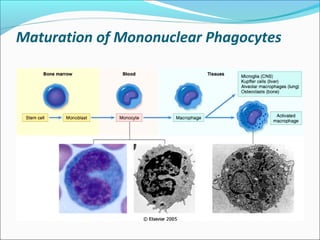
Mononuclear Phagocyte System
  Circulating blood monocytes →Tissue macrophages
                                     ↓
                  Kupffer cells (liver)
                  Sinus Histiocytes (spleen)
                  Microglia (CNS)
                  Alveolar Macrophages (lung)
Maturation of Mononuclear Phagocytes
Mechanisms of macrophage accumulation during
Chronic Inflammation

  Continued recruitment of monocytes from the
    circulation
    Most important source for macrophages
  Local proliferation of macrophages from the blood
   stream
  Immobilization of macrophages within the site of
   inflammation
       Cytokines and oxidized lipids can cause
      immobilization
Effects of Macrophage Activation
Other Cells of Chronic Inflammation
Infiltration with mast cells, lymphocytes and plasma
 cells
Lymphocytes
   Mobilization in antibody – mediated response
Mast Cells
   Widely distributed in connective tissues and participate in both
    acute and persistent inflammatory reactions
   Binds the Fc portion of the IgE antibody
Plasma Cells
   Produce antibody directed either against persistent antigen in
    the inflammatory site or against altered tissue components
Eosinophils
   parasitic infections
   Mediated by IgE
   Eotaxin – a chemokine that has the ability to prime eosinophils for
    chemotaxis
Granulomatous inflammation
It’s a pattern of chronic inflammatory reaction in
 which the predominant cells are
Aggregations of macrophages having an enlarged,
 squamous cell-like appearance (called Epitheloid
 macrophages)
GRANULOMA = Nodular collection of
 Epitheloid macrophages surrounded by a rim of
 LYMPHOCYTES
  It’s a focal area of Granulomatous inflammation
  In an H&E stain can see:
    Epitheloid cells have pale granular cytoplasm with indistinct
      boundaries
  Giant cells = Epitheloid cells that fuse (Langhan’s)
    Can be found in the periphery or sometimes in the center of the
      granuloma
    Have large mass of cytoplasm
    Have 20 or more small nuclei arranged in the periphery or
      haphazardly
Granulomatous inflammation
 Types of Granulomatous Inflammation
 1. Immune granulomas
   Caused by insoluble particles that are capable of
    inducing a cell-mediated immune response
   Macrophages are transformed into Epitheloid cells and
    multinucleate giant cells
   Examples:
        Bacteria
          Tuberculosis   *** (high incidence due to drug
           resistant stains)
          Leprosy
        Parasites
          Schistosomiasis   (3 types)
        Fungi
          Histoplasmosis
          Blastomycosis
Granulomatous inflammation
2.Foreign Body Granulomas
  Don’t incite either an inflammatory or immune
     response.
  Epitheloid cells and giant cells are apposed to the
     surface and encompass the foreign body.
  The foreign body is usually found in the center of the
     granuloma.
     Examples:
         Metal/Dust
            Berylliosis
            Silicosis
         Foreign body
           Splinter
           Suture
Granulomatous inflammation
 3 Sarcoidosis
  Bad systemic disease, probably autoimmune disease
  Etiologic agent is unknown
LYMPHATICS IN INFLAMMATION


  Secondary line of defense
  Lymph flow is increased in        inflammation
   and helps drain the edema fluid
  Lymphangitis
  Lymphadenitis
Third line of defense

 organisms gain access to the vascular circulation-
  Bacteremia
 next line of defense
   Phagocytic cells of the liver, spleen, and bone
     marrow
 heart valves, meninges, kidneys, and joints are
  favored sites of implantation for blood-borne
  organisms
Systemic Effects of Inflammation
Infections→ reactions to cytokines
                     ↓
Acute phase response or the systemic
 inflammatory response syndrome (SIRS)
Acute phase response consists of
Acute phase response

 Fever-elevation of body         temperature by 1° to
  4°C
   pyrogens stimulate prostaglandin        synthesis
    in the vascular and perivascular cells of the
    hypothalamus
      exogenous pyrogens (LPS)
      endogenous pyrogens (TNF, IL-1)
1.Fever
PGE2 via neurotransmitters such as cyclic AMP
     ↓
Reset the temperature set-point at a higher level
     ↓
Fever
     ↓
Fever induce heat shock proteins that enhance
 lymphocyte responses to microbial antigens
2.Acute-phase proteins


    C-reactive protein (CRP)
    Fibrinogen
    Serum amyloid A protein (SAA)
 Synthesised by hepatocytes
 Synthesis is by upregulated by cytokines
    IL-6 (for CRP and fibrinogen)
    IL-1 or TNF (for SAA)
2.Acute-phase proteins
CRP and SAA act as opsonins helps in
 clearing
    Necroticcell nuclei
    Microbial cell walls


      Unlimited production of SAA - secondary
        amyloidosis in chronic inflammation
3.Leukocytosis


    Common feature of inflammatory reactions
    Bacterial infection
    Usually 15,000 or 20,000 cells/μl,
3.Leukocytosis contd…

 A) Accelerated release of cells from the bone
  marrow post - mitotic         reserve pool
                          ↓
      (shift to the left) by cytokines
 B) Colony stimulating factors cause increase
  production of WBC
3.Leukocytosis contd…

   Most bacterial infections induce Neutrophilia
   Viral infections-Lymphocytosis
   Typhoid fever , Rickettsiae-Leukopenia
   bronchial asthma, hay fever, and parasitic
     infestations- Eosinophilia
Other features of APR


    Effects of cytokines on brain cells
    Increased pulse and blood pressure
    Decreased sweating,
    Rigors (shivering)
    Chills (search for warmth)
    Anorexia
    Malaise
Sepsis
 Sepsis ;- severe bacterial infection
 Large amounts of LPS & TNF
 Multiple small thrombi by expressing Tissue
  Factor (TF) on Endothelial cells (EC)
 Septic shock – Triad
   1. Liver failure – no Gluconeogenesis (Hypoglycemia)
   2. Loss of perfusion pressure & heart failure –
      hemodynamic shock
   3. Disseminated Intravascular Coagulation (DIC) –
      Multiple Thrombi in circulation & Fibrin split
      products
 Multi Organ Failure
    Mainly Lung , Liver also Kidney & Bowel
Consequences of impaired inflammation
Defective inflammation    Excess Inflammation
↑ susceptibility to      Allergies
 infection                Important in
Delay in wound healing     Cancer
Tissue damage              Atherosclerosis
                            Fibrosis as a sequel of
                             chronic infections,
                             metabolic conditions

Chronic inflammation 2-1-2

  • 1.
    Chronic Inflammation Definition:  Inflammation of prolonged duration in which active inflammation, tissue injury and the healing proceed simultaneously Causes: Persistent Infections  Ex. Treponema palladium (causative organism of syphilis)  Organism of low toxicity and evoke an immune reaction = delayed hypersensitivity Prolonged Exposure to toxic Agents Autoimmunity  Ex. Autoimmune diseases
  • 2.
    Chronic Inflammation Morphologic Features: Infiltration with mononuclear cells (macrophages, lymphocytes & plasma cells)  indicates persistent reaction to injury Tissue destruction  Done by way of Inflammatory cells Repair involving angiogenesis and fibrosis  Attempt to replace lost tissue
  • 3.
    Chronic Inflammation Mononuclear PhagocyteSystem Circulating blood monocytes →Tissue macrophages ↓ Kupffer cells (liver) Sinus Histiocytes (spleen) Microglia (CNS) Alveolar Macrophages (lung)
  • 4.
  • 5.
    Mechanisms of macrophageaccumulation during Chronic Inflammation Continued recruitment of monocytes from the circulation Most important source for macrophages Local proliferation of macrophages from the blood stream Immobilization of macrophages within the site of inflammation  Cytokines and oxidized lipids can cause immobilization
  • 6.
  • 7.
    Other Cells ofChronic Inflammation Infiltration with mast cells, lymphocytes and plasma cells Lymphocytes  Mobilization in antibody – mediated response Mast Cells  Widely distributed in connective tissues and participate in both acute and persistent inflammatory reactions  Binds the Fc portion of the IgE antibody Plasma Cells  Produce antibody directed either against persistent antigen in the inflammatory site or against altered tissue components Eosinophils  parasitic infections  Mediated by IgE  Eotaxin – a chemokine that has the ability to prime eosinophils for chemotaxis
  • 8.
    Granulomatous inflammation It’s apattern of chronic inflammatory reaction in which the predominant cells are Aggregations of macrophages having an enlarged, squamous cell-like appearance (called Epitheloid macrophages) GRANULOMA = Nodular collection of Epitheloid macrophages surrounded by a rim of LYMPHOCYTES It’s a focal area of Granulomatous inflammation In an H&E stain can see:  Epitheloid cells have pale granular cytoplasm with indistinct boundaries Giant cells = Epitheloid cells that fuse (Langhan’s)  Can be found in the periphery or sometimes in the center of the granuloma  Have large mass of cytoplasm  Have 20 or more small nuclei arranged in the periphery or haphazardly
  • 9.
    Granulomatous inflammation Typesof Granulomatous Inflammation 1. Immune granulomas Caused by insoluble particles that are capable of inducing a cell-mediated immune response Macrophages are transformed into Epitheloid cells and multinucleate giant cells Examples:  Bacteria  Tuberculosis *** (high incidence due to drug resistant stains)  Leprosy  Parasites  Schistosomiasis (3 types)  Fungi  Histoplasmosis  Blastomycosis
  • 10.
    Granulomatous inflammation 2.Foreign BodyGranulomas Don’t incite either an inflammatory or immune response. Epitheloid cells and giant cells are apposed to the surface and encompass the foreign body. The foreign body is usually found in the center of the granuloma. Examples: Metal/Dust Berylliosis Silicosis Foreign body Splinter Suture
  • 11.
    Granulomatous inflammation  3Sarcoidosis  Bad systemic disease, probably autoimmune disease  Etiologic agent is unknown
  • 12.
    LYMPHATICS IN INFLAMMATION  Secondary line of defense  Lymph flow is increased in inflammation and helps drain the edema fluid  Lymphangitis  Lymphadenitis
  • 13.
    Third line ofdefense organisms gain access to the vascular circulation- Bacteremia next line of defense Phagocytic cells of the liver, spleen, and bone marrow heart valves, meninges, kidneys, and joints are favored sites of implantation for blood-borne organisms
  • 14.
    Systemic Effects ofInflammation Infections→ reactions to cytokines ↓ Acute phase response or the systemic inflammatory response syndrome (SIRS) Acute phase response consists of
  • 15.
    Acute phase response Fever-elevation of body temperature by 1° to 4°C pyrogens stimulate prostaglandin synthesis in the vascular and perivascular cells of the hypothalamus  exogenous pyrogens (LPS)  endogenous pyrogens (TNF, IL-1)
  • 16.
    1.Fever PGE2 via neurotransmitterssuch as cyclic AMP ↓ Reset the temperature set-point at a higher level ↓ Fever ↓ Fever induce heat shock proteins that enhance lymphocyte responses to microbial antigens
  • 17.
    2.Acute-phase proteins  C-reactive protein (CRP)  Fibrinogen  Serum amyloid A protein (SAA) Synthesised by hepatocytes Synthesis is by upregulated by cytokines  IL-6 (for CRP and fibrinogen)  IL-1 or TNF (for SAA)
  • 18.
    2.Acute-phase proteins CRP andSAA act as opsonins helps in clearing Necroticcell nuclei Microbial cell walls Unlimited production of SAA - secondary amyloidosis in chronic inflammation
  • 19.
    3.Leukocytosis Common feature of inflammatory reactions Bacterial infection Usually 15,000 or 20,000 cells/μl,
  • 20.
    3.Leukocytosis contd… A)Accelerated release of cells from the bone marrow post - mitotic reserve pool ↓ (shift to the left) by cytokines B) Colony stimulating factors cause increase production of WBC
  • 21.
    3.Leukocytosis contd… Most bacterial infections induce Neutrophilia Viral infections-Lymphocytosis Typhoid fever , Rickettsiae-Leukopenia bronchial asthma, hay fever, and parasitic infestations- Eosinophilia
  • 22.
    Other features ofAPR Effects of cytokines on brain cells Increased pulse and blood pressure Decreased sweating, Rigors (shivering) Chills (search for warmth) Anorexia Malaise
  • 23.
    Sepsis  Sepsis ;-severe bacterial infection  Large amounts of LPS & TNF  Multiple small thrombi by expressing Tissue Factor (TF) on Endothelial cells (EC)  Septic shock – Triad 1. Liver failure – no Gluconeogenesis (Hypoglycemia) 2. Loss of perfusion pressure & heart failure – hemodynamic shock 3. Disseminated Intravascular Coagulation (DIC) – Multiple Thrombi in circulation & Fibrin split products  Multi Organ Failure  Mainly Lung , Liver also Kidney & Bowel
  • 24.
    Consequences of impairedinflammation Defective inflammation Excess Inflammation ↑ susceptibility to Allergies infection Important in Delay in wound healing Cancer Tissue damage Atherosclerosis Fibrosis as a sequel of chronic infections, metabolic conditions

Editor's Notes