GENERAL PATHOLOGY MADE EASY
GENERAL PATHOLOGY
MADE EASY
FOR MEDICAL STUDENTS & JUNIOR DOCTORS
First Edition
GENERAL PATHOLOGY MADE EASY
2
COPY RIGHT
All rights reserved. No part of this book may be reproduced or transmitted in
any form or by any means, including photocopying, recording or any other
means without permission from the publisher.
GENERAL PATHOLOGY MADE EASY
3
Contributors
Authors:
1- Dr. Abuobieda Bala Mohammed Abusharib, MD in Pathology
University of Khartoum, Assistant Professor of Pathology, College of
Medicine, Najran University, Saudi Arabia.
2- Dr. Mohammed Ahmed Abdulalha, MD in Pathology University of
Khartoum, Assistant Professor of Pathology, College of Medicine,
Karary University, Sudan.
3- Dr. Awad Elkarim Hassan AbdAllah, MD in Pathology University of
Khartoum, Assistant Professor of Pathology, College of Medicine,
International University of Africa, Sudan.
Computer Design:
1- Dr. Ihab Hamid Norein, PhD in Histopathology Sudan University,
College of Applied Medical Science, Najran University Saudi Arabia
GENERAL PATHOLOGY MADE EASY
4
FOREWORD
I would first like to congratulate the authors on this brave endeavor of writing
a book. I do admire the way they simplified general pathology by using very
simple language. This book in my opinion will be of great help to our
undergraduates' students who suffer with understanding complicated English
language. The book provides an excellent coverage of general pathology in a
clear well organized manner and the use of illustration has made it even more
attractive to read. In addition to the standard general pathology the authors
have provided an excellent concise part on pathology of some tropical
diseases which are frequently encountered in Sudan, this give the book a
special flavor.
Dr. Anwar Elkordofani
Professor of Pathology, University of Khartoum.
I am delighted to read through this dependable and complete book on general
pathology. The book is readable with up to date latent and most essential
knowledge. The knowledge is displayed in simple English and easy for
students to grasp its content. There are eight chapters starting with cell injury
and adaptation, inflammation and healing, neoplasia, hemodynamic disorders,
genetic disorders, immunopathology and selected tropical diseases, I
recommend this book for students studying Pathology and those following the
specialty. Finally the book is decorated with interesting cartoons describing
different points in the text
Dr. Ahmmed Ibrahim Shomo
Professor of pathology, International University of Africa.
GENERAL PATHOLOGY MADE EASY
5
AKNOWLEDGEMENT
Words cannot express how gratefully we are to Professor Anwar Elkordofani
for her unlimited support, guidance and encouragement since we were post
graduate students, now she is giving her time and generously writing the
foreword of the book, after a meticulous revision and language correction
through the whole book.
Also we owe a deep sense of appreciation and gratitude to Professor Shomo
for his revision, brilliant comments, suggestions and constructive criticism
which contributed to evolution of our ideas and approach in arranging the
topics of the book.
Moreover we would like to thank Dr. Ihab Nourain for the help in the process
of computer designing. Additionally, we appreciate Mr. Mohamed Rodwan
help in the graphic adjustment of the book.
Last but not least we would like to thank our wives and kids for being patient
and inspiring, till the work was completed.
Dr. Abuobieda
Dr. Moh Ahmed
Dr. Awad Elkarim
GENERAL PATHOLOGY MADE EASY
6
PREFACE
This book has been written primarily for medical students of pathology whose
mother tongue is not English, and as an aid to the teachers of the subject and
junior doctors preparing for their postgraduate studies in any speciality, the
depth of this book is intended to make the need for references and
complicated textbooks on the subject as less as possible but definitely is not
an absolute substitution for them.
Generally, books on pathology divide the subject into two main parts, general
and systemic pathology, this book deals with the general pathology part, and
it would be followed by another book in systemic pathology.
The unique things about this book is that it was written to be easy, concise,
and illustrated with diagrams and drawings and revised by more than one
teacher in an attempt to fill the gaps in the medical library in the local region,
and in Sudan in particular, where more than twenty five medical colleges and
schools are found, without a single book written for the students or junior
doctors in the subject. Furthermore, this book focuses a light on pathology of
selected topics in tropical and subtropical diseases.
Most, if not all of this work was taken from recommended text books of
pathology for medical students, i.e., ROBBINS, MUIR'S, and RUBBIN text
books.
Finally, we could not say this is a complete work, definitely it needs more and
more revision and amendments and we would be thankful if you contact the
authors and share your comments and recommendations.
Correspondence email: abuobiedha@hotmail.com
Abuobieda
Moh.Ahmed
Awad Alkarim
April 2016. Khartoum.
GENERAL PATHOLOGY MADE EASY
7
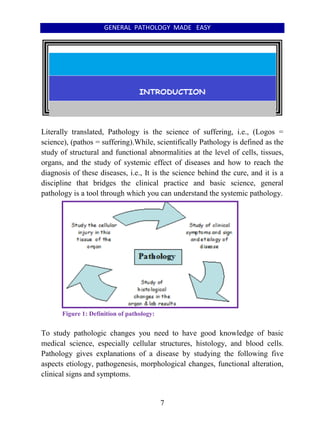
Literally translated, Pathology is the science of suffering, i.e., (Logos =
science), (pathos = suffering).While, scientifically Pathology is defined as the
study of structural and functional abnormalities at the level of cells, tissues,
organs, and the study of systemic effect of diseases and how to reach the
diagnosis of these diseases, i.e., It is the science behind the cure, and it is a
discipline that bridges the clinical practice and basic science, general
pathology is a tool through which you can understand the systemic pathology.
Figure 1: Definition of pathology:
To study pathologic changes you need to have good knowledge of basic
medical science, especially cellular structures, histology, and blood cells.
Pathology gives explanations of a disease by studying the following five
aspects etiology, pathogenesis, morphological changes, functional alteration,
clinical signs and symptoms.
GENERAL PATHOLOGY MADE EASY
8
Etiology: Etiology of a disease means the cause of the disease, if the cause is
known, it may be of primary or secondary type, when the cause is unknown it
is called idiopathic etiology. Additionally, there is another category, genetic
or acquired etiology (infectious, nutritional, chemical, physical, etc., are
acquired types).
Pathogenesis: Means the mechanism through which the disease and
pathological and clinical manifestations take place.
Morphological Changes: The morphological changes refer to the structural
alterations at the level of cells, tissues, and organs of the whole body. Which
occur following the mechanisms. Those changes seen by the naked eyes are
called gross changes or macroscopic findings & those seen under the
microscope are called microscopic changes. Both the gross & the microscopic
morphological changes may be specific to that disease or non-specific ones.
Therefore, these morphological changes must be detected by the pathologist
for the final diagnosis the diseases, then the treating doctor can choose the
proper way of treatment accordingly. In addition, the morphological changes
will lead to functional alterations to produce the clinical signs &symptoms of
the disease. The morphologic changes in the organ influence the normal
functions of that organ, by doing so; they determine the clinical features
(symptoms and signs), course, and prognosis of the disease. In summary,
pathology studies: etiology, pathogenesis, morphological changes, clinical
features, diagnosis and prognosis of all diseases.
GENERAL PATHOLOGYMADE EASY
GENERAL PATHOLOGY MADE EASY
9
CELLINJURY
Homeostasis (Steady State): Normal cell is confined to a relatively narrow
range of functions and structures by its genetic reprogramming to handle
normal physiologic demands. The cells react to an adverse influence by:
Adaption (new homeostasis)
Reversible cell injury
Irreversible cellular injury-leading to cell death
Causes of Cell Injury:
1-Hypoxia: Decrease of oxygen supply, it is the most common cause of cell
injury, occurs usually as a result of ischemia (loss of blood supply), which
occur s for example, when arterial wall develop atherosclerosis or thrombotic
occlusion of arteries. The most common cause of hypoxia is due to
inadequate oxygenation, for example in cardio respiratory failure, anemia or
after poisoning with carbon monoxide (CO).
2-Chemical Agent: The list of chemicals that may cause cell and tissue
injury includes:
Poisons (arsenic, cyanide, mercuric salts... etc.)
Air pollutants
Insecticides and herbicides.NERAL PATHOLOGYMADE EASY
Alcohol, narcotic drugs
Variety of therapeutic drugs and even oxygen in high concentrations.
3-Physical Agent: Many forms of physical energy can give rise to cell and
tissue injury, such as mechanical trauma, extremes of temperature, sudden
changes in atmospheric pressure, electromagnetic energy, radiation and
electric shock, the most important and frequently in clinical practice are
GENERAL PATHOLOGY MADE EASY
10
mechanical forces (car accidents), changes in atmospheric pressure and
hypothermia are relatively uncommon causes of injury, but hyperthermia
(burns) is encountered more often, radiation injury, also have assumed
importance as potential causes of injuries.
3-Infectious Agent: Viral, bacterial, fungal and parasitic infections
4-Immunological Agent: Loss of self-tolerance (Autoimmune diseases),
antigen antibody precipitate, and atopic allergy.
5-Genetic Defect: Like sickle cell anemia, Down’s syndrome, etc.
6-Intracellular Substance Accumulation: Deposition and accumulation due
to excess of substances like pigments, fat, protein... etc.
7-Nutritional Imbalances: Nutritional deficiency continues to be a major
cause of cell injury. Protein-calorie deficiencies- chiefly among
underprivileged population deficiencies of specific vitamins, nutritional
excesses have become important in cell injury among over privileged
population (excess in lipids-predispose to: atherosclerosis, obesity, diabetes
mellitus).
Figure 2: Outcome of cell injury
GENERAL PATHOLOGY MADE EASY
11
Mechanisms of Cell InjuryENERAL PATHOLOGYMADE
Hypoxia &ATP Depletion: hypoxia resulted in abnormal metabolism
associated with the following changes:
Reduce phosphorylation hence ATP.
Increase anaerobic glycolysis.
Increase lactic acidosis.
Decrease pH (cellular acidosis).
The sequel of the above mention disorders include clumping of chromatin,
loss of ribosome, and intracellular influx of water
Y
Figure 3: Reduce ATP in cell injury
Formation of Free Radicals: Like superoxide O-
3, hydrogen peroxide H2O2,
hydroxile group OH-
those lead to damage
of cell membranes with loss of Na, K, and influx of Ca++, energy dependent
sodium pump slows down. The normal activity of the sodium pump keeps the
intracellular concentration of potassium (K+) significantly high. Failure of
active transport through the cell membrane causes accumulation of sodium
(Na+) and water within the cell, and potassium out of the cell.
GENERAL PATHOLOGY MADE EASY
12
Increase of intracellular calcium: Release of Free (ca++) from intracellular
stores with activation of different enzymes
GENERAL PATHOLOGYMADE EASY
Figure 4: Increase cyopalsmic calcium in cell injury
Outcome of Cell Injury
 Recovery of Cells: In cases of reversible injuries, restoring full
structure and functions may take place.
 Cell Adaptation: includes atrophy, hyper trophy, hyperplasia, and
metaplasia.
 Cell Death: Occur s by necrosis or apoptosis in cases of irreversible
cell injury.
 Inflammation: Occur s after cell death and necrosis in acute and
chronic forms
 Tissue Repair: Include cell regeneration and fibrosis, after
inflammation to fill the gap.
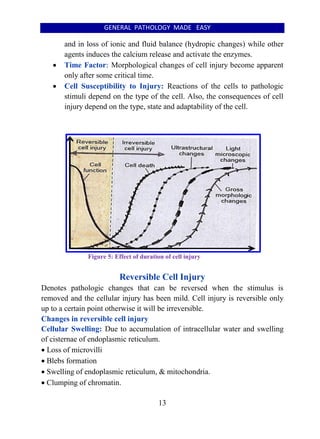
Morphological Changes in Cell Injury: The effect of injury depends on the
type, duration, and severity of injury, thus short ischemia may induce
reversible injury, while more prolonged ischemia might lead either to slow,
irreversible injury, ultra structural changes, light microscopic or gross
changes and ultimately cell death. The following factors influence the
severity of injury, hence the reversibility.
 Type of Injurious Agent: For example hypoxia results in impairment
of aerobic respiration, disrupts the energy-dependent sodium pump
GENERAL PATHOLOGY MADE EASY
13
and in loss of ionic and fluid balance (hydropic changes) while other
agents induces the calcium release and activate the enzymes.
 Time Factor: Morphological changes of cell injury become apparent
only after some critical time.
 Cell Susceptibility to Injury: Reactions of the cells to pathologic
stimuli depend on the type of the cell. Also, the consequences of cell
injury depend on the type, state and adaptability of the cell.
GENERAL PATHOLOGYMADE EASY
Figure 5: Effect of duration of cell injury
Reversible Cell Injury
Denotes pathologic changes that can be reversed when the stimulus is
removed and the cellular injury has been mild. Cell injury is reversible only
up to a certain point otherwise it will be irreversible.
Changes in reversible cell injury
Cellular Swelling: Due to accumulation of intracellular water and swelling
of cisternae of endoplasmic reticulum.
Loss of microvilli
Blebs formation
Swelling of endoplasmic reticulum, & mitochondria.
Clumping of chromatin.
GENERAL PATHOLOGY MADE EASY
14
All the above mentioned changes are only reversible if oxygenation is
restored.
GENERA L
Figure 6: Reversible changes in cell injury
PATHOLOGYMADE EASY
Irreversible Cell Injury
Denotes pathologic changes that are permanent and cause cell death, they
cannot be reversed to normal state. For example, if the blood supply to the
heart muscles is cut off for 10-15 minutes, the myocardial cells experience
injury but it can recover to normal function. However, if the blood flow is cut
off for longer period the myocardial fiber dies and necrosis occur. Irreversible
injury is marked by severe mitochondrial vacuolization and density
formation, extensive damage to plasma membranes, detachment of ribosomes
from the granular endoplasmic reticulum (ER). Injury to lysosomal bodies
leads to leakage of lysosomal enzymes into the cytoplasm. There is no
universal agreed biochemical point of no return
GENERAL PATHOLOGY MADE EASY
15
GENERAL P ATHOE
Figure7: Irreversible changes in cell injury
EASY
Events in Irreversible Cell Injury:
 ATP Depletion: As a result of mitochondrial dysfunction (lack of
oxidative phosphorylation), ATP is depleted and production of energy
is reduced
 Cell Membrane Damage: The earliest phase of irreversible injury is
associated with functional and structural defects in cell membranes,
great deal of evidence indicates that cell membrane damage is a
central factor in the pathogenesis of irreversible injury, intact cell
membranes are essential to the maintenance of normal cell
permeability and volume, loss of membrane integrity causes massive
influx of calcium from the extracellular space, resulting in
mitochondrial dysfunction, activation of intracellular enzymes, and
denaturation of proteins.
Ischemia-Reperfusion Injury: In reversible injury due to ischemia, the
restoration of blood flow can result in cell recovery. However, under certain
circumstances, the restoration of blood flow to ischemic but otherwise viable
tissues results paradoxically in exacerbating and accelerated injury. As a
result, tissues sustain the loss of cells in addition to those that are irreversibly
GENERAL PATHOLOGY MADE EASY
16
damaged at the end of the ischemic episode. This so-called ischemia-
reperfusion injury is a clinically important process that may contribute
significantly to tissue damage in myocardial and cerebral infarctions, several
mechanisms may account for the exacerbation of cell injury resulting from
reperfusion into ischemic tissues: New damage may be initiated during
reoxygenation by increased generation of ROS (reactive oxygen species)
from parenchymal and endothelial cells and from infiltrating leukocytes.
When the supply of oxygen is increased, there may be a corresponding
increase in the production of ROS, especially, because mitochondrial damage
leads to reduction of oxygen, and because of the action of oxidases in
leukocytes, endothelial cells, or parenchymal cells, cellular antioxidant
defense mechanisms may also be compromised by ischemia. Ischemic injury
is associated with inflammation, which may increase with reperfusion
because of the increased influx of leukocytes and plasma proteins. The
products of activated leukocytes may cause additional tissue injury; activation
of the complement system may also contribute to ischemia-reperfusion injury.
Some antibodies have a propensity to deposit in ischemic tissues for unknown
reasons, and when blood flow is resumed, complement proteins bind to the
deposited antibodies, are activated, and exacerbate the cell injury and
inflammation.
Sub-cellular Alteration in Irreversible Cell Injury
Effects of injurious agents on organelles and cellular components varies,
some forms of cell injury affect particular organelles and have unique
manifestations, e.g.
 Autophagy: In nutritional deprivation, cellular organelles are
enclosed in dead vacuoles that fuse with lysosomes, the organelles are
digested but in some cases indigestible remnants form a pigment
called lipofuscin, autophagy is thought to be a survival mechanism in
times of nutrient deprivation, such that the starved cell lives by eating
its own contents, in this process, intracellular organelles and portions
of cytosol are first sequestered from the cytoplasm in an autophagic
vacuole formed from ribosome-free regions of the rough endoplasmic
reticulum (RER). The vacuole fuses with lysosomes to form an
autophagolysosome, and the cellular components are digested by
lysosomal enzymes.
GENERAL PATHOLOGY MADE EASY
17
Figure 8: Autophagy
 Hypertrophy of Smooth Endoplasmic Reticulum: Cells exposed to
toxins that are metabolized in the smooth endoplasmic reticulum
(SER) show hyper trophy of the ER, a compensatory mechanism to
maximize removal of the toxins especially in the liver .
 Mitochondrial Alterations: Changes in the number, size, and shape
of mitochondria are seen in diver se adaptations and responses to
chronic injury.
 Cytoskeletal Alterations: Some drugs and toxins interfere with the
assembly and functions of cytoskeletal filaments or result in abnormal
accumulations of filaments.
Intracellular Accumulation of Substances: Intracellular accumulations of
abnormal substances are known causes of cell injury associated with
pathological changes in the affected organ, as seen in the following
examples.ADE EASY
1-Accumulation of Protein: Occurs in cases of alpha1 antitrypsin
deficiency, and mallary bodies in alcoholic liver disease
2-Fatty Changes: in this change cells have been damaged and become
unable to metabolize fat adequately, small vacuoles of fat accumulate and
become dispersed within the cytoplasm, mild fatty change may have no effect
GENERAL PATHOLOGY MADE EASY
18
on cell function; however more severe fatty change can impair cellular
function. In the liver. The enlargement of hepatocytes due to fatty change
may compress adjacent bile canaliculi, leading to cholestasis. Depending on
the cause and severity of the lipid accumulation, fatty change is generally
reversible. Accumulation of fat within the cells of the liver, hearts, muscles,
and kidneys, occur s in cases of malnutrition, obesity, DM, alcohol abuse, and
CCl4 poisoning.
3-Glycogen Accumulation: Occur s in cases of glycogen storage diseases
4-Pigment Accumulation: Pigments are colored substances that are either
indigenous (melanin, lipofuscin, heamochromatosis), or exogenous pigments
like carbon, asbestoses…etc.
 Exogenous Pigment: The most common exogenous pigment is
carbon from coal dust, and air pollutant of urban life. When inhaled it
is phagocytosed by alveolar macrophages and transported through
lymphatic channels causing anthracosis or coal workers ’
pneumoconiosis.
 Endogenous Pigments: Include lipofuscin, melanin, and
haemosiderin. Lipofuscin: “wear -and-tear pigment,”is an insoluble
brown to yellow granular intracellular material that accumulates in a
variety of tissues (pa ticularly the heart, liver , and brain) as a sign of
age and atrophy. It is not injurious to the cell, but is important as a
marker of past free-radical injury, the brown pigment when present in
large amounts are called brown atrophy. Melanin: This is an
endogenous, brown-black pigment produced in melanocytes and acts
as a screen against harmful ultraviolet radiation, adjacent basal
keratinocytes in the skin can accumulate the pigment, as can dermal
macrophages. Haemosiderin: this is a hemoglobin-derived granular
pigment that is golden yellow to brown and accumulates in tissues
when there is a local or a systemic excess of iron, more extensive
accumulations of iron are seen in hereditary haemochromatosis with
tissue injury including liver , heart fibrosis, and diabetes mellitus.
GENERAL PATHOLOGY MADE EASY
19
CALCIFICATION
Definition: Intracellular or extra-cellar deposition of calcium salts in an
organ or a tissue, it can be metastatic or dystrophic calcification.
Dystrophic Calcifications: This is a common pathologic process in a wide
variety of disease states; it implies the abnormal deposition of calcium salts,
together with smaller amounts of iron, magnesium, and other minerals. When
the deposition occur s in dead or dying tissue called dystrophic calcification;
it occur s in the absence of calcium metabolic disorders (i.e., with normal
serum levels of calcium), in contrast, the deposition of calcium salts in
normal tissues is known as metastatic calcification and almost always reflects
some derangement in calcium metabolism (hypocalcaemia). It should be
noted that while hypocalcaemia is not a prerequisite for dystrophic
calcification, it can exacerbate it. The main differences between the two types
are shown in the table below.
Table 1: Comparison between dystrophies and metastatic calcification
Character Dystrophic calcification Metastatic calcifications
Type of tissue In dead tissues In living, healthy tissues
Ca++ level Normal level High level
Site of deposition Areas of necrosis
(Atheroma, granuloma, etc.)
Intracellular or extra-
cellular
Healthy tissues, kidney, heart,
lung,
Intracellular or extra-cellular
GENERAL PATHOLOGYMADE EASY
Histologically, calcification appears as intracellular and/or extracellular
basophilic deposits. Sometimes, bone formation may be found in a focus of
calcification. etastatic calcification can occur widely throughout the body, but
principally affects the interstitial tissues of the vasculature, kidneys, lungs,
and gastric mucosa. Extensive calcifications in the lungs may produce
remarkable radiographs and respiratory deficits, and massive deposits in the
kidney (nephrocalcinosis) can cause renal damage.
GENERAL PATHOLOGY MADE EASY
20
AMYLOIDOSIS
Definition: Amyloidosis refers s to the extracellular deposition of fibrillary
misfolded proteins in various organs.
Figure 9: Misfolded protein and Amyloid
Pathogenesis: It is associated with miss-folding of proteins, which are
deposited as fibrils in extracellular tissues and interfere with normal function
of tissues and organs; it is either due to normal protein that is produced in
excess amount or mutant proteins that are prone to misfolding.
GENERAL PATHOLOGYMADE EASY
Figure10: Formation of fibril and deposition intravascular
GENERAL PATHOLOGY MADE EASY
21
Classification of Amyloidosis: According to the type of fibril amyloidosis is
categorized into the following subtypes
1-AL (Amyloid Light Chain Protein): Define as fibrils from light chains
produced by plasma cells, and are made up of complete immunoglobulin light
chains, amino-terminal fragments of light chains, or both of them. It is
associated with proliferation of plasma cells in multiple myeloma or any
monoclonal proliferation of B lymphocyte.
2-AA (Amyloid-Associated Proteins): Fibrils derived from a serum
precursor called SAA (serum amyloid-associated protein) that is synthesized
in the liver during inflammation; thus, long-standing inflammation leads to
elevated SAA levels, and ultimately the AA form of amyloid deposits.
GENERAL PATHOLOGYMADE EASY
Table 2: Showed type of Amyloid fibril and its clinical association
Clinical types Associated condition Amyloid
Fibril
Primary or
Secondary
Multiple myeloma AL
Secondary Chronic inflammatory
disease,
Rheumatoid arthritis
,TB, skin, and lung
abscesses
AA
Secondary Cancer, Hodgkin's disease AA
3-Other Rare Types of Amyloidosis:
 ATTR (Amyloid Transthyretin Protein): Transthyretin protein is a
product of a mutation in the liver, occurs as familial or none familial
type, and may alter its structure, making the protein resistant to
proteolysis, this leads to the formation of aggregates that deposit as
amyloid.
 A β 2M (Amyloid β 2 – Microglobulin): β 2-microglubuline is a
component of MHC class I molecules, this type of amyloidosis is
associated with long-term hemodialysis. There are other types of
GENERAL PATHOLOGY MADE EASY
22
abnormal proteins depsited in the body like A β (amyloid beta
protein), associated with Alzhemer disease, and deposited in the wall
of the cerebral blood vessels.
Clinical Classification of Amyloidosis: Amyloid may be systemic
(generalized), involving several organs, or localized when deposits are limited
to a single organ such as the heart, kidney...etc., clinically the systemic type is
classified to primary and secondary:
 Primary Amyloidosis: It is of the AL type, in some cases, there is a
readily identifiable monoclonal plasma cell proliferation .
 Secondary Amyloidosis: Usually reactive and made of AA protein
and it is secondary to chronic inflammatory conditions . E.g.
tuberculosis, bronchiectasis, and chronic osteomyelitis and some
malignant disease, e.g. renalcell carcinoma and Hodgkin's lymphoma.
 Familial (Hereditary) Amyloidosis : It is associated with familial
Mediterranean fever , which is due to mutation of pyrogens, results in
persistent inflammation and fever .
 Endocrine Amyloid: It occur s in patient suffering from endocrine
tumour s e.g., medullary carcinoma, islet tumours of the pancreas,
pheochromocytomas, and undifferentiated carcinomas of the stomach,
as well as in patients with type II diabetes mellitus.
 Amyloid of Aging (Senile Cardiac Amyloidosis ) : It is seen in
elderly per sons usually causing restrictive cardiomyopathy and
arrhythmias.
Clinical Course of Amyloidosis: Most of the patients have no apparent
clinical manifestations, only presenting with nonspecific complaints such as
weakness, fatigue, and weight loss, later on it may present with
organomagally, e.g., hepatomegaly, splenomegaly, macroglossia, cardiac
abnormalities, and renal involvement, giving rise to nephritic syndrome and
renal failure. Hepato-splenomegaly rarely causes significant clinical
dysfunction, cardiac amyloidosis may manifest as conduction disturbances
(cardiac arrhythmias) or as restrictive cardiomyopathy.
GENERAL PATHOLOGYMADE EASY
GENERAL PATHOLOGY MADE EASY
23
Figure 11: Clinical presentation of amyloidosis
Microscopic Findings: On histological examination, the amyloid deposition
is always extracellular between cells. The histological diagnosis of amyloid is
based almost entirely on its staining characteristics. The most commonly used
stain is Congo red, which stains the amyloid deposits in pink or red color,
under polarized light the Congo red stain amyloid shows so called apple
green birefringence. Confirmation can be obtained by electron microscopy
and immunohistochemistry.
Organic Changes in Amyliodosis
Kidney: The kidney may be abnormally large, pale, grey, and firm; in long-
standing cases, kidney may be reduced in size. Microscopically, the amyloid
deposits is found principally in the glomeruli, but also present in the
interstitial peritubular tissue as well as in the walls of the blood vessels, the
glomeruli first develops focal deposits within the mesangial matrix, diffuse or
nodular thickenings of the basement membranes of the capillary loops, with
progression, the deposition encroaches on the capillary lumen and eventually
leads to total obliteration of the vascular tuft. The interstitial peritubular
deposits frequently are associated with the appearance of amorphous pink
casts within the tubular lumens, presumably of a proteinaceous nature.
Amyloid deposits may develop in the walls of blood vessels of all sizes, often
causing marked vascular narrowing.
GENERAL PATHOLOGY MADE EASY
24
Spleen: Amyloidosis of the spleen often causes moderate or even marked
enlargement. For obscure reasons, either of the following two patterns may
develop:
 the deposits may be limited to the splenic follicles, producing tapioca-
like granules on gross examination (“sago spleen”),
 the amyloidosis may principally involve the splenic sinuses,
eventually extending to the splenic pulp, with formation of large
sheet-like deposits (“lardaceous spleen”).
In both patterns, the spleen is firm in consistency; the presence of blood in
splenic sinuses imparts a reddish color to the waxy friable deposits.
Liver: Amyloidosis of the liver may cause massive enlargement, in such
advanced cases the liver is extremely pale, grayish, and waxy on both the
external surface and the cut section. Histological analysis shows that amyloid
deposits firstly appears in the space and then Progressively enlarge to
encroach on the adjacent hepatic parenchyma and sinusoids, the trapped liver
cells undergo compression atrophy and are eventually replaced by sheets of
amyloid; remarkably, normal liver function may be preserved even in the
setting of severe involvement.
Heart: Amyloid deposits may cause minimal to moderate cardiac
enlargement, the most characteristic gross findings are grey-pink, drop-like
subendocardial elevations, particularly in the atria. On histological
examination, deposits typically are found throughout the myocardium,
beginning between myocardial fibers and eventually causing pressure
atrophy.
Other Organs: The adrenals, thyroid, and pituitary are common sites of
involvement, usually without apparent disturbance of function, the
gastrointestinal tract is also a favored site for deposition, amyloid may be
found in various forms, and sometimes producing masses that must be
distinguished from neoplasm, nodular depositions in the tongue may produce
macroglossia. On the basis of the frequent involvement of the gastrointestinal
tract, gingival, intestinal, and rectal biopsies serve in the diagnosis of
suspected cases. Deposition of β 2-microglobulin amyloid in patients
receiving long-term dialysis occur s most commonly in the carpal ligaments
of the wrist.
GENERAL PATHOLOGY MADE EASY
25
CELL DEATH
It is a loss of biological activities and architecture of the cell as a result of
irreversible injury; death is one of the most crucial events in the evolution of
disease in any tissues or organs.
Two Types of Cell Deaths: Necrosis and apoptosis, which differ in their
morphology, physiology, mechanisms, and roles in diseases.
NECROSIS
Definition: Necrosis is the death of a group of cell in a living tissue and
complete lyses of these cells by their own enzymes (autolysis) or other
enzymes from recruited inflammatory cells, like neutrophils,
macrophages,..etc. (heterolysis). Necrosis is the major pathway of cell death
in many commonly encountered injuries, such as those resulting from
ischemia, exposure to toxins, various infections, and trauma. The term
necrosis was first used by morphologists referring to a series of changes that
accompany cell death, largely resulting from the degrading action of enzymes
in lethally injured cells. Necrotic cells are unable to maintain membrane
integrity, and their contents often leak out.
Microscopic Findings: The necrotic cells show increased eosinophilia (i.e.,
pink staining from the eosin dye, the “E”in “H&E”). This is attributable in
part to increased binding of eosin to denatured cytoplasmic proteins and in
part to loss of the basophilia that is normally imparted by the ribonucleic acid
(RNA) in the cytoplasm (basophilia is the blue staining from the hematoxylin
dye, the “H”in “H&E”). When enzymes have digested the cytoplasmic
organelles, the cytoplasm becomes vacuolated and appears moth-eaten. Dead
cells may be replaced by large, whorled phospholipid masses, called myelin
figures that are derived from damaged cell membranes. They are thought to
result from dissociation of lipoproteins and calcification of fatty acid residues
results in the generation of calcium soaps, thus, the dead cells may ultimately
become calcified. On electron microscopy necrotic cells are characterized by
discontinuities in cytoplasmic and organelle membranes, marked dilation of
mitochondria with the appearance of large amorphous densities, disruption of
lysosomes, intracytoplasmic myelin figures, and profound nuclear changes
culminating in nuclear dissolution.YMADE EASY
GENERAL PATHOLOGY MADE EASY
26
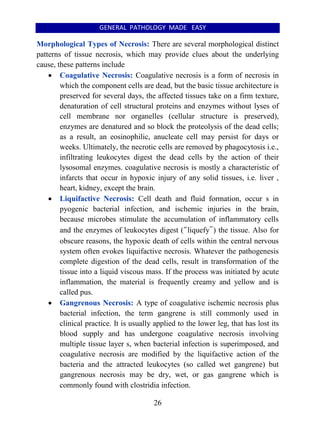
Morphological Types of Necrosis: There are several morphological distinct
patterns of tissue necrosis, which may provide clues about the underlying
cause, these patterns include
 Coagulative Necrosis: Coagulative necrosis is a form of necrosis in
which the component cells are dead, but the basic tissue architecture is
preserved for several days, the affected tissues take on a firm texture,
denaturation of cell structural proteins and enzymes without lyses of
cell membrane nor organelles (cellular structure is preserved),
enzymes are denatured and so block the proteolysis of the dead cells;
as a result, an eosinophilic, anucleate cell may persist for days or
weeks. Ultimately, the necrotic cells are removed by phagocytosis i.e.,
infiltrating leukocytes digest the dead cells by the action of their
lysosomal enzymes. coagulative necrosis is mostly a characteristic of
infarcts that occur in hypoxic injury of any solid tissues, i.e. liver ,
heart, kidney, except the brain.
 Liquifactive Necrosis: Cell death and fluid formation, occur s in
pyogenic bacterial infection, and ischemic injuries in the brain,
because microbes stimulate the accumulation of inflammatory cells
and the enzymes of leukocytes digest (“liquefy”) the tissue. Also for
obscure reasons, the hypoxic death of cells within the central nervous
system often evokes liquifactive necrosis. Whatever the pathogenesis
complete digestion of the dead cells, result in transformation of the
tissue into a liquid viscous mass. If the process was initiated by acute
inflammation, the material is frequently creamy and yellow and is
called pus.
 Gangrenous Necrosis: A type of coagulative ischemic necrosis plus
bacterial infection, the term gangrene is still commonly used in
clinical practice. It is usually applied to the lower leg, that has lost its
blood supply and has undergone coagulative necrosis involving
multiple tissue layer s, when bacterial infection is superimposed, and
coagulative necrosis are modified by the liquifactive action of the
bacteria and the attracted leukocytes (so called wet gangrene) but
gangrenous necrosis may be dry, wet, or gas gangrene which is
commonly found with clostridia infection.EASY
GENERAL PATHOLOGY MADE EASY
27
 Caseous Necrosis: Caseous necrosis is encountered most often in foci
of tuberculous infection. The term “Caseous”(cheese like) is derived
from the friable yellow-white appearance of the area of necrosis. On
microsco ic examination, the necrotic focus appears as a collect ion of
fragmented or lost cells with an amorphous granular appearance,
unlike coagulative necrosis, the tissue architecture is completely
obliterated and cellular outlines cannot be seen. Caseous necrosis is
often enclosed within a distinctive inflammatory border; this
characteristic is known as a granuloma.
 Fat Necrosis: Occur s in fatty tissues in cases of acute pancreatitis
and breast trauma, Fat necrosis, commonly found in an areas of fat
destruction, typically results from release of activated pancreatic
lipases into the tissues of the pancreas and the peritoneal cavity, this
occurs in an emergency case known as acute pancreatitis, in this
disorder, pancreatic enzymes that have leaked out of acinar cells and
ducts liquefy the membranes of fat cells in the peritoneum, and lipases
split the triglyceride ester s contained within fat cells, the released
fatty acids combine with calcium to produce grossly visible chalky
white areas (fat saponification), which enable the surgeon and the
pathologist to identify the lesions by the naked eyes. On histological
examination, the foci of necrosis contain shadowy outlines of necrotic
fat cells with basophilic calcium deposits, surrounded by an
inflammatory reaction.
 Fibrinoid Necrosis: This is a special form of necrosis usually seen in
immune reactions involving the blood vessels. This pattern of necrosis
is prominent when complexes of antigens and antibodies are deposited
in the walls of arteries.Deposits of these “ immune complexes,
"together with fibrin that has leaked out of vessels, resulted in a bright
pink and amorphous appearance in H&E stains, called “fibrinoid ”
(fibrin-like) by pathologists in immunologically mediated diseases
(e.g., polyarteritis nodosa).
Mechanisms of Necrosis: In irreversible cell injury the following steps take
place::HOLOGYMADE
GENERAL PATHOLOGY MADE EASY
28
 ATP Depletion And Mitochondrial Damage: ATP depletion →
failure of energy-dependent functions → irreversible injury →
necrosis and leakage of proteins.
 Calcium Release: Influx of calcium from intracellular stores leads to
activation of enzymes that damage cellular components and may also
trigger further enzyme activation and rapture of lysomes .
 Accumulation of Reactive Oxygen Species : Oxygen free radicals
result in covalent bonds modification of cellular proteins, lipids,
nucleic acids.
 Increased Permeability of Cellular Membranes: This may affect
cytoplasmic, lysosomal, and mitochondrial membranes; typically
culminates in necrosis by letting substances freely move in and out of
the cell.
Morphological Recognition of Necrosis: Necrosis can be detected in H&E
stains by the following findings,
 Cytoplasm Eosinophilia: Redness of the cytoplasm in H&E stains
due to release of RNA from the nucleus.
 Karyolysis : Dissolution of nuclear chromatin.
 Karyorrhexis: Fragmentation of nuclear chromatin.
 Pyknosis: Condensation of nuclear chromatin.
Fate of Necrosis (Outcome) The final outcome of necrosis after an
inflammatory period may be one of the followings,
 Resolution: Restoring of normal tissue function and structure.
 Organization: Replacement of the necrotic tissue by granulation
tissue and fibrosis
 Calcification: Dystrophic calcification due to precipitation of calcium
salts.
APOPTOSIS
Definition: literally apoptosis means falling off something, for example
(leaves of the trees), while scientifically means programmed cell death,
affecting a single or small group of cells, as a result of signal transduction of
specific genes. Apoptosis is an active process that needs energy; it is a tightly
regulated type of cell death that is seen in some specific situations. Whereas
necrosis is always a pathological process, apoptosis serves many normal
GENERAL PATHOLOGY MADE EASY
29
functions and is not necessarily associated with pathological cell injury, and
the dying cells are scattered throughout the tissue. Apoptosis is a process of
self destruction, in which the cells shrink as a result of the decrease of
cytosol, organelles, and the nucleus is fragmented into small parts without
loss of membrane, some organelles are lysed and repelled outside the cells,
and the cell disintegrates into fragments refer red to as apoptotic bodies. In
the average adult between 50 and 70 billion cells die each day by apoptosis.
Inhibition of apoptosis can result in a number of cancers, autoimmune
diseases, inflammatory diseases, whilst hyperactive apoptosis can lead to
neurodegenerative diseases, marrow aplasia, and skin disease.
Figure 13: Cartoons describe s mechanism of apoptosis
Mechanisms of Apoptosis: Signal transductions from a specific gene
(apoptotic gene) is started as a result of withdrawal of specific growth factor
s, the second step is activation of internal enzyme like nuclease, protease,
endonucleases, which lyses and repel out of some cellular organelle, the third
step is reduction of cell size and loss of the biological activities of this cell
forming multiple apoptotic bodies (dead bodies), there is no complete lyses of
cells, and there are two pathways for initiation of apoptosis, as described
below:
 Mitochondrial ( Intrinsic) Pathway: This pathway is triggered by a
loss of survival signals, DNA damage, accumulation of miss-folded
proteins, and endoplasmic reticulum stress and associated with
leakage of pro-apoptotic proteins from the mitochondrial membrane
GENERAL PATHOLOGY MADE EASY
30
into the cytoplasm, where they trigger caspase that used to be
inhibited by antiapoptotic member s of the BCl family.
 Death Receptors (Extrinsic) Pathway: This pathway is responsible
for elimination of self-reactive lymphocytes and damage by cytotoxic
T lymphocytes, it is initiated by engagement of death receptor s
(member s of the TNF receptor family) by the legends on adjacent
cells, apoptosis is divided into two types
Physiological Apoptosis: Occurs in a number of situations, it involves
normal tissue turnover, in hormone-induced atrophy i.e., endometrium during
menstrual cycle, mammary gland in menopause, in the aging process, and in
developing tissues (embryogenesis).
Pathological Apoptosis: Occurs in pathologic stimuli such as viral infection
example Councilman bodies in liver cells in viral hepatitis is an apoptotic
body, tumor regression induced by chemotherapy are probably the most
interesting aspect is spontaneous occurrence of apoptosis in solid tumor s of
various types which is now being studied very intensively, particularly,
involvement of apoptosis in tumor growth, and regression in radiation
exposure.
GENERAL PATHO
LOGYMADE
EASY
Figure 14: Mechanism of apoptosis in three steps
GENERAL PATHOLOGY MADE EASY
31
Morphological Recognition of Apoptosis:
The cell appears in (H and E) stains as a round, oval mass with eosinophilic
cytoplasm.
Figure 12: Necrosis and apoptosis (should come after necrosis & apoptosis)
Table 3: Comparison between apoptosis and necrosis
Features Apoptosis Necrosis
Energy(ATP)
Needed ( active
process)
Not needed (passive
process)
Type of control Genetic (apoptotic
gene)
No gene control
Lyses of cells Not found, only
reduction in cell size
Complete lyses of cell may
occur
Tissue reaction No inflammation
around dead tissue
Inflammatory cells, around
the dead tissue
Type of stimuli Physiological or
pathology stimuli
Pathologic stimuli only
Number of cells Single or small groups Large groups of cells
GENERAL PATHOLOGY MADE EASY
32
CELLUL AGING
Agingis a process that results from the following factors.
 Accumulation of DNA Damage: Defective DNA repair mechanisms
result in accumulation of damage caused by free radicals over a
prolonged period of time.
 Replicative Senescence: Reduced ability of cells to divide because of
decreasing amount of telomerase and progressive shortening of
chromosomal ends (telomeres).
 Other Factors: Progressive and accumulative metabolic damage by
specific growth factors that promote aging process.
CELLULAR ADAPTATION
Definition: Morphological and functional changes associated with sustained
cell injury, adaptations are reversible changes in the number, size, phenotype,
metabolic activity, and functions of cells in a response to environmental
changes. Physiological adaptations usually represent responses of cells to
normal stimulation by hormones or endogenous chemical mediator s (e.g., the
hormone-induced enlargement of the breast and uterus during pregnancy).
Pathologic adaptations are responses to stress that allow cells to modulate
their structure and function and thus escape injury.
Types of Cell Adaptation: Include Atrophy, Hypertrophy, Hyperplasia, and
Metaplasia.
ATROPHY
Definition of atrophy is a decrease of cell size due to loss of some cellular
substance (organelles), and reduced biological activities of the cell, (the
number of cells don’t change in atrophy), when a sufficient number of cells is
involved, the entire tissue or organ diminishes in size, and become atrophic. It
should be emphasized that although atrophic cells may have diminished
function, they are not dead. Causes of atrophy include a decreased workload
(e.g., immobilization of a limb to permit healing of a fracture), loss of
innervations, diminished blood supply, inadequate nutrition, loss of endocrine
stimulation, and aging (senile atrophy). Although some of these stimuli are
physiologic (e.g., the loss of hormone stimulation in menopause and
GENERAL PATHOLOGY MADE EASY
33
endometrial atrophy) but others are pathologic (e.g., denervation), the
fundamental cellular changes are identical, they represent retreat of the cell to
a smaller size at which survival is still possible; a new equilibrium is achieved
between cell size and diminished blood supply, nutrition, or tropic
stimulation. Atrophy is resulted from decreased protein synthesis and
increased protein degradation in cells. Protein synthesis decreases because of
reduced metabolic activity, the degradation of cellular protein occurs mainly
by the ubiquitin-proteasome pathway. Nutritional deficiency and disuse of
organ may activate ubiquitin ligases, which attach multiple copies of the
small peptide ubiquitin to cellular proteins and target these proteins for
degradation. This pathway is also thought to be responsible for the
accelerated proteolysis seen in a variety of catabolic conditions, including
cancer cachexia. In many situations, atrophy is also accompanied by
increased autophagy, i.e., increases the number of autophagic vacuoles.
Autophagy (“self-eating”) is the process in which the starved cell eats its own
components in an attempt to find nutrients and survive.
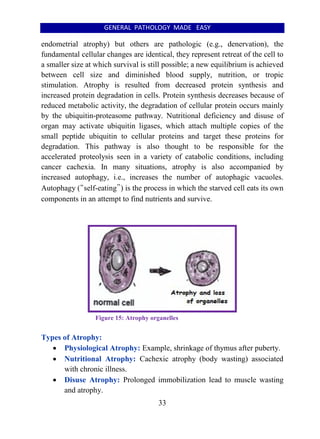
Figure 15: Atrophy organelles
Types of Atrophy:
 Physiological Atrophy: Example, shrinkage of thymus after puberty.
 Nutritional Atrophy: Cachexic atrophy (body wasting) associated
with chronic illness.
 Disuse Atrophy: Prolonged immobilization lead to muscle wasting
and atrophy.
GENERAL PATHOLOGY MADE EASY
34
 Neuropathic Atrophy: Nerve injury lead to atrophy of the specific
organ example lower limbs in poliomyelitis.
 Endocrine atrophy: Example pituitary failure leads to thyroid
atrophy, adrenal atrophy, due to loss of TSH, ACTH.
Mechanism of Atrophy: Mechanism of cell atrophy include decreased
synthesis of structural proteins, increased intracellular catabolism and
decrease of anabolism, release of lysosomal protease and degradation of some
organelles by autophagy, and decrease of biological functions of cell.
Atrophy is different from hypoplasia, hypoplasia means failure of organ to
reach normal size during development (agenesis or dysgenesis), example;
defect in limbs development (Acondroplasia).
HYPERTOPHY & HYPERPLASIA
Hyper trophy is an increase in the size of cells resulting in increase in the
organ size, in contrast, hyperplasia (discussed next) is characterized by an
increase in cell number, in other words, for pure hyper trophy there are no
new cells division, just bigger or larger cells, as a result of increased amount
of structural proteins and organelles. Hyperplasia is an adaptive response in
cells capable of division, whereas hypertrophy occurs when cells are
incapable of division. Hypertrophy can be physiologic or pathologic process
and is caused either by increased functional demand or by specific hormonal
stimulation, Hypertrophy and hyperplasia can also occur together, and
obviously both result in an enlarged organ. Thus, the massive physiologic
enlargement of the uterus during pregnancy occurs as a consequence of
estrogen stimulated smooth muscle hyper trophy and smooth muscle
hyperplasia. In contrast, the striated muscle cells in both the skeletal muscle
and the heart can undergo only hypertrophy in response to increased demand
because in adults they have limited capacity to divide, therefore, the weight
lifter men can develop hypertrophy of skeletal muscle cells induced by an
increased workload. Examples of pathologic cellular hypertrophy include the
cardiac enlargement that occurs with hypertension or aortic valve disease.
The mechanisms driving cardiac hypertrophy involve at least two types of
signals: mechanical triggers, such as stretch, and atrophic triggers, such as
activation of α- adrenergic receptors, these stimuli turn on signal transduction
GENERAL PATHOLOGY MADE EASY
35
pathways that lead to induction of number of genes, which in turn stimulate
synthesis of numerous cellular proteins, including growth factors and
structural proteins, the result is the synthesis of more proteins and
myofilaments per cell, which achieves improved performance and thus a
balance between the demand and the cell’s functional capacity.
Mechanisms of Hypertrophy: Mechanism includes signals affecting specific
genes resulted in
- Increase cellular structural proteins
- Increase the number of the internal organelle
- Increase of the cell size and organ size.
Types of Hyperplasia: As discussed above, hyperplasia takes place if the
cell population is capable of replication; it may occur with hyper trophy and
often in response to the same stimuli, Hyperplasia can be of physiologic or
pathologic origin, example of physiologic hyperplasia includes:
(1) Hormonal hyperplasia, exemplified by the proliferation of the glandular
epithelium of the female breast at puberty, lactation, and during pregnancy.
(2) Compensatory hyperplasia, which occur s when a portion of tissue is
removed or diseased, for example, when a liver is partially resected, or
hyperplasia of nephrones after removal of the other kidney. Pathological
hyperplasia is caused by excessive hormonal or growth factor stimulation, for
example, after a normal menstrual period, there is a burst of uterine epithelial
proliferation that is normally tightly regulated by stimulation through
pituitary hormones and ovarian estrogen and by inhibit ion through
progesterone, however, if the balance between estrogen and progesterone is
disturbed, endometrial hyperplasia ensues, a common cause of abnormal
menstrual bleeding. Hyperplasia is also an important response of connective
tissue cells in wound healing, in which proliferating fibroblasts and blood
vessels aid in repair ; in this process growth factors are produced by white
blood cells (leukocytes) responding to the injury and by cells in the
extracellular matrix, stimulation by growth factors is also involved in
hyperplasia that is associated with certain viral infections; for example,
papilloma viruses cause skin warts and mucosal lesions composed of masses
of hyperplastic epithelium. Here the growth factor s may be produced by the
virus or by infected cells, it is important to note that in all these situations, the
hyperplastic process remains controlled; if hormonal or growth factor
GENERAL PATHOLOGY MADE EASY
36
stimulation abates, the hyperplasia disappears. It is this sensitivity to normal
regulatory control mechanisms that distinguishes benign pathologic
hyperplasia from cancer, in which the growth control mechanisms become
dysregulated or ineffective. Never the less, pathologic hyperplasia constitutes
after tile soil in which cancerous proliferation may eventually arises: thus,
patients with hyperplasia of the endometrium are at increased risk of
developing endometrial cancer, and certain papilloma virus infections
predispose to cervical cancers.
Hyperplasia without Hypertrophy: Occurs as a response to increase
biological demands, for example bone marrow hyperplasia in anemic patients
(compensatory hyperplasia); also in a compensatory mechanism for
nephrectomy, hyperplasia occur s in the normal kidney after removal of the
other one.
Hypertrophy without Hyperplasia: Occurs in Skeletal muscle hyper trophy
in athletes, and manual labor, also in Cardiac muscle hyper trophy in heart
failure (cardiomagally) and in hyper trophy of the smooth muscle of the
stomach in pyloric stenosis.
GENERAL PATHOLOGYMADE EASY
Table 4: Examples of Hyperplasia and Hypertrophy
Hyperplasia &
Hypertrophy
Isolated Hyperplasia Isolated Hypertrophy
-Uterus
during pregnancy
-Erythroid hyperplasia.
-Hyperplasia of the nephrones
of other kidney after
nephrectomy.
-Hyperplasia of the breast
glands during lactation
-Hypertrophy of
skeletal muscle in
athletes.
-Hypertrophy of
cardiac muscle with
increased demands
METAPLASIA
Definition: It is a reversible condition, in which one mature tissue changes
into another mature one, as a response to sustained stress or cell injury.
GENERAL PATHOLOGY MADE EASY
37
GENER AL
PATHOLOGYM
Figure16: Metaplasia of epithelium
In this type of cellular adaptation, cells exposed to a particular stress are
replaced by other types able to withstand the adverse environment.
Metaplasia is thought to arise from genetic “reprogramming" of stem cells
rather than trans-differentiation of already differentiated cells. Epithelial
metaplasia is exemplified by the squamous change that occurs in the
respiratory epithelium in habitual cigarette smoker s, the normal ciliated
columnar epithelial cells of the trachea and bronchi are focally or widely
replaced by stratified squamous epithelial cells. Vitamin A deficiency may
also induce squamous metaplasia in the respiratory epithelium. The “rugged”
stratified squamous epithelium may be able to survive under circumstances
that the more fragile specialized epithelium would not tolerate, although the
metaplastic squamous epithelium has survival advantages, important
protective mechanisms are lost, such as mucus secretion and ciliary clearance
of particulate matter. Epithelial metaplasia is therefore a double-edged sword;
moreover, the influences that induce metaplastic transformation, if persistent,
may predispose to malignant transformation of the epithelium. In a common
form of lung cancer, squamous metaplsia of the respiratory epithelium often
coexists with malignant squamous cells, it is thought that cigarette smoking
initially causes squamous metaplasia, and cancers arise later. Metaplasia not
always occur in the direction of columnar to squamous epithelium; in chronic
gastric reflux, the normal stratified squamous epithelium of the lower
oesophagus may undergo metaplastic transformation to gastric or intestinal
type columnar epithelium. Metaplasia may also occur in mesenchyma cells,
GENERAL PATHOLOGY MADE EASY
38
but less clearly as an adaptive response, for example, bone is occasionally
formed in soft tissues, particularly in foci of injury.
GENERAL PATHOLOGYMADE EASY
Table 5: Metaplasia in different tissues
Mechanisms of Metaplasia: Due to genetic remodeling or reprogramming of
the genes in epithelial stem cell, or mesenchymal stems cell to give a new
tissue.
Complications of Metaplasia: include loss of the functions (for example loss
of secretion in respiratory system), progression to dysplasia, and induction of
pre-cancerous lesions in the lung, bladder…etc.
Original tissue Stimuli Metaplastic tissue
Ciliated columnar
Epithelium of bronchial
tree
Smoking Squamous epithelium
Transitional epithelium
(Bladder)
Stones Squamous epithelium
Columnar
Epithelium (glands duct)
Stones Squamous epithelium
Fibrocollagenous Trauma Bone
Formation
Oesophageal squamous
epithelium
Gastric
Acidity
Columnar
Epithelium (glands duct)
Columnar glandular
epithelium
Vitamin A def Squamous epithelium
GENERAL PATHOLOGY MADE EASY
39
INFLAMMATION
Literally inflammation in Latin means "burnout", scientifically inflammation
is a physiological response to cell injury, associated with cellular, vascular
events and cytokine secretion.
Cardinal Signs of Inflammation: Include the following five characters
Rubor (redness), Color (heat), Dollar (pain), Tumor (swelling), Functio
laesa (loss of function).
1-Redness (Rubor): An acutely inflamed tissue appears red, due to dilatation
of small blood vessels and increase blood supply (hyperemia).
2-Swelling (Tumor): Swelling resulting from accumulation of fluid in the
extravascular space as part of the inflammatory fluid exudates, and to a much
lesser extent, from the physical mass of the inflammatory cells accumulated
in the area.
3-Heat (Color): Increase in temperature is readily detected in the skin; it is
due to increased blood flow (hyperemia) through the region, resulting in
vascular dilation and delivery of warm blood to the area.
4-Pain (Dolor): Pain results partly from the stretching and distortion of
tissues due to inflammatory edema and, in part from some of the chemical
mediators of acute inflammation, especially bradykinin and prostaglandins.
5-Loss of Function (Functio laesa): Loss of function is a well-known
consequence of inflammation, movement of an inflamed organ is inhibited by
pain, either consciously or by reflexes, while severe swelling may physically
immobilize the affected area.
GENERAL PATHOLOGY MADE EASY
40
Figure 17: Cartoon, cardinal signs of inflammation and cellular events
Purpose of the Inflammatory Process: To localize the damage of tissues to
specific area, and to get rid of the cause of injury, in addition to repairing the
damaged area.
General Features of Inflammation: The inflammatory process is redundant
and complex, this makes it a challenging subject to study, you will see several
mediator s of inflammation have the same functions and the same mediator
may have different effects on different tissues, the process is continuous over
a period of time. Preacute, acute, subacute, and chronic are terms used to
describe different stages of inflammation. Inflammation is caused by a
stimulus and removal of the stimulus should result in abatement of
inflammation, if it does not get fixed in the acute period, it becomes chronic
type.
Effects of Inflammation: The effects of inflammation can be both local and
systemic. The systemic effects of acute inflammation include fever, malaise,
and leukocytosis. While the local effects are usually beneficial, for example
the destruction of invading microorganisms, but at other times they appear to
GENERAL PATHOLOGY MADE EASY
41
serve no obvious function, or may even be harmful e.g., swelling and loss of
function
Systemic Effect of Inflammation: Both acute and chronic inflammation,
even if well localized, can have effects on the whole body, which include:
 Leukocytosis: Leukocytosis is a common feature of inflammatory
reactions, leukocytosis means an abnormally high number of
circulating white blood cells, and a general rule is that increased
neutrophils indicate a bacterial infection whereas increased
lymphocytes are most likely to occur in viral infections. This is one
reason why we often do a CBC when as an initial routine test.
 Fever: Fever is a common systemic response to inflammation. Fever
is most often associated with inflammation that has an infectious
cause, although there are some non-infectious ones, fever is produced
by cytokines and interleukins. What is the function of fever? The
elevation of body temperature is thought to improve the efficiency of
leukocyte killing and may also impair the replication of many
invading organisms.
 Increased Acute Phase Reactant& ESR: Both of them are due to
increased level of IL1, IL6, and TNF … etc. and other proteins
produced from the liver in association with inflammation.
 Beneficial Effect of Inflammation: Dilution effect results in removal
and washout of the bacterial toxins through the lymphatic system
away from the inflammatory areas. And promoting the immunity by
enhancing immune response after bringing microorganism to the
adjacent lymph node, in addition inflammatory process provides
antibodies, WBCs to the site of inflammation, also provides different
proteins like fibrinogen, complement system, and nutrition to the sick
cells .
 Harmful Effects of Inflammation:
- Swelling: Swelling is a sign of inflammation which may result in
obstruction of lumen as in acute laryngitis, or increase intracranial
pressure in encephalitis and ischemic injury if obstruction of blood
supply take place.
GENERAL PATHOLOGY MADE EASY
42
- Loss of Organ Function: For example hepatitis (inflammation of
liver ) is associated with impaired liver function tests.
Nomenclature of the Inflamed Tissue: The rule of nomenclature is by
adding the suffix (itis) at the end of the name of the organ or tissue, example:
 Appendix: Appendicitis
 Gastric tissue: Gastritis
 Colon: Colitis
 Mammary tissue: Mastitis
Exceptional Rule: Pulmonary inflammation called pneumonia, pleural
inflammation is called pleurisy...etc.
Classification of Inflammation: Inflammation can be categorized into acute
inflammation, subacute inflammation & chronic inflammation.
Acute Inflammation
Acute inflammation is the type of inflammation, which presents with all
cardinal signs of inflammation within a short period of time (days) and is
associated with neutrophils infiltration.
Clinical Presentations of Acute Inflammation
- Serous Inflammation: Type of inflammation with protein-poor
fluid, example, skin blister resulting from burning.
- Suppurative (Purulent Inflammation): This is a pyeogenic
inflammation and pus formation in the inflamed area.
- Ulcerative Inflammation: Ulcer formation, loss of continuity of
epithelium, in skin or mucous membrane due to inflammatory
tissue damage, example ulcerative colitis, peptic ulcer .
- Boils and Furuncles: Focal skin collect ion of abscess commonly
in hair follicles.
- Pseudo-membranous Inflammation: Following clostridia,
diphtheria infection, characterized by formation of pseudo-
membrane composed of (necrotic tissue + coagulated fibrin +
neutrophils and macrophage + bacteria).
Control of Acute Inflammation: Chemical mediators are the corner stone in
controlling the inflammatory Process. Mediators are substances produced by
inflammatory cell, endothelial cells, WBCs and platelet, and associated with
vascular, cellular, and humeral events.
GENERAL PATHOLOGY MADE EASY
43
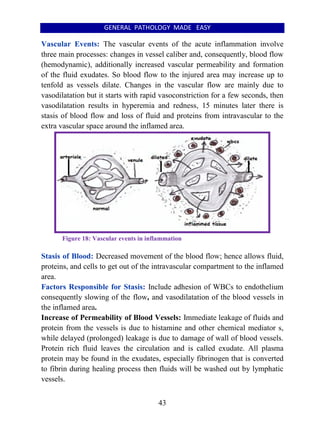
Vascular Events: The vascular events of the acute inflammation involve
three main processes: changes in vessel caliber and, consequently, blood flow
(hemodynamic), additionally increased vascular permeability and formation
of the fluid exudates. So blood flow to the injured area may increase up to
tenfold as vessels dilate. Changes in the vascular flow are mainly due to
vasodilatation but it starts with rapid vasoconstriction for a few seconds, then
vasodilatation results in hyperemia and redness, 15 minutes later there is
stasis of blood flow and loss of fluid and proteins from intravascular to the
extra vascular space around the inflamed area.
Figure 18: Vascular events in inflammation
Stasis of Blood: Decreased movement of the blood flow; hence allows fluid,
proteins, and cells to get out of the intravascular compartment to the inflamed
area.
Factors Responsible for Stasis: Include adhesion of WBCs to endothelium
consequently slowing of the flow, and vasodilatation of the blood vessels in
the inflamed area.
Increase of Permeability of Blood Vessels: Immediate leakage of fluids and
protein from the vessels is due to histamine and other chemical mediator s,
while delayed (prolonged) leakage is due to damage of wall of blood vessels.
Protein rich fluid leaves the circulation and is called exudate. All plasma
protein may be found in the exudates, especially fibrinogen that is converted
to fibrin during healing process then fluids will be washed out by lymphatic
vessels.
GENERAL PATHOLOGY MADE EASY
44
Figure 19: Vascular and cellular events of inflammation
Cellular Events of inflammation
Cells move out of the vessels into the area of inflammation recruited by
chemotactic agents. Inflammatory cells become activated and then can
phagocytosed offending materials, this process occur in steps as follows
1-Margination and Rolling of WBCs: Moving from axial flow to the
margin of the vessels is called margination. Marginated leukocytes begin to
roll on the endothelial surface by forming transient adhesion molecules via
the selectin family of proteins: (E-selectin on endothelial cells, P-selectin on
endothelial cells and platelets, L-selectin on leukocytes). Selectins bind
oligosaccharides that decorate mucin-like glycoproteins. Adhesion to
endothelium occurs via selectins and integrins.
Figure 20: Escape of cell outside vessels
GENERAL PATHOLOGY MADE EASY
45
2-Migration of Leucocytes: Passage of the cells across the wall of blood
vessels, and moved to reach the site of inflammation by the effect of chemical
mediator s gradient (chemotaxis).
3-Chemotaxis: A process resulting from certain products of WBCs, platelets,
and microorganisms, which attracts WBCs towards the inflammation area
according to the high concentration of that substance.
4-Phagocytosis: Define as engulfment and internalization of foreign bodies
(bacteria, viruses, etc.) in the phagosome and digestion of this substance.
Phagocytosis is a process whereby cells ingest solid particles. The first step in
phagocytosis is adhesion of the particle to be phagocytesed to the cell surface.
Then the phagocyte ingests the attached particle by sending out pseudopodia
around it. Then met and fused so that the particle lies in a phagocytic vacuole
(called a phagosome) then bounded to small bodies containing enzymatic
compounds called lysosomes, to form phagolysosomes. In which intracellular
killing of microorganisms occurs. Phagocytic cells include neutrophils,
polymornuclear cells, eosinophils, and monocytes.
Figure 21: Steps of cells migration and phagocytosis
GENERAL PATHOLOGY MADE EASY
46
Humeral Events (Chemical Mediators): These are chemical substances that
are produced locally or systemically, controlling the vascular and cellular
events in acute and chronic inflammation, e.g., increase permeability,
margination, migration, chemotaxis, and phagocytosis…etc.
Characteristics of Mediators: Small substances produced by inflammatory
cells like lymphocyte, macrophages, neutrophils…etc., or produced from the
liver, they act mainly locally on the neighboring cells (paracrine) or on
themselves (autocrine).
Table 6: Inflammatory cells and mediators
Type of cells Mediators
Monocytes No, IL1, TNF, chemotactic factor, Fibrosing factor.
Neutrophils Leukotriens, protease.
Platelets Luekotriens,Thromboxane A2.
Lymphocytes IL1, IL6, INF.
Effects of Mediators: Mediators have several effects associated with
vascular or cellular events as follows:
- Vasoconstriction: Caused by histamine, thromboxane A2,
leukotriens, PAF.
- Vasodilatation: prostaglandins, and nitric oxide.
- Increased Vascular Permeability: Histamine, serotonin,
leukotriens, and bradykinin.
- Chemotaxis: C5a,TNF, IL8.
- Fever: IL1, IL6, TNF, prostaglandin.
- Pain: Prostaglandin, bradykinin.
GENERAL PATHOLOGY MADE EASY
47
Table 7: inflammatory process and the main causing mediator
Effects Main mediator
Vasoconstriction ThromboxaneA2, leukotriens C4, D4, E4.
Vasodilatation Prostaglandin I2, E1, E2, D2.
Increases permeability Leukotriens C4, D4, E4.
Pl atelet adhesion Thromboxane A2.
Pain Prostaglandin E2.
Fever Prostaglandin E2.
IL-1/ TNF: These are considered the most important mediators of acute and
chronic inflammation; both have local and systemic effect the table below
describe their effects in the body:
GENE
RAL PATHOLOGYMADE EASY
Figure 22: Effects of IL-1&TNF (tumors necrosis factor)
Inhibitory cytokines of acute inflammation: These are mediators when
released stop the inflammatory process and followed by resolution and
healing however, if the they are enough the process progress to chronic
inflammation, they include, IL-10, Interferon α, Transforming growth factor
β
GENERAL PATHOLOGY MADE EASY
48
Outcome of Acute Inflammation
Outcome, fate, or subsequent effects of acute inflammation include:
- Resolution: Complete restoration of the structures and functions of
inflamed tissue, for example resolution is what occurs in lobar pneumonia,
after removal of injurious agent. The resolution requires the following steps
to take place:
- Removal of inflammatory exudates, fibrin, and cells,
- Cessation of vascular changes in inflamed tissues,
- Regeneration of lost specialized cells,
- Increase of lymphatic drainage to get rid of all debris (remaining parts of
cells)
- Fibrosis: Occur s in acute inflammation in three situations, in heavy
deposition of fibrin and failure to be removed completely, or if there is a large
amount of tissues necrosis or the tissue cannot regenerate like cardiac, and
CNS tissues and finally when chronic inflammation supervenes on top of
acute inflammation
- Formation of Abscess: Occurs with pyogenic bacteria or fungal infection.
- Developing of Chronic Inflammation: Process continues as chronic
inflammation.
Chronic Inflammation
Definition: Inflammatory reaction over a prolonged period of time i.e.,
months to years, in which active inflammation plus a healing process occur
at a time. This usually proceeded by acute inflammation when the causative
agent is not removed and is characterized by the following changes:
diminished polymorphs cells and presences of macrophages, (epitheliod, and
giant cells), plasma cells, and lymphocytes, in addition to vascular budding
and formation of new capillaries (angiogenesis). Proliferation of fibroblast
and fibrosis (in attempt of healing). Cells in the chronic inflammatory process
tend to produce substances that add new tissue, such as collagen and new
blood vessels, many of these changes also represent the repair process, and
there is a blurry continuum between chronic inflammation and the whole
repair process. In general, chronic inflammation is characterized by tissue
destruction and attempts at repair, all happening at a time.
Comparison Between Acute and Chronic Inflammation: Acute
inflammation occurs during a short period of time, days or weeks, in the
GENERAL PATHOLOGY MADE EASY
49
presence of all cardinal signs of inflammation and infiltration of
inflammatory cells, mainly neutrophil. While, chronic inflammation occurs in
a long period of time, months or years, and is infiltrated with lymphocytes,
plasma cells and macrophages associated with formation of fibrous tissue in
the periphery of the inflamed tissue.
Table 8: Comparison, Acute &chronic inflammation
Granulomatous Inflammation: This is a chronic inflammation in which
epitheliod cells accumulate in clusters with central necrosis, and giant cells
surrounded by lymphocyte, plasma cell, fibrous tissue in a peripheral zone,
the lesion is called a granuloma. Inflammatory cell forming granuloma
includes: macrophages, plasma cells and lymphocytes
-Macrophages: Macrophages in granuloma are derived from circulating
monocyte, when reaching the inflammatory site they become epitheliod cells
with powerful secretary activity, or become giant cells. Several macrophages
fused together and became a powerful phagocytic cell called giant cells.
Feature Acute inflammation Chronic inflammation
Duration Days or weeks Months or years
Types of cells Mainly neutrophils Mainly lymphocytes, and plasma
cells, macrophages and monocyte.
Cardinal signs All are present Some of them
Healing process Complete resolution By fibrosis
GENERAL PATHOLOGY MADE EASY
50
GENER PATHOLOGYMADE
Figure 23: Cellular event in granuloma EASY
Types of Giant cells:
 Langhan’s Giant Cell: This is a large macrophage results from the
fusion of many macrophages, and has multiple nuclei, arranged in a
horseshoe pattern, and found in tuberculous granuloma.
 Foreign Body Giant Cells: This large cell results from the fusion of
several macrophages, with multiple nuclei, arranged in a scattered
pattern found in the granuloma of foreign body together with
lymphocytes, plasma cells and fibroblast.
-Lymphocytes: These are immune cells responsible for secretion of
cytokines, interferon gamma, fibroblast growth factor , transforming growth
factor beta… etc..
-Plasma cells: These are responsible for antibody formation.
Example of Chronic Granulomatous Inflammation: Tuberculosis presents
with granuloma containing Langhan's giant cell, central caseous necrosis.
Other causes of Granulomatous diseases include leprosy, syphilis, sarcoidosis
and foreign bodies.
GENERAL PATHOLOGY MADE EASY
51
GENERAL PATH
O Figure 24: Histopathology of granuloma LOGYMADE EASY
HEALING AND REPAIR
Inflammation and healing are closely inter twined; but repair is discussed here
as a separate entity. Repair of injuries is intimately associated with the
inflammatory response. The healing process begins early in the inflammatory
process and results in repair of the injury by replacement of dead or damaged
cells with healthy ones. The body uses two distinct processes in repair:
-Regeneration: It is the replacement of injured tissue with cells of the same
type,
-Fibrosis: Defined as a replacement of damaged tissue by fibrous connective
tissue. Most injuries are repaired by a combination of these two processes; it
is most advantageous for repairs to occur by regeneration because this will
restore the organ to normal functioning capabilities.
Regeneration: Repair by regeneration is governed by several factors;
including the regenerative capacity of the cells involved and the severity of
the injury. Based on their regenerative capabilities, cells of the body are
divided into three groups, labile cells, stable cells, and permanent cells.
- Labile Cells: In a proliferative state throughout life, to replace
cells that are continually being destroyed (continuously and
rapidly replaced), examples: surface epithelium of the skin,
gastrointestinal tract, genitourinary tract, hematopoietic cells.
These cells heal by regeneration.
GENERAL PATHOLOGY MADE EASY
52
- Stable Cells: Stable cells are cells that divide only when needed,
they spend most of the time in the quiescent (G0 phase) of the cell
cycle, but can be stimulated to enter the cell cycle when needed.,
examples include: liver , proximal tubules of the kidney, and
endocrine glands, endothelium, smooth muscle and mesenchymal
cells such as fibroblasts, osteoblasts, &c hondroblasts. These cells
can heal by regeneration.
- Permanent Cells: These are cells that are incapable of division,
some portions of these cells may be restored as in CNS neurons,
the cells themselves do not regenerate, and also regeneration does
not occur in skeletal and cardiac muscle. Injuries in organs or
tissues composed of permanent cells will be repaired by fibrosis,
while injuries in organs composed of labile or stable cells are
repaired either by regeneration or by a combination of
regeneration and fibrous tissue formation, the extent of the injury
is a major factor in determining which of this to occur , because
the scaffolding provided by stroma and basement membranes is so
critical, if the injury is such that these structures are preserved,it is
more likely that injury heals by regeneration. However, if these
structures are also damaged, then repair by fibrous tissue
replacement becomes more likely.
Control of Regeneration: Regeneration is controlled by stimulatory and
inhibitory factors; stimulation is a two-stage process:
- Initiation: Cells in resting phrase (G0) are primed for progression to cell
division; initiation is brought about by tissue-specific growth factor s such as
Epidermal Growth Factor (EGF), and Platelet Derived Growth Factor
(PDGF).
- Potentiation: Nonspecific growth factor s such as insulin, hydrocortisone,
and growth-hormone, these stimulate cells which have already been primed
by the appropriate initiator to enter S phase.
- Repair by Connective Tissue (Fibrosis ): This type of repair predominates
when injuries occur in tissues formed largely of permanent cells or when the
injury results in extensive damage to stromal framework and supporting
connective tissues. In these situations, the injured tissue is replaced by
fibroblastic cells, usually in a form of granulation tissue, which eventually
GENERAL PATHOLOGY MADE EASY
53
results in the formation of a scar. Granulation tissue formation is early in the
inflammatory process. Fibroblasts and vascular endothelial cells star t to
proliferate, and sometimes this begins as early as 24 hours after injury. By
three to five days, a specialized type of tissue appears that is known as
granulation tissue. This specialized tissue is composed of proliferating
fibroblasts and newly formed blood vessels. The process resulting in the
development of these newly formed blood vessels is called angiogenesis or
neovascularization. This process is important in healing, and is also involved
in the progressive growth of parenchymatous tumors. It occur s in four basic
steps: enzymatic degradation of the basement membrane of the parent vessel,
migration of endothelial cells toward the angiogenic stimulus, proliferation of
endothelial cells, maturation of endothelial cells and organization into
capillary tubes. These newly formed vessels have leaky inter -endothelial
junctions, thus granulation tissue tends to be edematous. Granulation tissue
will generally have considerable numbers of macrophages, initially, their
main purpose is to eliminate injurious agents. Macrophages also remove
extracellular debris and ultimately they participate in "blanching" of the
wound, a process by which the excess granulation tissue is removed. In
addition, granulation tissue may have varying numbers of neutrophils,
lymphocytes, and eosinophils.
GENERAL PAT
Figure 25:Healing by regeneration &scar formation
GENERAL PATHOLOGY MADE EASY
54
Mechanisms Involved in Repair: The mechanisms regulating repairs are
becoming better understood and the more important features involved in it
include:
- Growth factors,
- Cell to cell and cell to matrix interactions.
- Extracellular matrix synthesis and collagenization.
Growth Factors: The cell proliferation is controlled by a delicate
counterbalance between growth stimulators and growth inhibitors. The
following are growth factor implicated in healing and repair .
- Epidermal Growth Factor (EGF) : This is a polypeptide that is
mitogenic for a variety of epithelial cells and fibroblasts in vitro
and in vivo.
- Platelet-derived Growth Factor (PDGF): primarily found in the
alpha granules of platelets from which it is released subsequent to
platelet activation. It is also produced by activated macrophages,
endothelium, smooth muscle cells, and a variety of tumor cells.
PDGF causes proliferation and migration of fibroblasts and
smooth muscle cells.
- Fibroblast Growth Factor (s) (FGFs) Are families of
polypeptide growth factor s that have numerous activities
including stimulation of fibroblast proliferation and angiogenesis.
- Transforming Growth Factor Alpha and Transforming
Growth, and Factor Beta: Transforming growth factor alpha is
similar to EGF structurally. It binds to EGF receptors and
produces similar biologic effects as EGF. Transforming growth
factor beta is produced by different cell types including platelets,
endothelium, T cells, and macrophages. It inhibits growth in most
cell types; however, it stimulates fibroblast chemotaxis and the
production of collagen and fibronectin.
- Interleukin-1 (IL-1) and Tumor Necrosis Factor (TNF):
Stimulate fibroblastic proliferation and the synthesis of collagen
and collagenase. They are believed to play a role in fibrosis and
remodeling of inflammatory connective tissue. In addition, TNF
has been shown to have angiogenic properties in vivo.
GENERAL PATHOLOGY MADE EASY
55
Growth Inhibitors: A number of growth inhibitor s are known to be
produced during inflammation, transforming growth factor beta has already
been described and others include alpha interferon, prostaglandin E2, and
heparin.
-Cell to Cell, and Cell to Matrix Interactions:
Normal cells in tissue cultures tend to proliferate until a confluent monolayer
is formed at which point proliferation stops, this is controlled by either
- Limitation of necessary materials in the environment,
- Alterations in the number of receptor sites for growth factors
- Accumulation of growth inhibitors.
- Contact inhibit ion
The same phenomenon occurs in vivo and is at least partly responsible for the
regulation of cell proliferation in healing; it has been shown that transforming
growth factor beta is responsible for limiting proliferation of hepatocytes
following partial hepatectomy. The nature of the matrix appears to influence
cell proliferation and differentiation, such factors include: the type of
collagen, the presence of fibronectin or laminin, and the nature of the
proteoglycans. Endothelial cells grown in culture and exposed to growth
factors, proliferate faster when grown on type I collagen or laminin than
when grown on type IV collagen. On the other hand, when grown on type IV
collagen, they tend to form tube-like structures. Fibronectin fragments
promote migration of fibroblasts and endothelial cells into an area of injury.
This cell to cell interaction seems to be mediated through cell surface
receptors which interacts with the cytoskeleton to signal locomotion or
differentiation. This group of receptors includes integrins which are primarily
adhesion receptors such as fibronectin receptors, platelet glycoprotein
receptors, and leukocyte adhesion molecules.
Collagenization of Wounds : Collagen ultimately provides the tensile
strength of healing wounds. It is produced by the proliferating fibroblasts that
are a par t of the healing process. The fundamental unit of collagen is the
collagen molecule which is called tropocollagen.
Factors Affects Healing Process
-Local Factors: Infection, poor blood supply, foreign bodies like sutures
remnants, movement, and exposure to ionizing radiation delay wound
healing, while exposure to ultraviolet light facilitates healing. Type, size and
GENERAL PATHOLOGY MADE EASY
56
location of injury all of these are localized factors influencing healing
process.
-Systemic Factors:
- Age: Wound healing take place rapid in the young and slow in
aged and debilitated people
- Nutrition: Deficiency of protein, vitamin C, and zinc delays the
wound healing process
- Systemic infection: Delays healing, administration of large doses
of glucocorticoids delays the healing process.
- Uncontrolled diabetics : Diabetics are more prone to develop
infections and hence delayed healing.
- Hematologic abnormalities: Defect of neutrophil functions,
neutropenia and bleeding disorders slow wound healing.
-
Skin Wound Healing
Wound healing is a complex and dynamic process. The physiology of the
normal wound healing occurs through the phases of haemostasis,
inflammation, granulation and maturation.
Haemostasis: A process in which fibrin mesh strengthens the platelet
aggregate into a stable haemostatic plug, finally platelets also secrete
cytokines such as platelet-derived growth factor (PDGF), which is recognized
as one of the first factors secreted in initiating subsequent steps. Homeostasis
occur within minutes of the initial injury unless there are underlying clot ting
disorders.
Inflammatory Phase: Inflammation is the second stage of wound healing
presents as erythema, swelling, and warmth often associated with pain, the
classic (rubor , tumor , color , and dolor ). This stage usually lasts up to four
days post injury and followed by contraction.
Proliferative Phase: Proliferation of granulation tissues start approximately
four days after wounding and usually lasts until day 21 in acute wounds
depending on the size of the wound.
Remodeling or Maturation Phase: Remodeling can take up to two years
after wounding and explains why apparently healed wounds can break down
so dramatically and quickly if attention is not paid to the initial causative
factors.
GENERAL PATHOLOGY MADE EASY
57
Steps of Wound Healing:
Escape of blood and exudates.
Acute inflammatory response at the margins.
Hardening of the surface and forming a scab.
Demolition by macrophages
Organization
Epidermal proliferation
Contraction of the wound
Progressive increase in collagen fibbers
Loss of vascularity and shrinkage of the scar
GFirst Intention Wound Healing (Primary Union)
This type of healing occur s when there is no contamination of the wound,
and the edges of the wound are approximated, thus closing the wound. The
best example of this situation is the surgical incision where contamination of
the wound is minimized and the wound is closed by suturing, once the wound
is sutured, the incision space fills with blood, which contains fibrin and blood
cells and which subsequently clots, the surface of this clot becomes
dehydrated and forms a scab. Within 24 hours, neutrophils appear at the
edges of the incision and the epithelium at the edges of the incision begins to
proliferate, it migrates under the scab and forms a thin continuous epithelial
layer. By 72 hours, macrophages are usually the most numerous
inflammatory cells and granulation tissue starts to develop, collagen fibers are
present but do not bridge the incision site, the epithelial cells continue to
proliferate under the scab and the epidermal covering over the incision
becomes thicker . By day 5, the incision space is filled with granulation tissue
and collagen fibers begin to bridge the incision, the epidermis returns to its
normal thickness and keratinised architecture. During the second week, there
is continued accumulation of collagen fiber s and proliferation of fibroblasts,
inflammatory cells and edema disappears and the process of blanching
begins. By the end of one month, there is a connective tissue scar that is
devoid of inflammatory cells and is covered by an intact epidermis.
GENERAL PATHOLOGYMADE EASY
GENERAL PATHOLOGY MADE EASY
58
Figure 26: Inflammatory phase of healing Day 3
Healing by Secondary Intention
This type of healing occurs when injuries result in more extensive loss of
tissues such as with infarction, inflammatory ulceration, and large surface
wounds. In these situations, due to the large tissue defects, repair by
regeneration is minimal and the defect is filled with granulation tissue.
Second intention healing differ from first intention healing in several ways,
first the greater injury induce a more intense inflammatory response.
Secondly, much more granulation tissue is formed, and thirdly wounds that
are repaired by second intention healing undergo a phenomenon known as
"wound contraction" whereby specialized granulation tissue fibroblasts called
myofibroblasts contract and dramatically reduce the size of the wound.
GENERAL PATHOLOGY MADE EASY
59
Figure 27: Healing first and second intention
Complications of Wound Healing
- Excessive Scar Formation: Excessive granulation is
characterized by the formation of a mass of granulation tissue
protruding from the wound and prevents re-epithelialization. Such
excesses are commonly refer red to as "proud flesh".
- Keloid Formation: Keloid formation also refer s to an aberration
of wound healing resulting in the formation of large bulging scars,
but it differ s from excessive scar in that it is caused by excessive
collagenizat ion of the wound and not excessive formation of
granulation tissue, this phenomenon is a common problem in
darker people.
GENERAL PATHOLOGY MADE EASY
60
- Wound Rupture: Failure of fusion of the two ends of the wound,
or nonunion of bone fracture.
- Epidermoid Cyst: Implantation of epidermal cells, giving rise to
keratin filled cyst known as epidermoid cyst.
- Infection: Bacterial infection and pus discharge may take place if
a wound is contaminated.
- Weak Scars Formation: Failure to close the wound.
GENERAL PATHOLOGYMADE EASY
GENERAL PATHOLOGY MADE EASY
61
NEOPLASIA
Definition: Neoplasia, (Neo) literally means new and plasia means formation,
while scientifically defined as an abnormal growth of tissues exceeding and
un-coordinating with the evoking stimuli (loss of responsiveness to normal
stimuli of growth). Neoplastic cells tend to be monoclonal, or similar in their
genetic makeup, indicating the same origin from one transformed cell. Non-
neoplastic proliferations (such as reactions to inflammation) have cells that
are polyclonal in origin.
Biological Behavior of Neoplasia: Neoplastic tissues behave as parasites,
depending on the host nutrient, i.e., the tumour is flourishing in a wasting
patient. Autonomy of growth, i.e., they increases in size regardless of the
local environment. Additionally, some neoplasms behave as benign while
others behave as malignant.
Special Characteristics of Malignant Neoplasm: Malignant growth is not
inhibited by contact with surrounding cells, they are discohesive and
transplantable favouring invasion and metastasis. Tumour cells can bind to
laminin and fibronectin in connective tissues, then secrete collagenases or
proteases, and then invade the surrounding tissue. Neoplastic cells may attain
"immortality" or the ability to keep dividing indefinitely.
Nomenclature of Neoplasia: There are general rules for nomenclature with
few exceptions and the rules depend on the following factors:
- From where does tumour arise?. Parenchymal or mesenchymal origin.
-What is the clinical behaviour of the tumours?. i.e., benign or malignant or
borderline. For better understanding, we have to know the following
terminology.
GENERAL PATHOLOGY MADE EASY
62
- Parenchymal Cells: The functioning cells, like gland, epithelial,
and hepatic cells.
- Mesenchyemal Cells: The supporting stroma, fibrous, muscle,
and bone tissue (connective tissue).
Nomenclature of Benign Tumours: Benign tumours are named by adding
the suffix (oma) to the end of the name of the tissue or cells from which they
arise. For example, benign tumours of fibrous tissues are called fibroma,
while of cartilages named chondroma, moreover from glands are named
adenoma, and from bone are named osteoma, papilloma a name given for
tumors arising from surface epithelium like skin or gastrointestinal surfaces.
Basis of Nomenclature of Malignant Tumours : All malignant tumors are
called cancer, cancer is a sea animal (crab) which has multiple fingers like
structures for fixation and nutrition. Malignant tumors arising from epithelial
tissues are named by adding suffix carcinoma to the name of tissue or cell of
origin, so it will be adenocarcinoma for glandular epithelium, squamous cell
carcinoma for tumor s arise from squamous epithelium…etc. While those
arising from mesenchymal (connective) tissue are named by adding the sufix
sarcoma at the end of the name of cell or tissue of origin, so it will be
fibrosarcoma for tumor arises from fibrous tissues,…etc. The following table
gives you more examples.
GENERAL PATHOLOGY MADE EASY
63
Table 9: Basis of nomenclature of benign and malignant tumors
Type of tissue Origin Benign tumor Malignant Tumor
Mesanchymal
tissues
(Connective
tissue)
Fibrous tissue Fibroma Fibrosarcoma
Fatty tissues Lipoma Liposarcoma
Cartilage Chondroma Chondrosarcoma
Bones Osteoma Osteosarcoma
Skeletal
muscle
Rhabdomyoma Rhabdomyosarrcoma
Smooth muscle Leiomyoma Leiomyosarcoma
Blood veseels Haemangioma angiosarcoma
Lymphatic
vessels
lymphangioma lymphangiosarcoma
Parynchemal
tissue
Skin surfaces Squamous cell papiloma Squamous cell carcinoma
Skin Basal cell papiloma Basal cell carcinoma
Gland Adenoma Adenocarcinoma
Exceptions in Nomenclature of Malignant Tumors: Some tumors are
malignant in spite of that, ended with the suffix (-oma) e.g.
-Seminoma: Malignant tumor of spermatocyte
-Lymphoma: Malignant tumor of lymphoid tissue
-Melanoma: Malignant tumor of melanocyte
-Teratoma: Neoplasm that originates from germ cells, (sperm or ova), and is
composed of mixed tissue are named teratoma, If it has benign features it is
called benign teratoma and if has malignant features it is named malignant
teratoma.
-Papilloma: Benign epithelial neoplasms growing on any surface epithelium
showing microscopic or macroscopic finger -like patterns.
-Polyp: A mass that projects above the epithelial surface to form a
microscopically visible structure, e.g., colonic polyps and nasal polyps.
-Hamartoma: This is not a neoplasm, it is a local malformed growth that
resembles a tumour, and it grows at the same rate as the surrounding tissues
do. It is composed of tissue elements normally found at that site, most often
GENERAL PATHOLOGY MADE EASY
64
asymptomatic and undetected unless seen in an image taken for another
reason.
-Choristoma: Amass composed of normal cells in a wrong location, e.g.,
pancreatic choristoma in liver or stomach. Both hamartoma and choristoma
are considered as malformations and not neoplasms, and they are
distinguished from neoplasms by the fact that they do not exhibit continued
growth. They are a group of tumor -like tissue masses which may be confused
with neoplasms.
Cytological features of malignancy: There are abnormal cytological
findings at the level of cytoplasm and the nucleus associated with
malignancy, and used by the pathologist to diagnose malignancy which
includes:
- Pleomorphism: Different shape and size of cells or nucleus
- Hyperchromatism: Darkened nucleus in H&E stain
- Coarse Chromatin: Normally the chromatin is finely stained
- Abnormal Mitotic Figure: Increased number with abnormal
shape (Tri, quadri-polar ). Normally it is bipolar figure.
- Increase (Nuclear to Cytoplasmic) Ratio: High N/Cratio as
result of big bizarre nucleus
- Presence of Nucleoli: Prominent and irregular nucleoli which
normally should not be seen.
Figure 28: Cytological features of malignancy
GENERAL PATHOLOGY MADE EASY
65
Cellular Differentiation in Neaoplasia
Differentiation means the degree of resemblance of neoplastic tissue to the
original one, and this criterion is used to predict the prognosis of the tumour ,
so there are three degrees of differentiation:
1-Well Differentiated Tumours: Means a high degree of resemblance to the
normal tissue of origin (has good prognosis).
2-Moderately Differentiated Tumour: Moderate degree of resemblance to
the tissue of origin (moderate prognosis).
3-Poorly Differentiated Tumour: Means no resemblance to the tissue of
origin, sometimes are called anaplastic tumours. They have the worse
prognosis.
Anaplasia: It means failure of the tumour to resemble the original tissue, i.e.,
(Anaplasia = lack of differentiation). The cells will be large bizarre,
pleomorphic and multinucleated. In general, benign tumours are well
differentiated, while malignant tumours range from well differentiated to
undifferentiated, Features of anaplasia include pleomorphism, abnormal cell
morphology (atypia), abundant and/or atypical mitoses, and loss of polarity.
GEN
RAL PATHOLOGYMADE EASY
GENERAL PATHOLOGY MADE EASY
66
Table 10: Comparison between benign and malignant tumors.
Etiology of Neoplasm; Tumour formation is a multifactorial and multistep
process, the following factors plays major role in its formation.
1-Genetic Factors: Genetic damage lies at the core of the etiology of tumour,
there are four main types of genes responsible for the formation of tumours.
- Proto-oncogene: A gene that normally produces growth factors
when activated to oncogene they produce cancer
- Cancer Suppressor Gene: A Gene that prevents cancer
formation. Its absence leads to tumor formation.
- Apoptotic Gene: A gene that is responsible for apoptosis. Its
absence leads to tumor formation.
- DNA Repair Gene: Genes that is responsible for repairing errors
in DNA synthesis. Their absence leads to tumor formation.
Examples of Oncogene:
RAS Oncogene: Found in 15-20% of all human cancer s, normally RAS is
activated by receptor s to exchange GDP for GTP. Activated RAS returns to
Benign tumors Malignant tumor
Slowly growing mass Rapidly growing mass
Regular surface, capsulated, not
attached to deep structures
Irregular surfaces, Non-capsulated attached
to deep structures
Noninvasive to another organ or
tissues
Invasive to other organs
No spread or metastasis Spread and metastasis
Well differentiated all the them Poorly differentiated, moderately or well
differentiated
No recurrence after surgery Recurrence after surgery
No bleeding in cut surfaces Bleeding from cut surfaces is common
Named by adding suffix –oma Named by adding suffix sarcoma
or carcinoma
Slight pressure effect on the
neighbouring organ
Remarkable pressure effect on neighbouring
tissue
GENERAL PATHOLOGY MADE EASY
67
ground state by its intrinsic GTPase activity. Mutant forms of RAS bind GAP
but their control of GTPase activity is not augmented.
Tumour Suppressor Genes : Examples;
 Retinoblastoma Gene (RB) : First recognized in retinoblastoma a
rare paediatric tumour of the eye. The RB tumour suppressor gene is a
nuclear phosphoprotein that regulates the cell cycle, actitylate
hypophosphorylated state in non-dividing cells and inactive
hyperphosphorylated state in cell cycle. Several cancers have
mutations in the RB pathway.
2-Oncogenic Viruses: These are viruses containing viral oncogenes i.e.,
(ABL,MYC, RAS … etc) which are transported to the human genome
during viral infection, and later on causes neoplasms. Viral oncogene may be
inserted in the human genome near a human oncogenes it amplify them and
make them over expressed, example of oncogenic viruses:
- Human T-ce ll Leukaemia Lymphoma Virus Type 1
(HTLV-1 ) : Causing lymphoma and leukaemia in adults.
- Human Papillomavirus (HPV): Causing benign squamous cell
papillomas of the skin, and carcinoma of the cervix.
- Epstein - Barr virus (EBV) : Causing Burkett's lymphoma,
Hodgkin disease and nasopharyngeal carcinoma.
- Hepatitis B Virus (HBV) : Infection is associated with liver
cancer .
3-Heredity Factors in Cancer Formation: some cancers run in families due
to specific Mendelian genes responsible for it. Cancer syndromes inherited as
Mendelian patterns include familial retinoblastoma, familial adenomatous
polyps of the colon, Neurofibromatosis types I and II while breast, ovarian,
and colon cancer are none Mendelian inherited cancer .
4-Carcinogenic Agents: Carcinogenic agents are substance that has a role in
tumour formation, and can be classified into
5-Chemical Carcinogens
- Alkylating Agents: They are anticancer drugs like Cyclo-
phosphamide, chlorambucil, busulfan, and melphalan in spite of
that, they may produce cancers.
- Nitrosamines and Amines: Related to gastric carcinoma.
- Aromatic Amines and Azo Dyes
GENERAL PATHOLOGY MADE EASY
68
6-Naturally Occurring Carcinogens: This are not chemical substances can
be found naturally, like aflatoxin in ground-nuts that results hepatatic
carcinoma.
7-Miscellaneous Agents: Asbestos which causes bronchogenic carcinomas,
mesothelioma , Arsenic associated with skin cancer .
8-Radiation Carcinogens: UV light is a cause of skin cancer s; ionizing
radiations, X-rays, atomic radiation, and atomic bomb have produced a
variety of malignancies, especially leukaemia, lymphoma, in Hiroshima,
Nagasaki, and in Chernobyl village in Russia.
9-Premalignant Lesion: These are potentially malignant lesions found in
tissues and after a period of time they may transform into malignancy e.g.
gastric adenoma.
 Chronic Skin Ulcer: May be transformed into squamous cell
carcinoma
 Liver Cirrhosis: May transform into hepatic carcinoma.
 Ulcerative Colitis: May transform into colonic carcinoma.
 Leukoplakia: Transforms into squamous cell carcinoma.
Dysplasia (Disordered Growth)
This is an irreversible premalignant change affecting a focal area of epithelial
tissues without invading the basement membrane, and represents a state
between hyperplasia and carcinoma in situ (preinvasive neoplasia). Most of
the cases are on top of metaplastic changes from continuous stimuli, e.g.,
prolonged cigarette smoking ends up with metaplasia, then dysplasia
followed by broncogenic carcinoma. Dysplasia does not necessarily progress
to cancer in all cases.
GENERAL PATHOLOGY MADE EASY
69
GENERAL PATHOLOG
YMADE EASY
Figure 29: Dysplasia Figure 30: Invasive carcinoma
Grades of Dysplasia:
 Mild Dysplasia: Affecting one layer of tissue.
 Mode rate Dysplasia: More than one layer is affected.
 Severe Dysplasia: All layers are affected without breaching the
basement membrane and also known as carcinoma in situ or
preinvasive neoplasia.
NB: If the basement membrane is breached, this is known as invasive
carcinoma.
Invasion and Metastasis of Cancer
Metastasis: Means secondary spread of cancer in a remote area, for example,
breast carcinoma metastasizes to the lung, liver , and bone marrow.
Invasion: Means local spread when it breaches the basement membrane and
invade the neighboring tissue, local invasion occurs through a four-step
process that includes:
- Detachment of Tumor Cells from Each Other: This occur s due
to loss of the intercellular glue substance (E. cadheren) and
resulted in loosening up of tumour cells .
- Attachment of Tumor Cells to the Extrace llular Matrix
(E.C.M) : The E.C.M. Includes basement membrane which
contains laminin and inter stitial connective tissue, which contains
fibronectin, tumour cells develop laminin & fibronectin receptor s,
which let them adhere to the B.M. & interstitial C.T
GENERAL PATHOLOGY MADE EASY
70
Figure 31:Attachments of malignant cell to collagen
and loss cellular junction
- Degradation of the Extra Cellular Matrix: Tumour cells then secrete
proteases which cause degradation of the E.C.M and type IV collagenase.
N.B Protease inhibitors thus can be used as therapeutic agents to treat
tumours.
- Migration: Movements of malignant cell from its site, this step occur
sunder the effect of certain chemotactic factors, e.g., tumour cell derived
cytokines, products of matrix components and some growth factors.
Distant Spread (Metastasis) : It is the presence of a tumour cell away from
its primary original site, without continuity with it. Distant spread can occur
by: blood, lymphatics, transcoelomic rout, through natural passages and by
implantation and inoculation. The most important step in metastasis is
angiogenesis (new vessel formation) in primary tumour site, then local
invasion of the blood vessel with intravasation and transport through the
circulation and arrested in micro-vessel in liver, lung or bones, followed by
extravasations of cells from the vessels and forming of micro-metastasis, then
proliferate to form macrometastasis (tumors).
GENERAL PATHOLOGY MADE EASY
71
Figure 32: Steps of cancer metastasis
Routes of Spread of Cancer: This includes the following ways intracavitary
spread through cavities, such as the peritoneum, pleura, etc, for example,
gastric carcinoma metastasize through the peritoneal cavity to ovaries called
Krukenberg's tumour, lymphatic spread (via the lymphatic vessels),
haematogenous spread: via arteries or veins, direct invasion of the nearby
organs by extension of the tumour from its origin.
Figure 33: (Krukenberg's tumour)
Stages of Cancer: Generally speaking tumors can be sub divided clinically
into stage I-IV depending on the degree of metastasis and size of the tumor.
Stage I: Tumor confined to the site of origin
Stage II: Cancer is locally invasive (in original organ)
GENERAL PATHOLOGY MADE EASY
72
Stage III: Cancer has spread to regional structures (neighboring tissues)
invasion of adjacent structures.
Stage IV: Cancer has spread to distant sites. Also, there is another system for
staging called the TNM system:
 T= tumour size,
 N= node involvement,
 M= presence of distant metastasis,
Size of Tumour: Includes, T0, T1, T2,and T3.
Node Involvement: No involvement N0, involvement N1
Extent of Spread: No metastasis M0. Metastasis M1...
The Stage may influence choice of management, i.e., stage I is treated
differently from sage IV.
Grading of Cancer: This is microscopic sub-categorization of tumours
depends only on cytological and histological findings which affects prognosis
and method of management of some tumours. There are three methods of
grading as shown in the table below, depending on the degree of resemblance
to the original tissue (differentiation).ADE EASY
Table11: Grades of adenocarcinoma
Grade Grade Differentiation Morphology
Grade 1 Low grade Well differentiated
Grade 2
Intermediate
grade
Moderately
differentiated
Grade 3 High grade Poorly differentiated
Grade 4 Anaplastic Anaplastic
GENERAL PATHOLOGY MADE EASY
73
Concept of Transformation: As discussed above some factors cause a cell
to be transformed into a neoplastic cell that is not controlled by normal body
processes Probably most severely transformed cells die because they are too
abnormal to function or they are abnormal enough for the body's immune
system to destroy them. However, if the factors promoting neoplasia persist, a
transformed cell may sometimes give rise to a clone that does continue to
grow. There are "pre-cancerous" conditions in which malignant neoplasia is
more likely to occur (but not in every case): liver cirrhosis, chronic ulcerative
colitis, atrophic gastritis, epidermal actinic keratosis, and oral leukoplakia. In
these cases, there is ongoing cellular proliferation for repair of damaged
tissue, often from ongoing inflammation, abnormal cell proliferation leads to
a greater likelihood for mutations to occur .
Figure34: Transformation
Concept of Progression and Heterogeneity of Tumors: Progression of
cancer means gradual acquisition of fully neoplastic characteristics, i.e.,
progression of cancer starts when hyperplasia transforms to dysplasia (mild,
moderate and severe) then to pre-neoplastic nodules, and carcinoma in situ or
any other histological type. Finally full malignant neoplasia. Progression is
not necessarily accompanied by increase tumor size. The concept of "tumor
progression" holds that subclones may arise over time from the original
malignant clone, these subclones may differ from the original clone in
specific characteristics such as invasiveness, metastatic potentiality, and
response to therapy. The sub-clones may arise from acquisition of additional
mutations and genes.
GENERAL PATHOLOGYMADE EASY
GENERAL PATHOLOGY MADE EASY
74
Figure 35: Showed different abilities of different cell in one tumor
As progression of tumor take place, different cell in the tumor developed
different hallmarks e.g. invasion abilities, evading the immune system,
angiogesis abilities, …etc, and this is refer red to as tumor heterogeneity
which are described in the following diagram
GENERAL PATHOLOGY MADE EASY
75
GENERAL PAT
Figure36:Concept of tumor cells heterogeneity
Clinical Features of Cancers
Local Effect
- Obstruction and Pressure : Especially in tumors infiltrating
nearby organs, for example pancreatic carcinoma infiltrating bile
duct resulting in obstructive jaundice.
- Ulceration/Bleeding: Commonly occur s in colonic, gastric, and
renal cell carcinomas
- Infection: Often due to luminal obstruction like pneumonia,
urinary tract infection...etc.
- Rupture: In carcinoma of the ovary, bladder, and colon all of
them may ruptured.
Systemic Effects:
- Fatigue: Due biochemical changes, loss of muscle function, and
sleep disturbances,
GENERAL PATHOLOGY MADE EASY
76
- Anemia: Due to malnutrition, chronic bleeding, cytotoxic drugs
and bone marrow involvement.
- Cancer Cachexia: This is progressive weakness, loss of appetite,
anemia and profound weight loss, often correlates with tumor
mass & spread as a result of increased metabolism and production
of cytokines and interleukin like TNF-α.
- Paraneoplastic Syndromes: A clinical states resulting from
products released from the tumor itself, mainly hormones like
substances, for example Cushing’s Syndrome in cases of Lung
Carcinoma producing high levels of adrenocor tictrophic hormone
(ACTH), or inappropr iate ADH secretion: in lung carcinoma,
hypocalcaemia due to production of parathyroid like hormone
from colorectal adenocarcinoma and hypoglycemia with insulin or
insulin like activities in fibrosarcoma.
Diagnosis of Neoplasia
- Clinical Diagnosis: Depends on symptoms and signs of neoplasia, loss of
weight, anemia…etc.
- Imaging Technology: X-rays/ S, CT scan may be helpful in diagnosis.
- Tumor Markers: Measuring tumor marker may help in diagnosis, follow
up and to predict the prognosis. They are proteins produced by the neoplastic
cells, for example prostate specific antigen in prostatic neoplasm, alkaline
phosphates in bone tumors.
- Cytology: Fine needle aspiration for cytology especially in breast neoplasm
or fluid cytology from ascetic aspiration or pleural fluid, looking for the
cytological features of cancers in smears.
- Surgical Biopsy for Histopathology: Excision or incision biopsy by taking
small cuts of tissue, processed and stained with routine stains (H&E) or fur
their stains like immunological marker , or special stains are the corner stone
of diagnosis.
- Molecular Technology: Gene detection using PCR, RFLP, FISH…etc.
GENERAL PATHOLOGY MADE EASY
77
HAEMODYNAMIC DISORDERS
Water Balance: The usual sources of water intake are ingested liquids, foods
(fruits and vegetables) and endogenous metabolic water production. The
sources of water output comprise:
 sensible losses, urine, stools, and sweat. he ability to dilute and to
concentrate urine allows a wide flexibility in urine flow.
 insensible losses include skin loss insensible perspiration, exhaled air
from the respiratory tract.
Osmolality and Tonicity: The total solute concentration (tonicity) of body
fluids is maintained constant, osmolality is defined by the ratio of total body
solute in total body water, and it is regulated at 280–295 m.osm/ kg.
Body Water Distribution: Water accounts for 60% of the body weight of the
men and 50% of the women. The body water is distributed in two
compartments, intra-cellular (ICF), extra-cellular (ECF). The proportion of
intracellular water to extra cellular water is 2:1, extra-cellular compartment
has two component, Intra-vascular (Plasma), extra-vascular or interstitial
(tissue fluid, lymph).The proportion of interstitial to intracellular water is 3:1,
taking all these facts into account the total body water in a male, weighing
72kg is 42 liters and its distribution is shown in the following table.
Table 12: Distribution of the body water
Total Body Weight 100% 70 kg
Total body water 60% 42 L
Intra cellular water 40% 28 L
Extra cellular water 20% 14 L
GENERAL PATHOLOGY MADE EASY
78
Extracellular fluid comprises blood plasma, Lymph, in addition to
transcellular fluids which include intra-ocular, pericardial, peritoneal, pleural,
synovial fluids, cerebro-spinal fluid, and glandular secretion. These are
separated from plasma by an additional epithelial layer.
Assessment of Extra-cellular Fluid: Extracellular fluid volume status can be
assessed clinically by measuring the level of consciousness, the presence of
thirst, moistness of mucosal surfaces, skin turgor, heart rate, blood pressure,
and urine output.
Mechanisms of Water Homeostasis: Water is regulated by an interaction
between osmoreceptors and volume receptors in (carotid body and
hypothalamus), (ADH or vasopressin), and the kidney. The mechanisms
contributing to water balance can be outlined as mechanisms involving:
- Renal System: Urine concentrating mechanism
- Osmoreceptors : Hypothalamic osmo-receptors are sensor s for
the plasma osmolality
- Arginine Vasopressin (ADH) : Activated by pain, stress, volume,
and thirst sensors.
-The Kidney and Water Balance: Reabsorption of 65% to 75% of water
takes place in the proximal convoluted tubule accompanying sodium and
other solutes. Further reabsorption occur s in the descending limb of the loop
of Henle, and in the collecting ducts, due to the action of Arginine
Vasopressin which is also named anti-diuretic hormones (ADH).
-ADH Stimulation: Antidiuretic hormone is stimulated by the following
mechanism:
-Osmolality: Increased plasma tonicity or osmolarity detected by
hypothalamic osmoreceptors stimulate ADH secretion.
-Plasma Volume : Reduced plasma volume can be detected by
cardiovascular volume receptors stimulate ADH secretion.
-Blood Pressure: Fall in arterial blood Pressure detected by cardiovascular
baroreceptor s stimulate ADH secretion.
-Hormonal Stimulation: Adrenaline, angiotensin II, hypothyroidism,
hypoadrenalism.
-Drugs: Nicotine barbiturates, vincristine
-Miscellaneous: Nausea and vomiting, hypoglycemia, stress, and heat,
stimulate ADH secretion.
GENERAL PATHOLOGY MADE EASY
79
-ADH Inhibition: ADH inhibition involves mechanisms which are the vice
versa of the above mention i.e., decreased osmolality, volume expansion, a
rise in blood Pressure detected by baroreceptor A, alpha adrenergic
stimulation, cold, and ethanol.
Figure37: Association between osmolality and ADH releases .
Water Loss (Dehydration)
In dehydration, fluids from the blood and the space between the cells
(together called extracellular space) are lost first, followed by loss of fluid
from the cells (intracellular space), dehydration can be categorized into
isotonic, hyper tonic and hypotonic type, depending on how it affects the
tonicity of the extracellular fluids, when dehydration does not affect the
concentration of sodium in the extracellular fluid, it is called isonatremic
dehydration also named isotonic or iso-osmolar dehydration, however when
dehydration results in an increased sodium concentration of the extracellular
fluid, called hypernatremic dehydration also named hyper tonic or
hyperosmolar dehydration. On the other hand, when dehydration results in a
GENERAL PATHOLOGY MADE EASY
80
decreased in sodium concentration of the extracellular fluids, it is called
hyponatremia or hypotonic or hypoosmolar dehydration. If you ask why is it
important to know the dehydration types (iso-, hyper -, or hypotonic), the
answer because this can suggest the etiology of dehydration and the way of
management.
Excess of Water (Over Hydration): In this condition the amount of water in
the body is increased, there are two types of over -hydration, increased water
intake or retaining water in the body, drinking more water than the kidneys
can get rid of causes too much water to collect in the body. Retaining water
happens with several medical conditions associated with inappropriate ADH
secretion. When too much water is collected in the body, it can lead to water
intoxication or low levels of sodium in the blood (hyponatremia) and this can
be dangerous and fatal.
SODIUMMETABOLISM
Regulation of sodium content is achieved through a balance between intake,
and excretion of water (i.e., sodium is regulated by water and water is
regulated by sodium).
Physiological Role of Sodium: Role of sodium is to maintain the followings
- Osmolality: Sodium maintains plasma and extracellular fluid
osmolality by being the principal osmotically active solute.
- Fluid Volume: Increases or decreases in total body sodium, lead
to increase or decrease in the extracellular fluid and plasma
volume.
- Nerve Excitation: Sodium has an essential role in
transmembrane potential differences that are responsible for
excitability in nerve, and muscle fibres.
- Cell Volume: Na+
Permits movement of water to intracellular
compartment and thereby influences cell volume, also ensures
potassium supply to intracellular fluid.
- Co-transport Mechanism: Na+ facilitates both renal
reabsorption and enteric uptake of solutes such as glucose and
amino acids.
- Na-K-pump: Rates of sodium transport potentially affect a
variety of metabolic pathways because Na-KATPase is a major
gate in the cells.
GENERAL PATHOLOGY MADE EASY
81
Sodium Balance: Sodium balance is maintained by a variety of mechanisms
outlined below, generally speaking sodium is regulated by water and water is
regulated by sodium, both processes, maintain a constant osmolality (295 m.
Osm/kg). The serum sodium level is normally maintained between 135 and
145 mmol/ l, the level normally reflects total body water. Abnormalities in
serum sodium levels need to be interpreted in relation to the extracellular
fluid volume status.
- Regulation of Sodium by Water: This is done by sensor s for
osmolalaity, pressure, and volume, distributed in the following
organs: pressure receptors (baroreceptors) in the carotid sinus, and
renal juxtaglomerular apparatus, osmoreceptors and volume
receptor s in the atria, hypothalamus and hepatic vasculature all of
these sensor s stimulate or inhibit ADH hence water , which in
turns dilute or concentrate sodium accordingly .
- Renal Control of Sodium: This an important mechanism for
regulating sodium, that starts in the proximal tubule where e.g.
reabsorption of sodium and water takes place by physical forces,
while in the distal convoluted tubules aldostrone increases sodium
reabsorption and excretion of potasium take place after activation
of the neurohumonal axis of renin – angiotensin – aldosterone
system.
GENERAL PATHOLOGY MADE EASY
82
Figure38: Role of aldestrone in sodium
and potassium metabolism
Disorders of Sodium
- Hyponatremia (a dilutional state) due to too much water , results in
low plasma sodium.
- Hypernatremia (a concentration state) due to too little water , results
in increase plasma sodium.
- Hypovolaemia (reduced total sodium, to the total body water, because
sodium is responsible for the volume) also known as hypotonic, or
hypoosmlar state.
- Euvoleamia (a state of normal total body sodium to the total body
water ) also known as isotonic or isoosmolar state
- Hypervolaemia (state of increase sodium of the total body water )
also known as hypertonic or hyperosmolar state.
GE
NERAL PATHOLOGYMADE EASY
GENERAL PATHOLOGY MADE EASY
83
Hyponatremia
Refers to a serum sodium level under 130 mmol/ l,
Figure 39: Signs of hyponatremia
The cause of a low level of sodium can be broken down into the following
types:
1. Pseudo-Hyponatraemia: Sample errors accompanied by normal
osmolality of the extracellular fluid caused by severe
hyperproteinaemia, hypertriglyceridaemia and sample taken from
a vein just after IV fluid.
2. True Hyponatraemia: Plasma sodium is low, and can be
classified according to the extracellular fluid volume into the
following causes.
o Hypovolaemic Type: Which is due to a dispropor tionately
greater reduction in total body sodium than in total body water
, and is accompanied by features of extracellular fluid
depletion, this can be due to renal losses from diuretics,
gastrointestinal losses, skin losses, and intraperitoneal losses.
o Euvolemic Type: Which is associated with increased body
water and normal total body sodium this can be due to arginine
vasopressin excess or a reset osmostat.
GENERAL PATHOLOGY MADE EASY
84
o Hypervolemic Type: Which is associated with a
disproportionately greater reduction in total body water than in
total body sodium, and is accompanied by features of
expanded extracellular fluid volume. Oedematous states
responsible may be due to congestive heart failure, cirrhosis of
the liver , nephrotic syndrome or renal failure.
o Redistribution Type: Which is secondary to water shifts from
the intracellular to the extracellular compartment, and
associated with normal total body water and total body
sodium. The extracellular fluid osmolality and tonicity are
high, This can be associated with severe hyperglycemia.
Table 13: Causes of hyponatremia
Hypernatremia
Refers to a serum sodium level greater than 150 mmol/ l, and is always
indicative of an absolute or relative water deficit (state of concentration). It is
associated with the following pathophysiological mechanisms:
Hypovolaemia
Gastrointestinal solute loss (diarrhoea, emesis)
Third-spacing (ileus, pancreatitis)
Diuretic use
Addison's disease
Salt-wasting nephritis
Euvolemic
Syndrome of inappropriate antidiuretic hormone (SIADH)
Diuretic use
Glucocorticoid deficiency
Hypothyroidism
Beer drinker's potomania, psychogenic polydipsia
Reset osmostat
Hypervolaemia with Decreased Effective Circulating Blood Volume
Decompensated heart failure
Advanced liver cirrhosis
Renal failure with or without nephrosis
GENERAL PATHOLOGY MADE EASY
85
o Hypovolaemic Type: Which is due to a total body water deficit that
is dispropor tionately greater than total body sodium deficit, this is
associated with renal losses (e.g., osmotic diuresis), skin losses, or
gastrointestinal losses (e.g. secretary diarrhoea), renal water loss can
be evaluated by measuring urine osmolality.PATHOLOGYMADE
o Hypervolemic Type: Which is due to an increase in total body
sodium that is disproportionately greater than the increase in total
body water , this is either iatrogenic caused by hyper tonic saline, or
associated with primary hyperaldosteronism.
o Euvolemic Type: This is caused by either renalwater losses (diabetes
insipidus) or increased insensible water losses, and is associated with
a normal total body sodium content.
Potassium Metabolism
Potassium is the major cation in the intracellular fluid, the serum level ranges
between 3.5 and 5 mmol/ l.
Functions of Potassium: Generation of transmembrane potentials, thereby
affecting the electrical excitability of tissues, a cofactor in enzymatic
reactions, responsible for normal cell volume by being the predominant
intracellular solute, maintenance of cell polarity, maintenance of acid–base
balance,... etc..
Potassium Balance: Potassium homeostasis is maintained by a balance
between intake, excretion, and distribution between the compartments, ninety
per cent of the total body potassium is available for exchange, allowing for
major shifts between body compartments.
Factors Stimulating Intracellular Movements of Potassium:
Alkalosis, mainly metabolic type, insulin, beta-adrenergic agonists
(catecholamines), high extracellular potassium concentration,
hyperosmolarity of the extracellular fluid.
Factors Stimulating Potassium Exit from Cells: Acidosis, mainly
respiratory type, low osmolarity of the extracellular fluid, glucagon, beta-
adrenergic blockade, alpha-adrenergic agonists (catecholamines), cell injury.
Renal Control of Potassium: Serum potassium is normally maintained
between (3.5 and 5.0 mmol/ l).This process, in the kidney depends on the net
effect of the following factors: reabsorption in the proximal convoluted tubule
GENERAL PATHOLOGY MADE EASY
86
and in the ascending limb of the loop of Henle. Renal secretion of potassium
depends on Na-K-pump, and H-K pump in the tubule under the effect of
reninin-angiotensin system.
- Hypokalemia: Reduction of serum potassium less than 3.5 mmol/ l
can be related to the following pathophysiological mechanisms:
redistribution due to intracellular shifts of K+ by alkalosis, β 2
adrenergic stimulation, insulin, rapid cell growth in acute anabolic
states.
True Hypokalaemia: In which renal loss of K+ occurs and is
associated with urine potassium greater than 20 mmol in 24 hour s,
This can be produced by diuretics, high aldestrone level (mineralocor
ticoids), high dose of glucocorticoids, or in states of osmotic dieresis,
gastrointestinal losses of K+ in secretary diarrhoea; laxative abuse;
villous adenoma and metabolic alkalosis.
- Hyperkalemia: Types and causes of hyperkalemia include the
followings
o Pseudo-Hyperkalemia: Improper blood collect ion with
haemolysis; marked leukocytosis; marked thrombocytosis due
to exit from the cells.
o True Hyperkalaemia: Reduced excretion in acute renal
failure; potassium-sparing diuretics, increased supplements
intake or release of pota sium in ; rhabdomyolysis, hemolytic
states, extracellular shifts of pota sium in acidosis; beta
blocker s, cell destruction (tumor lysis).
HEAMOSTASIS
Haemostasis is a mechanism through which the body controls bleeding and
prevent thrombosis, hoaemostasis is maintained by various mechanisms and
pathways that act together in a synergistic way.
Mechanisms of Heamostasis
- Intact Blood Vessel: Intact blood vessels prevents both bleeding and
thrombosis at the same time through a negative charge of the
endothelium, which repels negatively charged platelets, and
vasoconstriction of blood vessels when injured to prevent bleedings.
GENERAL PATHOLOGY MADE EASY
87
- Normal Platelets: Normal in count and function, platelets are
responsible for the formation of primary haemostatic plugs, Normal
platelet count is (150-400) thousand/ cu.mm, while normal functions
include adhesion, aggregation, and release. Thus any reduction in the
number or abnormality in function results in bleeding.
- Normal Coagulation Factors: These are circulating proteins in an
inactive form, but when trauma occurs will be activated in a cascade
manner (each one activate the other ) factor I to factor XIII, there are
three pathways for activation, starting in an intrinsic or extrinsic way
ending with common pathway.
- Normal Fibrinolytic System: Fibrinolytic factor s are proteins that
prevent propagation of thrombus formation (localizations of thrombus
in one site). Plasminogen is the main fibrinolytic factor. The absence
of these factor s results in excessive thrombosis.
- Natural Inhibitors: Like Protein S, C, antithrombin III, which
inactivate active coagulation factor, so prevent further thrombosis,
lack of these inhibitor s result in thrombosis.
THROMBOSIS
Definition: Thrombus is a coagulated solid mass composed of blood
constituents (platelets, fibrin, WBS and RBCs) which develops in an artery,
vein or capillary or heart champers.
Pathogenesis of thrombosis: According to Virchow’s triad theory, there are
three factor s responsible for this process.
A- Damage to the endothelial lining of a blood vessel.
B- Abnormal blood flow (Stasis or turbulence).
C- Increased coagulablity of blood, i.e., increased coagulation factors or
decrease natural inhibitors.
GENERAL PATHOLOGY MADE EASY
88
GENERAL PATH
OLOGYMADE EASY
Figure40: Virchow triads of thrombosis
Endothelial Injuries and Thrombosis : There are two main reasons for
thrombosis in cases of endothelial injury.
- Damaged endothelial cells produce or release procoagulant substances
(e.g., thromboplastin, VonWillebrand factor , PAF, and inhibitor of
plasminogen activator ), or reduce anticoagulant substances (e.g.,
thrombomodulin, antithrombin III, NO, and plasminogen activator ).
- Loss of endothelial cells exposes the underlying basement membrane
or collagen in the wall of the blood vessels, allowing the binding of
platelets to these structures. Binding of platelets to th ese surfaces,
mediated by a Von Willebrand factor , leads to formation of platelet
aggregates and initiates the formation of thrombi.
Causes of Endothelial injury Cell Associated with Thrombosis
- Hemodynamic injury in high blood pressure.
- Atherosclerosis.
- Infection, e.g., thrombophlebitis.
- Autoimmune diseases, e.g., polyarteritis nodosa.
- Metabolic disorder s e.g., hyperlipidaemia and homocystinemia
- Trauma or surgery.
GENERAL PATHOLOGY MADE EASY
89
Predisposing Factors for venous Thrombosis
1. Varicose Veins: Associated with deep vein thrombosis.
2. Prolonged Immobility: Lying in bed or sitting long times e.g. in an ai
plane predisposes to thrombosis, also after surgery or tissue damage
prolonged bed rest may cause stasis of the blood and increase the risk
for thrombosis.
3. Tissue Damage: Conditions that cause massive tissue destruction,
such as crush trauma, burns or surgery are commonly complicated by
thrombosis.
4. Pregnancy and Obstetrical Complications: Generally speaking,
pregnancy, forceps delivery and pelvic manipulation predisposes to
thrombosis, also oral contraceptives and steroid hormones increase the
risk of thrombosis.
5. Circulatory Disturbances: Major circulatory disturbances such as
myocardial infarction and stroke, are important risk factor s.
6. Tumors: Thrombosis in tumours is related to the release of
thromboplastin, which promotes coagulation.
Macroscopic Features of Thrombi: Large thrombi formed in the veins,
arteries, and heart of a living person has typical macroscopical features that
distinguish them from postmortem clots which includes the followings:
o Lines of Zhan: Thrombi formed by the deposition of platelets and
fibrin, which forms a white layer , then RBCs deposit on it forming a
red layer on which a new layer of fibrin and platelets is deposited,
these alternating white and red lines are called lines of Zhan.
o Friability: Thrombi are held together with fibrin that does not
permeate all layers uniformly but leaves cleavage lines between the
white and red layers. Most thrombi will crumble along cleavage lines
when bent or compressed with the finger . The friability of thrombi
accounts for the fact that they may detach and embolize.
o Attachment: Thrombi are attached to the surface of the vessel or
heart chamber in which they are formed.
o Molding: Thrombi formed in veins typically retain the shape of the
vessel in which they are formed and appear like casts of these veins
and their tributaries, veins filled with thrombi and appear expanded
GENERAL PATHOLOGY MADE EASY
90
and may be palpated during physical examination. At autopsy, such
veins appear completely filled and widened
Postmortem Clots
Appearance: Postmortem clots are formed from blood that does not
circulate, owing to the forces of gravity RBCs sediment and are separated
from plasma. Accordingly, the postmortem clots consist of a lower red part
described as resembling ‘‘currant jelly 'and a yellow part known as ‘‘chicken
fat’’, postmortem thrombi are pliable and do not appear friable like the
premortem thrombi. Such clots do not fill or expand the blood vessels in
which they are found. Postmortem thrombi can be easily removed from the
blood vessels at autopsy.
Table 14: Comparison, thrombus and clot
features Thrombus Clot
Occurrence During life After death
Morphology White and red layer, Lines
of Zhan are formed
Red currant jelly, and yellow
chicken appearance
Texture Friable (fragments) Pliable (no fragment)
Ability of moldings Moldings' (taking the shape
of the vessel)
No molding
Attachment Attached to the wall Not attached to the wall
Arterial Thrombosis : Common sites are coronary, cerebral, mesenteric, and
renal artery
Clinical Features : The main clinical feature is due to obstruction of blood
supply resulting in infarction according to the location, e.g., myocardial, brain
intestines, kidney the leg muscles.
Venous Thrombosis : Commonly develop in deep veins so called deep
venous thrombosis,
GENERAL PATHOLOGY MADE EASY
91
GE NERAL
PATHOLOMADE EASY
Figure 41: DVT
Deep Vein Thrombosis (DVT)
Also known as phlebo-thrombosis, often involves the deep leg veins. It is the
most common form of clinically diagnosed thrombosis. DVT may be related
to varicose calf veins, but often the causes are not apparent.
Predisposing Factors: Include stasis of the circulation, injury (trauma,
surgery), hypercoagulability, oral contraceptives, late pregnancy, cancer,
advanced age, and sickle cell disease.
Table15: Comparison, venous and arterial thrombi
Venous thrombi Arterial thrombi
Arise at the area of stasis Arises at the site of injury
Grow in the direction of blood flow
from its site of attachment. (Grow
towards the heart)
Grow in a retrograde fashion,
backwards to site of attachment
also towards the heart
Loose attachment, (embolism
formation)
Firm attachment and organized.
Almost partially occlusive Usually occlude the blood flow
completely
Rapid lyses Slow lyses
GENERAL PATHOLOGY MADE EASY
92
Outcomes of Thrombosis:
o Resolution: Fibrinolysis mediated by plasmin accounts for the
dissolution of most thrombi. Because the endothelial cells lining the
veins produce more plasminogen activator , venous thrombi are lysed
more readily than cardiac and arterial thrombi.
o Propagation: Thrombi that do not resolve by fibrinolysis tend to ‘‘
grow’’because of the deposition of additional platelets, fibrin, and red
blood cells. Such growth is typically accompanied by the formation of
a downstream ‘‘tail.’’
o Embolization: Thrombi may detach from the vessel wall and give
rise to emboli carried downstream by the blood. Large thrombi may
form fragments, which also may embolize.
o Organization: Ingrowths of granulation tissue from the vessel wall
forms a firm link between the thrombus and the vessel wall. As in a
healing wound, granulation tissue will slowly transform into a fibrous
scar. A small ‘‘bump’’inside the vessel may be the only residue of
such an organized thrombus.
o Recanalization: The blood vessels in the granulation tissue,
organizing the thrombus may fuse into larger channels that bridge the
thrombus, allowing the resumption of blood flow.
Figure 42: Fate of thrombosis
GENERAL PATHOLOGY MADE EASY
93
HEMORRHAGE
Definition: Hemorrhage (bleeding) is an escape of blood from the blood
vessels (artery, vein, capillary or heart), as a result of trauma, inflammation,
neoplasia or abnormal haemostasis.
Classification of Bleeding According to the Affected Organ:
 Cardiac Bleeding: This is usually caused by penetrating wounds or
rupture of ventricle as a result of myocardial infarction.
 Arterial Bleeding: This is usually caused by trauma or rupture of an
aneurysm
 Capillary Bleeding: this is usually caused by trauma or surgery, it
may also occur in a variety of diseases characterized by weakness of
vessel walls e.g., Ehlers–Danlos syndrome, vitamin C deficiency, and
platelet disorders e.g., idiopathic thrombocytopenic purpura.
 Venous Bleeding: this is commonly caused by trauma or surgery.
Classification of Bleedings According to the Site Bleeding: includes the
following entities:
 External Bleeding: Visible bleeding outside the body or
extravasations into tissues with swelling, this is called a hematoma.
 Internal Bleeding: Intra-cavitary, i.e., into peritoneal cavity or
intracranial bleeding that is not visible.
 Local Bleeding: Caused by trauma, inflammation, neoplastic
infiltration of blood vessels.
 Generalized Bleeding: Commonly caused by factor deficiency, like
haemophilia, DIC, and platelet count and function abnormalities.
Important terminology :
 Petechiae, Purpura, and Ecchymoses: All the three terms refer to
hemorrhages into the skin and mucosae. Pinpoint hemorrhages smaller
than 1 mm are called petechiae; those measuring 1 mm to one cm in
diameter are called purpura; and those larger than one cm are called
ecchymoses. Note that petechiae often become confluent and become
purpura or ecchymoses. To complicate matters, the term purpura is
also used for several diseases characterized by widespread cutaneous
GENERAL PATHOLOGY MADE EASY
94
hemorrhages e.g., thrombotic thrombocytopenic purpura and Henoch-
Schonlein purpura.
 Hematoma: Hematoma is a grossly visible extravasated blood in the
tissue. Firstly it is red, then as the blood is deoxygenated, it becomes
bluish red, as the RBCs are lysed. Biliverdin then forms and the
hematoma appears greenish. Bilirubin formed from biliverdin will
give it a yellowish colour. After that, the remnants of the RBC may be
resorbed and the tissue resumes its normal color, but some time iron
pigment is formed and taken up by macrophages and degraded into
hemosiderin, which gives the tissues a brownish color.
 Hemorrhages into Body Cavities: Hemorrhage can occur in any of
the preexisting body cavities, such hemorrhages are named by
combining the prefixes hem or hemato (from Greek haima, „„blood‟‟)
and the anatomic site involved. Accordingly, most of these terms are
self-explainatory for example hematopericardium, hematothorax,
and hemarthrosis can be easily understood as denoting bleeding into
the pericardial, pleural, or intraarticular space, respectively. Other
terms are not so obvious, for example, hematocephalus denotes
accumulation of blood into the ventricles of the brain and
hematocolpos signifies accumulation of blood in a vagina occluded
by an imperforate hymen.
 Hematuria: Hematuria is appearance of blood in urine, it may be
classified as microscopic i.e., detectable by microscope or
macroscopic if visible to the naked eyes. Hematuria may be a sign of
kidney or urinary tract disease.
 Hematemesis: Hematemesis is vomiting of blood; typically, it is a
sign of ruptured esophageal varices, ulcer of the stomach and
duodenum.
 Hemoptysis: bloody stained sputum and associated with cough
EDEMA
Definition: This condition also known as dropsy, and hydropsy is an abnormal
accumulation of fluid in the interstitial, located beneath the skin and in the
cavities of the body. Clinically, edema manifests as swellings; the amount of
GENERAL PATHOLOGY MADE EASY
95
interstitial fluid is determined by the balance of fluid homeostasis, and the
increased secretion of fluid into the interstitium, or the impaired removal of the
fluid.
Figure 43: Mechanism of edema
Causes of Edema: Several factors can contribute to the formation of edema
including the following:
-Increased hydrostatic pressure;
-Reduced colloidal (oncotic) pressure within blood vessels.
-Increased tissue colloid pressure.
-Increased blood vessel permeability e.g., inflammation.
-Obstruction of fluid clearance in the lymphatic system.
GENERAL PATHOLOGY MADE EASY
96
Figure 44: Mechanism of lymph collection
Pathophysiology of Edema: Accumulation of interstitial fluid is regulated by
the forces of the Starling equation, hydrostatic pressure within blood vessels
tends to cause water to filter out into the tissue. This leads to a difference in
protein concentration between plasma and tissue, as a result the colloidal
or oncotic pressure of the higher level of protein in the plasma tends to draw
water back into the blood vessels from the tissue, Starling's equation states
that the rate of leakage of fluid is determined by the difference between the
two forces and also by the permeability of the vessel wall to water, which
determines the rate of flow for a given force imbalance. Most water leakage
occurs in capillaries or post capillary venule, which have a semi-permeable
membrane that allows water to pass more freely than protein. If the gaps
between the cells of the vessel wall open up then permeability to water is
increased and as the gaps increases in size permeability to protein also
increases. Changes in the variables in Starling's equation can contribute to the
formation of edema, either by an increase in hydrostatic pressure within the
blood vessel or a decrease in the oncotic pressure within the blood vessel or
an increase in vessel wall permeability. The latter has two effects, it allows
water to flow more freely and it reduces the colloidal or oncotic pressure
difference by allowing protein to leave the vessel more easily. Raised
hydrostatic pressure often reflects retention of water and sodium by the
kidney. Sodium & water retention occurs in various clinical conditions such
GENERAL PATHOLOGY MADE EASY
97
as congestive heart failure & renal failure, in these conditions, the retained
sodium & water result in increased capillary hydrostatic pressure which leads
to the edema seen in these diseases.
Figure 45: Mechanism of edema
Clinical Classification of Edema: Edema is referred to as "pitting" when,
pressure is applied to a small area and the indentation persists after the release
of the pressure. Peripheral pitting edema, is the more common type, resulting
from water retention. It can be caused by systemic diseases, pregnancy in
some women, either directly or as a result of heart failure, or local conditions
such as varicose veins, thrombophlebitis, insect bites, and dermatitis.
GENERAL PATHOLOGY MADE EASY
98
Figure 46: Pitting edema
Non-pitting edema is observed when the indentation does not persist; it is
associated with such conditions as lymphedema, and myxedema. Also we can
clinically classify edema into localized & generalized types as demonstrated
in the table below
Table 16: Causes of local and generalized edema
Localized edema Generalized edema
Deep venous thrombosis
Pulmonary edema
Brain edema
Lymphatic edema
Laryngeal edema
Nephrotic syndrome
Liver cirrhosis
Malnutrition
Heart failure
Renal failure
Generalized edema may be caused by malnutrition ( kwashiorkor) or due to
raised hydrostatic pressure in cardiac failure and also when osmotic pressure
falls in nephrotic syndrome and liver diseases. As well as the previously
mentioned conditions, edema often occurs during the late stages of pregnancy
in some women and is usually found in the lower part of the legs.
Organ-specific Edema: Edema may occur in specific organs as part of
inflammations or other mechanism. Examples of organ-specific edema:
GENERAL PATHOLOGY MADE EASY
99
 Cerebral Edema: This is extracellular fluid accumulation in the
brain, it can occur in toxic or abnormal metabolic states and
conditions such as reduced oxygen at high altitudes. It causes
drowsiness or loss of consciousness.
 Pulmonary Edema: This type occurs when the pressure in blood
vessels in the lung is raised because of obstruction of blood in the
pulmonary veins, this is usually due to failure of the left ventricle of
the heart, it can also occur in altitude sickness or inhalation of toxic
chemicals, pulmonary edema produces shortness of breath. Pleural
effusion may occur when fluid accumulates in the pleural cavity.
 Corneal Edema: This is may also be found in the cornea of the eye
with glaucoma, severe conjunctivitis, keratitis or after surgery.
 Periorbital Edema: Edema surrounding the eyes and is also called eye
puffiness. The periorbital tissues are most noticeably swollen immediately
after waking up, perhaps as a result of the gravitational redistribution of fluid
in the horizontal position.
 Cutaneous Edema: Common appearances of cutaneous edema are
observed with mosquito bites, spider bites, bee stings (wheal and flare), and
skin contact with certain plants such as Poison Ivy, which are
termed contact dermatitis. Another cutaneous form of edema is myxedema,
in which there is increase in mucinous substances deposited in the tissue
matrix.
 Lymphedema: This is an abnormal removal of interstitial fluid caused by
failure of the lymphatic system, this may be due to obstruction from
cancer or enlarged lymph nodes, destruction of lymph vessels
by radiotherapy, or infiltration of the lymphatics by parasite such as filarial
elephantiasis.
 Hydrops Fetalis: In this condition the fetus is characterized by
accumulation of fluid, or edema all over the body.
 Larngeal edem: commonly occurs in hiardye posining
GENERAL PATHOLOGY MADE EASY
100
Figure 47: Hydrops fetalis
EMBOLISM
Definition: Embolism is the passage of solid, liquid or gaseous material in
blood vessels capable of obstructing blood flow distal to the site of the
embolus. Usually occurs due to detachments of a thrombus from original site to
remote area, where the diameter prevents further passage.
Classification of Embolism: According to the composition of embolus,
embolism can be divided into:
 Solid Embolism: e.g., thrombus, tumors, bacterial embolism,
cholesterol and atherosclerotic debris, foreign material embolism
(bullets, intravenous catheters)
Thrombus Embolism: This is the most common cause of embolism,
representing about 99% of embolism, and if is infected called septic
thromo-embolism,
Tumor Embolism: This is occasionally seen in the lung during
hematogenous dissemination of cancer.
 Liquid Embolism: Lipid embolism (oily substances given
intravenously instead of intramuscularly), traumatic fatty embolism
which describes the release of fatty marrow into damaged blood vessels
following bone fractures, amniotic fluid embolism which refers to the
entry of amniotic fluid into maternal circulation through uterine veins
during labor (in special situations): damage caused by thromboplastin
releas.
GENERAL PATHOLOGY MADE EASY
101
 Gaseous Material: Aspiration of air into large veins in the neck or
thorax (trauma, surgery). Air embolism is the second most common
cause of death in sport diving
Migration Pathway of Emboli: From its site of formation up to the final
location of insertion, as followings:
 Venous Emboli: Start in peripheral veins, goes to the right heart,
pulmonary artery, finally settles in the lung.
 Arterial Emboli: Start in left heart (common) to the main branches of
aorta then to more distal arteries finally to the brain, kidney or other
organs.
 Portal Emboli: Start in the mesenteric veins then go to portal vein
(inside the liver).
 Crossed Embolism (Paradoxical Embolism): This type take place in
the presence of patent foramen ovale, when an embolus is transferred
from the right to the left side of the heart, then into the systemic
circulation (from venous to arterial emboli).
Types of Emboli According to Affected Organs: Depending on the affected
organ emboli can be classified into:
 Pulmonary Thrombeomblism (PTE): 95% of PTE arise from venous
thrombi in the deep leg veins. The thromboembolus will travel along
with the venous return & reach the right side of the heart. From there,
it will go into the pulmonary trunk & pulmonary arteries, and
depending on the size of the embolus and on the state of pulmonary
circulation, the pulmonary embolism can have the following effects: If
the thrombus is large, it may block the outflow tract of the right
ventricle or the bifurcation of the main pulmonary trunk (saddle
embolus) or both of its branches, causing sudden death due to
circulatory arrest, right side heart failure (cor-pulmonale), or
cardiovascular collapse which occurs when 60% or more of the
pulmonary circulation is obstructed with emboli. If the embolus is very
small, as in 60-80% of the cases, the pulmonary emboli will be
clinically silent. Embolic obstruction of medium sized arteries
manifests as pulmonary hemorrhage but does not cause infarction
because of dual blood supply to the area, from the bronchial circulation.
GENERAL PATHOLOGY MADE EASY
102
If the cardio-respiratory condition of the patient is poor (i.e., the patient
previously had cardiac or pulmonary disease), then obstruction of a
medium sized pulmonary artery due to a medium-sized embolus can
lead to pulmonary infarction. Recurrent thrombo-embolism can lead to
pulmonary hypertension in the long run; a patient who has had one
pulmonary embolus is at high risk of having more. Massive pulmonary
embolism is the most common cause of death after major orthopedic or
pelvic surgery.The patient often experiences immediate severe
hypotension and may die within minutes.
 Systemic Embolism (Arterial Thromboembolism): Systemic
thromboembolism refers to emboli travells within arterial circulation &
impacted in the systemic arteries. Most systemic emboli (80%) arise
from intra-cardiac mural thrombi, In turn, two thirds of intra-cardiac
mural thrombi are associated with left ventricular wall infarcts and
another quarter with dilated left atria secondary to rheumatic valvular
heart disease. The remaining (20%) of systemic emboli arise from
aortic aneurysm thrombi on top of ulcerated atherosclerotic plaques, or
fragmentation of valvular vegetation. Unlike venous emboli, which tend
to lodge primarily in one vascular bed of the lung, arterial emboli can
travel to a wide variety of sites. The major sites for arteriolar
embolization are the lower extremities (75%) & the brain (10%), with
the rest lodging in the intestines, kidney, & spleen. The emboli may
obstruct the arterial blood flow to the tissue distal to the site of the
obstruction. This obstruction may lead to infarction. Infarctions in turn
lead to different clinical features which vary according to the involved
organ.
Effects of Systemic Emboli on Organs:
 Brain Embolism: Arterial emboli passing to the brain result in
ischemic necrosis of the brain tissue.
 Intestinal Embolism: Emboli in the mesenteric circulation, cause
infarction and ischemia of the bowel.
 Lower Limbs Embolism: Embolism of an artery of the leg leads to
sudden pain, absence of pulses, and cold limbs. In some cases, the limb
must be amputated.
GENERAL PATHOLOGY MADE EASY
103
 Kidney Embolism: Renal artery embolism may infarct the entire
kidney, but more commonly results in small peripheral infarcts.
 Heart Embolism: Coronary artery embolism resulting in myocardial
infarcts is reported, but this is a rare condition.
INFARCTION
Definition: A process in which ischaemic necrosis developes in an area
distal to the occlusion of an artery or vein by an embolus, thrombus, spasm or
torsion… etc. Common organ to be affected: Lung, brain, heart, intestine, and
lowers limbs. Nearly 99% of all infarcts result from thrombotic or embolic
events. Other mechanisms include: local vasospasm, expansion of atheroma
due to hemorrhage into athermotous plaque, external compression of the
vessels e.g., trauma and entrapment of vessels at hernial sacks.
Factors affecting infarction: The development & the size of an infarct are
determined by the nature of the vascular supply dual or single, the rate of
development of occlusion slow or rapid, susceptibility of the tissue to`
hypoxia, oxygen content of the blood, the severity & duration of ischemia.
Some organs have single blood supply while others have a dual supply.
 Organ with dual blood supply:
Lung: Pulmonary artery and bronchial artery.
Liver: Hepatic artery and portal vein.
Hand & Forearm: Radial arteries and ulnar arteries.
The effect of such a dual blood supply is that if there is obstruction of
one of the arteries, the other one may prevent the rapid occurrence of
the infarction in these organs, unlike the renal & splenic circulations
which have ended arterial supply. Infarction caused by venous
thrombosis is more likely to occur in organs with single venous
outflow channels, such as testis &ovary.
 Rate of Occlusion Development: Slowly developing occlusions are
less likely to cause infraction since they provide time for the
development of collaterals.
 Tissue Susceptibility to Hypoxia: The susceptibility of a tissue to
hypoxia influences the likelihood of infarction. Neurons undergo
irreversible damage when deprived of their blood supply for only 3 to
GENERAL PATHOLOGY MADE EASY
104
4 minutes, myocardial cells die after 20-30 minutes of ischemia, and
fibroblasts are more resistant.
 Oxygen Content of Blood: Partial obstruction of the blood flow in an
anaemic or cyanotic patient may lead to severe tissue infarction.
Types of Infarcts: Infarcts are classified depending on the basis of their
colour (reflecting the amount of haemorrhage) into: haemorrhagic (red)
infarcts, anaemic (white) infarcts.
 Red Infarcts: Occur in venous occlusions as in testicular and ovarian
torsion, loose tissues such as intestine, lung, and tissues with dual
circulations (e.g., the lung, liver), that permitting flow of blood from
unobstructed vessel into the necrotic zone, in tissues that were
previously congested because of the sluggish outflow of blood,
additionally when blood flow is reestablished to a site of previous
arterial occlusion & necrosis.
 White Infarcts: Occur in arterial occlusion in solid organs with a
single arterial blood supply, such as the heart, spleen, & kidney, where
the solidity of the tissue limits the amount of haemorrhage that can
seep into the area of ischemia.
Table17: Comparison, white &red infarcts
Character White infarct Red infarct
Color Pale, anemic Red hemorrhagic
Affected vessels Arterial
occlusion
Venous occlusion
Consistency of
the organ
Solid organ Loose organ
Blood supply of
the organ
Single artery Dual arterial blood
supply
Examples of
organs
Kidney, heart,
spleen (solid
organs)
Lung, intestine,
liver (dual blood)
ovary, testis
GENERAL PATHOLOGY MADE EASY
105
Other Morphological Types of Infarction:
 Gangrene: Due to arterial occlusion + infection, and is actually a large
pale infarct infected by microorganisms. My be dry, wet or gaseous
gangrene.
 Liquifactive Infarction: Occurs in the brain, an infarct typically
undergoes liquification and become a fluid-filled cyst. Also it takes
place in abscess formation.
Morphology of Infarcts:
 Gross Morphology: All infarcts are wedge-shaped with the occluded
vessel at the apex and the periphery of the organ forming the base of the
wedge, the infarction will induce inflammation in the tissue
surrounding the area of infarction. Following inflammation, some of the
infarcts may show recovery, however, most are ultimately replaced by
scars except in the brain.
 Microscopic Morphology: The dominant histologic feature of
infarction is ischemic coagulative necrosis; the brain is an exception to
this generalization, where liquifactive necrosis is common.
Clinical Examples of Infarction
 Myocardial Infarctions: usually results from occlusive thrombosis
supervening on ulcerating atheroma of a major coronary artery. They
are white infarcts, and may cause sudden death, or cardiac failure,…etc.
 Cerebral Infarcts: May appear as pale or haemorrhagic and associated
with a fatal increase intracranial pressure due to swelling. Since
hypoxic cells lack the ability to maintain ionic gradients, they absorb
water & swell forming liquifactive necrosis.
 Lung Infarcts: Are typically dark red & conical wedge-shaped, and
may cause chest pain, and hemoptysis.
 Splenic Infarcts: Conical & sub-capsular initially dark red later turn to
be pale.
GENERAL PATHOLOGY MADE EASY
106
SHOCK
Definition: Shock is a clinical state of systemic hypoperfusion, in which there
is progressive cardiovascular collapse associated with acute reduction in
cardiac output and effective circulating blood volume, resulting in hypotension,
and organs insuffincy. Adequate organ perfusion depends on arterial blood
pressure (BP), which in turn depends on: Cardiac output (CO), peripheral
vascular resistance (PVR).
(CO) = Stroke Volume x Heart rate.
In turn, stroke volume depends on: Preload (i.e., blood volume), and after-load
(i.e. Arterial resistance, & myocardial contractility). Any defect in any of these
factors might result in shock.
Causes and Types of Shocks:
Shock can be classified into: hypovolemic shock, cardiogenic shock,
distributive shock.
 Hypovolemic Shock: This type is caused by reduced blood volume,
reduction in circulating blood volume results in a reduction of the
preload which leads to inadequate left ventricular filling, reflected as
decreased left & right ventricular end diastolic volume and pressure.
The reduced preload culminates in decreased cardiac output which
leads to widespread tissue hypoperfusion .
Causes of Hypovolemia: Haemorrhage, dehydration in cases of
vomiting or diarrhoea. The effect of haemorrhage depends on the rate
and amount of blood loss. Hypovolemic shock is the most common
type of shock in clinical practice. A normal healthy adult can lose half a
liter (10%of blood volume) without significant symptoms, but loss of
25% or more of the blood volume (N=1,2 liter) results in significant
hypovolemia.
 Cardiogenic Shock: This is a shock that results from severe depression
of cardiac performance, primarily resulting from pump failure of the
right or left ventricle. The most common cause is left ventricular MI,
shock occurs when > 40% of ventricular mass is damaged, and
mortality rate may reach 80% of affected individuals.
Causes of Cardiogenic Shock: Causes of cardiogenic shock include
- Acute MI occurs if ≥ 40% of ventricular mass are involved,
GENERAL PATHOLOGY MADE EASY
107
-Ventricle outflow obstruction, e.g., aortic stenosis, hypertrophic
cardiomyopathy
-Reduction in cardiac output, e.g. Aortic or mitral regurgitation
- Arrhythmia
-Cardiac tamponade (gross fluid accumulation in the pericardial space)
-Tension pneumothorax (gas accumulation in pleural space)
-Massive pulmonary embolism
-Severe pulmonary hypertension
 Distributive Shock: Refers to subtypes of shock caused by profound
peripheral vasodilatation despite normal or high cardiac output and
characterized by, inadequate perfusion of tissues due to mis-distribution
of blood flow, and the blood is not reaching the tissues adequatly.
Causes of Distributive Shock: Septic shock, anaphylactic shock,
neurogenic shock
Septic Shock: Serious bacterial infections caused by Gram-negative
organisms, e.g., E. Coli and gram positive bacteria (Bacteroides), or
fungi. Pathogenesis: Cell walls of microorganisms contain endotoxins
which are activate inflammatory mediators, that induce vasodilatation
& increase capillary permeability resulting in reduced cardiac output
and presenting with shock.
Anaphylactic Shock: Defined as a wide spread vasodilatation and
vascular permeability, that results from the widespread allergic reaction
to an antigen. This hypersensitivity reaction is life threatening. The
pathophysiology is due to re-exposure to antigen, resulting in
degradation of IgE bound mast cells and basophils. The released
contents of granule lead to vasodilatation, Increased vascular
permeability, broncho-constriction and increased mucus production.
Neurogenic Shock: Shock that results from the loss or suppression of
sympathetic tone causing massive vasodilatation in the venous
vasculature, venous return to the heart, cardiac output, and the most
common aetiology include: spinal cord injury above T6 level, and
severe pain.
Clinical Features of Shock: Low blood pressure, rapid, weak pulse, low urine
output, confusion and CNS disturbance, cold extremities, cyanosis and loss of
skin elasticity.
GENERAL PATHOLOGY MADE EASY
108
Systemic Changes in Shock: All systems are affected, in a trial of adaptation,
but the net results are:
Lungs: Changes in the rate and depth of breathing, metabolic acidosis which
stimulates respiratory centre resulting in hyperventilation and adult respiratory
distress syndrome (ARDS).
Kidneys: The secretary function of the kidneys is always disturbed in shock.
This is due to the circulatory collapse and hypotension but it may be
aggravated by the secretion of renin by the kidney itself, aldosterone by the
adrenal and antidiuretic hormone by the posterior pituitary gland. These
hormones are secreted in an attempt to retain fluid and restore the blood
volume as a compensatory mechanism.
Adrenal Gland: In addition to the release of aldosterone in response to
changes in kidney function and fluid electrolyte disorders, adrenal gland also
secretes gluococorticoids hormones.
GIT: Acute ulceration of the stomach and duodenum may complicate shock,
the mechanism is not known. This is called Curling's or stress ulcers and may
be due to increased stress hormones.
CNS: During the compensated phase of shock, cerebral ischemia is associated
with changes in the state of consciousness (confusion), and when the blood
pressure falls to levels below 50-60 mHg, the brain suffers serious ischaemic
damage.
Stages of Shock:
 Initial Stage: in this stage tissues are under-perfused and associated
with decreased cardiac output, increased anaerobic metabolism and
lactic acid.
 Compensatory Stage: Reversible condition in which sympathetic
system is activated, in an attempt to compensate the hypoperfusion
state.
 Progressive Stage: State of progress in the compensatory with lactic
acid production and development of metabolic acidosis.
 Irreversible or Refractory Stage: In this stage, there is cellular
necrosis and multiple organ dysfunction syndromes may occur (death is
expected). Theoretically, at some point in its evolution shock becomes
irreversible due to the severity of vascular impairment and tissue
GENERAL PATHOLOGY MADE EASY
109
damage. No certain indications are available to say when this point is
reached. Measurements of blood pressure and central venous pressure
indicate the severity of the vascular disturbance, but may respond to
treatment, unfortunately, when reaching this point death is highly
sexpected.
Figure 48: Signs and stages of shock
GENERAL PATHOLOGY MADE EASY
Outcome of Shock: There are three possible outcomes :complete recovery
after convalescence, survival with permanent damage, and death.
CONGESTION & HYPEREMIA
Definition: Both of them can be defined as a local increase in volume of blood
in a particular tissue or organ.
Table18: Comparison, hyperaemia and congestion
Hyperaemia Congestion
Active process Passive process
Arteriolar dilatation Venous obstruction
Red colour tissue Tissue is blue-red
Oxygenated blood
accumulated in the organ
Deoxygenated blood is accumulated
Muscle exercise is an example Heart failure and lung congestion
HYPEREMIA
Hyperemia is an active process resulting from an increased blood flow into a
tissue, due to arteriolar vasodilatation. It commonly occurs in exercising
skeletal muscles or acute inflammation. Affected tissue becomes red as there is
engorgement with oxygenated blood.
Figure 49: Hyperaemia
GENERAL PATHOLOGY MADE EASY
111
CONGESTION
Congestion is a passive process resulting from impaired outflow of blood
follow in a tissue. It occurs systemically as in cardiac failure or locally as in
isolated venous obstruction. Affected tissue appears blue-red due to
accumulation of deoxygenated blood. In long-standing congestion (also called
chronic passive congestion states), poorly oxygenated blood causes hypoxia
which results in parenchyma cell degeneration or cell death.
Figure 50: Congestion
Macroscopic and Microscopic Findings in Congested Organs:
Pulmonary Congestion: Passive accumulation of blood in the lung due to left
heart failure, miteral stenosis...etc, associated with gross and microscopic
changes. In the acute type of congestion gross changes include, heavy firm
dark lung and cut surface shows frothy hemorrhagic fluid on squeezing.
Microscopic changes include, alveolar capillaries engorged with blood, and
septal edema. While in chronic pulmonary congestion gross findings include
brown indurations of the lung and microscopic findings include thickened &
fibrotic beaded alveolar septa, alveolar spaces contain hemosiderin-laden
macrophages(cardiac failure cells). Chronic pulmonary congestion may result
in pulmonary hypertension.
GENERAL PATHOLOGY MADE EASY
112
Hepatic Congestion:
 Acute Hepatic Congestion: Both central vein & sinusoids are distended
there is central hepatocyte degeneration, fatty changes in the middle
zone, while peripheral hepatocytes are normal because they are better
oxygenated.
 Chronic Hepatic Congestion: This is a passive Congestion of Liver in
which gross changes are detected including depressed central zone with
fatty changes. Liver appears red brown (nutmeg liver) i.e., similar to the
cut surafece of nutmeg seeds, portal zone is red, because of better
oxygenation. Microscopical changes include appearance of haemosiderin
laden macrophages. While in longstanding hepatic congestion, as in right
sided cardiac failure, there is fibrosis and loss of architecture called
cardiac cirrhosis.
GENERAL PATHOLOGY MADE EASY
113
BASICS OF GENETICS
Etiology of disease in general may be environmental, genetic or both of them
(polygenic). Genetic disease are common, fifty percent of spontaneous
abortions during early gestation have a demonstrable genetic abnormality,
Figure 51: etiology of diseases
Terminology in Genetics:
 Hereditary Diseases: Derived from parents
 Familial Diseases: Transmitted from one generation to the other
(through generations) can appears in any one of the family
 Congenital Diseases: Present at birth "born with" (not always
genetically determined, e.g., congenital syphilis, toxoplasmosis). Not
all genetic diseases are congenital e.g., Huntington disease appears in
3rd to 4th decade of life.
GENERAL PATHOLOGY MADE EASY
114
 Genotype: The genetic composition of a specific character
 Phenotype: The observed functional & morphological characteristics
caused by genotype.
 Allele: Allele is one of a pair of genes that appear at a particular
location on a particular chromosome and control the same
characteristic, such as blood group or color blindness.
 Gene: is the part of the DNA sequence that codes for a specific
character, and is composed of two alleles.
Chromosomes and Genetic Information
Genetic information is stored in the DNA sequences and found on the
chromosomes. The typical normal human cell contains 46 chromosomes, i.e.,
23 pairs of chromosomes: (22 homologous pairs of autosomes & one pair of
sex chromosomes). Sex chromosome may be XX female, or XY male.
Members of a pair of chromosomes (described as homologous chromosomes)
carry matching genetic information i.e., they have the same gene loci in the
same sequence of nucleotides, though at any specific locus they may have
either identical or slightly different forms, which are called alleles. One
member of each pair of chromosomes is inherited from the father, the other
from the mother.
Figure 52: Chromosome
DNA Structure: Each chromosome contains a continuous. DNA molecules,
DNA is composed of two very long complementary chains of
deoxynucleotides, the two chains (strands) of DNA wind around each other
i.e., twist about each other forming a double helix “the twisted ladder model”.
GENERAL PATHOLOGY MADE EASY
115
Each deoxynucleotide, in turn, is composed of a nitrogenous base {i.e.
Adenine (A), or guanine (G), or cytosine (C), or thymine (T)} bound to
deoxyribose & phosphate.
DNA Functions: It codes for the proteins which are important for the
structures and functions of the cell, i.e. it provides the genetic information for
protein synthesis; it transmits the genetic information to the daughter cells & to
the offspring of the individual by a process of transcription and translation.
Figure 53: Gene expression
Genetic Information
DNA stores genetic information. This is done by keeping the sequence of the
nucleotides in the DNA. The portion of DNA that is required for the production
of a protein is called gene, a gene has exons (coding sequences) & introns
(intervening non-coding sequences). The transcription of a gene is regulated by
a promoter region, enhancer region. The sequence of nucleotides in a gene
determines the sequence of amino acids in a specific protein. Three consecutive
nucleotides form a code word or codon. Each codon signifies a single amino
acid but since the number of codons (64) is more than the number of amino
acids (20), most amino acids are specified by more than one Condon, each of
which is completely specific for it. To translate its genetic information into a
protein, a segment of DNA (a gene) is first transcribed into mRNA; the mRNA
contains a sequence of nucleotides that is complementary to the nucleotides of
its DNA, (i.e. each DNA triplet codon is converted into a corresponding RNA
GENERAL PATHOLOGY MADE EASY
116
triplet codon). Then each mRNA codon codes for a specific amino acid. Hence,
the sequences of the RNA cordons are translated into a sequence of amino
acids (i.e. Protein). Therefore, the sequence of the amino acids in the protein is
determined by the sequence of the codons in the mRNA which in turn is
determined by the sequence of nucleotides in the DNA of that gene.
Figure 54: Gene mutation
In summary, the primary sequence of bases in the coding regions of DNA
determines the sequence of amino acids in the protein. Hence, any alteration in
the sequence of bases in the normal gene causes an alteration of the protein at a
specific point in its sequence. Such alteration is called mutation & it is the
basis of genetic diseases.
Figure 55: Gene mutation
GENERAL PATHOLOGY MADE EASY
117
Transmission of Genetic Information through Generations
Genetic information is transmitted to the daughter cells under two
circumstances:
 Somatic cells divide by mitosis, allowing the diploid (2n) chromosome
to replicate itself completely in conjunction with cell division.
 Germ cells (sperm & ova) undergo meiosis a process that enables the
reduction of the diploid (2n) set of chromosomes to be haploid state
(1n). When the ova are fertilized by the sperm, the two haploid sets are
resumed once more, thereby restoring the diploid state in the
zygote(2n).
Mosaicism: Refers to the presence of two or more cell lines with different
chromosome compositions in an individual. Mosaicism occurs as a result of
chromosomal non-disjunction after fertilization (when cells go through meiosis
the chromosomes do not separate correctly and either too many or not enough
are passed on).
Genetic Disorders
Genetic disorders can be categorized into
 Monogenic (Mendelian): Disorders of one gene defect. Mutation
affecting one gene results in a new change in function or morphology.
 Multi-factorial Disorders: Due to (polygenic factors) may be multiple
genes or more than one environmental factor
 Chromosomal Aberrations: Abnormal in numbers or structure of
chromosome)
 Mitochondrial Disorders: This type is mediated by maternally
transmitted mitochondrial genes, which are inherited exclusively from
the maternal side (sperm has no mitochondria unlike ova). It is a rare
form of inheritance mentioned here just for the sake of completeness.
Monogenic (Mendelian) Disorders
Controlled by one gene. Today there are 5000 diseases inherited as a
Mendelian pattern which can be divided into, Autosomal dominant,
Autosomal recessive, X-linked disorder
1-Autosomal Dominant Disorders: Only one allele is needed for the
character to appear.
GENERAL PATHOLOGY MADE EASY
118
Figure 56: Autosomal dominant gene
Dominant character means only one allele is enough for an individual to be
affected, so both homozygotes and heterozygotes are affected i.e., no carrier
state, every affected child should have at least an affected one parent, some
patients do not have affected parents because of new mutations in the
sperm/ovum from which the patients were derived. Mutations occur more
frequently with parents of advanced age.
GENERAL PATHOLOGY MADE EASY
119
Figure 57: Inheritance of autosomal dominant in affected father
& normal mother
In the mating of an affected heterozygote to a normal homozygote (the usual
situation), each child has a 50% chance to inherit the abnormal allele and be
affected, and a 50 % chance inherit the normal allele with no disease (figure
57). The two sexes are affected in equal chances (because the defective gene
resides on one of the 22 autosomes (i.e., non sex chromosomes).
Expression of Autosomal Dominant Genes: Autosomal dominant disorders
commonly show variable expressivity. Variable expressivity is the ability of
the same genetic mutation to cause a wide phenotypic spectrum. It is when the
trait is seen in all individuals carrying the mutant gene but is expressed
differently among them, for example, some patients with neurofibromatosis
type1 (which is an autosomal dominant disorder) have only brownish spots
(café au lait spots) whereas other patients with the same genetic constitution
have a severe form of skin tumors & skeletal deformities. Therefore,
neurofibromatosis is said to show variable expressivity in affected individuals.
GENERAL PATHOLOGY MADE EASY
120
Examples of Autosomal Dominant Disorders:
 Marfan's syndrome
 Ehlers – Danlos syndrome
 Osteogenesis imperfecta
 Achondroplasia
 Huntington disease
 Neurofibromatosis
 Tuberous sclerosis
 Myotonic dystrophy
 Familial hypercholesterolemia
 Hereditary spherocytosis
 Familial polyposis coli
 Polycystic kidney disease
2-Autosomal Recessive: In autosomal recessive disorders, the phenotype is
usually observed only in the homozygote (two allele). The typical pedigree
shows affected male & female siblings with normal parents (parents are
carriers). Recessive inheritance is suspected when parents are
consanguineous.
Figure 58: Two allele is needed for a character to appear
In the mating of two carriers (heterozygotes) who are phenotypically normal,
the segregation frequency with each pregnancy is 25% normal homozygous,
25% affected homozygous and 50% carrier heterozygous who are clinically
normal.
GENERAL PATHOLOGY MADE EASY
121
Figure 59: Autosomal recessive inheritance
Children who have autosomal recessive disease frequently show signs &
symptoms early in life, whereas many autosomal dominant disorders have
delayed onset, e.g. Huntington disease clinically manifests for the first time
during adulthood.
Examples of Autosomal Recessive Disorders: Sickle cell anaemia,
thalassemias, congenital adrenal hyperplasia, cystic fibrosis, Wilson disease,
hemochromatosis, enzyme defect disorders (phenylketonuria, galactosemia,
homocystinuria, lysosomal storage diseases, α1 antitrypsin deficiency,
glycogen storage disease)
Table 19: Comparison, autosomal recessive & autosomal dominant
Character
Autosomal Recessive Autosomal Dominant
Number of affected
alleles
Two abnormal alleles from
father and mother for the
appearance of the
phenotype
Only one allele is
needed from maternal
or paternal side
Carrier state Carrier state when only
one allele is affected
No carrier stated
Onset of the disorder Early life Late onset may be
over two decades
GENERAL PATHOLOGY MADE EASY
122
3-Sex Linked Disorders: All sex linked characters are carried in the female
and appear in their sons. This is because the Y chromosome is short and
carries no characters, and it is only responsible for determination of male
gonads (sex factor). So the presence of one allele in X chromosome is enough
for the phenotype to appear in males.
Figure 59: Affected male with one allele
in X chromosome
This type of inheritance is suspected when several relatives male in the family
are affected. Typically it occurs in mating of a heterozygous carrier female
with normal male, so half of their sons are hemizygous affected and half is
normal (i.e., the sons have a 50% chance of being affected) & (half of the
The effect on the
function of that gene
Complete loss of the
function
Reduced function
Gene penetrance Full penetrance Partial penetrance
Expression of the
gene
The same expression in all
individual, you cannot get
variable severity of
disease
Variable expression,
sometimes may be
silent or mild,
moderate.
GENERAL PATHOLOGY MADE EASY
123
daughters are heterozygous carriers & the other half are normal homozygotes)
i.e., all the daughters are phenotypically normal. No father-to-son transmission
in all sex-linked inheritance, because a male gives his Y chromosome to his
sons, and gives the X chromosome to his daughters. Since a male contributes
his sole X chromosome to each daughter, all daughters of an affected male will
inherit the mutant allele, so all female offspring of affected males are carriers.
In males, the Y chromosome is not homologous to the X-chromosome in
carrying genes, so mutant genes on the X are not paired with alleles on the Y
chromosome. The male is therefore said to be hemizygous (& not
heterozygous) for the X-linked mutant genes. Males have only one X-
chromosome, so they will clinically show the full phenotype of X-linked
recessive diseases, regardless of whether the mutation produces a recessive or
dominant allele in the female. Thus, the terms X-linked dominant or X-linked
recessive refer only to the expression of the mutations in women.
- X-linked Recessive Disorders: Males are affected while females are
carrier, examples include:
 Haemophilia A & B
 Chronic granulomatous disease of childhood
 Glucose-6-phosphate dehydrogenase deficiency
 Agammaglobulinemia
 Wiskott -Aldrich syndrome
 Diabetes insipidus
 Lesch-Nyhan syndrome
 Fragile X syndrome
 Duchenne muscular dystrophy
- X-linked Dominant Inheritance: No carrier state, this is a rare variant of
X-linked inheritance, when heterozygous females & hemizygous males
phenotypically manifest the disorder and is exemplified by vitamin D-
resistant rickets.
Multi-factorial Disorders(Polygenic)
Etiology of disease may be environmental, genetics, or multifactorial or in
between, see the diagram below
GENERAL PATHOLOGY MADE EASY
124
Figure 60: Right pole completely genetic factors, in the left pole environmental factors, while in the centre
polygenic factors.
This mode of inheritance is more common than Mendelian disorders. It
occurs as a result of the combined actions of environmental factors & two or
more mutant genes having additive effects (i.e. The greater the number of
inherited mutant genes, the more severe the phenotypic expression of the
disease). The disease is clinically manifested only when the combined
influences of the genes & the environment reach a certain threshold. Such
condition is relatively frequent.
Examples of Multi-factorial Disorders:
 Diabetes mellitus
 Hypertension
 Gout
 Schizophrenia (Psychiatry)
 Congenital heart disease - certain forms
 Some types of cancer (ovarian, breast, colon)
Chromosomal Abnormalities
Chromosomal anomalies may be numerical or structural ones, Numerical
anomalies can result in either aneuploidy or polyploidy. Aneuploidy is the
addition or loss of one chromosome, while polyploidy is the addition of
complete haploid sets of chromosomes i.e., doubling of haploid (n). Structural
GENERAL PATHOLOGY MADE EASY
125
anomalies result in rearrangements of genetic material between chromosomes
(translocation). These may be either balanced or unbalanced translocation. In
balanced structural anomalies, there is no change in the amount of genetic
material whereas in the unbalanced ones there is a gain or loss of part of
chromosome.
1-Numerical Anomalies: affecting numbers of chromosome
 Aneuploidy: Addition or loss of one chromosome, it includes two
types, trisomy & monosomy.
-Trisomy: (an increase of one chromosome to be tripled instead of
diploid) i.e., the presence of three copies of a particular chromosome
instead of a normal two copies. In other words it is the presence of an
extra chromosome.
-Monosomy: (loss of one chromosome) it is the presence of only one
copy of a particular chromosome instead of a normal pair, i.e., it is the
absence of paternal or maternal chromosome. These changes may
result from anaphase lag (lag behind) or non-disjunction of
chromosomes (failure of separation during the division of cells)
Examples:
- Down syndrome: trisomy 21
- Edward syndrome: trisomy 18
- Patau syndrome: trisomy 13
-Chromosome 22q11 deletion syndrome: monosomy
 Polyploidy: (addition of a complete set of haploid number). It is a
chromosome number that is greater than double haploid number.
Example for polyploidy: Triploidy is 3x (the haploid number) (69
chromosomes instead of 46 chromosome i.e. 3n), tetraploidy is 4x (the
haploid number), i.e. 92 chromosome instead of 46, (4n). Both are
rarely compatible with life thus usually result in spontaneous abortion.
2-Structural Anomalies: Structural defects result from chromosome
breakage and rearrangement; possibilities include unbalanced
translocations, deletions, duplications, inversions, and isochromosomes.
 Duplication: Genetic material is present twice;
GENERAL PATHOLOGY MADE EASY
126
 Chromosomal Non-disjunction: When cells go through meiosis the
chromosomes do not separate correctly and either too many or not
enough are passed on to the daughter cell
 Deletion: This is loss of a portion of a chromosome, and denoted by
using the prefix „del‟ before the notation for the site of the deletion,
e.g. 46, XX, del (18) (p14) or it can also be denoted by a minus sign
following the number of the chromosome & the sign for the
chromosome arm involved, e.g. 46, XX, 5p- (which indicates deletion
of the short arm of chromosome 5)
 Isochromosome Formation: Results when one arm of a chromosome
is lost & the remaining arm is duplicated, resulting in a chromosome
consisting of two short arms only, or two long arms only.
 Inversion: Parts of the chromosome are flipped (genetic material is
“flipped”) i.e., reunion of a chromosome broken at two points, in
which the internal segment is reinserted in an inverted position.
 Translocation: It is an exchange of chromosomal segments between
two non-homologous chromosomes; it is denoted by a “t” followed by
the involved chromosomes in numerical order
Examples of Structural Anomalies: Cri du chat syndrome (5q deletion),
Wilms tumour with aniridia (11 q deletion), Prader-Willi syndrome.
Disorders Affecting Sex Chromosomes: Sex chromosomal disorders have the
following general features: they are often difficult to diagnose at birth. Many
are first recognized at puberty. They induce a group of chronic problems
relating to sexual development & fertility, the more the number of the X
chromosomes the more the likelihood of mental retardation. They are far
more common than those related to autosomal aberrations, and are also better
tolerated than autosomal disorders, i.e., extreme karyotype deviations in the
sex chromosomes are compatible with life.
Examples of Sex Chromosomal Abnormalities: Klinefelter's syndrome (47,
XXY). Turner's syndrome (45, 0X)
 Klinefelter's Syndrome: Cytogenetics 47, XXY, male
Clinical Features: Hypogonadism with small testes, gynaecomastia,
and tall stature (tall legs), infertility (most common presentation). It is
GENERAL PATHOLOGY MADE EASY
127
common condition, but isnot a serious disease, which may benefit
from testosterone therapy.
 Turner's Syndrome: Cytogenetics: 45, XO, female, Incidence:
1/5000
Clinical Features: Lymphedema of hands and feet in newborn, short
stature, webbing of neck, a wide carrying angle, gonadal dysgenesis
(1ry amenorrhea), renal anomalies and cardiac anomalies, edema of
dorsum of hand & feet, low posterior hairline, broad chest & wide
spaced nipples, cubitus valgus .
Disorders Affecting Autosomal Chromosomes: Examples include the
following syndromes:
 Patau's Syndrome: Trisomy 13, described by Bartholin (1657) &
redefined by Patau (1960), may be male or female, the composition of
their chromosomes is: 47, XX, +13 (female) or 47, XY, +13 (male)
Features of Patau's Syndrome: Mental deficiency, low birth weight,
abnormal development of frontal lobe, absence of corpus callosum,
hypoplasia of cerebellum, malformed ears, congenital heart defects,
renal tract anomalies, microphthalmia, bilateral cleft lip/palate,
polydactyly with rudimentary digits.
 Edward's Syndrome: Trisomy 18, Chromosomal composition is: 47,
XX, +18 (female) or 47, XY, +18 (male)
Features of Edward's Syndrome: Mental deficiency, growth
retardation, webbing of the neck, short sternum, micrognathia, low-set
malformed ears, ventricular septal defects, renal anomalies, clenched
fists with overlapping of fingers, hypoplastic nails.
 Down's syndrome: Trisomy 21 Chromosomal composition is: 47,
XX, +21 (female) or 47, XY, +21 (male)
Features of Down's syndrome: Malformation affecting most of the
organs, demonstrated by the following picture:
GENERAL PATHOLOGY MADE EASY
128
Figure 61: Signs of Down syndrome.
GENERAL PATHOLOGY MADE EASY
129
ENVIRONMENTAL DISEASES
The term environmental disease refers to disorders caused by exposure to
harmful substances in the environment, physical, chemical or nutritional
factors. It can originate from occupational or non-occupational exposures,
polluted ambient air, chemicals taken into the body through the lung, GIT, or
from physical agents that come in contact with the body. With this overview of
the nature and magnitude of these diseases we will concentrate on the more
important ones
Figure 62: Environmental diseases
GENERAL PATHOLOGY MADE EASY
130
Physical Injuries
These are mainly classified into four groups: injuries due to changes in
temperature, changes in atmospheric pressures, electromagnetic energy, and
mechanical forces.
1- Changes in Temperature
The effect of environmental temperature is essential in humans. Body core
temperature is maintained at 37°C by the thermo-regulator centre in the
hypothalamus. Acclimatization to heat takes place over several weeks, through
sweat volume and its salt content.
Clinical Features of Changes in Temperature: Both increase and decrease of
temperatures has effects on human bodies. Increased temperature may present
with:
Heat Cramps: As a result of loss of electrolytes through sweating, painful
muscle cramps in the legs or other muscle groups occur, often in fit people
when they exercise excessively in hot weather.
Heat Exhaustion (Heat Illness): The underlying mechanism of this condition
is marked generalized peripheral vasodilatation with peripheral pooling of
blood and a decreased circulating blood volume. High humidity associated
with high temperature inhibits sweating and causes weakness, exhaustion,
cramps, dizziness and syncope.
Heat Stroke (Heat Injury): An acute life-threatening condition occurs when
the core temperature rises above 41°C. Presents with hypovolaemia,
vasodilatation, and heart failure, and also headache, nausea, vomiting and
weakness, progressing to confusion, coma and death may occur, the skin feels
intensely hot to the touch, sweating is often absent. Heat injury can lead to a
fall in cardiac output, lactic acidosis and intravascular coagulation.
GENERAL PATHOLOGY MADE EASY
131
Figure 63: Cartoon describes heat stroke
Malignant Hyperthermia: Due to mutation of genes that control calcium
levels in skeletal muscle cells. In affected individuals, exposure to certain
anaesthetic drugs during surgery may trigger a rapid rise in calcium levels in
skeletal muscle, which in turn leads to muscle rigidity and increase heat
production.
Hypothermia: Defined as a core temperature less than 32°C. It becomes lethal
when the core temperature falls below 30°C, due to crystallization of the intra-
and extracellular water, vasoconstriction and increased permeability leading to
edema. Hypothermia occurs in two settings, indoors when the temperature falls
below 8°C, due to poor heating, inadequate clothing and poor nutrition,
outdoors on land, hypothermia is a prominent cause of death in climbers,
skiers, polar travelers. Cold water immersion may result in dangerous
hypothermia which develops following immersion for more than 30 min to 1
hour in water temperatures of 15–20°C.
Frost Bite: Ice crystals form within the skin and superficial tissues, when the
temperature of the tissue falls to (minus 3°C). Typically, fingers, toes, nose and
ears become frost bitten.
Chilblains: These are small, purplish itchy, inflammatory lesions, occurring on
toes and fingers due to low temperature.
GENERAL PATHOLOGY MADE EASY
132
2- Atmospheric Pressure Injuries
Change in pressure may result in injuries and this includes mountain sickness,
diving injuries… etc.
Mountain Sickness: High altitude illness is encountered in mountain climbers
at altitudes above 4000 m. The low oxygen tension produces headaches,
capillary permeability with systemic and pulmonary edema. It may present as
an acute or chronic condition as follows:
Acute Mountains Sickness: Presented with malaise, nausea, headache and
lassitude, affecting those staying for a few days, above 3500 meters. At higher
levels, pulmonary edema, cerebral edema and retinal hemorrhages may occur.
Chronic Mountain Sickness: Occurs in long-term residents at high altitudes,
presenting with headache, polycythaemia, lassitude, cyanosis, finger clubbing,
due to chronic lung disease; in addition coronary artery disease and
hypertension are rare complications at high altitude.
Diving (Ascend and Descend Injuries): Diving is associated with
atmospheric pressure changes. Many problems take place during descent in
deep water e.g., middle ear baro-traum. This condition is characterized by
hearing loss, pains and may be associated with tympanic membrane rupture
and acute vertigo. Also sinus squeezing may occurs due to blockage of the
nasal and paranasal sinuses and is associated with severe pain. Nitrogen
narcosis occurs when compressed air is breathed below 30 meters. Narcotic
effects of nitrogen may impair brain function. Some times during ascent
PaCO2 rises; reducing the stimulus to respiration. Fatal loss of consciousness
can take place in water.
Decompression Sickness: Caused by release of bubbles of nitrogen or helium
following returning too rapidly to the surface of the water, when divers breath-
hold during emergency ascents after gas supplies become exhausted, causing
air embolism, lung rupture, pneumothorax and surgical emphysema.
Drowning and Near Drowning Injuries:
Dry Drowning: Occurs when laryngeal spasm develops acutely, followed by
apnea and cardiac arrest with dry lungs.
GENERAL PATHOLOGY MADE EASY
133
Wet Drowning: occurs when Fresh or sea water is aspirated, washing out
pulmonary surfactant, leading to alveolar collapse, mismatch
ventilation/perfusion ratio, and hypoxaemia.
3- Electromagnetic Injuries
Electric Shock: Cardiac, neurological and muscle damage, pains and
psychological stress, ventricular fibrillation, muscular contraction and spinal
cord damage can follow a major electric shock, or lightning strikes with high
voltage.
Electrical Burns: Occurs in non-fatal lightning strikes leading to fern-shaped
burns, muscle necrosis and spinal cord damage.
Electrocution: This means ventricular Fibrillation and death after electric
shock.
4-Ionizing Radiation Injuries: Ionizing radiation is either penetrating
(X-rays, γ-rays or neutrons) or non-penetrating (α- or β-particles). Penetrating
radiation affects the skin and deeper tissues, while non-penetrating radiation
affects the skin alone. All radiation injuries depend on the type of radiation,
the distribution, and dose rate.
Mild acute radiation sickness: presents with nausea, vomiting and malaise
following doses of (1Gy). Lymphopenia followed 2–3 weeks later by a fall in
all white cells and platelets occur in acute radiation sickness. Many systems
are affected as indicated below.
Haemopoietic System: Absorption of (2-10 Gy) is followed by vomiting in
some individuals, then a period of improvement. lymphocytes are particularly
sensitive to radiation; severe lymphopenia develops over several days, a
decrease in granulocytes and platelets 2–3 weeks later, since no new cells are
formed in the marrow.
GIT: A doses > 6 Gy cause vomiting several hours after exposure, then stops,
only to recur some 4 days later accompanied by diarrhea. The villous lining
of the intestine becomes denuded, intractable bloody diarrhoea and
dehydration, secondary infection and sometimes death.
GENERAL PATHOLOGY MADE EASY
134
CNS: Exposures of >30 Gy are followed rapidly by nausea, vomiting,
disorientation, coma and death due to cerebral edema.
Skin: Radiation dermatitis, skin erythema, purpura, blistering and secondary
infection occurs after radiation. Total loss of body hair is a bad prognostic
sign and usually follows an exposure of > 5 Gy. Late effects of radiation
increase risks of acute myeloid leukaemia and cancer, particularly of the skin,
thyroid and salivary glands. Infertility, teratogenesis and cataract are also late
squealae, may be years after exposure.
Figure 64: Clinical effects of radiation on the body
4- Mechanical Injuries
Noises Injuries: Repeated, prolonged exposure to loud noise, particularly
between (2 – 6) kHz, causes temporary and later permanent hearing loss, by
physically destroying hair cells in the organ of Corti, and eventually, auditory
GENERAL PATHOLOGY MADE EASY
135
neurons. Noise induced hearing loss is a common occupational problem, not
only in industry but also in the armed forces.
Other Effects of Noise: Noise is intensely stressful, producing anxiety and
anger. Excessive and repetitive noise is used in torture. Excess noise possibly
affects child development and reading skills.
Mechanical Forces Injuries: Here we deal with soft tissue injuries, which are
divided according to their depth into the following subtypes:
 Abrasion: Represents the most superficial type of skin injury, which
involves the epidermal layer, it occurs when superficial epidermal cells
are turned off by friction. There is no perforation of the skin & hence
regeneration occurs without scarring.
 Laceration: laceration is an injury over the skin which is an irregular
tear produced by overstretching. It depends on the tearing force and can
be linear or satellite. The margins of a laceration are frequently
hemorrhagic & traumatized and there will be bridging stands of tissues
like blood vessels or fibrous tissues at the base. On the other hand an
incision is made by a sharp cutting object like a knife. The margins are
relatively clean, and there are no bridging fibrous strands or tissues. An
incision in contrast to laceration, will be approximated by sutures to
heal leaving no or little scar. Laceration can take place in deeper tissues
or organs without apparent superficial injury for example when a fast
moving vehicle collides with an object, the liver of a driver, not using
safety belts, can lacerate when his body impacts on the steering wheel.
 Contusion: This is an injury caused by a blunt trauma, that injures
small blood vessels & causes internal bleeding usually without a breach
on the superficial tissue. The bleeding will be evident if the contusion is
on a superficial tissue but if it is in deeper structures like skeletal
muscles the bleeding will be evident after several hours or may remain
obscured except the swelling & the pain that is felt at the area over the
contusion.
 Gunshot Wounds: Looking at the gunshot wounds give a very detailed
story as to whether the shot is from a distance or, nearby, from a rifle
or a handgun. It also tells the direction from which the bullets came &
other important information for a forensic pathologist. The character of
GENERAL PATHOLOGY MADE EASY
136
a gunshot wound at entry & exit and the extent of injury depend on the
type of gun used, caliber of bullet, the type of ammunition, the distance
of the firearm from the body,…etc. Entry wounds in general are smaller
than exit wounds. In a shot from close range, the entry wound has a
gray black discoloration produced by the heat, smoke and unburned
powder, there are also peripheral stippling of discrete, larger particles
formed by the unburned powder. When the shoot distance increases
only the stippling is present and at greater distances no gray black
discoloration or stippling is present rather a wound smaller in size from
the bullet and with narrow enclosing rim of abrasion is present.
Cutaneous exit wounds are generally more irregular than the entry
wounds due to the wobbling or trajectory motion of the bullet. In high
velocity riffle bullets the exit wounds are larger and there are no
stippling or dark discolorations. Large caliber, light velocity bullets
cause extensive injury around the traversing wound due to the mass,
velocity and motion of the bullet, small caliber low velocity bullets
cause a limited amount of injury to surrounding tissue. In general, it is
correct to say that gunshot wounds tell a story to the experienced
individual.
CHEMICAL INJURIES
Smoke Injuries: Smoke is air containing toxic and/or irritant gases and carbon
particles, coated with organic acids, aldehydes and synthetic materials, carbon
monoxide, sulphur dioxide, sulphuric and hydrochloric acids and other toxins
may also be present. On smoke inhalation, patients become breathless,
tachypenic, and develop choking and strider, pulmonary edema and hypoxia
which can be fatal.
Tobacco Smoking:
Tobacco smoking out numbers all the effects of other pollutants. It is
considered as one of the most important preventable causes of death. Tobacco
smoking affects not only those who are actively smoking but also those who
are by the vicinity of the smoker. These individual are called passive Smokers.
1- Active Tobacco Smoking:
GENERAL PATHOLOGY MADE EASY
137
Chemicals in Cigarettes: The cigarette smoke that is taken through the mouth
into the lung (active smoking) has several types of chemicals that have diverse
& serious effects on our health, the composition depends on the type of
tobacco, length of the cigarette smoking, and the presence and effectiveness of
filter tips. Harmful substances in cigarettes smokes include:
Carcinogens e.g., polycyclic hydrocarbons, beta-naphthylamine, and
nitrosamines whose effects have been verified in lower animals, while
ammonia, formaldehyde, and oxides of nitrogen are cell irritants and toxins.
Moreover, carbon monoxide, and nicotine have various effects on the nervous
system, heart… etc.
Complication of Active Smoking:
- Lungs: The most common adverse health effects of tobacco are lung
cancer, also larynx cancer, and chronic obstructive lung disease (COPD)
e.g. (chronic bronchitis, emphysema).
- CVS: Coronary heart disease, and systemic atherosclerosis,
- GIT: While the less common effect is peptic ulcer, cancer that can origin
from oesophagus, pancreas,
- Urinary System: Carcinoma of the bladder & renal cell carcinoma,
- Obstetrical Complications: Fetuses are adversely affected by maternal
smoking; several studies have shown effects such as a low birth weight,
prematurity, stillbirth and higher infant mortality rate. Moreover, other
complications of pregnancy like abruptio placentae, placenta previa, and
premature rupture of membranes have been found to be caused by
maternal smoking.
The risk of mortality and morbidity is dose dependent i.e., on the number of
packs/day and duration of smoking in years.
2- Passive Smoking:
This is involuntary smoking when non-smoking people inspire the ambient air,
which is polluted by cigarette smoke, the health impact depends on the volume
of the air in the room, number of active smokers, the rate of air exchange and
duration of exposure.
-Complications of Passive Smoking: The risk of lung cancer increases by
1.5%. Also there is increase risk of cardiovascular diseases specially MI, and
high incidence of physical and intellectual growth retardation and lower
respiratory tract diseases in infants & children of smoking parents. Cessation or
GENERAL PATHOLOGY MADE EASY
138
reduction of exposure to cigarette smoke has lead to decline of risks of
diseases and subsequent deaths. The amount of cigarettes smoked/day and
duration of smoking determine the rate of decrease of the risks.
Figure 65: The effect of smoking on human
Chemicals & Drug Injuries: Injuries due to chemicals can be from
therapeutic agents and non-therapeutic agents.
Adverse drug reactions(ADRs): injuries due to therapeutic agents are known
as adverse drug reactions. Adverse drug reactions are any response to a drug
that is unintended and occurs at proper doses used in humans for prophylaxis,
diagnosis, or therapy. ADRs are only rarely due to physician failures like
inadequately monitored use or overuse of drugs. (ADRs) can be divided into
two categories:
- Exaggeration of the intended pharmacological effect which are largely
predictable effects and encompasses all adverse reactions, which result
from the use of powerful drugs used to treat potentially fatal diseases like
cancer… etc
- An unpredictable response, unrelated to the drugs primary action, and
they vary from individual to individual taking the drug, the reactions are
GENERAL PATHOLOGY MADE EASY
139
called idiosyncrasy and is due to an abnormal immunologic response to
the drug or unpredictable cytotoxicity caused by the drug.
Injuries by Non-therapeutic Chemicals
Alcoholic Injuries: Alcohol has an obvious acute effect and chronic or long
standing effects on organs and tissues.
Alcohol Metabolism: About 2 to 10% of the consumed ethanol is excreted
directly through the breath; urine or sweat. The amount exhaled is directly
proportional to the blood level and hence is used by legal enforcement
agencies. After ingestion, a small amount of ethanol is directly metabolized by
gastric alcohol dehydrogenase, the rest is rapidly absorbed from the stomach &
intestines. on reaching the liver alcohol is metabolized in hepatocytes to yield
acetaldehyde, which can be metabolized to acetate, and produce more NADH
from NAD.
Acute Alcoholism: Alcohol exerts its effects immediately on the CNS. Even
though the stomach and liver may also have reversible damages, alcohol has a
depressant effect on the CNS. It depresses the inhibitory control centers
thereby releasing excitatory pathways. The extent of CNS depression depends
on the blood levels. The cortex is affected firstly, then the limbic system,
cerebellum and finally brainstem as the blood level increases.
Chronic Alcoholism: The increase NADH: NAD ratio, which is created by
alcohol metabolism, may be responsible for all the metabolic complication of
chronic alcoholism. Chronic alcoholism produces morphological changes in
almost all organs and tissues.
-Liver: Hepatic changes are mainly fatty change, acute hepatitis and alcoholic
cirrhosis. Fatty changes can occur within a few days of even modest alcohol
consumption. Cells are distended with fat accumulation, which can be
mobilized when the exposure to alcohol is discontinued. Alcoholic hepatitis
can occur with episodes of heavy drinking and may or may not be preceded by
fat accumulation and may or may not be followed by cirrhosis which is the end
stage of fatty changes that occurs in chronic alcoholism.
-CNS Changes:
GENERAL PATHOLOGY MADE EASY
140
 Wernicke’s Encephalopathy: This is due to a thiamine deficiency that
occurs during chronic alcoholism. It is a multi-factorial process that
includes inadequate dietary intake and impairment of intestinal
absorption of thiamine. Wernicke‟s encephalopathy occur in those who
have an inherited or acquired abnormality of a thiamine dependent
transketolase reducing its affinity for thiamine. Clinically it is
characterized by ataxia, ophthalmoplegia and nystagmus. The underlying
morphology includes foci of symmetric discoloration and sometimes
softening with congestion, & punctate hemorrhages in the para-
ventricular region of the thalamus, hypothalamus, the mammillary bodies
and the aqueduct in the midbrain, and in the floor of the fourth ventricle
and in the anterior cerebellum. The neurons may be relatively spared in
the early stages, but eventually reveal degenerative changes and
eventually cell death.
 Korsakoff’s syndrome: It is a profound memory loss, which does not
improve with thiamine treatment so it thought to be due to direct
neurotoxicity of ethanol compoundes alone.
 Cerebellar Ataxia: Cerebellar degeneration, related to loss of purkinje‟s
cell in the cerebellar cortex is due to thiamine deficiency rather than
ethanol direct toxicity.
 Peripheral Nerves: Alcohol causes demyelinating polyneuropathy due
to thiamine deficiency.
-Cardiovascular System: Moderate alcohol consumption tends to increase
HDL and hence a protective mechanism. However, heavy consumption will
decrease the level of HDL and contribute to atherosclerosis & coronary heart
disease due to liver injury. Alcoholic cardiomyopathy can result from direct
ethanol injury to the myocardium.
-Miscellaneous Changes: Chronic alcohol intake has a tendency to produce
hypertension while low alcohol intake tends to reduce blood pressure. There is
association between chronic alcohol consumption and acute & chronic
pancreatitis. Skeletal muscle myopathy, fetal microcephally, mental
retardation, facial malformation & cardiac defects are seen with maternal
alcoholism. Increased risks of cancer of pharynx, larynx, esophagus, stomach,
& possibly rectum & lung have also been encountered in chronic alcoholics.
GENERAL PATHOLOGY MADE EASY
141
Figure66: Chronic alcoholic liver disease
Buildings Related Illness
- Non-specific Building Related Illness: Buildings with automated heating
and air-conditioning, and without external ventilation cause; headache, fatigue
and difficulty in concentrating. Psychological factors are thought to have a
substantial role. Temperature, humidity, dust, and volatile organic compounds,
e.g., paints and solvents, and even low level carbon monoxide toxicity have all
been blamed.
- Specific Building Related Illnesses: Legionnaires‟ disease can follow
contamination of air-conditioning systems. Humidifier fever, is also due to
contaminated systems, probably by fungi, bacteria and protozoa. Many
common viruses are potentially transmissible in an enclosed environment, e.g.,
common cold influenza, and rarely pulmonary TB. Allergic disorders, e.g.
rhinitis, asthma and dermatitis, also occur following exposure to indoor
GENERAL PATHOLOGY MADE EASY
142
allergens such as dust mites and plants. Office equipment, e.g. fumes from
photocopiers and passive smoking have also been implicated.
- Job-related Injuries: Every job has certain hazards, even a writer can get a
paper cut, but do you know that about 137 workers die from job-related
diseases every day?! This is more than eight times the number of people who
die from job-related accidents. Many of these illnesses are caused by
chemicals and other agents present in the workplace. Factories and scientific
laboratories can contain poisonous chemicals, dyes and metals. Doctors and
other health workers have to work with radiation. People who work in airports
or play in rock dancing can suffer hearing loss from loud noise. Some jobs
involve extreme heat or cold. Workers can protect themselves from hazards by
wearing special suits and using goggles, gloves, ear plugs, and other
equipment.
Figure 67: Cartoon job related injuries
Industrial Exposures
Diseases due to industrial exposure range from mere irritation of mucosa of
airways due to organic fumes to lung cancer due to inorganic dusts and
leukemia as a result of prolonged exposure to benzene and radioactive metals.
Pneumoconiosis is a lung disease due to industrial exposures (occupational
diseases).
Pneumoconiosis: These are a group of pulmonary diseases, due to
inhalation of organic and inorganic dust. Mineral pneumoconiosis, usually
occupational illness, results from coal, asbestos, silcon and beryllium dust.
GENERAL PATHOLOGY MADE EASY
143
Pathogenesis: The effect depends on the size, shape, solubility and reactivity
of the particles. Particles greater than 10μm are not harmful since they are
filtered before reaching distal airways. Inhaled particles 2-5 μm are trapped in
the mucus linings and removed through the ciliary movement and cough.
When they are less than 1μm in diameter they tend to move in and out of
alveoli like gases so that they will be engulfed by macrophages. They activate
macrophages to release fibrogenic factors, toxic factors and pro-inflammatory
factors which cause lung injury and fibrosis.
Figure 68: Size of particles inhaled and its effect
1- Coal Workers Pneumoconiosis:Coal dust contains carbon and some
trace metals, inorganic mineral and crystalline silica. The disease has
three distinct pathological entities:
2- Anthracosis: Where pigments of carbon are accumulated without
cellular reaction or symptoms i.e., no lung fibrosis, Microscopic
features of pulmonary anthracosis include accumulation of
macrophages in the alveoli and interstitium which are laden with
carbon pigments.
3- Simple Coal Workers Pneumoconiosis: Presents with minimal
cellular reaction, i.e. minimal lung fibrosis and little or no pulmonary
dysfunction. Microscopically are characterized by aggregated carbon-
GENERAL PATHOLOGY MADE EASY
144
laden macrophages called coal macules, or nodules when contains
collagen fibers.
4- Complicated Coal Workers Pneumoconiosis: Presents with
progressive and massive fibrosis and compromised pulmonary
function, occurring on top of simple coal workers pneumoconiosis
after many years by coalescence of coal nodules. It is characterized by
coal nodules intermingled with collagen fibers with central necrosis.
5- Asbestosis: This is a pneumoconiosis that results from inhalation of
asbestos fibers.
6- Pathogenesis: Asbestos fibers are thin and long so that they can reach
the alveoli, where, they are engulfed by macrophages and induce an
inflammatory process, which finally results in interstitial pulmonary
fibrosis. Pathology: starts as induction of an interstitial lung fibrosis.
Microscopically, asbestos body is the most diagnostic structure
associated with fibres, beaded with aggregates of iron along its length.
In addition to this, pleural plagues may be detected as (2- 3) mm,
densely collagenous and hyalinized and sometimes calcified lesions.
Malignant changes may also appear after a long period of time from
mesothelial cell called mesothelioma. Other malignancies like lung
and bladder cancers can also result from asbestos exposure.
Travel Disorders
Motion sickness is a common problem caused by repetitive stimulation of the
labyrinth system. Motion sickness occurs frequently at sea and in cars
(especially in children). It causes nausea, sweating, dizziness, vertigo and
profuse vomiting. Circadian dyschronism is the well-known phenomenon that
follows travelling through time-zones, particularly from West to East. Intense
insomnia, fatigue, poor concentration; irritability and loss of appetite are
common.
GENERAL PATHOLOGY MADE EASY
145
IMMUNOPATHOLOGY OF DISEASES
Immune System: Defined as a defense mechanism against microorganisms,
malfunctioning cells, and foreign particles that enter the body
Steps of Defense Mechanisms: The first defense mechanism against foreign
bodies and microorganism is called non-specific external barriers, i.e. skin,
mucous membranes, saliva, and HCl in the gastric juice. If these barriers are
penetrated, the body responds with innate immune response, i.e., phagocytes
and natural killer cells, inflammation, and fever. If the innate immune
response is insufficient, the body responds with adaptive immune response
cell-mediated immunity, and humaral immunity.
Non-specific Defense Mechanisms
These are designed to prevent infections by organism like viruses and bacteria
non-specifically, and they include intact skin, mucus and cilia, phagocytes…
etc.
Role of the Skin: Skin is a strong barrier from microorganisms. Moreover,
kin cells are constantly sloughed off, making it hard for invading bacteria to
colonize, sweat and oils contain anti-microbial chemicals, including some
antibiotics.
Role of Mucus, and Cilia: Mucus contains lysozymes, enzymes that destroy
bacterial cell walls. The normal flow of mucus washes bacteria and viruses
off, and away from mucous membranes. Cilia in the respiratory tract move
mucus out of the lungs to keep bacteria and viruses away.
Role of Phagocytes: Phagocytes are several types of white blood cells
(including macrophages and neutrophils... etc.) that engulfs and destroys
GENERAL PATHOLOGY MADE EASY
146
invaders. Some also engulf damaged body cells. Phagocytes are attracted by
an inflammatory response of damaged cells.
Role of Inflammation: Purpose of inflammation is to get rid of the
microorganism, and to wash out toxin and bacteria in the exudates fluid
Role of Fever: The temperature of the tissues may rise, which can kill
temperature-sensitive microbes, fever is a defense mechanism that can
destroy many types of microbes, fever also helps in fight of viral infections
by increasing interferon production.
Role of Innate Immune System: A general response to anything other than a
previously recognized antigen. So it is non-specific response only to the first
exposure. The most important cells working in innate immunity include,
neutrophils, eosinophils, mast cells, basophiles, natural killer (NK) cells, and
dendritic cells. All these cells have receptors for pathogens there for not in
need of previous recognition of the Ags, NK cell has the natural ability to
lyses tumour cells, virally-infected cells & IgG-coated target cells
Specific Defense Mechanisms
Specific defenses are those that give us immunity against certain diseases.
The immune system forms memory data for the invading microbe. If the
microbe is encountered again, the body reacts so quickly and specifically, that
few or no symptoms are felt. Major players in specific immunity are
macrophages, T cells (helper, cytotoxic, memory), B cells (plasma, memory)
and antibodies.
Adaptive Immune System: A specific immune response formed against a
“known foreign” antigen that is previously recognized. Using stored data
(memory cells) more cellular or humeral immune response is induced.
Antibody: A protein produced by the human immune system to tag specific
invasive microbes for destruction.
Antigen: any protein that our immune system can recognize. It may be self or
non-self antigen. Specific antibodies are formed to block specific antigens.
Lymphocytes in the Immune Response
Lymphocytes are two types T&B lymphocytes, B-cells mature in bone
marrow, then concentrate in lymph nodes and the spleen and produce
GENERAL PATHOLOGY MADE EASY
147
antibodies. T-cells mature in thymus. B and T cells then circulate in the blood
and lymph. Circulation ensures they come into contact with pathogens.
B-Lymphocytes: There are more than 10 million different B-lymphocytes,
each of which makes a different antibody that is specific to one Ag. The huge
variety is caused by genes coding for ABS changing sites. There are a small
group of B-lymphocytes from which antibodies do not leave and are
embedded in the plasma membrane of the cell, called antibody receptors.
When the receptors in the membrane recognise and antigen on the surface of
the pathogen the B-cell divides rapidly.
Figure 69: Stimulation of B lymphocyte to produce immunoglobulins
Some activated B cells give rise to plasma cells. These produce lots of
antibodies which travel to the blood, lymph, lining of the gut and lungs. Then
after a few weeks, numbers of plasma cells number go down while antibodies
stay in the blood longer, but eventually their numbers go down too. Some
activated B cells become memory cells; memory cells are able to divide rapidly
GENERAL PATHOLOGY MADE EASY
148
as soon as the antigen is reintroduced once more. When the pathogen infects
again it is destroyed before any symptoms appear.
Antibodies: Antibodies are also known as immunoglobulins
Structures and Types of antibodies: Antibodies are composed of heavy and
light chains of polypeptides. The chains are held together by disulphide
bridges. Antibodies are made up of two identical light chains and two identical
heavy chains. Each light chain bound to a heavy chain by disulfide bond (H-L).
Also heavy chain bound to heavy chain (H-H) by disulfide bonds. There are
five basic patterns for heavy chain (, , , , ) to give five types of
immunoglobulin (IgM, IgG, IgA, IgE, IgD) consecutively.
Antigen Binding Site: Each Ab has two identical Ag binding sites, or FAB
portion, for binding to specific Ag depending on the amino acid sequence and
very specific to its Ag, also called variable regions. The order of amino acids in
the variable region determines the shape of the binding site, which makes it, fit
the Ag just like a key and lock.
Figure 70: Shape of immunoglobulin
Cellular Binding Sites: Also each Ab has Fc receptors for binding to cells,
e.g. macrophage, basophiles… etc., and to the complement system.
How Abs Work? Some acts as labels to identify antigens and tell the
phagocytes. Others work as antitoxins i.e., they block toxins, e.g., diphtheria
and tetanus toxins, while others attach to bacterial flagella making them less
GENERAL PATHOLOGY MADE EASY
149
active and easier for phagocytes to engulf, and some cause agglutination
(clumping together) of bacteria, making them less likely to spread.
Immunglobulins Functions
 IgM: The first antibody to be produced; very effective against
microorganisms and agglutinating antigens. It is a pentamer and cannot
pass through the placenta.
 IgG: Enhances phagocytosis, neutralizes viruses & toxins, passes through
placenta and protects fetus & newborn, it is monomer.
 IgA: Provides localized protection on mucosal surfaces. It is dimmers,
and cannot pass through the placenta.
 IgE: Monomer and fixed to basophiles and eosinophils, responsible for
allergy and the killing of parasites
Table 20: Comparison of immunoglobulines
Type of
Abs
Structure Pass through the
placenta
Functions
IgG Monomer Yes 2ndry immune response
IgM Pentamer No 1ry immune response
IgA Diamer No Mucosal immunity
IgE Monomer No Allergy
T-Lymphocyte: T-cells lymphocyte has T cell receptors (TCR) which
have a very similar structure of antibodies variable region (FAB) and are
specific to one antigen. They become activated when the receptor comes into
contact with the Ag on antigen presenting cells (e.g. on a macrophage
membrane or an invaded body cell). After activation the cell divides to form
the following subtypes:
 T-helper Cells: Which secrete cytokines to help B cell proliferation, and
stimulate macrophages to secret more cytokines?
 Cytotoxic T Cells: Cytotoxic T cells, which Kill cells bound to the specific
Abs e.g., virally infected cells.
 Suppressor T Cell: Which inhibit further immune response, i.e., negative
feedback mechanism on the immune system?
GENERAL PATHOLOGY MADE EASY
150
 Memory T Cells: This cell remains in the circulation, waiting for re-
infection with the same microorganism. Then it will divide and give
activated T-cell, and the process start again
Figure 71: Humeral, cellular immunity and memory cell
.
Other Elements in the Immune Response
 Complement System: A group of proteins activate each other in a cascade
reaction, and regulate chemotaxis, opsonization, and phagocytosis. They
also kill microorganisms by forming perforins.
 Plasma proteins: Kinins, coagulation proteins, vasoactive amines,
arachidonic acid metabolites & platelet-activating factor are chemical
mediator which participates in the immune reactions.
GENERAL PATHOLOGY MADE EASY
151
Major Histocompatiblity Complex (MHC)
Histocompatibility: It's the degree of similarity and diversity between a
donor and a recipient tissue, to determine how much they share the same
antigens, so that a graft is accepted or rejected.
HLA and MHC: HLA is gene products of the MHC which is important in
the recognition of self and non-self antigens. They are inherited from both
parents. MHC gene is found on chromosome 6 where genes encode for a
group of variable proteins, also known as HLA human leukocyte antigens
(firstly discovered on WBCs). Histocompatibility antigens can stimulate an
immune response and reject transplants when the donor and recipient are
mismatched. MHC composed of class I, and II.
 Class I Antigens: MHC antigens Class I, are found in virtually every cell
in our body except RBC. Role of Class I Antigens is to protect against
intracellular organism such as viruses, and viral antigen are presented on
class I to CD8+
T-cells for recognition and subsequent destruction of the
viral infected cells by the cytokine of cytotoxic T-cell.
 Class II Antigen: HLA Class II Antigens are synthesized and expressed on
the surface of antigen presenting cells (APCs) including, follicular dendritic
cells, and Langerhans cells, primarily B lymphocytes and macrophages.
CD4+
T-lymphocytes have receptors that interact with class II-peptide
complex resulting in T-cell activation once antigen recognition and binding
occurs.
GENERAL PATHOLOGY MADE EASY
152
Figure 72: Ags processing and presentation in macrophage
Cell-Mediated Immunity
This is specific type of immunity in which T-cells are specific for a single
antigen, and these antigens are recognized by CD4+
lymphocyte only if attached
to MHC II receptor of antigen presenting cell APCs. At this time APCs secrete
IL-1 and CD4+
lymphocyte secrete IL-2, hence further activation of APCs,
proliferation and recruitment of antigen-specific TH cells, and TC cells take
place, the result of this T cytotoxic cells release perforin to lyses APC cells and
damage to the tissue around it (no antibodies in this type of immune response).
GENERAL PATHOLOGY MADE EASY
153
Figure 73: Interaction between Ags presenting cell and T-helper
Main Cytokines in Cell Mediated Immunity
 Interleukin-1: Produced by antigen presenting cell when attached to CD4+
cell, its role is to activate TH cell for proliferation and secretion
 Interleukin-2: Produced by CD4+
cell under the action of IL-1, its role as
autocrine and paracrine effects on both CD4+ cell and antigen presenting
cell, proliferation and differentiation of B cells, activation of TC cells & NK
cells
 Gamma interferon: One of the innate immune response. It inhibits virally
infected cell proliferation and regulate macrophage and antigen presenting
cells
 Tumor Necrosis Factor: Produced from activated macrophages, CD4+
cell. It kills tumor cells; and regulates the immune response, e.g., enhances
phagocyte action.
HYPER SENSITIVITY REACTION
Hypersensitivity reactions are classified mainly into four types:
Type I: Immediate hypersensitivity reaction
Type II: Antibody-mediated cytotoxicity reaction
Type III: Immune complex reaction
Type IV: Delayed cell-mediated reaction
GENERAL PATHOLOGY MADE EASY
154
 Hypersensitivity Reactions Type I: Immediately occurring immune
response. Takes place within a few minutes after exposure to an antigen
(allergen), and always mediated by IgE-bound basophils or mast cells.
During the first exposure to the Ags (allergens) there is formation of IgE
antibodies which are then fixed to mast cells or basophils and stay as a
complex in the circulation. In the second exposure the antigen form triple
complexes of (Ag-IgE-mast cell) with the preformed complex of the first
exposure which results in degranulation and release of histamine,
prostaglandins leuktriens…etc. This process is called anaphylaxis,
characterized by smooth muscle constriction bronchospasm, vasodilation,
increase permeability that results in severe fluid loss and leads to shock.
Example of Hypersensitivity Reaction type I: It Includes food allergies,
atopic dermatitis, hay fever, rhinitis due to pollen exposure with marked
tearing, sneezing, swelling of nasal mucosa and runny nose; with
asthmatic symptoms, i.e., dyspnea and wheezing due to spasmodic
contraction of the bronchi. Antihistamines are not adequate treatment
since leukotrienes & prostaglandins dominate.
GENERAL PATHOLOGY MADE EASY
155
Figure 74: Allergy allergen-IgE-mast cell complex
 Type II Hypersensitivity Reactions: Initiated by the binding of antibody
to a cell membrane Ags. This cell antigen may be intrinsic (self antigen),
or extrinsic, non-self antigen e.g., exogenous molecules such as a drug
metabolite adsorbed onto the cell membrane. This reaction is mediated by
the antibodies which can fix complement i.e., (IgM or IgG). The
complement system will be fixed, membrane attack complex (MAC) is
formed and lyses the cell.
Clinical Examples: Include autoimmune haemolytic anaemia, Pernicious
anemia, immune thrombocytopenia, transfusion reactions, Hashimoto's
thyroiditis, Myasthenia gravis.
 Type III Hypersensitivity Reactions: In this type of hypersensitivity
reaction, immune complex are formed stimulating fixation of the
complement. Aggregations of antigen-antibody complexes that are
preformed in the circulation, will deposit in various tissues (typically
skin, kidney and joints). This process leads to inflammation and tissue
damage at the sites of deposition, often resulting in angiopathy of blood
vessel of the affected organ. The tissue damage may be from the
GENERAL PATHOLOGY MADE EASY
156
interaction with exogenous antigens e.g. microbes, viruses, chemically
modified self-antigen or endogenous antigens e.g., plasma proteins.
Clinical Example: Glomerulonephritis, rheumatoid arthritis, serum
sickness, subacute bacterial endocarditis, systemic lupus erythematosus,
arthus reaction.
 Type IV Hypersensitivity Reactions: Type IV hypersensitivity is also
known as cell delayed reaction. The mechanism includes recruitment of
T lymphocytes, monocytes and macrophages, cytotoxic T cells,
particularly when the Ags is intracellular, resistant or large for
phagocytosis. So cytotoxic T-cells (Tc) cause direct damage to the
infected cell, whereas helper T (TH1) cells secrete cytokines which
activate cytotoxic-T cells and clonal proliferation of further specific cells.
Moreover recruitment, activation of monocytes and macrophages takes
place, which cause the bulk of the damage. The delayed hypersensitivity
lesions contain direct attack of host cells by leukocytes in the absence of
antibody, delayed hypersensitivity (DTH) which means it takes time for
recruiting more cells, sometimes called cytotoxic T lymphocyte (CTL)
response. Type IV reactions is an inflammatory response in which (CD4+
or CD8+
T cells) encounter and respond to antigen, i.e., CD4+ T cells may
be sensitized and respond to topically applied antigen (contact dermatitis),
or they may be sensitized by injected antigen, or CD8+
T cells may
encounter cell-surface antigen and directly cause cellular lyses (CTL).
The classical example of this hypersensitivity reactions is Tuberculin
Montoux Reaction. The reaction peaks 48 hours after the injection of
antigen (PPD or old tuberculin), the lesion is characterized by
granulomatous indurations and erythema in the skin. Other example
include granuloma of foreign body, TB, leprosy contact dermatitis. …etc.
IMMUNODEFICIENCY
Can be classified according to the deficient type of cells i.e., T or B
lymphocyte or combined deficiency, and according to the etiology whether
primary or secondary deficiency.
GENERAL PATHOLOGY MADE EASY
157
Primary Immune Deficiencies: A group of diseases caused by intrinsic
genetic or congenital defects, primary immune deficiencies occur in various
cell lineages, affecting different sets of cells/molecules. As indicated below.
B-cell Deficiencies: affecting B cells including the following:
 Bruton’s Disease: Congenital X-linked infantile
hypogammaglobulinemia. Pre-B cells do not mature into B-lymphocytes
hence reduce immunoglobulins production.
 Transient Hypogammaglobulinemia of Infancy: Occurs in infancy as a
transient finding
 Immunoglobulin Deficiency with Normal or High IgM: Other classes
of immunoglobulins are reduced.
 Common Variable Immunodeficiency: Presents with low IgG. young
adult presents with pyogenic infections.
 Selective IgA Deficiency: The most common form of primary
immunodeficiency. B-cell count is normal but IgA is not synthesized or
secreted. Presents as recurrent or opportunistic GI and respiratory tract
infections.
T-cell Deficiencies: Affecting T cells, including the following:
 DiGeorge’s Syndrome: Results from defect in thymic development
that prevent normal development and thymic education of T cells.
DiGeorge syndrome varies with the severity and may be accompanied
by abnormal development of embryological related tissues (aorta, face
and jaw, and parathyroid glands), due to abnormal embryogenesis of 3rd
and 4th
pharyngeal pouches.
 Chronic Mucocutaneous Candidiasis: Disorder of T-lymphocytes
characterized by chronic infection with Candida that are limited to the
mucosa, skin, and nails.
Combined B &T-cell Deficiencies: Both T and B lymphocytes are affected
including the following:
 Severe Combined Immunodeficiency (SCID): Due to adenosine
deaminase deficiency. resulting in accumulation of deoxyadenosine, a
toxic substance to lymphocytes so impairing both cellular and humeral
responses. It results in absence of B-cell & T-cells, and failure in
GENERAL PATHOLOGY MADE EASY
158
antigen presentation. It has two variants, autosomal recessive, and X-
linked form (the most common form of SCID).
 Wiskott-Aldrich Syndrome: Genetic defect leading to depletion of T-
lymphocytes, macrophages, and platelets from the body. Clinically
presents as severe eczema, thrombocytopenia, and recurrent infections
with defective T-cell function resulting in failure of T-cell, and
macrophage functions and with normal or high immunoglobulin and
good response to protein antigens, but not to polysaccharide antigens.
 Secondary Immune Deficiencies: These are acquired conditions
caused by chronic diseases, and environmental factors such as drugs,
cancer, malnutrition, and infection e.g., acquired immunodeficiency
syndrome (AIDS), HIV-1 and HIV-2, associated with complete loss of
cellular immunity as a result of reduction of CD4+
T- lymphocytes.
Clinically presents as asymptomatic, immune exhaustion, opportunistic
infections, and malignancies e.g., Kaposi‟s sarcoma, B-cell lymphomas.
AUTOIMMUNE DISEASES
Important Terminology in autoimmune diseases:
- Tolerance: Defined as failure of the immune system to respond to specific
types of Ags, so the body immune system can tolerate them. Normally only
self Ags should be tolerated.
- Central Tolerance: A process that occurs in the primary lymphoid organs
(bone marrow and thymus) during the early development of B and T cells to
eliminates all T and B lymphocyte that are formed against body antigens (self
Ags). Also called education of lymphocyte to know what is self, and what is
non-self Ag (desensitization of self antigen).
- Peripheral Tolerance: Results from mechanisms that inactivate or eliminate
B and T-cells in the circulation to create a state of immune anergy for both self
and non-self antigens.
- Anergy: Hypo-responsiveness (inactivation of B and T cells). It occurs when
naïve lymphocytes bind via their receptors (“first signal”) but fail to receive the
second signals provided by T cells for B cells and APCs that are necessary for
activation.
GENERAL PATHOLOGY MADE EASY
159
Mechanisms of Autoimmune Diseases: Autoimmune diseases are due to loss
of self-tolerance (failure to eliminate self-reactive cells). Loss of self-tolerance
may occur through different mechanisms: Molecular mimicry between the
body antigen and bacterial or viral antigen, loss of immune regulation
particularly immune suppression, or the exposure of sequestered antigens.
 Molecular Mimicry: Molecular mimicry between the body and
bacterial or viral antigen results in a cross reactivity of antibodies
against bacteria with the mimicking body Ags.
 Sequestered Antigens: It means hidden Ags in anatomical locations
that are normally sheltered or covered from recognition of the immune
system during the period of thymus education of lymphocytes. Some
autoimmune diseases have been caused by the recognition of
sequestered Ags by the immune system e.g., thyroid autoimmune
disease,
Organ and non-organ Specific Autoimmune Diseases:
Some diseases, such as systemic lupus erythematosus and rheumatoid arthritis,
are multi systemic and affect several body organs simultaneously, (non-organ
specific). Others, such as Hashimoto's thyroiditis and Sjögren's syndrome,
affect specific tissues or organs so called organ specific autoimmune disease.
Pathology of Autoimmune Diseases: Autoimmune pathology may result from
antibody-initiated damage i.e., (hypersensitivity types II, III, and IV). Some
autoimmune diseases have high frequencies in individuals carrying certain
HLA genes. The statistical association between the disease and the HLA gene
is expressed as the relative risk.
TISSUE TRANSPLANTATION
The genetic match of (similarity/disparity) between the donor and the host is a
very important factor in determining the likelihood of a successful transplant or
rejection, and this process depends on histocompatibility antigens among them
i.e., MHC class I and II molecules of the major histocompatibility complex
(MHC).
Types of Tissue grafts: Grafts that are placed in their normal anatomic
location are called isotopic grafts, while grafts that are placed in a site other
than their normal one are called heterotopic grafts.
GENERAL PATHOLOGY MADE EASY
160
 Autografts: Graft transferred from one part of an individual to another
location on the same individual, e.g.,a skin graft from the thigh to burnt
part in the body.
 Syngeneic Grafts: Graft transferred between different individuals who
are genetically identical, e.g., graft from an identical twin.
 Allogeneic Grafts (Allografts): Graft between two genetically
disparate individuals of the same species also called isograft.
 Xenogeneic Grafts (Xenografts): Graft exchanged between members
of different animal species.
Immunology of Tissue Transplantation: A host can recognize transplanted
tissue as foreign, and start an immune response against any histocompatibility
antigen not encoded within its own cells. The host immune system recognizes
peptide fragments presented only by both MHC class I or II molecules. The
recognition of foreign histocompatibility antigens and the activation of T cells
against them involve a process that is very similar to those involved in the
initiation of responses against antigens derived from infectious organisms.
Immune reaction from the host against the transplanted tissue is called graft
rejection. On the other hand, immune reaction from the transplanted tissue
against the host called graft versus host reaction
Complications of Tissue Transplantation: include the following
1- Tissue rejection:
- Chronic Rejection: This is the slowest and the least severe type of
transplant rejection, (occurs after three months). chronic rejection is a
typical situation in which the donor and recipient differ slightly in MHC
classes.
- Acute Rejection: Occurs much sooner after graft emplacement than does
chronic rejections (e.g., two to four weeks) due to incompatibility
between the host and the donor.
- Hyper-acute Rejections: These are the most rapid type of rejections.
They are initiated and completed within a very few days of graft
emplacement, usually before the grafted tissue or organs can establish
connections with the recipient vasculature, and occur when major
incompatibility between the host and recipient are found.
GENERAL PATHOLOGY MADE EASY
161
- Second Set Rejection: These types of grafts that are rejected more
rapidly when repeated in a recipient who rejected the same type of graft
on a previous occasion.
Pathology of Graft Rejection: Pathogenesis depends on development of
delayed type hypersensitivity reaction, and cytotoxic T lymphocyte
responses, directed against histocompatibility antigens which have been
detected as incompatible in both acute and chronic rejections. Steps can
be taken to inhibit the ability of the immune system to attack the engrafted
tissues using immune regulating medication.
Example of Graft Rejection: ABO mismatching can result in massive
destruction of transfused red blood cells (transfusion reaction) and, if
severe enough, can produce a type of transfusion reaction known as an
acute hemolytic reaction within 24 hours of transfusion. When an Rh-
negative (Rh–
) individual is exposed to Rh-positive (Rh+
) erythrocytes, he
or she can generate antibodies, some of which are of the IgG type, in the
second exposure to the same blood group, their RBCs will be attacked by
the previously formed Abs. In the case of an Rh-
mother carrying an Rh+
fetus, the maternal anti-Rh IgG, which was formed in the first exposure
can cross the placenta and bind to fetal erythrocytes, this can lead to
hemolytic disease of the newborn.
2- Graft-versus-host Disease (GVHD): This reaction develops from blood
transfusion, or bone marrow transplantation, when the immune system of
the donor (graft) attacks the recipient (host) tissue. Responsibility for this
is attributed to T-lymphocyte present in the implanted bone marrow or
blood. But the risk of developing GVHD can be minimized by removing
T cell from the bone marrow prior to its infusion.
GENERAL PATHOLOGY MADE EASY
162
TUBERCULOSIS
This is a chronic granulomatuos disease affects the lung, intestine, kidney,
bones and other organs, caused by the following species of mycobacteria:
 Mycobacterium Tuberculosis: Aerobic, alcohol acid fast bacilli
(AAFB), stain by Zeil Nelson method (ZN), but not by gram stain,
difficult to be cultured in a routine media, however, it needs 4-6
weeks in Lewenstein Jenson media (L.J media).
 Mycobacteria Bovis: Encountered from cow's milk causing
abdominal tuberculosis.
 Atypical Mycobacteria: Causes opportunistic disease in immune-
compromised individuals and include, M. avium, M. Intracellular, M.
scrafulatum, M. kansassi.
Epidemiology: About 1.7 billion cases in the world are affected, mainly in
poor countries, in Sudan 300.000 cases (1996-2006), nowadays HIV
increases the incidence of the disease around the globe, due to low immunity
and emergence of resistant strains, incidence in ♂ > ♀, blacks, and Indian
affected more than other races.
Predisposing Factors: Risk factors include the status of reduced immunity
e.g., children and elderly, HIV infection, steroid intake, cancers, malnutrition
socioeconomic factors (i.e. Poverty), however, vaccination reduces the
incidence of disease greatly.
Transmission: Through respiratory secretions in pulmonary TB, drinking
contaminated milk in abdominal TB, and direct contact in cutaneous TB.
GENERAL PATHOLOGY MADE EASY
163
Figure 75: Transmission of TB by respiratory secretions
Pathogenesis of Tuberculosis: The bacillus is not cytopathic, pathogenesis is
by an immune mechanism via type IV hypersensitivity reaction, this leads to
caseating granuloma with Langhan's giant cells, and pathogenesis of the
bacillus is related to the following cell wall components.
 Cord Factor: This is a cell wall glycolipid component which is found
in high virulence strains.
 Lipoarabinomann (LAM): It induces macrophages to secrete (TNF-α)
which causes fever, weight loss, and tissue damage, and also induces
IL-10 which suppresses (mycobacteria induced T-cell proliferation)
 Complement Activating factor on the Surface of Mycobacteria:
This factor helps in opsonize the organism and facilitate its uptake by
macrophages, using complement receptor.
 M. Tuberculosis Heat Shock Protein: This is similar to human heat
shock protein and may have a role in autoimmune reactions induced by
M. Tuberculosis.
According to pathologic changes tuberculosis can be classified to primary,
military and secondary tuberculosis.
Primary Tuberculosis
Primary tuberculosis occurs in persons who are exposed to the bacillus for the
first time, i.e. non-immunized. In the lung primary complex is formed, which is
composed of: primary lesion and enlarged hilar lymph nodes.
 Primary Lesion (Gohn’s Focus): It is a subplueritic lesion of 1-2cm
diameter in the midzone of the lung. Microscopically it shows central
caseation and granuloma.
GENERAL PATHOLOGY MADE EASY
164
 Hilar Lymphadenopathy: The bacillus reaches the draining lymph node
where extensive reaction takes place causing enlargement of lymph node
and caseation, the lesion here is larger than that in the primary lesion.
Figure 76: Primary complex of TB
Immunopathology of Primary Lung Tuberculosis: Infection by M.
Tuberculosis begins with inhalation of the organism, which reaches the
subplueretic area through the bronchus, and then is engulfed by alveolar
macrophages which bind to lipoarabinomann on the bacterial cell wall
through mannose receptors, and bind to opsonized mycobacteria through
complement receptors. At this point the macrophages are naive and unable to
kill mycobacteria which multiply and lyse the macrophage, to infect more
macrophages and drain to the hilar lymph nodes. Live bacteria prevent
phagolysosome fusion by a mechanisms involving inhibition of Ca+2
signals.
Failure of killing intracellular mycobacteria induces type IV hypersensitivity
reaction. This response is stimulated by mycobacterial antigens presented to T
lymphocyte by the antigen presenting cells. The T-lymphocytes consequently
differentiate to give THI cells, TH2 and TC. TH1 cell secrete interferon -γ
and other cytokines inducing epitheloid cell and langhan's giant cell
formation. Tc (CD+8
) lyses the macrophages and result in formation of
caseating granuloma with central necrosis. This is associated with progressive
fibrosis and calcification of persistent caseous debris.
GENERAL PATHOLOGY MADE EASY
165
Figure77: Immunopathology of TB
Fate of Primary TB: Most bacilli die and calcify but a few remain viable but
dormant for years until the person‟s immune response is reduced. If the
infected person is immunologically incompetent e.g., in a young child or
AIDS patients, the course of this primary infection is quite different. Such
persons lack the capacity to coordinate cell-mediated immune responses to
the organism and thus lack the capacity to contain the infection. Consequently
granulomas are poorly formed or not formed at all, and infection progresses
all over the lung, or to multiple sites (disseminations). This is called
progressive primary tuberculosis.
Progressive Primary Tuberculous Pneumonia: Commonly seen in children
less than five-year of age. However, it occurs in adults as well as those with
suppressed or defective immunity.
Pleural Effusion: Discharge of bacilli or antigens into the pleural cavity
results in the development of pleural effusion. It is common in adolescents
infected with M. tuberculosis for the first time.
Hillar or Mediastinal Lymph Nodes Enlargement: Enlarged lymph nodes
may result in obstruction of the bronchus causing lung collapse. The caseous
GENERAL PATHOLOGY MADE EASY
166
hilar lymph nodes may penetrate the bronchial wall pouring caseous materials
into the bronchus. Therefore tuberculosis broncho-pneumonia takes place, or
caseous material may disseminate to other parts of the body via blood streams
which is called military tuberculosis.
Figure 78: Symptoms of TB
Others Sites of Primary Tuberculosis:
 Intestinal Primary Infection: The primary complex is similar to that
of the lungs. The initial site may be in the gums with lymphatic spread
of bacilli to the cervical lymph nodes. The commonest location of
primary lesion is the illo-caecal region with local mesenteric node
involvement.
 Lymph Nodes: Tuberculous lymph adenitis is the most common type
of extra pulmonary tuberculosis that frequently involves the cervical
groups of lymph nodes with enlargement, and subsequent peri-adenitis
followed by matting and eventual ulcerations and sinus formation if left
untreated.
 Skin: Also involved in various forms of tuberculosis.
GENERAL PATHOLOGY MADE EASY
167
Miliary Tuberculosis
Defined as a haematogenous spread of large doses of T.B bacilli in a patient
with very low immunity that produce multiple, small , yellowish nodular
lesions in several organs. The term military emphasizes the resemblance of
the lesion to millet seeds. Seeding of the bacilli in the lungs, bones, kidneys,
fallopian tubes, bladder, and testis… etc occurs and persists for a long period
of time. Then reactivate and produce destructive necrotizing granulomatous
lesions (known as end organ tuberculosis). Gross findings include multiple,
rounded, yellowish, equal sized, small lesions in all affected organs, while
microscopic pictures show tubercles with central caseation and few or absent
Langhan's giant cells.
Figure 79: Military TB affecting lung, liver,
kidney and spleen
Secondary (Post-Primary) TB
This occurs as a result of a re-infection, a reactivation of dormant disease, or
direct progression of primary TB to disseminated disease. Granulomas of
secondary TB are found most often in the lung apices, kidneys, meninges,
marrow and other organs. Granulomas fail to get rid of mycobacterial
infection are the major cause of tissue damage in secondary TB. Cavities are
a common feature of secondary TB, and necrotic lesions may rupture into
vessels or airways spreading mycobacteria throughout the body or releasing
them in airspaces.
GENERAL PATHOLOGY MADE EASY
168
Figure 80: Granuloma of secondary TB
Morphology of Secondary TB: Secondary TB may take any form of
granuloma. The initial lesions starts as a tubercle measuring 1-3 mm with
central yellow caseation & grey to white periphery forming a small area of
consolidation at the lung apex. If progressive pulmonary TB takes place, an
expansion of the apical lesion erodes into bronchus evacuates the caseous
centre leaving a cavity. Microscopically the granuloma is composed of
central caseous material (eosinophilic material without cellular details in
H&E) and epithelioid cells, macrophages, langhan's giant cells, lymphocytes
& peripheral fibroblastic reaction. Epitheliod cells are larger than
macrophages with large vesicular nuclei, esinophilic cytoplasm & indistinct
cell borders.
GENERAL PATHOLOGY MADE EASY
169
Table 21: Primary and secondary TB
Primary T.B Secondary T.B
Occurs in (childhood)
- 1st
time infection
- Non immunized persons
Occurs in (adulthood)
- 2nd
time infection
- In a patient had 1ry
infection or B.C.G vaccine
Methods of infection:
exogenous by
- Inhalation
- Ingestion
- Direct contact
Methods of infection:
Endogenous due to
reactivation.
- Exogenous due to
reinfection
Site of 1ry complex:
Lung, Intestine, Tonsils, Skin,
Nose
Site: Any site, but mainly
lung & intestine
Reaction of the body against
bacilli
Primary complex
Reaction of the body
against bacilli
Tubercles in solid organs,
Secondary Pulmonary T.B: This is adulthood type of re-activation of
dormant focus or re-infection presenting as progressive T.B, cavitary TB,
tuberculosis pneumonia, cavitary-fibrus T.B. It starts as an apical focus and
extends to the adjacent bronchial wall. Then the caseous material becomes
discharged through the bronchioles leaving a mother cavity, which is
surrounded by a fibrous capsule and caseous material. The caseous material
extends in bronchioles & alveoli resulting in the formation of small cavities at
the base of the lung (daughter cavities), fibrosis as a trial for healing extend in
between the cavities causing shrunken lung and bronchiectasis. Progressive
pulmonary T.B presents with hemoptysis, pneumothorax, pleurisy, pyo-
pneumothorax, secondary amyloidosis.
Skin Tuberculosis: Part of generalized miliary tuberculosis or isolated skin
lesion called lupus vulgaris mainly in the face. Another type is called
GENERAL PATHOLOGY MADE EASY
170
scrufulosorum cutaneous tuberculosis presents with ulcer showing irregular
margins, caseating floor, and indurate base.
Tuberculous Enteritis: Ingestion of bacilli rarely affects the mouth, pharynx
or oesophagus. Small intestine is the commonly affected site. It is caused by
ingestion of bovine bacilli in milk, usually in children and starts as 1ry
intestinal complex composed of intestinal tubercles that undergo ulceration,
associated with lymphangitis, and lymphadenitis.
Tabes Mesentrica: Mesenteric LNs are enlarged, fused and matted as a
result of secondary intestinal T.B. It is usually due to swallowing of sputum in
patients with pulmonary T.B, and clinically presents with ulcerative type
which start in peyer's patches as a lesion that destroys the submucosa &
mucosa forming ulcers. It started as small and later become a girdle shaped
ulcer ( encircling the bowel ). Hyperplastic type or ileocaecal T.B, is a type in
which the wall of terminal ileum, caecum & ascending colon are diffusely
affected & thickened with narrowing of the lumen resulting in intestinal
obstruction, hemorrhage or fecal fistula & perforation.
Tuberculosis of the Spine (Pott's Disease): Tuberculus osteomyelitis
occurs in the spine especially thoracic and lumbar vertebrae, in the Knee, and
hip joints. It is a destructive disease which is difficult to be controlled. The
lesion is also known as Pott‟s disease, which affects vertebral bodies in
thoraco-lumber region and intervertebral discs, resulting in deformity,
kyphosis or scoliosis.
Cold Abscess: Extensive caseous destruction of bone, resulting in the
formation of tuberculous pus that may track to psoas muscle and inguinal
area.
Diagnosis of Tuberculosis: includes a clinical diagnosis, depending on the
symptoms and signs of tuberculosis and laboratory investigation.
Laboratory Investigations: including specific and non specific tests.
- Sputum for Zeil Nielson Stain
- Culture most sensitive and specific test using conventional Lowenstein
Jensen media. It takes (3-6 weeks).
- Molecular techniques, RFLP, PCR are available but should only be
performed by experienced laboratories
- Serological test ie., detection of immunoglobulin
- Mantoux test
GENERAL PATHOLOGY MADE EASY
171
- Radiology: x rays, especially in pulmonary and bone tuberculosis.
- C-reactive protein, and ESR are raised due to increased acute phase
protein in chronic inflammation.
- CBC: low Hb, lymphocytosis, monocytosis.
- Fine needle aspiration cytology: effective in detecting tuberculous
granuloma componants but not specific.
- Excision biopsy for lymph adenopathy and detection of well formed
granuloma.
Mantoux Test (Tuberculin Test): Infection by Mycobacterium tuberculosis.
Leads to a delayed hypersensitivity reaction which can be detected by the
Mantoux test about 2 to 4 weeks after infection, intracutaneous injection of
purified protein derivative (PPD) of M. Tuberculosis induces a visible and
palpable induration that peaks in 48 to 72 hours. Induration 10 mm or more at
48-72 hours in a child with symptoms of tuberculosis should be interpreted as
a positive test. False +ve occurs in previously infected or vaccinated people.
Induration 5-9 mm is suggestive and less than 5 mm considered -Ve test.
False -Ve occurs in immunocopmromized patients.
Figure 81: Mantoux test
Prevention: Screening, and proper treatment are a corner stone of
controlling the disease. Avoidance of contact with active cases, milk
pasteurization, improved economic status, vaccination all important for
prevention.
Bacille Calmette Guerin vaccine (BCG): it is a live attenuated vaccine
which gives immunity for 10-15 yrs.
Treatment: General measures, i.e., correction of anaemia, treatment of 2ry
infections, surgical draining of cold abscess, specific anti-TB medication.
GENERAL PATHOLOGY MADE EASY
172
SARCOIDOSIS
This is a chronic granulomatous inflammatory disease that affects multiple
organs in the body, but mostly the lungs and lymph glands,. Clinically there
are abnormal masses or nodules composed of granulomas in certain organs of
the body. These lesions may alter the normal structure and possibly the
function of the affected organ(s).
Figure 82: Symptoms of sarcoidosis
LEISHMANIASIS
Leishmaniasis is caused by unicellular eukaryotic obligatory intracellular
protozoa of the genus Leishmania and primarily affects the host's
reticuloendothelial system. Leishmaniasis is classified according to the sites
of infection into: visceral leishmaniasis, cutaneous leishmaniasis, and
mucosal leishmaniasis.
GENERAL PATHOLOGY MADE EASY
173
Figure 83: Classification of genus leishmanias
Etiology and Life Cycle: Leishmaniasis is a disease caused by twenty species
of the genus Leishmania the order Kinetoplastida and the family
Trypanosomatidae. The organisms are transmitted by phlebotomine sand flies
of the genus Phlebotomus in the "Old World" (Asia, Africa, and Europe) and
the genus Lutzomyia in the "New World" (the Americas). Transmission may
be anthroponotic or zoonotic. Human to human transmission through
intravenous drug users has been proven in the Mediterranean region.
Transplacental transmission to the fetus rarely occurs. Leishmania organisms
are found in two forms: extracellular, flagellate promastigotes in the sand fly
vector and intracellular, non-flagellate amastigotes in vertebrate hosts
including humans. Promastigotes are introduced through the bites of the female
sand fly into the skin of the vertebrate host. The parasites multiply as
amastigotes inside macrophages, causing cell rupture with subsequent invasion
of other macrophages. While feeding on infected hosts, sand flies pick up
amastigotes, which transform into the flagellate form of (promastigote). In the
flies posterior gut and multiply by binary fission. The promastigotes then
migrate to the anterior mid gut and can infect a new host when the flies take
another blood meal.
GENERAL PATHOLOGY MADE EASY
174
Figure 84: Life cycle of Leishmania donovani
Epidemiology: Leishmaniasis occurs in more than ninety countries, most of
them in tropical and temperate regions. Although the distribution of
leishmaniasis is limited by the distribution of sand flies vectors, human
leishmaniasis is increasing worldwide.
Visceral Leishmaniasis
(Kala-azar, a Hindi term meaning "black fever") is caused by the L. donovani
complex, which includes L. Donovani donovani, and L. Infantum (L. chagasi
in the new world). These species are responsible for anthroponotic and
zoonotic transmission, respectively, in the Mediterranean region and Europe.
Most cases are associated with HIV co-infection, and other forms of immune-
suppression (e.g., organ transplantation).
Immunopathogenesis: The majorities of individuals infected by L. donovani
or L. infantum mount a successful immune response and control the infection.
Forty eight hours after intradermal injection of killed promastigotes, these
individuals exhibit delayed-type hypersensitivity (DTH) to leishmanial
GENERAL PATHOLOGY MADE EASY
175
antigens in the leishmanin skin test. The immune response in patients
developing active visceral leishmaniasis is complex. In addition to increased
production of multiple proinflammatory cytokines and chemokines, patients
with active disease have markedly elevated levels of IL-10, which can render
macrophages unresponsive to activation signals and inhibit killing of
amastigotes by down regulating the production of TNF, and nitric oxide.
Patients with such suppression do not have positive leishmanin skin tests.
Organs of the reticuloendothelial system are predominantly affected with
remarkable enlargement of the spleen, liver, and lymph nodes. The bone
marrow, tonsils and intestinal submucosal lymphoid tissue are also heavily
infiltrated with parasites, bone marrow dysfunction results in pancytopenia.
Figure 85: life cycle of L. donovani
Clinical Features: The most common presentation of visceral leishmaniasis is
an abrupt onset of moderate to high grade fever associated with rigors and
chills, fever may continue for several weeks with decreasing intensity, and the
patient may become afebrile for a short period before experiencing another
bout of fever. The spleen may be palpable by the second week of illness and,
depending on the duration of the illness, may become hugely enlarged.
Hepatomegaly soon follows and lymphadenopathy is a common finding.
Patients lose weight and feel weak, and the skin gradually develops dark
GENERAL PATHOLOGY MADE EASY
176
discoloration due to hyperpigmentation that is most easily seen in lighter-
skinned individuals. In advanced illness, hypoalbuminemia may manifest as
pedal edema and ascites. Anemia appears early and may become severe enough
to cause congestive heart failure. Epistaxis, retinal hemorrhages, and
gastrointestinal bleeding are associated with thrombocytopenia. Secondary
infections such as measles, pneumonia, tuberculosis, bacillary or amoebic
dysentery, and gastroenteritis are common. Herpes zoster, chickenpox, boils on
the skin, and scabies may also occur. If untreated, the disease is fatal in most
patients. There is a marked polyclonal increase in serum immunoglobulins.
Serum levels of hepatic aminotransferases are raised in a significant proportion
of patients, and serum bilirubin levels are elevated occasionally, renal
dysfunction is uncommon.
Laboratory Diagnosis: Demonstration of amastigotes in smears of tissue
aspirates from bone marrow, lymph node, and spleen is the gold standard for
the diagnosis of visceral leishmaniasis. Several serologic techniques are
currently used to detect antibodies to Leishmania, an enzyme-linked
immunosorbent assay (ELISA) and the indirect immunofluorescent antibody
test (IFAT) are used. However, a rapid immunochromatographic test based on
the detection of antibodies. The test requires only a drop of finger prick blood
or serum, and the result can be read within 15 minutes. Qualitative detection of
leishmanial nucleic acid by polymerase chain reaction (PCR) and quantitative
detection by real-time PCR are confined to specialized laboratories and have
yet to be considered for routine diagnosis of VL in endemic areas.
Differential Diagnosis: Visceral leishmaniasis is easily mistaken for malaria,
and other febrile illnesses that may mimic visceral leishmaniasis including
typhoid fever, tuberculosis, brucellosis, and histoplasmosis. Splenomegaly
should be differentiated from portal hypertension, chronic myeloid leukemia,
tropical splenomegaly syndrome, and (in Africa) schistosomiasis may also be
confused with visceral leishmaniasis. Generally speaking fever with
neutropenia or pancytopenia in patients from an endemic region strongly
suggests a diagnosis of visceral leishmaniasis; hypergammaglobulinemia in
patients with long-standing illness strengthens the diagnosis, in non-endemic
countries. A careful travel history is essential when any patient presents with
fever.
GENERAL PATHOLOGY MADE EASY
177
Treatment: Severe anemia should be corrected by blood transfusion, and other
associated conditions should be managed promptly. Treatment of visceral
leishmaniasis is complex, as the optimal drug, dosage, and duration vary with
the endemic region. A pentavalent antimonial agent is the drug of choice in
most endemic regions of the world, but there is widespread resistance to
antimony in some endemic areas, where amphotericin B can be used.
Post–Kala-Azar Dermal Leishmaniasis: In the Indian subcontinent and in
Sudan and other East African countries, 2–50% of patients develop skin lesions
concurrent with or after the cure of visceral leishmaniasis. Most common are
hypopigmented macules, papules, and/or nodules or diffuse infiltration of the
skin and sometimes of the oral mucosa. The African and Indian diseases differ
in several respects. Important features of post-kala-azar dermal leishmaniasis
(PKDL) are: parasites are scanty in hypopigmented macules but may be
detected more easily from nodular lesions, cellular infiltrates are heavier in
nodules than in macules, lymphocytes are the dominant cells; next most
common are histiocytes and plasma cells, in about half of the cases, epithelioid
cell scattered individually or forming compact granulomas are seen. The
diagnosis is based on history and clinical findings, but rK39 and other
serologic tests are positive in most cases.
Cutaneous Leishmaniasis
Cutaneous leishmaniasis can be divided into old world and new world forms.
Old world cutaneous leishmaniasis is caused by L. tropica. It is an
anthroponotic disease confined to urban or suburban areas. Zoonotic cutaneous
leishmaniasis is most commonly due to L. major, which naturally parasitizes
several species of desert rodents that act as reservoirs over wide areas of the
Middle East, Africa, and central and southern Asia. L. aethiopica is restricted
to the highlands of Ethiopia, Kenya, and Uganda. New world cutaneous
leishmaniasis is mainly zoonotic and is most often caused by L. mexicana, L.
panamensis, and L. amazonensis. A wide range of forest animals acting as
reservoirs and human infections with these species are predominantly rural.
GENERAL PATHOLOGY MADE EASY
178
Figure 86: Promastigotes and amastigote
Immunopathology: Response in cutaneous leishmaniasis may result in
either asymptomatic or subclinical infection. However, in some individuals
the immune response causes ulcerative skin lesions. The majority of which
heal spontaneously, leaving a scar. Healing is usually followed by immunity
for life to that species of parasite.
Clinical Features: A few days or weeks after the bite of a sand fly, a papule
develops and grows into a nodule that ulcerates over some weeks or months.
The base of the ulcer which is usually painless consists of necrotic tissue and
crusted serum, but secondary bacterial infection sometimes occurs. The
margins of the ulcer are raised and indurate, lesions may be single or multiple
and vary in size from 0.5 to >3 cm. Lymph glands may be palpable and may
precede the appearance of the skin lesion. The lesions usually heal
spontaneously after 2–15 months.
Differential Diagnosis: A typical history is of an insect bite followed by the
events leading to ulceration in a resident of or a traveler to an endemic focus
is strongly suggests cutaneous leishmaniasis. Cutaneous tuberculosis, fungal
infections, leprosy, sarcoidosis, and malignant ulcers are sometimes mistaken
for cutaneous leishmaniasis.
Laboratory Diagnosis: Demonstration of amastigotes in material obtained
from the lesion remains the diagnostic gold standard. Microscopic
examination of slit skin smears, aspirates, or biopsies of the lesion is used for
detection of parasites. Culture of smear or biopsy material may yield
Leishmania, PCR is more sensitive than microscopy and culture.
GENERAL PATHOLOGY MADE EASY
179
Treatment: Although lesions heal spontaneously in the majority of cases,
their spread or persistence indicates that treatment may be needed. One or few
small lesions due to "self-healing species" can be treated with topical agents.
Diffuse Cutaneous Leishmeniasis (DCL): This is a rare form of
leishmaniasis caused by L. Amazonensis and L. Mexicana in South and
Central America and by L. Aethiopica in Ethiopia and Kenya. Diffuse
cutaneous leishmaniasis is characterized by the lack of a cell-mediated
immune response to the parasite. The uncontrolled multiplication of which
thus continues unabated. The delayed type hypersensitivity response is
negative. Diffuse cutaneous leishmaniasis patients have a polarized immune
response with high levels of immunosuppressive cytokines, including IL-10,
TGF, and IL-4, and low concentrations of IFN. Lesions may initially be
confined to the face or a limb but spread over months or years to other areas
of the skin. They may be symmetrically or asymmetrically distributed and
include papules, nodules, plaques, and areas of diffuse infiltration. These
lesions do not ulcerate and the overlying skin is usually erythematous.
Diffuse cutaneous leishmaniasis does not heal spontaneously and is difficult
to treat.
Mucosal Leishmaniasis
Mucosal Leishmaniasis is caused typically by L. braziliensis and rarely by L.
amazonensis, L. guyanensis, and L. panamensis.
Young men with chronic lesions of cutaneous leishmaniasis are at particular
risk. Not every patient with mucosal leishmaniasis has a history of prior
cutaneous leishmaniasis, and mucosal leishmaniasis is almost entirely
confined to the Americas.
Immunopathogensis and Clinical Features: The immune response is
polarized towards a T helper1 (TH1) response, with marked increases of IFN,
& TNF, and varying levels of T helper 2 (TH2) cytokines (IL-10 and TGF).
Patients have a stronger delayed-type hypersensitivity response with mucosal
leishmaniasis than with cutaneous leishmaniasis. The parasite spread via the
lymphatics or the bloodstream to mucosal tissues of the upper respiratory
tract. Intense inflammation leads to destruction, and severe disability ensues.
Lesions in or around the nose or mouth are the typical presentation of
mucosal leishmaniasis, patients usually provide a history of self-healed
cutaneous leishmaniasis preceding mucosal leishmaniasis by 1–5 years.
GENERAL PATHOLOGY MADE EASY
180
Typically, mucosal leishmaniasis presents as nasal stuffiness and bleeding
followed by destruction of nasal cartilage, perforation of the nasal septum,
and collapse of the nasal bridge. Subsequent involvement of the pharynx and
larynx leads to difficulty in swallowing and phonation. The lips, cheeks, and
soft palate may also be affected. Secondary bacterial infection is common,
and aspiration pneumonia may be fatal. Despite the high degree of TH1
immunity and the strong delayed-type hypersensitivity response, mucosal
leishmaniasis does not heal spontaneously.
Diagnosis: Tissue biopsy is essential for identification of the parasite (lymph
node or bone marrow aspiration ) but sometimes the rate of detection is poor
unless PCR techniques are used, the strongly positive delayed-type
hypersensitivity response fails to distinguish between past and present
infection.
Treatment: The regimen of choice is a pentavalent antimonial agent,
Amphotracine B or Miltefosine should be used to treat unresponsive cases.
Prevention: No vaccine is available for any form of leishmaniasis;
anthroponotic leishmaniasis is controlled by case finding, treatment, and
vector control.
GENERAL PATHOLOGY MADE EASY
181
MALARIA
Introduction: More than 40% of the world population is at risk of getting
infection. Deaths reach more than two million per year; the majority are
children, as a result of limited anti-malarial drugs & emergence of resistance,
in addition to failure of vector control, and lack of vaccines.
Table 22: Species of malaria
Species Type Location Incubation
period
Relapse
P. falciparum Tertian malaria 48hrs Tropical areas
in Africa, Asia,
Latin America
6-12 days No
P. vivax Tertian malaria 48hrs Worldwide 10-17 days Yes
P. ovale Tertian malaria 48hrs West Africa 14 days Yes
P. malaria Quartan malaria 72hrs Worldwide 28-30 days No
Malaria Transmission: Malaria parasite typically is transmitted to people by
mosquitoes belonging to the genus Anopheles. In rare cases, a person may
contract malaria through contaminated blood or from a mother to her fetus
before or during delivery ("congenital" malaria). Because malaria parasite is
found in red blood cells, malaria can also be transmitted through blood
transfusion, organ transplant, or the shared use of needles or syringes
contaminated with blood.
GENERAL PATHOLOGY MADE EASY
182
Figure 87: Cartoon describes danger of mosquitoes
Life Cycle:
The life cycle of malaria parasite involves two hosts, during a blood meal,
malaria-infected female Anopheles mosquito inoculates sporozoites into the
human host, and sporozoites circulate to infect the liver
Exo-erythrocytic Schizogony (liver): The first step for sporozoites is to infect
the liver cells and mature there into schizonts, which rupture and release
merozoites. In P. Vivax and P. ovale a dormant stage (hypnozoites) can persist
in the liver and cause relapses by invading the bloodstream weeks, or even
years later.
Erythrocytes Schizogony: The parasites undergo asexual division in the
erythrocytes (erythrocytic schizogony). Merozoites coming from the liver
infect red blood cells and become trophozoites. The ring stage trophozoites
mature into schizonts, which rupture releasing merozoites. Some parasites
differentiate into sexual erythrocytic stages (gametocytes). Blood stage
parasites are responsible for the clinical manifestations of the disease. The
gametocytes, male (microgametocytes) and female (macrogametocytes) are
ingested by an Anopheles mosquito during a blood meal. The parasites
multiplication in the mosquito is known as the saprogenic cycle. While in the
mosquito's stomach, the microgametes penetrate the macrogametes generating
zygotes, which in turn become motile and elongated (ookinetes) and invade the
midgut wall of the mosquito where they develop into oocysts. The oocysts
grow, rupture, and release sporozoites, which make their way to the mosquito's
GENERAL PATHOLOGY MADE EASY
183
salivary glands. Inoculation of the sporozoites into a new human host
perpetuates the malaria life cycle.
Figure 88: Life cycle of malaria
Clinical Features of Malaria
Prodromal Stage: Cold stage for one hour, flu-like headache, shivering, rapid
weak pulse.
Hot Stage: intermittent fever for 6 hrs, recurrence of the same symptoms every
48 hrs or 72 hrs according to the species, i.e., tertian or quartan malaria.
Tertian Malaria: Caused by P. vivax & P. Ovale, relapses are common in this
type. Prodromal symptoms include myalgia, headache, chills, low grade
irregular fever. Symptoms of P. ovale are milder and shorter than Vivax.
Quartan Malaria: Caused by P. malariae presented with paroxysms every
third day, it is the mildest type and chronic type of malaria.
Malignant Tertian Malaria: Caused by P. falciparum, the most common
cause of malaria deaths. Presents with high fever, severe haemolytic anaemia,
jaundice, CNS dysfunction (delirium, stupor, coma) and splenomegaly. In
endemic areas, with various complications e.g., aligid shock syndrome, black
water fever, tropical splenomegaly syndrome.
GENERAL PATHOLOGY MADE EASY
184
Pathology of P. falciparum: The main pathology in all organs is through
damage & obstruction of small blood vessels, damage to endothelium with
adhesion & loss of fluid, tissue anoxia, in addition to intravascular hemolytic
anaemia.
Changes in the RBCS: The parasite produces changes in RBCs size, shape
and deformability. Parasite derived proteins form knobs on the RBCs surface
(Cyto-adhesion) particularly in P. falciparum; this facilitate RBCs
sequestration and adherence to endothelium.
Haemolysis & Anaemia in Malaria: Haemolysis in malaria occurs by several
mechanisms. Firstly rupture of parasitized RBCs, i.e., intravascular heamolysis,
in addition to immuno-mediated haemolysis of unparasitized RBCs.
Splenomegaly and hypersplenism also result in extravascular heamolyis.
Ineffective erythropoisis play important role in anaemia.
Aligid Shock Syndrome: Acute severe anemia results in adrenal hemorrhagic
necrosis and shock, when parasitized red cells > 25% of the whole blood.
Cerebral Malaria: Presented as cerebral congestion, arteriolar obstruction
with parasitized red cells, and perivascular hemorrhages, finally coma and
death.
Liver and Malaria: Hepatic dysfunction and hyperplasia of splenic and liver
macrophages may occur. Enlargement & congestion of liver (sequestration of
RBCs) also may occur. Gross findings of the liver include dark-red
discolouration, with centrilobular necrosis occurs in severe falciparum malaria.
Parasitized RBCs in sinusoids cause kupffer cell hyperplasia with pigment
accumulation.
Renal Diseases and Malaria: Renal failure is common in adults and is a poor
prognostic sign. Transient nephrotic syndrome is associated with P. malariae in
children.
Black Water Fever: Occurs as massive intra vascular haemolysis causing
haemoglobinuria and black urine, acute renal failure, renal tubular necrosis.
Parasitemia may be absent. It is common in non-immune travellers to endemic
areas of P. falciparum or G6PD deficiency patients, with 20-30% mortality
rate.
Tropical Splenomegaly Syndrome: Tropical splenomegaly syndrome, also
known as hyper-reactive malarial splenomegaly. It occurs due to
immunological over-stimulation to parasite antigens from repeated attacks of
GENERAL PATHOLOGY MADE EASY
185
malarial over a long period of time. The condition is usually seen in endemic
areas like Africa and India. The tropical splenomegaly syndrome is
characterized by massive splenomegaly, hepatomegaly and marked elevations
of serum IgM and anti-malarial antibodies. The spleen shows dilated sinusoids,
and lymphocytic infiltration of the pulp. Peripheral smear for malaria parasite
is usually negative. This condition may show features of hypersplenism in
severe forms like anemia and thrombocytopenia.
Pregnancy and Malaria: There are serious complications in pregnancy;
maternal deaths, fetal death & fetal retardation, placental sequestration & fibrin
deposits.
Diagnosis of Malaria: clinical and laboratory diagnosis
Clinical Diagnosis: Depending on symptoms and signs, i.e., fever, headache,
and sweating in tropical areas.
Laboratory Tests: blood smear, thick film to detect presence or absence of
parasites, thin film to determine the species of malaria,
immunochromatography ICT for malaria, blood Capillary fluorescence
Antigen capture and PCR.
Figure 89: Blood film ring form of malaria
SCHISTOSOMIASIS
Schistosomiasis or bilharzia is a disease affecting many people in developing
countries. Bilharzia, or bilharziasis, is named after Theodor Bilharz, who first
described the cause of urinary schistosomiasis in 1851. Although it has a low
mortality rate, Schistosomiasis can be a very debilitating disease, in the form of
'acute' schistosomiasis referred to as snail fever, or chronic illness.
GENERAL PATHOLOGY MADE EASY
186
Geographical Distribution & Epidemiology: The disease is found in Africa,
the Caribbean, Eastern South America, and East Asia and in the Middle East.
Schistosoma mansoni is found in parts of South America and the Caribbean,
Africa, and the Middle East. However, S. haematobium in Africa and the
Middle East. While S. japonicum in the Far East.
The most common way of getting schistosomiasis in developing countries is by
wading or swimming in lakes, ponds and other bodies of water, which are
infested with the snails (usually of the Biomphalaria Bulinus, or Oncomelania
genus) that are the natural reservoirs of the Schistosoma.
Life Cycle of Schistosoma: Human is the definitive host of Schistosoma. The
life cycles of all schistosomes are similar: eggs are released into fresh water
from human urine and faeces, eggs hatch releasing ciliated miracidia. Free
swimming miracidia find & infect snail host (different species prefer different
snail species.). Each miracidia transforms into many forked-tails, free
swimming forms called cercaria within 4-6 weeks of entering the snail.
Cercariae leave the snail and move into water at a rate of 150 metre / day for
up to 18 days.
Figure 90: Life cycle of bilharzia
When Cercariae find a human host, penetrate skin, and differentiate into larval
forms called schistosomulae and migrate through the host‟s skin and gain
access to the lymphatic system, then they travel to the lungs (stay 3-8 days and
GENERAL PATHOLOGY MADE EASY
187
~70% are eliminated), then migrate to the liver portal system, mature into male
& female adults. In liver, male and & female pair up (female inserts herself
into the gynecophoral canal of male. They are now „paired‟ and migrate to
favoured sites. S. mansoni to mesenteric venules of large bowel & rectum, S.
japonicum to mesenteric veins of the small intestine, S. haematobium to
perivesical venous plexus surrounding the bladder. Females start to release
eggs, and the eggs cling to vascular endothelial pores, which allow the release
of antigens, and enzymes (aid in passage of eggs through host tissues). Eggs
enter the lumen of excretory organs. Fifty percent pass out of body, 50% are
trapped in tissues or carried away by blood circulation.
Pathology & Pathogenesis: Cercariae penetrate skin  rash called
schistosome or swimmer‟s itch. Also schistosoma release antigens  causes
katayama fever, a cute urticaria, malaise diarrhea. However symptoms of
chronic infection are caused by eggs that travel to various parts of the body.
Eggs remain trapped in host tissues  secrete Ags  granulomatous
inflammatory immune response. Granulomas are composed of macrophages
surrounded by lymphocytes (CD4, CD8 T-cells), which aggregate at the site of
infection. Fibroblasts cells also appear at the site of infection, during late stage
of chronic infection, fibroblast replace the granulomas. Their proliferation is
stimulated by factors produced by the schistosome egg, & by cytokines from
macrophages & CD4 T-cells leading to fibrosis.
Pathology of Intestinal Schistosoma:
In both S. mansoni and S. japonicum infection there are hepatic perisinusoidal
egg granulomas, symmers' pipestem periportal fibrosis, portal hypertension,
and occasional embolic egg granulomas in the brain or spinal cord, and
symptoms of Katayama syndrome.
Katayama Fever: Acute schistosomiasis (Katayama's fever) may occur weeks
after the initial infection, especially by S. mansoni and S. japonicum,
manifestations include: Abdominal pain, cough, diarrhea, extremely high
eosinophil granulocyte count, fever, and fatigue, and hepato-splenomegaly.
Pathology of S. hematobium: In genitourinary complications, eggs lodge
themselves in the wall of urinary bladder & develop into polyps. Polyps can
erode, ulcerate & cause hematuria (red blood cells in urine). Eggs may lodge in
ureters and urethra, causing lumps and lesions  renal failure. Also they may
can lodge into ovaries, uterus, cervix, fallopian tubes  lumps 
GENERAL PATHOLOGY MADE EASY
188
complications include infertility. In males eggs can also lodge into the testes
and the prostate. Clinical findings include hematuria, scarring, calcification,
squamous cell carcinoma, and occasional embolic egg granulomas in the brain
or spinal cord. Presence and mortality of bladder cancer are generally elevated
in endemic areas.
Figure 91: Pathology in S. hematobium
Clinical Features: Many infections are sub-clinically symptomatic, with mild
anemia and malnutrition being common in endemic areas. Symptoms depend
on where the eggs are lodge, infection may cause granulomatous reactions and
fibrosis in the affected organs, which may result in manifestations that include:
colonic polypus's with bloody diarrhea in schist soma mansoni, portal
hypertension with hematemesis and splenomegaly in both S. mansoni, and S.
japonicum. S haematobium presents with hematuria, which can progress to
bladder cancer. Pulmonary hypertension, glomerulonephritis and occasionally
central nervous system lesions may occur. The cerebral granulomatous disease
may be caused by ectopic S. japonicum eggs in the brain, and granulomatous
lesions around ectopic eggs in the spinal cord from
S. mansoni and S. haematobium infections.
Laboratory Diagnosis: Microscopic identification of eggs in stool or urine is
the most practical method for diagnosis. Tissue biopsy, and rectal biopsy for all
species, and biopsy of the bladder for S. haematobium can be obtained.
Antibody detection can be useful in both clinical management (e.g., recent
infections) and for epidemiologic surveys.
GENERAL PATHOLOGY MADE EASY
189
Figure 92: Ova of Schistosoma
Treatment & Prevention: Schistosomiasis is readily treated using a single
oral dose of the drug praziquantel. Prevention should be done by well designed
plans that eliminating the water-borne snails which are natural reservoirs for
the disease. This is usually done by identifying bodies of water, such as lakes,
ponds, etc., and forbidding or warning against swimming and adding
niclosamide, acrolein, and copper sulfate to the water in order to kill the snails.
Irrigations schemes can be designed to make it hard for the snails to colonize
the water, and to reduce the contact with the local population.
SYPHILIS
A chronic infective granuloma caused by spirochete microorganisms
(Treponema pallidum) which is transmitted mainly by direct sexual intercourse
or non-venereal type by touching syphilitic lesion. Blood transfusion and
transplacental transmission from infected mother to her fetus.
Pathogenesis: The organism is delicate and susceptible to drying and does not
survive long outside the body. The organism invades mucosa directly possibly
aided by surface abrasions. Following intercourse with an infected person, a
primary lesion, an ulcer known as chancre, develops at the site of infection
usually in the external genitalia, but also lips and ano-rectal region are affected.
Within hours, the T. pallidum passes to regional lymph nodes and gains access
to systemic circulations, thereafter, the disease is unpredictable, its incubation
period is about 3 weeks, whatever the stage of the disease and location of the
lesions the histological hallmarks of syphilis are obliterative endarteritis
GENERAL PATHOLOGY MADE EASY
190
plasma cell rich mononuclear cell infiltrates. The endarteritis is secondary to
the binding of spirochetes to endothelial cells mediated by fibronectin
molecules bound to the surface of the spirochetes. The mononuclear infiltrates
are an immunologic response. Host humeral and cellular immune responses
may prevent the formation of chancre on subsequent infections with T.
pallidum but are insufficient to clear the spirochetes. Generally speaking the
disease is divided into three stages primary, secondary, and tertiary stage.
Primary Stage: It occurs about two weeks incubation period after the onset of
infection, and is characterized by formation of a hard sore (chancre) at the site
of entrance of the spirochete (skin or mucous membranes in men, vulva or
cervix in females). The chancre may last 3-12 weeks.
Secondary Stage: Occurs about two months from the primary stage. Almost
any organ is involved. Widespread mucocutaneous lesions involving the oral
cavity, palms of the hands and soles of the feet, generalized
lymphadenopathies, especially epi-trochlear lymph node, mucosal patches
(snail track ulcers) on the pharynx and genitalia, which are highly infectious. In
addition to that, a lesion called condylomata lata which is papular lesions
formed in moist areas such as axillae, perineum, vulva and scrotum, which are
stuffed with abundant spirochetes. Also there is follicular syphilitid which is a
small papular lesion around hair follicles that causes loss of hair; also coin-like
lesions involving the face and perineum take place. If untreated, secondary
syphilis can relapse and may show a more granulomatous histology in skin
lesions and progress to the next stage (latent syphilis).
GENERAL PATHOLOGY MADE EASY
191
Figure 93: Spread of T.pallidum 2ry syphilis
Tertiary Stage: Occurs about 2-10 years from secondary stage, forming grey
white rubbery masses of variable sizes which occur in most organs but
commonly in the skin, subcutaneous tissue, bones, Joints and testes. It is
characterized by granulomatous reaction with necrosis & fibrosis called
gumma. Tertiary stage is destructive with formation of fibrosis in many
organs, i.e., gummatous ulcer and a thickening precancerous lesion called
leukoplakia of the tongue, while in the liver leads to multiple gummas
surrounded by fibrosis and resulting in pseudo-lobulation of the liver. Tertiary
syphilis of bone results in diffuse syphilitic periosteitis (in long bones) with
new bone formation (osteosclerosis). Tertiary syphilis of the testes is called
syphilitic orchitis and leads to loss of testicular sensation and anterior scrotal
sinus. Tertiary syphilis of cardiovascular system is the most common lesion
and it include artistes, aortic value regurgitation, aortic aneurysm, and
coronary artery ostia stenosis, endartereritis and periarteritis of the
vasavasoum in the wall of the aorta and aneurysms which eventually rupture,
classically in the arch of the aorta. Finally tertiary neurosyphilis occurs in
about 10% of untreated patients. It is comprised of meningovascular syphilis,
tabes dorsalis affects dorsal columns and post roots of spinal nerves causing
bilateral progressive degeneration of the nerve fibers common in lumbar
region (lumbar tabes) sometimes in cervical region (cervical tabes) or optic
nerve lesion and general paralysis of insane (GPI) or dementia paralytica if
cerebral cortex is affected.
GENERAL PATHOLOGY MADE EASY
192
Congenital Syphilis
It occurs due to transplacental transmission of spirochetes from the infected
mother to her fetus, three forms of congenital syphilis may occur, depending
on the intensity of the fetal infection:
 Neonatal Syphilis: Presents as a premature birth of a dead,
macerated, heavily infected fetus, or a live neonate with skin rash,
enlarged internal organs, pneumonia and generalized
lymphadenopathy may occur.
 Infantile Syphilis: Syphilitic lesions appears during the first two
years of life as skin rash, atrophic rhinitis, liver fibrosis and cirrhosis,
syphilitic epiphysitis (retarded bone growth), diffuse syphilitic
periosteitis.
 Hutchinson’s Triad: Hutchinson‟s teeth, with notched edges,
deafness, and keratitis.
Figure 94: Hutchison teeth in congenital syphilis
Investigations: Depending on the stage of the disease. In primary syphilis
spirochetes from the chancher sites can be detected by dark field microscopy,
while in secondary stages serology may be the best method and in tertiary
stage serology and histopathology can be used. Serological tests can be
specific detection of treponema Ags by tremonnema pallidum
hemoagglutination test or florescent treponnema adsorption test, or non
specific detection of antibodies by VDRL, RPT test. The latter tests can be
false +ve in malaria, TB, kalazar.
GENERAL PATHOLOGY MADE EASY
193
Treatment: Trponnema is sensitive to penicillin, and now this disease is very
rare due to wide use of antibiotic for other diseases.
GENERAL PATHOLOGY MADE EASY
194
REFERENCES
1- Mesele Bezabeh, Abiye Tesfaye, Bahiru Ergicho, Mengistu Erke,
Seyoum Mengistu, Alemayehu Bedane, Abiyot Desta. General
Pathology lecture Note for Health Science Students. Ethiopia Public
Health Training Initiative. 1st
edition 2004
2- Cotran RS, Kumar V, Collins T. Robins pathologic basis of diseases.
Philadilphia, J.B.Saunders Company. 6th edition 2012
3- Mac Sween RNM, Whaley K. Muir‟s Text book of pathology.
London, Edward Arlond 13th edition 1992
4- Rubin-E, Farber-JC. Pathology Philadelphia, J.B. Lippincott
Company 6th edition 1994
5- Dey NC, Dey TK. A Textbook of Pathology Calcatta, Messers Allied
agency 10th edition 2014
6- Cotran RS, Kumar V, Collins T. Robins pathologic basis of diseases.
Philadilphia, J.B. Saunders Company. 6th edition 2008
7- Rubin's Pathology Philadelphia, J.B. Lippincott Company 6th edition
2009
8- Dey NC, Dey TK. A Textbook of Pathology Calcatta, Messers Allied
agency 10th edition 2005.
9- Emanuel Rubin, and John L. Farber, Essential Pathology,
Philadelphia, 200
10- James E. Pointer; Alan B. Fletcher; Basic life support, California,
1986
11- F.B. Walter and M.S Israel; General Pathology, Churchill Livingston
Edinburgh and London, 7th edition, 2004
12- Stanley L. Robin, Text book of Pathology with clinical applications,
W.B. Saunders Company, 2nd edition, 2000
13- Macfarlane, Reid, callander, Illustrated Pathology, Churchill
Livingstone, 5th edition, 2000.
GENERAL PATHOLOGY MADE EASY
195
Web link
1- https://en.wikipedia.org/wiki/Pathology
2- https://tulane.edu/academics/
3- http://www.iarc.fr/en/publications/list/bb/
4- http://www.pathologyoutlines.com/booksWHO.html
5- http://www.medicinenet.com/script/main/art.asp?articlekey=3
979
GENERAL PATHOLOGY MADE EASY
196
CONTENTS
Foreword………………………………………………………..….……...…4
Acknowledgement……………………………………………..……….……5
Preface............................................................................................................6
Introduction....................................................................................................7
Chapter 1: Cell Injury and adaptation......................................................9
Mechanism of Cell Injury: .........................................................................11
Reversible Cell Injury..................................................................................13
Irreversible Cell Injury………………..…………………………….….….14
Intracellular Accumulation of Substances……...…………………………17
Calcification……………………………….…………………………….…19
Amyloidosis……………………………………………………………….20
Cell Death…………………………………………………………….……25
Necrosis…………………………………………………………….….…..25
Morphological Types of Necrosis……………………..……………..……26
Apoptosis……………………………………………….……..…….…….28
Cellular Aging……………………………………………..…….……….…32
Cellular Adaptation…………………………………….….….…………....32
Atrophy………………………………………….……………….…………32
Hypertophy & Hyperplasia………………………………………….……..34
GENERAL PATHOLOGY MADE EASY
197
Metaplasia…………………………………………………………………..36
Chapter 2: Inflammation, Healing and Repair…………………………39
Cardinal Signs of Inflammation……………………………. …………….39
Systemic Effect of Inflammation………………………………………….41.
Acute Inflammation……………………………………………………….42
Chronic Inflammation…………………………………………….……….45
Granulomatous Inflammation…………………………………….……..45
Healing and Repair………………………………………….…..….……..51
First Intention Wound Healing (Primary Union)…………………….……57
Healing by secondry Intention (Secondary Union)……………….……..58
Complications of Wound Healing…………………………………..…….59
Chapter 3: Neoplasia……………………………………………………61
Biological Behaviour of Neoplasia………………………………….…….61
Nomenclature of Neoplasia……………………………………..……….61
Etiology of Neoplasm ………………………………….………………..64
Dysplasia (Disordered Growth) ………………………….…………….68
Clinical Features of Cancers………………………………….…….…….75
Chapter 4: Haemodynamic Disorders…………………………….….77
Water Balance…………………………………………………...……..….77
Sodium Metabolism……………………………………….….…………..80
GENERAL PATHOLOGY MADE EASY
198
Potassium Metabolism……………………………………………….……..85
Heamostasis………………………………………………………...……….86
Thrombosis………………………………………………………....……….87
Hemorrhage…………………………………………………..…….…….…93
Edema……………………………………………………….……..….……..94
Embolism……………………………………………………….…………..100
Infarction…………………………………………………………..….……103
Shock……………………………………………………..………..…..…..106
Hyperemia……………………………………………………………….…110
Congestion………………………………………………………….………111
Chapter 5: Basic of Genetics…………………………….….…….………113
Genetic Information …………………………………….………….…..…..115
Autosomal Dominant Disorders…………………………….….………….117
Autosomal Recessive…………………………………………..………….120
Sex Linked Disorders………………………………………..…………….122
Multi-Factorial Disorders (Polygenic)……………………….…..……..…123
Chromosomal Abnormalities………………………….…….….….………124
Disorders Affecting Sex Chromosomes………………….…….……..….125
Disorders Affecting Autosomal Chromosomes ………..………….….……127
Chapter 6: Environmental Diseases ……………………..…..………….129
GENERAL PATHOLOGY MADE EASY
199
Physical Injuries…………………………………………………….……..130
Chemical Injuries………………………………………….….………….136.
Alcoholic Injuries ………………………………………………….…….139
Buildings Related Illness……………………………….………..………141
Pneumoconiosis…………………………………………..………..…….142
Chapter 7: Immunopathology of Diseases……………….….…..……145
Non-specific Defense Mechanism………………………….……..…….145
Specific Defense Mechanisms…………………………………….….….146
Major Histocompatibility Complex (MHC)……………………..…..…..151
Cell-Mediated Immunity…………………………………….…..….…..152
Hyper Sensitivity Reaction……………………………………………….143
Immunodeficiency……………………………………………..……….156
Autoimmune Diseases………………………………………….……….158
Tissue Transplantation……………………………………………..……159
Chapter 8: Selcted Tropical Diseases. ………… …………….………162
Tuberculosis………………………………………………………..….…162
Sarcoidosis……………………………………………………….………172
Leishmaniasis…………………………..……………………….…..……173
Malaria………………………………..………………..…………………181
Schistosomiasis…………………………….….…………………..……. 185
GENERAL PATHOLOGY MADE EASY
200
Syphilis………………………………………..……………………………..189
References………………………………………….………………………..194
GENERAL PATHOLOGY MADE EASY
201
‫اإليداع‬ ‫رقم‬ : 053/2016
ISBN: 978-99942-4-185-9

General Pathology Made Eeasy

  • 1.
    GENERAL PATHOLOGY MADEEASY GENERAL PATHOLOGY MADE EASY FOR MEDICAL STUDENTS & JUNIOR DOCTORS First Edition
  • 2.
    GENERAL PATHOLOGY MADEEASY 2 COPY RIGHT All rights reserved. No part of this book may be reproduced or transmitted in any form or by any means, including photocopying, recording or any other means without permission from the publisher.
  • 3.
    GENERAL PATHOLOGY MADEEASY 3 Contributors Authors: 1- Dr. Abuobieda Bala Mohammed Abusharib, MD in Pathology University of Khartoum, Assistant Professor of Pathology, College of Medicine, Najran University, Saudi Arabia. 2- Dr. Mohammed Ahmed Abdulalha, MD in Pathology University of Khartoum, Assistant Professor of Pathology, College of Medicine, Karary University, Sudan. 3- Dr. Awad Elkarim Hassan AbdAllah, MD in Pathology University of Khartoum, Assistant Professor of Pathology, College of Medicine, International University of Africa, Sudan. Computer Design: 1- Dr. Ihab Hamid Norein, PhD in Histopathology Sudan University, College of Applied Medical Science, Najran University Saudi Arabia
  • 4.
    GENERAL PATHOLOGY MADEEASY 4 FOREWORD I would first like to congratulate the authors on this brave endeavor of writing a book. I do admire the way they simplified general pathology by using very simple language. This book in my opinion will be of great help to our undergraduates' students who suffer with understanding complicated English language. The book provides an excellent coverage of general pathology in a clear well organized manner and the use of illustration has made it even more attractive to read. In addition to the standard general pathology the authors have provided an excellent concise part on pathology of some tropical diseases which are frequently encountered in Sudan, this give the book a special flavor. Dr. Anwar Elkordofani Professor of Pathology, University of Khartoum. I am delighted to read through this dependable and complete book on general pathology. The book is readable with up to date latent and most essential knowledge. The knowledge is displayed in simple English and easy for students to grasp its content. There are eight chapters starting with cell injury and adaptation, inflammation and healing, neoplasia, hemodynamic disorders, genetic disorders, immunopathology and selected tropical diseases, I recommend this book for students studying Pathology and those following the specialty. Finally the book is decorated with interesting cartoons describing different points in the text Dr. Ahmmed Ibrahim Shomo Professor of pathology, International University of Africa.
  • 5.
    GENERAL PATHOLOGY MADEEASY 5 AKNOWLEDGEMENT Words cannot express how gratefully we are to Professor Anwar Elkordofani for her unlimited support, guidance and encouragement since we were post graduate students, now she is giving her time and generously writing the foreword of the book, after a meticulous revision and language correction through the whole book. Also we owe a deep sense of appreciation and gratitude to Professor Shomo for his revision, brilliant comments, suggestions and constructive criticism which contributed to evolution of our ideas and approach in arranging the topics of the book. Moreover we would like to thank Dr. Ihab Nourain for the help in the process of computer designing. Additionally, we appreciate Mr. Mohamed Rodwan help in the graphic adjustment of the book. Last but not least we would like to thank our wives and kids for being patient and inspiring, till the work was completed. Dr. Abuobieda Dr. Moh Ahmed Dr. Awad Elkarim
  • 6.
    GENERAL PATHOLOGY MADEEASY 6 PREFACE This book has been written primarily for medical students of pathology whose mother tongue is not English, and as an aid to the teachers of the subject and junior doctors preparing for their postgraduate studies in any speciality, the depth of this book is intended to make the need for references and complicated textbooks on the subject as less as possible but definitely is not an absolute substitution for them. Generally, books on pathology divide the subject into two main parts, general and systemic pathology, this book deals with the general pathology part, and it would be followed by another book in systemic pathology. The unique things about this book is that it was written to be easy, concise, and illustrated with diagrams and drawings and revised by more than one teacher in an attempt to fill the gaps in the medical library in the local region, and in Sudan in particular, where more than twenty five medical colleges and schools are found, without a single book written for the students or junior doctors in the subject. Furthermore, this book focuses a light on pathology of selected topics in tropical and subtropical diseases. Most, if not all of this work was taken from recommended text books of pathology for medical students, i.e., ROBBINS, MUIR'S, and RUBBIN text books. Finally, we could not say this is a complete work, definitely it needs more and more revision and amendments and we would be thankful if you contact the authors and share your comments and recommendations. Correspondence email: abuobiedha@hotmail.com Abuobieda Moh.Ahmed Awad Alkarim April 2016. Khartoum.
  • 7.
    GENERAL PATHOLOGY MADEEASY 7 Literally translated, Pathology is the science of suffering, i.e., (Logos = science), (pathos = suffering).While, scientifically Pathology is defined as the study of structural and functional abnormalities at the level of cells, tissues, organs, and the study of systemic effect of diseases and how to reach the diagnosis of these diseases, i.e., It is the science behind the cure, and it is a discipline that bridges the clinical practice and basic science, general pathology is a tool through which you can understand the systemic pathology. Figure 1: Definition of pathology: To study pathologic changes you need to have good knowledge of basic medical science, especially cellular structures, histology, and blood cells. Pathology gives explanations of a disease by studying the following five aspects etiology, pathogenesis, morphological changes, functional alteration, clinical signs and symptoms.
  • 8.
    GENERAL PATHOLOGY MADEEASY 8 Etiology: Etiology of a disease means the cause of the disease, if the cause is known, it may be of primary or secondary type, when the cause is unknown it is called idiopathic etiology. Additionally, there is another category, genetic or acquired etiology (infectious, nutritional, chemical, physical, etc., are acquired types). Pathogenesis: Means the mechanism through which the disease and pathological and clinical manifestations take place. Morphological Changes: The morphological changes refer to the structural alterations at the level of cells, tissues, and organs of the whole body. Which occur following the mechanisms. Those changes seen by the naked eyes are called gross changes or macroscopic findings & those seen under the microscope are called microscopic changes. Both the gross & the microscopic morphological changes may be specific to that disease or non-specific ones. Therefore, these morphological changes must be detected by the pathologist for the final diagnosis the diseases, then the treating doctor can choose the proper way of treatment accordingly. In addition, the morphological changes will lead to functional alterations to produce the clinical signs &symptoms of the disease. The morphologic changes in the organ influence the normal functions of that organ, by doing so; they determine the clinical features (symptoms and signs), course, and prognosis of the disease. In summary, pathology studies: etiology, pathogenesis, morphological changes, clinical features, diagnosis and prognosis of all diseases. GENERAL PATHOLOGYMADE EASY
  • 9.
    GENERAL PATHOLOGY MADEEASY 9 CELLINJURY Homeostasis (Steady State): Normal cell is confined to a relatively narrow range of functions and structures by its genetic reprogramming to handle normal physiologic demands. The cells react to an adverse influence by: Adaption (new homeostasis) Reversible cell injury Irreversible cellular injury-leading to cell death Causes of Cell Injury: 1-Hypoxia: Decrease of oxygen supply, it is the most common cause of cell injury, occurs usually as a result of ischemia (loss of blood supply), which occur s for example, when arterial wall develop atherosclerosis or thrombotic occlusion of arteries. The most common cause of hypoxia is due to inadequate oxygenation, for example in cardio respiratory failure, anemia or after poisoning with carbon monoxide (CO). 2-Chemical Agent: The list of chemicals that may cause cell and tissue injury includes: Poisons (arsenic, cyanide, mercuric salts... etc.) Air pollutants Insecticides and herbicides.NERAL PATHOLOGYMADE EASY Alcohol, narcotic drugs Variety of therapeutic drugs and even oxygen in high concentrations. 3-Physical Agent: Many forms of physical energy can give rise to cell and tissue injury, such as mechanical trauma, extremes of temperature, sudden changes in atmospheric pressure, electromagnetic energy, radiation and electric shock, the most important and frequently in clinical practice are
  • 10.
    GENERAL PATHOLOGY MADEEASY 10 mechanical forces (car accidents), changes in atmospheric pressure and hypothermia are relatively uncommon causes of injury, but hyperthermia (burns) is encountered more often, radiation injury, also have assumed importance as potential causes of injuries. 3-Infectious Agent: Viral, bacterial, fungal and parasitic infections 4-Immunological Agent: Loss of self-tolerance (Autoimmune diseases), antigen antibody precipitate, and atopic allergy. 5-Genetic Defect: Like sickle cell anemia, Down’s syndrome, etc. 6-Intracellular Substance Accumulation: Deposition and accumulation due to excess of substances like pigments, fat, protein... etc. 7-Nutritional Imbalances: Nutritional deficiency continues to be a major cause of cell injury. Protein-calorie deficiencies- chiefly among underprivileged population deficiencies of specific vitamins, nutritional excesses have become important in cell injury among over privileged population (excess in lipids-predispose to: atherosclerosis, obesity, diabetes mellitus). Figure 2: Outcome of cell injury
  • 11.
    GENERAL PATHOLOGY MADEEASY 11 Mechanisms of Cell InjuryENERAL PATHOLOGYMADE Hypoxia &ATP Depletion: hypoxia resulted in abnormal metabolism associated with the following changes: Reduce phosphorylation hence ATP. Increase anaerobic glycolysis. Increase lactic acidosis. Decrease pH (cellular acidosis). The sequel of the above mention disorders include clumping of chromatin, loss of ribosome, and intracellular influx of water Y Figure 3: Reduce ATP in cell injury Formation of Free Radicals: Like superoxide O- 3, hydrogen peroxide H2O2, hydroxile group OH- those lead to damage of cell membranes with loss of Na, K, and influx of Ca++, energy dependent sodium pump slows down. The normal activity of the sodium pump keeps the intracellular concentration of potassium (K+) significantly high. Failure of active transport through the cell membrane causes accumulation of sodium (Na+) and water within the cell, and potassium out of the cell.
  • 12.
    GENERAL PATHOLOGY MADEEASY 12 Increase of intracellular calcium: Release of Free (ca++) from intracellular stores with activation of different enzymes GENERAL PATHOLOGYMADE EASY Figure 4: Increase cyopalsmic calcium in cell injury Outcome of Cell Injury  Recovery of Cells: In cases of reversible injuries, restoring full structure and functions may take place.  Cell Adaptation: includes atrophy, hyper trophy, hyperplasia, and metaplasia.  Cell Death: Occur s by necrosis or apoptosis in cases of irreversible cell injury.  Inflammation: Occur s after cell death and necrosis in acute and chronic forms  Tissue Repair: Include cell regeneration and fibrosis, after inflammation to fill the gap. Morphological Changes in Cell Injury: The effect of injury depends on the type, duration, and severity of injury, thus short ischemia may induce reversible injury, while more prolonged ischemia might lead either to slow, irreversible injury, ultra structural changes, light microscopic or gross changes and ultimately cell death. The following factors influence the severity of injury, hence the reversibility.  Type of Injurious Agent: For example hypoxia results in impairment of aerobic respiration, disrupts the energy-dependent sodium pump
  • 13.
    GENERAL PATHOLOGY MADEEASY 13 and in loss of ionic and fluid balance (hydropic changes) while other agents induces the calcium release and activate the enzymes.  Time Factor: Morphological changes of cell injury become apparent only after some critical time.  Cell Susceptibility to Injury: Reactions of the cells to pathologic stimuli depend on the type of the cell. Also, the consequences of cell injury depend on the type, state and adaptability of the cell. GENERAL PATHOLOGYMADE EASY Figure 5: Effect of duration of cell injury Reversible Cell Injury Denotes pathologic changes that can be reversed when the stimulus is removed and the cellular injury has been mild. Cell injury is reversible only up to a certain point otherwise it will be irreversible. Changes in reversible cell injury Cellular Swelling: Due to accumulation of intracellular water and swelling of cisternae of endoplasmic reticulum. Loss of microvilli Blebs formation Swelling of endoplasmic reticulum, & mitochondria. Clumping of chromatin.
  • 14.
    GENERAL PATHOLOGY MADEEASY 14 All the above mentioned changes are only reversible if oxygenation is restored. GENERA L Figure 6: Reversible changes in cell injury PATHOLOGYMADE EASY Irreversible Cell Injury Denotes pathologic changes that are permanent and cause cell death, they cannot be reversed to normal state. For example, if the blood supply to the heart muscles is cut off for 10-15 minutes, the myocardial cells experience injury but it can recover to normal function. However, if the blood flow is cut off for longer period the myocardial fiber dies and necrosis occur. Irreversible injury is marked by severe mitochondrial vacuolization and density formation, extensive damage to plasma membranes, detachment of ribosomes from the granular endoplasmic reticulum (ER). Injury to lysosomal bodies leads to leakage of lysosomal enzymes into the cytoplasm. There is no universal agreed biochemical point of no return
  • 15.
    GENERAL PATHOLOGY MADEEASY 15 GENERAL P ATHOE Figure7: Irreversible changes in cell injury EASY Events in Irreversible Cell Injury:  ATP Depletion: As a result of mitochondrial dysfunction (lack of oxidative phosphorylation), ATP is depleted and production of energy is reduced  Cell Membrane Damage: The earliest phase of irreversible injury is associated with functional and structural defects in cell membranes, great deal of evidence indicates that cell membrane damage is a central factor in the pathogenesis of irreversible injury, intact cell membranes are essential to the maintenance of normal cell permeability and volume, loss of membrane integrity causes massive influx of calcium from the extracellular space, resulting in mitochondrial dysfunction, activation of intracellular enzymes, and denaturation of proteins. Ischemia-Reperfusion Injury: In reversible injury due to ischemia, the restoration of blood flow can result in cell recovery. However, under certain circumstances, the restoration of blood flow to ischemic but otherwise viable tissues results paradoxically in exacerbating and accelerated injury. As a result, tissues sustain the loss of cells in addition to those that are irreversibly
  • 16.
    GENERAL PATHOLOGY MADEEASY 16 damaged at the end of the ischemic episode. This so-called ischemia- reperfusion injury is a clinically important process that may contribute significantly to tissue damage in myocardial and cerebral infarctions, several mechanisms may account for the exacerbation of cell injury resulting from reperfusion into ischemic tissues: New damage may be initiated during reoxygenation by increased generation of ROS (reactive oxygen species) from parenchymal and endothelial cells and from infiltrating leukocytes. When the supply of oxygen is increased, there may be a corresponding increase in the production of ROS, especially, because mitochondrial damage leads to reduction of oxygen, and because of the action of oxidases in leukocytes, endothelial cells, or parenchymal cells, cellular antioxidant defense mechanisms may also be compromised by ischemia. Ischemic injury is associated with inflammation, which may increase with reperfusion because of the increased influx of leukocytes and plasma proteins. The products of activated leukocytes may cause additional tissue injury; activation of the complement system may also contribute to ischemia-reperfusion injury. Some antibodies have a propensity to deposit in ischemic tissues for unknown reasons, and when blood flow is resumed, complement proteins bind to the deposited antibodies, are activated, and exacerbate the cell injury and inflammation. Sub-cellular Alteration in Irreversible Cell Injury Effects of injurious agents on organelles and cellular components varies, some forms of cell injury affect particular organelles and have unique manifestations, e.g.  Autophagy: In nutritional deprivation, cellular organelles are enclosed in dead vacuoles that fuse with lysosomes, the organelles are digested but in some cases indigestible remnants form a pigment called lipofuscin, autophagy is thought to be a survival mechanism in times of nutrient deprivation, such that the starved cell lives by eating its own contents, in this process, intracellular organelles and portions of cytosol are first sequestered from the cytoplasm in an autophagic vacuole formed from ribosome-free regions of the rough endoplasmic reticulum (RER). The vacuole fuses with lysosomes to form an autophagolysosome, and the cellular components are digested by lysosomal enzymes.
  • 17.
    GENERAL PATHOLOGY MADEEASY 17 Figure 8: Autophagy  Hypertrophy of Smooth Endoplasmic Reticulum: Cells exposed to toxins that are metabolized in the smooth endoplasmic reticulum (SER) show hyper trophy of the ER, a compensatory mechanism to maximize removal of the toxins especially in the liver .  Mitochondrial Alterations: Changes in the number, size, and shape of mitochondria are seen in diver se adaptations and responses to chronic injury.  Cytoskeletal Alterations: Some drugs and toxins interfere with the assembly and functions of cytoskeletal filaments or result in abnormal accumulations of filaments. Intracellular Accumulation of Substances: Intracellular accumulations of abnormal substances are known causes of cell injury associated with pathological changes in the affected organ, as seen in the following examples.ADE EASY 1-Accumulation of Protein: Occurs in cases of alpha1 antitrypsin deficiency, and mallary bodies in alcoholic liver disease 2-Fatty Changes: in this change cells have been damaged and become unable to metabolize fat adequately, small vacuoles of fat accumulate and become dispersed within the cytoplasm, mild fatty change may have no effect
  • 18.
    GENERAL PATHOLOGY MADEEASY 18 on cell function; however more severe fatty change can impair cellular function. In the liver. The enlargement of hepatocytes due to fatty change may compress adjacent bile canaliculi, leading to cholestasis. Depending on the cause and severity of the lipid accumulation, fatty change is generally reversible. Accumulation of fat within the cells of the liver, hearts, muscles, and kidneys, occur s in cases of malnutrition, obesity, DM, alcohol abuse, and CCl4 poisoning. 3-Glycogen Accumulation: Occur s in cases of glycogen storage diseases 4-Pigment Accumulation: Pigments are colored substances that are either indigenous (melanin, lipofuscin, heamochromatosis), or exogenous pigments like carbon, asbestoses…etc.  Exogenous Pigment: The most common exogenous pigment is carbon from coal dust, and air pollutant of urban life. When inhaled it is phagocytosed by alveolar macrophages and transported through lymphatic channels causing anthracosis or coal workers ’ pneumoconiosis.  Endogenous Pigments: Include lipofuscin, melanin, and haemosiderin. Lipofuscin: “wear -and-tear pigment,”is an insoluble brown to yellow granular intracellular material that accumulates in a variety of tissues (pa ticularly the heart, liver , and brain) as a sign of age and atrophy. It is not injurious to the cell, but is important as a marker of past free-radical injury, the brown pigment when present in large amounts are called brown atrophy. Melanin: This is an endogenous, brown-black pigment produced in melanocytes and acts as a screen against harmful ultraviolet radiation, adjacent basal keratinocytes in the skin can accumulate the pigment, as can dermal macrophages. Haemosiderin: this is a hemoglobin-derived granular pigment that is golden yellow to brown and accumulates in tissues when there is a local or a systemic excess of iron, more extensive accumulations of iron are seen in hereditary haemochromatosis with tissue injury including liver , heart fibrosis, and diabetes mellitus.
  • 19.
    GENERAL PATHOLOGY MADEEASY 19 CALCIFICATION Definition: Intracellular or extra-cellar deposition of calcium salts in an organ or a tissue, it can be metastatic or dystrophic calcification. Dystrophic Calcifications: This is a common pathologic process in a wide variety of disease states; it implies the abnormal deposition of calcium salts, together with smaller amounts of iron, magnesium, and other minerals. When the deposition occur s in dead or dying tissue called dystrophic calcification; it occur s in the absence of calcium metabolic disorders (i.e., with normal serum levels of calcium), in contrast, the deposition of calcium salts in normal tissues is known as metastatic calcification and almost always reflects some derangement in calcium metabolism (hypocalcaemia). It should be noted that while hypocalcaemia is not a prerequisite for dystrophic calcification, it can exacerbate it. The main differences between the two types are shown in the table below. Table 1: Comparison between dystrophies and metastatic calcification Character Dystrophic calcification Metastatic calcifications Type of tissue In dead tissues In living, healthy tissues Ca++ level Normal level High level Site of deposition Areas of necrosis (Atheroma, granuloma, etc.) Intracellular or extra- cellular Healthy tissues, kidney, heart, lung, Intracellular or extra-cellular GENERAL PATHOLOGYMADE EASY Histologically, calcification appears as intracellular and/or extracellular basophilic deposits. Sometimes, bone formation may be found in a focus of calcification. etastatic calcification can occur widely throughout the body, but principally affects the interstitial tissues of the vasculature, kidneys, lungs, and gastric mucosa. Extensive calcifications in the lungs may produce remarkable radiographs and respiratory deficits, and massive deposits in the kidney (nephrocalcinosis) can cause renal damage.
  • 20.
    GENERAL PATHOLOGY MADEEASY 20 AMYLOIDOSIS Definition: Amyloidosis refers s to the extracellular deposition of fibrillary misfolded proteins in various organs. Figure 9: Misfolded protein and Amyloid Pathogenesis: It is associated with miss-folding of proteins, which are deposited as fibrils in extracellular tissues and interfere with normal function of tissues and organs; it is either due to normal protein that is produced in excess amount or mutant proteins that are prone to misfolding. GENERAL PATHOLOGYMADE EASY Figure10: Formation of fibril and deposition intravascular
  • 21.
    GENERAL PATHOLOGY MADEEASY 21 Classification of Amyloidosis: According to the type of fibril amyloidosis is categorized into the following subtypes 1-AL (Amyloid Light Chain Protein): Define as fibrils from light chains produced by plasma cells, and are made up of complete immunoglobulin light chains, amino-terminal fragments of light chains, or both of them. It is associated with proliferation of plasma cells in multiple myeloma or any monoclonal proliferation of B lymphocyte. 2-AA (Amyloid-Associated Proteins): Fibrils derived from a serum precursor called SAA (serum amyloid-associated protein) that is synthesized in the liver during inflammation; thus, long-standing inflammation leads to elevated SAA levels, and ultimately the AA form of amyloid deposits. GENERAL PATHOLOGYMADE EASY Table 2: Showed type of Amyloid fibril and its clinical association Clinical types Associated condition Amyloid Fibril Primary or Secondary Multiple myeloma AL Secondary Chronic inflammatory disease, Rheumatoid arthritis ,TB, skin, and lung abscesses AA Secondary Cancer, Hodgkin's disease AA 3-Other Rare Types of Amyloidosis:  ATTR (Amyloid Transthyretin Protein): Transthyretin protein is a product of a mutation in the liver, occurs as familial or none familial type, and may alter its structure, making the protein resistant to proteolysis, this leads to the formation of aggregates that deposit as amyloid.  A β 2M (Amyloid β 2 – Microglobulin): β 2-microglubuline is a component of MHC class I molecules, this type of amyloidosis is associated with long-term hemodialysis. There are other types of
  • 22.
    GENERAL PATHOLOGY MADEEASY 22 abnormal proteins depsited in the body like A β (amyloid beta protein), associated with Alzhemer disease, and deposited in the wall of the cerebral blood vessels. Clinical Classification of Amyloidosis: Amyloid may be systemic (generalized), involving several organs, or localized when deposits are limited to a single organ such as the heart, kidney...etc., clinically the systemic type is classified to primary and secondary:  Primary Amyloidosis: It is of the AL type, in some cases, there is a readily identifiable monoclonal plasma cell proliferation .  Secondary Amyloidosis: Usually reactive and made of AA protein and it is secondary to chronic inflammatory conditions . E.g. tuberculosis, bronchiectasis, and chronic osteomyelitis and some malignant disease, e.g. renalcell carcinoma and Hodgkin's lymphoma.  Familial (Hereditary) Amyloidosis : It is associated with familial Mediterranean fever , which is due to mutation of pyrogens, results in persistent inflammation and fever .  Endocrine Amyloid: It occur s in patient suffering from endocrine tumour s e.g., medullary carcinoma, islet tumours of the pancreas, pheochromocytomas, and undifferentiated carcinomas of the stomach, as well as in patients with type II diabetes mellitus.  Amyloid of Aging (Senile Cardiac Amyloidosis ) : It is seen in elderly per sons usually causing restrictive cardiomyopathy and arrhythmias. Clinical Course of Amyloidosis: Most of the patients have no apparent clinical manifestations, only presenting with nonspecific complaints such as weakness, fatigue, and weight loss, later on it may present with organomagally, e.g., hepatomegaly, splenomegaly, macroglossia, cardiac abnormalities, and renal involvement, giving rise to nephritic syndrome and renal failure. Hepato-splenomegaly rarely causes significant clinical dysfunction, cardiac amyloidosis may manifest as conduction disturbances (cardiac arrhythmias) or as restrictive cardiomyopathy. GENERAL PATHOLOGYMADE EASY
  • 23.
    GENERAL PATHOLOGY MADEEASY 23 Figure 11: Clinical presentation of amyloidosis Microscopic Findings: On histological examination, the amyloid deposition is always extracellular between cells. The histological diagnosis of amyloid is based almost entirely on its staining characteristics. The most commonly used stain is Congo red, which stains the amyloid deposits in pink or red color, under polarized light the Congo red stain amyloid shows so called apple green birefringence. Confirmation can be obtained by electron microscopy and immunohistochemistry. Organic Changes in Amyliodosis Kidney: The kidney may be abnormally large, pale, grey, and firm; in long- standing cases, kidney may be reduced in size. Microscopically, the amyloid deposits is found principally in the glomeruli, but also present in the interstitial peritubular tissue as well as in the walls of the blood vessels, the glomeruli first develops focal deposits within the mesangial matrix, diffuse or nodular thickenings of the basement membranes of the capillary loops, with progression, the deposition encroaches on the capillary lumen and eventually leads to total obliteration of the vascular tuft. The interstitial peritubular deposits frequently are associated with the appearance of amorphous pink casts within the tubular lumens, presumably of a proteinaceous nature. Amyloid deposits may develop in the walls of blood vessels of all sizes, often causing marked vascular narrowing.
  • 24.
    GENERAL PATHOLOGY MADEEASY 24 Spleen: Amyloidosis of the spleen often causes moderate or even marked enlargement. For obscure reasons, either of the following two patterns may develop:  the deposits may be limited to the splenic follicles, producing tapioca- like granules on gross examination (“sago spleen”),  the amyloidosis may principally involve the splenic sinuses, eventually extending to the splenic pulp, with formation of large sheet-like deposits (“lardaceous spleen”). In both patterns, the spleen is firm in consistency; the presence of blood in splenic sinuses imparts a reddish color to the waxy friable deposits. Liver: Amyloidosis of the liver may cause massive enlargement, in such advanced cases the liver is extremely pale, grayish, and waxy on both the external surface and the cut section. Histological analysis shows that amyloid deposits firstly appears in the space and then Progressively enlarge to encroach on the adjacent hepatic parenchyma and sinusoids, the trapped liver cells undergo compression atrophy and are eventually replaced by sheets of amyloid; remarkably, normal liver function may be preserved even in the setting of severe involvement. Heart: Amyloid deposits may cause minimal to moderate cardiac enlargement, the most characteristic gross findings are grey-pink, drop-like subendocardial elevations, particularly in the atria. On histological examination, deposits typically are found throughout the myocardium, beginning between myocardial fibers and eventually causing pressure atrophy. Other Organs: The adrenals, thyroid, and pituitary are common sites of involvement, usually without apparent disturbance of function, the gastrointestinal tract is also a favored site for deposition, amyloid may be found in various forms, and sometimes producing masses that must be distinguished from neoplasm, nodular depositions in the tongue may produce macroglossia. On the basis of the frequent involvement of the gastrointestinal tract, gingival, intestinal, and rectal biopsies serve in the diagnosis of suspected cases. Deposition of β 2-microglobulin amyloid in patients receiving long-term dialysis occur s most commonly in the carpal ligaments of the wrist.
  • 25.
    GENERAL PATHOLOGY MADEEASY 25 CELL DEATH It is a loss of biological activities and architecture of the cell as a result of irreversible injury; death is one of the most crucial events in the evolution of disease in any tissues or organs. Two Types of Cell Deaths: Necrosis and apoptosis, which differ in their morphology, physiology, mechanisms, and roles in diseases. NECROSIS Definition: Necrosis is the death of a group of cell in a living tissue and complete lyses of these cells by their own enzymes (autolysis) or other enzymes from recruited inflammatory cells, like neutrophils, macrophages,..etc. (heterolysis). Necrosis is the major pathway of cell death in many commonly encountered injuries, such as those resulting from ischemia, exposure to toxins, various infections, and trauma. The term necrosis was first used by morphologists referring to a series of changes that accompany cell death, largely resulting from the degrading action of enzymes in lethally injured cells. Necrotic cells are unable to maintain membrane integrity, and their contents often leak out. Microscopic Findings: The necrotic cells show increased eosinophilia (i.e., pink staining from the eosin dye, the “E”in “H&E”). This is attributable in part to increased binding of eosin to denatured cytoplasmic proteins and in part to loss of the basophilia that is normally imparted by the ribonucleic acid (RNA) in the cytoplasm (basophilia is the blue staining from the hematoxylin dye, the “H”in “H&E”). When enzymes have digested the cytoplasmic organelles, the cytoplasm becomes vacuolated and appears moth-eaten. Dead cells may be replaced by large, whorled phospholipid masses, called myelin figures that are derived from damaged cell membranes. They are thought to result from dissociation of lipoproteins and calcification of fatty acid residues results in the generation of calcium soaps, thus, the dead cells may ultimately become calcified. On electron microscopy necrotic cells are characterized by discontinuities in cytoplasmic and organelle membranes, marked dilation of mitochondria with the appearance of large amorphous densities, disruption of lysosomes, intracytoplasmic myelin figures, and profound nuclear changes culminating in nuclear dissolution.YMADE EASY
  • 26.
    GENERAL PATHOLOGY MADEEASY 26 Morphological Types of Necrosis: There are several morphological distinct patterns of tissue necrosis, which may provide clues about the underlying cause, these patterns include  Coagulative Necrosis: Coagulative necrosis is a form of necrosis in which the component cells are dead, but the basic tissue architecture is preserved for several days, the affected tissues take on a firm texture, denaturation of cell structural proteins and enzymes without lyses of cell membrane nor organelles (cellular structure is preserved), enzymes are denatured and so block the proteolysis of the dead cells; as a result, an eosinophilic, anucleate cell may persist for days or weeks. Ultimately, the necrotic cells are removed by phagocytosis i.e., infiltrating leukocytes digest the dead cells by the action of their lysosomal enzymes. coagulative necrosis is mostly a characteristic of infarcts that occur in hypoxic injury of any solid tissues, i.e. liver , heart, kidney, except the brain.  Liquifactive Necrosis: Cell death and fluid formation, occur s in pyogenic bacterial infection, and ischemic injuries in the brain, because microbes stimulate the accumulation of inflammatory cells and the enzymes of leukocytes digest (“liquefy”) the tissue. Also for obscure reasons, the hypoxic death of cells within the central nervous system often evokes liquifactive necrosis. Whatever the pathogenesis complete digestion of the dead cells, result in transformation of the tissue into a liquid viscous mass. If the process was initiated by acute inflammation, the material is frequently creamy and yellow and is called pus.  Gangrenous Necrosis: A type of coagulative ischemic necrosis plus bacterial infection, the term gangrene is still commonly used in clinical practice. It is usually applied to the lower leg, that has lost its blood supply and has undergone coagulative necrosis involving multiple tissue layer s, when bacterial infection is superimposed, and coagulative necrosis are modified by the liquifactive action of the bacteria and the attracted leukocytes (so called wet gangrene) but gangrenous necrosis may be dry, wet, or gas gangrene which is commonly found with clostridia infection.EASY
  • 27.
    GENERAL PATHOLOGY MADEEASY 27  Caseous Necrosis: Caseous necrosis is encountered most often in foci of tuberculous infection. The term “Caseous”(cheese like) is derived from the friable yellow-white appearance of the area of necrosis. On microsco ic examination, the necrotic focus appears as a collect ion of fragmented or lost cells with an amorphous granular appearance, unlike coagulative necrosis, the tissue architecture is completely obliterated and cellular outlines cannot be seen. Caseous necrosis is often enclosed within a distinctive inflammatory border; this characteristic is known as a granuloma.  Fat Necrosis: Occur s in fatty tissues in cases of acute pancreatitis and breast trauma, Fat necrosis, commonly found in an areas of fat destruction, typically results from release of activated pancreatic lipases into the tissues of the pancreas and the peritoneal cavity, this occurs in an emergency case known as acute pancreatitis, in this disorder, pancreatic enzymes that have leaked out of acinar cells and ducts liquefy the membranes of fat cells in the peritoneum, and lipases split the triglyceride ester s contained within fat cells, the released fatty acids combine with calcium to produce grossly visible chalky white areas (fat saponification), which enable the surgeon and the pathologist to identify the lesions by the naked eyes. On histological examination, the foci of necrosis contain shadowy outlines of necrotic fat cells with basophilic calcium deposits, surrounded by an inflammatory reaction.  Fibrinoid Necrosis: This is a special form of necrosis usually seen in immune reactions involving the blood vessels. This pattern of necrosis is prominent when complexes of antigens and antibodies are deposited in the walls of arteries.Deposits of these “ immune complexes, "together with fibrin that has leaked out of vessels, resulted in a bright pink and amorphous appearance in H&E stains, called “fibrinoid ” (fibrin-like) by pathologists in immunologically mediated diseases (e.g., polyarteritis nodosa). Mechanisms of Necrosis: In irreversible cell injury the following steps take place::HOLOGYMADE
  • 28.
    GENERAL PATHOLOGY MADEEASY 28  ATP Depletion And Mitochondrial Damage: ATP depletion → failure of energy-dependent functions → irreversible injury → necrosis and leakage of proteins.  Calcium Release: Influx of calcium from intracellular stores leads to activation of enzymes that damage cellular components and may also trigger further enzyme activation and rapture of lysomes .  Accumulation of Reactive Oxygen Species : Oxygen free radicals result in covalent bonds modification of cellular proteins, lipids, nucleic acids.  Increased Permeability of Cellular Membranes: This may affect cytoplasmic, lysosomal, and mitochondrial membranes; typically culminates in necrosis by letting substances freely move in and out of the cell. Morphological Recognition of Necrosis: Necrosis can be detected in H&E stains by the following findings,  Cytoplasm Eosinophilia: Redness of the cytoplasm in H&E stains due to release of RNA from the nucleus.  Karyolysis : Dissolution of nuclear chromatin.  Karyorrhexis: Fragmentation of nuclear chromatin.  Pyknosis: Condensation of nuclear chromatin. Fate of Necrosis (Outcome) The final outcome of necrosis after an inflammatory period may be one of the followings,  Resolution: Restoring of normal tissue function and structure.  Organization: Replacement of the necrotic tissue by granulation tissue and fibrosis  Calcification: Dystrophic calcification due to precipitation of calcium salts. APOPTOSIS Definition: literally apoptosis means falling off something, for example (leaves of the trees), while scientifically means programmed cell death, affecting a single or small group of cells, as a result of signal transduction of specific genes. Apoptosis is an active process that needs energy; it is a tightly regulated type of cell death that is seen in some specific situations. Whereas necrosis is always a pathological process, apoptosis serves many normal
  • 29.
    GENERAL PATHOLOGY MADEEASY 29 functions and is not necessarily associated with pathological cell injury, and the dying cells are scattered throughout the tissue. Apoptosis is a process of self destruction, in which the cells shrink as a result of the decrease of cytosol, organelles, and the nucleus is fragmented into small parts without loss of membrane, some organelles are lysed and repelled outside the cells, and the cell disintegrates into fragments refer red to as apoptotic bodies. In the average adult between 50 and 70 billion cells die each day by apoptosis. Inhibition of apoptosis can result in a number of cancers, autoimmune diseases, inflammatory diseases, whilst hyperactive apoptosis can lead to neurodegenerative diseases, marrow aplasia, and skin disease. Figure 13: Cartoons describe s mechanism of apoptosis Mechanisms of Apoptosis: Signal transductions from a specific gene (apoptotic gene) is started as a result of withdrawal of specific growth factor s, the second step is activation of internal enzyme like nuclease, protease, endonucleases, which lyses and repel out of some cellular organelle, the third step is reduction of cell size and loss of the biological activities of this cell forming multiple apoptotic bodies (dead bodies), there is no complete lyses of cells, and there are two pathways for initiation of apoptosis, as described below:  Mitochondrial ( Intrinsic) Pathway: This pathway is triggered by a loss of survival signals, DNA damage, accumulation of miss-folded proteins, and endoplasmic reticulum stress and associated with leakage of pro-apoptotic proteins from the mitochondrial membrane
  • 30.
    GENERAL PATHOLOGY MADEEASY 30 into the cytoplasm, where they trigger caspase that used to be inhibited by antiapoptotic member s of the BCl family.  Death Receptors (Extrinsic) Pathway: This pathway is responsible for elimination of self-reactive lymphocytes and damage by cytotoxic T lymphocytes, it is initiated by engagement of death receptor s (member s of the TNF receptor family) by the legends on adjacent cells, apoptosis is divided into two types Physiological Apoptosis: Occurs in a number of situations, it involves normal tissue turnover, in hormone-induced atrophy i.e., endometrium during menstrual cycle, mammary gland in menopause, in the aging process, and in developing tissues (embryogenesis). Pathological Apoptosis: Occurs in pathologic stimuli such as viral infection example Councilman bodies in liver cells in viral hepatitis is an apoptotic body, tumor regression induced by chemotherapy are probably the most interesting aspect is spontaneous occurrence of apoptosis in solid tumor s of various types which is now being studied very intensively, particularly, involvement of apoptosis in tumor growth, and regression in radiation exposure. GENERAL PATHO LOGYMADE EASY Figure 14: Mechanism of apoptosis in three steps
  • 31.
    GENERAL PATHOLOGY MADEEASY 31 Morphological Recognition of Apoptosis: The cell appears in (H and E) stains as a round, oval mass with eosinophilic cytoplasm. Figure 12: Necrosis and apoptosis (should come after necrosis & apoptosis) Table 3: Comparison between apoptosis and necrosis Features Apoptosis Necrosis Energy(ATP) Needed ( active process) Not needed (passive process) Type of control Genetic (apoptotic gene) No gene control Lyses of cells Not found, only reduction in cell size Complete lyses of cell may occur Tissue reaction No inflammation around dead tissue Inflammatory cells, around the dead tissue Type of stimuli Physiological or pathology stimuli Pathologic stimuli only Number of cells Single or small groups Large groups of cells
  • 32.
    GENERAL PATHOLOGY MADEEASY 32 CELLUL AGING Agingis a process that results from the following factors.  Accumulation of DNA Damage: Defective DNA repair mechanisms result in accumulation of damage caused by free radicals over a prolonged period of time.  Replicative Senescence: Reduced ability of cells to divide because of decreasing amount of telomerase and progressive shortening of chromosomal ends (telomeres).  Other Factors: Progressive and accumulative metabolic damage by specific growth factors that promote aging process. CELLULAR ADAPTATION Definition: Morphological and functional changes associated with sustained cell injury, adaptations are reversible changes in the number, size, phenotype, metabolic activity, and functions of cells in a response to environmental changes. Physiological adaptations usually represent responses of cells to normal stimulation by hormones or endogenous chemical mediator s (e.g., the hormone-induced enlargement of the breast and uterus during pregnancy). Pathologic adaptations are responses to stress that allow cells to modulate their structure and function and thus escape injury. Types of Cell Adaptation: Include Atrophy, Hypertrophy, Hyperplasia, and Metaplasia. ATROPHY Definition of atrophy is a decrease of cell size due to loss of some cellular substance (organelles), and reduced biological activities of the cell, (the number of cells don’t change in atrophy), when a sufficient number of cells is involved, the entire tissue or organ diminishes in size, and become atrophic. It should be emphasized that although atrophic cells may have diminished function, they are not dead. Causes of atrophy include a decreased workload (e.g., immobilization of a limb to permit healing of a fracture), loss of innervations, diminished blood supply, inadequate nutrition, loss of endocrine stimulation, and aging (senile atrophy). Although some of these stimuli are physiologic (e.g., the loss of hormone stimulation in menopause and
  • 33.
    GENERAL PATHOLOGY MADEEASY 33 endometrial atrophy) but others are pathologic (e.g., denervation), the fundamental cellular changes are identical, they represent retreat of the cell to a smaller size at which survival is still possible; a new equilibrium is achieved between cell size and diminished blood supply, nutrition, or tropic stimulation. Atrophy is resulted from decreased protein synthesis and increased protein degradation in cells. Protein synthesis decreases because of reduced metabolic activity, the degradation of cellular protein occurs mainly by the ubiquitin-proteasome pathway. Nutritional deficiency and disuse of organ may activate ubiquitin ligases, which attach multiple copies of the small peptide ubiquitin to cellular proteins and target these proteins for degradation. This pathway is also thought to be responsible for the accelerated proteolysis seen in a variety of catabolic conditions, including cancer cachexia. In many situations, atrophy is also accompanied by increased autophagy, i.e., increases the number of autophagic vacuoles. Autophagy (“self-eating”) is the process in which the starved cell eats its own components in an attempt to find nutrients and survive. Figure 15: Atrophy organelles Types of Atrophy:  Physiological Atrophy: Example, shrinkage of thymus after puberty.  Nutritional Atrophy: Cachexic atrophy (body wasting) associated with chronic illness.  Disuse Atrophy: Prolonged immobilization lead to muscle wasting and atrophy.
  • 34.
    GENERAL PATHOLOGY MADEEASY 34  Neuropathic Atrophy: Nerve injury lead to atrophy of the specific organ example lower limbs in poliomyelitis.  Endocrine atrophy: Example pituitary failure leads to thyroid atrophy, adrenal atrophy, due to loss of TSH, ACTH. Mechanism of Atrophy: Mechanism of cell atrophy include decreased synthesis of structural proteins, increased intracellular catabolism and decrease of anabolism, release of lysosomal protease and degradation of some organelles by autophagy, and decrease of biological functions of cell. Atrophy is different from hypoplasia, hypoplasia means failure of organ to reach normal size during development (agenesis or dysgenesis), example; defect in limbs development (Acondroplasia). HYPERTOPHY & HYPERPLASIA Hyper trophy is an increase in the size of cells resulting in increase in the organ size, in contrast, hyperplasia (discussed next) is characterized by an increase in cell number, in other words, for pure hyper trophy there are no new cells division, just bigger or larger cells, as a result of increased amount of structural proteins and organelles. Hyperplasia is an adaptive response in cells capable of division, whereas hypertrophy occurs when cells are incapable of division. Hypertrophy can be physiologic or pathologic process and is caused either by increased functional demand or by specific hormonal stimulation, Hypertrophy and hyperplasia can also occur together, and obviously both result in an enlarged organ. Thus, the massive physiologic enlargement of the uterus during pregnancy occurs as a consequence of estrogen stimulated smooth muscle hyper trophy and smooth muscle hyperplasia. In contrast, the striated muscle cells in both the skeletal muscle and the heart can undergo only hypertrophy in response to increased demand because in adults they have limited capacity to divide, therefore, the weight lifter men can develop hypertrophy of skeletal muscle cells induced by an increased workload. Examples of pathologic cellular hypertrophy include the cardiac enlargement that occurs with hypertension or aortic valve disease. The mechanisms driving cardiac hypertrophy involve at least two types of signals: mechanical triggers, such as stretch, and atrophic triggers, such as activation of α- adrenergic receptors, these stimuli turn on signal transduction
  • 35.
    GENERAL PATHOLOGY MADEEASY 35 pathways that lead to induction of number of genes, which in turn stimulate synthesis of numerous cellular proteins, including growth factors and structural proteins, the result is the synthesis of more proteins and myofilaments per cell, which achieves improved performance and thus a balance between the demand and the cell’s functional capacity. Mechanisms of Hypertrophy: Mechanism includes signals affecting specific genes resulted in - Increase cellular structural proteins - Increase the number of the internal organelle - Increase of the cell size and organ size. Types of Hyperplasia: As discussed above, hyperplasia takes place if the cell population is capable of replication; it may occur with hyper trophy and often in response to the same stimuli, Hyperplasia can be of physiologic or pathologic origin, example of physiologic hyperplasia includes: (1) Hormonal hyperplasia, exemplified by the proliferation of the glandular epithelium of the female breast at puberty, lactation, and during pregnancy. (2) Compensatory hyperplasia, which occur s when a portion of tissue is removed or diseased, for example, when a liver is partially resected, or hyperplasia of nephrones after removal of the other kidney. Pathological hyperplasia is caused by excessive hormonal or growth factor stimulation, for example, after a normal menstrual period, there is a burst of uterine epithelial proliferation that is normally tightly regulated by stimulation through pituitary hormones and ovarian estrogen and by inhibit ion through progesterone, however, if the balance between estrogen and progesterone is disturbed, endometrial hyperplasia ensues, a common cause of abnormal menstrual bleeding. Hyperplasia is also an important response of connective tissue cells in wound healing, in which proliferating fibroblasts and blood vessels aid in repair ; in this process growth factors are produced by white blood cells (leukocytes) responding to the injury and by cells in the extracellular matrix, stimulation by growth factors is also involved in hyperplasia that is associated with certain viral infections; for example, papilloma viruses cause skin warts and mucosal lesions composed of masses of hyperplastic epithelium. Here the growth factor s may be produced by the virus or by infected cells, it is important to note that in all these situations, the hyperplastic process remains controlled; if hormonal or growth factor
  • 36.
    GENERAL PATHOLOGY MADEEASY 36 stimulation abates, the hyperplasia disappears. It is this sensitivity to normal regulatory control mechanisms that distinguishes benign pathologic hyperplasia from cancer, in which the growth control mechanisms become dysregulated or ineffective. Never the less, pathologic hyperplasia constitutes after tile soil in which cancerous proliferation may eventually arises: thus, patients with hyperplasia of the endometrium are at increased risk of developing endometrial cancer, and certain papilloma virus infections predispose to cervical cancers. Hyperplasia without Hypertrophy: Occurs as a response to increase biological demands, for example bone marrow hyperplasia in anemic patients (compensatory hyperplasia); also in a compensatory mechanism for nephrectomy, hyperplasia occur s in the normal kidney after removal of the other one. Hypertrophy without Hyperplasia: Occurs in Skeletal muscle hyper trophy in athletes, and manual labor, also in Cardiac muscle hyper trophy in heart failure (cardiomagally) and in hyper trophy of the smooth muscle of the stomach in pyloric stenosis. GENERAL PATHOLOGYMADE EASY Table 4: Examples of Hyperplasia and Hypertrophy Hyperplasia & Hypertrophy Isolated Hyperplasia Isolated Hypertrophy -Uterus during pregnancy -Erythroid hyperplasia. -Hyperplasia of the nephrones of other kidney after nephrectomy. -Hyperplasia of the breast glands during lactation -Hypertrophy of skeletal muscle in athletes. -Hypertrophy of cardiac muscle with increased demands METAPLASIA Definition: It is a reversible condition, in which one mature tissue changes into another mature one, as a response to sustained stress or cell injury.
  • 37.
    GENERAL PATHOLOGY MADEEASY 37 GENER AL PATHOLOGYM Figure16: Metaplasia of epithelium In this type of cellular adaptation, cells exposed to a particular stress are replaced by other types able to withstand the adverse environment. Metaplasia is thought to arise from genetic “reprogramming" of stem cells rather than trans-differentiation of already differentiated cells. Epithelial metaplasia is exemplified by the squamous change that occurs in the respiratory epithelium in habitual cigarette smoker s, the normal ciliated columnar epithelial cells of the trachea and bronchi are focally or widely replaced by stratified squamous epithelial cells. Vitamin A deficiency may also induce squamous metaplasia in the respiratory epithelium. The “rugged” stratified squamous epithelium may be able to survive under circumstances that the more fragile specialized epithelium would not tolerate, although the metaplastic squamous epithelium has survival advantages, important protective mechanisms are lost, such as mucus secretion and ciliary clearance of particulate matter. Epithelial metaplasia is therefore a double-edged sword; moreover, the influences that induce metaplastic transformation, if persistent, may predispose to malignant transformation of the epithelium. In a common form of lung cancer, squamous metaplsia of the respiratory epithelium often coexists with malignant squamous cells, it is thought that cigarette smoking initially causes squamous metaplasia, and cancers arise later. Metaplasia not always occur in the direction of columnar to squamous epithelium; in chronic gastric reflux, the normal stratified squamous epithelium of the lower oesophagus may undergo metaplastic transformation to gastric or intestinal type columnar epithelium. Metaplasia may also occur in mesenchyma cells,
  • 38.
    GENERAL PATHOLOGY MADEEASY 38 but less clearly as an adaptive response, for example, bone is occasionally formed in soft tissues, particularly in foci of injury. GENERAL PATHOLOGYMADE EASY Table 5: Metaplasia in different tissues Mechanisms of Metaplasia: Due to genetic remodeling or reprogramming of the genes in epithelial stem cell, or mesenchymal stems cell to give a new tissue. Complications of Metaplasia: include loss of the functions (for example loss of secretion in respiratory system), progression to dysplasia, and induction of pre-cancerous lesions in the lung, bladder…etc. Original tissue Stimuli Metaplastic tissue Ciliated columnar Epithelium of bronchial tree Smoking Squamous epithelium Transitional epithelium (Bladder) Stones Squamous epithelium Columnar Epithelium (glands duct) Stones Squamous epithelium Fibrocollagenous Trauma Bone Formation Oesophageal squamous epithelium Gastric Acidity Columnar Epithelium (glands duct) Columnar glandular epithelium Vitamin A def Squamous epithelium
  • 39.
    GENERAL PATHOLOGY MADEEASY 39 INFLAMMATION Literally inflammation in Latin means "burnout", scientifically inflammation is a physiological response to cell injury, associated with cellular, vascular events and cytokine secretion. Cardinal Signs of Inflammation: Include the following five characters Rubor (redness), Color (heat), Dollar (pain), Tumor (swelling), Functio laesa (loss of function). 1-Redness (Rubor): An acutely inflamed tissue appears red, due to dilatation of small blood vessels and increase blood supply (hyperemia). 2-Swelling (Tumor): Swelling resulting from accumulation of fluid in the extravascular space as part of the inflammatory fluid exudates, and to a much lesser extent, from the physical mass of the inflammatory cells accumulated in the area. 3-Heat (Color): Increase in temperature is readily detected in the skin; it is due to increased blood flow (hyperemia) through the region, resulting in vascular dilation and delivery of warm blood to the area. 4-Pain (Dolor): Pain results partly from the stretching and distortion of tissues due to inflammatory edema and, in part from some of the chemical mediators of acute inflammation, especially bradykinin and prostaglandins. 5-Loss of Function (Functio laesa): Loss of function is a well-known consequence of inflammation, movement of an inflamed organ is inhibited by pain, either consciously or by reflexes, while severe swelling may physically immobilize the affected area.
  • 40.
    GENERAL PATHOLOGY MADEEASY 40 Figure 17: Cartoon, cardinal signs of inflammation and cellular events Purpose of the Inflammatory Process: To localize the damage of tissues to specific area, and to get rid of the cause of injury, in addition to repairing the damaged area. General Features of Inflammation: The inflammatory process is redundant and complex, this makes it a challenging subject to study, you will see several mediator s of inflammation have the same functions and the same mediator may have different effects on different tissues, the process is continuous over a period of time. Preacute, acute, subacute, and chronic are terms used to describe different stages of inflammation. Inflammation is caused by a stimulus and removal of the stimulus should result in abatement of inflammation, if it does not get fixed in the acute period, it becomes chronic type. Effects of Inflammation: The effects of inflammation can be both local and systemic. The systemic effects of acute inflammation include fever, malaise, and leukocytosis. While the local effects are usually beneficial, for example the destruction of invading microorganisms, but at other times they appear to
  • 41.
    GENERAL PATHOLOGY MADEEASY 41 serve no obvious function, or may even be harmful e.g., swelling and loss of function Systemic Effect of Inflammation: Both acute and chronic inflammation, even if well localized, can have effects on the whole body, which include:  Leukocytosis: Leukocytosis is a common feature of inflammatory reactions, leukocytosis means an abnormally high number of circulating white blood cells, and a general rule is that increased neutrophils indicate a bacterial infection whereas increased lymphocytes are most likely to occur in viral infections. This is one reason why we often do a CBC when as an initial routine test.  Fever: Fever is a common systemic response to inflammation. Fever is most often associated with inflammation that has an infectious cause, although there are some non-infectious ones, fever is produced by cytokines and interleukins. What is the function of fever? The elevation of body temperature is thought to improve the efficiency of leukocyte killing and may also impair the replication of many invading organisms.  Increased Acute Phase Reactant& ESR: Both of them are due to increased level of IL1, IL6, and TNF … etc. and other proteins produced from the liver in association with inflammation.  Beneficial Effect of Inflammation: Dilution effect results in removal and washout of the bacterial toxins through the lymphatic system away from the inflammatory areas. And promoting the immunity by enhancing immune response after bringing microorganism to the adjacent lymph node, in addition inflammatory process provides antibodies, WBCs to the site of inflammation, also provides different proteins like fibrinogen, complement system, and nutrition to the sick cells .  Harmful Effects of Inflammation: - Swelling: Swelling is a sign of inflammation which may result in obstruction of lumen as in acute laryngitis, or increase intracranial pressure in encephalitis and ischemic injury if obstruction of blood supply take place.
  • 42.
    GENERAL PATHOLOGY MADEEASY 42 - Loss of Organ Function: For example hepatitis (inflammation of liver ) is associated with impaired liver function tests. Nomenclature of the Inflamed Tissue: The rule of nomenclature is by adding the suffix (itis) at the end of the name of the organ or tissue, example:  Appendix: Appendicitis  Gastric tissue: Gastritis  Colon: Colitis  Mammary tissue: Mastitis Exceptional Rule: Pulmonary inflammation called pneumonia, pleural inflammation is called pleurisy...etc. Classification of Inflammation: Inflammation can be categorized into acute inflammation, subacute inflammation & chronic inflammation. Acute Inflammation Acute inflammation is the type of inflammation, which presents with all cardinal signs of inflammation within a short period of time (days) and is associated with neutrophils infiltration. Clinical Presentations of Acute Inflammation - Serous Inflammation: Type of inflammation with protein-poor fluid, example, skin blister resulting from burning. - Suppurative (Purulent Inflammation): This is a pyeogenic inflammation and pus formation in the inflamed area. - Ulcerative Inflammation: Ulcer formation, loss of continuity of epithelium, in skin or mucous membrane due to inflammatory tissue damage, example ulcerative colitis, peptic ulcer . - Boils and Furuncles: Focal skin collect ion of abscess commonly in hair follicles. - Pseudo-membranous Inflammation: Following clostridia, diphtheria infection, characterized by formation of pseudo- membrane composed of (necrotic tissue + coagulated fibrin + neutrophils and macrophage + bacteria). Control of Acute Inflammation: Chemical mediators are the corner stone in controlling the inflammatory Process. Mediators are substances produced by inflammatory cell, endothelial cells, WBCs and platelet, and associated with vascular, cellular, and humeral events.
  • 43.
    GENERAL PATHOLOGY MADEEASY 43 Vascular Events: The vascular events of the acute inflammation involve three main processes: changes in vessel caliber and, consequently, blood flow (hemodynamic), additionally increased vascular permeability and formation of the fluid exudates. So blood flow to the injured area may increase up to tenfold as vessels dilate. Changes in the vascular flow are mainly due to vasodilatation but it starts with rapid vasoconstriction for a few seconds, then vasodilatation results in hyperemia and redness, 15 minutes later there is stasis of blood flow and loss of fluid and proteins from intravascular to the extra vascular space around the inflamed area. Figure 18: Vascular events in inflammation Stasis of Blood: Decreased movement of the blood flow; hence allows fluid, proteins, and cells to get out of the intravascular compartment to the inflamed area. Factors Responsible for Stasis: Include adhesion of WBCs to endothelium consequently slowing of the flow, and vasodilatation of the blood vessels in the inflamed area. Increase of Permeability of Blood Vessels: Immediate leakage of fluids and protein from the vessels is due to histamine and other chemical mediator s, while delayed (prolonged) leakage is due to damage of wall of blood vessels. Protein rich fluid leaves the circulation and is called exudate. All plasma protein may be found in the exudates, especially fibrinogen that is converted to fibrin during healing process then fluids will be washed out by lymphatic vessels.
  • 44.
    GENERAL PATHOLOGY MADEEASY 44 Figure 19: Vascular and cellular events of inflammation Cellular Events of inflammation Cells move out of the vessels into the area of inflammation recruited by chemotactic agents. Inflammatory cells become activated and then can phagocytosed offending materials, this process occur in steps as follows 1-Margination and Rolling of WBCs: Moving from axial flow to the margin of the vessels is called margination. Marginated leukocytes begin to roll on the endothelial surface by forming transient adhesion molecules via the selectin family of proteins: (E-selectin on endothelial cells, P-selectin on endothelial cells and platelets, L-selectin on leukocytes). Selectins bind oligosaccharides that decorate mucin-like glycoproteins. Adhesion to endothelium occurs via selectins and integrins. Figure 20: Escape of cell outside vessels
  • 45.
    GENERAL PATHOLOGY MADEEASY 45 2-Migration of Leucocytes: Passage of the cells across the wall of blood vessels, and moved to reach the site of inflammation by the effect of chemical mediator s gradient (chemotaxis). 3-Chemotaxis: A process resulting from certain products of WBCs, platelets, and microorganisms, which attracts WBCs towards the inflammation area according to the high concentration of that substance. 4-Phagocytosis: Define as engulfment and internalization of foreign bodies (bacteria, viruses, etc.) in the phagosome and digestion of this substance. Phagocytosis is a process whereby cells ingest solid particles. The first step in phagocytosis is adhesion of the particle to be phagocytesed to the cell surface. Then the phagocyte ingests the attached particle by sending out pseudopodia around it. Then met and fused so that the particle lies in a phagocytic vacuole (called a phagosome) then bounded to small bodies containing enzymatic compounds called lysosomes, to form phagolysosomes. In which intracellular killing of microorganisms occurs. Phagocytic cells include neutrophils, polymornuclear cells, eosinophils, and monocytes. Figure 21: Steps of cells migration and phagocytosis
  • 46.
    GENERAL PATHOLOGY MADEEASY 46 Humeral Events (Chemical Mediators): These are chemical substances that are produced locally or systemically, controlling the vascular and cellular events in acute and chronic inflammation, e.g., increase permeability, margination, migration, chemotaxis, and phagocytosis…etc. Characteristics of Mediators: Small substances produced by inflammatory cells like lymphocyte, macrophages, neutrophils…etc., or produced from the liver, they act mainly locally on the neighboring cells (paracrine) or on themselves (autocrine). Table 6: Inflammatory cells and mediators Type of cells Mediators Monocytes No, IL1, TNF, chemotactic factor, Fibrosing factor. Neutrophils Leukotriens, protease. Platelets Luekotriens,Thromboxane A2. Lymphocytes IL1, IL6, INF. Effects of Mediators: Mediators have several effects associated with vascular or cellular events as follows: - Vasoconstriction: Caused by histamine, thromboxane A2, leukotriens, PAF. - Vasodilatation: prostaglandins, and nitric oxide. - Increased Vascular Permeability: Histamine, serotonin, leukotriens, and bradykinin. - Chemotaxis: C5a,TNF, IL8. - Fever: IL1, IL6, TNF, prostaglandin. - Pain: Prostaglandin, bradykinin.
  • 47.
    GENERAL PATHOLOGY MADEEASY 47 Table 7: inflammatory process and the main causing mediator Effects Main mediator Vasoconstriction ThromboxaneA2, leukotriens C4, D4, E4. Vasodilatation Prostaglandin I2, E1, E2, D2. Increases permeability Leukotriens C4, D4, E4. Pl atelet adhesion Thromboxane A2. Pain Prostaglandin E2. Fever Prostaglandin E2. IL-1/ TNF: These are considered the most important mediators of acute and chronic inflammation; both have local and systemic effect the table below describe their effects in the body: GENE RAL PATHOLOGYMADE EASY Figure 22: Effects of IL-1&TNF (tumors necrosis factor) Inhibitory cytokines of acute inflammation: These are mediators when released stop the inflammatory process and followed by resolution and healing however, if the they are enough the process progress to chronic inflammation, they include, IL-10, Interferon α, Transforming growth factor β
  • 48.
    GENERAL PATHOLOGY MADEEASY 48 Outcome of Acute Inflammation Outcome, fate, or subsequent effects of acute inflammation include: - Resolution: Complete restoration of the structures and functions of inflamed tissue, for example resolution is what occurs in lobar pneumonia, after removal of injurious agent. The resolution requires the following steps to take place: - Removal of inflammatory exudates, fibrin, and cells, - Cessation of vascular changes in inflamed tissues, - Regeneration of lost specialized cells, - Increase of lymphatic drainage to get rid of all debris (remaining parts of cells) - Fibrosis: Occur s in acute inflammation in three situations, in heavy deposition of fibrin and failure to be removed completely, or if there is a large amount of tissues necrosis or the tissue cannot regenerate like cardiac, and CNS tissues and finally when chronic inflammation supervenes on top of acute inflammation - Formation of Abscess: Occurs with pyogenic bacteria or fungal infection. - Developing of Chronic Inflammation: Process continues as chronic inflammation. Chronic Inflammation Definition: Inflammatory reaction over a prolonged period of time i.e., months to years, in which active inflammation plus a healing process occur at a time. This usually proceeded by acute inflammation when the causative agent is not removed and is characterized by the following changes: diminished polymorphs cells and presences of macrophages, (epitheliod, and giant cells), plasma cells, and lymphocytes, in addition to vascular budding and formation of new capillaries (angiogenesis). Proliferation of fibroblast and fibrosis (in attempt of healing). Cells in the chronic inflammatory process tend to produce substances that add new tissue, such as collagen and new blood vessels, many of these changes also represent the repair process, and there is a blurry continuum between chronic inflammation and the whole repair process. In general, chronic inflammation is characterized by tissue destruction and attempts at repair, all happening at a time. Comparison Between Acute and Chronic Inflammation: Acute inflammation occurs during a short period of time, days or weeks, in the
  • 49.
    GENERAL PATHOLOGY MADEEASY 49 presence of all cardinal signs of inflammation and infiltration of inflammatory cells, mainly neutrophil. While, chronic inflammation occurs in a long period of time, months or years, and is infiltrated with lymphocytes, plasma cells and macrophages associated with formation of fibrous tissue in the periphery of the inflamed tissue. Table 8: Comparison, Acute &chronic inflammation Granulomatous Inflammation: This is a chronic inflammation in which epitheliod cells accumulate in clusters with central necrosis, and giant cells surrounded by lymphocyte, plasma cell, fibrous tissue in a peripheral zone, the lesion is called a granuloma. Inflammatory cell forming granuloma includes: macrophages, plasma cells and lymphocytes -Macrophages: Macrophages in granuloma are derived from circulating monocyte, when reaching the inflammatory site they become epitheliod cells with powerful secretary activity, or become giant cells. Several macrophages fused together and became a powerful phagocytic cell called giant cells. Feature Acute inflammation Chronic inflammation Duration Days or weeks Months or years Types of cells Mainly neutrophils Mainly lymphocytes, and plasma cells, macrophages and monocyte. Cardinal signs All are present Some of them Healing process Complete resolution By fibrosis
  • 50.
    GENERAL PATHOLOGY MADEEASY 50 GENER PATHOLOGYMADE Figure 23: Cellular event in granuloma EASY Types of Giant cells:  Langhan’s Giant Cell: This is a large macrophage results from the fusion of many macrophages, and has multiple nuclei, arranged in a horseshoe pattern, and found in tuberculous granuloma.  Foreign Body Giant Cells: This large cell results from the fusion of several macrophages, with multiple nuclei, arranged in a scattered pattern found in the granuloma of foreign body together with lymphocytes, plasma cells and fibroblast. -Lymphocytes: These are immune cells responsible for secretion of cytokines, interferon gamma, fibroblast growth factor , transforming growth factor beta… etc.. -Plasma cells: These are responsible for antibody formation. Example of Chronic Granulomatous Inflammation: Tuberculosis presents with granuloma containing Langhan's giant cell, central caseous necrosis. Other causes of Granulomatous diseases include leprosy, syphilis, sarcoidosis and foreign bodies.
  • 51.
    GENERAL PATHOLOGY MADEEASY 51 GENERAL PATH O Figure 24: Histopathology of granuloma LOGYMADE EASY HEALING AND REPAIR Inflammation and healing are closely inter twined; but repair is discussed here as a separate entity. Repair of injuries is intimately associated with the inflammatory response. The healing process begins early in the inflammatory process and results in repair of the injury by replacement of dead or damaged cells with healthy ones. The body uses two distinct processes in repair: -Regeneration: It is the replacement of injured tissue with cells of the same type, -Fibrosis: Defined as a replacement of damaged tissue by fibrous connective tissue. Most injuries are repaired by a combination of these two processes; it is most advantageous for repairs to occur by regeneration because this will restore the organ to normal functioning capabilities. Regeneration: Repair by regeneration is governed by several factors; including the regenerative capacity of the cells involved and the severity of the injury. Based on their regenerative capabilities, cells of the body are divided into three groups, labile cells, stable cells, and permanent cells. - Labile Cells: In a proliferative state throughout life, to replace cells that are continually being destroyed (continuously and rapidly replaced), examples: surface epithelium of the skin, gastrointestinal tract, genitourinary tract, hematopoietic cells. These cells heal by regeneration.
  • 52.
    GENERAL PATHOLOGY MADEEASY 52 - Stable Cells: Stable cells are cells that divide only when needed, they spend most of the time in the quiescent (G0 phase) of the cell cycle, but can be stimulated to enter the cell cycle when needed., examples include: liver , proximal tubules of the kidney, and endocrine glands, endothelium, smooth muscle and mesenchymal cells such as fibroblasts, osteoblasts, &c hondroblasts. These cells can heal by regeneration. - Permanent Cells: These are cells that are incapable of division, some portions of these cells may be restored as in CNS neurons, the cells themselves do not regenerate, and also regeneration does not occur in skeletal and cardiac muscle. Injuries in organs or tissues composed of permanent cells will be repaired by fibrosis, while injuries in organs composed of labile or stable cells are repaired either by regeneration or by a combination of regeneration and fibrous tissue formation, the extent of the injury is a major factor in determining which of this to occur , because the scaffolding provided by stroma and basement membranes is so critical, if the injury is such that these structures are preserved,it is more likely that injury heals by regeneration. However, if these structures are also damaged, then repair by fibrous tissue replacement becomes more likely. Control of Regeneration: Regeneration is controlled by stimulatory and inhibitory factors; stimulation is a two-stage process: - Initiation: Cells in resting phrase (G0) are primed for progression to cell division; initiation is brought about by tissue-specific growth factor s such as Epidermal Growth Factor (EGF), and Platelet Derived Growth Factor (PDGF). - Potentiation: Nonspecific growth factor s such as insulin, hydrocortisone, and growth-hormone, these stimulate cells which have already been primed by the appropriate initiator to enter S phase. - Repair by Connective Tissue (Fibrosis ): This type of repair predominates when injuries occur in tissues formed largely of permanent cells or when the injury results in extensive damage to stromal framework and supporting connective tissues. In these situations, the injured tissue is replaced by fibroblastic cells, usually in a form of granulation tissue, which eventually
  • 53.
    GENERAL PATHOLOGY MADEEASY 53 results in the formation of a scar. Granulation tissue formation is early in the inflammatory process. Fibroblasts and vascular endothelial cells star t to proliferate, and sometimes this begins as early as 24 hours after injury. By three to five days, a specialized type of tissue appears that is known as granulation tissue. This specialized tissue is composed of proliferating fibroblasts and newly formed blood vessels. The process resulting in the development of these newly formed blood vessels is called angiogenesis or neovascularization. This process is important in healing, and is also involved in the progressive growth of parenchymatous tumors. It occur s in four basic steps: enzymatic degradation of the basement membrane of the parent vessel, migration of endothelial cells toward the angiogenic stimulus, proliferation of endothelial cells, maturation of endothelial cells and organization into capillary tubes. These newly formed vessels have leaky inter -endothelial junctions, thus granulation tissue tends to be edematous. Granulation tissue will generally have considerable numbers of macrophages, initially, their main purpose is to eliminate injurious agents. Macrophages also remove extracellular debris and ultimately they participate in "blanching" of the wound, a process by which the excess granulation tissue is removed. In addition, granulation tissue may have varying numbers of neutrophils, lymphocytes, and eosinophils. GENERAL PAT Figure 25:Healing by regeneration &scar formation
  • 54.
    GENERAL PATHOLOGY MADEEASY 54 Mechanisms Involved in Repair: The mechanisms regulating repairs are becoming better understood and the more important features involved in it include: - Growth factors, - Cell to cell and cell to matrix interactions. - Extracellular matrix synthesis and collagenization. Growth Factors: The cell proliferation is controlled by a delicate counterbalance between growth stimulators and growth inhibitors. The following are growth factor implicated in healing and repair . - Epidermal Growth Factor (EGF) : This is a polypeptide that is mitogenic for a variety of epithelial cells and fibroblasts in vitro and in vivo. - Platelet-derived Growth Factor (PDGF): primarily found in the alpha granules of platelets from which it is released subsequent to platelet activation. It is also produced by activated macrophages, endothelium, smooth muscle cells, and a variety of tumor cells. PDGF causes proliferation and migration of fibroblasts and smooth muscle cells. - Fibroblast Growth Factor (s) (FGFs) Are families of polypeptide growth factor s that have numerous activities including stimulation of fibroblast proliferation and angiogenesis. - Transforming Growth Factor Alpha and Transforming Growth, and Factor Beta: Transforming growth factor alpha is similar to EGF structurally. It binds to EGF receptors and produces similar biologic effects as EGF. Transforming growth factor beta is produced by different cell types including platelets, endothelium, T cells, and macrophages. It inhibits growth in most cell types; however, it stimulates fibroblast chemotaxis and the production of collagen and fibronectin. - Interleukin-1 (IL-1) and Tumor Necrosis Factor (TNF): Stimulate fibroblastic proliferation and the synthesis of collagen and collagenase. They are believed to play a role in fibrosis and remodeling of inflammatory connective tissue. In addition, TNF has been shown to have angiogenic properties in vivo.
  • 55.
    GENERAL PATHOLOGY MADEEASY 55 Growth Inhibitors: A number of growth inhibitor s are known to be produced during inflammation, transforming growth factor beta has already been described and others include alpha interferon, prostaglandin E2, and heparin. -Cell to Cell, and Cell to Matrix Interactions: Normal cells in tissue cultures tend to proliferate until a confluent monolayer is formed at which point proliferation stops, this is controlled by either - Limitation of necessary materials in the environment, - Alterations in the number of receptor sites for growth factors - Accumulation of growth inhibitors. - Contact inhibit ion The same phenomenon occurs in vivo and is at least partly responsible for the regulation of cell proliferation in healing; it has been shown that transforming growth factor beta is responsible for limiting proliferation of hepatocytes following partial hepatectomy. The nature of the matrix appears to influence cell proliferation and differentiation, such factors include: the type of collagen, the presence of fibronectin or laminin, and the nature of the proteoglycans. Endothelial cells grown in culture and exposed to growth factors, proliferate faster when grown on type I collagen or laminin than when grown on type IV collagen. On the other hand, when grown on type IV collagen, they tend to form tube-like structures. Fibronectin fragments promote migration of fibroblasts and endothelial cells into an area of injury. This cell to cell interaction seems to be mediated through cell surface receptors which interacts with the cytoskeleton to signal locomotion or differentiation. This group of receptors includes integrins which are primarily adhesion receptors such as fibronectin receptors, platelet glycoprotein receptors, and leukocyte adhesion molecules. Collagenization of Wounds : Collagen ultimately provides the tensile strength of healing wounds. It is produced by the proliferating fibroblasts that are a par t of the healing process. The fundamental unit of collagen is the collagen molecule which is called tropocollagen. Factors Affects Healing Process -Local Factors: Infection, poor blood supply, foreign bodies like sutures remnants, movement, and exposure to ionizing radiation delay wound healing, while exposure to ultraviolet light facilitates healing. Type, size and
  • 56.
    GENERAL PATHOLOGY MADEEASY 56 location of injury all of these are localized factors influencing healing process. -Systemic Factors: - Age: Wound healing take place rapid in the young and slow in aged and debilitated people - Nutrition: Deficiency of protein, vitamin C, and zinc delays the wound healing process - Systemic infection: Delays healing, administration of large doses of glucocorticoids delays the healing process. - Uncontrolled diabetics : Diabetics are more prone to develop infections and hence delayed healing. - Hematologic abnormalities: Defect of neutrophil functions, neutropenia and bleeding disorders slow wound healing. - Skin Wound Healing Wound healing is a complex and dynamic process. The physiology of the normal wound healing occurs through the phases of haemostasis, inflammation, granulation and maturation. Haemostasis: A process in which fibrin mesh strengthens the platelet aggregate into a stable haemostatic plug, finally platelets also secrete cytokines such as platelet-derived growth factor (PDGF), which is recognized as one of the first factors secreted in initiating subsequent steps. Homeostasis occur within minutes of the initial injury unless there are underlying clot ting disorders. Inflammatory Phase: Inflammation is the second stage of wound healing presents as erythema, swelling, and warmth often associated with pain, the classic (rubor , tumor , color , and dolor ). This stage usually lasts up to four days post injury and followed by contraction. Proliferative Phase: Proliferation of granulation tissues start approximately four days after wounding and usually lasts until day 21 in acute wounds depending on the size of the wound. Remodeling or Maturation Phase: Remodeling can take up to two years after wounding and explains why apparently healed wounds can break down so dramatically and quickly if attention is not paid to the initial causative factors.
  • 57.
    GENERAL PATHOLOGY MADEEASY 57 Steps of Wound Healing: Escape of blood and exudates. Acute inflammatory response at the margins. Hardening of the surface and forming a scab. Demolition by macrophages Organization Epidermal proliferation Contraction of the wound Progressive increase in collagen fibbers Loss of vascularity and shrinkage of the scar GFirst Intention Wound Healing (Primary Union) This type of healing occur s when there is no contamination of the wound, and the edges of the wound are approximated, thus closing the wound. The best example of this situation is the surgical incision where contamination of the wound is minimized and the wound is closed by suturing, once the wound is sutured, the incision space fills with blood, which contains fibrin and blood cells and which subsequently clots, the surface of this clot becomes dehydrated and forms a scab. Within 24 hours, neutrophils appear at the edges of the incision and the epithelium at the edges of the incision begins to proliferate, it migrates under the scab and forms a thin continuous epithelial layer. By 72 hours, macrophages are usually the most numerous inflammatory cells and granulation tissue starts to develop, collagen fibers are present but do not bridge the incision site, the epithelial cells continue to proliferate under the scab and the epidermal covering over the incision becomes thicker . By day 5, the incision space is filled with granulation tissue and collagen fibers begin to bridge the incision, the epidermis returns to its normal thickness and keratinised architecture. During the second week, there is continued accumulation of collagen fiber s and proliferation of fibroblasts, inflammatory cells and edema disappears and the process of blanching begins. By the end of one month, there is a connective tissue scar that is devoid of inflammatory cells and is covered by an intact epidermis. GENERAL PATHOLOGYMADE EASY
  • 58.
    GENERAL PATHOLOGY MADEEASY 58 Figure 26: Inflammatory phase of healing Day 3 Healing by Secondary Intention This type of healing occurs when injuries result in more extensive loss of tissues such as with infarction, inflammatory ulceration, and large surface wounds. In these situations, due to the large tissue defects, repair by regeneration is minimal and the defect is filled with granulation tissue. Second intention healing differ from first intention healing in several ways, first the greater injury induce a more intense inflammatory response. Secondly, much more granulation tissue is formed, and thirdly wounds that are repaired by second intention healing undergo a phenomenon known as "wound contraction" whereby specialized granulation tissue fibroblasts called myofibroblasts contract and dramatically reduce the size of the wound.
  • 59.
    GENERAL PATHOLOGY MADEEASY 59 Figure 27: Healing first and second intention Complications of Wound Healing - Excessive Scar Formation: Excessive granulation is characterized by the formation of a mass of granulation tissue protruding from the wound and prevents re-epithelialization. Such excesses are commonly refer red to as "proud flesh". - Keloid Formation: Keloid formation also refer s to an aberration of wound healing resulting in the formation of large bulging scars, but it differ s from excessive scar in that it is caused by excessive collagenizat ion of the wound and not excessive formation of granulation tissue, this phenomenon is a common problem in darker people.
  • 60.
    GENERAL PATHOLOGY MADEEASY 60 - Wound Rupture: Failure of fusion of the two ends of the wound, or nonunion of bone fracture. - Epidermoid Cyst: Implantation of epidermal cells, giving rise to keratin filled cyst known as epidermoid cyst. - Infection: Bacterial infection and pus discharge may take place if a wound is contaminated. - Weak Scars Formation: Failure to close the wound. GENERAL PATHOLOGYMADE EASY
  • 61.
    GENERAL PATHOLOGY MADEEASY 61 NEOPLASIA Definition: Neoplasia, (Neo) literally means new and plasia means formation, while scientifically defined as an abnormal growth of tissues exceeding and un-coordinating with the evoking stimuli (loss of responsiveness to normal stimuli of growth). Neoplastic cells tend to be monoclonal, or similar in their genetic makeup, indicating the same origin from one transformed cell. Non- neoplastic proliferations (such as reactions to inflammation) have cells that are polyclonal in origin. Biological Behavior of Neoplasia: Neoplastic tissues behave as parasites, depending on the host nutrient, i.e., the tumour is flourishing in a wasting patient. Autonomy of growth, i.e., they increases in size regardless of the local environment. Additionally, some neoplasms behave as benign while others behave as malignant. Special Characteristics of Malignant Neoplasm: Malignant growth is not inhibited by contact with surrounding cells, they are discohesive and transplantable favouring invasion and metastasis. Tumour cells can bind to laminin and fibronectin in connective tissues, then secrete collagenases or proteases, and then invade the surrounding tissue. Neoplastic cells may attain "immortality" or the ability to keep dividing indefinitely. Nomenclature of Neoplasia: There are general rules for nomenclature with few exceptions and the rules depend on the following factors: - From where does tumour arise?. Parenchymal or mesenchymal origin. -What is the clinical behaviour of the tumours?. i.e., benign or malignant or borderline. For better understanding, we have to know the following terminology.
  • 62.
    GENERAL PATHOLOGY MADEEASY 62 - Parenchymal Cells: The functioning cells, like gland, epithelial, and hepatic cells. - Mesenchyemal Cells: The supporting stroma, fibrous, muscle, and bone tissue (connective tissue). Nomenclature of Benign Tumours: Benign tumours are named by adding the suffix (oma) to the end of the name of the tissue or cells from which they arise. For example, benign tumours of fibrous tissues are called fibroma, while of cartilages named chondroma, moreover from glands are named adenoma, and from bone are named osteoma, papilloma a name given for tumors arising from surface epithelium like skin or gastrointestinal surfaces. Basis of Nomenclature of Malignant Tumours : All malignant tumors are called cancer, cancer is a sea animal (crab) which has multiple fingers like structures for fixation and nutrition. Malignant tumors arising from epithelial tissues are named by adding suffix carcinoma to the name of tissue or cell of origin, so it will be adenocarcinoma for glandular epithelium, squamous cell carcinoma for tumor s arise from squamous epithelium…etc. While those arising from mesenchymal (connective) tissue are named by adding the sufix sarcoma at the end of the name of cell or tissue of origin, so it will be fibrosarcoma for tumor arises from fibrous tissues,…etc. The following table gives you more examples.
  • 63.
    GENERAL PATHOLOGY MADEEASY 63 Table 9: Basis of nomenclature of benign and malignant tumors Type of tissue Origin Benign tumor Malignant Tumor Mesanchymal tissues (Connective tissue) Fibrous tissue Fibroma Fibrosarcoma Fatty tissues Lipoma Liposarcoma Cartilage Chondroma Chondrosarcoma Bones Osteoma Osteosarcoma Skeletal muscle Rhabdomyoma Rhabdomyosarrcoma Smooth muscle Leiomyoma Leiomyosarcoma Blood veseels Haemangioma angiosarcoma Lymphatic vessels lymphangioma lymphangiosarcoma Parynchemal tissue Skin surfaces Squamous cell papiloma Squamous cell carcinoma Skin Basal cell papiloma Basal cell carcinoma Gland Adenoma Adenocarcinoma Exceptions in Nomenclature of Malignant Tumors: Some tumors are malignant in spite of that, ended with the suffix (-oma) e.g. -Seminoma: Malignant tumor of spermatocyte -Lymphoma: Malignant tumor of lymphoid tissue -Melanoma: Malignant tumor of melanocyte -Teratoma: Neoplasm that originates from germ cells, (sperm or ova), and is composed of mixed tissue are named teratoma, If it has benign features it is called benign teratoma and if has malignant features it is named malignant teratoma. -Papilloma: Benign epithelial neoplasms growing on any surface epithelium showing microscopic or macroscopic finger -like patterns. -Polyp: A mass that projects above the epithelial surface to form a microscopically visible structure, e.g., colonic polyps and nasal polyps. -Hamartoma: This is not a neoplasm, it is a local malformed growth that resembles a tumour, and it grows at the same rate as the surrounding tissues do. It is composed of tissue elements normally found at that site, most often
  • 64.
    GENERAL PATHOLOGY MADEEASY 64 asymptomatic and undetected unless seen in an image taken for another reason. -Choristoma: Amass composed of normal cells in a wrong location, e.g., pancreatic choristoma in liver or stomach. Both hamartoma and choristoma are considered as malformations and not neoplasms, and they are distinguished from neoplasms by the fact that they do not exhibit continued growth. They are a group of tumor -like tissue masses which may be confused with neoplasms. Cytological features of malignancy: There are abnormal cytological findings at the level of cytoplasm and the nucleus associated with malignancy, and used by the pathologist to diagnose malignancy which includes: - Pleomorphism: Different shape and size of cells or nucleus - Hyperchromatism: Darkened nucleus in H&E stain - Coarse Chromatin: Normally the chromatin is finely stained - Abnormal Mitotic Figure: Increased number with abnormal shape (Tri, quadri-polar ). Normally it is bipolar figure. - Increase (Nuclear to Cytoplasmic) Ratio: High N/Cratio as result of big bizarre nucleus - Presence of Nucleoli: Prominent and irregular nucleoli which normally should not be seen. Figure 28: Cytological features of malignancy
  • 65.
    GENERAL PATHOLOGY MADEEASY 65 Cellular Differentiation in Neaoplasia Differentiation means the degree of resemblance of neoplastic tissue to the original one, and this criterion is used to predict the prognosis of the tumour , so there are three degrees of differentiation: 1-Well Differentiated Tumours: Means a high degree of resemblance to the normal tissue of origin (has good prognosis). 2-Moderately Differentiated Tumour: Moderate degree of resemblance to the tissue of origin (moderate prognosis). 3-Poorly Differentiated Tumour: Means no resemblance to the tissue of origin, sometimes are called anaplastic tumours. They have the worse prognosis. Anaplasia: It means failure of the tumour to resemble the original tissue, i.e., (Anaplasia = lack of differentiation). The cells will be large bizarre, pleomorphic and multinucleated. In general, benign tumours are well differentiated, while malignant tumours range from well differentiated to undifferentiated, Features of anaplasia include pleomorphism, abnormal cell morphology (atypia), abundant and/or atypical mitoses, and loss of polarity. GEN RAL PATHOLOGYMADE EASY
  • 66.
    GENERAL PATHOLOGY MADEEASY 66 Table 10: Comparison between benign and malignant tumors. Etiology of Neoplasm; Tumour formation is a multifactorial and multistep process, the following factors plays major role in its formation. 1-Genetic Factors: Genetic damage lies at the core of the etiology of tumour, there are four main types of genes responsible for the formation of tumours. - Proto-oncogene: A gene that normally produces growth factors when activated to oncogene they produce cancer - Cancer Suppressor Gene: A Gene that prevents cancer formation. Its absence leads to tumor formation. - Apoptotic Gene: A gene that is responsible for apoptosis. Its absence leads to tumor formation. - DNA Repair Gene: Genes that is responsible for repairing errors in DNA synthesis. Their absence leads to tumor formation. Examples of Oncogene: RAS Oncogene: Found in 15-20% of all human cancer s, normally RAS is activated by receptor s to exchange GDP for GTP. Activated RAS returns to Benign tumors Malignant tumor Slowly growing mass Rapidly growing mass Regular surface, capsulated, not attached to deep structures Irregular surfaces, Non-capsulated attached to deep structures Noninvasive to another organ or tissues Invasive to other organs No spread or metastasis Spread and metastasis Well differentiated all the them Poorly differentiated, moderately or well differentiated No recurrence after surgery Recurrence after surgery No bleeding in cut surfaces Bleeding from cut surfaces is common Named by adding suffix –oma Named by adding suffix sarcoma or carcinoma Slight pressure effect on the neighbouring organ Remarkable pressure effect on neighbouring tissue
  • 67.
    GENERAL PATHOLOGY MADEEASY 67 ground state by its intrinsic GTPase activity. Mutant forms of RAS bind GAP but their control of GTPase activity is not augmented. Tumour Suppressor Genes : Examples;  Retinoblastoma Gene (RB) : First recognized in retinoblastoma a rare paediatric tumour of the eye. The RB tumour suppressor gene is a nuclear phosphoprotein that regulates the cell cycle, actitylate hypophosphorylated state in non-dividing cells and inactive hyperphosphorylated state in cell cycle. Several cancers have mutations in the RB pathway. 2-Oncogenic Viruses: These are viruses containing viral oncogenes i.e., (ABL,MYC, RAS … etc) which are transported to the human genome during viral infection, and later on causes neoplasms. Viral oncogene may be inserted in the human genome near a human oncogenes it amplify them and make them over expressed, example of oncogenic viruses: - Human T-ce ll Leukaemia Lymphoma Virus Type 1 (HTLV-1 ) : Causing lymphoma and leukaemia in adults. - Human Papillomavirus (HPV): Causing benign squamous cell papillomas of the skin, and carcinoma of the cervix. - Epstein - Barr virus (EBV) : Causing Burkett's lymphoma, Hodgkin disease and nasopharyngeal carcinoma. - Hepatitis B Virus (HBV) : Infection is associated with liver cancer . 3-Heredity Factors in Cancer Formation: some cancers run in families due to specific Mendelian genes responsible for it. Cancer syndromes inherited as Mendelian patterns include familial retinoblastoma, familial adenomatous polyps of the colon, Neurofibromatosis types I and II while breast, ovarian, and colon cancer are none Mendelian inherited cancer . 4-Carcinogenic Agents: Carcinogenic agents are substance that has a role in tumour formation, and can be classified into 5-Chemical Carcinogens - Alkylating Agents: They are anticancer drugs like Cyclo- phosphamide, chlorambucil, busulfan, and melphalan in spite of that, they may produce cancers. - Nitrosamines and Amines: Related to gastric carcinoma. - Aromatic Amines and Azo Dyes
  • 68.
    GENERAL PATHOLOGY MADEEASY 68 6-Naturally Occurring Carcinogens: This are not chemical substances can be found naturally, like aflatoxin in ground-nuts that results hepatatic carcinoma. 7-Miscellaneous Agents: Asbestos which causes bronchogenic carcinomas, mesothelioma , Arsenic associated with skin cancer . 8-Radiation Carcinogens: UV light is a cause of skin cancer s; ionizing radiations, X-rays, atomic radiation, and atomic bomb have produced a variety of malignancies, especially leukaemia, lymphoma, in Hiroshima, Nagasaki, and in Chernobyl village in Russia. 9-Premalignant Lesion: These are potentially malignant lesions found in tissues and after a period of time they may transform into malignancy e.g. gastric adenoma.  Chronic Skin Ulcer: May be transformed into squamous cell carcinoma  Liver Cirrhosis: May transform into hepatic carcinoma.  Ulcerative Colitis: May transform into colonic carcinoma.  Leukoplakia: Transforms into squamous cell carcinoma. Dysplasia (Disordered Growth) This is an irreversible premalignant change affecting a focal area of epithelial tissues without invading the basement membrane, and represents a state between hyperplasia and carcinoma in situ (preinvasive neoplasia). Most of the cases are on top of metaplastic changes from continuous stimuli, e.g., prolonged cigarette smoking ends up with metaplasia, then dysplasia followed by broncogenic carcinoma. Dysplasia does not necessarily progress to cancer in all cases.
  • 69.
    GENERAL PATHOLOGY MADEEASY 69 GENERAL PATHOLOG YMADE EASY Figure 29: Dysplasia Figure 30: Invasive carcinoma Grades of Dysplasia:  Mild Dysplasia: Affecting one layer of tissue.  Mode rate Dysplasia: More than one layer is affected.  Severe Dysplasia: All layers are affected without breaching the basement membrane and also known as carcinoma in situ or preinvasive neoplasia. NB: If the basement membrane is breached, this is known as invasive carcinoma. Invasion and Metastasis of Cancer Metastasis: Means secondary spread of cancer in a remote area, for example, breast carcinoma metastasizes to the lung, liver , and bone marrow. Invasion: Means local spread when it breaches the basement membrane and invade the neighboring tissue, local invasion occurs through a four-step process that includes: - Detachment of Tumor Cells from Each Other: This occur s due to loss of the intercellular glue substance (E. cadheren) and resulted in loosening up of tumour cells . - Attachment of Tumor Cells to the Extrace llular Matrix (E.C.M) : The E.C.M. Includes basement membrane which contains laminin and inter stitial connective tissue, which contains fibronectin, tumour cells develop laminin & fibronectin receptor s, which let them adhere to the B.M. & interstitial C.T
  • 70.
    GENERAL PATHOLOGY MADEEASY 70 Figure 31:Attachments of malignant cell to collagen and loss cellular junction - Degradation of the Extra Cellular Matrix: Tumour cells then secrete proteases which cause degradation of the E.C.M and type IV collagenase. N.B Protease inhibitors thus can be used as therapeutic agents to treat tumours. - Migration: Movements of malignant cell from its site, this step occur sunder the effect of certain chemotactic factors, e.g., tumour cell derived cytokines, products of matrix components and some growth factors. Distant Spread (Metastasis) : It is the presence of a tumour cell away from its primary original site, without continuity with it. Distant spread can occur by: blood, lymphatics, transcoelomic rout, through natural passages and by implantation and inoculation. The most important step in metastasis is angiogenesis (new vessel formation) in primary tumour site, then local invasion of the blood vessel with intravasation and transport through the circulation and arrested in micro-vessel in liver, lung or bones, followed by extravasations of cells from the vessels and forming of micro-metastasis, then proliferate to form macrometastasis (tumors).
  • 71.
    GENERAL PATHOLOGY MADEEASY 71 Figure 32: Steps of cancer metastasis Routes of Spread of Cancer: This includes the following ways intracavitary spread through cavities, such as the peritoneum, pleura, etc, for example, gastric carcinoma metastasize through the peritoneal cavity to ovaries called Krukenberg's tumour, lymphatic spread (via the lymphatic vessels), haematogenous spread: via arteries or veins, direct invasion of the nearby organs by extension of the tumour from its origin. Figure 33: (Krukenberg's tumour) Stages of Cancer: Generally speaking tumors can be sub divided clinically into stage I-IV depending on the degree of metastasis and size of the tumor. Stage I: Tumor confined to the site of origin Stage II: Cancer is locally invasive (in original organ)
  • 72.
    GENERAL PATHOLOGY MADEEASY 72 Stage III: Cancer has spread to regional structures (neighboring tissues) invasion of adjacent structures. Stage IV: Cancer has spread to distant sites. Also, there is another system for staging called the TNM system:  T= tumour size,  N= node involvement,  M= presence of distant metastasis, Size of Tumour: Includes, T0, T1, T2,and T3. Node Involvement: No involvement N0, involvement N1 Extent of Spread: No metastasis M0. Metastasis M1... The Stage may influence choice of management, i.e., stage I is treated differently from sage IV. Grading of Cancer: This is microscopic sub-categorization of tumours depends only on cytological and histological findings which affects prognosis and method of management of some tumours. There are three methods of grading as shown in the table below, depending on the degree of resemblance to the original tissue (differentiation).ADE EASY Table11: Grades of adenocarcinoma Grade Grade Differentiation Morphology Grade 1 Low grade Well differentiated Grade 2 Intermediate grade Moderately differentiated Grade 3 High grade Poorly differentiated Grade 4 Anaplastic Anaplastic
  • 73.
    GENERAL PATHOLOGY MADEEASY 73 Concept of Transformation: As discussed above some factors cause a cell to be transformed into a neoplastic cell that is not controlled by normal body processes Probably most severely transformed cells die because they are too abnormal to function or they are abnormal enough for the body's immune system to destroy them. However, if the factors promoting neoplasia persist, a transformed cell may sometimes give rise to a clone that does continue to grow. There are "pre-cancerous" conditions in which malignant neoplasia is more likely to occur (but not in every case): liver cirrhosis, chronic ulcerative colitis, atrophic gastritis, epidermal actinic keratosis, and oral leukoplakia. In these cases, there is ongoing cellular proliferation for repair of damaged tissue, often from ongoing inflammation, abnormal cell proliferation leads to a greater likelihood for mutations to occur . Figure34: Transformation Concept of Progression and Heterogeneity of Tumors: Progression of cancer means gradual acquisition of fully neoplastic characteristics, i.e., progression of cancer starts when hyperplasia transforms to dysplasia (mild, moderate and severe) then to pre-neoplastic nodules, and carcinoma in situ or any other histological type. Finally full malignant neoplasia. Progression is not necessarily accompanied by increase tumor size. The concept of "tumor progression" holds that subclones may arise over time from the original malignant clone, these subclones may differ from the original clone in specific characteristics such as invasiveness, metastatic potentiality, and response to therapy. The sub-clones may arise from acquisition of additional mutations and genes. GENERAL PATHOLOGYMADE EASY
  • 74.
    GENERAL PATHOLOGY MADEEASY 74 Figure 35: Showed different abilities of different cell in one tumor As progression of tumor take place, different cell in the tumor developed different hallmarks e.g. invasion abilities, evading the immune system, angiogesis abilities, …etc, and this is refer red to as tumor heterogeneity which are described in the following diagram
  • 75.
    GENERAL PATHOLOGY MADEEASY 75 GENERAL PAT Figure36:Concept of tumor cells heterogeneity Clinical Features of Cancers Local Effect - Obstruction and Pressure : Especially in tumors infiltrating nearby organs, for example pancreatic carcinoma infiltrating bile duct resulting in obstructive jaundice. - Ulceration/Bleeding: Commonly occur s in colonic, gastric, and renal cell carcinomas - Infection: Often due to luminal obstruction like pneumonia, urinary tract infection...etc. - Rupture: In carcinoma of the ovary, bladder, and colon all of them may ruptured. Systemic Effects: - Fatigue: Due biochemical changes, loss of muscle function, and sleep disturbances,
  • 76.
    GENERAL PATHOLOGY MADEEASY 76 - Anemia: Due to malnutrition, chronic bleeding, cytotoxic drugs and bone marrow involvement. - Cancer Cachexia: This is progressive weakness, loss of appetite, anemia and profound weight loss, often correlates with tumor mass & spread as a result of increased metabolism and production of cytokines and interleukin like TNF-α. - Paraneoplastic Syndromes: A clinical states resulting from products released from the tumor itself, mainly hormones like substances, for example Cushing’s Syndrome in cases of Lung Carcinoma producing high levels of adrenocor tictrophic hormone (ACTH), or inappropr iate ADH secretion: in lung carcinoma, hypocalcaemia due to production of parathyroid like hormone from colorectal adenocarcinoma and hypoglycemia with insulin or insulin like activities in fibrosarcoma. Diagnosis of Neoplasia - Clinical Diagnosis: Depends on symptoms and signs of neoplasia, loss of weight, anemia…etc. - Imaging Technology: X-rays/ S, CT scan may be helpful in diagnosis. - Tumor Markers: Measuring tumor marker may help in diagnosis, follow up and to predict the prognosis. They are proteins produced by the neoplastic cells, for example prostate specific antigen in prostatic neoplasm, alkaline phosphates in bone tumors. - Cytology: Fine needle aspiration for cytology especially in breast neoplasm or fluid cytology from ascetic aspiration or pleural fluid, looking for the cytological features of cancers in smears. - Surgical Biopsy for Histopathology: Excision or incision biopsy by taking small cuts of tissue, processed and stained with routine stains (H&E) or fur their stains like immunological marker , or special stains are the corner stone of diagnosis. - Molecular Technology: Gene detection using PCR, RFLP, FISH…etc.
  • 77.
    GENERAL PATHOLOGY MADEEASY 77 HAEMODYNAMIC DISORDERS Water Balance: The usual sources of water intake are ingested liquids, foods (fruits and vegetables) and endogenous metabolic water production. The sources of water output comprise:  sensible losses, urine, stools, and sweat. he ability to dilute and to concentrate urine allows a wide flexibility in urine flow.  insensible losses include skin loss insensible perspiration, exhaled air from the respiratory tract. Osmolality and Tonicity: The total solute concentration (tonicity) of body fluids is maintained constant, osmolality is defined by the ratio of total body solute in total body water, and it is regulated at 280–295 m.osm/ kg. Body Water Distribution: Water accounts for 60% of the body weight of the men and 50% of the women. The body water is distributed in two compartments, intra-cellular (ICF), extra-cellular (ECF). The proportion of intracellular water to extra cellular water is 2:1, extra-cellular compartment has two component, Intra-vascular (Plasma), extra-vascular or interstitial (tissue fluid, lymph).The proportion of interstitial to intracellular water is 3:1, taking all these facts into account the total body water in a male, weighing 72kg is 42 liters and its distribution is shown in the following table. Table 12: Distribution of the body water Total Body Weight 100% 70 kg Total body water 60% 42 L Intra cellular water 40% 28 L Extra cellular water 20% 14 L
  • 78.
    GENERAL PATHOLOGY MADEEASY 78 Extracellular fluid comprises blood plasma, Lymph, in addition to transcellular fluids which include intra-ocular, pericardial, peritoneal, pleural, synovial fluids, cerebro-spinal fluid, and glandular secretion. These are separated from plasma by an additional epithelial layer. Assessment of Extra-cellular Fluid: Extracellular fluid volume status can be assessed clinically by measuring the level of consciousness, the presence of thirst, moistness of mucosal surfaces, skin turgor, heart rate, blood pressure, and urine output. Mechanisms of Water Homeostasis: Water is regulated by an interaction between osmoreceptors and volume receptors in (carotid body and hypothalamus), (ADH or vasopressin), and the kidney. The mechanisms contributing to water balance can be outlined as mechanisms involving: - Renal System: Urine concentrating mechanism - Osmoreceptors : Hypothalamic osmo-receptors are sensor s for the plasma osmolality - Arginine Vasopressin (ADH) : Activated by pain, stress, volume, and thirst sensors. -The Kidney and Water Balance: Reabsorption of 65% to 75% of water takes place in the proximal convoluted tubule accompanying sodium and other solutes. Further reabsorption occur s in the descending limb of the loop of Henle, and in the collecting ducts, due to the action of Arginine Vasopressin which is also named anti-diuretic hormones (ADH). -ADH Stimulation: Antidiuretic hormone is stimulated by the following mechanism: -Osmolality: Increased plasma tonicity or osmolarity detected by hypothalamic osmoreceptors stimulate ADH secretion. -Plasma Volume : Reduced plasma volume can be detected by cardiovascular volume receptors stimulate ADH secretion. -Blood Pressure: Fall in arterial blood Pressure detected by cardiovascular baroreceptor s stimulate ADH secretion. -Hormonal Stimulation: Adrenaline, angiotensin II, hypothyroidism, hypoadrenalism. -Drugs: Nicotine barbiturates, vincristine -Miscellaneous: Nausea and vomiting, hypoglycemia, stress, and heat, stimulate ADH secretion.
  • 79.
    GENERAL PATHOLOGY MADEEASY 79 -ADH Inhibition: ADH inhibition involves mechanisms which are the vice versa of the above mention i.e., decreased osmolality, volume expansion, a rise in blood Pressure detected by baroreceptor A, alpha adrenergic stimulation, cold, and ethanol. Figure37: Association between osmolality and ADH releases . Water Loss (Dehydration) In dehydration, fluids from the blood and the space between the cells (together called extracellular space) are lost first, followed by loss of fluid from the cells (intracellular space), dehydration can be categorized into isotonic, hyper tonic and hypotonic type, depending on how it affects the tonicity of the extracellular fluids, when dehydration does not affect the concentration of sodium in the extracellular fluid, it is called isonatremic dehydration also named isotonic or iso-osmolar dehydration, however when dehydration results in an increased sodium concentration of the extracellular fluid, called hypernatremic dehydration also named hyper tonic or hyperosmolar dehydration. On the other hand, when dehydration results in a
  • 80.
    GENERAL PATHOLOGY MADEEASY 80 decreased in sodium concentration of the extracellular fluids, it is called hyponatremia or hypotonic or hypoosmolar dehydration. If you ask why is it important to know the dehydration types (iso-, hyper -, or hypotonic), the answer because this can suggest the etiology of dehydration and the way of management. Excess of Water (Over Hydration): In this condition the amount of water in the body is increased, there are two types of over -hydration, increased water intake or retaining water in the body, drinking more water than the kidneys can get rid of causes too much water to collect in the body. Retaining water happens with several medical conditions associated with inappropriate ADH secretion. When too much water is collected in the body, it can lead to water intoxication or low levels of sodium in the blood (hyponatremia) and this can be dangerous and fatal. SODIUMMETABOLISM Regulation of sodium content is achieved through a balance between intake, and excretion of water (i.e., sodium is regulated by water and water is regulated by sodium). Physiological Role of Sodium: Role of sodium is to maintain the followings - Osmolality: Sodium maintains plasma and extracellular fluid osmolality by being the principal osmotically active solute. - Fluid Volume: Increases or decreases in total body sodium, lead to increase or decrease in the extracellular fluid and plasma volume. - Nerve Excitation: Sodium has an essential role in transmembrane potential differences that are responsible for excitability in nerve, and muscle fibres. - Cell Volume: Na+ Permits movement of water to intracellular compartment and thereby influences cell volume, also ensures potassium supply to intracellular fluid. - Co-transport Mechanism: Na+ facilitates both renal reabsorption and enteric uptake of solutes such as glucose and amino acids. - Na-K-pump: Rates of sodium transport potentially affect a variety of metabolic pathways because Na-KATPase is a major gate in the cells.
  • 81.
    GENERAL PATHOLOGY MADEEASY 81 Sodium Balance: Sodium balance is maintained by a variety of mechanisms outlined below, generally speaking sodium is regulated by water and water is regulated by sodium, both processes, maintain a constant osmolality (295 m. Osm/kg). The serum sodium level is normally maintained between 135 and 145 mmol/ l, the level normally reflects total body water. Abnormalities in serum sodium levels need to be interpreted in relation to the extracellular fluid volume status. - Regulation of Sodium by Water: This is done by sensor s for osmolalaity, pressure, and volume, distributed in the following organs: pressure receptors (baroreceptors) in the carotid sinus, and renal juxtaglomerular apparatus, osmoreceptors and volume receptor s in the atria, hypothalamus and hepatic vasculature all of these sensor s stimulate or inhibit ADH hence water , which in turns dilute or concentrate sodium accordingly . - Renal Control of Sodium: This an important mechanism for regulating sodium, that starts in the proximal tubule where e.g. reabsorption of sodium and water takes place by physical forces, while in the distal convoluted tubules aldostrone increases sodium reabsorption and excretion of potasium take place after activation of the neurohumonal axis of renin – angiotensin – aldosterone system.
  • 82.
    GENERAL PATHOLOGY MADEEASY 82 Figure38: Role of aldestrone in sodium and potassium metabolism Disorders of Sodium - Hyponatremia (a dilutional state) due to too much water , results in low plasma sodium. - Hypernatremia (a concentration state) due to too little water , results in increase plasma sodium. - Hypovolaemia (reduced total sodium, to the total body water, because sodium is responsible for the volume) also known as hypotonic, or hypoosmlar state. - Euvoleamia (a state of normal total body sodium to the total body water ) also known as isotonic or isoosmolar state - Hypervolaemia (state of increase sodium of the total body water ) also known as hypertonic or hyperosmolar state. GE NERAL PATHOLOGYMADE EASY
  • 83.
    GENERAL PATHOLOGY MADEEASY 83 Hyponatremia Refers to a serum sodium level under 130 mmol/ l, Figure 39: Signs of hyponatremia The cause of a low level of sodium can be broken down into the following types: 1. Pseudo-Hyponatraemia: Sample errors accompanied by normal osmolality of the extracellular fluid caused by severe hyperproteinaemia, hypertriglyceridaemia and sample taken from a vein just after IV fluid. 2. True Hyponatraemia: Plasma sodium is low, and can be classified according to the extracellular fluid volume into the following causes. o Hypovolaemic Type: Which is due to a dispropor tionately greater reduction in total body sodium than in total body water , and is accompanied by features of extracellular fluid depletion, this can be due to renal losses from diuretics, gastrointestinal losses, skin losses, and intraperitoneal losses. o Euvolemic Type: Which is associated with increased body water and normal total body sodium this can be due to arginine vasopressin excess or a reset osmostat.
  • 84.
    GENERAL PATHOLOGY MADEEASY 84 o Hypervolemic Type: Which is associated with a disproportionately greater reduction in total body water than in total body sodium, and is accompanied by features of expanded extracellular fluid volume. Oedematous states responsible may be due to congestive heart failure, cirrhosis of the liver , nephrotic syndrome or renal failure. o Redistribution Type: Which is secondary to water shifts from the intracellular to the extracellular compartment, and associated with normal total body water and total body sodium. The extracellular fluid osmolality and tonicity are high, This can be associated with severe hyperglycemia. Table 13: Causes of hyponatremia Hypernatremia Refers to a serum sodium level greater than 150 mmol/ l, and is always indicative of an absolute or relative water deficit (state of concentration). It is associated with the following pathophysiological mechanisms: Hypovolaemia Gastrointestinal solute loss (diarrhoea, emesis) Third-spacing (ileus, pancreatitis) Diuretic use Addison's disease Salt-wasting nephritis Euvolemic Syndrome of inappropriate antidiuretic hormone (SIADH) Diuretic use Glucocorticoid deficiency Hypothyroidism Beer drinker's potomania, psychogenic polydipsia Reset osmostat Hypervolaemia with Decreased Effective Circulating Blood Volume Decompensated heart failure Advanced liver cirrhosis Renal failure with or without nephrosis
  • 85.
    GENERAL PATHOLOGY MADEEASY 85 o Hypovolaemic Type: Which is due to a total body water deficit that is dispropor tionately greater than total body sodium deficit, this is associated with renal losses (e.g., osmotic diuresis), skin losses, or gastrointestinal losses (e.g. secretary diarrhoea), renal water loss can be evaluated by measuring urine osmolality.PATHOLOGYMADE o Hypervolemic Type: Which is due to an increase in total body sodium that is disproportionately greater than the increase in total body water , this is either iatrogenic caused by hyper tonic saline, or associated with primary hyperaldosteronism. o Euvolemic Type: This is caused by either renalwater losses (diabetes insipidus) or increased insensible water losses, and is associated with a normal total body sodium content. Potassium Metabolism Potassium is the major cation in the intracellular fluid, the serum level ranges between 3.5 and 5 mmol/ l. Functions of Potassium: Generation of transmembrane potentials, thereby affecting the electrical excitability of tissues, a cofactor in enzymatic reactions, responsible for normal cell volume by being the predominant intracellular solute, maintenance of cell polarity, maintenance of acid–base balance,... etc.. Potassium Balance: Potassium homeostasis is maintained by a balance between intake, excretion, and distribution between the compartments, ninety per cent of the total body potassium is available for exchange, allowing for major shifts between body compartments. Factors Stimulating Intracellular Movements of Potassium: Alkalosis, mainly metabolic type, insulin, beta-adrenergic agonists (catecholamines), high extracellular potassium concentration, hyperosmolarity of the extracellular fluid. Factors Stimulating Potassium Exit from Cells: Acidosis, mainly respiratory type, low osmolarity of the extracellular fluid, glucagon, beta- adrenergic blockade, alpha-adrenergic agonists (catecholamines), cell injury. Renal Control of Potassium: Serum potassium is normally maintained between (3.5 and 5.0 mmol/ l).This process, in the kidney depends on the net effect of the following factors: reabsorption in the proximal convoluted tubule
  • 86.
    GENERAL PATHOLOGY MADEEASY 86 and in the ascending limb of the loop of Henle. Renal secretion of potassium depends on Na-K-pump, and H-K pump in the tubule under the effect of reninin-angiotensin system. - Hypokalemia: Reduction of serum potassium less than 3.5 mmol/ l can be related to the following pathophysiological mechanisms: redistribution due to intracellular shifts of K+ by alkalosis, β 2 adrenergic stimulation, insulin, rapid cell growth in acute anabolic states. True Hypokalaemia: In which renal loss of K+ occurs and is associated with urine potassium greater than 20 mmol in 24 hour s, This can be produced by diuretics, high aldestrone level (mineralocor ticoids), high dose of glucocorticoids, or in states of osmotic dieresis, gastrointestinal losses of K+ in secretary diarrhoea; laxative abuse; villous adenoma and metabolic alkalosis. - Hyperkalemia: Types and causes of hyperkalemia include the followings o Pseudo-Hyperkalemia: Improper blood collect ion with haemolysis; marked leukocytosis; marked thrombocytosis due to exit from the cells. o True Hyperkalaemia: Reduced excretion in acute renal failure; potassium-sparing diuretics, increased supplements intake or release of pota sium in ; rhabdomyolysis, hemolytic states, extracellular shifts of pota sium in acidosis; beta blocker s, cell destruction (tumor lysis). HEAMOSTASIS Haemostasis is a mechanism through which the body controls bleeding and prevent thrombosis, hoaemostasis is maintained by various mechanisms and pathways that act together in a synergistic way. Mechanisms of Heamostasis - Intact Blood Vessel: Intact blood vessels prevents both bleeding and thrombosis at the same time through a negative charge of the endothelium, which repels negatively charged platelets, and vasoconstriction of blood vessels when injured to prevent bleedings.
  • 87.
    GENERAL PATHOLOGY MADEEASY 87 - Normal Platelets: Normal in count and function, platelets are responsible for the formation of primary haemostatic plugs, Normal platelet count is (150-400) thousand/ cu.mm, while normal functions include adhesion, aggregation, and release. Thus any reduction in the number or abnormality in function results in bleeding. - Normal Coagulation Factors: These are circulating proteins in an inactive form, but when trauma occurs will be activated in a cascade manner (each one activate the other ) factor I to factor XIII, there are three pathways for activation, starting in an intrinsic or extrinsic way ending with common pathway. - Normal Fibrinolytic System: Fibrinolytic factor s are proteins that prevent propagation of thrombus formation (localizations of thrombus in one site). Plasminogen is the main fibrinolytic factor. The absence of these factor s results in excessive thrombosis. - Natural Inhibitors: Like Protein S, C, antithrombin III, which inactivate active coagulation factor, so prevent further thrombosis, lack of these inhibitor s result in thrombosis. THROMBOSIS Definition: Thrombus is a coagulated solid mass composed of blood constituents (platelets, fibrin, WBS and RBCs) which develops in an artery, vein or capillary or heart champers. Pathogenesis of thrombosis: According to Virchow’s triad theory, there are three factor s responsible for this process. A- Damage to the endothelial lining of a blood vessel. B- Abnormal blood flow (Stasis or turbulence). C- Increased coagulablity of blood, i.e., increased coagulation factors or decrease natural inhibitors.
  • 88.
    GENERAL PATHOLOGY MADEEASY 88 GENERAL PATH OLOGYMADE EASY Figure40: Virchow triads of thrombosis Endothelial Injuries and Thrombosis : There are two main reasons for thrombosis in cases of endothelial injury. - Damaged endothelial cells produce or release procoagulant substances (e.g., thromboplastin, VonWillebrand factor , PAF, and inhibitor of plasminogen activator ), or reduce anticoagulant substances (e.g., thrombomodulin, antithrombin III, NO, and plasminogen activator ). - Loss of endothelial cells exposes the underlying basement membrane or collagen in the wall of the blood vessels, allowing the binding of platelets to these structures. Binding of platelets to th ese surfaces, mediated by a Von Willebrand factor , leads to formation of platelet aggregates and initiates the formation of thrombi. Causes of Endothelial injury Cell Associated with Thrombosis - Hemodynamic injury in high blood pressure. - Atherosclerosis. - Infection, e.g., thrombophlebitis. - Autoimmune diseases, e.g., polyarteritis nodosa. - Metabolic disorder s e.g., hyperlipidaemia and homocystinemia - Trauma or surgery.
  • 89.
    GENERAL PATHOLOGY MADEEASY 89 Predisposing Factors for venous Thrombosis 1. Varicose Veins: Associated with deep vein thrombosis. 2. Prolonged Immobility: Lying in bed or sitting long times e.g. in an ai plane predisposes to thrombosis, also after surgery or tissue damage prolonged bed rest may cause stasis of the blood and increase the risk for thrombosis. 3. Tissue Damage: Conditions that cause massive tissue destruction, such as crush trauma, burns or surgery are commonly complicated by thrombosis. 4. Pregnancy and Obstetrical Complications: Generally speaking, pregnancy, forceps delivery and pelvic manipulation predisposes to thrombosis, also oral contraceptives and steroid hormones increase the risk of thrombosis. 5. Circulatory Disturbances: Major circulatory disturbances such as myocardial infarction and stroke, are important risk factor s. 6. Tumors: Thrombosis in tumours is related to the release of thromboplastin, which promotes coagulation. Macroscopic Features of Thrombi: Large thrombi formed in the veins, arteries, and heart of a living person has typical macroscopical features that distinguish them from postmortem clots which includes the followings: o Lines of Zhan: Thrombi formed by the deposition of platelets and fibrin, which forms a white layer , then RBCs deposit on it forming a red layer on which a new layer of fibrin and platelets is deposited, these alternating white and red lines are called lines of Zhan. o Friability: Thrombi are held together with fibrin that does not permeate all layers uniformly but leaves cleavage lines between the white and red layers. Most thrombi will crumble along cleavage lines when bent or compressed with the finger . The friability of thrombi accounts for the fact that they may detach and embolize. o Attachment: Thrombi are attached to the surface of the vessel or heart chamber in which they are formed. o Molding: Thrombi formed in veins typically retain the shape of the vessel in which they are formed and appear like casts of these veins and their tributaries, veins filled with thrombi and appear expanded
  • 90.
    GENERAL PATHOLOGY MADEEASY 90 and may be palpated during physical examination. At autopsy, such veins appear completely filled and widened Postmortem Clots Appearance: Postmortem clots are formed from blood that does not circulate, owing to the forces of gravity RBCs sediment and are separated from plasma. Accordingly, the postmortem clots consist of a lower red part described as resembling ‘‘currant jelly 'and a yellow part known as ‘‘chicken fat’’, postmortem thrombi are pliable and do not appear friable like the premortem thrombi. Such clots do not fill or expand the blood vessels in which they are found. Postmortem thrombi can be easily removed from the blood vessels at autopsy. Table 14: Comparison, thrombus and clot features Thrombus Clot Occurrence During life After death Morphology White and red layer, Lines of Zhan are formed Red currant jelly, and yellow chicken appearance Texture Friable (fragments) Pliable (no fragment) Ability of moldings Moldings' (taking the shape of the vessel) No molding Attachment Attached to the wall Not attached to the wall Arterial Thrombosis : Common sites are coronary, cerebral, mesenteric, and renal artery Clinical Features : The main clinical feature is due to obstruction of blood supply resulting in infarction according to the location, e.g., myocardial, brain intestines, kidney the leg muscles. Venous Thrombosis : Commonly develop in deep veins so called deep venous thrombosis,
  • 91.
    GENERAL PATHOLOGY MADEEASY 91 GE NERAL PATHOLOMADE EASY Figure 41: DVT Deep Vein Thrombosis (DVT) Also known as phlebo-thrombosis, often involves the deep leg veins. It is the most common form of clinically diagnosed thrombosis. DVT may be related to varicose calf veins, but often the causes are not apparent. Predisposing Factors: Include stasis of the circulation, injury (trauma, surgery), hypercoagulability, oral contraceptives, late pregnancy, cancer, advanced age, and sickle cell disease. Table15: Comparison, venous and arterial thrombi Venous thrombi Arterial thrombi Arise at the area of stasis Arises at the site of injury Grow in the direction of blood flow from its site of attachment. (Grow towards the heart) Grow in a retrograde fashion, backwards to site of attachment also towards the heart Loose attachment, (embolism formation) Firm attachment and organized. Almost partially occlusive Usually occlude the blood flow completely Rapid lyses Slow lyses
  • 92.
    GENERAL PATHOLOGY MADEEASY 92 Outcomes of Thrombosis: o Resolution: Fibrinolysis mediated by plasmin accounts for the dissolution of most thrombi. Because the endothelial cells lining the veins produce more plasminogen activator , venous thrombi are lysed more readily than cardiac and arterial thrombi. o Propagation: Thrombi that do not resolve by fibrinolysis tend to ‘‘ grow’’because of the deposition of additional platelets, fibrin, and red blood cells. Such growth is typically accompanied by the formation of a downstream ‘‘tail.’’ o Embolization: Thrombi may detach from the vessel wall and give rise to emboli carried downstream by the blood. Large thrombi may form fragments, which also may embolize. o Organization: Ingrowths of granulation tissue from the vessel wall forms a firm link between the thrombus and the vessel wall. As in a healing wound, granulation tissue will slowly transform into a fibrous scar. A small ‘‘bump’’inside the vessel may be the only residue of such an organized thrombus. o Recanalization: The blood vessels in the granulation tissue, organizing the thrombus may fuse into larger channels that bridge the thrombus, allowing the resumption of blood flow. Figure 42: Fate of thrombosis
  • 93.
    GENERAL PATHOLOGY MADEEASY 93 HEMORRHAGE Definition: Hemorrhage (bleeding) is an escape of blood from the blood vessels (artery, vein, capillary or heart), as a result of trauma, inflammation, neoplasia or abnormal haemostasis. Classification of Bleeding According to the Affected Organ:  Cardiac Bleeding: This is usually caused by penetrating wounds or rupture of ventricle as a result of myocardial infarction.  Arterial Bleeding: This is usually caused by trauma or rupture of an aneurysm  Capillary Bleeding: this is usually caused by trauma or surgery, it may also occur in a variety of diseases characterized by weakness of vessel walls e.g., Ehlers–Danlos syndrome, vitamin C deficiency, and platelet disorders e.g., idiopathic thrombocytopenic purpura.  Venous Bleeding: this is commonly caused by trauma or surgery. Classification of Bleedings According to the Site Bleeding: includes the following entities:  External Bleeding: Visible bleeding outside the body or extravasations into tissues with swelling, this is called a hematoma.  Internal Bleeding: Intra-cavitary, i.e., into peritoneal cavity or intracranial bleeding that is not visible.  Local Bleeding: Caused by trauma, inflammation, neoplastic infiltration of blood vessels.  Generalized Bleeding: Commonly caused by factor deficiency, like haemophilia, DIC, and platelet count and function abnormalities. Important terminology :  Petechiae, Purpura, and Ecchymoses: All the three terms refer to hemorrhages into the skin and mucosae. Pinpoint hemorrhages smaller than 1 mm are called petechiae; those measuring 1 mm to one cm in diameter are called purpura; and those larger than one cm are called ecchymoses. Note that petechiae often become confluent and become purpura or ecchymoses. To complicate matters, the term purpura is also used for several diseases characterized by widespread cutaneous
  • 94.
    GENERAL PATHOLOGY MADEEASY 94 hemorrhages e.g., thrombotic thrombocytopenic purpura and Henoch- Schonlein purpura.  Hematoma: Hematoma is a grossly visible extravasated blood in the tissue. Firstly it is red, then as the blood is deoxygenated, it becomes bluish red, as the RBCs are lysed. Biliverdin then forms and the hematoma appears greenish. Bilirubin formed from biliverdin will give it a yellowish colour. After that, the remnants of the RBC may be resorbed and the tissue resumes its normal color, but some time iron pigment is formed and taken up by macrophages and degraded into hemosiderin, which gives the tissues a brownish color.  Hemorrhages into Body Cavities: Hemorrhage can occur in any of the preexisting body cavities, such hemorrhages are named by combining the prefixes hem or hemato (from Greek haima, „„blood‟‟) and the anatomic site involved. Accordingly, most of these terms are self-explainatory for example hematopericardium, hematothorax, and hemarthrosis can be easily understood as denoting bleeding into the pericardial, pleural, or intraarticular space, respectively. Other terms are not so obvious, for example, hematocephalus denotes accumulation of blood into the ventricles of the brain and hematocolpos signifies accumulation of blood in a vagina occluded by an imperforate hymen.  Hematuria: Hematuria is appearance of blood in urine, it may be classified as microscopic i.e., detectable by microscope or macroscopic if visible to the naked eyes. Hematuria may be a sign of kidney or urinary tract disease.  Hematemesis: Hematemesis is vomiting of blood; typically, it is a sign of ruptured esophageal varices, ulcer of the stomach and duodenum.  Hemoptysis: bloody stained sputum and associated with cough EDEMA Definition: This condition also known as dropsy, and hydropsy is an abnormal accumulation of fluid in the interstitial, located beneath the skin and in the cavities of the body. Clinically, edema manifests as swellings; the amount of
  • 95.
    GENERAL PATHOLOGY MADEEASY 95 interstitial fluid is determined by the balance of fluid homeostasis, and the increased secretion of fluid into the interstitium, or the impaired removal of the fluid. Figure 43: Mechanism of edema Causes of Edema: Several factors can contribute to the formation of edema including the following: -Increased hydrostatic pressure; -Reduced colloidal (oncotic) pressure within blood vessels. -Increased tissue colloid pressure. -Increased blood vessel permeability e.g., inflammation. -Obstruction of fluid clearance in the lymphatic system.
  • 96.
    GENERAL PATHOLOGY MADEEASY 96 Figure 44: Mechanism of lymph collection Pathophysiology of Edema: Accumulation of interstitial fluid is regulated by the forces of the Starling equation, hydrostatic pressure within blood vessels tends to cause water to filter out into the tissue. This leads to a difference in protein concentration between plasma and tissue, as a result the colloidal or oncotic pressure of the higher level of protein in the plasma tends to draw water back into the blood vessels from the tissue, Starling's equation states that the rate of leakage of fluid is determined by the difference between the two forces and also by the permeability of the vessel wall to water, which determines the rate of flow for a given force imbalance. Most water leakage occurs in capillaries or post capillary venule, which have a semi-permeable membrane that allows water to pass more freely than protein. If the gaps between the cells of the vessel wall open up then permeability to water is increased and as the gaps increases in size permeability to protein also increases. Changes in the variables in Starling's equation can contribute to the formation of edema, either by an increase in hydrostatic pressure within the blood vessel or a decrease in the oncotic pressure within the blood vessel or an increase in vessel wall permeability. The latter has two effects, it allows water to flow more freely and it reduces the colloidal or oncotic pressure difference by allowing protein to leave the vessel more easily. Raised hydrostatic pressure often reflects retention of water and sodium by the kidney. Sodium & water retention occurs in various clinical conditions such
  • 97.
    GENERAL PATHOLOGY MADEEASY 97 as congestive heart failure & renal failure, in these conditions, the retained sodium & water result in increased capillary hydrostatic pressure which leads to the edema seen in these diseases. Figure 45: Mechanism of edema Clinical Classification of Edema: Edema is referred to as "pitting" when, pressure is applied to a small area and the indentation persists after the release of the pressure. Peripheral pitting edema, is the more common type, resulting from water retention. It can be caused by systemic diseases, pregnancy in some women, either directly or as a result of heart failure, or local conditions such as varicose veins, thrombophlebitis, insect bites, and dermatitis.
  • 98.
    GENERAL PATHOLOGY MADEEASY 98 Figure 46: Pitting edema Non-pitting edema is observed when the indentation does not persist; it is associated with such conditions as lymphedema, and myxedema. Also we can clinically classify edema into localized & generalized types as demonstrated in the table below Table 16: Causes of local and generalized edema Localized edema Generalized edema Deep venous thrombosis Pulmonary edema Brain edema Lymphatic edema Laryngeal edema Nephrotic syndrome Liver cirrhosis Malnutrition Heart failure Renal failure Generalized edema may be caused by malnutrition ( kwashiorkor) or due to raised hydrostatic pressure in cardiac failure and also when osmotic pressure falls in nephrotic syndrome and liver diseases. As well as the previously mentioned conditions, edema often occurs during the late stages of pregnancy in some women and is usually found in the lower part of the legs. Organ-specific Edema: Edema may occur in specific organs as part of inflammations or other mechanism. Examples of organ-specific edema:
  • 99.
    GENERAL PATHOLOGY MADEEASY 99  Cerebral Edema: This is extracellular fluid accumulation in the brain, it can occur in toxic or abnormal metabolic states and conditions such as reduced oxygen at high altitudes. It causes drowsiness or loss of consciousness.  Pulmonary Edema: This type occurs when the pressure in blood vessels in the lung is raised because of obstruction of blood in the pulmonary veins, this is usually due to failure of the left ventricle of the heart, it can also occur in altitude sickness or inhalation of toxic chemicals, pulmonary edema produces shortness of breath. Pleural effusion may occur when fluid accumulates in the pleural cavity.  Corneal Edema: This is may also be found in the cornea of the eye with glaucoma, severe conjunctivitis, keratitis or after surgery.  Periorbital Edema: Edema surrounding the eyes and is also called eye puffiness. The periorbital tissues are most noticeably swollen immediately after waking up, perhaps as a result of the gravitational redistribution of fluid in the horizontal position.  Cutaneous Edema: Common appearances of cutaneous edema are observed with mosquito bites, spider bites, bee stings (wheal and flare), and skin contact with certain plants such as Poison Ivy, which are termed contact dermatitis. Another cutaneous form of edema is myxedema, in which there is increase in mucinous substances deposited in the tissue matrix.  Lymphedema: This is an abnormal removal of interstitial fluid caused by failure of the lymphatic system, this may be due to obstruction from cancer or enlarged lymph nodes, destruction of lymph vessels by radiotherapy, or infiltration of the lymphatics by parasite such as filarial elephantiasis.  Hydrops Fetalis: In this condition the fetus is characterized by accumulation of fluid, or edema all over the body.  Larngeal edem: commonly occurs in hiardye posining
  • 100.
    GENERAL PATHOLOGY MADEEASY 100 Figure 47: Hydrops fetalis EMBOLISM Definition: Embolism is the passage of solid, liquid or gaseous material in blood vessels capable of obstructing blood flow distal to the site of the embolus. Usually occurs due to detachments of a thrombus from original site to remote area, where the diameter prevents further passage. Classification of Embolism: According to the composition of embolus, embolism can be divided into:  Solid Embolism: e.g., thrombus, tumors, bacterial embolism, cholesterol and atherosclerotic debris, foreign material embolism (bullets, intravenous catheters) Thrombus Embolism: This is the most common cause of embolism, representing about 99% of embolism, and if is infected called septic thromo-embolism, Tumor Embolism: This is occasionally seen in the lung during hematogenous dissemination of cancer.  Liquid Embolism: Lipid embolism (oily substances given intravenously instead of intramuscularly), traumatic fatty embolism which describes the release of fatty marrow into damaged blood vessels following bone fractures, amniotic fluid embolism which refers to the entry of amniotic fluid into maternal circulation through uterine veins during labor (in special situations): damage caused by thromboplastin releas.
  • 101.
    GENERAL PATHOLOGY MADEEASY 101  Gaseous Material: Aspiration of air into large veins in the neck or thorax (trauma, surgery). Air embolism is the second most common cause of death in sport diving Migration Pathway of Emboli: From its site of formation up to the final location of insertion, as followings:  Venous Emboli: Start in peripheral veins, goes to the right heart, pulmonary artery, finally settles in the lung.  Arterial Emboli: Start in left heart (common) to the main branches of aorta then to more distal arteries finally to the brain, kidney or other organs.  Portal Emboli: Start in the mesenteric veins then go to portal vein (inside the liver).  Crossed Embolism (Paradoxical Embolism): This type take place in the presence of patent foramen ovale, when an embolus is transferred from the right to the left side of the heart, then into the systemic circulation (from venous to arterial emboli). Types of Emboli According to Affected Organs: Depending on the affected organ emboli can be classified into:  Pulmonary Thrombeomblism (PTE): 95% of PTE arise from venous thrombi in the deep leg veins. The thromboembolus will travel along with the venous return & reach the right side of the heart. From there, it will go into the pulmonary trunk & pulmonary arteries, and depending on the size of the embolus and on the state of pulmonary circulation, the pulmonary embolism can have the following effects: If the thrombus is large, it may block the outflow tract of the right ventricle or the bifurcation of the main pulmonary trunk (saddle embolus) or both of its branches, causing sudden death due to circulatory arrest, right side heart failure (cor-pulmonale), or cardiovascular collapse which occurs when 60% or more of the pulmonary circulation is obstructed with emboli. If the embolus is very small, as in 60-80% of the cases, the pulmonary emboli will be clinically silent. Embolic obstruction of medium sized arteries manifests as pulmonary hemorrhage but does not cause infarction because of dual blood supply to the area, from the bronchial circulation.
  • 102.
    GENERAL PATHOLOGY MADEEASY 102 If the cardio-respiratory condition of the patient is poor (i.e., the patient previously had cardiac or pulmonary disease), then obstruction of a medium sized pulmonary artery due to a medium-sized embolus can lead to pulmonary infarction. Recurrent thrombo-embolism can lead to pulmonary hypertension in the long run; a patient who has had one pulmonary embolus is at high risk of having more. Massive pulmonary embolism is the most common cause of death after major orthopedic or pelvic surgery.The patient often experiences immediate severe hypotension and may die within minutes.  Systemic Embolism (Arterial Thromboembolism): Systemic thromboembolism refers to emboli travells within arterial circulation & impacted in the systemic arteries. Most systemic emboli (80%) arise from intra-cardiac mural thrombi, In turn, two thirds of intra-cardiac mural thrombi are associated with left ventricular wall infarcts and another quarter with dilated left atria secondary to rheumatic valvular heart disease. The remaining (20%) of systemic emboli arise from aortic aneurysm thrombi on top of ulcerated atherosclerotic plaques, or fragmentation of valvular vegetation. Unlike venous emboli, which tend to lodge primarily in one vascular bed of the lung, arterial emboli can travel to a wide variety of sites. The major sites for arteriolar embolization are the lower extremities (75%) & the brain (10%), with the rest lodging in the intestines, kidney, & spleen. The emboli may obstruct the arterial blood flow to the tissue distal to the site of the obstruction. This obstruction may lead to infarction. Infarctions in turn lead to different clinical features which vary according to the involved organ. Effects of Systemic Emboli on Organs:  Brain Embolism: Arterial emboli passing to the brain result in ischemic necrosis of the brain tissue.  Intestinal Embolism: Emboli in the mesenteric circulation, cause infarction and ischemia of the bowel.  Lower Limbs Embolism: Embolism of an artery of the leg leads to sudden pain, absence of pulses, and cold limbs. In some cases, the limb must be amputated.
  • 103.
    GENERAL PATHOLOGY MADEEASY 103  Kidney Embolism: Renal artery embolism may infarct the entire kidney, but more commonly results in small peripheral infarcts.  Heart Embolism: Coronary artery embolism resulting in myocardial infarcts is reported, but this is a rare condition. INFARCTION Definition: A process in which ischaemic necrosis developes in an area distal to the occlusion of an artery or vein by an embolus, thrombus, spasm or torsion… etc. Common organ to be affected: Lung, brain, heart, intestine, and lowers limbs. Nearly 99% of all infarcts result from thrombotic or embolic events. Other mechanisms include: local vasospasm, expansion of atheroma due to hemorrhage into athermotous plaque, external compression of the vessels e.g., trauma and entrapment of vessels at hernial sacks. Factors affecting infarction: The development & the size of an infarct are determined by the nature of the vascular supply dual or single, the rate of development of occlusion slow or rapid, susceptibility of the tissue to` hypoxia, oxygen content of the blood, the severity & duration of ischemia. Some organs have single blood supply while others have a dual supply.  Organ with dual blood supply: Lung: Pulmonary artery and bronchial artery. Liver: Hepatic artery and portal vein. Hand & Forearm: Radial arteries and ulnar arteries. The effect of such a dual blood supply is that if there is obstruction of one of the arteries, the other one may prevent the rapid occurrence of the infarction in these organs, unlike the renal & splenic circulations which have ended arterial supply. Infarction caused by venous thrombosis is more likely to occur in organs with single venous outflow channels, such as testis &ovary.  Rate of Occlusion Development: Slowly developing occlusions are less likely to cause infraction since they provide time for the development of collaterals.  Tissue Susceptibility to Hypoxia: The susceptibility of a tissue to hypoxia influences the likelihood of infarction. Neurons undergo irreversible damage when deprived of their blood supply for only 3 to
  • 104.
    GENERAL PATHOLOGY MADEEASY 104 4 minutes, myocardial cells die after 20-30 minutes of ischemia, and fibroblasts are more resistant.  Oxygen Content of Blood: Partial obstruction of the blood flow in an anaemic or cyanotic patient may lead to severe tissue infarction. Types of Infarcts: Infarcts are classified depending on the basis of their colour (reflecting the amount of haemorrhage) into: haemorrhagic (red) infarcts, anaemic (white) infarcts.  Red Infarcts: Occur in venous occlusions as in testicular and ovarian torsion, loose tissues such as intestine, lung, and tissues with dual circulations (e.g., the lung, liver), that permitting flow of blood from unobstructed vessel into the necrotic zone, in tissues that were previously congested because of the sluggish outflow of blood, additionally when blood flow is reestablished to a site of previous arterial occlusion & necrosis.  White Infarcts: Occur in arterial occlusion in solid organs with a single arterial blood supply, such as the heart, spleen, & kidney, where the solidity of the tissue limits the amount of haemorrhage that can seep into the area of ischemia. Table17: Comparison, white &red infarcts Character White infarct Red infarct Color Pale, anemic Red hemorrhagic Affected vessels Arterial occlusion Venous occlusion Consistency of the organ Solid organ Loose organ Blood supply of the organ Single artery Dual arterial blood supply Examples of organs Kidney, heart, spleen (solid organs) Lung, intestine, liver (dual blood) ovary, testis
  • 105.
    GENERAL PATHOLOGY MADEEASY 105 Other Morphological Types of Infarction:  Gangrene: Due to arterial occlusion + infection, and is actually a large pale infarct infected by microorganisms. My be dry, wet or gaseous gangrene.  Liquifactive Infarction: Occurs in the brain, an infarct typically undergoes liquification and become a fluid-filled cyst. Also it takes place in abscess formation. Morphology of Infarcts:  Gross Morphology: All infarcts are wedge-shaped with the occluded vessel at the apex and the periphery of the organ forming the base of the wedge, the infarction will induce inflammation in the tissue surrounding the area of infarction. Following inflammation, some of the infarcts may show recovery, however, most are ultimately replaced by scars except in the brain.  Microscopic Morphology: The dominant histologic feature of infarction is ischemic coagulative necrosis; the brain is an exception to this generalization, where liquifactive necrosis is common. Clinical Examples of Infarction  Myocardial Infarctions: usually results from occlusive thrombosis supervening on ulcerating atheroma of a major coronary artery. They are white infarcts, and may cause sudden death, or cardiac failure,…etc.  Cerebral Infarcts: May appear as pale or haemorrhagic and associated with a fatal increase intracranial pressure due to swelling. Since hypoxic cells lack the ability to maintain ionic gradients, they absorb water & swell forming liquifactive necrosis.  Lung Infarcts: Are typically dark red & conical wedge-shaped, and may cause chest pain, and hemoptysis.  Splenic Infarcts: Conical & sub-capsular initially dark red later turn to be pale.
  • 106.
    GENERAL PATHOLOGY MADEEASY 106 SHOCK Definition: Shock is a clinical state of systemic hypoperfusion, in which there is progressive cardiovascular collapse associated with acute reduction in cardiac output and effective circulating blood volume, resulting in hypotension, and organs insuffincy. Adequate organ perfusion depends on arterial blood pressure (BP), which in turn depends on: Cardiac output (CO), peripheral vascular resistance (PVR). (CO) = Stroke Volume x Heart rate. In turn, stroke volume depends on: Preload (i.e., blood volume), and after-load (i.e. Arterial resistance, & myocardial contractility). Any defect in any of these factors might result in shock. Causes and Types of Shocks: Shock can be classified into: hypovolemic shock, cardiogenic shock, distributive shock.  Hypovolemic Shock: This type is caused by reduced blood volume, reduction in circulating blood volume results in a reduction of the preload which leads to inadequate left ventricular filling, reflected as decreased left & right ventricular end diastolic volume and pressure. The reduced preload culminates in decreased cardiac output which leads to widespread tissue hypoperfusion . Causes of Hypovolemia: Haemorrhage, dehydration in cases of vomiting or diarrhoea. The effect of haemorrhage depends on the rate and amount of blood loss. Hypovolemic shock is the most common type of shock in clinical practice. A normal healthy adult can lose half a liter (10%of blood volume) without significant symptoms, but loss of 25% or more of the blood volume (N=1,2 liter) results in significant hypovolemia.  Cardiogenic Shock: This is a shock that results from severe depression of cardiac performance, primarily resulting from pump failure of the right or left ventricle. The most common cause is left ventricular MI, shock occurs when > 40% of ventricular mass is damaged, and mortality rate may reach 80% of affected individuals. Causes of Cardiogenic Shock: Causes of cardiogenic shock include - Acute MI occurs if ≥ 40% of ventricular mass are involved,
  • 107.
    GENERAL PATHOLOGY MADEEASY 107 -Ventricle outflow obstruction, e.g., aortic stenosis, hypertrophic cardiomyopathy -Reduction in cardiac output, e.g. Aortic or mitral regurgitation - Arrhythmia -Cardiac tamponade (gross fluid accumulation in the pericardial space) -Tension pneumothorax (gas accumulation in pleural space) -Massive pulmonary embolism -Severe pulmonary hypertension  Distributive Shock: Refers to subtypes of shock caused by profound peripheral vasodilatation despite normal or high cardiac output and characterized by, inadequate perfusion of tissues due to mis-distribution of blood flow, and the blood is not reaching the tissues adequatly. Causes of Distributive Shock: Septic shock, anaphylactic shock, neurogenic shock Septic Shock: Serious bacterial infections caused by Gram-negative organisms, e.g., E. Coli and gram positive bacteria (Bacteroides), or fungi. Pathogenesis: Cell walls of microorganisms contain endotoxins which are activate inflammatory mediators, that induce vasodilatation & increase capillary permeability resulting in reduced cardiac output and presenting with shock. Anaphylactic Shock: Defined as a wide spread vasodilatation and vascular permeability, that results from the widespread allergic reaction to an antigen. This hypersensitivity reaction is life threatening. The pathophysiology is due to re-exposure to antigen, resulting in degradation of IgE bound mast cells and basophils. The released contents of granule lead to vasodilatation, Increased vascular permeability, broncho-constriction and increased mucus production. Neurogenic Shock: Shock that results from the loss or suppression of sympathetic tone causing massive vasodilatation in the venous vasculature, venous return to the heart, cardiac output, and the most common aetiology include: spinal cord injury above T6 level, and severe pain. Clinical Features of Shock: Low blood pressure, rapid, weak pulse, low urine output, confusion and CNS disturbance, cold extremities, cyanosis and loss of skin elasticity.
  • 108.
    GENERAL PATHOLOGY MADEEASY 108 Systemic Changes in Shock: All systems are affected, in a trial of adaptation, but the net results are: Lungs: Changes in the rate and depth of breathing, metabolic acidosis which stimulates respiratory centre resulting in hyperventilation and adult respiratory distress syndrome (ARDS). Kidneys: The secretary function of the kidneys is always disturbed in shock. This is due to the circulatory collapse and hypotension but it may be aggravated by the secretion of renin by the kidney itself, aldosterone by the adrenal and antidiuretic hormone by the posterior pituitary gland. These hormones are secreted in an attempt to retain fluid and restore the blood volume as a compensatory mechanism. Adrenal Gland: In addition to the release of aldosterone in response to changes in kidney function and fluid electrolyte disorders, adrenal gland also secretes gluococorticoids hormones. GIT: Acute ulceration of the stomach and duodenum may complicate shock, the mechanism is not known. This is called Curling's or stress ulcers and may be due to increased stress hormones. CNS: During the compensated phase of shock, cerebral ischemia is associated with changes in the state of consciousness (confusion), and when the blood pressure falls to levels below 50-60 mHg, the brain suffers serious ischaemic damage. Stages of Shock:  Initial Stage: in this stage tissues are under-perfused and associated with decreased cardiac output, increased anaerobic metabolism and lactic acid.  Compensatory Stage: Reversible condition in which sympathetic system is activated, in an attempt to compensate the hypoperfusion state.  Progressive Stage: State of progress in the compensatory with lactic acid production and development of metabolic acidosis.  Irreversible or Refractory Stage: In this stage, there is cellular necrosis and multiple organ dysfunction syndromes may occur (death is expected). Theoretically, at some point in its evolution shock becomes irreversible due to the severity of vascular impairment and tissue
  • 109.
    GENERAL PATHOLOGY MADEEASY 109 damage. No certain indications are available to say when this point is reached. Measurements of blood pressure and central venous pressure indicate the severity of the vascular disturbance, but may respond to treatment, unfortunately, when reaching this point death is highly sexpected. Figure 48: Signs and stages of shock
  • 110.
    GENERAL PATHOLOGY MADEEASY Outcome of Shock: There are three possible outcomes :complete recovery after convalescence, survival with permanent damage, and death. CONGESTION & HYPEREMIA Definition: Both of them can be defined as a local increase in volume of blood in a particular tissue or organ. Table18: Comparison, hyperaemia and congestion Hyperaemia Congestion Active process Passive process Arteriolar dilatation Venous obstruction Red colour tissue Tissue is blue-red Oxygenated blood accumulated in the organ Deoxygenated blood is accumulated Muscle exercise is an example Heart failure and lung congestion HYPEREMIA Hyperemia is an active process resulting from an increased blood flow into a tissue, due to arteriolar vasodilatation. It commonly occurs in exercising skeletal muscles or acute inflammation. Affected tissue becomes red as there is engorgement with oxygenated blood. Figure 49: Hyperaemia
  • 111.
    GENERAL PATHOLOGY MADEEASY 111 CONGESTION Congestion is a passive process resulting from impaired outflow of blood follow in a tissue. It occurs systemically as in cardiac failure or locally as in isolated venous obstruction. Affected tissue appears blue-red due to accumulation of deoxygenated blood. In long-standing congestion (also called chronic passive congestion states), poorly oxygenated blood causes hypoxia which results in parenchyma cell degeneration or cell death. Figure 50: Congestion Macroscopic and Microscopic Findings in Congested Organs: Pulmonary Congestion: Passive accumulation of blood in the lung due to left heart failure, miteral stenosis...etc, associated with gross and microscopic changes. In the acute type of congestion gross changes include, heavy firm dark lung and cut surface shows frothy hemorrhagic fluid on squeezing. Microscopic changes include, alveolar capillaries engorged with blood, and septal edema. While in chronic pulmonary congestion gross findings include brown indurations of the lung and microscopic findings include thickened & fibrotic beaded alveolar septa, alveolar spaces contain hemosiderin-laden macrophages(cardiac failure cells). Chronic pulmonary congestion may result in pulmonary hypertension.
  • 112.
    GENERAL PATHOLOGY MADEEASY 112 Hepatic Congestion:  Acute Hepatic Congestion: Both central vein & sinusoids are distended there is central hepatocyte degeneration, fatty changes in the middle zone, while peripheral hepatocytes are normal because they are better oxygenated.  Chronic Hepatic Congestion: This is a passive Congestion of Liver in which gross changes are detected including depressed central zone with fatty changes. Liver appears red brown (nutmeg liver) i.e., similar to the cut surafece of nutmeg seeds, portal zone is red, because of better oxygenation. Microscopical changes include appearance of haemosiderin laden macrophages. While in longstanding hepatic congestion, as in right sided cardiac failure, there is fibrosis and loss of architecture called cardiac cirrhosis.
  • 113.
    GENERAL PATHOLOGY MADEEASY 113 BASICS OF GENETICS Etiology of disease in general may be environmental, genetic or both of them (polygenic). Genetic disease are common, fifty percent of spontaneous abortions during early gestation have a demonstrable genetic abnormality, Figure 51: etiology of diseases Terminology in Genetics:  Hereditary Diseases: Derived from parents  Familial Diseases: Transmitted from one generation to the other (through generations) can appears in any one of the family  Congenital Diseases: Present at birth "born with" (not always genetically determined, e.g., congenital syphilis, toxoplasmosis). Not all genetic diseases are congenital e.g., Huntington disease appears in 3rd to 4th decade of life.
  • 114.
    GENERAL PATHOLOGY MADEEASY 114  Genotype: The genetic composition of a specific character  Phenotype: The observed functional & morphological characteristics caused by genotype.  Allele: Allele is one of a pair of genes that appear at a particular location on a particular chromosome and control the same characteristic, such as blood group or color blindness.  Gene: is the part of the DNA sequence that codes for a specific character, and is composed of two alleles. Chromosomes and Genetic Information Genetic information is stored in the DNA sequences and found on the chromosomes. The typical normal human cell contains 46 chromosomes, i.e., 23 pairs of chromosomes: (22 homologous pairs of autosomes & one pair of sex chromosomes). Sex chromosome may be XX female, or XY male. Members of a pair of chromosomes (described as homologous chromosomes) carry matching genetic information i.e., they have the same gene loci in the same sequence of nucleotides, though at any specific locus they may have either identical or slightly different forms, which are called alleles. One member of each pair of chromosomes is inherited from the father, the other from the mother. Figure 52: Chromosome DNA Structure: Each chromosome contains a continuous. DNA molecules, DNA is composed of two very long complementary chains of deoxynucleotides, the two chains (strands) of DNA wind around each other i.e., twist about each other forming a double helix “the twisted ladder model”.
  • 115.
    GENERAL PATHOLOGY MADEEASY 115 Each deoxynucleotide, in turn, is composed of a nitrogenous base {i.e. Adenine (A), or guanine (G), or cytosine (C), or thymine (T)} bound to deoxyribose & phosphate. DNA Functions: It codes for the proteins which are important for the structures and functions of the cell, i.e. it provides the genetic information for protein synthesis; it transmits the genetic information to the daughter cells & to the offspring of the individual by a process of transcription and translation. Figure 53: Gene expression Genetic Information DNA stores genetic information. This is done by keeping the sequence of the nucleotides in the DNA. The portion of DNA that is required for the production of a protein is called gene, a gene has exons (coding sequences) & introns (intervening non-coding sequences). The transcription of a gene is regulated by a promoter region, enhancer region. The sequence of nucleotides in a gene determines the sequence of amino acids in a specific protein. Three consecutive nucleotides form a code word or codon. Each codon signifies a single amino acid but since the number of codons (64) is more than the number of amino acids (20), most amino acids are specified by more than one Condon, each of which is completely specific for it. To translate its genetic information into a protein, a segment of DNA (a gene) is first transcribed into mRNA; the mRNA contains a sequence of nucleotides that is complementary to the nucleotides of its DNA, (i.e. each DNA triplet codon is converted into a corresponding RNA
  • 116.
    GENERAL PATHOLOGY MADEEASY 116 triplet codon). Then each mRNA codon codes for a specific amino acid. Hence, the sequences of the RNA cordons are translated into a sequence of amino acids (i.e. Protein). Therefore, the sequence of the amino acids in the protein is determined by the sequence of the codons in the mRNA which in turn is determined by the sequence of nucleotides in the DNA of that gene. Figure 54: Gene mutation In summary, the primary sequence of bases in the coding regions of DNA determines the sequence of amino acids in the protein. Hence, any alteration in the sequence of bases in the normal gene causes an alteration of the protein at a specific point in its sequence. Such alteration is called mutation & it is the basis of genetic diseases. Figure 55: Gene mutation
  • 117.
    GENERAL PATHOLOGY MADEEASY 117 Transmission of Genetic Information through Generations Genetic information is transmitted to the daughter cells under two circumstances:  Somatic cells divide by mitosis, allowing the diploid (2n) chromosome to replicate itself completely in conjunction with cell division.  Germ cells (sperm & ova) undergo meiosis a process that enables the reduction of the diploid (2n) set of chromosomes to be haploid state (1n). When the ova are fertilized by the sperm, the two haploid sets are resumed once more, thereby restoring the diploid state in the zygote(2n). Mosaicism: Refers to the presence of two or more cell lines with different chromosome compositions in an individual. Mosaicism occurs as a result of chromosomal non-disjunction after fertilization (when cells go through meiosis the chromosomes do not separate correctly and either too many or not enough are passed on). Genetic Disorders Genetic disorders can be categorized into  Monogenic (Mendelian): Disorders of one gene defect. Mutation affecting one gene results in a new change in function or morphology.  Multi-factorial Disorders: Due to (polygenic factors) may be multiple genes or more than one environmental factor  Chromosomal Aberrations: Abnormal in numbers or structure of chromosome)  Mitochondrial Disorders: This type is mediated by maternally transmitted mitochondrial genes, which are inherited exclusively from the maternal side (sperm has no mitochondria unlike ova). It is a rare form of inheritance mentioned here just for the sake of completeness. Monogenic (Mendelian) Disorders Controlled by one gene. Today there are 5000 diseases inherited as a Mendelian pattern which can be divided into, Autosomal dominant, Autosomal recessive, X-linked disorder 1-Autosomal Dominant Disorders: Only one allele is needed for the character to appear.
  • 118.
    GENERAL PATHOLOGY MADEEASY 118 Figure 56: Autosomal dominant gene Dominant character means only one allele is enough for an individual to be affected, so both homozygotes and heterozygotes are affected i.e., no carrier state, every affected child should have at least an affected one parent, some patients do not have affected parents because of new mutations in the sperm/ovum from which the patients were derived. Mutations occur more frequently with parents of advanced age.
  • 119.
    GENERAL PATHOLOGY MADEEASY 119 Figure 57: Inheritance of autosomal dominant in affected father & normal mother In the mating of an affected heterozygote to a normal homozygote (the usual situation), each child has a 50% chance to inherit the abnormal allele and be affected, and a 50 % chance inherit the normal allele with no disease (figure 57). The two sexes are affected in equal chances (because the defective gene resides on one of the 22 autosomes (i.e., non sex chromosomes). Expression of Autosomal Dominant Genes: Autosomal dominant disorders commonly show variable expressivity. Variable expressivity is the ability of the same genetic mutation to cause a wide phenotypic spectrum. It is when the trait is seen in all individuals carrying the mutant gene but is expressed differently among them, for example, some patients with neurofibromatosis type1 (which is an autosomal dominant disorder) have only brownish spots (café au lait spots) whereas other patients with the same genetic constitution have a severe form of skin tumors & skeletal deformities. Therefore, neurofibromatosis is said to show variable expressivity in affected individuals.
  • 120.
    GENERAL PATHOLOGY MADEEASY 120 Examples of Autosomal Dominant Disorders:  Marfan's syndrome  Ehlers – Danlos syndrome  Osteogenesis imperfecta  Achondroplasia  Huntington disease  Neurofibromatosis  Tuberous sclerosis  Myotonic dystrophy  Familial hypercholesterolemia  Hereditary spherocytosis  Familial polyposis coli  Polycystic kidney disease 2-Autosomal Recessive: In autosomal recessive disorders, the phenotype is usually observed only in the homozygote (two allele). The typical pedigree shows affected male & female siblings with normal parents (parents are carriers). Recessive inheritance is suspected when parents are consanguineous. Figure 58: Two allele is needed for a character to appear In the mating of two carriers (heterozygotes) who are phenotypically normal, the segregation frequency with each pregnancy is 25% normal homozygous, 25% affected homozygous and 50% carrier heterozygous who are clinically normal.
  • 121.
    GENERAL PATHOLOGY MADEEASY 121 Figure 59: Autosomal recessive inheritance Children who have autosomal recessive disease frequently show signs & symptoms early in life, whereas many autosomal dominant disorders have delayed onset, e.g. Huntington disease clinically manifests for the first time during adulthood. Examples of Autosomal Recessive Disorders: Sickle cell anaemia, thalassemias, congenital adrenal hyperplasia, cystic fibrosis, Wilson disease, hemochromatosis, enzyme defect disorders (phenylketonuria, galactosemia, homocystinuria, lysosomal storage diseases, α1 antitrypsin deficiency, glycogen storage disease) Table 19: Comparison, autosomal recessive & autosomal dominant Character Autosomal Recessive Autosomal Dominant Number of affected alleles Two abnormal alleles from father and mother for the appearance of the phenotype Only one allele is needed from maternal or paternal side Carrier state Carrier state when only one allele is affected No carrier stated Onset of the disorder Early life Late onset may be over two decades
  • 122.
    GENERAL PATHOLOGY MADEEASY 122 3-Sex Linked Disorders: All sex linked characters are carried in the female and appear in their sons. This is because the Y chromosome is short and carries no characters, and it is only responsible for determination of male gonads (sex factor). So the presence of one allele in X chromosome is enough for the phenotype to appear in males. Figure 59: Affected male with one allele in X chromosome This type of inheritance is suspected when several relatives male in the family are affected. Typically it occurs in mating of a heterozygous carrier female with normal male, so half of their sons are hemizygous affected and half is normal (i.e., the sons have a 50% chance of being affected) & (half of the The effect on the function of that gene Complete loss of the function Reduced function Gene penetrance Full penetrance Partial penetrance Expression of the gene The same expression in all individual, you cannot get variable severity of disease Variable expression, sometimes may be silent or mild, moderate.
  • 123.
    GENERAL PATHOLOGY MADEEASY 123 daughters are heterozygous carriers & the other half are normal homozygotes) i.e., all the daughters are phenotypically normal. No father-to-son transmission in all sex-linked inheritance, because a male gives his Y chromosome to his sons, and gives the X chromosome to his daughters. Since a male contributes his sole X chromosome to each daughter, all daughters of an affected male will inherit the mutant allele, so all female offspring of affected males are carriers. In males, the Y chromosome is not homologous to the X-chromosome in carrying genes, so mutant genes on the X are not paired with alleles on the Y chromosome. The male is therefore said to be hemizygous (& not heterozygous) for the X-linked mutant genes. Males have only one X- chromosome, so they will clinically show the full phenotype of X-linked recessive diseases, regardless of whether the mutation produces a recessive or dominant allele in the female. Thus, the terms X-linked dominant or X-linked recessive refer only to the expression of the mutations in women. - X-linked Recessive Disorders: Males are affected while females are carrier, examples include:  Haemophilia A & B  Chronic granulomatous disease of childhood  Glucose-6-phosphate dehydrogenase deficiency  Agammaglobulinemia  Wiskott -Aldrich syndrome  Diabetes insipidus  Lesch-Nyhan syndrome  Fragile X syndrome  Duchenne muscular dystrophy - X-linked Dominant Inheritance: No carrier state, this is a rare variant of X-linked inheritance, when heterozygous females & hemizygous males phenotypically manifest the disorder and is exemplified by vitamin D- resistant rickets. Multi-factorial Disorders(Polygenic) Etiology of disease may be environmental, genetics, or multifactorial or in between, see the diagram below
  • 124.
    GENERAL PATHOLOGY MADEEASY 124 Figure 60: Right pole completely genetic factors, in the left pole environmental factors, while in the centre polygenic factors. This mode of inheritance is more common than Mendelian disorders. It occurs as a result of the combined actions of environmental factors & two or more mutant genes having additive effects (i.e. The greater the number of inherited mutant genes, the more severe the phenotypic expression of the disease). The disease is clinically manifested only when the combined influences of the genes & the environment reach a certain threshold. Such condition is relatively frequent. Examples of Multi-factorial Disorders:  Diabetes mellitus  Hypertension  Gout  Schizophrenia (Psychiatry)  Congenital heart disease - certain forms  Some types of cancer (ovarian, breast, colon) Chromosomal Abnormalities Chromosomal anomalies may be numerical or structural ones, Numerical anomalies can result in either aneuploidy or polyploidy. Aneuploidy is the addition or loss of one chromosome, while polyploidy is the addition of complete haploid sets of chromosomes i.e., doubling of haploid (n). Structural
  • 125.
    GENERAL PATHOLOGY MADEEASY 125 anomalies result in rearrangements of genetic material between chromosomes (translocation). These may be either balanced or unbalanced translocation. In balanced structural anomalies, there is no change in the amount of genetic material whereas in the unbalanced ones there is a gain or loss of part of chromosome. 1-Numerical Anomalies: affecting numbers of chromosome  Aneuploidy: Addition or loss of one chromosome, it includes two types, trisomy & monosomy. -Trisomy: (an increase of one chromosome to be tripled instead of diploid) i.e., the presence of three copies of a particular chromosome instead of a normal two copies. In other words it is the presence of an extra chromosome. -Monosomy: (loss of one chromosome) it is the presence of only one copy of a particular chromosome instead of a normal pair, i.e., it is the absence of paternal or maternal chromosome. These changes may result from anaphase lag (lag behind) or non-disjunction of chromosomes (failure of separation during the division of cells) Examples: - Down syndrome: trisomy 21 - Edward syndrome: trisomy 18 - Patau syndrome: trisomy 13 -Chromosome 22q11 deletion syndrome: monosomy  Polyploidy: (addition of a complete set of haploid number). It is a chromosome number that is greater than double haploid number. Example for polyploidy: Triploidy is 3x (the haploid number) (69 chromosomes instead of 46 chromosome i.e. 3n), tetraploidy is 4x (the haploid number), i.e. 92 chromosome instead of 46, (4n). Both are rarely compatible with life thus usually result in spontaneous abortion. 2-Structural Anomalies: Structural defects result from chromosome breakage and rearrangement; possibilities include unbalanced translocations, deletions, duplications, inversions, and isochromosomes.  Duplication: Genetic material is present twice;
  • 126.
    GENERAL PATHOLOGY MADEEASY 126  Chromosomal Non-disjunction: When cells go through meiosis the chromosomes do not separate correctly and either too many or not enough are passed on to the daughter cell  Deletion: This is loss of a portion of a chromosome, and denoted by using the prefix „del‟ before the notation for the site of the deletion, e.g. 46, XX, del (18) (p14) or it can also be denoted by a minus sign following the number of the chromosome & the sign for the chromosome arm involved, e.g. 46, XX, 5p- (which indicates deletion of the short arm of chromosome 5)  Isochromosome Formation: Results when one arm of a chromosome is lost & the remaining arm is duplicated, resulting in a chromosome consisting of two short arms only, or two long arms only.  Inversion: Parts of the chromosome are flipped (genetic material is “flipped”) i.e., reunion of a chromosome broken at two points, in which the internal segment is reinserted in an inverted position.  Translocation: It is an exchange of chromosomal segments between two non-homologous chromosomes; it is denoted by a “t” followed by the involved chromosomes in numerical order Examples of Structural Anomalies: Cri du chat syndrome (5q deletion), Wilms tumour with aniridia (11 q deletion), Prader-Willi syndrome. Disorders Affecting Sex Chromosomes: Sex chromosomal disorders have the following general features: they are often difficult to diagnose at birth. Many are first recognized at puberty. They induce a group of chronic problems relating to sexual development & fertility, the more the number of the X chromosomes the more the likelihood of mental retardation. They are far more common than those related to autosomal aberrations, and are also better tolerated than autosomal disorders, i.e., extreme karyotype deviations in the sex chromosomes are compatible with life. Examples of Sex Chromosomal Abnormalities: Klinefelter's syndrome (47, XXY). Turner's syndrome (45, 0X)  Klinefelter's Syndrome: Cytogenetics 47, XXY, male Clinical Features: Hypogonadism with small testes, gynaecomastia, and tall stature (tall legs), infertility (most common presentation). It is
  • 127.
    GENERAL PATHOLOGY MADEEASY 127 common condition, but isnot a serious disease, which may benefit from testosterone therapy.  Turner's Syndrome: Cytogenetics: 45, XO, female, Incidence: 1/5000 Clinical Features: Lymphedema of hands and feet in newborn, short stature, webbing of neck, a wide carrying angle, gonadal dysgenesis (1ry amenorrhea), renal anomalies and cardiac anomalies, edema of dorsum of hand & feet, low posterior hairline, broad chest & wide spaced nipples, cubitus valgus . Disorders Affecting Autosomal Chromosomes: Examples include the following syndromes:  Patau's Syndrome: Trisomy 13, described by Bartholin (1657) & redefined by Patau (1960), may be male or female, the composition of their chromosomes is: 47, XX, +13 (female) or 47, XY, +13 (male) Features of Patau's Syndrome: Mental deficiency, low birth weight, abnormal development of frontal lobe, absence of corpus callosum, hypoplasia of cerebellum, malformed ears, congenital heart defects, renal tract anomalies, microphthalmia, bilateral cleft lip/palate, polydactyly with rudimentary digits.  Edward's Syndrome: Trisomy 18, Chromosomal composition is: 47, XX, +18 (female) or 47, XY, +18 (male) Features of Edward's Syndrome: Mental deficiency, growth retardation, webbing of the neck, short sternum, micrognathia, low-set malformed ears, ventricular septal defects, renal anomalies, clenched fists with overlapping of fingers, hypoplastic nails.  Down's syndrome: Trisomy 21 Chromosomal composition is: 47, XX, +21 (female) or 47, XY, +21 (male) Features of Down's syndrome: Malformation affecting most of the organs, demonstrated by the following picture:
  • 128.
    GENERAL PATHOLOGY MADEEASY 128 Figure 61: Signs of Down syndrome.
  • 129.
    GENERAL PATHOLOGY MADEEASY 129 ENVIRONMENTAL DISEASES The term environmental disease refers to disorders caused by exposure to harmful substances in the environment, physical, chemical or nutritional factors. It can originate from occupational or non-occupational exposures, polluted ambient air, chemicals taken into the body through the lung, GIT, or from physical agents that come in contact with the body. With this overview of the nature and magnitude of these diseases we will concentrate on the more important ones Figure 62: Environmental diseases
  • 130.
    GENERAL PATHOLOGY MADEEASY 130 Physical Injuries These are mainly classified into four groups: injuries due to changes in temperature, changes in atmospheric pressures, electromagnetic energy, and mechanical forces. 1- Changes in Temperature The effect of environmental temperature is essential in humans. Body core temperature is maintained at 37°C by the thermo-regulator centre in the hypothalamus. Acclimatization to heat takes place over several weeks, through sweat volume and its salt content. Clinical Features of Changes in Temperature: Both increase and decrease of temperatures has effects on human bodies. Increased temperature may present with: Heat Cramps: As a result of loss of electrolytes through sweating, painful muscle cramps in the legs or other muscle groups occur, often in fit people when they exercise excessively in hot weather. Heat Exhaustion (Heat Illness): The underlying mechanism of this condition is marked generalized peripheral vasodilatation with peripheral pooling of blood and a decreased circulating blood volume. High humidity associated with high temperature inhibits sweating and causes weakness, exhaustion, cramps, dizziness and syncope. Heat Stroke (Heat Injury): An acute life-threatening condition occurs when the core temperature rises above 41°C. Presents with hypovolaemia, vasodilatation, and heart failure, and also headache, nausea, vomiting and weakness, progressing to confusion, coma and death may occur, the skin feels intensely hot to the touch, sweating is often absent. Heat injury can lead to a fall in cardiac output, lactic acidosis and intravascular coagulation.
  • 131.
    GENERAL PATHOLOGY MADEEASY 131 Figure 63: Cartoon describes heat stroke Malignant Hyperthermia: Due to mutation of genes that control calcium levels in skeletal muscle cells. In affected individuals, exposure to certain anaesthetic drugs during surgery may trigger a rapid rise in calcium levels in skeletal muscle, which in turn leads to muscle rigidity and increase heat production. Hypothermia: Defined as a core temperature less than 32°C. It becomes lethal when the core temperature falls below 30°C, due to crystallization of the intra- and extracellular water, vasoconstriction and increased permeability leading to edema. Hypothermia occurs in two settings, indoors when the temperature falls below 8°C, due to poor heating, inadequate clothing and poor nutrition, outdoors on land, hypothermia is a prominent cause of death in climbers, skiers, polar travelers. Cold water immersion may result in dangerous hypothermia which develops following immersion for more than 30 min to 1 hour in water temperatures of 15–20°C. Frost Bite: Ice crystals form within the skin and superficial tissues, when the temperature of the tissue falls to (minus 3°C). Typically, fingers, toes, nose and ears become frost bitten. Chilblains: These are small, purplish itchy, inflammatory lesions, occurring on toes and fingers due to low temperature.
  • 132.
    GENERAL PATHOLOGY MADEEASY 132 2- Atmospheric Pressure Injuries Change in pressure may result in injuries and this includes mountain sickness, diving injuries… etc. Mountain Sickness: High altitude illness is encountered in mountain climbers at altitudes above 4000 m. The low oxygen tension produces headaches, capillary permeability with systemic and pulmonary edema. It may present as an acute or chronic condition as follows: Acute Mountains Sickness: Presented with malaise, nausea, headache and lassitude, affecting those staying for a few days, above 3500 meters. At higher levels, pulmonary edema, cerebral edema and retinal hemorrhages may occur. Chronic Mountain Sickness: Occurs in long-term residents at high altitudes, presenting with headache, polycythaemia, lassitude, cyanosis, finger clubbing, due to chronic lung disease; in addition coronary artery disease and hypertension are rare complications at high altitude. Diving (Ascend and Descend Injuries): Diving is associated with atmospheric pressure changes. Many problems take place during descent in deep water e.g., middle ear baro-traum. This condition is characterized by hearing loss, pains and may be associated with tympanic membrane rupture and acute vertigo. Also sinus squeezing may occurs due to blockage of the nasal and paranasal sinuses and is associated with severe pain. Nitrogen narcosis occurs when compressed air is breathed below 30 meters. Narcotic effects of nitrogen may impair brain function. Some times during ascent PaCO2 rises; reducing the stimulus to respiration. Fatal loss of consciousness can take place in water. Decompression Sickness: Caused by release of bubbles of nitrogen or helium following returning too rapidly to the surface of the water, when divers breath- hold during emergency ascents after gas supplies become exhausted, causing air embolism, lung rupture, pneumothorax and surgical emphysema. Drowning and Near Drowning Injuries: Dry Drowning: Occurs when laryngeal spasm develops acutely, followed by apnea and cardiac arrest with dry lungs.
  • 133.
    GENERAL PATHOLOGY MADEEASY 133 Wet Drowning: occurs when Fresh or sea water is aspirated, washing out pulmonary surfactant, leading to alveolar collapse, mismatch ventilation/perfusion ratio, and hypoxaemia. 3- Electromagnetic Injuries Electric Shock: Cardiac, neurological and muscle damage, pains and psychological stress, ventricular fibrillation, muscular contraction and spinal cord damage can follow a major electric shock, or lightning strikes with high voltage. Electrical Burns: Occurs in non-fatal lightning strikes leading to fern-shaped burns, muscle necrosis and spinal cord damage. Electrocution: This means ventricular Fibrillation and death after electric shock. 4-Ionizing Radiation Injuries: Ionizing radiation is either penetrating (X-rays, γ-rays or neutrons) or non-penetrating (α- or β-particles). Penetrating radiation affects the skin and deeper tissues, while non-penetrating radiation affects the skin alone. All radiation injuries depend on the type of radiation, the distribution, and dose rate. Mild acute radiation sickness: presents with nausea, vomiting and malaise following doses of (1Gy). Lymphopenia followed 2–3 weeks later by a fall in all white cells and platelets occur in acute radiation sickness. Many systems are affected as indicated below. Haemopoietic System: Absorption of (2-10 Gy) is followed by vomiting in some individuals, then a period of improvement. lymphocytes are particularly sensitive to radiation; severe lymphopenia develops over several days, a decrease in granulocytes and platelets 2–3 weeks later, since no new cells are formed in the marrow. GIT: A doses > 6 Gy cause vomiting several hours after exposure, then stops, only to recur some 4 days later accompanied by diarrhea. The villous lining of the intestine becomes denuded, intractable bloody diarrhoea and dehydration, secondary infection and sometimes death.
  • 134.
    GENERAL PATHOLOGY MADEEASY 134 CNS: Exposures of >30 Gy are followed rapidly by nausea, vomiting, disorientation, coma and death due to cerebral edema. Skin: Radiation dermatitis, skin erythema, purpura, blistering and secondary infection occurs after radiation. Total loss of body hair is a bad prognostic sign and usually follows an exposure of > 5 Gy. Late effects of radiation increase risks of acute myeloid leukaemia and cancer, particularly of the skin, thyroid and salivary glands. Infertility, teratogenesis and cataract are also late squealae, may be years after exposure. Figure 64: Clinical effects of radiation on the body 4- Mechanical Injuries Noises Injuries: Repeated, prolonged exposure to loud noise, particularly between (2 – 6) kHz, causes temporary and later permanent hearing loss, by physically destroying hair cells in the organ of Corti, and eventually, auditory
  • 135.
    GENERAL PATHOLOGY MADEEASY 135 neurons. Noise induced hearing loss is a common occupational problem, not only in industry but also in the armed forces. Other Effects of Noise: Noise is intensely stressful, producing anxiety and anger. Excessive and repetitive noise is used in torture. Excess noise possibly affects child development and reading skills. Mechanical Forces Injuries: Here we deal with soft tissue injuries, which are divided according to their depth into the following subtypes:  Abrasion: Represents the most superficial type of skin injury, which involves the epidermal layer, it occurs when superficial epidermal cells are turned off by friction. There is no perforation of the skin & hence regeneration occurs without scarring.  Laceration: laceration is an injury over the skin which is an irregular tear produced by overstretching. It depends on the tearing force and can be linear or satellite. The margins of a laceration are frequently hemorrhagic & traumatized and there will be bridging stands of tissues like blood vessels or fibrous tissues at the base. On the other hand an incision is made by a sharp cutting object like a knife. The margins are relatively clean, and there are no bridging fibrous strands or tissues. An incision in contrast to laceration, will be approximated by sutures to heal leaving no or little scar. Laceration can take place in deeper tissues or organs without apparent superficial injury for example when a fast moving vehicle collides with an object, the liver of a driver, not using safety belts, can lacerate when his body impacts on the steering wheel.  Contusion: This is an injury caused by a blunt trauma, that injures small blood vessels & causes internal bleeding usually without a breach on the superficial tissue. The bleeding will be evident if the contusion is on a superficial tissue but if it is in deeper structures like skeletal muscles the bleeding will be evident after several hours or may remain obscured except the swelling & the pain that is felt at the area over the contusion.  Gunshot Wounds: Looking at the gunshot wounds give a very detailed story as to whether the shot is from a distance or, nearby, from a rifle or a handgun. It also tells the direction from which the bullets came & other important information for a forensic pathologist. The character of
  • 136.
    GENERAL PATHOLOGY MADEEASY 136 a gunshot wound at entry & exit and the extent of injury depend on the type of gun used, caliber of bullet, the type of ammunition, the distance of the firearm from the body,…etc. Entry wounds in general are smaller than exit wounds. In a shot from close range, the entry wound has a gray black discoloration produced by the heat, smoke and unburned powder, there are also peripheral stippling of discrete, larger particles formed by the unburned powder. When the shoot distance increases only the stippling is present and at greater distances no gray black discoloration or stippling is present rather a wound smaller in size from the bullet and with narrow enclosing rim of abrasion is present. Cutaneous exit wounds are generally more irregular than the entry wounds due to the wobbling or trajectory motion of the bullet. In high velocity riffle bullets the exit wounds are larger and there are no stippling or dark discolorations. Large caliber, light velocity bullets cause extensive injury around the traversing wound due to the mass, velocity and motion of the bullet, small caliber low velocity bullets cause a limited amount of injury to surrounding tissue. In general, it is correct to say that gunshot wounds tell a story to the experienced individual. CHEMICAL INJURIES Smoke Injuries: Smoke is air containing toxic and/or irritant gases and carbon particles, coated with organic acids, aldehydes and synthetic materials, carbon monoxide, sulphur dioxide, sulphuric and hydrochloric acids and other toxins may also be present. On smoke inhalation, patients become breathless, tachypenic, and develop choking and strider, pulmonary edema and hypoxia which can be fatal. Tobacco Smoking: Tobacco smoking out numbers all the effects of other pollutants. It is considered as one of the most important preventable causes of death. Tobacco smoking affects not only those who are actively smoking but also those who are by the vicinity of the smoker. These individual are called passive Smokers. 1- Active Tobacco Smoking:
  • 137.
    GENERAL PATHOLOGY MADEEASY 137 Chemicals in Cigarettes: The cigarette smoke that is taken through the mouth into the lung (active smoking) has several types of chemicals that have diverse & serious effects on our health, the composition depends on the type of tobacco, length of the cigarette smoking, and the presence and effectiveness of filter tips. Harmful substances in cigarettes smokes include: Carcinogens e.g., polycyclic hydrocarbons, beta-naphthylamine, and nitrosamines whose effects have been verified in lower animals, while ammonia, formaldehyde, and oxides of nitrogen are cell irritants and toxins. Moreover, carbon monoxide, and nicotine have various effects on the nervous system, heart… etc. Complication of Active Smoking: - Lungs: The most common adverse health effects of tobacco are lung cancer, also larynx cancer, and chronic obstructive lung disease (COPD) e.g. (chronic bronchitis, emphysema). - CVS: Coronary heart disease, and systemic atherosclerosis, - GIT: While the less common effect is peptic ulcer, cancer that can origin from oesophagus, pancreas, - Urinary System: Carcinoma of the bladder & renal cell carcinoma, - Obstetrical Complications: Fetuses are adversely affected by maternal smoking; several studies have shown effects such as a low birth weight, prematurity, stillbirth and higher infant mortality rate. Moreover, other complications of pregnancy like abruptio placentae, placenta previa, and premature rupture of membranes have been found to be caused by maternal smoking. The risk of mortality and morbidity is dose dependent i.e., on the number of packs/day and duration of smoking in years. 2- Passive Smoking: This is involuntary smoking when non-smoking people inspire the ambient air, which is polluted by cigarette smoke, the health impact depends on the volume of the air in the room, number of active smokers, the rate of air exchange and duration of exposure. -Complications of Passive Smoking: The risk of lung cancer increases by 1.5%. Also there is increase risk of cardiovascular diseases specially MI, and high incidence of physical and intellectual growth retardation and lower respiratory tract diseases in infants & children of smoking parents. Cessation or
  • 138.
    GENERAL PATHOLOGY MADEEASY 138 reduction of exposure to cigarette smoke has lead to decline of risks of diseases and subsequent deaths. The amount of cigarettes smoked/day and duration of smoking determine the rate of decrease of the risks. Figure 65: The effect of smoking on human Chemicals & Drug Injuries: Injuries due to chemicals can be from therapeutic agents and non-therapeutic agents. Adverse drug reactions(ADRs): injuries due to therapeutic agents are known as adverse drug reactions. Adverse drug reactions are any response to a drug that is unintended and occurs at proper doses used in humans for prophylaxis, diagnosis, or therapy. ADRs are only rarely due to physician failures like inadequately monitored use or overuse of drugs. (ADRs) can be divided into two categories: - Exaggeration of the intended pharmacological effect which are largely predictable effects and encompasses all adverse reactions, which result from the use of powerful drugs used to treat potentially fatal diseases like cancer… etc - An unpredictable response, unrelated to the drugs primary action, and they vary from individual to individual taking the drug, the reactions are
  • 139.
    GENERAL PATHOLOGY MADEEASY 139 called idiosyncrasy and is due to an abnormal immunologic response to the drug or unpredictable cytotoxicity caused by the drug. Injuries by Non-therapeutic Chemicals Alcoholic Injuries: Alcohol has an obvious acute effect and chronic or long standing effects on organs and tissues. Alcohol Metabolism: About 2 to 10% of the consumed ethanol is excreted directly through the breath; urine or sweat. The amount exhaled is directly proportional to the blood level and hence is used by legal enforcement agencies. After ingestion, a small amount of ethanol is directly metabolized by gastric alcohol dehydrogenase, the rest is rapidly absorbed from the stomach & intestines. on reaching the liver alcohol is metabolized in hepatocytes to yield acetaldehyde, which can be metabolized to acetate, and produce more NADH from NAD. Acute Alcoholism: Alcohol exerts its effects immediately on the CNS. Even though the stomach and liver may also have reversible damages, alcohol has a depressant effect on the CNS. It depresses the inhibitory control centers thereby releasing excitatory pathways. The extent of CNS depression depends on the blood levels. The cortex is affected firstly, then the limbic system, cerebellum and finally brainstem as the blood level increases. Chronic Alcoholism: The increase NADH: NAD ratio, which is created by alcohol metabolism, may be responsible for all the metabolic complication of chronic alcoholism. Chronic alcoholism produces morphological changes in almost all organs and tissues. -Liver: Hepatic changes are mainly fatty change, acute hepatitis and alcoholic cirrhosis. Fatty changes can occur within a few days of even modest alcohol consumption. Cells are distended with fat accumulation, which can be mobilized when the exposure to alcohol is discontinued. Alcoholic hepatitis can occur with episodes of heavy drinking and may or may not be preceded by fat accumulation and may or may not be followed by cirrhosis which is the end stage of fatty changes that occurs in chronic alcoholism. -CNS Changes:
  • 140.
    GENERAL PATHOLOGY MADEEASY 140  Wernicke’s Encephalopathy: This is due to a thiamine deficiency that occurs during chronic alcoholism. It is a multi-factorial process that includes inadequate dietary intake and impairment of intestinal absorption of thiamine. Wernicke‟s encephalopathy occur in those who have an inherited or acquired abnormality of a thiamine dependent transketolase reducing its affinity for thiamine. Clinically it is characterized by ataxia, ophthalmoplegia and nystagmus. The underlying morphology includes foci of symmetric discoloration and sometimes softening with congestion, & punctate hemorrhages in the para- ventricular region of the thalamus, hypothalamus, the mammillary bodies and the aqueduct in the midbrain, and in the floor of the fourth ventricle and in the anterior cerebellum. The neurons may be relatively spared in the early stages, but eventually reveal degenerative changes and eventually cell death.  Korsakoff’s syndrome: It is a profound memory loss, which does not improve with thiamine treatment so it thought to be due to direct neurotoxicity of ethanol compoundes alone.  Cerebellar Ataxia: Cerebellar degeneration, related to loss of purkinje‟s cell in the cerebellar cortex is due to thiamine deficiency rather than ethanol direct toxicity.  Peripheral Nerves: Alcohol causes demyelinating polyneuropathy due to thiamine deficiency. -Cardiovascular System: Moderate alcohol consumption tends to increase HDL and hence a protective mechanism. However, heavy consumption will decrease the level of HDL and contribute to atherosclerosis & coronary heart disease due to liver injury. Alcoholic cardiomyopathy can result from direct ethanol injury to the myocardium. -Miscellaneous Changes: Chronic alcohol intake has a tendency to produce hypertension while low alcohol intake tends to reduce blood pressure. There is association between chronic alcohol consumption and acute & chronic pancreatitis. Skeletal muscle myopathy, fetal microcephally, mental retardation, facial malformation & cardiac defects are seen with maternal alcoholism. Increased risks of cancer of pharynx, larynx, esophagus, stomach, & possibly rectum & lung have also been encountered in chronic alcoholics.
  • 141.
    GENERAL PATHOLOGY MADEEASY 141 Figure66: Chronic alcoholic liver disease Buildings Related Illness - Non-specific Building Related Illness: Buildings with automated heating and air-conditioning, and without external ventilation cause; headache, fatigue and difficulty in concentrating. Psychological factors are thought to have a substantial role. Temperature, humidity, dust, and volatile organic compounds, e.g., paints and solvents, and even low level carbon monoxide toxicity have all been blamed. - Specific Building Related Illnesses: Legionnaires‟ disease can follow contamination of air-conditioning systems. Humidifier fever, is also due to contaminated systems, probably by fungi, bacteria and protozoa. Many common viruses are potentially transmissible in an enclosed environment, e.g., common cold influenza, and rarely pulmonary TB. Allergic disorders, e.g. rhinitis, asthma and dermatitis, also occur following exposure to indoor
  • 142.
    GENERAL PATHOLOGY MADEEASY 142 allergens such as dust mites and plants. Office equipment, e.g. fumes from photocopiers and passive smoking have also been implicated. - Job-related Injuries: Every job has certain hazards, even a writer can get a paper cut, but do you know that about 137 workers die from job-related diseases every day?! This is more than eight times the number of people who die from job-related accidents. Many of these illnesses are caused by chemicals and other agents present in the workplace. Factories and scientific laboratories can contain poisonous chemicals, dyes and metals. Doctors and other health workers have to work with radiation. People who work in airports or play in rock dancing can suffer hearing loss from loud noise. Some jobs involve extreme heat or cold. Workers can protect themselves from hazards by wearing special suits and using goggles, gloves, ear plugs, and other equipment. Figure 67: Cartoon job related injuries Industrial Exposures Diseases due to industrial exposure range from mere irritation of mucosa of airways due to organic fumes to lung cancer due to inorganic dusts and leukemia as a result of prolonged exposure to benzene and radioactive metals. Pneumoconiosis is a lung disease due to industrial exposures (occupational diseases). Pneumoconiosis: These are a group of pulmonary diseases, due to inhalation of organic and inorganic dust. Mineral pneumoconiosis, usually occupational illness, results from coal, asbestos, silcon and beryllium dust.
  • 143.
    GENERAL PATHOLOGY MADEEASY 143 Pathogenesis: The effect depends on the size, shape, solubility and reactivity of the particles. Particles greater than 10μm are not harmful since they are filtered before reaching distal airways. Inhaled particles 2-5 μm are trapped in the mucus linings and removed through the ciliary movement and cough. When they are less than 1μm in diameter they tend to move in and out of alveoli like gases so that they will be engulfed by macrophages. They activate macrophages to release fibrogenic factors, toxic factors and pro-inflammatory factors which cause lung injury and fibrosis. Figure 68: Size of particles inhaled and its effect 1- Coal Workers Pneumoconiosis:Coal dust contains carbon and some trace metals, inorganic mineral and crystalline silica. The disease has three distinct pathological entities: 2- Anthracosis: Where pigments of carbon are accumulated without cellular reaction or symptoms i.e., no lung fibrosis, Microscopic features of pulmonary anthracosis include accumulation of macrophages in the alveoli and interstitium which are laden with carbon pigments. 3- Simple Coal Workers Pneumoconiosis: Presents with minimal cellular reaction, i.e. minimal lung fibrosis and little or no pulmonary dysfunction. Microscopically are characterized by aggregated carbon-
  • 144.
    GENERAL PATHOLOGY MADEEASY 144 laden macrophages called coal macules, or nodules when contains collagen fibers. 4- Complicated Coal Workers Pneumoconiosis: Presents with progressive and massive fibrosis and compromised pulmonary function, occurring on top of simple coal workers pneumoconiosis after many years by coalescence of coal nodules. It is characterized by coal nodules intermingled with collagen fibers with central necrosis. 5- Asbestosis: This is a pneumoconiosis that results from inhalation of asbestos fibers. 6- Pathogenesis: Asbestos fibers are thin and long so that they can reach the alveoli, where, they are engulfed by macrophages and induce an inflammatory process, which finally results in interstitial pulmonary fibrosis. Pathology: starts as induction of an interstitial lung fibrosis. Microscopically, asbestos body is the most diagnostic structure associated with fibres, beaded with aggregates of iron along its length. In addition to this, pleural plagues may be detected as (2- 3) mm, densely collagenous and hyalinized and sometimes calcified lesions. Malignant changes may also appear after a long period of time from mesothelial cell called mesothelioma. Other malignancies like lung and bladder cancers can also result from asbestos exposure. Travel Disorders Motion sickness is a common problem caused by repetitive stimulation of the labyrinth system. Motion sickness occurs frequently at sea and in cars (especially in children). It causes nausea, sweating, dizziness, vertigo and profuse vomiting. Circadian dyschronism is the well-known phenomenon that follows travelling through time-zones, particularly from West to East. Intense insomnia, fatigue, poor concentration; irritability and loss of appetite are common.
  • 145.
    GENERAL PATHOLOGY MADEEASY 145 IMMUNOPATHOLOGY OF DISEASES Immune System: Defined as a defense mechanism against microorganisms, malfunctioning cells, and foreign particles that enter the body Steps of Defense Mechanisms: The first defense mechanism against foreign bodies and microorganism is called non-specific external barriers, i.e. skin, mucous membranes, saliva, and HCl in the gastric juice. If these barriers are penetrated, the body responds with innate immune response, i.e., phagocytes and natural killer cells, inflammation, and fever. If the innate immune response is insufficient, the body responds with adaptive immune response cell-mediated immunity, and humaral immunity. Non-specific Defense Mechanisms These are designed to prevent infections by organism like viruses and bacteria non-specifically, and they include intact skin, mucus and cilia, phagocytes… etc. Role of the Skin: Skin is a strong barrier from microorganisms. Moreover, kin cells are constantly sloughed off, making it hard for invading bacteria to colonize, sweat and oils contain anti-microbial chemicals, including some antibiotics. Role of Mucus, and Cilia: Mucus contains lysozymes, enzymes that destroy bacterial cell walls. The normal flow of mucus washes bacteria and viruses off, and away from mucous membranes. Cilia in the respiratory tract move mucus out of the lungs to keep bacteria and viruses away. Role of Phagocytes: Phagocytes are several types of white blood cells (including macrophages and neutrophils... etc.) that engulfs and destroys
  • 146.
    GENERAL PATHOLOGY MADEEASY 146 invaders. Some also engulf damaged body cells. Phagocytes are attracted by an inflammatory response of damaged cells. Role of Inflammation: Purpose of inflammation is to get rid of the microorganism, and to wash out toxin and bacteria in the exudates fluid Role of Fever: The temperature of the tissues may rise, which can kill temperature-sensitive microbes, fever is a defense mechanism that can destroy many types of microbes, fever also helps in fight of viral infections by increasing interferon production. Role of Innate Immune System: A general response to anything other than a previously recognized antigen. So it is non-specific response only to the first exposure. The most important cells working in innate immunity include, neutrophils, eosinophils, mast cells, basophiles, natural killer (NK) cells, and dendritic cells. All these cells have receptors for pathogens there for not in need of previous recognition of the Ags, NK cell has the natural ability to lyses tumour cells, virally-infected cells & IgG-coated target cells Specific Defense Mechanisms Specific defenses are those that give us immunity against certain diseases. The immune system forms memory data for the invading microbe. If the microbe is encountered again, the body reacts so quickly and specifically, that few or no symptoms are felt. Major players in specific immunity are macrophages, T cells (helper, cytotoxic, memory), B cells (plasma, memory) and antibodies. Adaptive Immune System: A specific immune response formed against a “known foreign” antigen that is previously recognized. Using stored data (memory cells) more cellular or humeral immune response is induced. Antibody: A protein produced by the human immune system to tag specific invasive microbes for destruction. Antigen: any protein that our immune system can recognize. It may be self or non-self antigen. Specific antibodies are formed to block specific antigens. Lymphocytes in the Immune Response Lymphocytes are two types T&B lymphocytes, B-cells mature in bone marrow, then concentrate in lymph nodes and the spleen and produce
  • 147.
    GENERAL PATHOLOGY MADEEASY 147 antibodies. T-cells mature in thymus. B and T cells then circulate in the blood and lymph. Circulation ensures they come into contact with pathogens. B-Lymphocytes: There are more than 10 million different B-lymphocytes, each of which makes a different antibody that is specific to one Ag. The huge variety is caused by genes coding for ABS changing sites. There are a small group of B-lymphocytes from which antibodies do not leave and are embedded in the plasma membrane of the cell, called antibody receptors. When the receptors in the membrane recognise and antigen on the surface of the pathogen the B-cell divides rapidly. Figure 69: Stimulation of B lymphocyte to produce immunoglobulins Some activated B cells give rise to plasma cells. These produce lots of antibodies which travel to the blood, lymph, lining of the gut and lungs. Then after a few weeks, numbers of plasma cells number go down while antibodies stay in the blood longer, but eventually their numbers go down too. Some activated B cells become memory cells; memory cells are able to divide rapidly
  • 148.
    GENERAL PATHOLOGY MADEEASY 148 as soon as the antigen is reintroduced once more. When the pathogen infects again it is destroyed before any symptoms appear. Antibodies: Antibodies are also known as immunoglobulins Structures and Types of antibodies: Antibodies are composed of heavy and light chains of polypeptides. The chains are held together by disulphide bridges. Antibodies are made up of two identical light chains and two identical heavy chains. Each light chain bound to a heavy chain by disulfide bond (H-L). Also heavy chain bound to heavy chain (H-H) by disulfide bonds. There are five basic patterns for heavy chain (, , , , ) to give five types of immunoglobulin (IgM, IgG, IgA, IgE, IgD) consecutively. Antigen Binding Site: Each Ab has two identical Ag binding sites, or FAB portion, for binding to specific Ag depending on the amino acid sequence and very specific to its Ag, also called variable regions. The order of amino acids in the variable region determines the shape of the binding site, which makes it, fit the Ag just like a key and lock. Figure 70: Shape of immunoglobulin Cellular Binding Sites: Also each Ab has Fc receptors for binding to cells, e.g. macrophage, basophiles… etc., and to the complement system. How Abs Work? Some acts as labels to identify antigens and tell the phagocytes. Others work as antitoxins i.e., they block toxins, e.g., diphtheria and tetanus toxins, while others attach to bacterial flagella making them less
  • 149.
    GENERAL PATHOLOGY MADEEASY 149 active and easier for phagocytes to engulf, and some cause agglutination (clumping together) of bacteria, making them less likely to spread. Immunglobulins Functions  IgM: The first antibody to be produced; very effective against microorganisms and agglutinating antigens. It is a pentamer and cannot pass through the placenta.  IgG: Enhances phagocytosis, neutralizes viruses & toxins, passes through placenta and protects fetus & newborn, it is monomer.  IgA: Provides localized protection on mucosal surfaces. It is dimmers, and cannot pass through the placenta.  IgE: Monomer and fixed to basophiles and eosinophils, responsible for allergy and the killing of parasites Table 20: Comparison of immunoglobulines Type of Abs Structure Pass through the placenta Functions IgG Monomer Yes 2ndry immune response IgM Pentamer No 1ry immune response IgA Diamer No Mucosal immunity IgE Monomer No Allergy T-Lymphocyte: T-cells lymphocyte has T cell receptors (TCR) which have a very similar structure of antibodies variable region (FAB) and are specific to one antigen. They become activated when the receptor comes into contact with the Ag on antigen presenting cells (e.g. on a macrophage membrane or an invaded body cell). After activation the cell divides to form the following subtypes:  T-helper Cells: Which secrete cytokines to help B cell proliferation, and stimulate macrophages to secret more cytokines?  Cytotoxic T Cells: Cytotoxic T cells, which Kill cells bound to the specific Abs e.g., virally infected cells.  Suppressor T Cell: Which inhibit further immune response, i.e., negative feedback mechanism on the immune system?
  • 150.
    GENERAL PATHOLOGY MADEEASY 150  Memory T Cells: This cell remains in the circulation, waiting for re- infection with the same microorganism. Then it will divide and give activated T-cell, and the process start again Figure 71: Humeral, cellular immunity and memory cell . Other Elements in the Immune Response  Complement System: A group of proteins activate each other in a cascade reaction, and regulate chemotaxis, opsonization, and phagocytosis. They also kill microorganisms by forming perforins.  Plasma proteins: Kinins, coagulation proteins, vasoactive amines, arachidonic acid metabolites & platelet-activating factor are chemical mediator which participates in the immune reactions.
  • 151.
    GENERAL PATHOLOGY MADEEASY 151 Major Histocompatiblity Complex (MHC) Histocompatibility: It's the degree of similarity and diversity between a donor and a recipient tissue, to determine how much they share the same antigens, so that a graft is accepted or rejected. HLA and MHC: HLA is gene products of the MHC which is important in the recognition of self and non-self antigens. They are inherited from both parents. MHC gene is found on chromosome 6 where genes encode for a group of variable proteins, also known as HLA human leukocyte antigens (firstly discovered on WBCs). Histocompatibility antigens can stimulate an immune response and reject transplants when the donor and recipient are mismatched. MHC composed of class I, and II.  Class I Antigens: MHC antigens Class I, are found in virtually every cell in our body except RBC. Role of Class I Antigens is to protect against intracellular organism such as viruses, and viral antigen are presented on class I to CD8+ T-cells for recognition and subsequent destruction of the viral infected cells by the cytokine of cytotoxic T-cell.  Class II Antigen: HLA Class II Antigens are synthesized and expressed on the surface of antigen presenting cells (APCs) including, follicular dendritic cells, and Langerhans cells, primarily B lymphocytes and macrophages. CD4+ T-lymphocytes have receptors that interact with class II-peptide complex resulting in T-cell activation once antigen recognition and binding occurs.
  • 152.
    GENERAL PATHOLOGY MADEEASY 152 Figure 72: Ags processing and presentation in macrophage Cell-Mediated Immunity This is specific type of immunity in which T-cells are specific for a single antigen, and these antigens are recognized by CD4+ lymphocyte only if attached to MHC II receptor of antigen presenting cell APCs. At this time APCs secrete IL-1 and CD4+ lymphocyte secrete IL-2, hence further activation of APCs, proliferation and recruitment of antigen-specific TH cells, and TC cells take place, the result of this T cytotoxic cells release perforin to lyses APC cells and damage to the tissue around it (no antibodies in this type of immune response).
  • 153.
    GENERAL PATHOLOGY MADEEASY 153 Figure 73: Interaction between Ags presenting cell and T-helper Main Cytokines in Cell Mediated Immunity  Interleukin-1: Produced by antigen presenting cell when attached to CD4+ cell, its role is to activate TH cell for proliferation and secretion  Interleukin-2: Produced by CD4+ cell under the action of IL-1, its role as autocrine and paracrine effects on both CD4+ cell and antigen presenting cell, proliferation and differentiation of B cells, activation of TC cells & NK cells  Gamma interferon: One of the innate immune response. It inhibits virally infected cell proliferation and regulate macrophage and antigen presenting cells  Tumor Necrosis Factor: Produced from activated macrophages, CD4+ cell. It kills tumor cells; and regulates the immune response, e.g., enhances phagocyte action. HYPER SENSITIVITY REACTION Hypersensitivity reactions are classified mainly into four types: Type I: Immediate hypersensitivity reaction Type II: Antibody-mediated cytotoxicity reaction Type III: Immune complex reaction Type IV: Delayed cell-mediated reaction
  • 154.
    GENERAL PATHOLOGY MADEEASY 154  Hypersensitivity Reactions Type I: Immediately occurring immune response. Takes place within a few minutes after exposure to an antigen (allergen), and always mediated by IgE-bound basophils or mast cells. During the first exposure to the Ags (allergens) there is formation of IgE antibodies which are then fixed to mast cells or basophils and stay as a complex in the circulation. In the second exposure the antigen form triple complexes of (Ag-IgE-mast cell) with the preformed complex of the first exposure which results in degranulation and release of histamine, prostaglandins leuktriens…etc. This process is called anaphylaxis, characterized by smooth muscle constriction bronchospasm, vasodilation, increase permeability that results in severe fluid loss and leads to shock. Example of Hypersensitivity Reaction type I: It Includes food allergies, atopic dermatitis, hay fever, rhinitis due to pollen exposure with marked tearing, sneezing, swelling of nasal mucosa and runny nose; with asthmatic symptoms, i.e., dyspnea and wheezing due to spasmodic contraction of the bronchi. Antihistamines are not adequate treatment since leukotrienes & prostaglandins dominate.
  • 155.
    GENERAL PATHOLOGY MADEEASY 155 Figure 74: Allergy allergen-IgE-mast cell complex  Type II Hypersensitivity Reactions: Initiated by the binding of antibody to a cell membrane Ags. This cell antigen may be intrinsic (self antigen), or extrinsic, non-self antigen e.g., exogenous molecules such as a drug metabolite adsorbed onto the cell membrane. This reaction is mediated by the antibodies which can fix complement i.e., (IgM or IgG). The complement system will be fixed, membrane attack complex (MAC) is formed and lyses the cell. Clinical Examples: Include autoimmune haemolytic anaemia, Pernicious anemia, immune thrombocytopenia, transfusion reactions, Hashimoto's thyroiditis, Myasthenia gravis.  Type III Hypersensitivity Reactions: In this type of hypersensitivity reaction, immune complex are formed stimulating fixation of the complement. Aggregations of antigen-antibody complexes that are preformed in the circulation, will deposit in various tissues (typically skin, kidney and joints). This process leads to inflammation and tissue damage at the sites of deposition, often resulting in angiopathy of blood vessel of the affected organ. The tissue damage may be from the
  • 156.
    GENERAL PATHOLOGY MADEEASY 156 interaction with exogenous antigens e.g. microbes, viruses, chemically modified self-antigen or endogenous antigens e.g., plasma proteins. Clinical Example: Glomerulonephritis, rheumatoid arthritis, serum sickness, subacute bacterial endocarditis, systemic lupus erythematosus, arthus reaction.  Type IV Hypersensitivity Reactions: Type IV hypersensitivity is also known as cell delayed reaction. The mechanism includes recruitment of T lymphocytes, monocytes and macrophages, cytotoxic T cells, particularly when the Ags is intracellular, resistant or large for phagocytosis. So cytotoxic T-cells (Tc) cause direct damage to the infected cell, whereas helper T (TH1) cells secrete cytokines which activate cytotoxic-T cells and clonal proliferation of further specific cells. Moreover recruitment, activation of monocytes and macrophages takes place, which cause the bulk of the damage. The delayed hypersensitivity lesions contain direct attack of host cells by leukocytes in the absence of antibody, delayed hypersensitivity (DTH) which means it takes time for recruiting more cells, sometimes called cytotoxic T lymphocyte (CTL) response. Type IV reactions is an inflammatory response in which (CD4+ or CD8+ T cells) encounter and respond to antigen, i.e., CD4+ T cells may be sensitized and respond to topically applied antigen (contact dermatitis), or they may be sensitized by injected antigen, or CD8+ T cells may encounter cell-surface antigen and directly cause cellular lyses (CTL). The classical example of this hypersensitivity reactions is Tuberculin Montoux Reaction. The reaction peaks 48 hours after the injection of antigen (PPD or old tuberculin), the lesion is characterized by granulomatous indurations and erythema in the skin. Other example include granuloma of foreign body, TB, leprosy contact dermatitis. …etc. IMMUNODEFICIENCY Can be classified according to the deficient type of cells i.e., T or B lymphocyte or combined deficiency, and according to the etiology whether primary or secondary deficiency.
  • 157.
    GENERAL PATHOLOGY MADEEASY 157 Primary Immune Deficiencies: A group of diseases caused by intrinsic genetic or congenital defects, primary immune deficiencies occur in various cell lineages, affecting different sets of cells/molecules. As indicated below. B-cell Deficiencies: affecting B cells including the following:  Bruton’s Disease: Congenital X-linked infantile hypogammaglobulinemia. Pre-B cells do not mature into B-lymphocytes hence reduce immunoglobulins production.  Transient Hypogammaglobulinemia of Infancy: Occurs in infancy as a transient finding  Immunoglobulin Deficiency with Normal or High IgM: Other classes of immunoglobulins are reduced.  Common Variable Immunodeficiency: Presents with low IgG. young adult presents with pyogenic infections.  Selective IgA Deficiency: The most common form of primary immunodeficiency. B-cell count is normal but IgA is not synthesized or secreted. Presents as recurrent or opportunistic GI and respiratory tract infections. T-cell Deficiencies: Affecting T cells, including the following:  DiGeorge’s Syndrome: Results from defect in thymic development that prevent normal development and thymic education of T cells. DiGeorge syndrome varies with the severity and may be accompanied by abnormal development of embryological related tissues (aorta, face and jaw, and parathyroid glands), due to abnormal embryogenesis of 3rd and 4th pharyngeal pouches.  Chronic Mucocutaneous Candidiasis: Disorder of T-lymphocytes characterized by chronic infection with Candida that are limited to the mucosa, skin, and nails. Combined B &T-cell Deficiencies: Both T and B lymphocytes are affected including the following:  Severe Combined Immunodeficiency (SCID): Due to adenosine deaminase deficiency. resulting in accumulation of deoxyadenosine, a toxic substance to lymphocytes so impairing both cellular and humeral responses. It results in absence of B-cell & T-cells, and failure in
  • 158.
    GENERAL PATHOLOGY MADEEASY 158 antigen presentation. It has two variants, autosomal recessive, and X- linked form (the most common form of SCID).  Wiskott-Aldrich Syndrome: Genetic defect leading to depletion of T- lymphocytes, macrophages, and platelets from the body. Clinically presents as severe eczema, thrombocytopenia, and recurrent infections with defective T-cell function resulting in failure of T-cell, and macrophage functions and with normal or high immunoglobulin and good response to protein antigens, but not to polysaccharide antigens.  Secondary Immune Deficiencies: These are acquired conditions caused by chronic diseases, and environmental factors such as drugs, cancer, malnutrition, and infection e.g., acquired immunodeficiency syndrome (AIDS), HIV-1 and HIV-2, associated with complete loss of cellular immunity as a result of reduction of CD4+ T- lymphocytes. Clinically presents as asymptomatic, immune exhaustion, opportunistic infections, and malignancies e.g., Kaposi‟s sarcoma, B-cell lymphomas. AUTOIMMUNE DISEASES Important Terminology in autoimmune diseases: - Tolerance: Defined as failure of the immune system to respond to specific types of Ags, so the body immune system can tolerate them. Normally only self Ags should be tolerated. - Central Tolerance: A process that occurs in the primary lymphoid organs (bone marrow and thymus) during the early development of B and T cells to eliminates all T and B lymphocyte that are formed against body antigens (self Ags). Also called education of lymphocyte to know what is self, and what is non-self Ag (desensitization of self antigen). - Peripheral Tolerance: Results from mechanisms that inactivate or eliminate B and T-cells in the circulation to create a state of immune anergy for both self and non-self antigens. - Anergy: Hypo-responsiveness (inactivation of B and T cells). It occurs when naïve lymphocytes bind via their receptors (“first signal”) but fail to receive the second signals provided by T cells for B cells and APCs that are necessary for activation.
  • 159.
    GENERAL PATHOLOGY MADEEASY 159 Mechanisms of Autoimmune Diseases: Autoimmune diseases are due to loss of self-tolerance (failure to eliminate self-reactive cells). Loss of self-tolerance may occur through different mechanisms: Molecular mimicry between the body antigen and bacterial or viral antigen, loss of immune regulation particularly immune suppression, or the exposure of sequestered antigens.  Molecular Mimicry: Molecular mimicry between the body and bacterial or viral antigen results in a cross reactivity of antibodies against bacteria with the mimicking body Ags.  Sequestered Antigens: It means hidden Ags in anatomical locations that are normally sheltered or covered from recognition of the immune system during the period of thymus education of lymphocytes. Some autoimmune diseases have been caused by the recognition of sequestered Ags by the immune system e.g., thyroid autoimmune disease, Organ and non-organ Specific Autoimmune Diseases: Some diseases, such as systemic lupus erythematosus and rheumatoid arthritis, are multi systemic and affect several body organs simultaneously, (non-organ specific). Others, such as Hashimoto's thyroiditis and Sjögren's syndrome, affect specific tissues or organs so called organ specific autoimmune disease. Pathology of Autoimmune Diseases: Autoimmune pathology may result from antibody-initiated damage i.e., (hypersensitivity types II, III, and IV). Some autoimmune diseases have high frequencies in individuals carrying certain HLA genes. The statistical association between the disease and the HLA gene is expressed as the relative risk. TISSUE TRANSPLANTATION The genetic match of (similarity/disparity) between the donor and the host is a very important factor in determining the likelihood of a successful transplant or rejection, and this process depends on histocompatibility antigens among them i.e., MHC class I and II molecules of the major histocompatibility complex (MHC). Types of Tissue grafts: Grafts that are placed in their normal anatomic location are called isotopic grafts, while grafts that are placed in a site other than their normal one are called heterotopic grafts.
  • 160.
    GENERAL PATHOLOGY MADEEASY 160  Autografts: Graft transferred from one part of an individual to another location on the same individual, e.g.,a skin graft from the thigh to burnt part in the body.  Syngeneic Grafts: Graft transferred between different individuals who are genetically identical, e.g., graft from an identical twin.  Allogeneic Grafts (Allografts): Graft between two genetically disparate individuals of the same species also called isograft.  Xenogeneic Grafts (Xenografts): Graft exchanged between members of different animal species. Immunology of Tissue Transplantation: A host can recognize transplanted tissue as foreign, and start an immune response against any histocompatibility antigen not encoded within its own cells. The host immune system recognizes peptide fragments presented only by both MHC class I or II molecules. The recognition of foreign histocompatibility antigens and the activation of T cells against them involve a process that is very similar to those involved in the initiation of responses against antigens derived from infectious organisms. Immune reaction from the host against the transplanted tissue is called graft rejection. On the other hand, immune reaction from the transplanted tissue against the host called graft versus host reaction Complications of Tissue Transplantation: include the following 1- Tissue rejection: - Chronic Rejection: This is the slowest and the least severe type of transplant rejection, (occurs after three months). chronic rejection is a typical situation in which the donor and recipient differ slightly in MHC classes. - Acute Rejection: Occurs much sooner after graft emplacement than does chronic rejections (e.g., two to four weeks) due to incompatibility between the host and the donor. - Hyper-acute Rejections: These are the most rapid type of rejections. They are initiated and completed within a very few days of graft emplacement, usually before the grafted tissue or organs can establish connections with the recipient vasculature, and occur when major incompatibility between the host and recipient are found.
  • 161.
    GENERAL PATHOLOGY MADEEASY 161 - Second Set Rejection: These types of grafts that are rejected more rapidly when repeated in a recipient who rejected the same type of graft on a previous occasion. Pathology of Graft Rejection: Pathogenesis depends on development of delayed type hypersensitivity reaction, and cytotoxic T lymphocyte responses, directed against histocompatibility antigens which have been detected as incompatible in both acute and chronic rejections. Steps can be taken to inhibit the ability of the immune system to attack the engrafted tissues using immune regulating medication. Example of Graft Rejection: ABO mismatching can result in massive destruction of transfused red blood cells (transfusion reaction) and, if severe enough, can produce a type of transfusion reaction known as an acute hemolytic reaction within 24 hours of transfusion. When an Rh- negative (Rh– ) individual is exposed to Rh-positive (Rh+ ) erythrocytes, he or she can generate antibodies, some of which are of the IgG type, in the second exposure to the same blood group, their RBCs will be attacked by the previously formed Abs. In the case of an Rh- mother carrying an Rh+ fetus, the maternal anti-Rh IgG, which was formed in the first exposure can cross the placenta and bind to fetal erythrocytes, this can lead to hemolytic disease of the newborn. 2- Graft-versus-host Disease (GVHD): This reaction develops from blood transfusion, or bone marrow transplantation, when the immune system of the donor (graft) attacks the recipient (host) tissue. Responsibility for this is attributed to T-lymphocyte present in the implanted bone marrow or blood. But the risk of developing GVHD can be minimized by removing T cell from the bone marrow prior to its infusion.
  • 162.
    GENERAL PATHOLOGY MADEEASY 162 TUBERCULOSIS This is a chronic granulomatuos disease affects the lung, intestine, kidney, bones and other organs, caused by the following species of mycobacteria:  Mycobacterium Tuberculosis: Aerobic, alcohol acid fast bacilli (AAFB), stain by Zeil Nelson method (ZN), but not by gram stain, difficult to be cultured in a routine media, however, it needs 4-6 weeks in Lewenstein Jenson media (L.J media).  Mycobacteria Bovis: Encountered from cow's milk causing abdominal tuberculosis.  Atypical Mycobacteria: Causes opportunistic disease in immune- compromised individuals and include, M. avium, M. Intracellular, M. scrafulatum, M. kansassi. Epidemiology: About 1.7 billion cases in the world are affected, mainly in poor countries, in Sudan 300.000 cases (1996-2006), nowadays HIV increases the incidence of the disease around the globe, due to low immunity and emergence of resistant strains, incidence in ♂ > ♀, blacks, and Indian affected more than other races. Predisposing Factors: Risk factors include the status of reduced immunity e.g., children and elderly, HIV infection, steroid intake, cancers, malnutrition socioeconomic factors (i.e. Poverty), however, vaccination reduces the incidence of disease greatly. Transmission: Through respiratory secretions in pulmonary TB, drinking contaminated milk in abdominal TB, and direct contact in cutaneous TB.
  • 163.
    GENERAL PATHOLOGY MADEEASY 163 Figure 75: Transmission of TB by respiratory secretions Pathogenesis of Tuberculosis: The bacillus is not cytopathic, pathogenesis is by an immune mechanism via type IV hypersensitivity reaction, this leads to caseating granuloma with Langhan's giant cells, and pathogenesis of the bacillus is related to the following cell wall components.  Cord Factor: This is a cell wall glycolipid component which is found in high virulence strains.  Lipoarabinomann (LAM): It induces macrophages to secrete (TNF-α) which causes fever, weight loss, and tissue damage, and also induces IL-10 which suppresses (mycobacteria induced T-cell proliferation)  Complement Activating factor on the Surface of Mycobacteria: This factor helps in opsonize the organism and facilitate its uptake by macrophages, using complement receptor.  M. Tuberculosis Heat Shock Protein: This is similar to human heat shock protein and may have a role in autoimmune reactions induced by M. Tuberculosis. According to pathologic changes tuberculosis can be classified to primary, military and secondary tuberculosis. Primary Tuberculosis Primary tuberculosis occurs in persons who are exposed to the bacillus for the first time, i.e. non-immunized. In the lung primary complex is formed, which is composed of: primary lesion and enlarged hilar lymph nodes.  Primary Lesion (Gohn’s Focus): It is a subplueritic lesion of 1-2cm diameter in the midzone of the lung. Microscopically it shows central caseation and granuloma.
  • 164.
    GENERAL PATHOLOGY MADEEASY 164  Hilar Lymphadenopathy: The bacillus reaches the draining lymph node where extensive reaction takes place causing enlargement of lymph node and caseation, the lesion here is larger than that in the primary lesion. Figure 76: Primary complex of TB Immunopathology of Primary Lung Tuberculosis: Infection by M. Tuberculosis begins with inhalation of the organism, which reaches the subplueretic area through the bronchus, and then is engulfed by alveolar macrophages which bind to lipoarabinomann on the bacterial cell wall through mannose receptors, and bind to opsonized mycobacteria through complement receptors. At this point the macrophages are naive and unable to kill mycobacteria which multiply and lyse the macrophage, to infect more macrophages and drain to the hilar lymph nodes. Live bacteria prevent phagolysosome fusion by a mechanisms involving inhibition of Ca+2 signals. Failure of killing intracellular mycobacteria induces type IV hypersensitivity reaction. This response is stimulated by mycobacterial antigens presented to T lymphocyte by the antigen presenting cells. The T-lymphocytes consequently differentiate to give THI cells, TH2 and TC. TH1 cell secrete interferon -γ and other cytokines inducing epitheloid cell and langhan's giant cell formation. Tc (CD+8 ) lyses the macrophages and result in formation of caseating granuloma with central necrosis. This is associated with progressive fibrosis and calcification of persistent caseous debris.
  • 165.
    GENERAL PATHOLOGY MADEEASY 165 Figure77: Immunopathology of TB Fate of Primary TB: Most bacilli die and calcify but a few remain viable but dormant for years until the person‟s immune response is reduced. If the infected person is immunologically incompetent e.g., in a young child or AIDS patients, the course of this primary infection is quite different. Such persons lack the capacity to coordinate cell-mediated immune responses to the organism and thus lack the capacity to contain the infection. Consequently granulomas are poorly formed or not formed at all, and infection progresses all over the lung, or to multiple sites (disseminations). This is called progressive primary tuberculosis. Progressive Primary Tuberculous Pneumonia: Commonly seen in children less than five-year of age. However, it occurs in adults as well as those with suppressed or defective immunity. Pleural Effusion: Discharge of bacilli or antigens into the pleural cavity results in the development of pleural effusion. It is common in adolescents infected with M. tuberculosis for the first time. Hillar or Mediastinal Lymph Nodes Enlargement: Enlarged lymph nodes may result in obstruction of the bronchus causing lung collapse. The caseous
  • 166.
    GENERAL PATHOLOGY MADEEASY 166 hilar lymph nodes may penetrate the bronchial wall pouring caseous materials into the bronchus. Therefore tuberculosis broncho-pneumonia takes place, or caseous material may disseminate to other parts of the body via blood streams which is called military tuberculosis. Figure 78: Symptoms of TB Others Sites of Primary Tuberculosis:  Intestinal Primary Infection: The primary complex is similar to that of the lungs. The initial site may be in the gums with lymphatic spread of bacilli to the cervical lymph nodes. The commonest location of primary lesion is the illo-caecal region with local mesenteric node involvement.  Lymph Nodes: Tuberculous lymph adenitis is the most common type of extra pulmonary tuberculosis that frequently involves the cervical groups of lymph nodes with enlargement, and subsequent peri-adenitis followed by matting and eventual ulcerations and sinus formation if left untreated.  Skin: Also involved in various forms of tuberculosis.
  • 167.
    GENERAL PATHOLOGY MADEEASY 167 Miliary Tuberculosis Defined as a haematogenous spread of large doses of T.B bacilli in a patient with very low immunity that produce multiple, small , yellowish nodular lesions in several organs. The term military emphasizes the resemblance of the lesion to millet seeds. Seeding of the bacilli in the lungs, bones, kidneys, fallopian tubes, bladder, and testis… etc occurs and persists for a long period of time. Then reactivate and produce destructive necrotizing granulomatous lesions (known as end organ tuberculosis). Gross findings include multiple, rounded, yellowish, equal sized, small lesions in all affected organs, while microscopic pictures show tubercles with central caseation and few or absent Langhan's giant cells. Figure 79: Military TB affecting lung, liver, kidney and spleen Secondary (Post-Primary) TB This occurs as a result of a re-infection, a reactivation of dormant disease, or direct progression of primary TB to disseminated disease. Granulomas of secondary TB are found most often in the lung apices, kidneys, meninges, marrow and other organs. Granulomas fail to get rid of mycobacterial infection are the major cause of tissue damage in secondary TB. Cavities are a common feature of secondary TB, and necrotic lesions may rupture into vessels or airways spreading mycobacteria throughout the body or releasing them in airspaces.
  • 168.
    GENERAL PATHOLOGY MADEEASY 168 Figure 80: Granuloma of secondary TB Morphology of Secondary TB: Secondary TB may take any form of granuloma. The initial lesions starts as a tubercle measuring 1-3 mm with central yellow caseation & grey to white periphery forming a small area of consolidation at the lung apex. If progressive pulmonary TB takes place, an expansion of the apical lesion erodes into bronchus evacuates the caseous centre leaving a cavity. Microscopically the granuloma is composed of central caseous material (eosinophilic material without cellular details in H&E) and epithelioid cells, macrophages, langhan's giant cells, lymphocytes & peripheral fibroblastic reaction. Epitheliod cells are larger than macrophages with large vesicular nuclei, esinophilic cytoplasm & indistinct cell borders.
  • 169.
    GENERAL PATHOLOGY MADEEASY 169 Table 21: Primary and secondary TB Primary T.B Secondary T.B Occurs in (childhood) - 1st time infection - Non immunized persons Occurs in (adulthood) - 2nd time infection - In a patient had 1ry infection or B.C.G vaccine Methods of infection: exogenous by - Inhalation - Ingestion - Direct contact Methods of infection: Endogenous due to reactivation. - Exogenous due to reinfection Site of 1ry complex: Lung, Intestine, Tonsils, Skin, Nose Site: Any site, but mainly lung & intestine Reaction of the body against bacilli Primary complex Reaction of the body against bacilli Tubercles in solid organs, Secondary Pulmonary T.B: This is adulthood type of re-activation of dormant focus or re-infection presenting as progressive T.B, cavitary TB, tuberculosis pneumonia, cavitary-fibrus T.B. It starts as an apical focus and extends to the adjacent bronchial wall. Then the caseous material becomes discharged through the bronchioles leaving a mother cavity, which is surrounded by a fibrous capsule and caseous material. The caseous material extends in bronchioles & alveoli resulting in the formation of small cavities at the base of the lung (daughter cavities), fibrosis as a trial for healing extend in between the cavities causing shrunken lung and bronchiectasis. Progressive pulmonary T.B presents with hemoptysis, pneumothorax, pleurisy, pyo- pneumothorax, secondary amyloidosis. Skin Tuberculosis: Part of generalized miliary tuberculosis or isolated skin lesion called lupus vulgaris mainly in the face. Another type is called
  • 170.
    GENERAL PATHOLOGY MADEEASY 170 scrufulosorum cutaneous tuberculosis presents with ulcer showing irregular margins, caseating floor, and indurate base. Tuberculous Enteritis: Ingestion of bacilli rarely affects the mouth, pharynx or oesophagus. Small intestine is the commonly affected site. It is caused by ingestion of bovine bacilli in milk, usually in children and starts as 1ry intestinal complex composed of intestinal tubercles that undergo ulceration, associated with lymphangitis, and lymphadenitis. Tabes Mesentrica: Mesenteric LNs are enlarged, fused and matted as a result of secondary intestinal T.B. It is usually due to swallowing of sputum in patients with pulmonary T.B, and clinically presents with ulcerative type which start in peyer's patches as a lesion that destroys the submucosa & mucosa forming ulcers. It started as small and later become a girdle shaped ulcer ( encircling the bowel ). Hyperplastic type or ileocaecal T.B, is a type in which the wall of terminal ileum, caecum & ascending colon are diffusely affected & thickened with narrowing of the lumen resulting in intestinal obstruction, hemorrhage or fecal fistula & perforation. Tuberculosis of the Spine (Pott's Disease): Tuberculus osteomyelitis occurs in the spine especially thoracic and lumbar vertebrae, in the Knee, and hip joints. It is a destructive disease which is difficult to be controlled. The lesion is also known as Pott‟s disease, which affects vertebral bodies in thoraco-lumber region and intervertebral discs, resulting in deformity, kyphosis or scoliosis. Cold Abscess: Extensive caseous destruction of bone, resulting in the formation of tuberculous pus that may track to psoas muscle and inguinal area. Diagnosis of Tuberculosis: includes a clinical diagnosis, depending on the symptoms and signs of tuberculosis and laboratory investigation. Laboratory Investigations: including specific and non specific tests. - Sputum for Zeil Nielson Stain - Culture most sensitive and specific test using conventional Lowenstein Jensen media. It takes (3-6 weeks). - Molecular techniques, RFLP, PCR are available but should only be performed by experienced laboratories - Serological test ie., detection of immunoglobulin - Mantoux test
  • 171.
    GENERAL PATHOLOGY MADEEASY 171 - Radiology: x rays, especially in pulmonary and bone tuberculosis. - C-reactive protein, and ESR are raised due to increased acute phase protein in chronic inflammation. - CBC: low Hb, lymphocytosis, monocytosis. - Fine needle aspiration cytology: effective in detecting tuberculous granuloma componants but not specific. - Excision biopsy for lymph adenopathy and detection of well formed granuloma. Mantoux Test (Tuberculin Test): Infection by Mycobacterium tuberculosis. Leads to a delayed hypersensitivity reaction which can be detected by the Mantoux test about 2 to 4 weeks after infection, intracutaneous injection of purified protein derivative (PPD) of M. Tuberculosis induces a visible and palpable induration that peaks in 48 to 72 hours. Induration 10 mm or more at 48-72 hours in a child with symptoms of tuberculosis should be interpreted as a positive test. False +ve occurs in previously infected or vaccinated people. Induration 5-9 mm is suggestive and less than 5 mm considered -Ve test. False -Ve occurs in immunocopmromized patients. Figure 81: Mantoux test Prevention: Screening, and proper treatment are a corner stone of controlling the disease. Avoidance of contact with active cases, milk pasteurization, improved economic status, vaccination all important for prevention. Bacille Calmette Guerin vaccine (BCG): it is a live attenuated vaccine which gives immunity for 10-15 yrs. Treatment: General measures, i.e., correction of anaemia, treatment of 2ry infections, surgical draining of cold abscess, specific anti-TB medication.
  • 172.
    GENERAL PATHOLOGY MADEEASY 172 SARCOIDOSIS This is a chronic granulomatous inflammatory disease that affects multiple organs in the body, but mostly the lungs and lymph glands,. Clinically there are abnormal masses or nodules composed of granulomas in certain organs of the body. These lesions may alter the normal structure and possibly the function of the affected organ(s). Figure 82: Symptoms of sarcoidosis LEISHMANIASIS Leishmaniasis is caused by unicellular eukaryotic obligatory intracellular protozoa of the genus Leishmania and primarily affects the host's reticuloendothelial system. Leishmaniasis is classified according to the sites of infection into: visceral leishmaniasis, cutaneous leishmaniasis, and mucosal leishmaniasis.
  • 173.
    GENERAL PATHOLOGY MADEEASY 173 Figure 83: Classification of genus leishmanias Etiology and Life Cycle: Leishmaniasis is a disease caused by twenty species of the genus Leishmania the order Kinetoplastida and the family Trypanosomatidae. The organisms are transmitted by phlebotomine sand flies of the genus Phlebotomus in the "Old World" (Asia, Africa, and Europe) and the genus Lutzomyia in the "New World" (the Americas). Transmission may be anthroponotic or zoonotic. Human to human transmission through intravenous drug users has been proven in the Mediterranean region. Transplacental transmission to the fetus rarely occurs. Leishmania organisms are found in two forms: extracellular, flagellate promastigotes in the sand fly vector and intracellular, non-flagellate amastigotes in vertebrate hosts including humans. Promastigotes are introduced through the bites of the female sand fly into the skin of the vertebrate host. The parasites multiply as amastigotes inside macrophages, causing cell rupture with subsequent invasion of other macrophages. While feeding on infected hosts, sand flies pick up amastigotes, which transform into the flagellate form of (promastigote). In the flies posterior gut and multiply by binary fission. The promastigotes then migrate to the anterior mid gut and can infect a new host when the flies take another blood meal.
  • 174.
    GENERAL PATHOLOGY MADEEASY 174 Figure 84: Life cycle of Leishmania donovani Epidemiology: Leishmaniasis occurs in more than ninety countries, most of them in tropical and temperate regions. Although the distribution of leishmaniasis is limited by the distribution of sand flies vectors, human leishmaniasis is increasing worldwide. Visceral Leishmaniasis (Kala-azar, a Hindi term meaning "black fever") is caused by the L. donovani complex, which includes L. Donovani donovani, and L. Infantum (L. chagasi in the new world). These species are responsible for anthroponotic and zoonotic transmission, respectively, in the Mediterranean region and Europe. Most cases are associated with HIV co-infection, and other forms of immune- suppression (e.g., organ transplantation). Immunopathogenesis: The majorities of individuals infected by L. donovani or L. infantum mount a successful immune response and control the infection. Forty eight hours after intradermal injection of killed promastigotes, these individuals exhibit delayed-type hypersensitivity (DTH) to leishmanial
  • 175.
    GENERAL PATHOLOGY MADEEASY 175 antigens in the leishmanin skin test. The immune response in patients developing active visceral leishmaniasis is complex. In addition to increased production of multiple proinflammatory cytokines and chemokines, patients with active disease have markedly elevated levels of IL-10, which can render macrophages unresponsive to activation signals and inhibit killing of amastigotes by down regulating the production of TNF, and nitric oxide. Patients with such suppression do not have positive leishmanin skin tests. Organs of the reticuloendothelial system are predominantly affected with remarkable enlargement of the spleen, liver, and lymph nodes. The bone marrow, tonsils and intestinal submucosal lymphoid tissue are also heavily infiltrated with parasites, bone marrow dysfunction results in pancytopenia. Figure 85: life cycle of L. donovani Clinical Features: The most common presentation of visceral leishmaniasis is an abrupt onset of moderate to high grade fever associated with rigors and chills, fever may continue for several weeks with decreasing intensity, and the patient may become afebrile for a short period before experiencing another bout of fever. The spleen may be palpable by the second week of illness and, depending on the duration of the illness, may become hugely enlarged. Hepatomegaly soon follows and lymphadenopathy is a common finding. Patients lose weight and feel weak, and the skin gradually develops dark
  • 176.
    GENERAL PATHOLOGY MADEEASY 176 discoloration due to hyperpigmentation that is most easily seen in lighter- skinned individuals. In advanced illness, hypoalbuminemia may manifest as pedal edema and ascites. Anemia appears early and may become severe enough to cause congestive heart failure. Epistaxis, retinal hemorrhages, and gastrointestinal bleeding are associated with thrombocytopenia. Secondary infections such as measles, pneumonia, tuberculosis, bacillary or amoebic dysentery, and gastroenteritis are common. Herpes zoster, chickenpox, boils on the skin, and scabies may also occur. If untreated, the disease is fatal in most patients. There is a marked polyclonal increase in serum immunoglobulins. Serum levels of hepatic aminotransferases are raised in a significant proportion of patients, and serum bilirubin levels are elevated occasionally, renal dysfunction is uncommon. Laboratory Diagnosis: Demonstration of amastigotes in smears of tissue aspirates from bone marrow, lymph node, and spleen is the gold standard for the diagnosis of visceral leishmaniasis. Several serologic techniques are currently used to detect antibodies to Leishmania, an enzyme-linked immunosorbent assay (ELISA) and the indirect immunofluorescent antibody test (IFAT) are used. However, a rapid immunochromatographic test based on the detection of antibodies. The test requires only a drop of finger prick blood or serum, and the result can be read within 15 minutes. Qualitative detection of leishmanial nucleic acid by polymerase chain reaction (PCR) and quantitative detection by real-time PCR are confined to specialized laboratories and have yet to be considered for routine diagnosis of VL in endemic areas. Differential Diagnosis: Visceral leishmaniasis is easily mistaken for malaria, and other febrile illnesses that may mimic visceral leishmaniasis including typhoid fever, tuberculosis, brucellosis, and histoplasmosis. Splenomegaly should be differentiated from portal hypertension, chronic myeloid leukemia, tropical splenomegaly syndrome, and (in Africa) schistosomiasis may also be confused with visceral leishmaniasis. Generally speaking fever with neutropenia or pancytopenia in patients from an endemic region strongly suggests a diagnosis of visceral leishmaniasis; hypergammaglobulinemia in patients with long-standing illness strengthens the diagnosis, in non-endemic countries. A careful travel history is essential when any patient presents with fever.
  • 177.
    GENERAL PATHOLOGY MADEEASY 177 Treatment: Severe anemia should be corrected by blood transfusion, and other associated conditions should be managed promptly. Treatment of visceral leishmaniasis is complex, as the optimal drug, dosage, and duration vary with the endemic region. A pentavalent antimonial agent is the drug of choice in most endemic regions of the world, but there is widespread resistance to antimony in some endemic areas, where amphotericin B can be used. Post–Kala-Azar Dermal Leishmaniasis: In the Indian subcontinent and in Sudan and other East African countries, 2–50% of patients develop skin lesions concurrent with or after the cure of visceral leishmaniasis. Most common are hypopigmented macules, papules, and/or nodules or diffuse infiltration of the skin and sometimes of the oral mucosa. The African and Indian diseases differ in several respects. Important features of post-kala-azar dermal leishmaniasis (PKDL) are: parasites are scanty in hypopigmented macules but may be detected more easily from nodular lesions, cellular infiltrates are heavier in nodules than in macules, lymphocytes are the dominant cells; next most common are histiocytes and plasma cells, in about half of the cases, epithelioid cell scattered individually or forming compact granulomas are seen. The diagnosis is based on history and clinical findings, but rK39 and other serologic tests are positive in most cases. Cutaneous Leishmaniasis Cutaneous leishmaniasis can be divided into old world and new world forms. Old world cutaneous leishmaniasis is caused by L. tropica. It is an anthroponotic disease confined to urban or suburban areas. Zoonotic cutaneous leishmaniasis is most commonly due to L. major, which naturally parasitizes several species of desert rodents that act as reservoirs over wide areas of the Middle East, Africa, and central and southern Asia. L. aethiopica is restricted to the highlands of Ethiopia, Kenya, and Uganda. New world cutaneous leishmaniasis is mainly zoonotic and is most often caused by L. mexicana, L. panamensis, and L. amazonensis. A wide range of forest animals acting as reservoirs and human infections with these species are predominantly rural.
  • 178.
    GENERAL PATHOLOGY MADEEASY 178 Figure 86: Promastigotes and amastigote Immunopathology: Response in cutaneous leishmaniasis may result in either asymptomatic or subclinical infection. However, in some individuals the immune response causes ulcerative skin lesions. The majority of which heal spontaneously, leaving a scar. Healing is usually followed by immunity for life to that species of parasite. Clinical Features: A few days or weeks after the bite of a sand fly, a papule develops and grows into a nodule that ulcerates over some weeks or months. The base of the ulcer which is usually painless consists of necrotic tissue and crusted serum, but secondary bacterial infection sometimes occurs. The margins of the ulcer are raised and indurate, lesions may be single or multiple and vary in size from 0.5 to >3 cm. Lymph glands may be palpable and may precede the appearance of the skin lesion. The lesions usually heal spontaneously after 2–15 months. Differential Diagnosis: A typical history is of an insect bite followed by the events leading to ulceration in a resident of or a traveler to an endemic focus is strongly suggests cutaneous leishmaniasis. Cutaneous tuberculosis, fungal infections, leprosy, sarcoidosis, and malignant ulcers are sometimes mistaken for cutaneous leishmaniasis. Laboratory Diagnosis: Demonstration of amastigotes in material obtained from the lesion remains the diagnostic gold standard. Microscopic examination of slit skin smears, aspirates, or biopsies of the lesion is used for detection of parasites. Culture of smear or biopsy material may yield Leishmania, PCR is more sensitive than microscopy and culture.
  • 179.
    GENERAL PATHOLOGY MADEEASY 179 Treatment: Although lesions heal spontaneously in the majority of cases, their spread or persistence indicates that treatment may be needed. One or few small lesions due to "self-healing species" can be treated with topical agents. Diffuse Cutaneous Leishmeniasis (DCL): This is a rare form of leishmaniasis caused by L. Amazonensis and L. Mexicana in South and Central America and by L. Aethiopica in Ethiopia and Kenya. Diffuse cutaneous leishmaniasis is characterized by the lack of a cell-mediated immune response to the parasite. The uncontrolled multiplication of which thus continues unabated. The delayed type hypersensitivity response is negative. Diffuse cutaneous leishmaniasis patients have a polarized immune response with high levels of immunosuppressive cytokines, including IL-10, TGF, and IL-4, and low concentrations of IFN. Lesions may initially be confined to the face or a limb but spread over months or years to other areas of the skin. They may be symmetrically or asymmetrically distributed and include papules, nodules, plaques, and areas of diffuse infiltration. These lesions do not ulcerate and the overlying skin is usually erythematous. Diffuse cutaneous leishmaniasis does not heal spontaneously and is difficult to treat. Mucosal Leishmaniasis Mucosal Leishmaniasis is caused typically by L. braziliensis and rarely by L. amazonensis, L. guyanensis, and L. panamensis. Young men with chronic lesions of cutaneous leishmaniasis are at particular risk. Not every patient with mucosal leishmaniasis has a history of prior cutaneous leishmaniasis, and mucosal leishmaniasis is almost entirely confined to the Americas. Immunopathogensis and Clinical Features: The immune response is polarized towards a T helper1 (TH1) response, with marked increases of IFN, & TNF, and varying levels of T helper 2 (TH2) cytokines (IL-10 and TGF). Patients have a stronger delayed-type hypersensitivity response with mucosal leishmaniasis than with cutaneous leishmaniasis. The parasite spread via the lymphatics or the bloodstream to mucosal tissues of the upper respiratory tract. Intense inflammation leads to destruction, and severe disability ensues. Lesions in or around the nose or mouth are the typical presentation of mucosal leishmaniasis, patients usually provide a history of self-healed cutaneous leishmaniasis preceding mucosal leishmaniasis by 1–5 years.
  • 180.
    GENERAL PATHOLOGY MADEEASY 180 Typically, mucosal leishmaniasis presents as nasal stuffiness and bleeding followed by destruction of nasal cartilage, perforation of the nasal septum, and collapse of the nasal bridge. Subsequent involvement of the pharynx and larynx leads to difficulty in swallowing and phonation. The lips, cheeks, and soft palate may also be affected. Secondary bacterial infection is common, and aspiration pneumonia may be fatal. Despite the high degree of TH1 immunity and the strong delayed-type hypersensitivity response, mucosal leishmaniasis does not heal spontaneously. Diagnosis: Tissue biopsy is essential for identification of the parasite (lymph node or bone marrow aspiration ) but sometimes the rate of detection is poor unless PCR techniques are used, the strongly positive delayed-type hypersensitivity response fails to distinguish between past and present infection. Treatment: The regimen of choice is a pentavalent antimonial agent, Amphotracine B or Miltefosine should be used to treat unresponsive cases. Prevention: No vaccine is available for any form of leishmaniasis; anthroponotic leishmaniasis is controlled by case finding, treatment, and vector control.
  • 181.
    GENERAL PATHOLOGY MADEEASY 181 MALARIA Introduction: More than 40% of the world population is at risk of getting infection. Deaths reach more than two million per year; the majority are children, as a result of limited anti-malarial drugs & emergence of resistance, in addition to failure of vector control, and lack of vaccines. Table 22: Species of malaria Species Type Location Incubation period Relapse P. falciparum Tertian malaria 48hrs Tropical areas in Africa, Asia, Latin America 6-12 days No P. vivax Tertian malaria 48hrs Worldwide 10-17 days Yes P. ovale Tertian malaria 48hrs West Africa 14 days Yes P. malaria Quartan malaria 72hrs Worldwide 28-30 days No Malaria Transmission: Malaria parasite typically is transmitted to people by mosquitoes belonging to the genus Anopheles. In rare cases, a person may contract malaria through contaminated blood or from a mother to her fetus before or during delivery ("congenital" malaria). Because malaria parasite is found in red blood cells, malaria can also be transmitted through blood transfusion, organ transplant, or the shared use of needles or syringes contaminated with blood.
  • 182.
    GENERAL PATHOLOGY MADEEASY 182 Figure 87: Cartoon describes danger of mosquitoes Life Cycle: The life cycle of malaria parasite involves two hosts, during a blood meal, malaria-infected female Anopheles mosquito inoculates sporozoites into the human host, and sporozoites circulate to infect the liver Exo-erythrocytic Schizogony (liver): The first step for sporozoites is to infect the liver cells and mature there into schizonts, which rupture and release merozoites. In P. Vivax and P. ovale a dormant stage (hypnozoites) can persist in the liver and cause relapses by invading the bloodstream weeks, or even years later. Erythrocytes Schizogony: The parasites undergo asexual division in the erythrocytes (erythrocytic schizogony). Merozoites coming from the liver infect red blood cells and become trophozoites. The ring stage trophozoites mature into schizonts, which rupture releasing merozoites. Some parasites differentiate into sexual erythrocytic stages (gametocytes). Blood stage parasites are responsible for the clinical manifestations of the disease. The gametocytes, male (microgametocytes) and female (macrogametocytes) are ingested by an Anopheles mosquito during a blood meal. The parasites multiplication in the mosquito is known as the saprogenic cycle. While in the mosquito's stomach, the microgametes penetrate the macrogametes generating zygotes, which in turn become motile and elongated (ookinetes) and invade the midgut wall of the mosquito where they develop into oocysts. The oocysts grow, rupture, and release sporozoites, which make their way to the mosquito's
  • 183.
    GENERAL PATHOLOGY MADEEASY 183 salivary glands. Inoculation of the sporozoites into a new human host perpetuates the malaria life cycle. Figure 88: Life cycle of malaria Clinical Features of Malaria Prodromal Stage: Cold stage for one hour, flu-like headache, shivering, rapid weak pulse. Hot Stage: intermittent fever for 6 hrs, recurrence of the same symptoms every 48 hrs or 72 hrs according to the species, i.e., tertian or quartan malaria. Tertian Malaria: Caused by P. vivax & P. Ovale, relapses are common in this type. Prodromal symptoms include myalgia, headache, chills, low grade irregular fever. Symptoms of P. ovale are milder and shorter than Vivax. Quartan Malaria: Caused by P. malariae presented with paroxysms every third day, it is the mildest type and chronic type of malaria. Malignant Tertian Malaria: Caused by P. falciparum, the most common cause of malaria deaths. Presents with high fever, severe haemolytic anaemia, jaundice, CNS dysfunction (delirium, stupor, coma) and splenomegaly. In endemic areas, with various complications e.g., aligid shock syndrome, black water fever, tropical splenomegaly syndrome.
  • 184.
    GENERAL PATHOLOGY MADEEASY 184 Pathology of P. falciparum: The main pathology in all organs is through damage & obstruction of small blood vessels, damage to endothelium with adhesion & loss of fluid, tissue anoxia, in addition to intravascular hemolytic anaemia. Changes in the RBCS: The parasite produces changes in RBCs size, shape and deformability. Parasite derived proteins form knobs on the RBCs surface (Cyto-adhesion) particularly in P. falciparum; this facilitate RBCs sequestration and adherence to endothelium. Haemolysis & Anaemia in Malaria: Haemolysis in malaria occurs by several mechanisms. Firstly rupture of parasitized RBCs, i.e., intravascular heamolysis, in addition to immuno-mediated haemolysis of unparasitized RBCs. Splenomegaly and hypersplenism also result in extravascular heamolyis. Ineffective erythropoisis play important role in anaemia. Aligid Shock Syndrome: Acute severe anemia results in adrenal hemorrhagic necrosis and shock, when parasitized red cells > 25% of the whole blood. Cerebral Malaria: Presented as cerebral congestion, arteriolar obstruction with parasitized red cells, and perivascular hemorrhages, finally coma and death. Liver and Malaria: Hepatic dysfunction and hyperplasia of splenic and liver macrophages may occur. Enlargement & congestion of liver (sequestration of RBCs) also may occur. Gross findings of the liver include dark-red discolouration, with centrilobular necrosis occurs in severe falciparum malaria. Parasitized RBCs in sinusoids cause kupffer cell hyperplasia with pigment accumulation. Renal Diseases and Malaria: Renal failure is common in adults and is a poor prognostic sign. Transient nephrotic syndrome is associated with P. malariae in children. Black Water Fever: Occurs as massive intra vascular haemolysis causing haemoglobinuria and black urine, acute renal failure, renal tubular necrosis. Parasitemia may be absent. It is common in non-immune travellers to endemic areas of P. falciparum or G6PD deficiency patients, with 20-30% mortality rate. Tropical Splenomegaly Syndrome: Tropical splenomegaly syndrome, also known as hyper-reactive malarial splenomegaly. It occurs due to immunological over-stimulation to parasite antigens from repeated attacks of
  • 185.
    GENERAL PATHOLOGY MADEEASY 185 malarial over a long period of time. The condition is usually seen in endemic areas like Africa and India. The tropical splenomegaly syndrome is characterized by massive splenomegaly, hepatomegaly and marked elevations of serum IgM and anti-malarial antibodies. The spleen shows dilated sinusoids, and lymphocytic infiltration of the pulp. Peripheral smear for malaria parasite is usually negative. This condition may show features of hypersplenism in severe forms like anemia and thrombocytopenia. Pregnancy and Malaria: There are serious complications in pregnancy; maternal deaths, fetal death & fetal retardation, placental sequestration & fibrin deposits. Diagnosis of Malaria: clinical and laboratory diagnosis Clinical Diagnosis: Depending on symptoms and signs, i.e., fever, headache, and sweating in tropical areas. Laboratory Tests: blood smear, thick film to detect presence or absence of parasites, thin film to determine the species of malaria, immunochromatography ICT for malaria, blood Capillary fluorescence Antigen capture and PCR. Figure 89: Blood film ring form of malaria SCHISTOSOMIASIS Schistosomiasis or bilharzia is a disease affecting many people in developing countries. Bilharzia, or bilharziasis, is named after Theodor Bilharz, who first described the cause of urinary schistosomiasis in 1851. Although it has a low mortality rate, Schistosomiasis can be a very debilitating disease, in the form of 'acute' schistosomiasis referred to as snail fever, or chronic illness.
  • 186.
    GENERAL PATHOLOGY MADEEASY 186 Geographical Distribution & Epidemiology: The disease is found in Africa, the Caribbean, Eastern South America, and East Asia and in the Middle East. Schistosoma mansoni is found in parts of South America and the Caribbean, Africa, and the Middle East. However, S. haematobium in Africa and the Middle East. While S. japonicum in the Far East. The most common way of getting schistosomiasis in developing countries is by wading or swimming in lakes, ponds and other bodies of water, which are infested with the snails (usually of the Biomphalaria Bulinus, or Oncomelania genus) that are the natural reservoirs of the Schistosoma. Life Cycle of Schistosoma: Human is the definitive host of Schistosoma. The life cycles of all schistosomes are similar: eggs are released into fresh water from human urine and faeces, eggs hatch releasing ciliated miracidia. Free swimming miracidia find & infect snail host (different species prefer different snail species.). Each miracidia transforms into many forked-tails, free swimming forms called cercaria within 4-6 weeks of entering the snail. Cercariae leave the snail and move into water at a rate of 150 metre / day for up to 18 days. Figure 90: Life cycle of bilharzia When Cercariae find a human host, penetrate skin, and differentiate into larval forms called schistosomulae and migrate through the host‟s skin and gain access to the lymphatic system, then they travel to the lungs (stay 3-8 days and
  • 187.
    GENERAL PATHOLOGY MADEEASY 187 ~70% are eliminated), then migrate to the liver portal system, mature into male & female adults. In liver, male and & female pair up (female inserts herself into the gynecophoral canal of male. They are now „paired‟ and migrate to favoured sites. S. mansoni to mesenteric venules of large bowel & rectum, S. japonicum to mesenteric veins of the small intestine, S. haematobium to perivesical venous plexus surrounding the bladder. Females start to release eggs, and the eggs cling to vascular endothelial pores, which allow the release of antigens, and enzymes (aid in passage of eggs through host tissues). Eggs enter the lumen of excretory organs. Fifty percent pass out of body, 50% are trapped in tissues or carried away by blood circulation. Pathology & Pathogenesis: Cercariae penetrate skin  rash called schistosome or swimmer‟s itch. Also schistosoma release antigens  causes katayama fever, a cute urticaria, malaise diarrhea. However symptoms of chronic infection are caused by eggs that travel to various parts of the body. Eggs remain trapped in host tissues  secrete Ags  granulomatous inflammatory immune response. Granulomas are composed of macrophages surrounded by lymphocytes (CD4, CD8 T-cells), which aggregate at the site of infection. Fibroblasts cells also appear at the site of infection, during late stage of chronic infection, fibroblast replace the granulomas. Their proliferation is stimulated by factors produced by the schistosome egg, & by cytokines from macrophages & CD4 T-cells leading to fibrosis. Pathology of Intestinal Schistosoma: In both S. mansoni and S. japonicum infection there are hepatic perisinusoidal egg granulomas, symmers' pipestem periportal fibrosis, portal hypertension, and occasional embolic egg granulomas in the brain or spinal cord, and symptoms of Katayama syndrome. Katayama Fever: Acute schistosomiasis (Katayama's fever) may occur weeks after the initial infection, especially by S. mansoni and S. japonicum, manifestations include: Abdominal pain, cough, diarrhea, extremely high eosinophil granulocyte count, fever, and fatigue, and hepato-splenomegaly. Pathology of S. hematobium: In genitourinary complications, eggs lodge themselves in the wall of urinary bladder & develop into polyps. Polyps can erode, ulcerate & cause hematuria (red blood cells in urine). Eggs may lodge in ureters and urethra, causing lumps and lesions  renal failure. Also they may can lodge into ovaries, uterus, cervix, fallopian tubes  lumps 
  • 188.
    GENERAL PATHOLOGY MADEEASY 188 complications include infertility. In males eggs can also lodge into the testes and the prostate. Clinical findings include hematuria, scarring, calcification, squamous cell carcinoma, and occasional embolic egg granulomas in the brain or spinal cord. Presence and mortality of bladder cancer are generally elevated in endemic areas. Figure 91: Pathology in S. hematobium Clinical Features: Many infections are sub-clinically symptomatic, with mild anemia and malnutrition being common in endemic areas. Symptoms depend on where the eggs are lodge, infection may cause granulomatous reactions and fibrosis in the affected organs, which may result in manifestations that include: colonic polypus's with bloody diarrhea in schist soma mansoni, portal hypertension with hematemesis and splenomegaly in both S. mansoni, and S. japonicum. S haematobium presents with hematuria, which can progress to bladder cancer. Pulmonary hypertension, glomerulonephritis and occasionally central nervous system lesions may occur. The cerebral granulomatous disease may be caused by ectopic S. japonicum eggs in the brain, and granulomatous lesions around ectopic eggs in the spinal cord from S. mansoni and S. haematobium infections. Laboratory Diagnosis: Microscopic identification of eggs in stool or urine is the most practical method for diagnosis. Tissue biopsy, and rectal biopsy for all species, and biopsy of the bladder for S. haematobium can be obtained. Antibody detection can be useful in both clinical management (e.g., recent infections) and for epidemiologic surveys.
  • 189.
    GENERAL PATHOLOGY MADEEASY 189 Figure 92: Ova of Schistosoma Treatment & Prevention: Schistosomiasis is readily treated using a single oral dose of the drug praziquantel. Prevention should be done by well designed plans that eliminating the water-borne snails which are natural reservoirs for the disease. This is usually done by identifying bodies of water, such as lakes, ponds, etc., and forbidding or warning against swimming and adding niclosamide, acrolein, and copper sulfate to the water in order to kill the snails. Irrigations schemes can be designed to make it hard for the snails to colonize the water, and to reduce the contact with the local population. SYPHILIS A chronic infective granuloma caused by spirochete microorganisms (Treponema pallidum) which is transmitted mainly by direct sexual intercourse or non-venereal type by touching syphilitic lesion. Blood transfusion and transplacental transmission from infected mother to her fetus. Pathogenesis: The organism is delicate and susceptible to drying and does not survive long outside the body. The organism invades mucosa directly possibly aided by surface abrasions. Following intercourse with an infected person, a primary lesion, an ulcer known as chancre, develops at the site of infection usually in the external genitalia, but also lips and ano-rectal region are affected. Within hours, the T. pallidum passes to regional lymph nodes and gains access to systemic circulations, thereafter, the disease is unpredictable, its incubation period is about 3 weeks, whatever the stage of the disease and location of the lesions the histological hallmarks of syphilis are obliterative endarteritis
  • 190.
    GENERAL PATHOLOGY MADEEASY 190 plasma cell rich mononuclear cell infiltrates. The endarteritis is secondary to the binding of spirochetes to endothelial cells mediated by fibronectin molecules bound to the surface of the spirochetes. The mononuclear infiltrates are an immunologic response. Host humeral and cellular immune responses may prevent the formation of chancre on subsequent infections with T. pallidum but are insufficient to clear the spirochetes. Generally speaking the disease is divided into three stages primary, secondary, and tertiary stage. Primary Stage: It occurs about two weeks incubation period after the onset of infection, and is characterized by formation of a hard sore (chancre) at the site of entrance of the spirochete (skin or mucous membranes in men, vulva or cervix in females). The chancre may last 3-12 weeks. Secondary Stage: Occurs about two months from the primary stage. Almost any organ is involved. Widespread mucocutaneous lesions involving the oral cavity, palms of the hands and soles of the feet, generalized lymphadenopathies, especially epi-trochlear lymph node, mucosal patches (snail track ulcers) on the pharynx and genitalia, which are highly infectious. In addition to that, a lesion called condylomata lata which is papular lesions formed in moist areas such as axillae, perineum, vulva and scrotum, which are stuffed with abundant spirochetes. Also there is follicular syphilitid which is a small papular lesion around hair follicles that causes loss of hair; also coin-like lesions involving the face and perineum take place. If untreated, secondary syphilis can relapse and may show a more granulomatous histology in skin lesions and progress to the next stage (latent syphilis).
  • 191.
    GENERAL PATHOLOGY MADEEASY 191 Figure 93: Spread of T.pallidum 2ry syphilis Tertiary Stage: Occurs about 2-10 years from secondary stage, forming grey white rubbery masses of variable sizes which occur in most organs but commonly in the skin, subcutaneous tissue, bones, Joints and testes. It is characterized by granulomatous reaction with necrosis & fibrosis called gumma. Tertiary stage is destructive with formation of fibrosis in many organs, i.e., gummatous ulcer and a thickening precancerous lesion called leukoplakia of the tongue, while in the liver leads to multiple gummas surrounded by fibrosis and resulting in pseudo-lobulation of the liver. Tertiary syphilis of bone results in diffuse syphilitic periosteitis (in long bones) with new bone formation (osteosclerosis). Tertiary syphilis of the testes is called syphilitic orchitis and leads to loss of testicular sensation and anterior scrotal sinus. Tertiary syphilis of cardiovascular system is the most common lesion and it include artistes, aortic value regurgitation, aortic aneurysm, and coronary artery ostia stenosis, endartereritis and periarteritis of the vasavasoum in the wall of the aorta and aneurysms which eventually rupture, classically in the arch of the aorta. Finally tertiary neurosyphilis occurs in about 10% of untreated patients. It is comprised of meningovascular syphilis, tabes dorsalis affects dorsal columns and post roots of spinal nerves causing bilateral progressive degeneration of the nerve fibers common in lumbar region (lumbar tabes) sometimes in cervical region (cervical tabes) or optic nerve lesion and general paralysis of insane (GPI) or dementia paralytica if cerebral cortex is affected.
  • 192.
    GENERAL PATHOLOGY MADEEASY 192 Congenital Syphilis It occurs due to transplacental transmission of spirochetes from the infected mother to her fetus, three forms of congenital syphilis may occur, depending on the intensity of the fetal infection:  Neonatal Syphilis: Presents as a premature birth of a dead, macerated, heavily infected fetus, or a live neonate with skin rash, enlarged internal organs, pneumonia and generalized lymphadenopathy may occur.  Infantile Syphilis: Syphilitic lesions appears during the first two years of life as skin rash, atrophic rhinitis, liver fibrosis and cirrhosis, syphilitic epiphysitis (retarded bone growth), diffuse syphilitic periosteitis.  Hutchinson’s Triad: Hutchinson‟s teeth, with notched edges, deafness, and keratitis. Figure 94: Hutchison teeth in congenital syphilis Investigations: Depending on the stage of the disease. In primary syphilis spirochetes from the chancher sites can be detected by dark field microscopy, while in secondary stages serology may be the best method and in tertiary stage serology and histopathology can be used. Serological tests can be specific detection of treponema Ags by tremonnema pallidum hemoagglutination test or florescent treponnema adsorption test, or non specific detection of antibodies by VDRL, RPT test. The latter tests can be false +ve in malaria, TB, kalazar.
  • 193.
    GENERAL PATHOLOGY MADEEASY 193 Treatment: Trponnema is sensitive to penicillin, and now this disease is very rare due to wide use of antibiotic for other diseases.
  • 194.
    GENERAL PATHOLOGY MADEEASY 194 REFERENCES 1- Mesele Bezabeh, Abiye Tesfaye, Bahiru Ergicho, Mengistu Erke, Seyoum Mengistu, Alemayehu Bedane, Abiyot Desta. General Pathology lecture Note for Health Science Students. Ethiopia Public Health Training Initiative. 1st edition 2004 2- Cotran RS, Kumar V, Collins T. Robins pathologic basis of diseases. Philadilphia, J.B.Saunders Company. 6th edition 2012 3- Mac Sween RNM, Whaley K. Muir‟s Text book of pathology. London, Edward Arlond 13th edition 1992 4- Rubin-E, Farber-JC. Pathology Philadelphia, J.B. Lippincott Company 6th edition 1994 5- Dey NC, Dey TK. A Textbook of Pathology Calcatta, Messers Allied agency 10th edition 2014 6- Cotran RS, Kumar V, Collins T. Robins pathologic basis of diseases. Philadilphia, J.B. Saunders Company. 6th edition 2008 7- Rubin's Pathology Philadelphia, J.B. Lippincott Company 6th edition 2009 8- Dey NC, Dey TK. A Textbook of Pathology Calcatta, Messers Allied agency 10th edition 2005. 9- Emanuel Rubin, and John L. Farber, Essential Pathology, Philadelphia, 200 10- James E. Pointer; Alan B. Fletcher; Basic life support, California, 1986 11- F.B. Walter and M.S Israel; General Pathology, Churchill Livingston Edinburgh and London, 7th edition, 2004 12- Stanley L. Robin, Text book of Pathology with clinical applications, W.B. Saunders Company, 2nd edition, 2000 13- Macfarlane, Reid, callander, Illustrated Pathology, Churchill Livingstone, 5th edition, 2000.
  • 195.
    GENERAL PATHOLOGY MADEEASY 195 Web link 1- https://en.wikipedia.org/wiki/Pathology 2- https://tulane.edu/academics/ 3- http://www.iarc.fr/en/publications/list/bb/ 4- http://www.pathologyoutlines.com/booksWHO.html 5- http://www.medicinenet.com/script/main/art.asp?articlekey=3 979
  • 196.
    GENERAL PATHOLOGY MADEEASY 196 CONTENTS Foreword………………………………………………………..….……...…4 Acknowledgement……………………………………………..……….……5 Preface............................................................................................................6 Introduction....................................................................................................7 Chapter 1: Cell Injury and adaptation......................................................9 Mechanism of Cell Injury: .........................................................................11 Reversible Cell Injury..................................................................................13 Irreversible Cell Injury………………..…………………………….….….14 Intracellular Accumulation of Substances……...…………………………17 Calcification……………………………….…………………………….…19 Amyloidosis……………………………………………………………….20 Cell Death…………………………………………………………….……25 Necrosis…………………………………………………………….….…..25 Morphological Types of Necrosis……………………..……………..……26 Apoptosis……………………………………………….……..…….…….28 Cellular Aging……………………………………………..…….……….…32 Cellular Adaptation…………………………………….….….…………....32 Atrophy………………………………………….……………….…………32 Hypertophy & Hyperplasia………………………………………….……..34
  • 197.
    GENERAL PATHOLOGY MADEEASY 197 Metaplasia…………………………………………………………………..36 Chapter 2: Inflammation, Healing and Repair…………………………39 Cardinal Signs of Inflammation……………………………. …………….39 Systemic Effect of Inflammation………………………………………….41. Acute Inflammation……………………………………………………….42 Chronic Inflammation…………………………………………….……….45 Granulomatous Inflammation…………………………………….……..45 Healing and Repair………………………………………….…..….……..51 First Intention Wound Healing (Primary Union)…………………….……57 Healing by secondry Intention (Secondary Union)……………….……..58 Complications of Wound Healing…………………………………..…….59 Chapter 3: Neoplasia……………………………………………………61 Biological Behaviour of Neoplasia………………………………….…….61 Nomenclature of Neoplasia……………………………………..……….61 Etiology of Neoplasm ………………………………….………………..64 Dysplasia (Disordered Growth) ………………………….…………….68 Clinical Features of Cancers………………………………….…….…….75 Chapter 4: Haemodynamic Disorders…………………………….….77 Water Balance…………………………………………………...……..….77 Sodium Metabolism……………………………………….….…………..80
  • 198.
    GENERAL PATHOLOGY MADEEASY 198 Potassium Metabolism……………………………………………….……..85 Heamostasis………………………………………………………...……….86 Thrombosis………………………………………………………....……….87 Hemorrhage…………………………………………………..…….…….…93 Edema……………………………………………………….……..….……..94 Embolism……………………………………………………….…………..100 Infarction…………………………………………………………..….……103 Shock……………………………………………………..………..…..…..106 Hyperemia……………………………………………………………….…110 Congestion………………………………………………………….………111 Chapter 5: Basic of Genetics…………………………….….…….………113 Genetic Information …………………………………….………….…..…..115 Autosomal Dominant Disorders…………………………….….………….117 Autosomal Recessive…………………………………………..………….120 Sex Linked Disorders………………………………………..…………….122 Multi-Factorial Disorders (Polygenic)……………………….…..……..…123 Chromosomal Abnormalities………………………….…….….….………124 Disorders Affecting Sex Chromosomes………………….…….……..….125 Disorders Affecting Autosomal Chromosomes ………..………….….……127 Chapter 6: Environmental Diseases ……………………..…..………….129
  • 199.
    GENERAL PATHOLOGY MADEEASY 199 Physical Injuries…………………………………………………….……..130 Chemical Injuries………………………………………….….………….136. Alcoholic Injuries ………………………………………………….…….139 Buildings Related Illness……………………………….………..………141 Pneumoconiosis…………………………………………..………..…….142 Chapter 7: Immunopathology of Diseases……………….….…..……145 Non-specific Defense Mechanism………………………….……..…….145 Specific Defense Mechanisms…………………………………….….….146 Major Histocompatibility Complex (MHC)……………………..…..…..151 Cell-Mediated Immunity…………………………………….…..….…..152 Hyper Sensitivity Reaction……………………………………………….143 Immunodeficiency……………………………………………..……….156 Autoimmune Diseases………………………………………….……….158 Tissue Transplantation……………………………………………..……159 Chapter 8: Selcted Tropical Diseases. ………… …………….………162 Tuberculosis………………………………………………………..….…162 Sarcoidosis……………………………………………………….………172 Leishmaniasis…………………………..……………………….…..……173 Malaria………………………………..………………..…………………181 Schistosomiasis…………………………….….…………………..……. 185
  • 200.
    GENERAL PATHOLOGY MADEEASY 200 Syphilis………………………………………..……………………………..189 References………………………………………….………………………..194
  • 201.
    GENERAL PATHOLOGY MADEEASY 201 ‫اإليداع‬ ‫رقم‬ : 053/2016 ISBN: 978-99942-4-185-9