Nature, Concepts and Purposes
of Curriculum Development
LESSON 2

Components of Curriculum And
Circular Approach
For most curricula, the major components or
elements are:

1.aims, goals and objectives
2.subject matter/content
3.learning experiences
4.evaluation approaches
When translated into questions, each component
can be addressed by the following:
1. What is to be done?
2. What subject matter is to be included?
3. What instructional strategies, resources and
activities will be employed?
4. What method and instruments will be used to
assess the results of the curriculum?
Component 1-Curriculum Aims, Goals and
Objectives
Based on the Philippine Constitution of1987,
all schools shall aim to:
1. inculcate patriotism and nationalism
2. foster love of humanity
3. promote respect for human rights
4. appreciate the role of national heroes in the
historical development of the country
5. teach the rights and duties of citizenship
Component 1-Curriculum Aims, Goals and
Objectives
6. strengthen ethical and spiritual values
7. develop moral character and personal
discipline
8. encourage critical and creative thinking
9. broaden scientific and technological
knowledge and promote vocational efficiency
Aims of Elementary Education (Education
Act of 1982)
In the elementary level, schools through their curricula
should aim to:
provide knowledge and develop skills, attitudes,
values essential to personal development and
necessary for living in and contributing to a
developing and changing society;
provide learning experiences which increase a child’s
awareness of and responsiveness to the changes in the
society;
Aims of Elementary Education
(Education Act of 1982)
promote and, intensify knowledge, identification
with and love for the nation and the people to
which he belongs; and
promote work experiences which develop orientation
to the world of work and prepare the learner to
engage in honest and gainful work
Aims of Secondary Education
In high school or secondary level, educational curricula
aim to:
continue to promote the objectives of elementary
education; and
discover and enhance the different aptitudes and
interests of students in order to equip them with
skills for productive endeavor and or to prepare
them for tertiary schooling
Aims of Tertiary Education
The different courses should aim to:
provide general education programs which will
promote national identity, cultural consciousness,
moral integrity and spiritual vigor;
train the nation’s manpower in the skills required for
national development; and
advance knowledge through research and apply new
knowledge for improving the quality of human life and
respond effectively to changing society.
The school’s vision
is a clear concept of what the institution
would like to become in the futureprovides the focal point or unifying
element according to which the school
staff, faculty, students perform
individually or collectively- is the guiding
post around which all educational efforts
including curricula should be directed
The school’s mission statement
- spells out how it intends to carry out its Vision- the
mission targets to produce the kind of persons the
students will become after having been educated over
a certain period of time.
- The school’s vision and mission are further translated
into goals which are broad statements or intents to be
accomplished. Data for the sources of school goals
may include the learners, the society and the fund of
knowledge.
The school’s mission statement, spells
out how it intends to carry out its Vision.
the mission targets to produce the kind
of persons the students will become
after having been educated over a
certain period of time. The school’s
vision and mission are further translated
into goals which are broad statements
or intents to be accomplished. Data for
the sources of school goals may include
the learners, the society and the fund of
knowledge.
In a curriculum, these goals are madesimple and
specific for the attainment ofeach learner. These
are called educational objectives. Benjamin Bloom
and Robert Mager defined educational objectives
in two ways:
 1. explicit formulation of the ways in which
students are expected to be changed by the
educative process
 2. intent communicated by statement describing a
proposed change in learners
Bloom and his associates classified
three big domains of objectives.
These are:
1. cognitive
2. Affective
3. psychomotor
Cognitive Domain
(Bloom et. Al. 1956) domain of thought process
1. Knowledge – recall, remembering of prior learned
materials, in terms of facts, concepts, theories
and principles. It is the lowest cognitive level.
2. Comprehension – ability to grasp the meaning of
material. It indicates the lowest form of
understanding
3. Application – the ability to use learned material
in new and concrete situation
Cognitive Domain
4. Analysis – ability to break down material into
component parts so that its organizational structure
may be understood
5. Synthesis – ability to put parts together to form a new
whole
6. Evaluation – ability to pass judgment based on given
criteria
Affective domain
(Krathwohl, 1964) – domain of valuing, attitude and
appreciation
1. Receiving – students’ willingness to pay attention to
particular event, stimuli, classroom activities
2. Responding – active participation on the part of the
students
3. Valuing – concerned with the worth or value a
student attaches to a particular phenomena, object or
behavior
Affective domain
4. Organization – concerned with bringing together
different values and building a value system
5. Characterization by a value or value complex –
developing a lifestyle from a value system
Psychomotor Domain
(Simpson, 1972) – domain of the use of psychomotor
attributes
1. Perception – use of sense organs to guide motor
activities
2. Set – refers to the readiness to take a particular type
of action
3. Guided response – concerned with the early stages in
learning complex skills. Imitation and trial and error
are some of the ways of doing
Psychomotor Domain
4.Mechanism – responses have become habitual.
Performance skills are with ease and confidence
5. Complex overt responses – skillful performance and with
complex movement patterns
6. Adaptation – skill well developed that the ability to
modify is very easy
7. Origination – refers to creating new movement patterns
to fit the situation. Creativity is evident.
Component 2

Curriculum
Content or
Subject
Matter
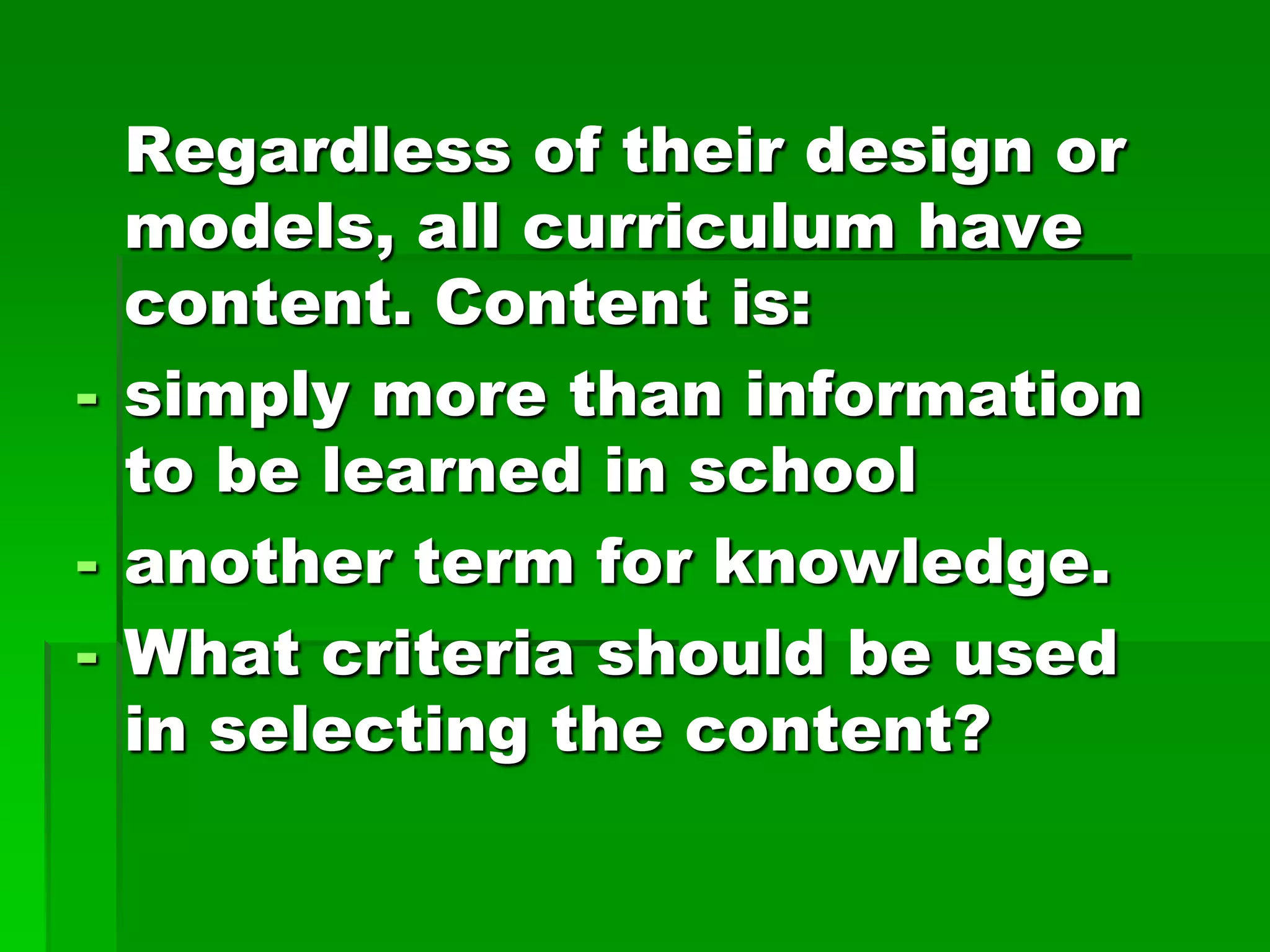
Regardless of their design or
models, all curriculum have
content. Content is:
- simply more than information
to be learned in school
- another term for knowledge.
- What criteria should be used
in selecting the content?
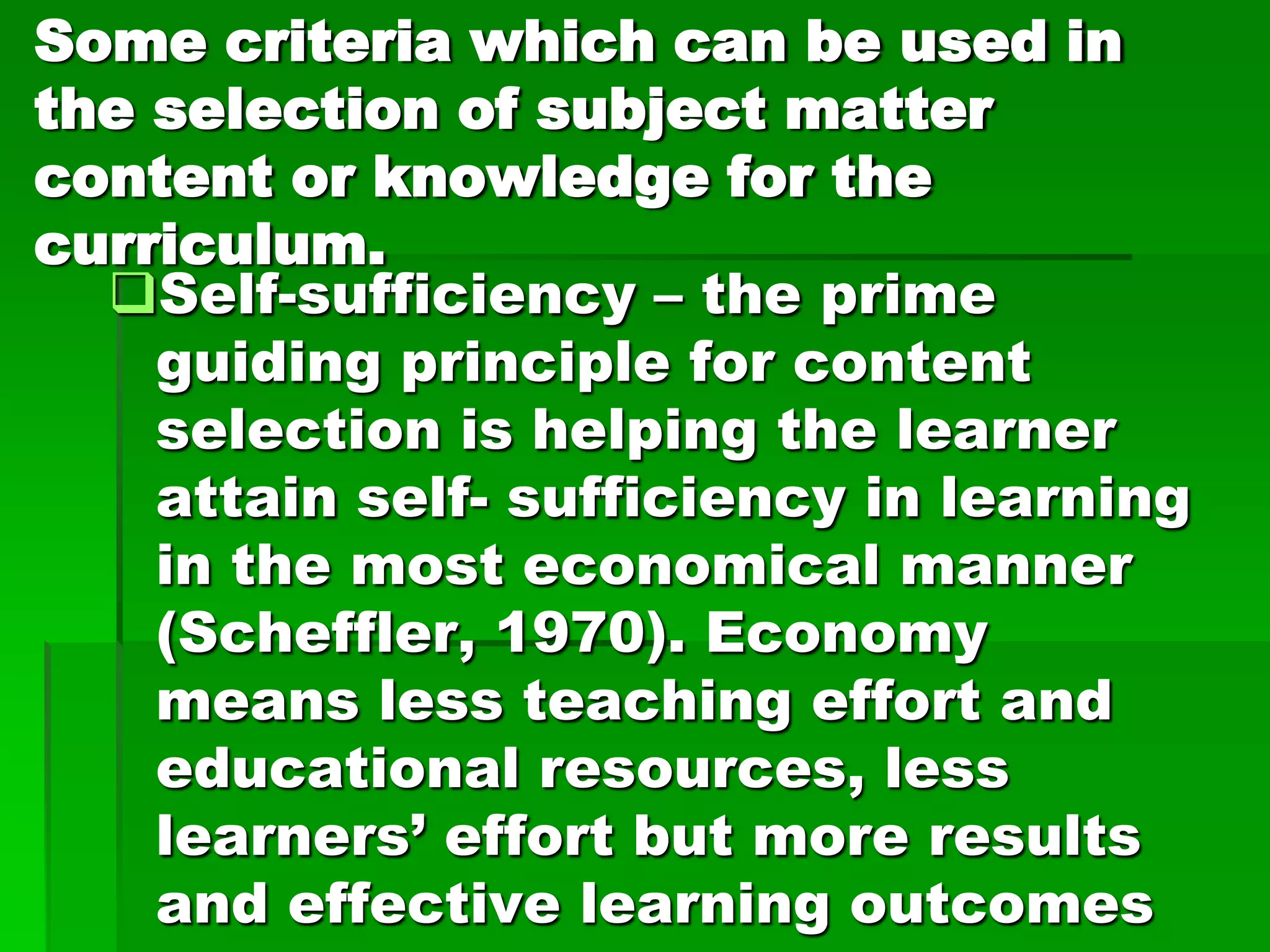
Some criteria which can be used in
the selection of subject matter
content or knowledge for the
curriculum.
Self-sufficiency – the prime
guiding principle for content
selection is helping the learner
attain self- sufficiency in learning
in the most economical manner
(Scheffler, 1970). Economy
means less teaching effort and
educational resources, less
learners’ effort but more results
and effective learning outcomes
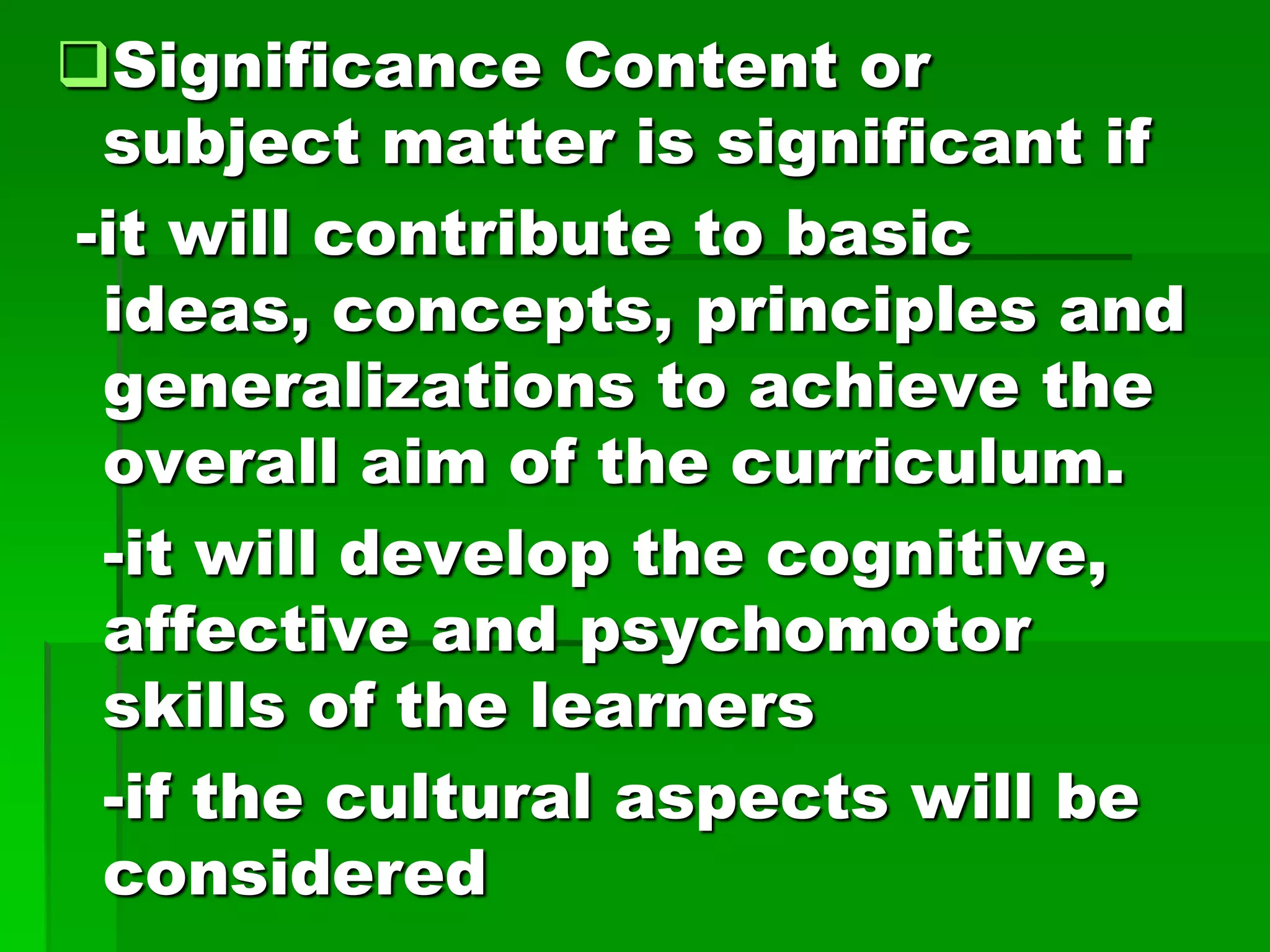
Significance Content or
subject matter is significant if
-it will contribute to basic
ideas, concepts, principles and
generalizations to achieve the
overall aim of the curriculum.
-it will develop the cognitive,
affective and psychomotor
skills of the learners
-if the cultural aspects will be
considered
Validity – the authenticity of the of the
subject matter. Subject matter should
be checked or verified at regular
intervals to determine if the content
that was originally valid continues to
be.
Interest – this is the key criterion for a
learner-centered curriculum. A learner
will value the content if it is
meaningful to him/her. Students’
interests should be adjusted taking
into consideration maturity, prior
experiences, educational and social
value of their interest among others.
Utility – usefulness of the content
or subject matter may be relative to
the learner who is going to use it.
Usefulness may be either be for the
present or the future.
 Learn ability – subject matter in the
curriculum should be within the
range of the experiences of the
learners.
Feasibility – content selection
should be considered within the
context of the existing reality in
schools, in society and government.
Other considerations that maybe
used in the selection of the
learning content
a. frequently and commonly used in
daily life
b. Suited to the maturity levels and
abilities of students
c. valuable in meeting the needs and
competencies of a future career;
d. related with other subject areas
important in the transfer of
learning
In organizing or putting
together the different
learning contents; the
following suggestions are
given (Palma)
1. Balance
2. Articulation
3. Sequence
4. Integration
5. Continuity
Curriculum Experiences
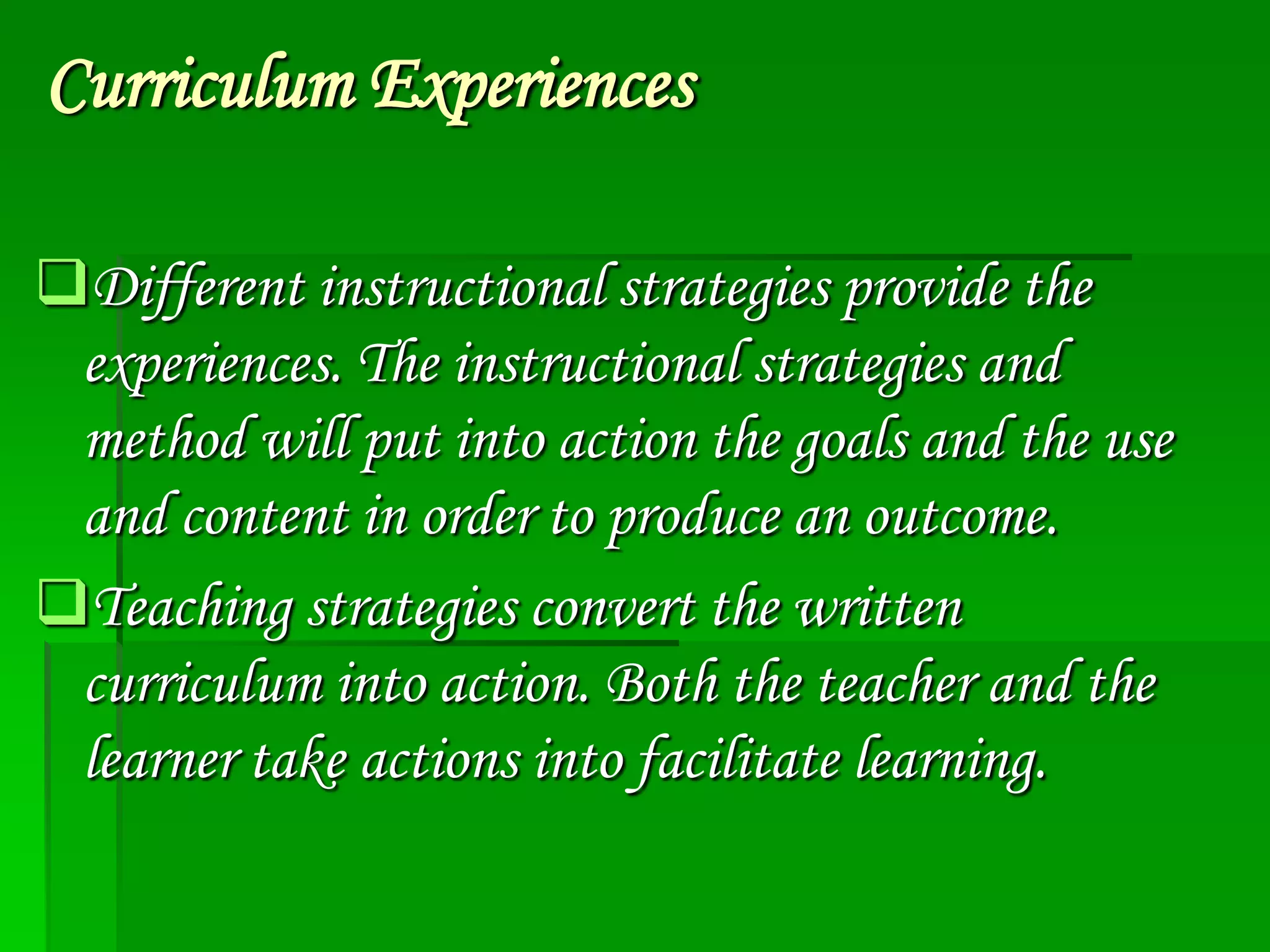
Different instructional strategies provide the
experiences. The instructional strategies and
method will put into action the goals and the use
and content in order to produce an outcome.
Teaching strategies convert the written
curriculum into action. Both the teacher and the
learner take actions into facilitate learning.
Curriculum Experiences
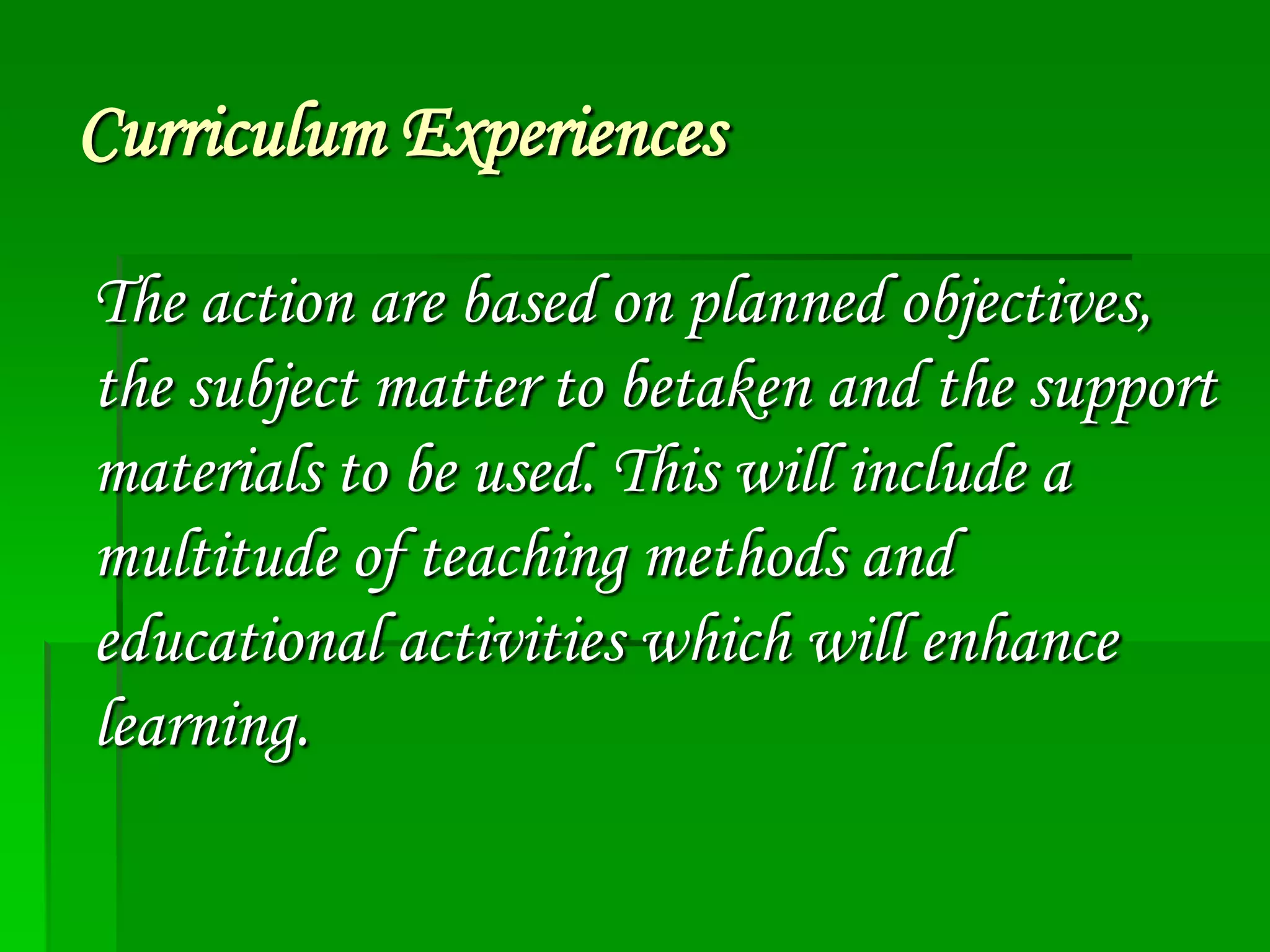
The action are based on planned objectives,
the subject matter to betaken and the support
materials to be used. This will include a
multitude of teaching methods and
educational activities which will enhance
learning.
Some guide for the selection
and use:
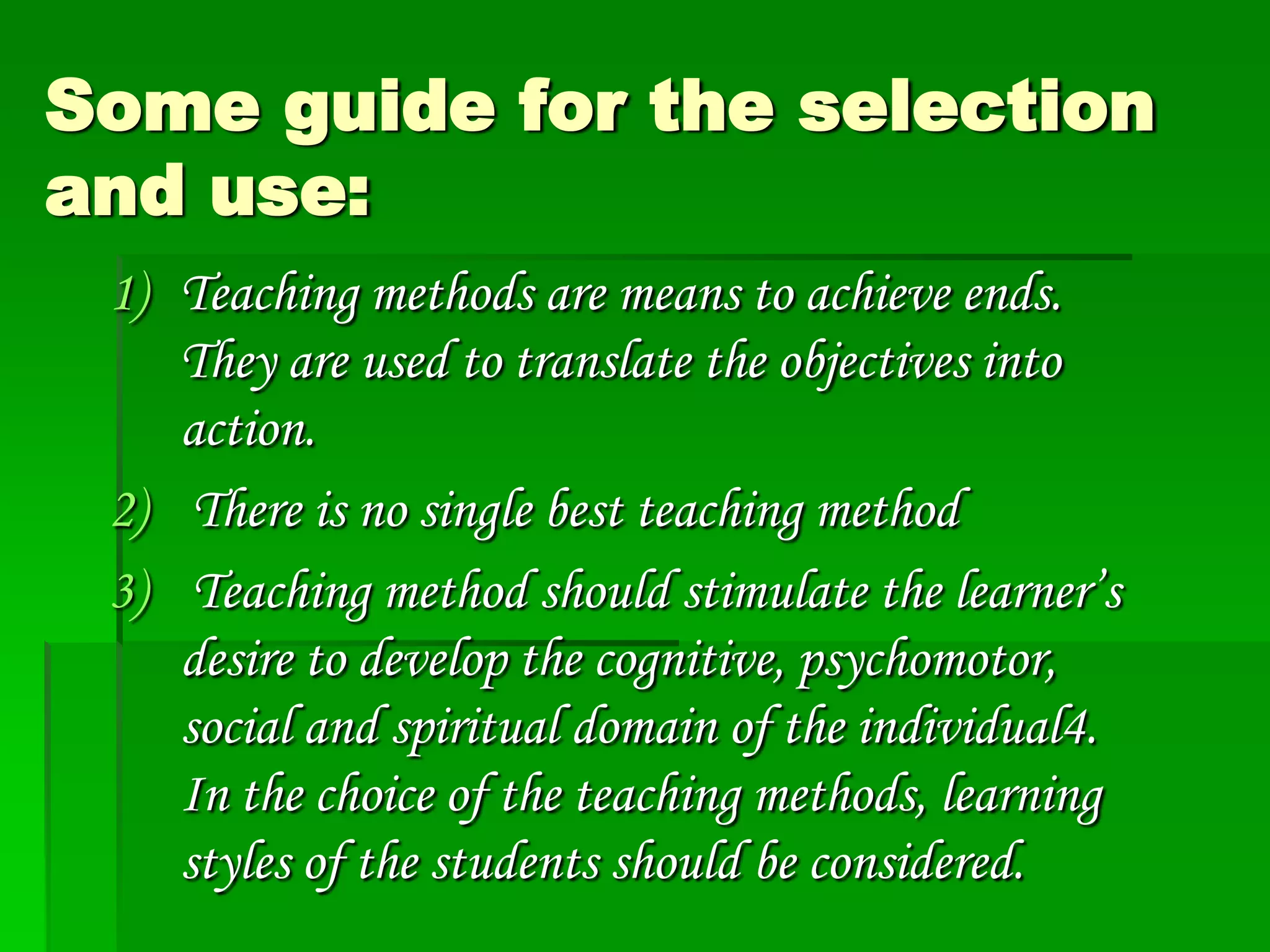
1) Teaching methods are means to achieve ends.
They are used to translate the objectives into
action.
2) There is no single best teaching method
3) Teaching method should stimulate the learner’s
desire to develop the cognitive, psychomotor,
social and spiritual domain of the individual4.
In the choice of the teaching methods, learning
styles of the students should be considered.
Some guide for the selection and use:
4. In the choice of the teaching methods, learning
styles of the students should be considered.
5. Every method should lead to the development of
the learning outcomes in the three domains:
cognitive, affective and psychomotor
6. Flexibility should be a consideration in the use of
the teaching methods
Component 4

Curriculum
Evaluation
Curriculum Evaluation
All curricula to be effective must have the element of
evaluation (Worthen and Sanders, 1987).
This refer to the formal determination of the quality,
effectiveness or value of the program, process, product
of the curri-culum. Evaluation is meeting the goals and
matching them with the intended outcomes.
There are different evaluation methods that can be
utilized like diagnos-tic, placement, formative or
summative evaluation or the norm or criterionreferenced evaluation.
Steps
1. Focus on one particular component of the
curriculum
2. Collect or gather the information
3. Organize the information
4. Analyze information
5. Report the information
6. Recycle the information for continuous
feedback, modifications and adjustments to
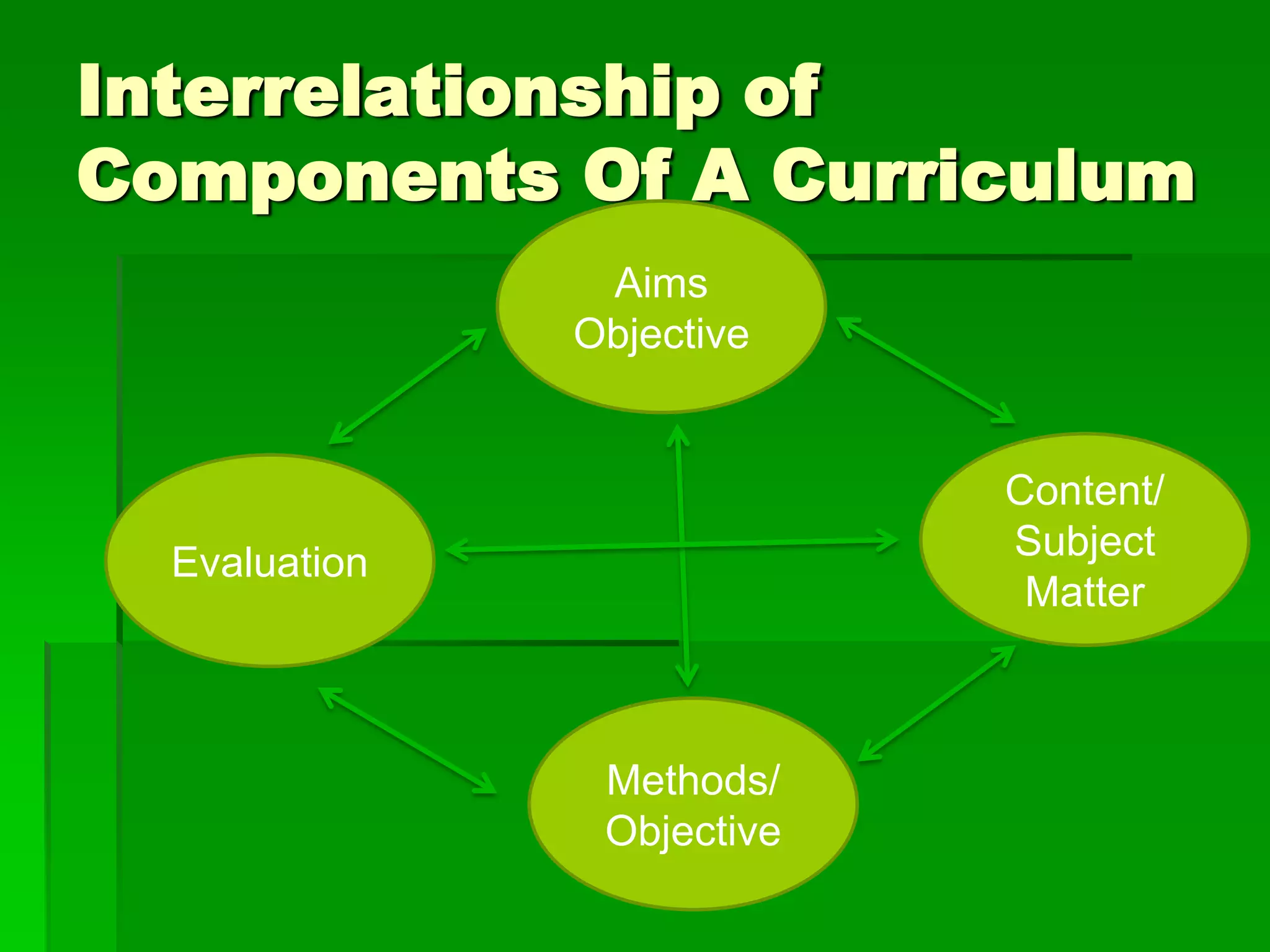
Interrelationship of
Components Of A Curriculum
Aims
Objective

Content/
Subject
Matter

Evaluation

Methods/
Objective
Curriculum practitioners and
implementers may use one or more
approaches in planning,
implementing and evaluating the
curriculum. Even textbook writers
or instructional materials producers
have different particular
approaches.
Behavioral Approach
This is based on a blueprint, where goals and objectives are
specified, contents and activities are also arranged to match with
the learning objectives.
The learning outcomes are evaluated in terms of goals and
objectives set at the beginning. This approach started with the
idea of Frederick Taylor which is aimed to achieve efficiency.
In education, behavioral approach begins with educational plans
that start with the setting of goals or objectives.
These are the important ingredients in curriculum
implementation as evaluating the learning outcomes as a change
of behavior. The change of behavior indicates the measure of the
accomplishment.
Managerial Approach
 In this approach, the principal is the curriculum leader and at the
same time instructional leader who is supposed to be the general
manager.
 The general manager sets the policies and priorities, establishes the
direction of change and innovation, and planning and organizing
curriculum and instruction.
 School administrators are less concerned about the content than
about organization and implementation. They are less concerned
about subject matter, methods and materials than improving the
curriculum
 Curriculum managers look at curriculum changes and innovations
as they administer the resources and restructure the schools.
Some of the roles of the Curriculum
Supervisors are education goals
 help develop the school's the following:
 plan curriculum with students, parents, teachers and other stakeholders
 design programs of study by grade levels
 plan or schedule classes or school calendar
 prepare curriculum guides or teacher guides by grade level or subject
area
 help in the evaluation and selection of textbooks
 observe teachers
 assist teachers in the implementation of the curriculum
 encourage curriculum innovation and change
 develop standards for curriculum and instructional evaluation
Systems Approach
This was influenced by systems theory, where the parts of the
total school district or school are examined in terms of how
they relate to each other.
The organizational chart of the school represents a systems
approach. It shows the line-staff relationships of personnel
and how decisions are made..
The following are of equal importance:
a) Administration
b) counseling
c) Curriculum
d) Instruction
e) evaluation
Humanistic Approach
This approach is rooted in the progressive philosophy and
child-centered movement. It considers the formal or
planned curriculum and the informal or hidden
curriculum. It considers the whole child and believes that
in curriculum the total development of the individual is
the prime consideration. The learner s at the center of the
curriculum.
Nature, concepts and purposes of curriculum development

Nature, concepts and purposes of curriculum development

  • 1.
    Nature, Concepts andPurposes of Curriculum Development
  • 2.
    LESSON 2 Components ofCurriculum And Circular Approach
  • 3.
    For most curricula,the major components or elements are: 1.aims, goals and objectives 2.subject matter/content 3.learning experiences 4.evaluation approaches
  • 4.
    When translated intoquestions, each component can be addressed by the following: 1. What is to be done? 2. What subject matter is to be included? 3. What instructional strategies, resources and activities will be employed? 4. What method and instruments will be used to assess the results of the curriculum?
  • 5.
    Component 1-Curriculum Aims,Goals and Objectives Based on the Philippine Constitution of1987, all schools shall aim to: 1. inculcate patriotism and nationalism 2. foster love of humanity 3. promote respect for human rights 4. appreciate the role of national heroes in the historical development of the country 5. teach the rights and duties of citizenship
  • 6.
    Component 1-Curriculum Aims,Goals and Objectives 6. strengthen ethical and spiritual values 7. develop moral character and personal discipline 8. encourage critical and creative thinking 9. broaden scientific and technological knowledge and promote vocational efficiency
  • 7.
    Aims of ElementaryEducation (Education Act of 1982) In the elementary level, schools through their curricula should aim to: provide knowledge and develop skills, attitudes, values essential to personal development and necessary for living in and contributing to a developing and changing society; provide learning experiences which increase a child’s awareness of and responsiveness to the changes in the society;
  • 8.
    Aims of ElementaryEducation (Education Act of 1982) promote and, intensify knowledge, identification with and love for the nation and the people to which he belongs; and promote work experiences which develop orientation to the world of work and prepare the learner to engage in honest and gainful work
  • 9.
    Aims of SecondaryEducation In high school or secondary level, educational curricula aim to: continue to promote the objectives of elementary education; and discover and enhance the different aptitudes and interests of students in order to equip them with skills for productive endeavor and or to prepare them for tertiary schooling
  • 10.
    Aims of TertiaryEducation The different courses should aim to: provide general education programs which will promote national identity, cultural consciousness, moral integrity and spiritual vigor; train the nation’s manpower in the skills required for national development; and advance knowledge through research and apply new knowledge for improving the quality of human life and respond effectively to changing society.
  • 11.
    The school’s vision isa clear concept of what the institution would like to become in the futureprovides the focal point or unifying element according to which the school staff, faculty, students perform individually or collectively- is the guiding post around which all educational efforts including curricula should be directed
  • 12.
    The school’s missionstatement - spells out how it intends to carry out its Vision- the mission targets to produce the kind of persons the students will become after having been educated over a certain period of time. - The school’s vision and mission are further translated into goals which are broad statements or intents to be accomplished. Data for the sources of school goals may include the learners, the society and the fund of knowledge.
  • 13.
    The school’s missionstatement, spells out how it intends to carry out its Vision. the mission targets to produce the kind of persons the students will become after having been educated over a certain period of time. The school’s vision and mission are further translated into goals which are broad statements or intents to be accomplished. Data for the sources of school goals may include the learners, the society and the fund of knowledge.
  • 14.
    In a curriculum,these goals are madesimple and specific for the attainment ofeach learner. These are called educational objectives. Benjamin Bloom and Robert Mager defined educational objectives in two ways:  1. explicit formulation of the ways in which students are expected to be changed by the educative process  2. intent communicated by statement describing a proposed change in learners
  • 15.
    Bloom and hisassociates classified three big domains of objectives. These are: 1. cognitive 2. Affective 3. psychomotor
  • 16.
    Cognitive Domain (Bloom et.Al. 1956) domain of thought process 1. Knowledge – recall, remembering of prior learned materials, in terms of facts, concepts, theories and principles. It is the lowest cognitive level. 2. Comprehension – ability to grasp the meaning of material. It indicates the lowest form of understanding 3. Application – the ability to use learned material in new and concrete situation
  • 17.
    Cognitive Domain 4. Analysis– ability to break down material into component parts so that its organizational structure may be understood 5. Synthesis – ability to put parts together to form a new whole 6. Evaluation – ability to pass judgment based on given criteria
  • 18.
    Affective domain (Krathwohl, 1964)– domain of valuing, attitude and appreciation 1. Receiving – students’ willingness to pay attention to particular event, stimuli, classroom activities 2. Responding – active participation on the part of the students 3. Valuing – concerned with the worth or value a student attaches to a particular phenomena, object or behavior
  • 19.
    Affective domain 4. Organization– concerned with bringing together different values and building a value system 5. Characterization by a value or value complex – developing a lifestyle from a value system
  • 20.
    Psychomotor Domain (Simpson, 1972)– domain of the use of psychomotor attributes 1. Perception – use of sense organs to guide motor activities 2. Set – refers to the readiness to take a particular type of action 3. Guided response – concerned with the early stages in learning complex skills. Imitation and trial and error are some of the ways of doing
  • 21.
    Psychomotor Domain 4.Mechanism –responses have become habitual. Performance skills are with ease and confidence 5. Complex overt responses – skillful performance and with complex movement patterns 6. Adaptation – skill well developed that the ability to modify is very easy 7. Origination – refers to creating new movement patterns to fit the situation. Creativity is evident.
  • 22.
  • 23.
    Regardless of theirdesign or models, all curriculum have content. Content is: - simply more than information to be learned in school - another term for knowledge. - What criteria should be used in selecting the content?
  • 24.
    Some criteria whichcan be used in the selection of subject matter content or knowledge for the curriculum. Self-sufficiency – the prime guiding principle for content selection is helping the learner attain self- sufficiency in learning in the most economical manner (Scheffler, 1970). Economy means less teaching effort and educational resources, less learners’ effort but more results and effective learning outcomes
  • 25.
    Significance Content or subjectmatter is significant if -it will contribute to basic ideas, concepts, principles and generalizations to achieve the overall aim of the curriculum. -it will develop the cognitive, affective and psychomotor skills of the learners -if the cultural aspects will be considered
  • 26.
    Validity – theauthenticity of the of the subject matter. Subject matter should be checked or verified at regular intervals to determine if the content that was originally valid continues to be. Interest – this is the key criterion for a learner-centered curriculum. A learner will value the content if it is meaningful to him/her. Students’ interests should be adjusted taking into consideration maturity, prior experiences, educational and social value of their interest among others.
  • 27.
    Utility – usefulnessof the content or subject matter may be relative to the learner who is going to use it. Usefulness may be either be for the present or the future.  Learn ability – subject matter in the curriculum should be within the range of the experiences of the learners. Feasibility – content selection should be considered within the context of the existing reality in schools, in society and government.
  • 28.
    Other considerations thatmaybe used in the selection of the learning content a. frequently and commonly used in daily life b. Suited to the maturity levels and abilities of students c. valuable in meeting the needs and competencies of a future career; d. related with other subject areas important in the transfer of learning
  • 29.
    In organizing orputting together the different learning contents; the following suggestions are given (Palma) 1. Balance 2. Articulation 3. Sequence 4. Integration 5. Continuity
  • 31.
    Curriculum Experiences Different instructionalstrategies provide the experiences. The instructional strategies and method will put into action the goals and the use and content in order to produce an outcome. Teaching strategies convert the written curriculum into action. Both the teacher and the learner take actions into facilitate learning.
  • 32.
    Curriculum Experiences The actionare based on planned objectives, the subject matter to betaken and the support materials to be used. This will include a multitude of teaching methods and educational activities which will enhance learning.
  • 33.
    Some guide forthe selection and use: 1) Teaching methods are means to achieve ends. They are used to translate the objectives into action. 2) There is no single best teaching method 3) Teaching method should stimulate the learner’s desire to develop the cognitive, psychomotor, social and spiritual domain of the individual4. In the choice of the teaching methods, learning styles of the students should be considered.
  • 34.
    Some guide forthe selection and use: 4. In the choice of the teaching methods, learning styles of the students should be considered. 5. Every method should lead to the development of the learning outcomes in the three domains: cognitive, affective and psychomotor 6. Flexibility should be a consideration in the use of the teaching methods
  • 35.
  • 36.
    Curriculum Evaluation All curriculato be effective must have the element of evaluation (Worthen and Sanders, 1987). This refer to the formal determination of the quality, effectiveness or value of the program, process, product of the curri-culum. Evaluation is meeting the goals and matching them with the intended outcomes. There are different evaluation methods that can be utilized like diagnos-tic, placement, formative or summative evaluation or the norm or criterionreferenced evaluation.
  • 38.
    Steps 1. Focus onone particular component of the curriculum 2. Collect or gather the information 3. Organize the information 4. Analyze information 5. Report the information 6. Recycle the information for continuous feedback, modifications and adjustments to
  • 39.
    Interrelationship of Components OfA Curriculum Aims Objective Content/ Subject Matter Evaluation Methods/ Objective
  • 40.
    Curriculum practitioners and implementersmay use one or more approaches in planning, implementing and evaluating the curriculum. Even textbook writers or instructional materials producers have different particular approaches.
  • 41.
    Behavioral Approach This isbased on a blueprint, where goals and objectives are specified, contents and activities are also arranged to match with the learning objectives. The learning outcomes are evaluated in terms of goals and objectives set at the beginning. This approach started with the idea of Frederick Taylor which is aimed to achieve efficiency. In education, behavioral approach begins with educational plans that start with the setting of goals or objectives. These are the important ingredients in curriculum implementation as evaluating the learning outcomes as a change of behavior. The change of behavior indicates the measure of the accomplishment.
  • 42.
    Managerial Approach  Inthis approach, the principal is the curriculum leader and at the same time instructional leader who is supposed to be the general manager.  The general manager sets the policies and priorities, establishes the direction of change and innovation, and planning and organizing curriculum and instruction.  School administrators are less concerned about the content than about organization and implementation. They are less concerned about subject matter, methods and materials than improving the curriculum  Curriculum managers look at curriculum changes and innovations as they administer the resources and restructure the schools.
  • 43.
    Some of theroles of the Curriculum Supervisors are education goals  help develop the school's the following:  plan curriculum with students, parents, teachers and other stakeholders  design programs of study by grade levels  plan or schedule classes or school calendar  prepare curriculum guides or teacher guides by grade level or subject area  help in the evaluation and selection of textbooks  observe teachers  assist teachers in the implementation of the curriculum  encourage curriculum innovation and change  develop standards for curriculum and instructional evaluation
  • 44.
    Systems Approach This wasinfluenced by systems theory, where the parts of the total school district or school are examined in terms of how they relate to each other. The organizational chart of the school represents a systems approach. It shows the line-staff relationships of personnel and how decisions are made.. The following are of equal importance: a) Administration b) counseling c) Curriculum d) Instruction e) evaluation
  • 45.
    Humanistic Approach This approachis rooted in the progressive philosophy and child-centered movement. It considers the formal or planned curriculum and the informal or hidden curriculum. It considers the whole child and believes that in curriculum the total development of the individual is the prime consideration. The learner s at the center of the curriculum.