By: Elina & Mei Seen
BASIC COMPONENTS IN
DEVELOPING A CURRICULUM
1
AIMS, GOALS AND OBJECTIVES
 Education is purposeful. It is
concerned with outcomes that are
expressed at several levels:
AIMS – the most general level
GOALS – reflect the purpose with some
outcomes in mind
OBJECTIVES – reflect the most specific
level of educational
outcomes
2
AIMS
Definition of AIMS
 Wilson (2004) defines AIMS as “general
statements that provide directions or intent of
educational action”
 Ornstein & Hunkins (2004) concluded that
AIMS serve to:
a) Be general statements that provide shape
and directions to the more specific actions
designed to achieve future product and
behaviour.
b) Be starting points for ideal/inspirational
vision of the good/future.
c) Reflect value judgements and value-laden
statements, and they furnish educators with
3
 Doll (1979) proposes 3 main dimensions
of Aims:
a) Dealing with intellectual dimensions
b) Social-Personal dimension –
concerned with person-to society,
person-to-person, and person-to-self
interactions.
c) Relating to the productive dimension
of schooling – focus on aspects of
education that allow individuals to
function in the home, on the job, and as
members of society/country’s citizen.4
 Ornstein & Hunkins (2004) added 4 other
dimensions:
a) Physical aims – dealing with
development and maintenance of strong,
healthy bodies (and minds).
b) Aesthetic aims – dealing with values and
appreciation of the arts.
c) Moral aims – dealing with values and
behaviour that reflect appropriate moral
values.
d) Spiritual aims – dealing with recognition
and belief in the divine and view of5
Groups involved in formulating Aims
 Basically, it involves 3 groups of people:
i) Boards of education, administrators, and
professional staff members. May also
include views of selected members of
society, parents, students etc.
ii) Opinions of community’s members after a
polling has been conducted. So, the aims
will be based on consensus of public
opinion.
iii) Professional educational organizations in
charge of preparing aims upon request
6
Examples of Aims
 Our KBSR English syllabus aims to
“equip learners with basic skills and
knowledge of the English language so
as to enable them to communicate, both
orally and in writing, in and out of
school”.
 Our KBSM English syllabus aims to
“extend learners’ English language
proficiency in order to meet their needs
to use English in certain situations in
everyday life, for knowledge acquisition,
and for future workplace needs”.
7
GOALS
Definition of GOALS
 Goals are statements of purpose with some
outcome in mind.
 According to Wilson (2005), goals are
“statements of educational intention which are
more specific than aims”
 Oliva (2001) distinguishes between curriculum
goals and instructional goals:
i) Curriculum goals - a purpose or end stated
in general terms without criteria of
achievement”.
ii) Instructional goals - a statement of
performance expected of each student in a
8
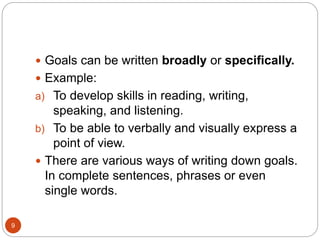
 Goals can be written broadly or specifically.
 Example:
a) To develop skills in reading, writing,
speaking, and listening.
b) To be able to verbally and visually express a
point of view.
 There are various ways of writing down goals.
In complete sentences, phrases or even
single words.
9
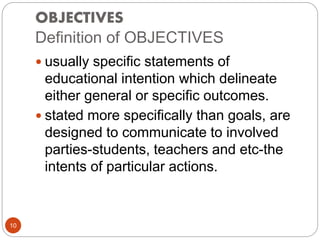
OBJECTIVES
Definition of OBJECTIVES
 usually specific statements of
educational intention which delineate
either general or specific outcomes.
 stated more specifically than goals, are
designed to communicate to involved
parties-students, teachers and etc-the
intents of particular actions.
10
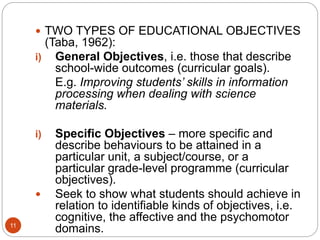
 TWO TYPES OF EDUCATIONAL OBJECTIVES
(Taba, 1962):
i) General Objectives, i.e. those that describe
school-wide outcomes (curricular goals).
E.g. Improving students’ skills in information
processing when dealing with science
materials.
i) Specific Objectives – more specific and
describe behaviours to be attained in a
particular unit, a subject/course, or a
particular grade-level programme (curricular
objectives).
 Seek to show what students should achieve in
relation to identifiable kinds of objectives, i.e.
cognitive, the affective and the psychomotor
domains.11
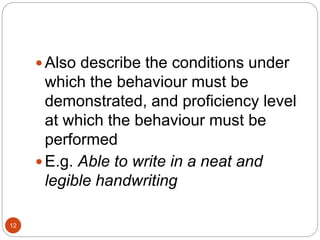
 Also describe the conditions under
which the behaviour must be
demonstrated, and proficiency level
at which the behaviour must be
performed
 E.g. Able to write in a neat and
legible handwriting
12
 Beane et al. (2004) point out that:
…”objectives are specific statements
reflecting the purposes of a particular
unit or level of the school programme”.
13
 Objectives can be written in a
number of ways.
 Currently, most objectives are
written in behavioral terms.
 Behavioral objectives usually
employ observable behaviour and
can be divided into specific
domains—cognitive, affective, and
psychomotor.
14
Examples
 Cognitive: Students will identify and list
5 slang terms they have heard from their
peers.
 Affective: Students will choose 3 of the
most offensive slang terms from a list
developed by the entire class.
 Psychomotor: Students will create
expressive gestures to go with their
favorite slang terms.
15
Sources of objectives
16
 Tyler (1949) identified 5 sources of objectives:
i) the learners themselves
ii) The needs of contemporary society
iii) The nature of subject matter
iv) The philosophy (set of values)
v) Psychology (the way learners learn)
 Tyler also included other factors such as
financial resources available, the nature of
teaching force etc.
17
 Kerr (1972) regards these sources in his
model:
i) The pupils
ii) Society
iii) The disciplines
 Consequently, the objectives are
linked & interrelated to knowledge, the
learning experiences (school) and
evaluation.
18
 Ornstein (2004) identifies objectives as the
level for which they are written. Thus, there
are 3 levels of objectives:
i) Program Objectives – addressing subjects
at particular grades
ii) Course Objectives – relating to particular
courses within a grade level
iii) Classroom Objectives – further divided
into unit objectives and lesson plan
objectives.
CURRICULUMCONTENT
19
“Content must take account of the
environment in which the course
will be used, the needs of the
learners, and principles of teaching
and learning”
Nation (1996)
20
 Environment
i) Learners
ii) Teachers
iii) Situation
 Needs
i) Lacks
ii) Wants
iii) Necessities
CURRICULUMEXPERIENCES
21
 Curriculum experience simply means the
extension of the normal activities of daily
life into directed instructional situations.
(Johnson, 1938)
 Curriculum encompasses the entire
scope of formative deed and experience
occurring in and out of school, and not
only experiences occurring in school;
experiences that are unplanned and
undirected, and experiences intentionally
directed for the purposeful formation of
adult members of society. (Bobbit, 1918)
22
 Quality and nature of the learning experience in
developing attributes and capabilities and in
achieving active engagement, motivation and
depth of learning.
 The totality of experiences which are planned for
children and young people, including the ethos
and life of the school and interdisciplinary studies
as well as learning within curriculum areas and
subjects. This means that they apply beyond
timetabled classes and into, for example,
enterprise and health activities and special
events.
(www.curriculumforexcellencescotland.gov.uk)
23
 Curriculum encompasses the entire scope of
formative deed and experience occurring in and
out of school, and not only experiences occurring
in school; experiences that are unplanned and
undirected, and experiences intentionally directed
for the purposeful formation of adult members of
society.
(Bobbit, 1918)
CURRICULUM ASSESSMENT
24
 Tyler (1949) defines assessment as “essentially the
process of determining to what extent of educational
objectives are actually being realized by the program
of curriculum and instruction.”
 Tyler suggested 4 fundamental questions in
connection with any curriculum:
1. What educational purposes should the school seek to
obtain?
2. What educational experiences can be provided that
are likely to attain these purposes?
3. How can these educational experiences be effectively
organized?
4. How can we determine whether these purposes are
25
 These 4 principal questions can be
translated into a simpler model:
Objectives – content – organization –
evaluation
 Therefore, if evaluation shows that
specified objectives have not been
attained, it must mean that the content
chosen or methods of teaching and
organization used were not appropriate.
26
Assessment:
 sets to ascertain students’ achievement
 sets to identify the quality and quantity of the
curriculum/syllabus.
 is concerned with deciding on the value or
“worthwhileness” of a learning process and
the effectiveness with which it is being carried
out.
 is concerned with preparing adequate and
efficient measuring devices for evaluating
purposes.
 “Evaluation is the process in which we decide
how well we have done whatever it is we were
trying to do” (Beane, 2004)
27
Implications
i) Assessment cannot occur unless
we know what we are trying to
accomplish.
ii) The goals of a program, or
objectives of a specific lesson,
must be clear and understood.
iii) Then a decision is required, one
which has to be made based on
some criterion or normal
judgment.
28
 Herrick (1962) identifies four roles that can
be assumed by persons involved in
curriculum assessment:
1. The “doer” – the child, teacher, or person
whose behavior is being evaluated.
2. The “observer” – the person who is
looking at what the learner is doing.
3. The “judger” – the person who is taking
the results of the observations and
judging their value and adequacy.
4. The “actor” – the individual who acts on
the results of the evaluation.
Measuring Devices in Assessment
29
 Various measuring
devices/instruments in assessment:
i) Paper-and Pencil Tests
ii) Observation
iii) Self-Evaluation
iv) Analysis of Projects
v) Unobtrusive Measures
30
There are two types of
assessment (Scrivens, 1967).
They are:
a) Formative Evaluation
b) Summative Evaluation
Formative Evaluation
31
 Purpose – to provide the developer with useful
information for on-going adjustments during the
programme.
 Characteristics:
- conducted during the planning and
implementation phases of a program.
- Formal/informal – used during period of
instruction.
- Embedded tests – as part of instructional
strategies.
 Use of data:
- diagnose and remedial actions
- by teachers to monitor their instruction
Summative Evaluation
32
 Purpose – making the summary or judgement on
the quality or adequacy of a course (Nation,
1996)
 Characteristics:
- takes place at the end of a course.
- Presented in a report
 Use of data:
- to determine if students have mastered the
preceding instruction.
- to reveal whether or not pre-specified learning
outcomes have been achieved.
- to revise program and methods for subsequent
groups
33
 Alkin (1969) identified five types of
program evaluations:
 The three formative evaluation types
are:
1.Systems assessment – during pre-
planning phase of a programme’s
development, or needs assessment.
2.Programme design – looking at internal
“fit” among various components of the
program.
3.Programme implementation –
concerned with process of carrying out
34
 The two summative evaluation types
are:
1. Program improvement – focus of
evaluation is on programme effects.
2. Programme certification – includes
programme comparison, compliance
review, and audit studies.
References
35
 Alkin, M. C. (1969). Evaluation theory development. Evaluation Comment, 2(1),
2-7.
 Bean, R.M. (2004). Promoting effective literacy instruction: The challenge for
literacy coaches. The California Reader, 37(3), 58-63
 Doll, W. (1979). A Structural View of Curriculum. Theory into Practice, 18(5),
Retrieved from http://www.jstor.org/pss/1476751
 Kerr, C. (1972). 'Foreword', Higher Education 1, 1-2.
 Nation, I.S.P. (1996). Language curriculum design. Wellington: English Language
Institute Occasional Publication No.16
 Oliva, P. (2001). Developing the curriculum. New York: Longman.
 Ornstein, A.C. & Hunkins, F.P. (2004). Curriculum foundations: Principles and
issues (4th ed.). Boston, MA: Allyn and Bacon.
 Robertson, F., Peterson, D., & Bean, J. C. (2004). Using federal reserve
publications in institutions and markets courses: An approach to teaching
critical thinking. Advances in Financial Education, 2(Fall), 15-25.
 Taba, H. (1962). Curriculum development: Theory and practice. New York, NY:
Harcourt, Brace, & World.
 Tyler, R.W. (1949). Basic principles of curriculum and instruction. Chicago:
University of Chicago Press
 Wilson, L. O. (2005). Wilson’s curriculum pages – writing aims, goals and
objectives. Retrieved from
http://www4.uwsp.edu/education/lwilson/curric/practice.htm

Curriculum

  • 1.
    By: Elina &Mei Seen BASIC COMPONENTS IN DEVELOPING A CURRICULUM 1
  • 2.
    AIMS, GOALS ANDOBJECTIVES  Education is purposeful. It is concerned with outcomes that are expressed at several levels: AIMS – the most general level GOALS – reflect the purpose with some outcomes in mind OBJECTIVES – reflect the most specific level of educational outcomes 2
  • 3.
    AIMS Definition of AIMS Wilson (2004) defines AIMS as “general statements that provide directions or intent of educational action”  Ornstein & Hunkins (2004) concluded that AIMS serve to: a) Be general statements that provide shape and directions to the more specific actions designed to achieve future product and behaviour. b) Be starting points for ideal/inspirational vision of the good/future. c) Reflect value judgements and value-laden statements, and they furnish educators with 3
  • 4.
     Doll (1979)proposes 3 main dimensions of Aims: a) Dealing with intellectual dimensions b) Social-Personal dimension – concerned with person-to society, person-to-person, and person-to-self interactions. c) Relating to the productive dimension of schooling – focus on aspects of education that allow individuals to function in the home, on the job, and as members of society/country’s citizen.4
  • 5.
     Ornstein &Hunkins (2004) added 4 other dimensions: a) Physical aims – dealing with development and maintenance of strong, healthy bodies (and minds). b) Aesthetic aims – dealing with values and appreciation of the arts. c) Moral aims – dealing with values and behaviour that reflect appropriate moral values. d) Spiritual aims – dealing with recognition and belief in the divine and view of5
  • 6.
    Groups involved informulating Aims  Basically, it involves 3 groups of people: i) Boards of education, administrators, and professional staff members. May also include views of selected members of society, parents, students etc. ii) Opinions of community’s members after a polling has been conducted. So, the aims will be based on consensus of public opinion. iii) Professional educational organizations in charge of preparing aims upon request 6
  • 7.
    Examples of Aims Our KBSR English syllabus aims to “equip learners with basic skills and knowledge of the English language so as to enable them to communicate, both orally and in writing, in and out of school”.  Our KBSM English syllabus aims to “extend learners’ English language proficiency in order to meet their needs to use English in certain situations in everyday life, for knowledge acquisition, and for future workplace needs”. 7
  • 8.
    GOALS Definition of GOALS Goals are statements of purpose with some outcome in mind.  According to Wilson (2005), goals are “statements of educational intention which are more specific than aims”  Oliva (2001) distinguishes between curriculum goals and instructional goals: i) Curriculum goals - a purpose or end stated in general terms without criteria of achievement”. ii) Instructional goals - a statement of performance expected of each student in a 8
  • 9.
     Goals canbe written broadly or specifically.  Example: a) To develop skills in reading, writing, speaking, and listening. b) To be able to verbally and visually express a point of view.  There are various ways of writing down goals. In complete sentences, phrases or even single words. 9
  • 10.
    OBJECTIVES Definition of OBJECTIVES usually specific statements of educational intention which delineate either general or specific outcomes.  stated more specifically than goals, are designed to communicate to involved parties-students, teachers and etc-the intents of particular actions. 10
  • 11.
     TWO TYPESOF EDUCATIONAL OBJECTIVES (Taba, 1962): i) General Objectives, i.e. those that describe school-wide outcomes (curricular goals). E.g. Improving students’ skills in information processing when dealing with science materials. i) Specific Objectives – more specific and describe behaviours to be attained in a particular unit, a subject/course, or a particular grade-level programme (curricular objectives).  Seek to show what students should achieve in relation to identifiable kinds of objectives, i.e. cognitive, the affective and the psychomotor domains.11
  • 12.
     Also describethe conditions under which the behaviour must be demonstrated, and proficiency level at which the behaviour must be performed  E.g. Able to write in a neat and legible handwriting 12
  • 13.
     Beane etal. (2004) point out that: …”objectives are specific statements reflecting the purposes of a particular unit or level of the school programme”. 13
  • 14.
     Objectives canbe written in a number of ways.  Currently, most objectives are written in behavioral terms.  Behavioral objectives usually employ observable behaviour and can be divided into specific domains—cognitive, affective, and psychomotor. 14
  • 15.
    Examples  Cognitive: Studentswill identify and list 5 slang terms they have heard from their peers.  Affective: Students will choose 3 of the most offensive slang terms from a list developed by the entire class.  Psychomotor: Students will create expressive gestures to go with their favorite slang terms. 15
  • 16.
    Sources of objectives 16 Tyler (1949) identified 5 sources of objectives: i) the learners themselves ii) The needs of contemporary society iii) The nature of subject matter iv) The philosophy (set of values) v) Psychology (the way learners learn)  Tyler also included other factors such as financial resources available, the nature of teaching force etc.
  • 17.
    17  Kerr (1972)regards these sources in his model: i) The pupils ii) Society iii) The disciplines  Consequently, the objectives are linked & interrelated to knowledge, the learning experiences (school) and evaluation.
  • 18.
    18  Ornstein (2004)identifies objectives as the level for which they are written. Thus, there are 3 levels of objectives: i) Program Objectives – addressing subjects at particular grades ii) Course Objectives – relating to particular courses within a grade level iii) Classroom Objectives – further divided into unit objectives and lesson plan objectives.
  • 19.
    CURRICULUMCONTENT 19 “Content must takeaccount of the environment in which the course will be used, the needs of the learners, and principles of teaching and learning” Nation (1996)
  • 20.
    20  Environment i) Learners ii)Teachers iii) Situation  Needs i) Lacks ii) Wants iii) Necessities
  • 21.
    CURRICULUMEXPERIENCES 21  Curriculum experiencesimply means the extension of the normal activities of daily life into directed instructional situations. (Johnson, 1938)  Curriculum encompasses the entire scope of formative deed and experience occurring in and out of school, and not only experiences occurring in school; experiences that are unplanned and undirected, and experiences intentionally directed for the purposeful formation of adult members of society. (Bobbit, 1918)
  • 22.
    22  Quality andnature of the learning experience in developing attributes and capabilities and in achieving active engagement, motivation and depth of learning.  The totality of experiences which are planned for children and young people, including the ethos and life of the school and interdisciplinary studies as well as learning within curriculum areas and subjects. This means that they apply beyond timetabled classes and into, for example, enterprise and health activities and special events. (www.curriculumforexcellencescotland.gov.uk)
  • 23.
    23  Curriculum encompassesthe entire scope of formative deed and experience occurring in and out of school, and not only experiences occurring in school; experiences that are unplanned and undirected, and experiences intentionally directed for the purposeful formation of adult members of society. (Bobbit, 1918)
  • 24.
    CURRICULUM ASSESSMENT 24  Tyler(1949) defines assessment as “essentially the process of determining to what extent of educational objectives are actually being realized by the program of curriculum and instruction.”  Tyler suggested 4 fundamental questions in connection with any curriculum: 1. What educational purposes should the school seek to obtain? 2. What educational experiences can be provided that are likely to attain these purposes? 3. How can these educational experiences be effectively organized? 4. How can we determine whether these purposes are
  • 25.
    25  These 4principal questions can be translated into a simpler model: Objectives – content – organization – evaluation  Therefore, if evaluation shows that specified objectives have not been attained, it must mean that the content chosen or methods of teaching and organization used were not appropriate.
  • 26.
    26 Assessment:  sets toascertain students’ achievement  sets to identify the quality and quantity of the curriculum/syllabus.  is concerned with deciding on the value or “worthwhileness” of a learning process and the effectiveness with which it is being carried out.  is concerned with preparing adequate and efficient measuring devices for evaluating purposes.  “Evaluation is the process in which we decide how well we have done whatever it is we were trying to do” (Beane, 2004)
  • 27.
    27 Implications i) Assessment cannotoccur unless we know what we are trying to accomplish. ii) The goals of a program, or objectives of a specific lesson, must be clear and understood. iii) Then a decision is required, one which has to be made based on some criterion or normal judgment.
  • 28.
    28  Herrick (1962)identifies four roles that can be assumed by persons involved in curriculum assessment: 1. The “doer” – the child, teacher, or person whose behavior is being evaluated. 2. The “observer” – the person who is looking at what the learner is doing. 3. The “judger” – the person who is taking the results of the observations and judging their value and adequacy. 4. The “actor” – the individual who acts on the results of the evaluation.
  • 29.
    Measuring Devices inAssessment 29  Various measuring devices/instruments in assessment: i) Paper-and Pencil Tests ii) Observation iii) Self-Evaluation iv) Analysis of Projects v) Unobtrusive Measures
  • 30.
    30 There are twotypes of assessment (Scrivens, 1967). They are: a) Formative Evaluation b) Summative Evaluation
  • 31.
    Formative Evaluation 31  Purpose– to provide the developer with useful information for on-going adjustments during the programme.  Characteristics: - conducted during the planning and implementation phases of a program. - Formal/informal – used during period of instruction. - Embedded tests – as part of instructional strategies.  Use of data: - diagnose and remedial actions - by teachers to monitor their instruction
  • 32.
    Summative Evaluation 32  Purpose– making the summary or judgement on the quality or adequacy of a course (Nation, 1996)  Characteristics: - takes place at the end of a course. - Presented in a report  Use of data: - to determine if students have mastered the preceding instruction. - to reveal whether or not pre-specified learning outcomes have been achieved. - to revise program and methods for subsequent groups
  • 33.
    33  Alkin (1969)identified five types of program evaluations:  The three formative evaluation types are: 1.Systems assessment – during pre- planning phase of a programme’s development, or needs assessment. 2.Programme design – looking at internal “fit” among various components of the program. 3.Programme implementation – concerned with process of carrying out
  • 34.
    34  The twosummative evaluation types are: 1. Program improvement – focus of evaluation is on programme effects. 2. Programme certification – includes programme comparison, compliance review, and audit studies.
  • 35.
    References 35  Alkin, M.C. (1969). Evaluation theory development. Evaluation Comment, 2(1), 2-7.  Bean, R.M. (2004). Promoting effective literacy instruction: The challenge for literacy coaches. The California Reader, 37(3), 58-63  Doll, W. (1979). A Structural View of Curriculum. Theory into Practice, 18(5), Retrieved from http://www.jstor.org/pss/1476751  Kerr, C. (1972). 'Foreword', Higher Education 1, 1-2.  Nation, I.S.P. (1996). Language curriculum design. Wellington: English Language Institute Occasional Publication No.16  Oliva, P. (2001). Developing the curriculum. New York: Longman.  Ornstein, A.C. & Hunkins, F.P. (2004). Curriculum foundations: Principles and issues (4th ed.). Boston, MA: Allyn and Bacon.  Robertson, F., Peterson, D., & Bean, J. C. (2004). Using federal reserve publications in institutions and markets courses: An approach to teaching critical thinking. Advances in Financial Education, 2(Fall), 15-25.  Taba, H. (1962). Curriculum development: Theory and practice. New York, NY: Harcourt, Brace, & World.  Tyler, R.W. (1949). Basic principles of curriculum and instruction. Chicago: University of Chicago Press  Wilson, L. O. (2005). Wilson’s curriculum pages – writing aims, goals and objectives. Retrieved from http://www4.uwsp.edu/education/lwilson/curric/practice.htm