Components of Curriculum and Curricular
Approaches
Tosloc, Dehynes Gulle
Tilos, John Carlo T.
Villadores, Lou
Objectives
At the end of the lesson, the students will be able to
 know the essential meaning of Curriculum, Components and
Curricular Approaches.
 appreciate the beauty of the content and process of Curriculum.
 explore the core of the Curriculum.
Elements or Components of the Curriculum
Tosloc, Dehynes Prince
 Aims, Goals and Objectives
 Subject Matter/Context
 Learning experience
 Evaluation approaches
Component 1
Curriculum Aims, Goals and Objectives
 School
- formal curriculum embedded a formal institution.
Education Levels
*Primary level
*Secondary level
*Tertiary level
All Schools shall aim to :
1.Inculcate patriotism and nationalism.
2.Foster love of Humanity.
3.Promote respect for human rights.
4.Appreciate the role of national heroes.
5.Teach the rights and duties of citizenship.
6.Strenghten ethical and spiritual values.
7.Develop moral character and personal discipline.
8.Encourage critical and creative thinking.
9.Broaden scientific and technological knowledge.
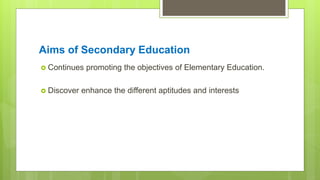
Aims of Secondary Education
 Continues promoting the objectives of Elementary Education.
 Discover enhance the different aptitudes and interests
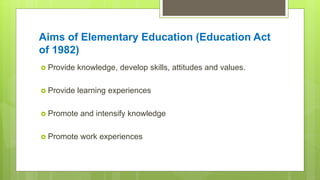
Aims of Elementary Education (Education Act
of 1982)
 Provide knowledge, develop skills, attitudes and values.
 Provide learning experiences
 Promote and intensify knowledge
 Promote work experiences
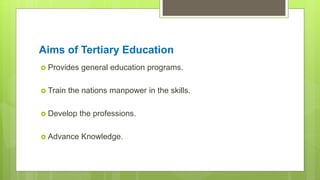
Aims of Tertiary Education
 Provides general education programs.
 Train the nations manpower in the skills.
 Develop the professions.
 Advance Knowledge.
 The brief prospective of a teacher is
to asks students a question about their
experiences and have a reflect on their
own understandings.
 This is to educate them mold as
a total person in the future.
---------
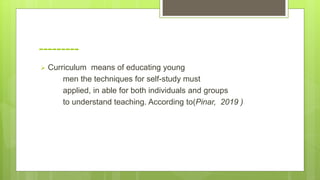
 Curriculum means of educating young
men the techniques for self-study must
applied, in able for both individuals and groups
to understand teaching. According to(Pinar, 2019 )
Vision, Mission and Goals
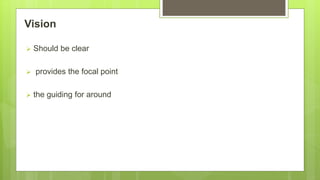
Vision
 Should be clear
 provides the focal point
 the guiding for around
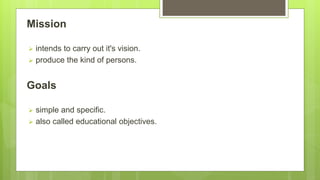
Mission
 intends to carry out it's vision.
 produce the kind of persons.
Goals
 simple and specific.
 also called educational objectives.
 The learners must be guided by the
school inside or outside, whether it carried
in peer, groups or individual.
 Curriculum is a knowledge to be transmitted
and to make students achieve what they
deserve According to ( Kerr, 1960)
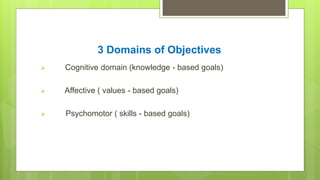
3 Domains of Objectives
 Cognitive domain (knowledge - based goals)
 Affective ( values - based goals)
 Psychomotor ( skills - based goals)
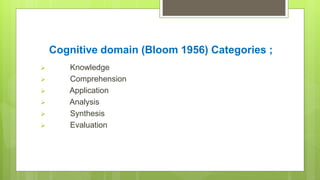
Cognitive domain (Bloom 1956) Categories ;
 Knowledge
 Comprehension
 Application
 Analysis
 Synthesis
 Evaluation
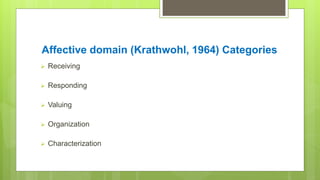
Affective domain (Krathwohl, 1964) Categories
 Receiving
 Responding
 Valuing
 Organization
 Characterization
----
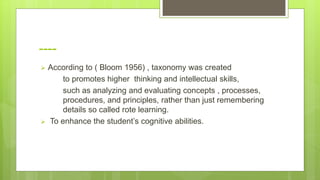
 According to ( Bloom 1956) , taxonomy was created
to promotes higher thinking and intellectual skills,
such as analyzing and evaluating concepts , processes,
procedures, and principles, rather than just remembering
details so called rote learning.
 To enhance the student’s cognitive abilities.
----
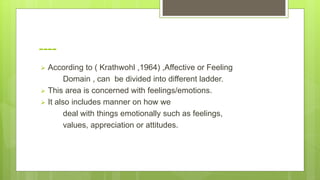
 According to ( Krathwohl ,1964) ,Affective or Feeling
Domain , can be divided into different ladder.
 This area is concerned with feelings/emotions.
 It also includes manner on how we
deal with things emotionally such as feelings,
values, appreciation or attitudes.
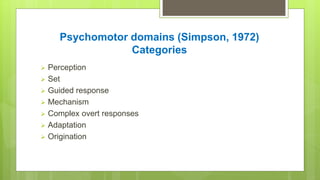
Psychomotor domains (Simpson, 1972)
Categories
 Perception
 Set
 Guided response
 Mechanism
 Complex overt responses
 Adaptation
 Origination
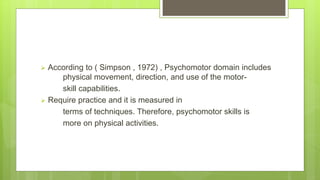
 According to ( Simpson , 1972) , Psychomotor domain includes
physical movement, direction, and use of the motor-
skill capabilities.
 Require practice and it is measured in
terms of techniques. Therefore, psychomotor skills is
more on physical activities.
Curriculum Content or Subject Matter
John Carlo Tilos
Curriculum Content or Subject Matter
 Curriculum content is designed to learned it
 Curriculum content is another term for knowledge
 Learners relates knowledge to personal and social
 Knowledge is a model we build
 According to Cha Reyes, (2014) Content is
more than just information to be learn.
Subject Matter or Learning Content
 These are the examples
 Communications Arts = Listening,speaking,reading and writing
 Mathematics = Numeric,geometry,algebra,logic and reasoning
 Science = Explanation, discovery,scientific method etc.
 Social Studies - Geography, History, Sociology, Anthropology,
Psychology etc.
 Music -Listening, Singing, Playing Musical Instruments etc.
 Physical Education -Health, Physical Fitness, Individual etc.
 Vocational Education -Basic Crafts, Trades, Design etc.
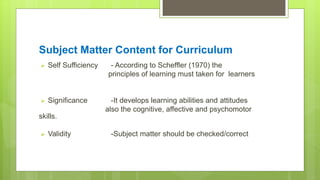
Subject Matter Content for Curriculum
 Self Sufficiency - According to Scheffler (1970) the
principles of learning must taken for learners
 Significance -It develops learning abilities and attitudes
also the cognitive, affective and psychomotor
skills.
 Validity -Subject matter should be checked/correct
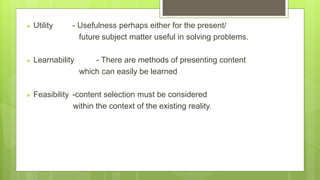
 Utility - Usefulness perhaps either for the present/
future subject matter useful in solving problems.
 Learnability - There are methods of presenting content
which can easily be learned
 Feasibility -content selection must be considered
within the context of the existing reality.
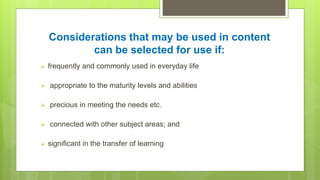
Considerations that may be used in content
can be selected for use if:
 frequently and commonly used in everyday life
 appropriate to the maturity levels and abilities
 precious in meeting the needs etc.
 connected with other subject areas; and
 significant in the transfer of learning
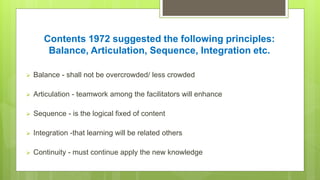
Contents 1972 suggested the following principles:
Balance, Articulation, Sequence, Integration etc.
 Balance - shall not be overcrowded/ less crowded
 Articulation - teamwork among the facilitators will enhance
 Sequence - is the logical fixed of content
 Integration -that learning will be related others
 Continuity - must continue apply the new knowledge
----
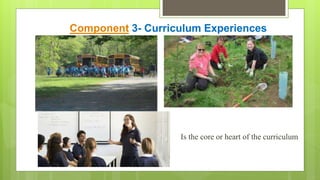
Component 3- Curriculum Experiences
Is the core or heart of the curriculum
Curriculum Experiences
 All about instructional strategies and methods
that brings about experiential learning
 Convert written curriculum into life or action
 Contemporarily updated and multifunctional
Teaching Strategies and Methods
 Achieve the end
 Situationally functional according to the capacity of
the learners and skill of the teacher
 Tap learners’ cognitive, affective, psychomotor, social and
spiritual being
Teaching Strategies…cont’d
 Learner-centered
 Develop learners’ cognitive, affective and psychomotor
learning outcomes
 Highly flexible
Component 4- Curriculum Evaluation
Curriculum Evaluation
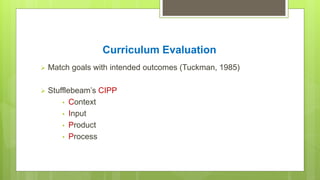
 Match goals with intended outcomes (Tuckman, 1985)
 Stufflebeam’s CIPP
• Context
• Input
• Product
• Process
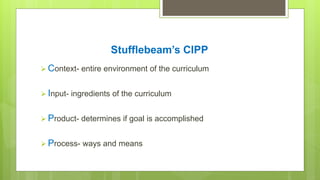
Stufflebeam’s CIPP
 Context- entire environment of the curriculum
 Input- ingredients of the curriculum
 Product- determines if goal is accomplished
 Process- ways and means
Activities for Effective Evaluation
 Diagnostic
 Placement
 Formative evaluation
 Summative evaluation
 Criterion-reference measurement
 Norm-reference measurement
Steps in the Process of Curriculum Evaluation
 Focus on one component of the curriculum
 Collect or gather information
 Organize the information
 Analyze the information
 Report the information
 Recycle the information for feedback and adjustments
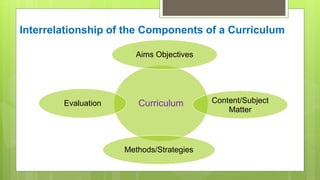
Interrelationship of the Components of a Curriculum
Curriculum
Aims Objectives
Content/Subject
Matter
Methods/Strategies
Evaluation
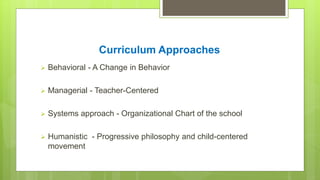
Curriculum Approaches
 Behavioral - A Change in Behavior
 Managerial - Teacher-Centered
 Systems approach - Organizational Chart of the school
 Humanistic - Progressive philosophy and child-centered
movement
Component 1
 Referrence
William Pinar, 2019; Curriculum Theory//www.scholargoogle.com//url//Retrieved
from https://www.taylorfrancis.com/books/9781315625683
Retrieved on : June 18, 2019
John Kerr, 1960; the outcomes based curriculum initiative //www.google.com//url//
retrieved from: https://obecurriculumsessions.wordpress.com/what-is-curriculum/
Retrieved on : June 18, 2019
Component 2
 Referrence
Cha Reyes, (2014). Curriculum Content or Subject Matter.
Retrived from
https://prezi.com/komfyqkwdxv_/curriculum-content-or- subject-matter/
Retrieved on June 18, 2019
Scheffler, (1970). Curriculum Content or Subject Matter.
Retrived from
https://www.scribd.com/doc/317004254/Curriculum- Content-or-Subject-
Matter
Retrieved on June 18, 2019
Component 3
 Referrence
Tucksman, Abaham (1965). Tuckman's stages of Group development: the
forming–storming–norming–performing model of group development.
Retrieved from
[https://en.wikipedia.org/wiki/Tuckman%27s_stages_of_group_development
]. Retrieved on June 18, 2019.
Component 4
 Referrence
Stufflebeam, Daniel (1936-2017). The CIPP evaluation model: The
�CIPP� model of evaluation. Retrieved from
[http://www.cglrc.cgiar.org/icraf/toolkit/The_CIPP_evaluation_
model.htm].
Retrieved on June 18, 2019.
Purita P. Bilbao, Ed. D,. Et.al, (2008) Curriculum Development:
Components of Curriculum and Curricular Approaches. Retrieved
from LORIMAR Publishing Company.
Retrieved on June 18, 2019.
Bloom'sTaxonomyofLearningDomains//www.google.com
Retrieved fromhttp://www.nwlink.com/~donclark/hrd/bloom.html//
Retrieved on June 18, 2019
Krathwohl,1964;Krathwol'sAffectiveDomain
Taxonomy//www.google.com//url.
Retrievedfrom
https://sites.educ.ualberta.ca/staff/olenka.bilash/Best%20
of%20Bilash/krathwol.html
Retrieved on June 18,2019
Thank You For Listening