ELEMENTS/COMPONENTS OF THE
CURRICULUM
What is to be done?
The Philippine educational
system is divided in three
educational levels:
• Primary;
• Secondary; and
• Tertiary
•Provide knowledge and develop
skills, attitudes, values essential to
personal development and
necessary for living in and
contributing to a developing and
changing society;
•Provide learning
experiences which
increase the child’s
awareness of and
responsiveness to the
changes in the society
•Promote and intensify
knowledge,
identification with love
for the nation and the
people to which he
belongs; and
•Promote work
experiences which
develop orientation to
the world of work and
prepare the learner to
engage in the honest
and gainful work.
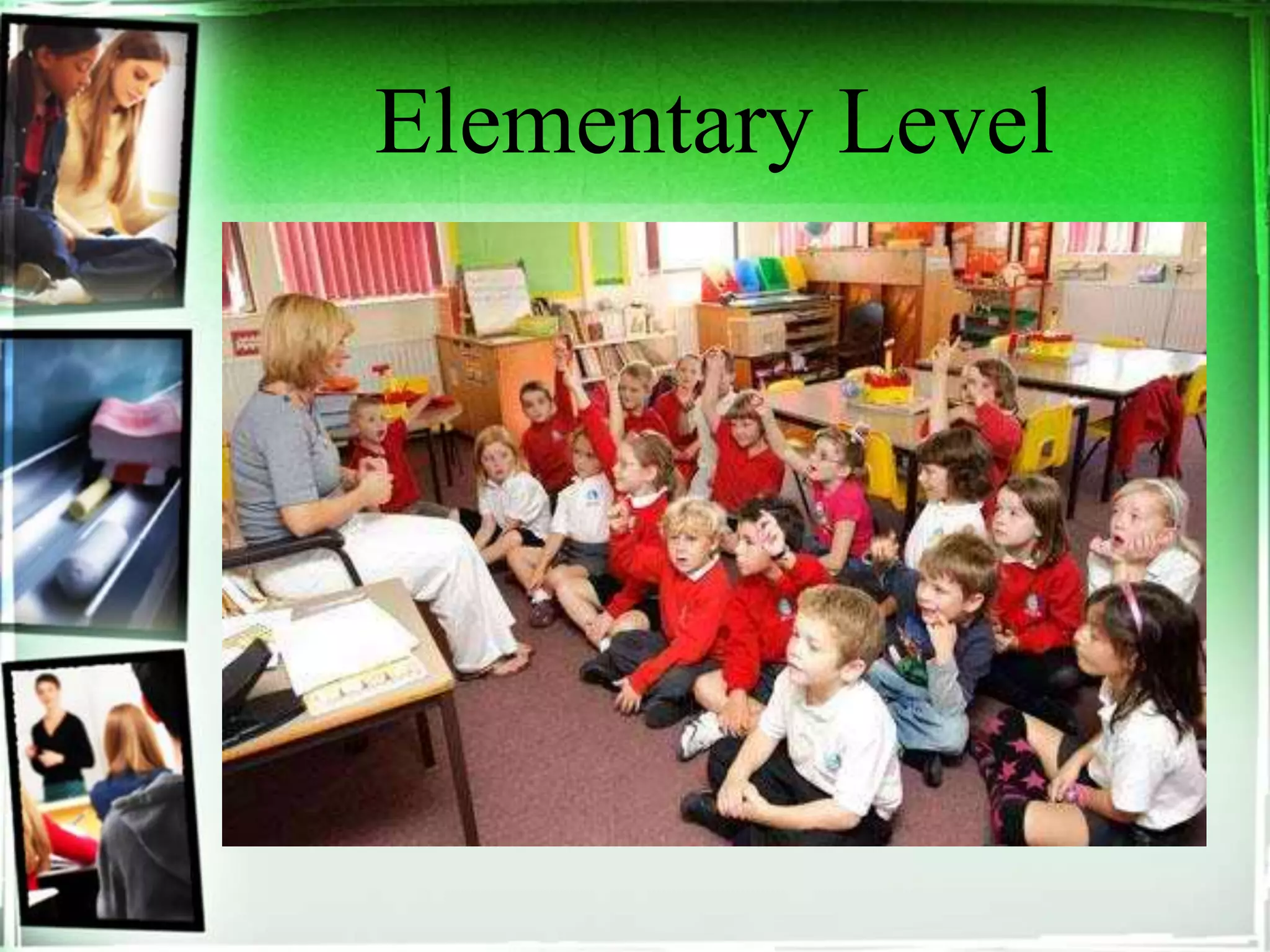
Elementary Level
Level: Secondary Aims of
Secondary Education
• Continue to promote the objectives of
elementary education; and
• Discover and enhance the different
aptitudes and interests of students in
order to equip them with skills for
productive endeavor and or to prepare
them for tertiary schooling.
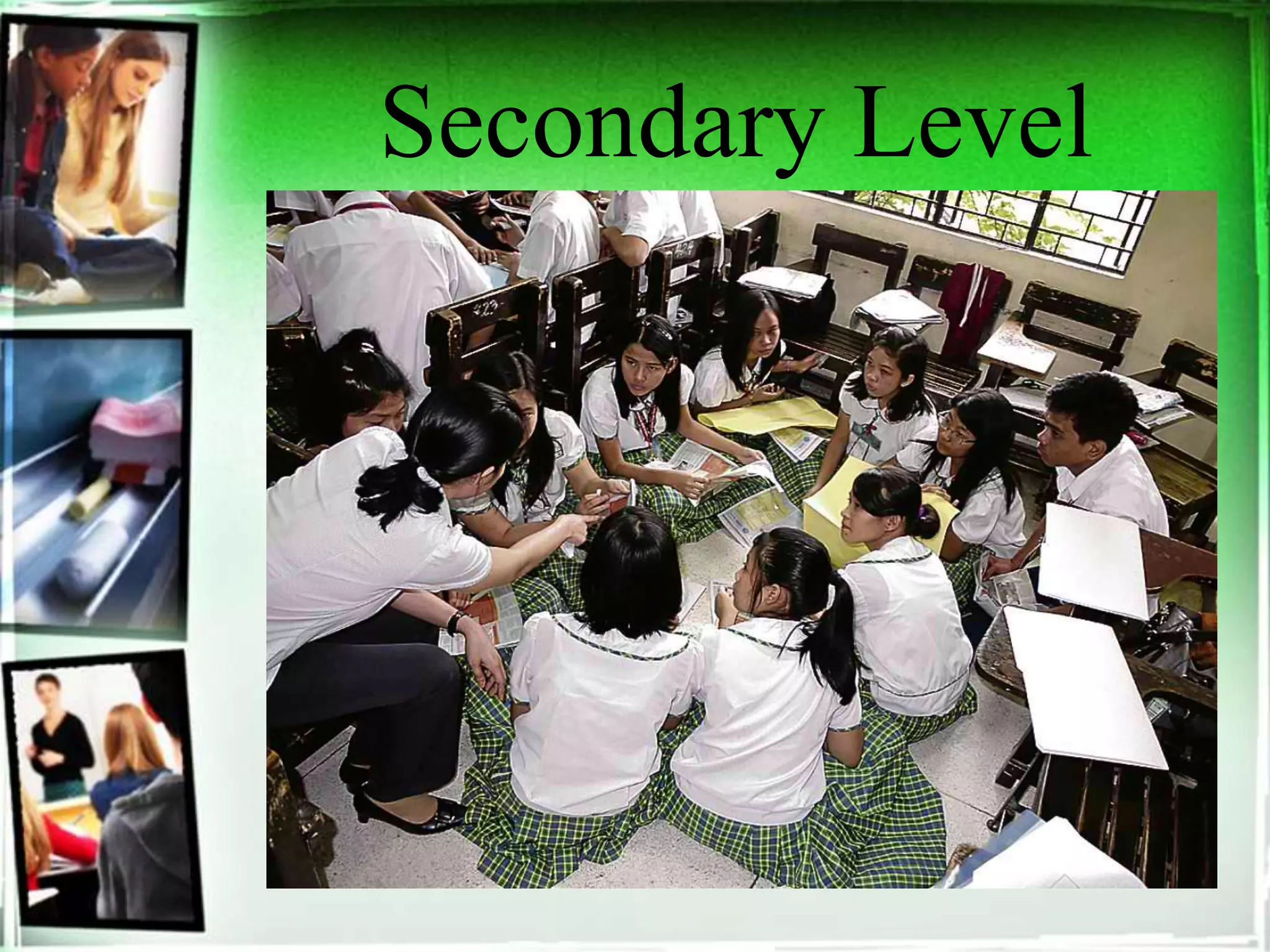
Secondary Level
Tertiary education - refers to college and
university formal education based on
the curricula of the different courses
• Provide general education programs
which will promote national identity,
cultural consciousness, moral integrity
and spiritual vigor;
• Train the nation’s manpower in the
skills required for national
development;
•Develop the professions that
will provide leadership for the
nation; and
•Advance knowledge through
research and apply new
knowledge for improving the
quality of human life and
respond effectively to changing
society.
Tertiary
Level
VISION:
MISSION:
School Vision and Mission
Example of school’s vision:
• A model performing high school
where students are equipped with
knowledge, skills and strength of
character to realize their potential to
the fullest.
Example of school’s mission:
• To produce globally competitive
lifelong learners.
GOALS:
Example of School’s Goals:
• To develop professional, highly
competent, responsible, self-
renewing and ethical teachers who
will serve the community and who
will be effective catalysts of
change in response to the quest for
global competitiveness.
•Build a strong
foundation of
skills and
concepts.
Educational Objectives
Domains
• Cognitive – knowledge, comprehension,
application, analysis, synthesis,
evaluation
• Affective – receiving, responding,
valuing, organization, characterization
• Psychomotor – perception, set, guided
response, mechanism, complex overt
response, adaptation, origination.
Component 2: Curriculum Content or
Subject Matter
Subject-centered view of
curriculum
• The fund of human
knowledge represents the
repository of accumulated
discoveries and inventions
of man down the centuries,
due to man’s exploration of
the world.
Learner-centered view of
curriculum
• Relates knowledge to the
individual’s personal and social
world and how he or she
defines reality.
• Gerome Bruner: “Knowledge is
a model we construct to give
meaning and structure to
regularities in experience.”
•Criteria used in
selection of
subject matter for
the curriculum:
• Self-sufficiency – “less teaching
effort and educational resources,
less learner’s effort but more results
and effective learning outcomes –
most economical manner
(Scheffler, 1970)
• Significance – contribute to basic
ideas to achieve overall aim of
curriculum, develop learning skills.
• Validity – meaningful to the learner
based on maturity, prior experience,
educational and social value.
• Interest –learner will value the
content if it is meaningful to
him/her.
• Utility – usefulness of the content
either for the present or the future.
• Learnability – within the range of
the experience of the learners
• Feasibility – can be learned within
the time allowed, resources
available, expertise of the teacher,
nature of learner
•Principles to follow
in organizing the
learning contents
(Palma 1992):
• Balance – Content curriculum
should be fairly distributed in depth
and breadth of the particular
learning or discipline. This will
ensure that the level or area will not
be overcrowded or less crowded.
• Articulation – Each level of subject
matter should be smoothly
connected to the next, glaring gaps
or wasteful overlaps in the subject
matter will be avoided.
• Sequence – This is the logical
arrangement of the subject matter.
It refers to the deepening and
broadening of content as it is taken
up in the higher level.
• The horizontal connections are
needed in subject areas that are
similar so that learning will be
related to one another. This is
INTEGRATION.
• Learning requires a continuing
application of the new knowledge,
skills, attitudes or values so that
theses will be used in daily living.
The constant repetition, review and
reinforcement of learning is what is
referred to as CONTINUITY.
Component 3
CURRICULUM
EXPERIENCE
• Instructional strategies and
methods will link to curriculum
experiences, the core and heart of
the curriculum. The instructional
strategies and methods will put into
action the goals and use of the
content in order to produce an
outcome.
• Teaching strategies convert the written
curriculum to instruction. Among these
are time tested methods, inquiry
approaches, constructivist and other
emerging strategies that complement
new theories in teaching and learning.
Educational activities like field trips,
conducting experiments, interacting with
computer programs and other
experiential learning will also form par of
the repertoire of teaching.
• Whatever methods the teacher
utilizes to implement the curriculum,
there will be some guide for the
selection and use. Here are some
of them:
Teaching methods are means to
achieve the end
There is no single best teaching
method
Teaching methods should
stimulate the learner’s desire to
develop the cognitive, affective,
psychomotor, social and spiritual
domain of the individual.
In the choice of teaching
methods, learning styles of the
students should be considered.
Every method should lead to the
development of the learning
outcome in three domains
Flexibility should be a
consideration in the use of
teaching methods
Component 4
•Curriculum
Evaluation
• To be effective, all curricula must have
an element of evaluation. Curriculum
evaluation refer to the formal
determination of the quality,
effectiveness or value of the program,
process and product of the curriculum.
Several methods of evaluation came up.
The most widely used is Stufflebeam’s
CIPP Model. The process in CIPP
model is continuous and very important
to curriculum managers.
CIPP Model
Context
• environment of curriculum
Input
• ingredients of curriculum
Process
• ways and means of implementing
Product
• accomplishment of goals
• Regardless of the methods and
materials evaluation will utilize, a
suggested plan of action for the
process of curriculum evaluation is
introduced. Theses are the steps:
Focus on one particular
component of the curriculum. Will
it be subject are, the grade level,
the course, or the degree
program? Specify objectives of
evaluation.
Collect or gather the
information. Information is
made up of data needed
regarding the object of
evaluation.
Organize the information. This
step will require coding,
organizing, storing and
retrieving data for
interpretation.
Analyze information. An
appropriate way of analyzing will
be utilized.
Report the information. The
report of evaluation should be
reported to specific audiences. It
can be done formally in
conferences with stakeholders,
or informally through round table
discussion and conversations.
Recycle the information for
continuous feedback,
modifications and adjustments
to be made.
Interrelationships of the
Components of a Curriculum
Aims
Objectives
Content/Subject
Matter
Methods/Strategies
Evaluation
THANK
YOU !
PREPARED BY:
JOYSLY B. CUTANDA
BSE- MAPEH

Components of curriculum

  • 1.
  • 3.
    What is tobe done? The Philippine educational system is divided in three educational levels: • Primary; • Secondary; and • Tertiary
  • 6.
    •Provide knowledge anddevelop skills, attitudes, values essential to personal development and necessary for living in and contributing to a developing and changing society;
  • 7.
    •Provide learning experiences which increasethe child’s awareness of and responsiveness to the changes in the society
  • 8.
    •Promote and intensify knowledge, identificationwith love for the nation and the people to which he belongs; and
  • 9.
    •Promote work experiences which developorientation to the world of work and prepare the learner to engage in the honest and gainful work.
  • 10.
  • 11.
    Level: Secondary Aimsof Secondary Education • Continue to promote the objectives of elementary education; and • Discover and enhance the different aptitudes and interests of students in order to equip them with skills for productive endeavor and or to prepare them for tertiary schooling.
  • 12.
  • 13.
    Tertiary education -refers to college and university formal education based on the curricula of the different courses • Provide general education programs which will promote national identity, cultural consciousness, moral integrity and spiritual vigor; • Train the nation’s manpower in the skills required for national development;
  • 14.
    •Develop the professionsthat will provide leadership for the nation; and •Advance knowledge through research and apply new knowledge for improving the quality of human life and respond effectively to changing society.
  • 15.
  • 16.
  • 17.
  • 18.
    School Vision andMission Example of school’s vision: • A model performing high school where students are equipped with knowledge, skills and strength of character to realize their potential to the fullest. Example of school’s mission: • To produce globally competitive lifelong learners.
  • 19.
  • 20.
    Example of School’sGoals: • To develop professional, highly competent, responsible, self- renewing and ethical teachers who will serve the community and who will be effective catalysts of change in response to the quest for global competitiveness.
  • 21.
    •Build a strong foundationof skills and concepts.
  • 22.
  • 23.
    Domains • Cognitive –knowledge, comprehension, application, analysis, synthesis, evaluation • Affective – receiving, responding, valuing, organization, characterization • Psychomotor – perception, set, guided response, mechanism, complex overt response, adaptation, origination.
  • 24.
    Component 2: CurriculumContent or Subject Matter
  • 25.
    Subject-centered view of curriculum •The fund of human knowledge represents the repository of accumulated discoveries and inventions of man down the centuries, due to man’s exploration of the world.
  • 26.
    Learner-centered view of curriculum •Relates knowledge to the individual’s personal and social world and how he or she defines reality. • Gerome Bruner: “Knowledge is a model we construct to give meaning and structure to regularities in experience.”
  • 27.
    •Criteria used in selectionof subject matter for the curriculum:
  • 28.
    • Self-sufficiency –“less teaching effort and educational resources, less learner’s effort but more results and effective learning outcomes – most economical manner (Scheffler, 1970) • Significance – contribute to basic ideas to achieve overall aim of curriculum, develop learning skills.
  • 29.
    • Validity –meaningful to the learner based on maturity, prior experience, educational and social value. • Interest –learner will value the content if it is meaningful to him/her. • Utility – usefulness of the content either for the present or the future.
  • 30.
    • Learnability –within the range of the experience of the learners • Feasibility – can be learned within the time allowed, resources available, expertise of the teacher, nature of learner
  • 31.
    •Principles to follow inorganizing the learning contents (Palma 1992):
  • 32.
    • Balance –Content curriculum should be fairly distributed in depth and breadth of the particular learning or discipline. This will ensure that the level or area will not be overcrowded or less crowded.
  • 33.
    • Articulation –Each level of subject matter should be smoothly connected to the next, glaring gaps or wasteful overlaps in the subject matter will be avoided. • Sequence – This is the logical arrangement of the subject matter. It refers to the deepening and broadening of content as it is taken up in the higher level.
  • 34.
    • The horizontalconnections are needed in subject areas that are similar so that learning will be related to one another. This is INTEGRATION.
  • 35.
    • Learning requiresa continuing application of the new knowledge, skills, attitudes or values so that theses will be used in daily living. The constant repetition, review and reinforcement of learning is what is referred to as CONTINUITY.
  • 36.
  • 37.
    • Instructional strategiesand methods will link to curriculum experiences, the core and heart of the curriculum. The instructional strategies and methods will put into action the goals and use of the content in order to produce an outcome.
  • 38.
    • Teaching strategiesconvert the written curriculum to instruction. Among these are time tested methods, inquiry approaches, constructivist and other emerging strategies that complement new theories in teaching and learning. Educational activities like field trips, conducting experiments, interacting with computer programs and other experiential learning will also form par of the repertoire of teaching.
  • 39.
    • Whatever methodsthe teacher utilizes to implement the curriculum, there will be some guide for the selection and use. Here are some of them: Teaching methods are means to achieve the end There is no single best teaching method
  • 40.
    Teaching methods should stimulatethe learner’s desire to develop the cognitive, affective, psychomotor, social and spiritual domain of the individual. In the choice of teaching methods, learning styles of the students should be considered.
  • 41.
    Every method shouldlead to the development of the learning outcome in three domains Flexibility should be a consideration in the use of teaching methods
  • 42.
  • 43.
    • To beeffective, all curricula must have an element of evaluation. Curriculum evaluation refer to the formal determination of the quality, effectiveness or value of the program, process and product of the curriculum. Several methods of evaluation came up. The most widely used is Stufflebeam’s CIPP Model. The process in CIPP model is continuous and very important to curriculum managers.
  • 44.
    CIPP Model Context • environmentof curriculum Input • ingredients of curriculum Process • ways and means of implementing Product • accomplishment of goals
  • 45.
    • Regardless ofthe methods and materials evaluation will utilize, a suggested plan of action for the process of curriculum evaluation is introduced. Theses are the steps: Focus on one particular component of the curriculum. Will it be subject are, the grade level, the course, or the degree program? Specify objectives of evaluation.
  • 46.
    Collect or gatherthe information. Information is made up of data needed regarding the object of evaluation. Organize the information. This step will require coding, organizing, storing and retrieving data for interpretation.
  • 47.
    Analyze information. An appropriateway of analyzing will be utilized. Report the information. The report of evaluation should be reported to specific audiences. It can be done formally in conferences with stakeholders, or informally through round table discussion and conversations.
  • 48.
    Recycle the informationfor continuous feedback, modifications and adjustments to be made.
  • 49.
    Interrelationships of the Componentsof a Curriculum Aims Objectives Content/Subject Matter Methods/Strategies Evaluation
  • 50.
  • 51.
    PREPARED BY: JOYSLY B.CUTANDA BSE- MAPEH