STUDIES OF THE INFLUENCE OF
VALUES,
OF SOCIETY AND CULTURE
ON CURRICULUM PROCESS
BY: LEONY C. ESPIN
Values life’s artifacts that we prize
and cherish most
Society structured community of people
bounded together by similar traditions,
institutions or nationality
LET’S DEFINE…….
Culture shapes the mind... it provides us with the toolkit by
which we construct not only our worlds but our
very conception of our selves and our powers‘-
Jerome Bruner
Culture is a complex whole which includes knowledge,
beliefs, arts, morals, customs and any other
capabilities acquired by man as a member of the
society. It is the sum total of a given society’s way of
life molded and shaped by prevailing circumstances
and environment(Brown, 1990)
DEFINITIONS OF CULTURE
Culture is the most powerful source
of leverage for bringing about
change in a school – or any
organization, for that matter.
Thomas J. Sergiovanni
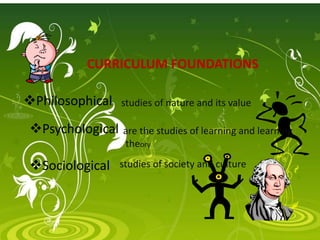
CURRICULUM FOUNDATIONS
Sociological
Psychological
Philosophical
are the studies of learning and learning
theory
studies of nature and its value
studies of society and culture
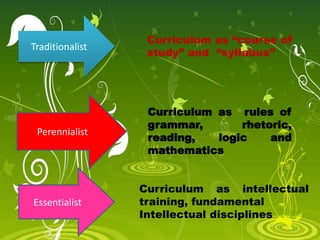
Perennialist
Traditionalist
Essentialist
Curriculum as intellectual
training, fundamental
Intellectual disciplines
Curriculum as “course of
study” and “syllabus”
Curriculum as rules of
grammar, rhetoric,
reading, logic and
mathematics
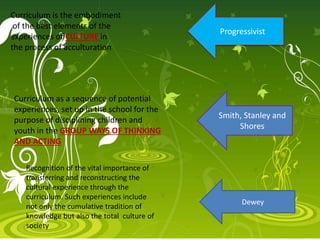
Progressivist
Curriculum is the embodiment
of the best elements of the
experiences of CULTURE in
the process of acculturation
Smith, Stanley and
Shores
Curriculum as a sequence of potential
experiences, set up in the school for the
purpose of disciplining children and
youth in the GROUP WAYS OF THINKING
AND ACTING
Dewey
Recognition of the vital importance of
transferring and reconstructing the
cultural experience through the
curriculum. Such experiences include
not only the cumulative tradition of
knowledge but also the total culture of
society
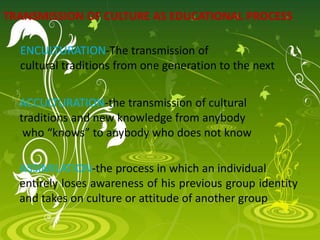
TRANSMISSION OF CULTURE AS EDUCATIONAL PROCESS
ENCULTURATION-The transmission of
cultural traditions from one generation to the next
ACCULTURATION-the transmission of cultural
traditions and new knowledge from anybody
who “knows” to anybody who does not know
ASSIMILATION-the process in which an individual
entirely loses awareness of his previous group identity
and takes on culture or attitude of another group
Sociological Foundations- curriculum
designers must consider both the real and
ideal order of the things in society
Things to consider in making a curriculum
based on the society’s problem
 Needs and problems of the society which the
school intends to serve
 Scientific breakthroughs
 Technological revolution
 Unemployment
 Basic values, beliefs and principles of the
people
 Destruction of the
environment
 Philosophy, points of view and
recommendations of educators
 Social, economic and political
conditions
Careers and vocations open to graduates
Cultural changes
Legal mandates affecting education
Poverty
Weakening of family as the basic social unit
Value crises among youths
and adults
Beauchamp
1. Outline of culture content to be taught
2.Statement of goals and specific objectives
3.Statement of the purposes
4.Appraisal scheme
PROBLEM-CENTERED CURRICULUM
conceived as the framework which is guided toward
maturity within the context of the social group
It places equal emphasis upon the needs of society
and demands of teachers’ knowledge and
understanding of the forces which shape society
It assumes that the needs of children and the needs of
society are not antithetic but rather complementary and
that children reach their highest potential as they are
encouraged to develop their capabilities within the
context of group life
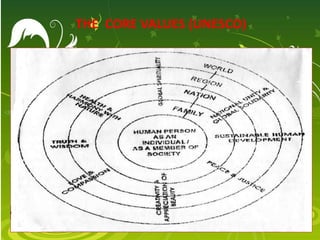
THE CORE VALUES (UNESCO)
K12 PREMISE ON SOCIETY AND ECONOMY
• K to 12 will contribute to economic growth. Several
studies have shown that improvements in the quality of
education will increase GDP growth by as much as 2%.
• K to 12 will facilitate mutual recognition of Filipino
graduates and professionals in other countries.
• A better educated society provides a sound
foundation for long-term socio economic
development.
MULTICULTURAL
EDUCATION
GLOBALIZATION
Multicultural education is an approach to teaching that values diversity
in the classroom—diversity in content, methods, perspectives,
educators, students, and cultures. Being a multicultural educator means
embracing your students’ and others’ cultural diversity as a means of
nurturing your students’ academic and personal growth.
Multicultural education is an idea, an educational reform movement,
and a process (Banks, 1997). As an idea, multicultural education seeks to
create equal educational opportunities for all students, including those
from different racial, ethnic, and social-class groups. Multicultural
education tries to create equal educational opportunities for all
students by changing the total school environment so that it will reflect
the diverse cultures and groups within a society and within the nation's
classrooms.
DEFINITIONS OF MULTICULTURAL EDUCATION
MULTICULTURAL EDUCATION
The primary goal of multicultural
education is to transform the schools that
male and female, exceptional students, a
and students from diverse cultural, social
class, racial and ethnic groups experience
and opportunity to learn (Banks, 2005).
APPROACHES TO MULTICULTURAL EDUCATION
Level 1: Contributions
Level 2: Additive
Level 3: Transformation
Level 4: Social Action
EDUCATION AND GLOBALIZATION
used to describe the growing integration of
economies worldwide through increase in
trade of investments flows and technology
transfer
refers to the increasing interconnectedness
and convergence of activities and forms of
life among diverse cultures throughout the world
INFLUENCE OF VALUES AND CULTURE IN CURRICULUM PROCESS

INFLUENCE OF VALUES AND CULTURE IN CURRICULUM PROCESS

  • 1.
    STUDIES OF THEINFLUENCE OF VALUES, OF SOCIETY AND CULTURE ON CURRICULUM PROCESS BY: LEONY C. ESPIN
  • 2.
    Values life’s artifactsthat we prize and cherish most Society structured community of people bounded together by similar traditions, institutions or nationality LET’S DEFINE…….
  • 3.
    Culture shapes themind... it provides us with the toolkit by which we construct not only our worlds but our very conception of our selves and our powers‘- Jerome Bruner Culture is a complex whole which includes knowledge, beliefs, arts, morals, customs and any other capabilities acquired by man as a member of the society. It is the sum total of a given society’s way of life molded and shaped by prevailing circumstances and environment(Brown, 1990) DEFINITIONS OF CULTURE
  • 4.
    Culture is themost powerful source of leverage for bringing about change in a school – or any organization, for that matter. Thomas J. Sergiovanni
  • 5.
    CURRICULUM FOUNDATIONS Sociological Psychological Philosophical are thestudies of learning and learning theory studies of nature and its value studies of society and culture
  • 6.
    Perennialist Traditionalist Essentialist Curriculum as intellectual training,fundamental Intellectual disciplines Curriculum as “course of study” and “syllabus” Curriculum as rules of grammar, rhetoric, reading, logic and mathematics
  • 7.
    Progressivist Curriculum is theembodiment of the best elements of the experiences of CULTURE in the process of acculturation Smith, Stanley and Shores Curriculum as a sequence of potential experiences, set up in the school for the purpose of disciplining children and youth in the GROUP WAYS OF THINKING AND ACTING Dewey Recognition of the vital importance of transferring and reconstructing the cultural experience through the curriculum. Such experiences include not only the cumulative tradition of knowledge but also the total culture of society
  • 8.
    TRANSMISSION OF CULTUREAS EDUCATIONAL PROCESS ENCULTURATION-The transmission of cultural traditions from one generation to the next ACCULTURATION-the transmission of cultural traditions and new knowledge from anybody who “knows” to anybody who does not know ASSIMILATION-the process in which an individual entirely loses awareness of his previous group identity and takes on culture or attitude of another group
  • 9.
    Sociological Foundations- curriculum designersmust consider both the real and ideal order of the things in society Things to consider in making a curriculum based on the society’s problem  Needs and problems of the society which the school intends to serve  Scientific breakthroughs  Technological revolution  Unemployment
  • 10.
     Basic values,beliefs and principles of the people  Destruction of the environment  Philosophy, points of view and recommendations of educators  Social, economic and political conditions
  • 11.
    Careers and vocationsopen to graduates Cultural changes Legal mandates affecting education Poverty Weakening of family as the basic social unit Value crises among youths and adults
  • 12.
    Beauchamp 1. Outline ofculture content to be taught 2.Statement of goals and specific objectives 3.Statement of the purposes 4.Appraisal scheme
  • 13.
    PROBLEM-CENTERED CURRICULUM conceived asthe framework which is guided toward maturity within the context of the social group It places equal emphasis upon the needs of society and demands of teachers’ knowledge and understanding of the forces which shape society It assumes that the needs of children and the needs of society are not antithetic but rather complementary and that children reach their highest potential as they are encouraged to develop their capabilities within the context of group life
  • 14.
  • 15.
    K12 PREMISE ONSOCIETY AND ECONOMY • K to 12 will contribute to economic growth. Several studies have shown that improvements in the quality of education will increase GDP growth by as much as 2%. • K to 12 will facilitate mutual recognition of Filipino graduates and professionals in other countries. • A better educated society provides a sound foundation for long-term socio economic development.
  • 16.
  • 17.
    Multicultural education isan approach to teaching that values diversity in the classroom—diversity in content, methods, perspectives, educators, students, and cultures. Being a multicultural educator means embracing your students’ and others’ cultural diversity as a means of nurturing your students’ academic and personal growth. Multicultural education is an idea, an educational reform movement, and a process (Banks, 1997). As an idea, multicultural education seeks to create equal educational opportunities for all students, including those from different racial, ethnic, and social-class groups. Multicultural education tries to create equal educational opportunities for all students by changing the total school environment so that it will reflect the diverse cultures and groups within a society and within the nation's classrooms. DEFINITIONS OF MULTICULTURAL EDUCATION
  • 18.
    MULTICULTURAL EDUCATION The primarygoal of multicultural education is to transform the schools that male and female, exceptional students, a and students from diverse cultural, social class, racial and ethnic groups experience and opportunity to learn (Banks, 2005).
  • 19.
    APPROACHES TO MULTICULTURALEDUCATION Level 1: Contributions Level 2: Additive Level 3: Transformation Level 4: Social Action
  • 20.
    EDUCATION AND GLOBALIZATION usedto describe the growing integration of economies worldwide through increase in trade of investments flows and technology transfer refers to the increasing interconnectedness and convergence of activities and forms of life among diverse cultures throughout the world