
MANAGEMENT OF NATURAL RESOURCES IN CONSTRUCTION Dr. N. Sai Bhaskar Reddy, GEO http://www.e-geo.org CDI, HYDERABAD 23 RD  JULY 2009
Introduction Since the Industrial Revolution the world has witnessed incalculable technological achievements  population growth  corresponding increases in resource use “ Side effects” of all the activities and achievements include:  pollution, landfills at capacity, toxic waste, global warming, resource  and ozone depletion, and deforestation All these efforts are straining the limits of the Earth’s “carrying capacity”— its ability to provide the resources required to sustain life while retaining the capacity to regenerate and remain viable.
Sustainability SUSTAINABLE DEVELOPMENT   Development that meets the needs of the present without compromising the ability of future generations to meet their own needs (The Brundtland Commission,1987)
Sustainability and the Construction Industry 'Sustainability' is becoming a central concern for us all out of wider recognition that rising populations and economic development are threatening the degradation of the earth's resources. The construction, maintenance and use of buildings impacts substantially on our environment and is currently contributing significantly to irreversible changes in the world's climate, atmosphere and ecosystem. Buildings are by far the greatest producers of harmful gases such as CO2 and this 'eco-footprint' can only increase with the large population growth predicted to occur by 2050 and the industrialization of the developing world.
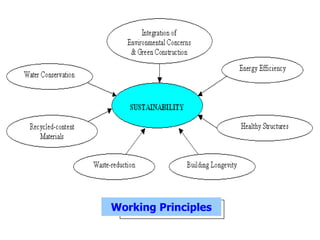
How the Construction Industry can move towards Sustainable Development –  Energy: reducing energy consumption, being more energy efficient  and using renewable energy and 'alternative technology'. –  Materials: Choosing, using, re-using and recycling materials during  design, manufacture, construction and maintenance to reduce resource requirements. –  Waste: Producing less waste and recycling more. –  Pollution: Producing less toxicity, water, noise and spatial pollution.
Aspects of building material adoption Natural Social Economical Political Cultural Historical Environmental
Concrete - impacts http://www.youtube.com/watch?v=BdG0s8llQrA
Environmental Amenities reducing, reusing and recycling materials
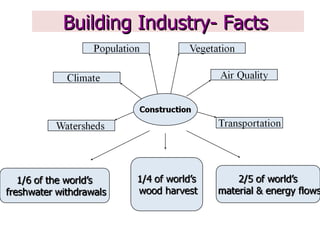
Building Industry- Facts
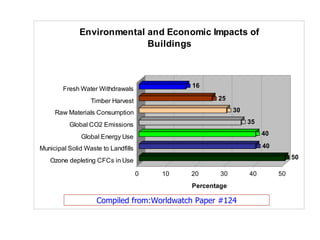
Compiled from:Worldwatch Paper #124
Working Principles
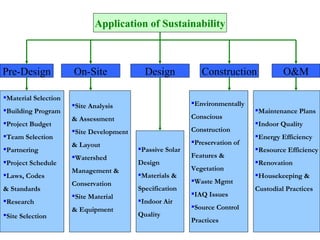
Application of Sustainability Pre-Design On-Site Design Construction O&M Material Selection Building Program Project Budget Team Selection  Partnering Project Schedule Laws, Codes  & Standards Research Site Selection   Site Analysis  & Assessment Site Development & Layout Watershed  Management & Conservation Site Material  & Equipment Environmentally  Conscious  Construction Preservation of  Features &  Vegetation Waste Mgmt IAQ Issues Source Control  Practices Passive Solar  Design Materials &  Specification Indoor Air  Quality Maintenance Plans Indoor Quality Energy Efficiency Resource Efficiency Renovation Housekeeping & Custodial Practices
How does the Construction Industry consume Energy? •  Consider the 'embodied' energy in every brick in every structure. Every brick has used energy at every stage in its production and use. •  Energy is consumed when: –  Extracting raw materials. –  Producing materials (Manufacturing process). –  Transporting materials. –  Transporting workforce. –  Building structures. –  Using and powering structures. –  Maintaining structures and demolishing structures.
Materials •  Around 50% of all global resources go into the construction industry, with a specific example being that 70% of all timber is used for building. •  It is therefore very important that a sustainable approach to choosing and using materials is adopted. •  The environmental and economic benefits of sustainability are inherently linked when considering building materials, due to the long-term financial advantages of recycling, using recycled products and sourcing heavy materials locally. •  Life-Cycle Assessment, Eco-Labelling and Embodied Energy Audits all of which can help choosing materials and assess the balance between short-term costs and long-term environmental, social and financial benefits.
How to Choose and Use Materials in a more Sustainable way •  Considerations to take into account when re-evaluating the way in which materials are used in construction: –  What reserves are left of our materials, and how can their complete successive depletion be prevented? –  What are the pollution impacts of the manufacturing process involved with creating new materials? –  How can existing materials be recycled (roof tiles, bricks, timber, etc.) and can they be designed and used in a way more conducive to re-use? –  How much energy is consumed in the transport of materials? (try sourcing heavy, bulky materials locally and lightweight materials globally). –  Can more prefabricated components be used? (reduces waste and dust on site). –  How can more low maintenance materials be used in order to reduce further energy and resource use in the future of the building?
Fire resistant natural material: Asbestos Name one synthetic material: Synthetic Materials Acrylic, polyethylene, nylon, polystyrene – synthetic materials are widely used and are employed in almost all areas of life. Conservation of Natural Resources: The wise use of earths resources by humanity. Building Industry Impact 1/6 th  of worlds freshwater withdrawals 1/4 th  of worlds wood harvest 2/5 th  of worlds material and energy flows
Thank you Ref: http://

Natural Resources In Construction Geo Cdi Final

  • 1.
    MANAGEMENT OF NATURALRESOURCES IN CONSTRUCTION Dr. N. Sai Bhaskar Reddy, GEO http://www.e-geo.org CDI, HYDERABAD 23 RD JULY 2009
  • 2.
    Introduction Since theIndustrial Revolution the world has witnessed incalculable technological achievements population growth corresponding increases in resource use “ Side effects” of all the activities and achievements include: pollution, landfills at capacity, toxic waste, global warming, resource and ozone depletion, and deforestation All these efforts are straining the limits of the Earth’s “carrying capacity”— its ability to provide the resources required to sustain life while retaining the capacity to regenerate and remain viable.
  • 3.
    Sustainability SUSTAINABLE DEVELOPMENT Development that meets the needs of the present without compromising the ability of future generations to meet their own needs (The Brundtland Commission,1987)
  • 4.
    Sustainability and theConstruction Industry 'Sustainability' is becoming a central concern for us all out of wider recognition that rising populations and economic development are threatening the degradation of the earth's resources. The construction, maintenance and use of buildings impacts substantially on our environment and is currently contributing significantly to irreversible changes in the world's climate, atmosphere and ecosystem. Buildings are by far the greatest producers of harmful gases such as CO2 and this 'eco-footprint' can only increase with the large population growth predicted to occur by 2050 and the industrialization of the developing world.
  • 5.
    How the ConstructionIndustry can move towards Sustainable Development – Energy: reducing energy consumption, being more energy efficient and using renewable energy and 'alternative technology'. – Materials: Choosing, using, re-using and recycling materials during design, manufacture, construction and maintenance to reduce resource requirements. – Waste: Producing less waste and recycling more. – Pollution: Producing less toxicity, water, noise and spatial pollution.
  • 6.
    Aspects of buildingmaterial adoption Natural Social Economical Political Cultural Historical Environmental
  • 7.
    Concrete - impactshttp://www.youtube.com/watch?v=BdG0s8llQrA
  • 8.
    Environmental Amenities reducing,reusing and recycling materials
  • 9.
  • 10.
  • 11.
  • 12.
    Application of SustainabilityPre-Design On-Site Design Construction O&M Material Selection Building Program Project Budget Team Selection Partnering Project Schedule Laws, Codes & Standards Research Site Selection Site Analysis & Assessment Site Development & Layout Watershed Management & Conservation Site Material & Equipment Environmentally Conscious Construction Preservation of Features & Vegetation Waste Mgmt IAQ Issues Source Control Practices Passive Solar Design Materials & Specification Indoor Air Quality Maintenance Plans Indoor Quality Energy Efficiency Resource Efficiency Renovation Housekeeping & Custodial Practices
  • 13.
    How does theConstruction Industry consume Energy? • Consider the 'embodied' energy in every brick in every structure. Every brick has used energy at every stage in its production and use. • Energy is consumed when: – Extracting raw materials. – Producing materials (Manufacturing process). – Transporting materials. – Transporting workforce. – Building structures. – Using and powering structures. – Maintaining structures and demolishing structures.
  • 14.
    Materials • Around 50% of all global resources go into the construction industry, with a specific example being that 70% of all timber is used for building. • It is therefore very important that a sustainable approach to choosing and using materials is adopted. • The environmental and economic benefits of sustainability are inherently linked when considering building materials, due to the long-term financial advantages of recycling, using recycled products and sourcing heavy materials locally. • Life-Cycle Assessment, Eco-Labelling and Embodied Energy Audits all of which can help choosing materials and assess the balance between short-term costs and long-term environmental, social and financial benefits.
  • 15.
    How to Chooseand Use Materials in a more Sustainable way • Considerations to take into account when re-evaluating the way in which materials are used in construction: – What reserves are left of our materials, and how can their complete successive depletion be prevented? – What are the pollution impacts of the manufacturing process involved with creating new materials? – How can existing materials be recycled (roof tiles, bricks, timber, etc.) and can they be designed and used in a way more conducive to re-use? – How much energy is consumed in the transport of materials? (try sourcing heavy, bulky materials locally and lightweight materials globally). – Can more prefabricated components be used? (reduces waste and dust on site). – How can more low maintenance materials be used in order to reduce further energy and resource use in the future of the building?
  • 16.
    Fire resistant naturalmaterial: Asbestos Name one synthetic material: Synthetic Materials Acrylic, polyethylene, nylon, polystyrene – synthetic materials are widely used and are employed in almost all areas of life. Conservation of Natural Resources: The wise use of earths resources by humanity. Building Industry Impact 1/6 th of worlds freshwater withdrawals 1/4 th of worlds wood harvest 2/5 th of worlds material and energy flows
  • 17.

Editor's Notes

  • #7 Besides reducing, reusing and recycling materials, green building includes other environmental amenities: - Hard drive and walk surfaces made of permeable materials to reduce water runoff - Lower monthly utility bills - Less dependence on petroleum by using local materials that cut down on transportation needs - Healthy, productive work and home environments *statistics used from the Smart Growth Network web site, www.smartgrowth.org
  • #9 Besides reducing, reusing and recycling materials, green building includes other environmental amenities: - Hard drive and walk surfaces made of permeable materials to reduce water runoff - Lower monthly utility bills - Less dependence on petroleum by using local materials that cut down on transportation needs - Healthy, productive work and home environments *statistics used from the Smart Growth Network web site, www.smartgrowth.org