DR N SAI BHASKAR REDDY | Environmentalist and Biochar Expert
saibhaskarnakka@gmail.com
National Seminar on
Biochar – Status & Opportunities
17-18 August 2023
Venue: ni-msme, Yousufguda, Hyderabad
18 August 2023
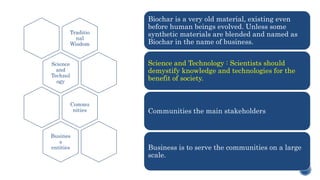
Traditio
nal
Wisdom
Science
and
Technol
ogy
Commu
nities
Busines
s
entities
Biochar is a very old material, existing even
before human beings evolved. Unless some
synthetic materials are blended and named as
Biochar in the name of business.
Science and Technology : Scientists should
demystify knowledge and technologies for the
benefit of society.
Communities the main stakeholders
Business is to serve the communities on a large
scale.
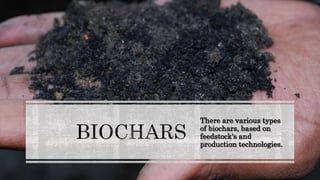
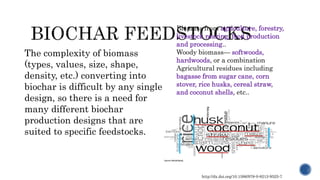
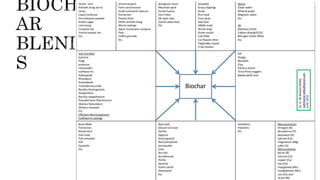
There are various types
of biochars, based on
feedstock's and
production technologies.
Biomass from agriculture, forestry,
livestock rearing, food production
and processing..
Woody biomass— softwoods,
hardwoods, or a combination
Agricultural residues including
bagasse from sugar cane, corn
stover, rice husks, cereal straw,
and coconut shells, etc..
http://dx.doi.org/10.1596/978-0-8213-9525-7
The complexity of biomass
(types, values, size, shape,
density, etc.) converting into
biochar is difficult by any single
design, so there is a need for
many different biochar
production designs that are
suited to specific feedstocks.
 Soil carbon is probably the most important component in soils as it affects almost
all soil properties. Carbon, as soil organic matter, alters the physical, chemical,
and biological properties of soils. Soil organic matter refers to all decomposed,
partly decomposed and undecomposed organic materials of plant and animal
origin. It is generally synonymous with humus although the latter is more
commonly used when referring to the well decomposed organic matter called
humic substances. Soil organic matter is a primary indicator of soil quality. FAO
(Standard operating procedure for soil organic carbon. Walkley-Black method:
titration and colorimetric method (fao.org))
 … Converting waste plant material into a charcoal-like substance
called biochar and burying it in soil can also be used to store carbon away from the
atmosphere for decades to centuries… (Ref IPCC Report)
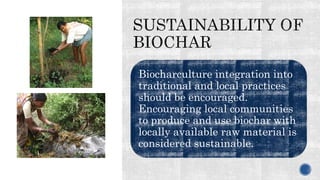
Biocharculture integration into
traditional and local practices
should be encouraged.
Encouraging local communities
to produce and use biochar with
locally available raw material is
considered sustainable.
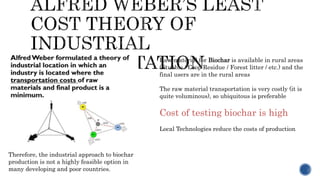
Raw material for Biochar is available in rural areas
(Stubble / Crop Residue / Forest litter / etc.) and the
final users are in the rural areas
The raw material transportation is very costly (it is
quite voluminous), so ubiquitous is preferable
Cost of testing biochar is high
Local Technologies reduce the costs of production
Therefore, the industrial approach to biochar
production is not a highly feasible option in
many developing and poor countries.
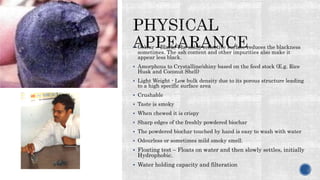
 Colour – Black, The shiny reflective surface reduces the blackness
sometimes. The ash content and other impurities also make it
appear less black.
 Amorphous to Crystalline/shiny based on the feed stock (E.g. Rice
Husk and Coconut Shell)
 Light Weight - Low bulk density due to its porous structure leading
to a high specific surface area
 Crushable
 Taste is smoky
 When chewed it is crispy
 Sharp edges of the freshly powdered biochar
 The powdered biochar touched by hand is easy to wash with water
 Odourless or sometimes mild smoky smell.
 Floating test – Floats on water and then slowly settles, initially
Hydrophobic.
 Water holding capacity and filteration
RESULTS ARE IMPORTANT
 Biochar is a process medium rather than a 'result' medium. However,
testing the chemical composition of biochar as a ‘result’ medium is
easier than estimating and appreciating the real value of the functions
biochar performs in space and over time.
 After application to the soil, evaluation of a process medium could
involve measuring the moisture retention in the soil, the extent of
aeration of the soil, the level of absorption of harmful pesticides and
chemicals from the soil, release of nitrogen into the soil, level of
absorption of GHGs from the soil, temperature regulation in the soil,
and quality of habitat for the thriving of soil microbes, quantity of soil
microbes and other variables.
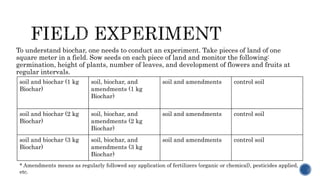
To understand biochar, one needs to conduct an experiment. Take pieces of land of one
square meter in a field. Sow seeds on each piece of land and monitor the following:
germination, height of plants, number of leaves, and development of flowers and fruits at
regular intervals.
soil and biochar (1 kg
Biochar)
soil, biochar, and
amendments (1 kg
Biochar)
soil and amendments control soil
soil and biochar (2 kg
Biochar)
soil, biochar, and
amendments (2 kg
Biochar)
soil and amendments control soil
soil and biochar (3 kg
Biochar)
soil, biochar, and
amendments (3 kg
Biochar)
soil and amendments control soil
* Amendments means as regularly followed say application of fertilizers (organic or chemical), pesticides applied,
etc.
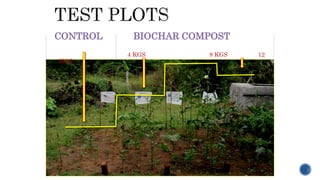
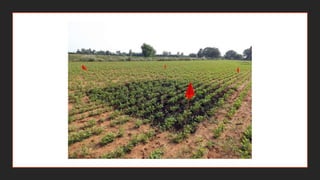
CONTROL BIOCHAR COMPOST
4 KGS 8 KGS 12
KGS
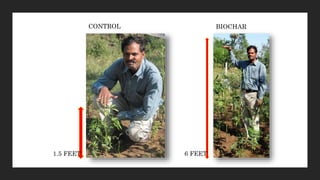
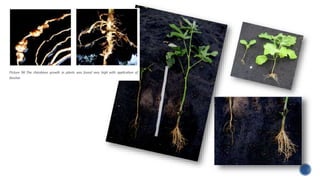
1.5 FEET 6 FEET
CONTROL BIOCHAR
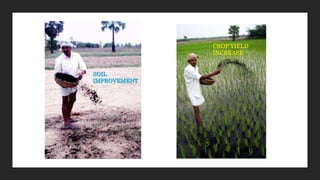
CROP YIELD
INCREASE
SOIL
IMPROVEMENT
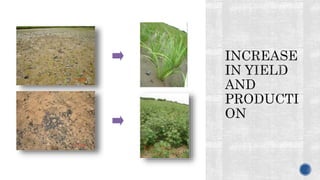
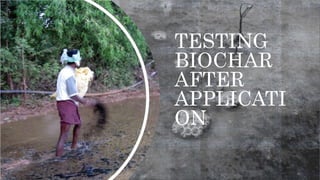
TESTING
BIOCHAR
AFTER
APPLICATI
ON
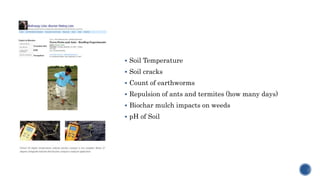
 Soil Temperature
 Soil cracks
 Count of earthworms
 Repulsion of ants and termites (how many days)
 Biochar mulch impacts on weeds
 pH of Soil
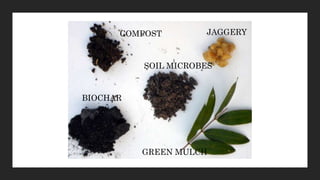
JAGGERY
COMPOST
BIOCHAR
SOIL MICROBES
GREEN MULCH
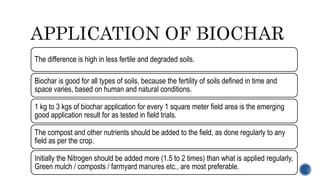
The difference is high in less fertile and degraded soils.
Biochar is good for all types of soils, because the fertility of soils defined in time and
space varies, based on human and natural conditions.
1 kg to 3 kgs of biochar application for every 1 square meter field area is the emerging
good application result for as tested in field trials.
The compost and other nutrients should be added to the field, as done regularly to any
field as per the crop.
Initially the Nitrogen should be added more (1.5 to 2 times) than what is applied regularly,
Green mulch / composts / farmyard manures etc., are most preferable.
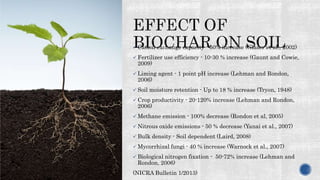
 Cation exchange capacity - 50% increase (Glaser et al., 2002)
 Fertilizer use efficiency - 10-30 % increase (Gaunt and Cowie,
2009)
 Liming agent - 1 point pH increase (Lehman and Rondon,
2006)
 Soil moisture retention - Up to 18 % increase (Tryon, 1948)
 Crop productivity - 20-120% increase (Lehman and Rondon,
2006)
 Methane emission - 100% decrease (Rondon et al, 2005)
 Nitrous oxide emissions - 50 % decrease (Yanai et al., 2007)
 Bulk density - Soil dependent (Laird, 2008)
 Mycorrhizal fungi - 40 % increase (Warnock et al., 2007)
 Biological nitrogen fixation - 50-72% increase (Lehman and
Rondon, 2006)
(NICRA Bulletin 1/2013)
 Proximate Analysis:Determines basic composition: moisture content, volatile matter,
fixed carbon, and ash content.Insights into energy content and potential nutrient
retention.
 Ultimate Analysis:Measures elemental composition: carbon, hydrogen, nitrogen,
sulfur, and oxygen content.Assesses stability and interactions with soils.
 pH and Electrical Conductivity:Determines pH, impacting interaction with soils and
plants.Reflects soluble salts presence influencing soil conductivity and nutrient
availability.
 Cation Exchange Capacity (CEC) Measurement:Assesses ability to retain and
exchange nutrients.Influences potential as a soil amendment and nutrient availability
to plants.
 Surface Area and Porosity Analysis:Utilizes techniques like BET analysis to quantify
surface area and pore distribution.Important for understanding adsorption capacity
and water-holding ability.
 Heavy Metal and Contaminant Analysis:Determines levels of heavy metals and
contaminants.Ensures biochar safety for agricultural and environmental use.
 Nutrient Content Analysis:Measures essential nutrient concentrations (e.g.,
nitrogen, phosphorus, potassium).Provides insight into fertilization potential.
 Microbial Activity Assessment:Evaluates impact on soil microbial
communities.Gauges potential to enhance soil biology and nutrient cycling.
 Thermal Stability Analysis:Utilizes techniques like thermogravimetric analysis
(TGA).Assesses thermal stability and decomposition characteristics.
 X-ray Diffraction (XRD) Analysis:Identifies crystalline mineral phases.Provides
insight into mineralogical composition.
 FTIR (Fourier Transform Infrared) Spectroscopy:Analyzes functional groups
present.Helps understand chemical composition and interactions.
 Scanning Electron Microscopy (SEM):Provides images of surface
morphology.Reveals physical structure and porosity.
 Water Holding Capacity:Determines by soaking and drying the sample.Calculated
as mass percentage of saturated and dry mass.
 Bulk Density, Particle Size Distribution, Water Content:Assess biochar’s physical
properties affecting its behavior in soil.
 PAHs (Polycyclic Aromatic Hydrocarbons) and PCDD/Fs (Polychlorinated Dibenzo-
p-Dioxins and Dibenzofurans):Tests for the presence of these potentially harmful
compounds.
 Agronomic and Plant Growth Trials:Controlled greenhouse or field experiments
assess impact on plant growth, yield, and soil improvement over time.
 Germination Inhibition:Evaluates whether biochar affects seed germination.
https://www.smashwords.com/books/view/649995 https://www.smashwords.com/books/view/921589 https://www.smashwords.com/books/view/953940 https://www.smashwords.com/books/view/878122 https://www.smashwords.com/books/view/643892
https://web.archive.org/web/20171227063253/http://www.biocharindia.com/Home
https://archive.org/details/InterviewSaibhaskarBiocharEg
https://archive.org/details/BiocharInterviewOfDrNSaiBhaskarReddyByLauramunoz23October2013
https://saibhaskar.com

FIELD LEVEL TESTING OF BIOCHAR.pptx

  • 1.
    DR N SAIBHASKAR REDDY | Environmentalist and Biochar Expert saibhaskarnakka@gmail.com National Seminar on Biochar – Status & Opportunities 17-18 August 2023 Venue: ni-msme, Yousufguda, Hyderabad 18 August 2023
  • 2.
    Traditio nal Wisdom Science and Technol ogy Commu nities Busines s entities Biochar is avery old material, existing even before human beings evolved. Unless some synthetic materials are blended and named as Biochar in the name of business. Science and Technology : Scientists should demystify knowledge and technologies for the benefit of society. Communities the main stakeholders Business is to serve the communities on a large scale.
  • 3.
    There are varioustypes of biochars, based on feedstock's and production technologies.
  • 4.
    Biomass from agriculture,forestry, livestock rearing, food production and processing.. Woody biomass— softwoods, hardwoods, or a combination Agricultural residues including bagasse from sugar cane, corn stover, rice husks, cereal straw, and coconut shells, etc.. http://dx.doi.org/10.1596/978-0-8213-9525-7 The complexity of biomass (types, values, size, shape, density, etc.) converting into biochar is difficult by any single design, so there is a need for many different biochar production designs that are suited to specific feedstocks.
  • 5.
     Soil carbonis probably the most important component in soils as it affects almost all soil properties. Carbon, as soil organic matter, alters the physical, chemical, and biological properties of soils. Soil organic matter refers to all decomposed, partly decomposed and undecomposed organic materials of plant and animal origin. It is generally synonymous with humus although the latter is more commonly used when referring to the well decomposed organic matter called humic substances. Soil organic matter is a primary indicator of soil quality. FAO (Standard operating procedure for soil organic carbon. Walkley-Black method: titration and colorimetric method (fao.org))  … Converting waste plant material into a charcoal-like substance called biochar and burying it in soil can also be used to store carbon away from the atmosphere for decades to centuries… (Ref IPCC Report)
  • 6.
    Biocharculture integration into traditionaland local practices should be encouraged. Encouraging local communities to produce and use biochar with locally available raw material is considered sustainable.
  • 7.
    Raw material forBiochar is available in rural areas (Stubble / Crop Residue / Forest litter / etc.) and the final users are in the rural areas The raw material transportation is very costly (it is quite voluminous), so ubiquitous is preferable Cost of testing biochar is high Local Technologies reduce the costs of production Therefore, the industrial approach to biochar production is not a highly feasible option in many developing and poor countries.
  • 8.
     Colour –Black, The shiny reflective surface reduces the blackness sometimes. The ash content and other impurities also make it appear less black.  Amorphous to Crystalline/shiny based on the feed stock (E.g. Rice Husk and Coconut Shell)  Light Weight - Low bulk density due to its porous structure leading to a high specific surface area  Crushable  Taste is smoky  When chewed it is crispy  Sharp edges of the freshly powdered biochar  The powdered biochar touched by hand is easy to wash with water  Odourless or sometimes mild smoky smell.  Floating test – Floats on water and then slowly settles, initially Hydrophobic.  Water holding capacity and filteration
  • 9.
    RESULTS ARE IMPORTANT Biochar is a process medium rather than a 'result' medium. However, testing the chemical composition of biochar as a ‘result’ medium is easier than estimating and appreciating the real value of the functions biochar performs in space and over time.  After application to the soil, evaluation of a process medium could involve measuring the moisture retention in the soil, the extent of aeration of the soil, the level of absorption of harmful pesticides and chemicals from the soil, release of nitrogen into the soil, level of absorption of GHGs from the soil, temperature regulation in the soil, and quality of habitat for the thriving of soil microbes, quantity of soil microbes and other variables.
  • 10.
    To understand biochar,one needs to conduct an experiment. Take pieces of land of one square meter in a field. Sow seeds on each piece of land and monitor the following: germination, height of plants, number of leaves, and development of flowers and fruits at regular intervals. soil and biochar (1 kg Biochar) soil, biochar, and amendments (1 kg Biochar) soil and amendments control soil soil and biochar (2 kg Biochar) soil, biochar, and amendments (2 kg Biochar) soil and amendments control soil soil and biochar (3 kg Biochar) soil, biochar, and amendments (3 kg Biochar) soil and amendments control soil * Amendments means as regularly followed say application of fertilizers (organic or chemical), pesticides applied, etc.
  • 11.
    CONTROL BIOCHAR COMPOST 4KGS 8 KGS 12 KGS
  • 12.
    1.5 FEET 6FEET CONTROL BIOCHAR
  • 14.
  • 16.
  • 18.
     Soil Temperature Soil cracks  Count of earthworms  Repulsion of ants and termites (how many days)  Biochar mulch impacts on weeds  pH of Soil
  • 21.
  • 25.
    The difference ishigh in less fertile and degraded soils. Biochar is good for all types of soils, because the fertility of soils defined in time and space varies, based on human and natural conditions. 1 kg to 3 kgs of biochar application for every 1 square meter field area is the emerging good application result for as tested in field trials. The compost and other nutrients should be added to the field, as done regularly to any field as per the crop. Initially the Nitrogen should be added more (1.5 to 2 times) than what is applied regularly, Green mulch / composts / farmyard manures etc., are most preferable.
  • 26.
     Cation exchangecapacity - 50% increase (Glaser et al., 2002)  Fertilizer use efficiency - 10-30 % increase (Gaunt and Cowie, 2009)  Liming agent - 1 point pH increase (Lehman and Rondon, 2006)  Soil moisture retention - Up to 18 % increase (Tryon, 1948)  Crop productivity - 20-120% increase (Lehman and Rondon, 2006)  Methane emission - 100% decrease (Rondon et al, 2005)  Nitrous oxide emissions - 50 % decrease (Yanai et al., 2007)  Bulk density - Soil dependent (Laird, 2008)  Mycorrhizal fungi - 40 % increase (Warnock et al., 2007)  Biological nitrogen fixation - 50-72% increase (Lehman and Rondon, 2006) (NICRA Bulletin 1/2013)
  • 27.
     Proximate Analysis:Determinesbasic composition: moisture content, volatile matter, fixed carbon, and ash content.Insights into energy content and potential nutrient retention.  Ultimate Analysis:Measures elemental composition: carbon, hydrogen, nitrogen, sulfur, and oxygen content.Assesses stability and interactions with soils.  pH and Electrical Conductivity:Determines pH, impacting interaction with soils and plants.Reflects soluble salts presence influencing soil conductivity and nutrient availability.  Cation Exchange Capacity (CEC) Measurement:Assesses ability to retain and exchange nutrients.Influences potential as a soil amendment and nutrient availability to plants.  Surface Area and Porosity Analysis:Utilizes techniques like BET analysis to quantify surface area and pore distribution.Important for understanding adsorption capacity and water-holding ability.  Heavy Metal and Contaminant Analysis:Determines levels of heavy metals and contaminants.Ensures biochar safety for agricultural and environmental use.
  • 28.
     Nutrient ContentAnalysis:Measures essential nutrient concentrations (e.g., nitrogen, phosphorus, potassium).Provides insight into fertilization potential.  Microbial Activity Assessment:Evaluates impact on soil microbial communities.Gauges potential to enhance soil biology and nutrient cycling.  Thermal Stability Analysis:Utilizes techniques like thermogravimetric analysis (TGA).Assesses thermal stability and decomposition characteristics.  X-ray Diffraction (XRD) Analysis:Identifies crystalline mineral phases.Provides insight into mineralogical composition.  FTIR (Fourier Transform Infrared) Spectroscopy:Analyzes functional groups present.Helps understand chemical composition and interactions.  Scanning Electron Microscopy (SEM):Provides images of surface morphology.Reveals physical structure and porosity.
  • 29.
     Water HoldingCapacity:Determines by soaking and drying the sample.Calculated as mass percentage of saturated and dry mass.  Bulk Density, Particle Size Distribution, Water Content:Assess biochar’s physical properties affecting its behavior in soil.  PAHs (Polycyclic Aromatic Hydrocarbons) and PCDD/Fs (Polychlorinated Dibenzo- p-Dioxins and Dibenzofurans):Tests for the presence of these potentially harmful compounds.  Agronomic and Plant Growth Trials:Controlled greenhouse or field experiments assess impact on plant growth, yield, and soil improvement over time.  Germination Inhibition:Evaluates whether biochar affects seed germination.
  • 30.
    https://www.smashwords.com/books/view/649995 https://www.smashwords.com/books/view/921589 https://www.smashwords.com/books/view/953940https://www.smashwords.com/books/view/878122 https://www.smashwords.com/books/view/643892 https://web.archive.org/web/20171227063253/http://www.biocharindia.com/Home https://archive.org/details/InterviewSaibhaskarBiocharEg https://archive.org/details/BiocharInterviewOfDrNSaiBhaskarReddyByLauramunoz23October2013 https://saibhaskar.com

Editor's Notes

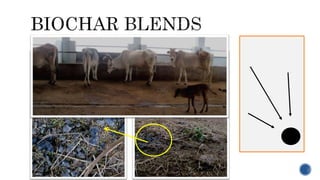
  • #24 The use of biochar as animal feed is an important emerging market in Australia. Those who feed biochar to cattle do so on a daily basis for the purpose of improved cattle health, improved cattle weight gain, methane emissions reduction and reduced feed cost.