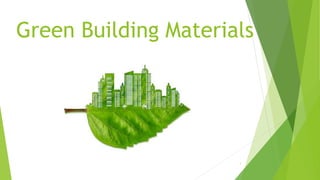
Green Building Materials
1
CIVIL ENGINEERING DEPARTMENT,
FACUALTU OF TACHENOLOGY, D.D.UNIVERSITY.
ACADEMIC YEAR 2016-2017
• GUIDED BY :
PARMAR SAMIR SIR
• SUBMITTED BY :
• GOSWAMI HEMANGGIRI Y. CL-034
HIRPARA AKASH J. CL-035
JANI KAPIL G. CL-036 2
Table Of Contents
 Introduction
 Important
 Fundamental Principles
 Selection Criteria for Green Building Materials
 Material
 Green building project in India
 Conclusion
 References
3
Definition:
“It is the practice of increasing
efficiency with which buildings
use resources- energy, water
and materials-while reducing
building impacts on human
health and the environment.”
4
Importants:
 As the earth’s population continuous to explode and developing nations
begin to use their share of world’s resources, it is necessary to ascertain
how we, as a planet, use our earth’s precious resources.
 During construction or at the end of useful building life, construction
materials and components are often discarded with construction debris
accounting for nearly 28% of land waste in country.
 Inappropriate use of building material that emit chemical can pollute the
indoor environment contributing to poor indoor air quality (IAQ) with
some new building chemical concentrations up to 100 times grater than
outside levels.
 World Health Organization estimate approximately 30% of all building will
have IAQ concerns during facility occupancy.
 Green Building Materials can help create more sustainable, healthful,
and ecologically sensitive Buildings.
Continues..
5
 Nowadays, we should make a way to maximize our natural resources
and also help our mother earth to get some relief since pollution is
everywhere plus the global warming that we are all experiencing.
Non-renewable energy is expensive and unsafe but did you know that
through green building we can save a lot of energy.
 let's define first the meaning of green building (know also as green
construction) is the practice of creating structures and using
processes that are environmentally responsible and resource-
efficient throughout a building's life-cycle: from siting to design,
construction, operation, maintenance, renovation, and
deconstruction.
 The importance of this is it lessen the consume of energy and the
pollution as well because the more we use nonrenewable energy the
higher the risk of pollution.
6
Selection Criteria
 Aesthetic Quality
 Durability
 Ecological Impact
 Embodied Energy
 Performance
 Social Impact
 Cost
 Non-Toxic or Less-Toxic Materials
 Renewable Energy
 Biodegradability
7
Fundamental Principles
 Structure design efficiency
 Energy efficiency
 Water efficiency
 Materials efficiency
 Waste and toxic reduction
8
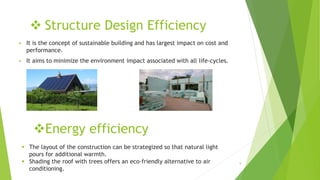
 Structure Design Efficiency
 It is the concept of sustainable building and has largest impact on cost and
performance.
 It aims to minimize the environment impact associated with all life-cycles.
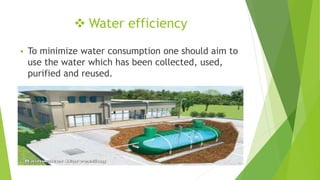
Energy efficiency
 The layout of the construction can be strategized so that natural light
pours for additional warmth.
 Shading the roof with trees offers an eco-friendly alternative to air
conditioning.
9
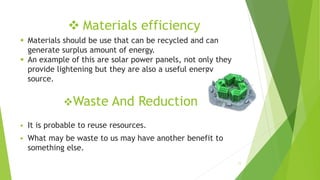
 Water efficiency
 To minimize water consumption one should aim to
use the water which has been collected, used,
purified and reused.
10
 Materials efficiency
Waste And Reduction
 It is probable to reuse resources.
 What may be waste to us may have another benefit to
something else.
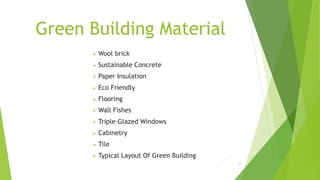
 Materials should be use that can be recycled and can
generate surplus amount of energy.
 An example of this are solar power panels, not only they
provide lightening but they are also a useful energy
source.
11
Green Building Material
 Wool brick
 Sustainable Concrete
 Paper Insulation
 Eco Friendly
 Flooring
 Wall Fishes
 Triple-Glazed Windows
 Cabinetry
 Tile
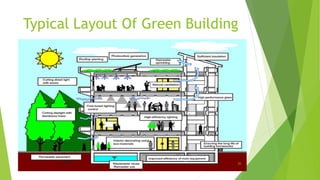
 Typical Layout Of Green Building
12
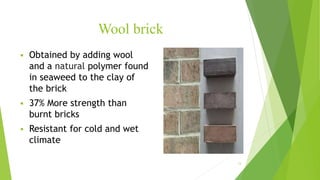
Wool brick
 Obtained by adding wool
and a natural polymer found
in seaweed to the clay of
the brick
 37% More strength than
burnt bricks
 Resistant for cold and wet
climate
13
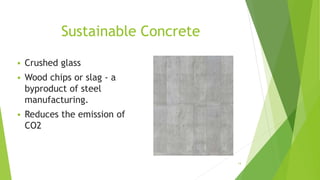
Sustainable Concrete
 Crushed glass
 Wood chips or slag - a
byproduct of steel
manufacturing.
 Reduces the emission of
CO2
14
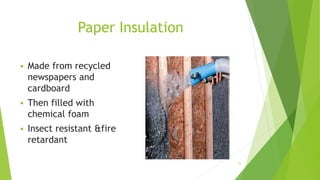
Paper Insulation
 Made from recycled
newspapers and
cardboard
 Then filled with
chemical foam
 Insect resistant &fire
retardant
15
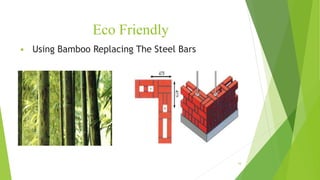
Eco Friendly
 Using Bamboo Replacing The Steel Bars
16
Flooring
 Rapidly Renewable Flooring
 “Waste” Based Flooring
 FSC Certified Flooring
 Sustainable Carpeting
17
Flooring
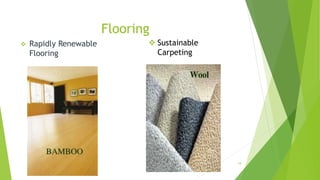
 Rapidly Renewable
Flooring
 Sustainable
Carpeting
18
Flooring
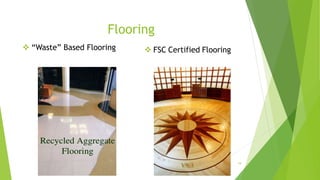
 “Waste” Based Flooring  FSC Certified Flooring
19
Flooring
 FSC Certified Flooring
 PRINCIPLE #1: COMPLIANCE WITH LAWS AND FSC PRINCIPLES
 PRINCIPLE #2: TENURE AND USE RIGHTS AND RESPONSIBILITIES
 PRINCIPLE #3: INDIGENOUS PEOPLES’ RIGHTS
 PRINCIPLE #4: COMMUNITY RELATIONS AND WORKER’S RIGHTS
 PRINCIPLE # 5: BENEFITS FROM THE FOREST
 PRINCIPLE #6: ENVIRONMENTAL IMPACT
 PRINCIPLE #7: MANAGEMENT PLAN
 PRINCIPLE #8: MONITORING AND ASSESSMENT
 PRINCIPLE # 9: MAINTENANCE OF HIGH CONSERVATION VALUE FORESTS
 PRINCIPLE # 10: PLANTATIONS
20
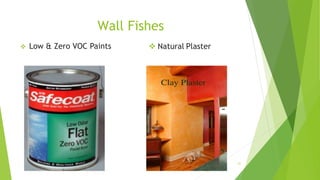
Wall Fishes
 Low & Zero VOC Paints  Natural Plaster
21
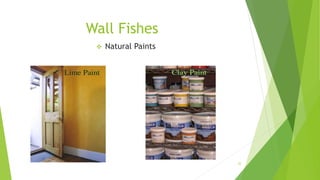
Wall Fishes
 Natural Paints
22
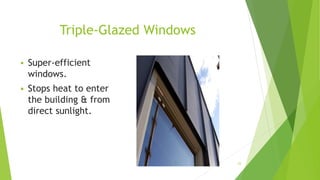
Triple-Glazed Windows
 Super-efficient
windows.
 Stops heat to enter
the building & from
direct sunlight.
23
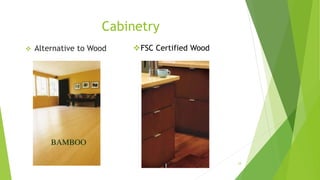
Cabinetry
 Alternative to Wood FSC Certified Wood
24
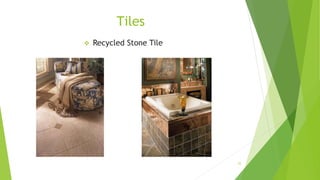
Tiles
 Recycled Stone Tile
25
Typical Layout Of Green Building
26
Green building project in India
 Nokia-Gurgaon
 Suzlon Energy Limited-Pune
 Hybrid- HVAC system: Olympia Tech Park-Chennai
 Biodiversity Conservation India-Bangalore
 Olympia Technology Park-Chennai
 ITC Green Centre-Gurgaon
 The Druk White Lotus School-Ladakh
 Doon School-Dehradun
 Raintree Hotels-Chennai
 Rajiv Gandhi International Airport-Hyderabad
 Hiranandini-BG House, Powai
 ABN Amro Bank, Chennai
 Palais Royale at Worli, Mumbai
 Punjab Forest Complex ,Mohali
27
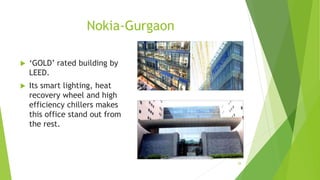
Nokia-Gurgaon
 ‘GOLD’ rated building by
LEED.
 Its smart lighting, heat
recovery wheel and high
efficiency chillers makes
this office stand out from
the rest.
28
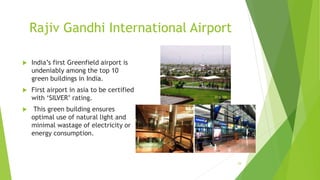
Rajiv Gandhi International Airport
 India’s first Greenfield airport is
undeniably among the top 10
green buildings in India.
 First airport in asia to be certified
with ‘SILVER’ rating.
 This green building ensures
optimal use of natural light and
minimal wastage of electricity or
energy consumption.
29
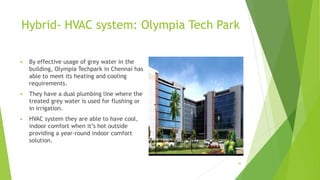
Hybrid- HVAC system: Olympia Tech Park
 By effective usage of grey water in the
building, Olympia Techpark in Chennai has
able to meet its heating and cooling
requirements.
 They have a dual plumbing line where the
treated grey water is used for flushing or
in irrigation.
 HVAC system they are able to have cool,
indoor comfort when it’s hot outside
providing a year-round indoor comfort
solution.
30
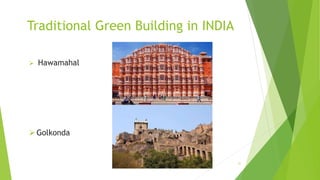
Traditional Green Building in INDIA
 Hawamahal
Golkonda
31
Conclusion
o This research identified the exciting developments taking
place on the technology front and analyses their
implications for intelligent and green buildings,
highlighting examples of “best in class” buildings
employing green and intelligent technologies. These
buildings are dynamic environments that respond to their
occupants’ changing needs and lifestyles. This research
provided documented evidence to educate and influence
end-users, building owners, architects, and contractors
that a “greener building” can be achieved using
intelligent technology and that this “greening” will
provide a tangible and significant return on investment.
32
References
 http://www.igbc.in/site/igbc/tests.jsp?event=22869
 http://www.greenbuildingsindia.com/Green-Buildings.html
 http://www.biperusa.org/6-objectives-of-green-building.html
 http://www.brighthub.com/environment/green-
living/articles/51601.aspx
 http://ecenter.colorado.edu/greening-cu/green-building
 http://www.chillibreeze.com/articles/top-10-green-buildings-in-
India-1011.asp
 http://gbindia.wordpress.com/igbc-rating-system-2/
 Lynn M. Froeschle, “Ridgehaven Green Office Building”
33
34

Green Building Materials

  • 1.
  • 2.
    CIVIL ENGINEERING DEPARTMENT, FACUALTUOF TACHENOLOGY, D.D.UNIVERSITY. ACADEMIC YEAR 2016-2017 • GUIDED BY : PARMAR SAMIR SIR • SUBMITTED BY : • GOSWAMI HEMANGGIRI Y. CL-034 HIRPARA AKASH J. CL-035 JANI KAPIL G. CL-036 2
  • 3.
    Table Of Contents Introduction  Important  Fundamental Principles  Selection Criteria for Green Building Materials  Material  Green building project in India  Conclusion  References 3
  • 4.
    Definition: “It is thepractice of increasing efficiency with which buildings use resources- energy, water and materials-while reducing building impacts on human health and the environment.” 4
  • 5.
    Importants:  As theearth’s population continuous to explode and developing nations begin to use their share of world’s resources, it is necessary to ascertain how we, as a planet, use our earth’s precious resources.  During construction or at the end of useful building life, construction materials and components are often discarded with construction debris accounting for nearly 28% of land waste in country.  Inappropriate use of building material that emit chemical can pollute the indoor environment contributing to poor indoor air quality (IAQ) with some new building chemical concentrations up to 100 times grater than outside levels.  World Health Organization estimate approximately 30% of all building will have IAQ concerns during facility occupancy.  Green Building Materials can help create more sustainable, healthful, and ecologically sensitive Buildings. Continues.. 5
  • 6.
     Nowadays, weshould make a way to maximize our natural resources and also help our mother earth to get some relief since pollution is everywhere plus the global warming that we are all experiencing. Non-renewable energy is expensive and unsafe but did you know that through green building we can save a lot of energy.  let's define first the meaning of green building (know also as green construction) is the practice of creating structures and using processes that are environmentally responsible and resource- efficient throughout a building's life-cycle: from siting to design, construction, operation, maintenance, renovation, and deconstruction.  The importance of this is it lessen the consume of energy and the pollution as well because the more we use nonrenewable energy the higher the risk of pollution. 6
  • 7.
    Selection Criteria  AestheticQuality  Durability  Ecological Impact  Embodied Energy  Performance  Social Impact  Cost  Non-Toxic or Less-Toxic Materials  Renewable Energy  Biodegradability 7
  • 8.
    Fundamental Principles  Structuredesign efficiency  Energy efficiency  Water efficiency  Materials efficiency  Waste and toxic reduction 8
  • 9.
     Structure DesignEfficiency  It is the concept of sustainable building and has largest impact on cost and performance.  It aims to minimize the environment impact associated with all life-cycles. Energy efficiency  The layout of the construction can be strategized so that natural light pours for additional warmth.  Shading the roof with trees offers an eco-friendly alternative to air conditioning. 9
  • 10.
     Water efficiency To minimize water consumption one should aim to use the water which has been collected, used, purified and reused. 10
  • 11.
     Materials efficiency WasteAnd Reduction  It is probable to reuse resources.  What may be waste to us may have another benefit to something else.  Materials should be use that can be recycled and can generate surplus amount of energy.  An example of this are solar power panels, not only they provide lightening but they are also a useful energy source. 11
  • 12.
    Green Building Material Wool brick  Sustainable Concrete  Paper Insulation  Eco Friendly  Flooring  Wall Fishes  Triple-Glazed Windows  Cabinetry  Tile  Typical Layout Of Green Building 12
  • 13.
    Wool brick  Obtainedby adding wool and a natural polymer found in seaweed to the clay of the brick  37% More strength than burnt bricks  Resistant for cold and wet climate 13
  • 14.
    Sustainable Concrete  Crushedglass  Wood chips or slag - a byproduct of steel manufacturing.  Reduces the emission of CO2 14
  • 15.
    Paper Insulation  Madefrom recycled newspapers and cardboard  Then filled with chemical foam  Insect resistant &fire retardant 15
  • 16.
    Eco Friendly  UsingBamboo Replacing The Steel Bars 16
  • 17.
    Flooring  Rapidly RenewableFlooring  “Waste” Based Flooring  FSC Certified Flooring  Sustainable Carpeting 17
  • 18.
  • 19.
    Flooring  “Waste” BasedFlooring  FSC Certified Flooring 19
  • 20.
    Flooring  FSC CertifiedFlooring  PRINCIPLE #1: COMPLIANCE WITH LAWS AND FSC PRINCIPLES  PRINCIPLE #2: TENURE AND USE RIGHTS AND RESPONSIBILITIES  PRINCIPLE #3: INDIGENOUS PEOPLES’ RIGHTS  PRINCIPLE #4: COMMUNITY RELATIONS AND WORKER’S RIGHTS  PRINCIPLE # 5: BENEFITS FROM THE FOREST  PRINCIPLE #6: ENVIRONMENTAL IMPACT  PRINCIPLE #7: MANAGEMENT PLAN  PRINCIPLE #8: MONITORING AND ASSESSMENT  PRINCIPLE # 9: MAINTENANCE OF HIGH CONSERVATION VALUE FORESTS  PRINCIPLE # 10: PLANTATIONS 20
  • 21.
    Wall Fishes  Low& Zero VOC Paints  Natural Plaster 21
  • 22.
  • 23.
    Triple-Glazed Windows  Super-efficient windows. Stops heat to enter the building & from direct sunlight. 23
  • 24.
    Cabinetry  Alternative toWood FSC Certified Wood 24
  • 25.
  • 26.
    Typical Layout OfGreen Building 26
  • 27.
    Green building projectin India  Nokia-Gurgaon  Suzlon Energy Limited-Pune  Hybrid- HVAC system: Olympia Tech Park-Chennai  Biodiversity Conservation India-Bangalore  Olympia Technology Park-Chennai  ITC Green Centre-Gurgaon  The Druk White Lotus School-Ladakh  Doon School-Dehradun  Raintree Hotels-Chennai  Rajiv Gandhi International Airport-Hyderabad  Hiranandini-BG House, Powai  ABN Amro Bank, Chennai  Palais Royale at Worli, Mumbai  Punjab Forest Complex ,Mohali 27
  • 28.
    Nokia-Gurgaon  ‘GOLD’ ratedbuilding by LEED.  Its smart lighting, heat recovery wheel and high efficiency chillers makes this office stand out from the rest. 28
  • 29.
    Rajiv Gandhi InternationalAirport  India’s first Greenfield airport is undeniably among the top 10 green buildings in India.  First airport in asia to be certified with ‘SILVER’ rating.  This green building ensures optimal use of natural light and minimal wastage of electricity or energy consumption. 29
  • 30.
    Hybrid- HVAC system:Olympia Tech Park  By effective usage of grey water in the building, Olympia Techpark in Chennai has able to meet its heating and cooling requirements.  They have a dual plumbing line where the treated grey water is used for flushing or in irrigation.  HVAC system they are able to have cool, indoor comfort when it’s hot outside providing a year-round indoor comfort solution. 30
  • 31.
    Traditional Green Buildingin INDIA  Hawamahal Golkonda 31
  • 32.
    Conclusion o This researchidentified the exciting developments taking place on the technology front and analyses their implications for intelligent and green buildings, highlighting examples of “best in class” buildings employing green and intelligent technologies. These buildings are dynamic environments that respond to their occupants’ changing needs and lifestyles. This research provided documented evidence to educate and influence end-users, building owners, architects, and contractors that a “greener building” can be achieved using intelligent technology and that this “greening” will provide a tangible and significant return on investment. 32
  • 33.
    References  http://www.igbc.in/site/igbc/tests.jsp?event=22869  http://www.greenbuildingsindia.com/Green-Buildings.html http://www.biperusa.org/6-objectives-of-green-building.html  http://www.brighthub.com/environment/green- living/articles/51601.aspx  http://ecenter.colorado.edu/greening-cu/green-building  http://www.chillibreeze.com/articles/top-10-green-buildings-in- India-1011.asp  http://gbindia.wordpress.com/igbc-rating-system-2/  Lynn M. Froeschle, “Ridgehaven Green Office Building” 33
  • 34.