
1
Chapter 1:- Introduction
1.1. Definitions of “Green Building”:-
 While the definition of what constitutes a green building is constantly evolving, the
Office of the Federal Environmental Executive offers a useful working definition. This
agency defines this term as:
 the practice of (1) increasing the efficiency with which buildings and their sites use
energy, water, and materials, and (2) reducing building impacts on human health and
the environment, through better siting, design, construction, operation, maintenance,
and removal—the complete building life cycle.
 Similarly, the Environmental Protection Agency (EPA) defines green building as
follows:
 he practice of creating structures and using processes that are environmentally
responsible and resource-efficient throughout a building’s life-cycle from siting to
design, construction, operation, maintenance, renovation and deconstruction. This
practice expands and complements the classical building design concerns of economy,
utility, durability, and comfort. Green building is also known as a sustainable or ‘high
performance’ building.
 Both of these definitions mention life cycle assessment (LCA). LCA is the investigation
and valuation of the environmental, economic, and social impacts of a product or
service. In the context of green buildings, LCA evaluates building materials over the
course of their entire lives and takes into account a full range of environmental impacts,
including a material’s embodied energy; the solid waste generated in its extraction, use,
and disposal; the air and water pollution associated with it; and its global-warming
potential. LCA is an important tool because it can demonstrate whether a product used
in a green building is truly green.
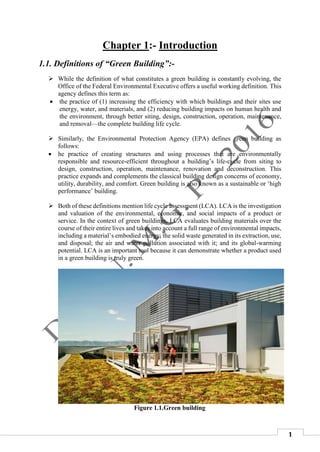
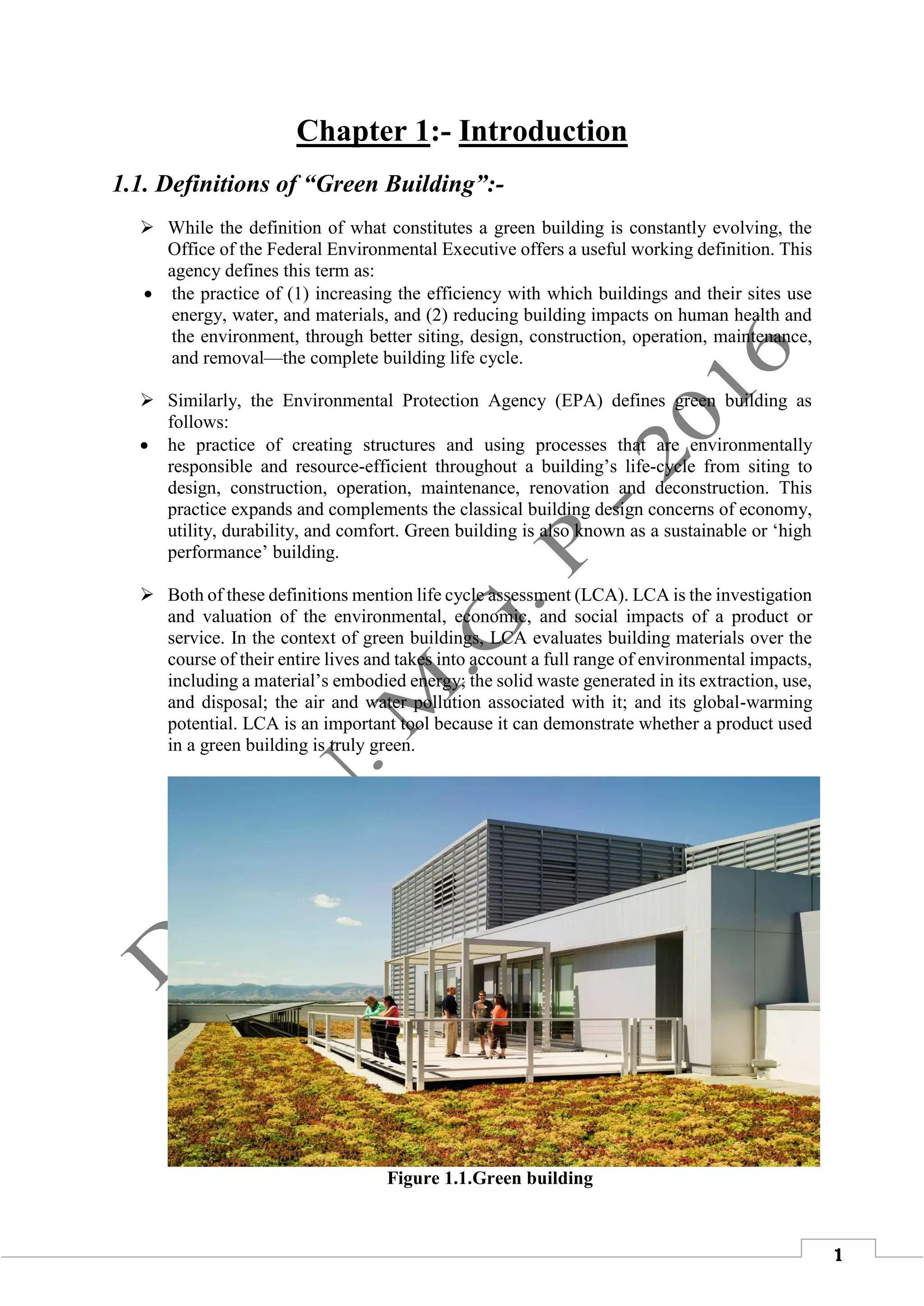
Figure 1.1.Green building
2
1.2. Why does it matter?
 Takes an intelligent approach to energy
• Minimising energy use in all stages of a building’s life-cycle, making new and
renovated buildings more comfortable, less expensive to run and helping building
users learn to be efficient too.
• Integrating renewable and low carbon technologies to supply buildings’ energy needs,
once design has maximised inbuilt and natural efficiencies.
 Safeguards our water resources
• Exploring ways to improve drinking and waste water efficiency and management,
harvesting water for safe indoor use in innovative ways and generally minimising
water use in the sector.
• Considering the impact of the built environment on storm water and drainage
infrastructure, ensuring these are not put under undue stress or prevented from doing
their job.
 Minimises waste and maximises reuse
• Using fewer, more durable materials and generating less waste, as well as accounting
for a building’s end of life stage by designing for demolition waste recovery and reuse.
• Engaging building users in reuse and recycling.
 Promotes health and well-being
• Bringing a breath of fresh air inside, delivering high indoor air quality through good
ventilation and avoiding materials and chemicals that create harmful emissions.
• Incorporating natural light and views to ensure building users’ comfort and enjoyment
of their surroundings, reducing lighting energy needs in the process.
• Designing for ears as well as eyes. In the education, health and residential sectors,
acoustics and proper sound insulation play important roles in helping concentration,
recuperation, and peaceful enjoyment of property.
• Ensuring people are comfortable in their everyday environments, creating the right
indoor temperature as the seasons pass through passive design or building
management and monitoring systems.
 Keeps our landscape green
• Recognising that our urban environment should preserve nature, ensuring diverse
wildlife and land quality are protected or enhanced, for example by remediating and
building on polluted land or creating green spaces.
• Looking for ways we can make our urban areas more productive, bringing agriculture
into our cities.
 Creates resilient and flexible structures
• Adapting to a changing environment, ensuring resilience to events such as flooding,
earthquakes or fires so that our buildings stand the test of time and keep people and
their belongings safe.
• Designing flexible and dynamic spaces, anticipating changes in their use over time
and avoiding the need to demolish and rebuild or significantly renovate buildings to
prevent them becoming obsolete.
3
 Connects us
• Creating diverse environments that connect and enhance communities, asking what a
building will add to its context in terms of positive economic and social effects and
engaging local communities in planning.
• Ensuring transport and distance to amenities are considered in design, reducing the
stresses of personal transport on the environment, roads and railways and
encouraging environmentally friendly options such as cycling.
 Considers all stages of a building’s life-cycle
• Seeking to lower all environmental impacts and maximise social and economic value
over a building’s whole life-cycle: through design, construction, operation,
maintenance, renovation, and demolition. The fragmented nature of the building
industry value chain means we have long looked at parts of the life-cycle in
isolation, but Green Building Councils are bringing the sector’s whole value chain
together through our members to build a wider vision.
• Making the invisible visible. Embodied resources are the invisible resources used in
buildings: for example, the energy or water used to produce and transport the
materials in the building. Green building considers these amongst a building’s
impacts, ensuring that our buildings are truly low impact.
4
Chapter 2:- Fundamental Principles of Green
Building
2.1. Sustainable Site Design:-
2.1.1. Key Principles:-
Minimize urban sprawl and needless destruction of valuable land, habitat and green
space, which results from inefficient low-density development. Encourage higher density
urban development, urban re-development and urban renewal, and brownfield
development as a means to preserve valuable green space. Preserve key environmental
assets through careful examination of each site. Engage in a design and construction
process that minimizes site disturbance and which values, preserves and actually restores
or regenerates valuable habitat, green space and associated eco-systems that are vital to
sustaining life.
 Key Strategies and Technologies:-
• Make more efficient use of space in existing occupied buildings, renovate and re-use
existing vacant buildings, sites, and associated infrastructure and consider re-
development of brownfield sites. Design buildings and renovations to maximize future
flexibility and reuse thereby expanding useful life.
• When new development is unavoidable, steer clear of sites that play a key role in the
local or regional ecosystem. Identify and protect valuable Greenfield and wetland sites
from development.
• Recognize that allowing higher density development in urban areas helps to preserve
green space and reduce urban sprawl. Invest time and energy in seeking variances and
regulatory reform where needed.
• Evaluate each site in terms of the location and orientation of buildings and
improvements in order to optimize the use of passive solar energy, natural day lighting,
and natural breezes and ventilation.
• Make best use of existing mass transit systems and make buildings and sites pedestrian
and bike friendly, including provisions for safe storage of bicycles. Develop programs
and incentives that promote car-pooling including preferred parking for commuters
who carpool. Consider making provisions for re-fuelling or recharging alternative fuel
vehicles.
• Help reduce the urban heat island effect by reducing the building and site development
footprint, maximizing the use of pervious surfaces, and using light colour roofs, paving,
and walkways. Provide natural shading of buildings and paved areas with trees and
other landscape features.
5
• Reduce impervious areas by carefully evaluating parking and roadway design. Pursue
variances or waivers where local ordinances may unintentionally result in the over-
design of roadways or parking.
• Optimize the use of on-site storm water treatment and ground water recharge.
Minimize the boundaries of the construction area, avoid needless compaction of
existing topsoil, and provide effective sedimentation and silt control during all phases
of site development and construction.
• Use landscape design to preserve and restore the region’s natural habitat and heritage
while emphasizing the use of indigenous, hardy, drought resistant trees, shrubs, plants
and turf.
• Help reduce night-time light pollution by avoiding over-illumination of the site and
use low cut-off exterior lighting fixtures which direct light downward, not upward and
outward.
2.2. Water Quality and Conservation:-
2.2.1. Key Principles:
Preserve the existing natural water cycle and design site and building improvements such
that they closely emulate the site’s natural “pre-development” hydrological systems.
Emphasis should be placed on retention of storm water and on-site infiltration and ground
water recharge using methods that closely emulate natural systems. Minimize the
unnecessary and inefficient use of potable water on the site while maximizing the
recycling and reuse of water, including harvested rainwater, storm water, and grey water.
 Key Strategies and Technologies:
• Recognize that the least costly, least time consuming and most environmentally
preferable design for site and storm water management is often the one in which the
design of buildings and site improvements respect the existing natural flows and
features of the land, instead of designing the building and site improvements with total
disregard for the site, which results in needless, extensive, disruptive, costly and time
consuming excavation and earthmoving.
• Conduct a thorough site assessment and strategically locate buildings and site
improvements so as to preserve key natural hydrological features. Special effort should
be made to preserve areas of the site that serve as natural storm water retention and
ground water infiltration and recharge systems. Preserve existing forest and mature
vegetation that play a vital role in the natural water cycle by absorbing and disbursing
up to 30% of a site’s rainwater through evaporate-transpiration.
• Minimize the building’s footprint, site improvements and construction area, and
minimize excavation, soil disturbance and compaction of existing topsoil as this soil in
6
its natural uncompact state serves a vital role in absorbing and storing up to 80% of
natural rainfall until it can be absorbed by vegetation or
• Design and locate buildings and site improvements to optimize use of low-impact
storm water technologies such as bio-retention, rain gardens, open grassy swales,
pervious bituminous paving, pervious concrete paving and walkways, constructed
wetlands, living/vegetated roofs, and other technologies that support on-site retention
and ground water recharge or evaporate-transpiration. Storm water that leaves the site
should be filtered and processed naturally or mechanically to remove trash and debris,
oil, grit and suspended solids. Use “hold and release” technologies such as dry retention
ponds only as a last resort as these technologies do not preserve the natural water cycle,
have little or no benefit in terms of ground water recharge and result in needless
additional site disturbance.
• Establish a water budget for the building and implement a design that minimizes the
use of potable water by using low-flow plumbing fixtures and toilets and waterless
urinals. Harvest, process and recycle rainwater, site storm water, and building grey
water and identify appropriate uses within the building and site. Use on-site treatment
systems that enable use of rain water for hand washing, grey water for toilet flushing,
rain and storm water for site irrigation, cooling tower make-up and other uses.
• Conserve water and preserve site and ground water quality by using only indigenous,
drought resistant and hardy trees, shrubs, plants and turf that require no irrigation,
fertilizers, pesticides or herbicides.
2.3. Energy and Environment:-
2.3.1. Key Principles:-
Minimize adverse impacts on the environment (air, water, land, natural resources)
through optimized building siting, optimized building design, material selection, and
aggressive use of energy conservation measures. Resulting building performance
should exceed minimum International Energy Code (IEC) compliance level by 30 to
40% or more. Maximize the use of renewable energy and other low impact energy
sources.
 Key Strategies and Technologies:
• Optimize passive solar orientation, building massing and use of external shading
devices such that the design of the building minimizes undesirable solar gains during
the summer months while maximizing desirable solar gains during winter months.
• Optimize building orientation, massing, shape, design, and interior colors and finishes
in order to maximize the use of controlled natural day lighting which significantly
reduces artificial lighting energy use thereby reducing the buildings internal cooling
load and energy use. Consider the use of light shelf technology.
7
• Use high performance low-e glazing, which can result in significant year round energy
savings. Consider insulated double glazing, triple glazing or double pane glazing with
a suspended low-e film. Selective coatings offer optimal light transmittance while
providing minimal solar gain and minimal heat transmission. Window frames, sashes
and curtain wall systems should also be designed for optimum energy performance
including the use of multiple thermal breaks to help reduce energy use.
• Optimize the value of exterior insulation and the overall thermal performance of the
exterior envelope assembly. Consider advanced/high performance envelope building
systems such as structural insulated panel systems (SIPS) and insulated concrete form
systems (ICF’s) that can be applied to light commercial and institutional buildings.
SIPS and ICF’s and other thermally “decoupled” envelope systems will offer the
highest energy performance.
• Use energy efficient T-8 and T-5 bulbs, high efficiency electronic ballasts, and lighting
controls. Consider using indirect ambient lighting with workstation based direct task
lighting to improve light quality, reduce glare and improve overall energy performance
in general office areas. Incorporate sensors and controls and design circuits so that
lighting along perimeter zones and offices can be switched off independently from other
interior lights when day lighting is sufficient in perimeter areas.
• Use state-of-the art, high efficiency, heating, ventilation and air conditioning (HVAC)
and plumbing equipment, chillers, boilers, and water heaters, etc. Use variable speed
drives on fan and pump motors. Use heat recovery ventilators and geothermal heat
pump technology for up to 40% energy savings.
• Avoid the use of HCFC and Halona based refrigeration, cooling and fire suppression
systems. Optimize the use of natural ventilation and where practical use evaporative
cooling, waste heat and/or solar regenerated desiccant dehumidification or absorption
cooling. Identify and use sources of waste energy.
• Use Energy Star certified energy efficient appliances, office equipment, lighting and
HVAC systems.
• Consider on-site small-scale wind, solar, and/or fuel cell based energy generation and
co-generation. Purchase environmentally preferable “green” power from certified
renewable and sustainable sources.
2.4. Indoor Environmental Quality:-
2.4.1 Key Principles:-
Provide a healthy, comfortable and productive indoor environment for building
occupants and visitors. Provide a building design, which affords the best possible
conditions in terms of indoor air quality, ventilation, and thermal comfort, access to
natural ventilation and day lighting, and effective control of the acoustical environment.
8
 Key Strategies and Technologies:
• Use building materials, adhesives, sealants, finishes and furnishings which do not
contain, harbour, generate or release any particulate or gaseous contaminants including
volatile organic compounds.
• Maximize the use of natural day lighting. Optimize solar orientation and design the
building to maximize penetration of natural daylight into interior spaces. Provide
shades or daylight controls where needed.
• Maximize the use of operable windows and natural ventilation. Provide dedicated
engineered ventilation systems that operate independently of the buildings heating and
cooling system. Ventilation systems should be capable of effectively removing or
treating indoor contaminants while providing adequate amounts of fresh clean make-
up air to all occupants and all regions of the building. Monitor indoor air conditions
including temperature, humidity and carbon dioxide levels, so that building ventilation
systems can respond when space conditions fall outside the optimum range.
• Provide a smoke free building. When smoking must be accommodated, provide
completely dedicated smoking areas are physically isolated, have dedicated HVAC
systems, and remain under negative pressure with respect to all adjoining spaces.
Assure that air from smoking areas does not get distributed to other areas of the building
does not re-enter the building through doors or vestibules, operable windows, or
building fresh air intakes.. Locate outdoor smoking areas so that non-smokers do not
have to pass through these areas when using primary building entrances or exits.
• Design building envelope and environmental systems that not only treat air
temperature and provide adequate ventilation, but which respect all of the
environmental conditions which affect human thermal comfort and health, including
the mean radiant temperature of interior surfaces, indoor air humidity, indoor air
velocity, and indoor air temperature. Following these principles and providing a
building that is also responsive to seasonal variations in desirable indoor humidity
levels, air velocity, and mean radiant temperatures can also result in significant energy
savings as improved occupant comfort results in less energy intensive operation of the
buildings air-side heating and cooling system.
• Maximize occupant health, comfort and performance by providing occupants with
individual space/zone control of heat, ventilation, cooling, day-lighting and artificial
lighting whenever possible.
• Prevent contamination of the building during construction. Take steps to minimize the
creation and spreading of construction dust and dirt. Prevent contamination of the
building and the buildings heating, cooling and ventilation systems during the
construction process. Protect construction materials from the elements so that they do
not become damp, mouldy or mildewed.
9
• Provide a clean and healthy building. Use biodegradable and environmentally friendly
cleaning agents that do not release VOCs or other harmful agents and residue. Prior to
occupancy install new air filters and clean any contaminated ductwork and ventilation
equipment. Use fresh outdoor air to naturally or mechanically purge the building of any
remaining airborne gaseous or particulate contaminants.
2.5. Materials and Resources:-
2.4.1. Key Principles:-
Minimize the use of non-renewable construction materials and other resources such as
energy and water through efficient engineering, design, planning and construction and
effective recycling of construction debris. Maximize the use of recycled content
materials, modern resource efficient engineered materials, and resource efficient
composite type structural systems wherever possible. Maximize the use of re-usable,
renewable, sustainably managed, bio-based materials. Remember that human creativity
and our abundant lab or force is perhaps our most valuable renewable resource. The best
solution is not necessarily the one that requires the least amount of physical work.
 Key Strategies and Technologies:
• Optimize the use of engineered materials which make use of proven engineering
principles such as engineered trusses, composite materials and structural systems
(concrete/steel, other…), structural insulated panels (stress skin panels), insulated
concrete forms, and frost protected shallow foundations which have been proven to
provide high strength and durability with the least amount of material.
• Identify ways to reduce the amount of materials used and reduce the amount of waste
generated through the implementation of a construction waste reduction plan. Adopt a
policy of “waste equals food” whereby 75% or more of all construction waste is
separated for recycling and used as feedstock for some future product rather than being
landfilled. Implement an aggressive construction waste recycling program and provide
separate, clearly labelled dumpsters for each recycled material. Train all crews and
subcontractors on the policy and enforce compliance.
• Identify ways to use high-recycled content materials in the building structure and
finishes. Consider everything from blended concrete using fly ash, slag, recycled
concrete aggregate, or other admixtures to recycled content materials such as structural
steel, ceiling and floor tiles, carpeting, carpet padding, sheathing, and gypsum
wallboard. Consider remanufactured office furniture and office partition systems, chairs
and furniture with recycled content or parts.
• Explore the use of bio-based materials and finishes such as various types of garboard
(sheathing and or insulation board made from agricultural waste and by products,
including straw, wheat, barley, soy, sunflower shells, peanut shells, and other
materials). Some structural insulated panels are now made from bio-based materials.
10
Use lumber and wood products from certified forests where the forest is managed and
lumber is harvested using sustainable practices. Use resource efficient engineered wood
products in lieu of full dimension lumber which comes from older growth forests.
• Evaluate all products and systems used for their ability to be recycled when they reach
the end of their useful life. Preference should be given to products and systems that
facilitate easy, non-energy intensive separation and recycling with minimal
contamination by foreign debris.
• Recognize that transportation becomes part of a product or building materials embodied
energy. Where practical, specify and use locally harvested, mined and manufactured
materials and products to support the regional economy and to reduce transportation,
energy use and emissions.
11
Chapter 3:- Green Building Materials
3.1. Overview:-
Green building materials are a rapidly developing and expanding sector of the
construction materials market. What constitutes a “green” material varies widely
depending on the source. While no official government standard exists to provide
definable guidelines, the Federal Trade Commission is working on such a plan.
Meanwhile, the certification of green and/or sustainable building materials has been left
to professional trade organizations. While each sector of the construction materials
industry has its own or multiple sets of criteria, the common bond tends to be the U.S.
Green Building Council’s Leadership in Energy and Environmental Design (LEED)
guidelines and standards. However, regardless of the source, the common elements that
bind green material evaluation are very similar and include– production energy usage
and waste, low toxicity/minimal emissions, recycled content/recyclability, locality of
production, impact on indoor air quality, and affordability.
3.2. Flooring:-
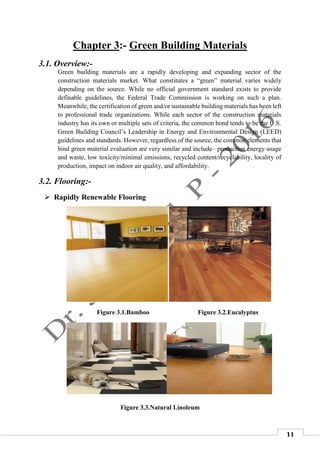
 Rapidly Renewable Flooring
Figure 3.1.Bamboo Figure 3.2.Eucalyptus
Figure 3.3.Natural Linoleum
12
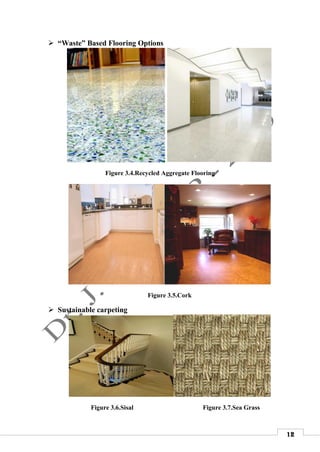
 “Waste” Based Flooring Options
Figure 3.4.Recycled Aggregate Flooring
Figure 3.5.Cork
 Sustainable carpeting
Figure 3.6.Sisal Figure 3.7.Sea Grass
13
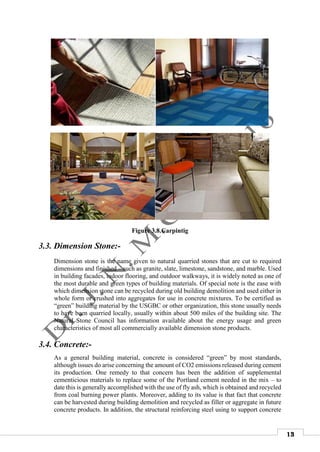
Figure 3.8.Carpintig
3.3. Dimension Stone:-
Dimension stone is the name given to natural quarried stones that are cut to required
dimensions and finished – such as granite, slate, limestone, sandstone, and marble. Used
in building facades, indoor flooring, and outdoor walkways, it is widely noted as one of
the most durable and green types of building materials. Of special note is the ease with
which dimension stone can be recycled during old building demolition and used either in
whole form or crushed into aggregates for use in concrete mixtures. To be certified as
“green” building material by the USGBC or other organization, this stone usually needs
to have been quarried locally, usually within about 500 miles of the building site. The
Natural Stone Council has information available about the energy usage and green
characteristics of most all commercially available dimension stone products.
3.4. Concrete:-
As a general building material, concrete is considered “green” by most standards,
although issues do arise concerning the amount of CO2 emissions released during cement
its production. One remedy to that concern has been the addition of supplemental
cementicious materials to replace some of the Portland cement needed in the mix – to
date this is generally accomplished with the use of fly ash, which is obtained and recycled
from coal burning power plants. Moreover, adding to its value is that fact that concrete
can be harvested during building demolition and recycled as filler or aggregate in future
concrete products. In addition, the structural reinforcing steel using to support concrete
14
can also be harvested and recycled. When used for paved surfaces or roofing, especially
when compared to asphalt materials, cement has been shown to greatly aide in reducing
the Heat Island Effect by reflecting a higher significance of light. Additionally, another
green aspect of concrete is a special form known as pervious concrete. It is primarily
used in pavement surfaces, such as parking lots, to help reduce storm water runoff
concerns. It is produced by adjusting the aggregate proportions in ready mix concrete –
by reducing the amount of sand and fine aggregates in the mix, voids are created that
allow for water to penetrate down through the pavement.
3.5. Recycled Steel:-
While the production of steel involves high emissions releases and large qualities of
energy, the use of recycled material accounts for 2/3 of new steel production by weight
in the United States. Additionally, the use of recycled materials reduces the necessary
amount of energy needed to produce steel product compared to that needed when using
virgin ore.
3.6. Wall Finishes:-
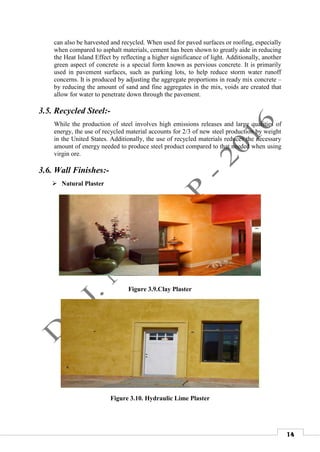
 Natural Plaster
Figure 3.9.Clay Plaster
Figure 3.10. Hydraulic Lime Plaster
15
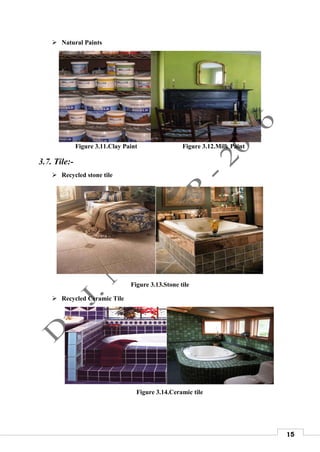
 Natural Paints
Figure 3.11.Clay Paint Figure 3.12.Milk Paint
3.7. Tile:-
 Recycled stone tile
Figure 3.13.Stone tile
 Recycled Ceramic Tile
Figure 3.14.Ceramic tile
16
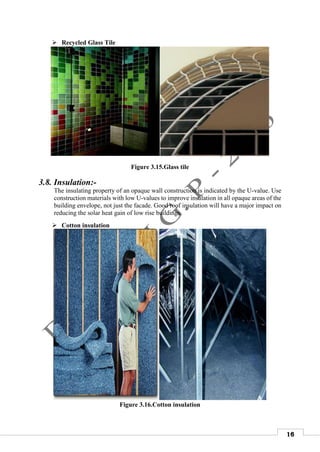
 Recycled Glass Tile
Figure 3.15.Glass tile
3.8. Insulation:-
The insulating property of an opaque wall construction is indicated by the U-value. Use
construction materials with low U-values to improve insulation in all opaque areas of the
building envelope, not just the facade. Good roof insulation will have a major impact on
reducing the solar heat gain of low rise buildings.
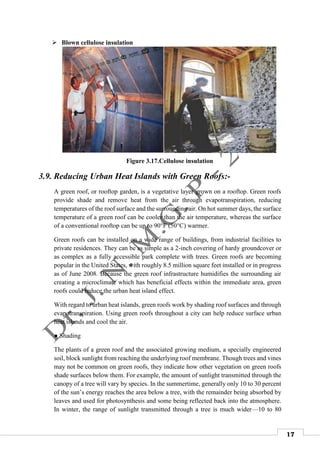
 Cotton insulation
Figure 3.16.Cotton insulation
17
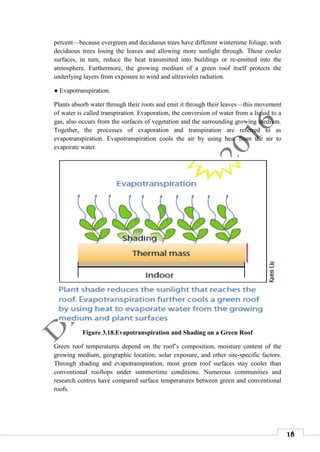
 Blown cellulose insulation
Figure 3.17.Cellulose insulation
3.9. Reducing Urban Heat Islands with Green Roofs:-
A green roof, or rooftop garden, is a vegetative layer grown on a rooftop. Green roofs
provide shade and remove heat from the air through evapotranspiration, reducing
temperatures of the roof surface and the surrounding air. On hot summer days, the surface
temperature of a green roof can be cooler than the air temperature, whereas the surface
of a conventional rooftop can be up to 90°F (50°C) warmer.
Green roofs can be installed on a wide range of buildings, from industrial facilities to
private residences. They can be as simple as a 2-inch covering of hardy groundcover or
as complex as a fully accessible park complete with trees. Green roofs are becoming
popular in the United States, with roughly 8.5 million square feet installed or in progress
as of June 2008. Because the green roof infrastructure humidifies the surrounding air
creating a microclimate which has beneficial effects within the immediate area, green
roofs could reduce the urban heat island effect.
With regard to urban heat islands, green roofs work by shading roof surfaces and through
evapotranspiration. Using green roofs throughout a city can help reduce surface urban
heat islands and cool the air.
● Shading
The plants of a green roof and the associated growing medium, a specially engineered
soil, block sunlight from reaching the underlying roof membrane. Though trees and vines
may not be common on green roofs, they indicate how other vegetation on green roofs
shade surfaces below them. For example, the amount of sunlight transmitted through the
canopy of a tree will vary by species. In the summertime, generally only 10 to 30 percent
of the sun’s energy reaches the area below a tree, with the remainder being absorbed by
leaves and used for photosynthesis and some being reflected back into the atmosphere.
In winter, the range of sunlight transmitted through a tree is much wider—10 to 80
18
percent—because evergreen and deciduous trees have different wintertime foliage, with
deciduous trees losing the leaves and allowing more sunlight through. These cooler
surfaces, in turn, reduce the heat transmitted into buildings or re-emitted into the
atmosphere. Furthermore, the growing medium of a green roof itself protects the
underlying layers from exposure to wind and ultraviolet radiation.
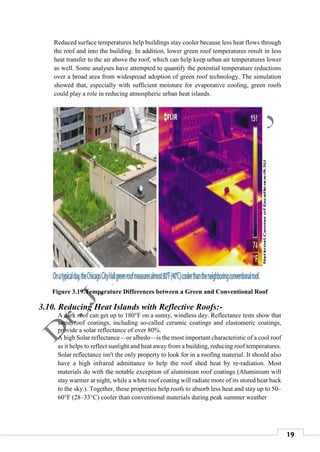
● Evapotranspiration.
Plants absorb water through their roots and emit it through their leaves—this movement
of water is called transpiration. Evaporation, the conversion of water from a liquid to a
gas, also occurs from the surfaces of vegetation and the surrounding growing medium.
Together, the processes of evaporation and transpiration are referred to as
evapotranspiration. Evapotranspiration cools the air by using heat from the air to
evaporate water.
Figure 3.18.Evapotranspiration and Shading on a Green Roof
Green roof temperatures depend on the roof’s composition, moisture content of the
growing medium, geographic location, solar exposure, and other site-specific factors.
Through shading and evapotranspiration, most green roof surfaces stay cooler than
conventional rooftops under summertime conditions. Numerous communities and
research centres have compared surface temperatures between green and conventional
roofs.
19
Reduced surface temperatures help buildings stay cooler because less heat flows through
the roof and into the building. In addition, lower green roof temperatures result in less
heat transfer to the air above the roof, which can help keep urban air temperatures lower
as well. Some analyses have attempted to quantify the potential temperature reductions
over a broad area from widespread adoption of green roof technology. The simulation
showed that, especially with sufficient moisture for evaporative cooling, green roofs
could play a role in reducing atmospheric urban heat islands.
Figure 3.19.Temperature Differences between a Green and Conventional Roof
3.10. Reducing Heat Islands with Reflective Roofs:-
A dark roof can get up to 180°F on a sunny, windless day. Reflectance tests show that
some roof coatings, including so-called ceramic coatings and elastomeric coatings,
provide a solar reflectance of over 80%.
A high Solar reflectance—or albedo—is the most important characteristic of a cool roof
as it helps to reflect sunlight and heat away from a building, reducing roof temperatures.
Solar reflectance isn't the only property to look for in a roofing material. It should also
have a high infrared admittance to help the roof shed heat by re-radiation. Most
materials do with the notable exception of aluminium roof coatings (Aluminium will
stay warmer at night, while a white roof coating will radiate more of its stored heat back
to the sky.). Together, these properties help roofs to absorb less heat and stay up to 50–
60°F (28–33°C) cooler than conventional materials during peak summer weather
20
3.10.1. Benefits of Reflective Roofs:-
Cool roofs provide a number of benefits beyond urban heat island mitigation,
including:
● Reduced energy use: A cool roof transfers less heat to the building below,
so the building stays cooler and uses less energy for air conditioning.
● Reduced air pollution and greenhouse gas emissions: By lowering energy
use, cool roofs decrease the production of associated air pollution and
greenhouse gas emissions.
● Improved human health and comfort: Cool roofs can reduce air temperatures
inside buildings with and without air conditioning, helping to prevent heat-
related illnesses and deaths.
● Cool roofs deflect some desired heat gain during the winter: In general,
though, cool roofs result in net energy savings, especially in areas where
electricity prices are high.
21
Chapter 4:- Case Study
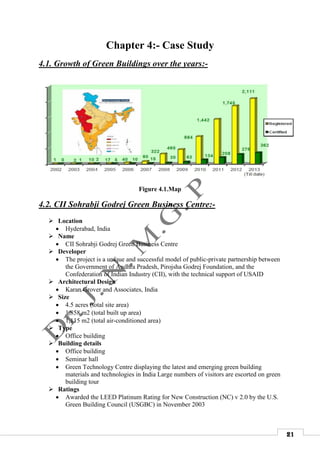
4.1. Growth of Green Buildings over the years:-
Figure 4.1.Map
4.2. CII Sohrabji Godrej Green Business Centre:-
 Location
 Hyderabad, India
 Name
 CII Sohrabji Godrej Green Business Centre
 Developer
 The project is a unique and successful model of public-private partnership between
the Government of Andhra Pradesh, Pirojsha Godrej Foundation, and the
Confederation of Indian Industry (CII), with the technical support of USAID
 Architectural Design
 Karan Grover and Associates, India
 Size
 4.5 acres (total site area)
 1,858 m2 (total built up area)
 1,115 m2 (total air-conditioned area)
 Type
 Office building
 Building details
 Office building
 Seminar hall
 Green Technology Centre displaying the latest and emerging green building
materials and technologies in India Large numbers of visitors are escorted on green
building tour
 Ratings
 Awarded the LEED Platinum Rating for New Construction (NC) v 2.0 by the U.S.
Green Building Council (USGBC) in November 2003
22
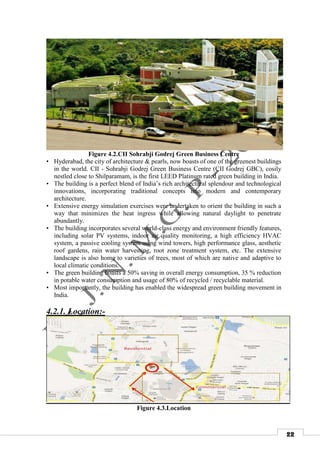
Figure 4.2.CII Sohrabji Godrej Green Business Centre
• Hyderabad, the city of architecture & pearls, now boasts of one of the greenest buildings
in the world. CII - Sohrabji Godrej Green Business Centre (CII Godrej GBC), cosily
nestled close to Shilparamam, is the first LEED Platinum rated green building in India.
• The building is a perfect blend of India’s rich architectural splendour and technological
innovations, incorporating traditional concepts into modern and contemporary
architecture.
• Extensive energy simulation exercises were undertaken to orient the building in such a
way that minimizes the heat ingress while allowing natural daylight to penetrate
abundantly.
• The building incorporates several world-class energy and environment friendly features,
including solar PV systems, indoor air quality monitoring, a high efficiency HVAC
system, a passive cooling system using wind towers, high performance glass, aesthetic
roof gardens, rain water harvesting, root zone treatment system, etc. The extensive
landscape is also home to varieties of trees, most of which are native and adaptive to
local climatic conditions.
• The green building boasts a 50% saving in overall energy consumption, 35 % reduction
in potable water consumption and usage of 80% of recycled / recyclable material.
• Most importantly, the building has enabled the widespread green building movement in
India.
4.2.1. Location:-
Figure 4.3.Location
23
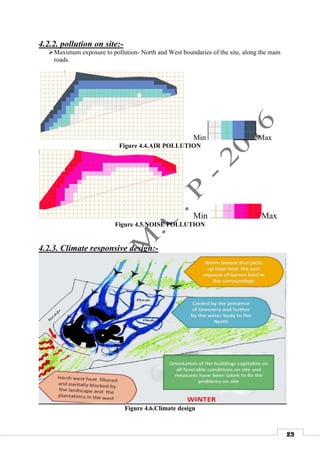
4.2.2. pollution on site:-
Maximum exposure to pollution- North and West boundaries of the site, along the main
roads.
Min Max
Figure 4.4.AIR POLLUTION
Min Max
Figure 4.5.NOISE POLLUTION
4.2.3. Climate responsive design:-
Figure 4.6.Climate design
24
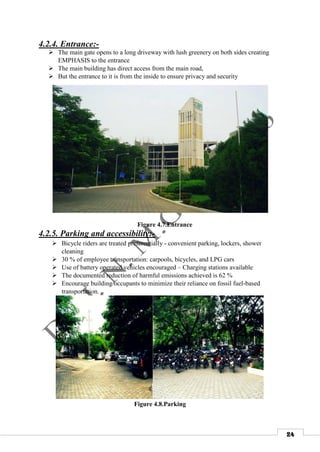
4.2.4. Entrance:-
 The main gate opens to a long driveway with lush greenery on both sides creating
EMPHASIS to the entrance
 The main building has direct access from the main road,
 But the entrance to it is from the inside to ensure privacy and security
Figure 4.7.Entrance
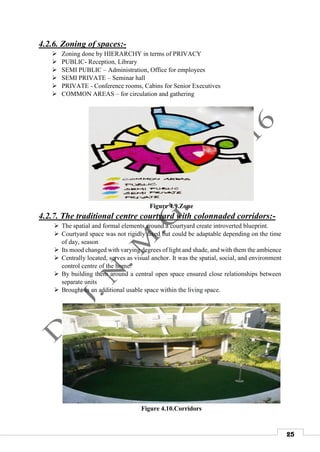
4.2.5. Parking and accessibility:-
 Bicycle riders are treated preferentially - convenient parking, lockers, shower
cleaning
 30 % of employee transportation: carpools, bicycles, and LPG cars
 Use of battery operated vehicles encouraged – Charging stations available
 The documented reduction of harmful emissions achieved is 62 %
 Encourage building occupants to minimize their reliance on fossil fuel-based
transportation.
Figure 4.8.Parking
25
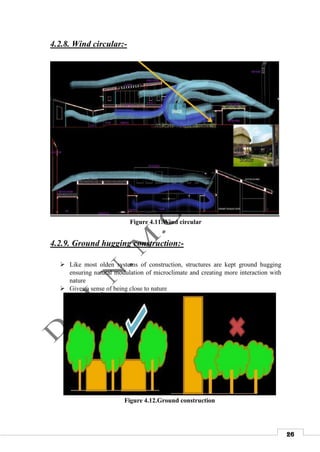
4.2.6. Zoning of spaces:-
 Zoning done by HIERARCHY in terms of PRIVACY
 PUBLIC- Reception, Library
 SEMI PUBLIC – Administration, Office for employees
 SEMI PRIVATE – Seminar hall
 PRIVATE - Conference rooms, Cabins for Senior Executives
 COMMON AREAS – for circulation and gathering
Figure 4.9.Zone
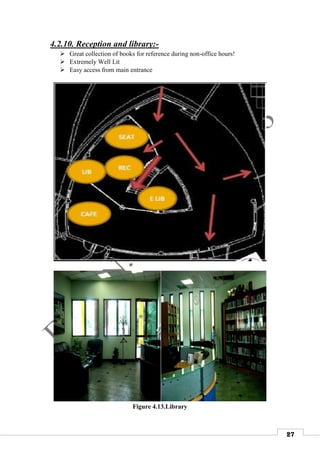
4.2.7. The traditional centre courtyard with colonnaded corridors:-
 The spatial and formal elements around a courtyard create introverted blueprint.
 Courtyard space was not rigidly fixed but could be adaptable depending on the time
of day, season
 Its mood changed with varying degrees of light and shade, and with them the ambience
 Centrally located, serves as visual anchor. It was the spatial, social, and environment
control centre of the home.
 By building them around a central open space ensured close relationships between
separate units
 Brought in an additional usable space within the living space.
Figure 4.10.Corridors
26
4.2.8. Wind circular:-
Figure 4.11.Wind circular
4.2.9. Ground hugging construction:-
 Like most olden systems of construction, structures are kept ground hugging
ensuring natural modulation of microclimate and creating more interaction with
nature
 Gives a sense of being close to nature
Figure 4.12.Ground construction
27
4.2.10. Reception and library:-
 Great collection of books for reference during non-office hours!
 Extremely Well Lit
 Easy access from main entrance
Figure 4.13.Library
28
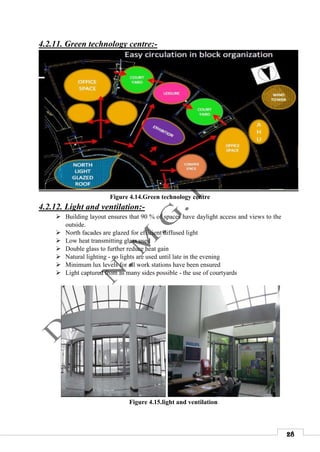
4.2.11. Green technology centre:-
Figure 4.14.Green technology centre
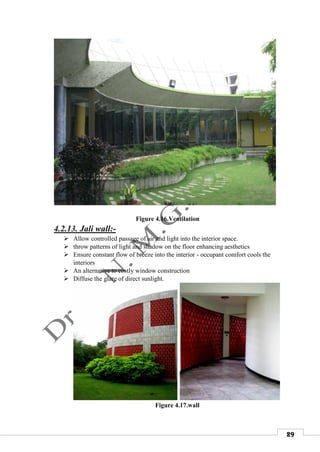
4.2.12. Light and ventilation:-
 Building layout ensures that 90 % of spaces have daylight access and views to the
outside.
 North facades are glazed for efficient diffused light
 Low heat transmitting glass used
 Double glass to further reduce heat gain
 Natural lighting - no lights are used until late in the evening
 Minimum lux levels for all work stations have been ensured
 Light captured from as many sides possible - the use of courtyards
Figure 4.15.light and ventilation
29
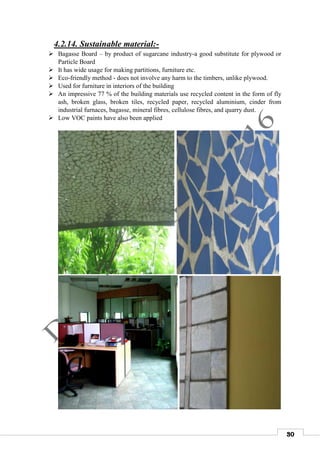
Figure 4.16.Ventilation
4.2.13. Jali wall:-
 Allow controlled passage of air and light into the interior space.
 throw patterns of light and shadow on the floor enhancing aesthetics
 Ensure constant flow of breeze into the interior - occupant comfort cools the
interiors
 An alternative to costly window construction
 Diffuse the glare of direct sunlight.
Figure 4.17.wall
30
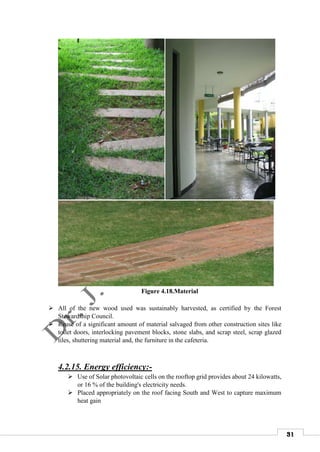
4.2.14. Sustainable material:-
 Bagasse Board – by product of sugarcane industry-a good substitute for plywood or
Particle Board
 It has wide usage for making partitions, furniture etc.
 Eco-friendly method - does not involve any harm to the timbers, unlike plywood.
 Used for furniture in interiors of the building
 An impressive 77 % of the building materials use recycled content in the form of fly
ash, broken glass, broken tiles, recycled paper, recycled aluminium, cinder from
industrial furnaces, bagasse, mineral fibres, cellulose fibres, and quarry dust.
 Low VOC paints have also been applied
31
Figure 4.18.Material
 All of the new wood used was sustainably harvested, as certified by the Forest
Stewardship Council.
 Reuse of a significant amount of material salvaged from other construction sites like
toilet doors, interlocking pavement blocks, stone slabs, and scrap steel, scrap glazed
tiles, shuttering material and, the furniture in the cafeteria.
4.2.15. Energy efficiency:-
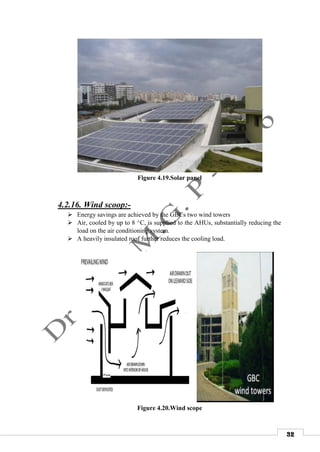
 Use of Solar photovoltaic cells on the rooftop grid provides about 24 kilowatts,
or 16 % of the building's electricity needs.
 Placed appropriately on the roof facing South and West to capture maximum
heat gain
32
Figure 4.19.Solar panel
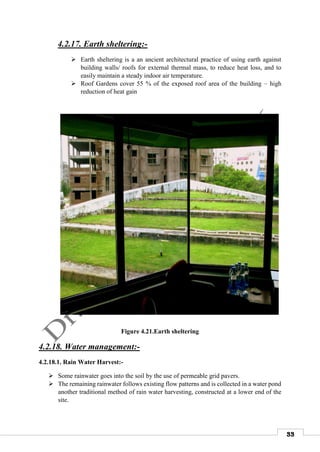
4.2.16. Wind scoop:-
 Energy savings are achieved by the GBCs two wind towers
 Air, cooled by up to 8 ^C, is supplied to the AHUs, substantially reducing the
load on the air conditioning system.
 A heavily insulated roof further reduces the cooling load.
Figure 4.20.Wind scope
33
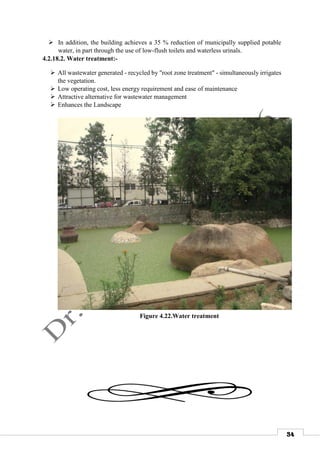
4.2.17. Earth sheltering:-
 Earth sheltering is a an ancient architectural practice of using earth against
building walls/ roofs for external thermal mass, to reduce heat loss, and to
easily maintain a steady indoor air temperature.
 Roof Gardens cover 55 % of the exposed roof area of the building – high
reduction of heat gain
Figure 4.21.Earth sheltering
4.2.18. Water management:-
4.2.18.1. Rain Water Harvest:-
 Some rainwater goes into the soil by the use of permeable grid pavers.
 The remaining rainwater follows existing flow patterns and is collected in a water pond
another traditional method of rain water harvesting, constructed at a lower end of the
site.
34
 In addition, the building achieves a 35 % reduction of municipally supplied potable
water, in part through the use of low-flush toilets and waterless urinals.
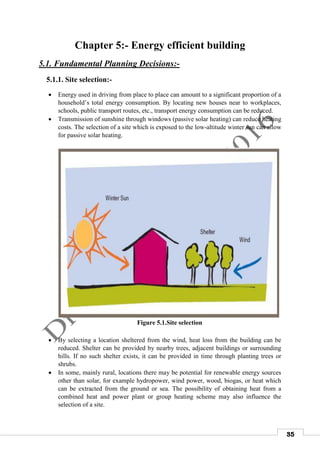
4.2.18.2. Water treatment:-
 All wastewater generated - recycled by "root zone treatment" - simultaneously irrigates
the vegetation.
 Low operating cost, less energy requirement and ease of maintenance
 Attractive alternative for wastewater management
 Enhances the Landscape


Figure 4.22.Water treatment
35
Chapter 5:- Energy efficient building
5.1. Fundamental Planning Decisions:-
5.1.1. Site selection:-
 Energy used in driving from place to place can amount to a significant proportion of a
household’s total energy consumption. By locating new houses near to workplaces,
schools, public transport routes, etc., transport energy consumption can be reduced.
 Transmission of sunshine through windows (passive solar heating) can reduce heating
costs. The selection of a site which is exposed to the low-altitude winter sun can allow
for passive solar heating.
Figure 5.1.Site selection
 By selecting a location sheltered from the wind, heat loss from the building can be
reduced. Shelter can be provided by nearby trees, adjacent buildings or surrounding
hills. If no such shelter exists, it can be provided in time through planting trees or
shrubs.
 In some, mainly rural, locations there may be potential for renewable energy sources
other than solar, for example hydropower, wind power, wood, biogas, or heat which
can be extracted from the ground or sea. The possibility of obtaining heat from a
combined heat and power plant or group heating scheme may also influence the
selection of a site.
36
5.1.2. Building form and orientation:-
 A compact building form of minimum surface-to-volume ratio is best for reducing heat
loss. However, a rectangular building with one of the longer facades facing south can
allow for increased passive solar heating, day-lighting and natural ventilation. As well
as reducing energy costs, sunny south-facing rooms also have high amenity value.
 Projections such as bay and dormer windows should be kept to a minimum, since by
increasing the surface-to-volume ratio of the building, they will increase heat loss. They
also tend to be more difficult to insulate effectively.
 Pitched roofs should have one slope oriented south to allow for optimum performance
of a roof-mounted or roof-integrated active solar heating system. Even if such a system
is not planned during construction, it may be installed at some stage during the life of
the building.
5.1.3. Energy assessment:-
 Many decisions affecting the energy performance of a house are taken early in the
design process. A method of calculating annual heating energy consumption should be
used to compare alternatives at the preliminary design stage.
5.2. Building Fabric and Structure:-
5.2.1. Insulation:-
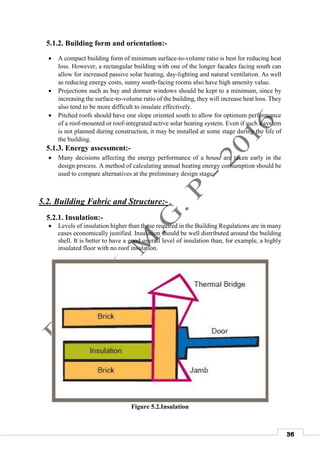
 Levels of insulation higher than those required in the Building Regulations are in many
cases economically justified. Insulation should be well distributed around the building
shell. It is better to have a good overall level of insulation than, for example, a highly
insulated floor with no roof insulation.
Figure 5.2.Insulation
37
 Attention should be given to the avoidance of thermal bridges. These are “short
circuits” across insulation, which are commonly found at lintels, jambs and sills of
doors and windows, and at junctions where floors and ceilings meet external walls.
They give rise to increased heat loss and possible condensation problems.
 There are many examples of buildings performing more poorly than expected in energy
terms due to poor quality workmanship in installing insulation. To achieve the level of
energy efficiency predicted by the design, it is very important to ensure good quality
workmanship and supervision during construction.
5.2.2. Ventilation:-
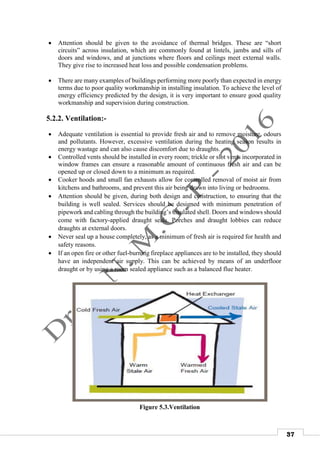
 Adequate ventilation is essential to provide fresh air and to remove moisture, odours
and pollutants. However, excessive ventilation during the heating season results in
energy wastage and can also cause discomfort due to draughts.
 Controlled vents should be installed in every room; trickle or slot vents incorporated in
window frames can ensure a reasonable amount of continuous fresh air and can be
opened up or closed down to a minimum as required.
 Cooker hoods and small fan exhausts allow for controlled removal of moist air from
kitchens and bathrooms, and prevent this air being drawn into living or bedrooms.
 Attention should be given, during both design and construction, to ensuring that the
building is well sealed. Services should be designed with minimum penetration of
pipework and cabling through the building’s insulated shell. Doors and windows should
come with factory-applied draught seals. Porches and draught lobbies can reduce
draughts at external doors.
 Never seal up a house completely, as a minimum of fresh air is required for health and
safety reasons.
 If an open fire or other fuel-burning fireplace appliances are to be installed, they should
have an independent air supply. This can be achieved by means of an underfloor
draught or by using a room sealed appliance such as a balanced flue heater.
Figure 5.3.Ventilation
38
 A balanced ventilation system involving fans, ductwork and a heat exchanger can
transfer heat from warm stale outgoing air to incoming fresh air (this is called
“mechanical ventilation with heat recovery”). Stale air is usually extracted from rooms
such as kitchens and bathrooms, and warmed fresh air supplied to living rooms and
bedrooms.
 For such systems to work well, the house must be well sealed. Correctly sized systems
can reduce ventilation heat loss considerably.
 If the house is to be built in an area where leakage of radon gas from the ground gives
rise to concern, appropriate steps should be taken to prevent its entry into the house.
The Radiological Protection Institute of Ireland can advise on this.
5.2.3. Passive solar features:-
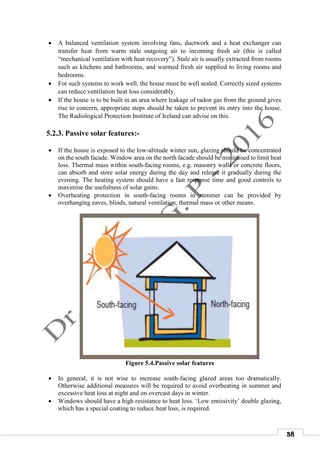
 If the house is exposed to the low-altitude winter sun, glazing should be concentrated
on the south facade. Window area on the north facade should be minimised to limit heat
loss. Thermal mass within south-facing rooms, e.g. masonry walls or concrete floors,
can absorb and store solar energy during the day and release it gradually during the
evening. The heating system should have a fast response time and good controls to
maximise the usefulness of solar gains.
 Overheating protection in south-facing rooms in summer can be provided by
overhanging eaves, blinds, natural ventilation, thermal mass or other means.
Figure 5.4.Passive solar features
 In general, it is not wise to increase south-facing glazed areas too dramatically.
Otherwise additional measures will be required to avoid overheating in summer and
excessive heat loss at night and on overcast days in winter.
 Windows should have a high resistance to heat loss. ‘Low emissivity’ double glazing,
which has a special coating to reduce heat loss, is required.
39
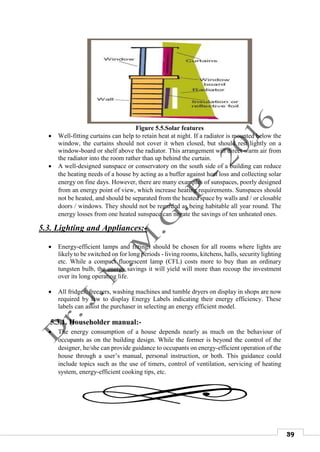
Figure 5.5.Solar features
 Well-fitting curtains can help to retain heat at night. If a radiator is mounted below the
window, the curtains should not cover it when closed, but should rest lightly on a
window-board or shelf above the radiator. This arrangement will direct warm air from
the radiator into the room rather than up behind the curtain.
 A well-designed sunspace or conservatory on the south side of a building can reduce
the heating needs of a house by acting as a buffer against heat loss and collecting solar
energy on fine days. However, there are many examples of sunspaces, poorly designed
from an energy point of view, which increase heating requirements. Sunspaces should
not be heated, and should be separated from the heated space by walls and / or closable
doors / windows. They should not be regarded as being habitable all year round. The
energy losses from one heated sunspace can negate the savings of ten unheated ones.
5.3. Lighting and Appliances:-
 Energy-efficient lamps and fittings should be chosen for all rooms where lights are
likely to be switched on for long periods - living rooms, kitchens, halls, security lighting
etc. While a compact fluorescent lamp (CFL) costs more to buy than an ordinary
tungsten bulb, the energy savings it will yield will more than recoup the investment
over its long operating life.
 All fridges, freezers, washing machines and tumble dryers on display in shops are now
required by law to display Energy Labels indicating their energy efficiency. These
labels can assist the purchaser in selecting an energy efficient model.
5.3.1. Householder manual:-
 The energy consumption of a house depends nearly as much on the behaviour of
occupants as on the building design. While the former is beyond the control of the
designer, he/she can provide guidance to occupants on energy-efficient operation of the
house through a user’s manual, personal instruction, or both. This guidance could
include topics such as the use of timers, control of ventilation, servicing of heating
system, energy-efficient cooking tips, etc.
40
Chapter 6:- Green Building Rating System
6.1. Why rating System?
 Some of the benefits of a green design to a building owner, user, and the society as a
whole are as follows:
 Reduced energy consumption without sacrificing the comfort levels (lower operational
costs)
 Reduced water consumption
 Reduced system sizes (HVAC, transformers, cabling, etc.) for optimal performance at
local conditions.
 Reduced investment (lifecycle cost)
 Reduced destruction of natural areas, habitats, biodiversity, reduced soil loss from
erosion etc.
 Reduced air and water pollution (with direct health benefits)
 Limited waste generation due to recycling and reuse
 Reduced pollution loads
 Increased user productivity
 Enhanced image and marketability
6.2. LEED:-

 Effective in India from 1st Jan 2007
 Based on professional reference standards like NBC, ASHRAE, and ECBC
etc.
 Assessment by 3rd party assessors & USGBC
 Voluntary, Consensus- based, Market driven
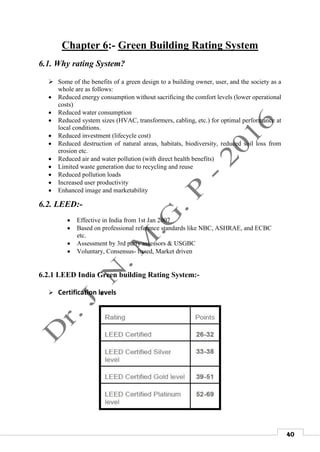
6.2.1 LEED India Green building Rating System:-
 Certification levels
41
6.2.2. Few LEED rated buildings in India:-
 Platinum rated:
 CII –Godrej GBC, Hyderabad
 ITC Green Centre, Gurgaon
 Wipro Technologies, Gurgaon
 Gold rated:
 IGP Office, Gulbarga
 NEG Macon, Chennai
 Grundfos Pumps, Chennai
 Silver Rated :
 L&T EDRC , Chennai
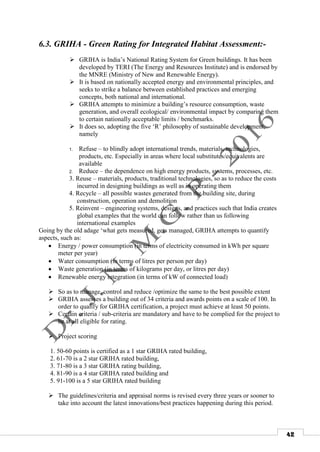
6.2.3. Leed India Green Building Rating System:-
42
6.3. GRIHA - Green Rating for Integrated Habitat Assessment:-
 GRIHA is India’s National Rating System for Green buildings. It has been
developed by TERI (The Energy and Resources Institute) and is endorsed by
the MNRE (Ministry of New and Renewable Energy).
 It is based on nationally accepted energy and environmental principles, and
seeks to strike a balance between established practices and emerging
concepts, both national and international.
 GRIHA attempts to minimize a building’s resource consumption, waste
generation, and overall ecological/ environmental impact by comparing them
to certain nationally acceptable limits / benchmarks.
 It does so, adopting the five ‘R’ philosophy of sustainable development,
namely
1. Refuse – to blindly adopt international trends, materials, technologies,
products, etc. Especially in areas where local substitutes/equivalents are
available
2. Reduce – the dependence on high energy products, systems, processes, etc.
3. Reuse – materials, products, traditional technologies, so as to reduce the costs
incurred in designing buildings as well as in operating them
4. Recycle – all possible wastes generated from the building site, during
construction, operation and demolition
5. Reinvent – engineering systems, designs, and practices such that India creates
global examples that the world can follow rather than us following
international examples
Going by the old adage ‘what gets measured, gets managed, GRIHA attempts to quantify
aspects, such as:
 Energy / power consumption (in terms of electricity consumed in kWh per square
meter per year)
 Water consumption (in terms of litres per person per day)
 Waste generation (in terms of kilograms per day, or litres per day)
 Renewable energy integration (in terms of kW of connected load)
 So as to manage, control and reduce /optimize the same to the best possible extent
 GRIHA assesses a building out of 34 criteria and awards points on a scale of 100. In
order to qualify for GRIHA certification, a project must achieve at least 50 points.
 Certain criteria / sub-criteria are mandatory and have to be complied for the project to
be at all eligible for rating.
 Project scoring
1. 50-60 points is certified as a 1 star GRIHA rated building,
2. 61-70 is a 2 star GRIHA rated building,
3. 71-80 is a 3 star GRIHA rating building,
4. 81-90 is a 4 star GRIHA rated building and
5. 91-100 is a 5 star GRIHA rated building
 The guidelines/criteria and appraisal norms is revised every three years or sooner to
take into account the latest innovations/best practices happening during this period.
43
 SVA GRIHA (Simple Versatile Affordable GRIHA) has been developed by ADaRSH
in collaboration with TERI and is currently under pilot stage. This variant of GRIHA
is meant to simplify, and make the greening of small buildings (less than 2500 sqm
built-up area) affordable.
6.4. IGBC:-
 Indian Green Building Council (IGBC) has launched ‘IGBC Green Homes Rating
System’ to address the national priorities.
 This rating programmer is a tool which enables the designer to apply green concepts
and criteria, so as to reduce the environmental impacts, which are measurable.
 The objective of IGBC Green Homes is to facilitate the creation of energy efficient,
water efficient, healthy, comfortable and environmentally friendly houses.
6.4.1:- IGBC Green New Buildings rating system:-
IGBC green new buildings rating system® addresses green features under the
following categories:
 Sustainable Architecture and Design
 Site Selection and Planning
 Water Conservation
 Energy Efficiency
 Building Materials and Resources
 Indoor Environmental Quality
 Innovation and Development
 The guidelines detailed under each mandatory requirement & credit enables the
design and construction of new buildings of all sizes and types (as defined in scope).
Different levels of green building certification are awarded based on the total credits
earned. However, every green new building should meet certain mandatory
requirements, which are non-negotiable.
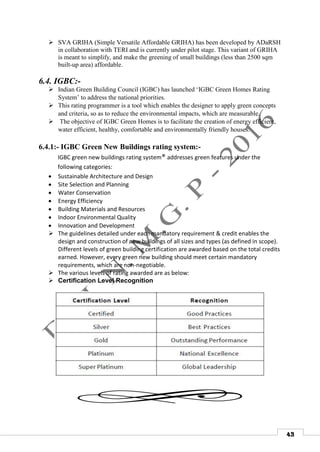
 The various levels of rating awarded are as below:
 Certification Level Recognition
44
CONCLUSION
After referring the literature survey & theory concept of pavement failure we can come on
following conclusion......
 the differences in green and normal building is that “Green Buildings” are more
environment friendly as they help in resources conservation .Also the initial cost may
be higher but they prove to be economical in long run. Due to this advantage it is
predicted that in 2 or 3 years there will be the 10% of the buildings will be green.
 Green building – high performance building increases the efficiency with which
buildings and their sites use and harvest energy, water, and materials.
 Green building brings together a vast array of practices, techniques, and skills to
reduce and ultimately eliminate the impacts of buildings on the environment and
human health.
 The `Green Building' concept is gaining importance in various countries, including
India. These are buildings that ensure that waste is minimized at every stage during the
construction and operation of the building, resulting in low costs, according to experts
in the technology.
 The sustainability requirements are to a greater or lesser extent interrelated. The
challenge for designers is to bring together these different sustainability requirements
in innovative ways. The new design approach must recognize the impacts of every
design choice on the natural and cultural resources of the local, regional and global
environments.
 The ‘GREEN BUILDING’ concept is gaining importance in various countries,
including India. These are buildings that ensure waste is minimized at every stage
during the construction and operation of the building, resulting in low costs, according
to experts in technology.
 A Green building is a structure that is environmentally responsible and resource
efficient throughout its life cycle.
 Green building benefits:-
 Increased occupant health and comfort as well as cost savings.
 Reduction of VOCs that can off-gas from materials into the air we breathe.
 Absenteeism and employee turnover dramatically decreases in several studies.
 Reduced health care costs,
 Increased recruitment appeal to employees,
 Boost to reputation and public relations
 Shortened project timeline,
 Increased rents/asset values
 Longer tenant tenure
 Longer asset life
 Increased business traffic and purchasing
 Regulatory approval streamlining
 Remaining competitive as product and service providers
 Better access to funds and financing,
 Emotional benefits from doing something good
45
REFRENCES & BIBLOGRAPHY
 www.google.com
 http://sallan.org/pdf-docs/CHOWE_GreenBuildiing
 file:///D:/Green_Building_Performance.pdf
 file:///D:/CHOWE_GreenBuildLaw.pdf
 file:///D:/Green%20Building%20Materials%20Presentation%202011.pdf
 www.nptl.org.in
 https://www.google.co.in/greenbuilding
 http://www.google.co.in/greenbuildingmaterials
 https://www.google.co.in/greenbuilding/leed
46
THANK YOU

Green building

  • 1.
    1 Chapter 1:- Introduction 1.1.Definitions of “Green Building”:-  While the definition of what constitutes a green building is constantly evolving, the Office of the Federal Environmental Executive offers a useful working definition. This agency defines this term as:  the practice of (1) increasing the efficiency with which buildings and their sites use energy, water, and materials, and (2) reducing building impacts on human health and the environment, through better siting, design, construction, operation, maintenance, and removal—the complete building life cycle.  Similarly, the Environmental Protection Agency (EPA) defines green building as follows:  he practice of creating structures and using processes that are environmentally responsible and resource-efficient throughout a building’s life-cycle from siting to design, construction, operation, maintenance, renovation and deconstruction. This practice expands and complements the classical building design concerns of economy, utility, durability, and comfort. Green building is also known as a sustainable or ‘high performance’ building.  Both of these definitions mention life cycle assessment (LCA). LCA is the investigation and valuation of the environmental, economic, and social impacts of a product or service. In the context of green buildings, LCA evaluates building materials over the course of their entire lives and takes into account a full range of environmental impacts, including a material’s embodied energy; the solid waste generated in its extraction, use, and disposal; the air and water pollution associated with it; and its global-warming potential. LCA is an important tool because it can demonstrate whether a product used in a green building is truly green. Figure 1.1.Green building
  • 2.
    2 1.2. Why doesit matter?  Takes an intelligent approach to energy • Minimising energy use in all stages of a building’s life-cycle, making new and renovated buildings more comfortable, less expensive to run and helping building users learn to be efficient too. • Integrating renewable and low carbon technologies to supply buildings’ energy needs, once design has maximised inbuilt and natural efficiencies.  Safeguards our water resources • Exploring ways to improve drinking and waste water efficiency and management, harvesting water for safe indoor use in innovative ways and generally minimising water use in the sector. • Considering the impact of the built environment on storm water and drainage infrastructure, ensuring these are not put under undue stress or prevented from doing their job.  Minimises waste and maximises reuse • Using fewer, more durable materials and generating less waste, as well as accounting for a building’s end of life stage by designing for demolition waste recovery and reuse. • Engaging building users in reuse and recycling.  Promotes health and well-being • Bringing a breath of fresh air inside, delivering high indoor air quality through good ventilation and avoiding materials and chemicals that create harmful emissions. • Incorporating natural light and views to ensure building users’ comfort and enjoyment of their surroundings, reducing lighting energy needs in the process. • Designing for ears as well as eyes. In the education, health and residential sectors, acoustics and proper sound insulation play important roles in helping concentration, recuperation, and peaceful enjoyment of property. • Ensuring people are comfortable in their everyday environments, creating the right indoor temperature as the seasons pass through passive design or building management and monitoring systems.  Keeps our landscape green • Recognising that our urban environment should preserve nature, ensuring diverse wildlife and land quality are protected or enhanced, for example by remediating and building on polluted land or creating green spaces. • Looking for ways we can make our urban areas more productive, bringing agriculture into our cities.  Creates resilient and flexible structures • Adapting to a changing environment, ensuring resilience to events such as flooding, earthquakes or fires so that our buildings stand the test of time and keep people and their belongings safe. • Designing flexible and dynamic spaces, anticipating changes in their use over time and avoiding the need to demolish and rebuild or significantly renovate buildings to prevent them becoming obsolete.
  • 3.
    3  Connects us •Creating diverse environments that connect and enhance communities, asking what a building will add to its context in terms of positive economic and social effects and engaging local communities in planning. • Ensuring transport and distance to amenities are considered in design, reducing the stresses of personal transport on the environment, roads and railways and encouraging environmentally friendly options such as cycling.  Considers all stages of a building’s life-cycle • Seeking to lower all environmental impacts and maximise social and economic value over a building’s whole life-cycle: through design, construction, operation, maintenance, renovation, and demolition. The fragmented nature of the building industry value chain means we have long looked at parts of the life-cycle in isolation, but Green Building Councils are bringing the sector’s whole value chain together through our members to build a wider vision. • Making the invisible visible. Embodied resources are the invisible resources used in buildings: for example, the energy or water used to produce and transport the materials in the building. Green building considers these amongst a building’s impacts, ensuring that our buildings are truly low impact.
  • 4.
    4 Chapter 2:- FundamentalPrinciples of Green Building 2.1. Sustainable Site Design:- 2.1.1. Key Principles:- Minimize urban sprawl and needless destruction of valuable land, habitat and green space, which results from inefficient low-density development. Encourage higher density urban development, urban re-development and urban renewal, and brownfield development as a means to preserve valuable green space. Preserve key environmental assets through careful examination of each site. Engage in a design and construction process that minimizes site disturbance and which values, preserves and actually restores or regenerates valuable habitat, green space and associated eco-systems that are vital to sustaining life.  Key Strategies and Technologies:- • Make more efficient use of space in existing occupied buildings, renovate and re-use existing vacant buildings, sites, and associated infrastructure and consider re- development of brownfield sites. Design buildings and renovations to maximize future flexibility and reuse thereby expanding useful life. • When new development is unavoidable, steer clear of sites that play a key role in the local or regional ecosystem. Identify and protect valuable Greenfield and wetland sites from development. • Recognize that allowing higher density development in urban areas helps to preserve green space and reduce urban sprawl. Invest time and energy in seeking variances and regulatory reform where needed. • Evaluate each site in terms of the location and orientation of buildings and improvements in order to optimize the use of passive solar energy, natural day lighting, and natural breezes and ventilation. • Make best use of existing mass transit systems and make buildings and sites pedestrian and bike friendly, including provisions for safe storage of bicycles. Develop programs and incentives that promote car-pooling including preferred parking for commuters who carpool. Consider making provisions for re-fuelling or recharging alternative fuel vehicles. • Help reduce the urban heat island effect by reducing the building and site development footprint, maximizing the use of pervious surfaces, and using light colour roofs, paving, and walkways. Provide natural shading of buildings and paved areas with trees and other landscape features.
  • 5.
    5 • Reduce imperviousareas by carefully evaluating parking and roadway design. Pursue variances or waivers where local ordinances may unintentionally result in the over- design of roadways or parking. • Optimize the use of on-site storm water treatment and ground water recharge. Minimize the boundaries of the construction area, avoid needless compaction of existing topsoil, and provide effective sedimentation and silt control during all phases of site development and construction. • Use landscape design to preserve and restore the region’s natural habitat and heritage while emphasizing the use of indigenous, hardy, drought resistant trees, shrubs, plants and turf. • Help reduce night-time light pollution by avoiding over-illumination of the site and use low cut-off exterior lighting fixtures which direct light downward, not upward and outward. 2.2. Water Quality and Conservation:- 2.2.1. Key Principles: Preserve the existing natural water cycle and design site and building improvements such that they closely emulate the site’s natural “pre-development” hydrological systems. Emphasis should be placed on retention of storm water and on-site infiltration and ground water recharge using methods that closely emulate natural systems. Minimize the unnecessary and inefficient use of potable water on the site while maximizing the recycling and reuse of water, including harvested rainwater, storm water, and grey water.  Key Strategies and Technologies: • Recognize that the least costly, least time consuming and most environmentally preferable design for site and storm water management is often the one in which the design of buildings and site improvements respect the existing natural flows and features of the land, instead of designing the building and site improvements with total disregard for the site, which results in needless, extensive, disruptive, costly and time consuming excavation and earthmoving. • Conduct a thorough site assessment and strategically locate buildings and site improvements so as to preserve key natural hydrological features. Special effort should be made to preserve areas of the site that serve as natural storm water retention and ground water infiltration and recharge systems. Preserve existing forest and mature vegetation that play a vital role in the natural water cycle by absorbing and disbursing up to 30% of a site’s rainwater through evaporate-transpiration. • Minimize the building’s footprint, site improvements and construction area, and minimize excavation, soil disturbance and compaction of existing topsoil as this soil in
  • 6.
    6 its natural uncompactstate serves a vital role in absorbing and storing up to 80% of natural rainfall until it can be absorbed by vegetation or • Design and locate buildings and site improvements to optimize use of low-impact storm water technologies such as bio-retention, rain gardens, open grassy swales, pervious bituminous paving, pervious concrete paving and walkways, constructed wetlands, living/vegetated roofs, and other technologies that support on-site retention and ground water recharge or evaporate-transpiration. Storm water that leaves the site should be filtered and processed naturally or mechanically to remove trash and debris, oil, grit and suspended solids. Use “hold and release” technologies such as dry retention ponds only as a last resort as these technologies do not preserve the natural water cycle, have little or no benefit in terms of ground water recharge and result in needless additional site disturbance. • Establish a water budget for the building and implement a design that minimizes the use of potable water by using low-flow plumbing fixtures and toilets and waterless urinals. Harvest, process and recycle rainwater, site storm water, and building grey water and identify appropriate uses within the building and site. Use on-site treatment systems that enable use of rain water for hand washing, grey water for toilet flushing, rain and storm water for site irrigation, cooling tower make-up and other uses. • Conserve water and preserve site and ground water quality by using only indigenous, drought resistant and hardy trees, shrubs, plants and turf that require no irrigation, fertilizers, pesticides or herbicides. 2.3. Energy and Environment:- 2.3.1. Key Principles:- Minimize adverse impacts on the environment (air, water, land, natural resources) through optimized building siting, optimized building design, material selection, and aggressive use of energy conservation measures. Resulting building performance should exceed minimum International Energy Code (IEC) compliance level by 30 to 40% or more. Maximize the use of renewable energy and other low impact energy sources.  Key Strategies and Technologies: • Optimize passive solar orientation, building massing and use of external shading devices such that the design of the building minimizes undesirable solar gains during the summer months while maximizing desirable solar gains during winter months. • Optimize building orientation, massing, shape, design, and interior colors and finishes in order to maximize the use of controlled natural day lighting which significantly reduces artificial lighting energy use thereby reducing the buildings internal cooling load and energy use. Consider the use of light shelf technology.
  • 7.
    7 • Use highperformance low-e glazing, which can result in significant year round energy savings. Consider insulated double glazing, triple glazing or double pane glazing with a suspended low-e film. Selective coatings offer optimal light transmittance while providing minimal solar gain and minimal heat transmission. Window frames, sashes and curtain wall systems should also be designed for optimum energy performance including the use of multiple thermal breaks to help reduce energy use. • Optimize the value of exterior insulation and the overall thermal performance of the exterior envelope assembly. Consider advanced/high performance envelope building systems such as structural insulated panel systems (SIPS) and insulated concrete form systems (ICF’s) that can be applied to light commercial and institutional buildings. SIPS and ICF’s and other thermally “decoupled” envelope systems will offer the highest energy performance. • Use energy efficient T-8 and T-5 bulbs, high efficiency electronic ballasts, and lighting controls. Consider using indirect ambient lighting with workstation based direct task lighting to improve light quality, reduce glare and improve overall energy performance in general office areas. Incorporate sensors and controls and design circuits so that lighting along perimeter zones and offices can be switched off independently from other interior lights when day lighting is sufficient in perimeter areas. • Use state-of-the art, high efficiency, heating, ventilation and air conditioning (HVAC) and plumbing equipment, chillers, boilers, and water heaters, etc. Use variable speed drives on fan and pump motors. Use heat recovery ventilators and geothermal heat pump technology for up to 40% energy savings. • Avoid the use of HCFC and Halona based refrigeration, cooling and fire suppression systems. Optimize the use of natural ventilation and where practical use evaporative cooling, waste heat and/or solar regenerated desiccant dehumidification or absorption cooling. Identify and use sources of waste energy. • Use Energy Star certified energy efficient appliances, office equipment, lighting and HVAC systems. • Consider on-site small-scale wind, solar, and/or fuel cell based energy generation and co-generation. Purchase environmentally preferable “green” power from certified renewable and sustainable sources. 2.4. Indoor Environmental Quality:- 2.4.1 Key Principles:- Provide a healthy, comfortable and productive indoor environment for building occupants and visitors. Provide a building design, which affords the best possible conditions in terms of indoor air quality, ventilation, and thermal comfort, access to natural ventilation and day lighting, and effective control of the acoustical environment.
  • 8.
    8  Key Strategiesand Technologies: • Use building materials, adhesives, sealants, finishes and furnishings which do not contain, harbour, generate or release any particulate or gaseous contaminants including volatile organic compounds. • Maximize the use of natural day lighting. Optimize solar orientation and design the building to maximize penetration of natural daylight into interior spaces. Provide shades or daylight controls where needed. • Maximize the use of operable windows and natural ventilation. Provide dedicated engineered ventilation systems that operate independently of the buildings heating and cooling system. Ventilation systems should be capable of effectively removing or treating indoor contaminants while providing adequate amounts of fresh clean make- up air to all occupants and all regions of the building. Monitor indoor air conditions including temperature, humidity and carbon dioxide levels, so that building ventilation systems can respond when space conditions fall outside the optimum range. • Provide a smoke free building. When smoking must be accommodated, provide completely dedicated smoking areas are physically isolated, have dedicated HVAC systems, and remain under negative pressure with respect to all adjoining spaces. Assure that air from smoking areas does not get distributed to other areas of the building does not re-enter the building through doors or vestibules, operable windows, or building fresh air intakes.. Locate outdoor smoking areas so that non-smokers do not have to pass through these areas when using primary building entrances or exits. • Design building envelope and environmental systems that not only treat air temperature and provide adequate ventilation, but which respect all of the environmental conditions which affect human thermal comfort and health, including the mean radiant temperature of interior surfaces, indoor air humidity, indoor air velocity, and indoor air temperature. Following these principles and providing a building that is also responsive to seasonal variations in desirable indoor humidity levels, air velocity, and mean radiant temperatures can also result in significant energy savings as improved occupant comfort results in less energy intensive operation of the buildings air-side heating and cooling system. • Maximize occupant health, comfort and performance by providing occupants with individual space/zone control of heat, ventilation, cooling, day-lighting and artificial lighting whenever possible. • Prevent contamination of the building during construction. Take steps to minimize the creation and spreading of construction dust and dirt. Prevent contamination of the building and the buildings heating, cooling and ventilation systems during the construction process. Protect construction materials from the elements so that they do not become damp, mouldy or mildewed.
  • 9.
    9 • Provide aclean and healthy building. Use biodegradable and environmentally friendly cleaning agents that do not release VOCs or other harmful agents and residue. Prior to occupancy install new air filters and clean any contaminated ductwork and ventilation equipment. Use fresh outdoor air to naturally or mechanically purge the building of any remaining airborne gaseous or particulate contaminants. 2.5. Materials and Resources:- 2.4.1. Key Principles:- Minimize the use of non-renewable construction materials and other resources such as energy and water through efficient engineering, design, planning and construction and effective recycling of construction debris. Maximize the use of recycled content materials, modern resource efficient engineered materials, and resource efficient composite type structural systems wherever possible. Maximize the use of re-usable, renewable, sustainably managed, bio-based materials. Remember that human creativity and our abundant lab or force is perhaps our most valuable renewable resource. The best solution is not necessarily the one that requires the least amount of physical work.  Key Strategies and Technologies: • Optimize the use of engineered materials which make use of proven engineering principles such as engineered trusses, composite materials and structural systems (concrete/steel, other…), structural insulated panels (stress skin panels), insulated concrete forms, and frost protected shallow foundations which have been proven to provide high strength and durability with the least amount of material. • Identify ways to reduce the amount of materials used and reduce the amount of waste generated through the implementation of a construction waste reduction plan. Adopt a policy of “waste equals food” whereby 75% or more of all construction waste is separated for recycling and used as feedstock for some future product rather than being landfilled. Implement an aggressive construction waste recycling program and provide separate, clearly labelled dumpsters for each recycled material. Train all crews and subcontractors on the policy and enforce compliance. • Identify ways to use high-recycled content materials in the building structure and finishes. Consider everything from blended concrete using fly ash, slag, recycled concrete aggregate, or other admixtures to recycled content materials such as structural steel, ceiling and floor tiles, carpeting, carpet padding, sheathing, and gypsum wallboard. Consider remanufactured office furniture and office partition systems, chairs and furniture with recycled content or parts. • Explore the use of bio-based materials and finishes such as various types of garboard (sheathing and or insulation board made from agricultural waste and by products, including straw, wheat, barley, soy, sunflower shells, peanut shells, and other materials). Some structural insulated panels are now made from bio-based materials.
  • 10.
    10 Use lumber andwood products from certified forests where the forest is managed and lumber is harvested using sustainable practices. Use resource efficient engineered wood products in lieu of full dimension lumber which comes from older growth forests. • Evaluate all products and systems used for their ability to be recycled when they reach the end of their useful life. Preference should be given to products and systems that facilitate easy, non-energy intensive separation and recycling with minimal contamination by foreign debris. • Recognize that transportation becomes part of a product or building materials embodied energy. Where practical, specify and use locally harvested, mined and manufactured materials and products to support the regional economy and to reduce transportation, energy use and emissions.
  • 11.
    11 Chapter 3:- GreenBuilding Materials 3.1. Overview:- Green building materials are a rapidly developing and expanding sector of the construction materials market. What constitutes a “green” material varies widely depending on the source. While no official government standard exists to provide definable guidelines, the Federal Trade Commission is working on such a plan. Meanwhile, the certification of green and/or sustainable building materials has been left to professional trade organizations. While each sector of the construction materials industry has its own or multiple sets of criteria, the common bond tends to be the U.S. Green Building Council’s Leadership in Energy and Environmental Design (LEED) guidelines and standards. However, regardless of the source, the common elements that bind green material evaluation are very similar and include– production energy usage and waste, low toxicity/minimal emissions, recycled content/recyclability, locality of production, impact on indoor air quality, and affordability. 3.2. Flooring:-  Rapidly Renewable Flooring Figure 3.1.Bamboo Figure 3.2.Eucalyptus Figure 3.3.Natural Linoleum
  • 12.
    12  “Waste” BasedFlooring Options Figure 3.4.Recycled Aggregate Flooring Figure 3.5.Cork  Sustainable carpeting Figure 3.6.Sisal Figure 3.7.Sea Grass
  • 13.
    13 Figure 3.8.Carpintig 3.3. DimensionStone:- Dimension stone is the name given to natural quarried stones that are cut to required dimensions and finished – such as granite, slate, limestone, sandstone, and marble. Used in building facades, indoor flooring, and outdoor walkways, it is widely noted as one of the most durable and green types of building materials. Of special note is the ease with which dimension stone can be recycled during old building demolition and used either in whole form or crushed into aggregates for use in concrete mixtures. To be certified as “green” building material by the USGBC or other organization, this stone usually needs to have been quarried locally, usually within about 500 miles of the building site. The Natural Stone Council has information available about the energy usage and green characteristics of most all commercially available dimension stone products. 3.4. Concrete:- As a general building material, concrete is considered “green” by most standards, although issues do arise concerning the amount of CO2 emissions released during cement its production. One remedy to that concern has been the addition of supplemental cementicious materials to replace some of the Portland cement needed in the mix – to date this is generally accomplished with the use of fly ash, which is obtained and recycled from coal burning power plants. Moreover, adding to its value is that fact that concrete can be harvested during building demolition and recycled as filler or aggregate in future concrete products. In addition, the structural reinforcing steel using to support concrete
  • 14.
    14 can also beharvested and recycled. When used for paved surfaces or roofing, especially when compared to asphalt materials, cement has been shown to greatly aide in reducing the Heat Island Effect by reflecting a higher significance of light. Additionally, another green aspect of concrete is a special form known as pervious concrete. It is primarily used in pavement surfaces, such as parking lots, to help reduce storm water runoff concerns. It is produced by adjusting the aggregate proportions in ready mix concrete – by reducing the amount of sand and fine aggregates in the mix, voids are created that allow for water to penetrate down through the pavement. 3.5. Recycled Steel:- While the production of steel involves high emissions releases and large qualities of energy, the use of recycled material accounts for 2/3 of new steel production by weight in the United States. Additionally, the use of recycled materials reduces the necessary amount of energy needed to produce steel product compared to that needed when using virgin ore. 3.6. Wall Finishes:-  Natural Plaster Figure 3.9.Clay Plaster Figure 3.10. Hydraulic Lime Plaster
  • 15.
    15  Natural Paints Figure3.11.Clay Paint Figure 3.12.Milk Paint 3.7. Tile:-  Recycled stone tile Figure 3.13.Stone tile  Recycled Ceramic Tile Figure 3.14.Ceramic tile
  • 16.
    16  Recycled GlassTile Figure 3.15.Glass tile 3.8. Insulation:- The insulating property of an opaque wall construction is indicated by the U-value. Use construction materials with low U-values to improve insulation in all opaque areas of the building envelope, not just the facade. Good roof insulation will have a major impact on reducing the solar heat gain of low rise buildings.  Cotton insulation Figure 3.16.Cotton insulation
  • 17.
    17  Blown celluloseinsulation Figure 3.17.Cellulose insulation 3.9. Reducing Urban Heat Islands with Green Roofs:- A green roof, or rooftop garden, is a vegetative layer grown on a rooftop. Green roofs provide shade and remove heat from the air through evapotranspiration, reducing temperatures of the roof surface and the surrounding air. On hot summer days, the surface temperature of a green roof can be cooler than the air temperature, whereas the surface of a conventional rooftop can be up to 90°F (50°C) warmer. Green roofs can be installed on a wide range of buildings, from industrial facilities to private residences. They can be as simple as a 2-inch covering of hardy groundcover or as complex as a fully accessible park complete with trees. Green roofs are becoming popular in the United States, with roughly 8.5 million square feet installed or in progress as of June 2008. Because the green roof infrastructure humidifies the surrounding air creating a microclimate which has beneficial effects within the immediate area, green roofs could reduce the urban heat island effect. With regard to urban heat islands, green roofs work by shading roof surfaces and through evapotranspiration. Using green roofs throughout a city can help reduce surface urban heat islands and cool the air. ● Shading The plants of a green roof and the associated growing medium, a specially engineered soil, block sunlight from reaching the underlying roof membrane. Though trees and vines may not be common on green roofs, they indicate how other vegetation on green roofs shade surfaces below them. For example, the amount of sunlight transmitted through the canopy of a tree will vary by species. In the summertime, generally only 10 to 30 percent of the sun’s energy reaches the area below a tree, with the remainder being absorbed by leaves and used for photosynthesis and some being reflected back into the atmosphere. In winter, the range of sunlight transmitted through a tree is much wider—10 to 80
  • 18.
    18 percent—because evergreen anddeciduous trees have different wintertime foliage, with deciduous trees losing the leaves and allowing more sunlight through. These cooler surfaces, in turn, reduce the heat transmitted into buildings or re-emitted into the atmosphere. Furthermore, the growing medium of a green roof itself protects the underlying layers from exposure to wind and ultraviolet radiation. ● Evapotranspiration. Plants absorb water through their roots and emit it through their leaves—this movement of water is called transpiration. Evaporation, the conversion of water from a liquid to a gas, also occurs from the surfaces of vegetation and the surrounding growing medium. Together, the processes of evaporation and transpiration are referred to as evapotranspiration. Evapotranspiration cools the air by using heat from the air to evaporate water. Figure 3.18.Evapotranspiration and Shading on a Green Roof Green roof temperatures depend on the roof’s composition, moisture content of the growing medium, geographic location, solar exposure, and other site-specific factors. Through shading and evapotranspiration, most green roof surfaces stay cooler than conventional rooftops under summertime conditions. Numerous communities and research centres have compared surface temperatures between green and conventional roofs.
  • 19.
    19 Reduced surface temperatureshelp buildings stay cooler because less heat flows through the roof and into the building. In addition, lower green roof temperatures result in less heat transfer to the air above the roof, which can help keep urban air temperatures lower as well. Some analyses have attempted to quantify the potential temperature reductions over a broad area from widespread adoption of green roof technology. The simulation showed that, especially with sufficient moisture for evaporative cooling, green roofs could play a role in reducing atmospheric urban heat islands. Figure 3.19.Temperature Differences between a Green and Conventional Roof 3.10. Reducing Heat Islands with Reflective Roofs:- A dark roof can get up to 180°F on a sunny, windless day. Reflectance tests show that some roof coatings, including so-called ceramic coatings and elastomeric coatings, provide a solar reflectance of over 80%. A high Solar reflectance—or albedo—is the most important characteristic of a cool roof as it helps to reflect sunlight and heat away from a building, reducing roof temperatures. Solar reflectance isn't the only property to look for in a roofing material. It should also have a high infrared admittance to help the roof shed heat by re-radiation. Most materials do with the notable exception of aluminium roof coatings (Aluminium will stay warmer at night, while a white roof coating will radiate more of its stored heat back to the sky.). Together, these properties help roofs to absorb less heat and stay up to 50– 60°F (28–33°C) cooler than conventional materials during peak summer weather
  • 20.
    20 3.10.1. Benefits ofReflective Roofs:- Cool roofs provide a number of benefits beyond urban heat island mitigation, including: ● Reduced energy use: A cool roof transfers less heat to the building below, so the building stays cooler and uses less energy for air conditioning. ● Reduced air pollution and greenhouse gas emissions: By lowering energy use, cool roofs decrease the production of associated air pollution and greenhouse gas emissions. ● Improved human health and comfort: Cool roofs can reduce air temperatures inside buildings with and without air conditioning, helping to prevent heat- related illnesses and deaths. ● Cool roofs deflect some desired heat gain during the winter: In general, though, cool roofs result in net energy savings, especially in areas where electricity prices are high.
  • 21.
    21 Chapter 4:- CaseStudy 4.1. Growth of Green Buildings over the years:- Figure 4.1.Map 4.2. CII Sohrabji Godrej Green Business Centre:-  Location  Hyderabad, India  Name  CII Sohrabji Godrej Green Business Centre  Developer  The project is a unique and successful model of public-private partnership between the Government of Andhra Pradesh, Pirojsha Godrej Foundation, and the Confederation of Indian Industry (CII), with the technical support of USAID  Architectural Design  Karan Grover and Associates, India  Size  4.5 acres (total site area)  1,858 m2 (total built up area)  1,115 m2 (total air-conditioned area)  Type  Office building  Building details  Office building  Seminar hall  Green Technology Centre displaying the latest and emerging green building materials and technologies in India Large numbers of visitors are escorted on green building tour  Ratings  Awarded the LEED Platinum Rating for New Construction (NC) v 2.0 by the U.S. Green Building Council (USGBC) in November 2003
  • 22.
    22 Figure 4.2.CII SohrabjiGodrej Green Business Centre • Hyderabad, the city of architecture & pearls, now boasts of one of the greenest buildings in the world. CII - Sohrabji Godrej Green Business Centre (CII Godrej GBC), cosily nestled close to Shilparamam, is the first LEED Platinum rated green building in India. • The building is a perfect blend of India’s rich architectural splendour and technological innovations, incorporating traditional concepts into modern and contemporary architecture. • Extensive energy simulation exercises were undertaken to orient the building in such a way that minimizes the heat ingress while allowing natural daylight to penetrate abundantly. • The building incorporates several world-class energy and environment friendly features, including solar PV systems, indoor air quality monitoring, a high efficiency HVAC system, a passive cooling system using wind towers, high performance glass, aesthetic roof gardens, rain water harvesting, root zone treatment system, etc. The extensive landscape is also home to varieties of trees, most of which are native and adaptive to local climatic conditions. • The green building boasts a 50% saving in overall energy consumption, 35 % reduction in potable water consumption and usage of 80% of recycled / recyclable material. • Most importantly, the building has enabled the widespread green building movement in India. 4.2.1. Location:- Figure 4.3.Location
  • 23.
    23 4.2.2. pollution onsite:- Maximum exposure to pollution- North and West boundaries of the site, along the main roads. Min Max Figure 4.4.AIR POLLUTION Min Max Figure 4.5.NOISE POLLUTION 4.2.3. Climate responsive design:- Figure 4.6.Climate design
  • 24.
    24 4.2.4. Entrance:-  Themain gate opens to a long driveway with lush greenery on both sides creating EMPHASIS to the entrance  The main building has direct access from the main road,  But the entrance to it is from the inside to ensure privacy and security Figure 4.7.Entrance 4.2.5. Parking and accessibility:-  Bicycle riders are treated preferentially - convenient parking, lockers, shower cleaning  30 % of employee transportation: carpools, bicycles, and LPG cars  Use of battery operated vehicles encouraged – Charging stations available  The documented reduction of harmful emissions achieved is 62 %  Encourage building occupants to minimize their reliance on fossil fuel-based transportation. Figure 4.8.Parking
  • 25.
    25 4.2.6. Zoning ofspaces:-  Zoning done by HIERARCHY in terms of PRIVACY  PUBLIC- Reception, Library  SEMI PUBLIC – Administration, Office for employees  SEMI PRIVATE – Seminar hall  PRIVATE - Conference rooms, Cabins for Senior Executives  COMMON AREAS – for circulation and gathering Figure 4.9.Zone 4.2.7. The traditional centre courtyard with colonnaded corridors:-  The spatial and formal elements around a courtyard create introverted blueprint.  Courtyard space was not rigidly fixed but could be adaptable depending on the time of day, season  Its mood changed with varying degrees of light and shade, and with them the ambience  Centrally located, serves as visual anchor. It was the spatial, social, and environment control centre of the home.  By building them around a central open space ensured close relationships between separate units  Brought in an additional usable space within the living space. Figure 4.10.Corridors
  • 26.
    26 4.2.8. Wind circular:- Figure4.11.Wind circular 4.2.9. Ground hugging construction:-  Like most olden systems of construction, structures are kept ground hugging ensuring natural modulation of microclimate and creating more interaction with nature  Gives a sense of being close to nature Figure 4.12.Ground construction
  • 27.
    27 4.2.10. Reception andlibrary:-  Great collection of books for reference during non-office hours!  Extremely Well Lit  Easy access from main entrance Figure 4.13.Library
  • 28.
    28 4.2.11. Green technologycentre:- Figure 4.14.Green technology centre 4.2.12. Light and ventilation:-  Building layout ensures that 90 % of spaces have daylight access and views to the outside.  North facades are glazed for efficient diffused light  Low heat transmitting glass used  Double glass to further reduce heat gain  Natural lighting - no lights are used until late in the evening  Minimum lux levels for all work stations have been ensured  Light captured from as many sides possible - the use of courtyards Figure 4.15.light and ventilation
  • 29.
    29 Figure 4.16.Ventilation 4.2.13. Jaliwall:-  Allow controlled passage of air and light into the interior space.  throw patterns of light and shadow on the floor enhancing aesthetics  Ensure constant flow of breeze into the interior - occupant comfort cools the interiors  An alternative to costly window construction  Diffuse the glare of direct sunlight. Figure 4.17.wall
  • 30.
    30 4.2.14. Sustainable material:- Bagasse Board – by product of sugarcane industry-a good substitute for plywood or Particle Board  It has wide usage for making partitions, furniture etc.  Eco-friendly method - does not involve any harm to the timbers, unlike plywood.  Used for furniture in interiors of the building  An impressive 77 % of the building materials use recycled content in the form of fly ash, broken glass, broken tiles, recycled paper, recycled aluminium, cinder from industrial furnaces, bagasse, mineral fibres, cellulose fibres, and quarry dust.  Low VOC paints have also been applied
  • 31.
    31 Figure 4.18.Material  Allof the new wood used was sustainably harvested, as certified by the Forest Stewardship Council.  Reuse of a significant amount of material salvaged from other construction sites like toilet doors, interlocking pavement blocks, stone slabs, and scrap steel, scrap glazed tiles, shuttering material and, the furniture in the cafeteria. 4.2.15. Energy efficiency:-  Use of Solar photovoltaic cells on the rooftop grid provides about 24 kilowatts, or 16 % of the building's electricity needs.  Placed appropriately on the roof facing South and West to capture maximum heat gain
  • 32.
    32 Figure 4.19.Solar panel 4.2.16.Wind scoop:-  Energy savings are achieved by the GBCs two wind towers  Air, cooled by up to 8 ^C, is supplied to the AHUs, substantially reducing the load on the air conditioning system.  A heavily insulated roof further reduces the cooling load. Figure 4.20.Wind scope
  • 33.
    33 4.2.17. Earth sheltering:- Earth sheltering is a an ancient architectural practice of using earth against building walls/ roofs for external thermal mass, to reduce heat loss, and to easily maintain a steady indoor air temperature.  Roof Gardens cover 55 % of the exposed roof area of the building – high reduction of heat gain Figure 4.21.Earth sheltering 4.2.18. Water management:- 4.2.18.1. Rain Water Harvest:-  Some rainwater goes into the soil by the use of permeable grid pavers.  The remaining rainwater follows existing flow patterns and is collected in a water pond another traditional method of rain water harvesting, constructed at a lower end of the site.
  • 34.
    34  In addition,the building achieves a 35 % reduction of municipally supplied potable water, in part through the use of low-flush toilets and waterless urinals. 4.2.18.2. Water treatment:-  All wastewater generated - recycled by "root zone treatment" - simultaneously irrigates the vegetation.  Low operating cost, less energy requirement and ease of maintenance  Attractive alternative for wastewater management  Enhances the Landscape   Figure 4.22.Water treatment
  • 35.
    35 Chapter 5:- Energyefficient building 5.1. Fundamental Planning Decisions:- 5.1.1. Site selection:-  Energy used in driving from place to place can amount to a significant proportion of a household’s total energy consumption. By locating new houses near to workplaces, schools, public transport routes, etc., transport energy consumption can be reduced.  Transmission of sunshine through windows (passive solar heating) can reduce heating costs. The selection of a site which is exposed to the low-altitude winter sun can allow for passive solar heating. Figure 5.1.Site selection  By selecting a location sheltered from the wind, heat loss from the building can be reduced. Shelter can be provided by nearby trees, adjacent buildings or surrounding hills. If no such shelter exists, it can be provided in time through planting trees or shrubs.  In some, mainly rural, locations there may be potential for renewable energy sources other than solar, for example hydropower, wind power, wood, biogas, or heat which can be extracted from the ground or sea. The possibility of obtaining heat from a combined heat and power plant or group heating scheme may also influence the selection of a site.
  • 36.
    36 5.1.2. Building formand orientation:-  A compact building form of minimum surface-to-volume ratio is best for reducing heat loss. However, a rectangular building with one of the longer facades facing south can allow for increased passive solar heating, day-lighting and natural ventilation. As well as reducing energy costs, sunny south-facing rooms also have high amenity value.  Projections such as bay and dormer windows should be kept to a minimum, since by increasing the surface-to-volume ratio of the building, they will increase heat loss. They also tend to be more difficult to insulate effectively.  Pitched roofs should have one slope oriented south to allow for optimum performance of a roof-mounted or roof-integrated active solar heating system. Even if such a system is not planned during construction, it may be installed at some stage during the life of the building. 5.1.3. Energy assessment:-  Many decisions affecting the energy performance of a house are taken early in the design process. A method of calculating annual heating energy consumption should be used to compare alternatives at the preliminary design stage. 5.2. Building Fabric and Structure:- 5.2.1. Insulation:-  Levels of insulation higher than those required in the Building Regulations are in many cases economically justified. Insulation should be well distributed around the building shell. It is better to have a good overall level of insulation than, for example, a highly insulated floor with no roof insulation. Figure 5.2.Insulation
  • 37.
    37  Attention shouldbe given to the avoidance of thermal bridges. These are “short circuits” across insulation, which are commonly found at lintels, jambs and sills of doors and windows, and at junctions where floors and ceilings meet external walls. They give rise to increased heat loss and possible condensation problems.  There are many examples of buildings performing more poorly than expected in energy terms due to poor quality workmanship in installing insulation. To achieve the level of energy efficiency predicted by the design, it is very important to ensure good quality workmanship and supervision during construction. 5.2.2. Ventilation:-  Adequate ventilation is essential to provide fresh air and to remove moisture, odours and pollutants. However, excessive ventilation during the heating season results in energy wastage and can also cause discomfort due to draughts.  Controlled vents should be installed in every room; trickle or slot vents incorporated in window frames can ensure a reasonable amount of continuous fresh air and can be opened up or closed down to a minimum as required.  Cooker hoods and small fan exhausts allow for controlled removal of moist air from kitchens and bathrooms, and prevent this air being drawn into living or bedrooms.  Attention should be given, during both design and construction, to ensuring that the building is well sealed. Services should be designed with minimum penetration of pipework and cabling through the building’s insulated shell. Doors and windows should come with factory-applied draught seals. Porches and draught lobbies can reduce draughts at external doors.  Never seal up a house completely, as a minimum of fresh air is required for health and safety reasons.  If an open fire or other fuel-burning fireplace appliances are to be installed, they should have an independent air supply. This can be achieved by means of an underfloor draught or by using a room sealed appliance such as a balanced flue heater. Figure 5.3.Ventilation
  • 38.
    38  A balancedventilation system involving fans, ductwork and a heat exchanger can transfer heat from warm stale outgoing air to incoming fresh air (this is called “mechanical ventilation with heat recovery”). Stale air is usually extracted from rooms such as kitchens and bathrooms, and warmed fresh air supplied to living rooms and bedrooms.  For such systems to work well, the house must be well sealed. Correctly sized systems can reduce ventilation heat loss considerably.  If the house is to be built in an area where leakage of radon gas from the ground gives rise to concern, appropriate steps should be taken to prevent its entry into the house. The Radiological Protection Institute of Ireland can advise on this. 5.2.3. Passive solar features:-  If the house is exposed to the low-altitude winter sun, glazing should be concentrated on the south facade. Window area on the north facade should be minimised to limit heat loss. Thermal mass within south-facing rooms, e.g. masonry walls or concrete floors, can absorb and store solar energy during the day and release it gradually during the evening. The heating system should have a fast response time and good controls to maximise the usefulness of solar gains.  Overheating protection in south-facing rooms in summer can be provided by overhanging eaves, blinds, natural ventilation, thermal mass or other means. Figure 5.4.Passive solar features  In general, it is not wise to increase south-facing glazed areas too dramatically. Otherwise additional measures will be required to avoid overheating in summer and excessive heat loss at night and on overcast days in winter.  Windows should have a high resistance to heat loss. ‘Low emissivity’ double glazing, which has a special coating to reduce heat loss, is required.
  • 39.
    39 Figure 5.5.Solar features Well-fitting curtains can help to retain heat at night. If a radiator is mounted below the window, the curtains should not cover it when closed, but should rest lightly on a window-board or shelf above the radiator. This arrangement will direct warm air from the radiator into the room rather than up behind the curtain.  A well-designed sunspace or conservatory on the south side of a building can reduce the heating needs of a house by acting as a buffer against heat loss and collecting solar energy on fine days. However, there are many examples of sunspaces, poorly designed from an energy point of view, which increase heating requirements. Sunspaces should not be heated, and should be separated from the heated space by walls and / or closable doors / windows. They should not be regarded as being habitable all year round. The energy losses from one heated sunspace can negate the savings of ten unheated ones. 5.3. Lighting and Appliances:-  Energy-efficient lamps and fittings should be chosen for all rooms where lights are likely to be switched on for long periods - living rooms, kitchens, halls, security lighting etc. While a compact fluorescent lamp (CFL) costs more to buy than an ordinary tungsten bulb, the energy savings it will yield will more than recoup the investment over its long operating life.  All fridges, freezers, washing machines and tumble dryers on display in shops are now required by law to display Energy Labels indicating their energy efficiency. These labels can assist the purchaser in selecting an energy efficient model. 5.3.1. Householder manual:-  The energy consumption of a house depends nearly as much on the behaviour of occupants as on the building design. While the former is beyond the control of the designer, he/she can provide guidance to occupants on energy-efficient operation of the house through a user’s manual, personal instruction, or both. This guidance could include topics such as the use of timers, control of ventilation, servicing of heating system, energy-efficient cooking tips, etc.
  • 40.
    40 Chapter 6:- GreenBuilding Rating System 6.1. Why rating System?  Some of the benefits of a green design to a building owner, user, and the society as a whole are as follows:  Reduced energy consumption without sacrificing the comfort levels (lower operational costs)  Reduced water consumption  Reduced system sizes (HVAC, transformers, cabling, etc.) for optimal performance at local conditions.  Reduced investment (lifecycle cost)  Reduced destruction of natural areas, habitats, biodiversity, reduced soil loss from erosion etc.  Reduced air and water pollution (with direct health benefits)  Limited waste generation due to recycling and reuse  Reduced pollution loads  Increased user productivity  Enhanced image and marketability 6.2. LEED:-   Effective in India from 1st Jan 2007  Based on professional reference standards like NBC, ASHRAE, and ECBC etc.  Assessment by 3rd party assessors & USGBC  Voluntary, Consensus- based, Market driven 6.2.1 LEED India Green building Rating System:-  Certification levels
  • 41.
    41 6.2.2. Few LEEDrated buildings in India:-  Platinum rated:  CII –Godrej GBC, Hyderabad  ITC Green Centre, Gurgaon  Wipro Technologies, Gurgaon  Gold rated:  IGP Office, Gulbarga  NEG Macon, Chennai  Grundfos Pumps, Chennai  Silver Rated :  L&T EDRC , Chennai 6.2.3. Leed India Green Building Rating System:-
  • 42.
    42 6.3. GRIHA -Green Rating for Integrated Habitat Assessment:-  GRIHA is India’s National Rating System for Green buildings. It has been developed by TERI (The Energy and Resources Institute) and is endorsed by the MNRE (Ministry of New and Renewable Energy).  It is based on nationally accepted energy and environmental principles, and seeks to strike a balance between established practices and emerging concepts, both national and international.  GRIHA attempts to minimize a building’s resource consumption, waste generation, and overall ecological/ environmental impact by comparing them to certain nationally acceptable limits / benchmarks.  It does so, adopting the five ‘R’ philosophy of sustainable development, namely 1. Refuse – to blindly adopt international trends, materials, technologies, products, etc. Especially in areas where local substitutes/equivalents are available 2. Reduce – the dependence on high energy products, systems, processes, etc. 3. Reuse – materials, products, traditional technologies, so as to reduce the costs incurred in designing buildings as well as in operating them 4. Recycle – all possible wastes generated from the building site, during construction, operation and demolition 5. Reinvent – engineering systems, designs, and practices such that India creates global examples that the world can follow rather than us following international examples Going by the old adage ‘what gets measured, gets managed, GRIHA attempts to quantify aspects, such as:  Energy / power consumption (in terms of electricity consumed in kWh per square meter per year)  Water consumption (in terms of litres per person per day)  Waste generation (in terms of kilograms per day, or litres per day)  Renewable energy integration (in terms of kW of connected load)  So as to manage, control and reduce /optimize the same to the best possible extent  GRIHA assesses a building out of 34 criteria and awards points on a scale of 100. In order to qualify for GRIHA certification, a project must achieve at least 50 points.  Certain criteria / sub-criteria are mandatory and have to be complied for the project to be at all eligible for rating.  Project scoring 1. 50-60 points is certified as a 1 star GRIHA rated building, 2. 61-70 is a 2 star GRIHA rated building, 3. 71-80 is a 3 star GRIHA rating building, 4. 81-90 is a 4 star GRIHA rated building and 5. 91-100 is a 5 star GRIHA rated building  The guidelines/criteria and appraisal norms is revised every three years or sooner to take into account the latest innovations/best practices happening during this period.
  • 43.
    43  SVA GRIHA(Simple Versatile Affordable GRIHA) has been developed by ADaRSH in collaboration with TERI and is currently under pilot stage. This variant of GRIHA is meant to simplify, and make the greening of small buildings (less than 2500 sqm built-up area) affordable. 6.4. IGBC:-  Indian Green Building Council (IGBC) has launched ‘IGBC Green Homes Rating System’ to address the national priorities.  This rating programmer is a tool which enables the designer to apply green concepts and criteria, so as to reduce the environmental impacts, which are measurable.  The objective of IGBC Green Homes is to facilitate the creation of energy efficient, water efficient, healthy, comfortable and environmentally friendly houses. 6.4.1:- IGBC Green New Buildings rating system:- IGBC green new buildings rating system® addresses green features under the following categories:  Sustainable Architecture and Design  Site Selection and Planning  Water Conservation  Energy Efficiency  Building Materials and Resources  Indoor Environmental Quality  Innovation and Development  The guidelines detailed under each mandatory requirement & credit enables the design and construction of new buildings of all sizes and types (as defined in scope). Different levels of green building certification are awarded based on the total credits earned. However, every green new building should meet certain mandatory requirements, which are non-negotiable.  The various levels of rating awarded are as below:  Certification Level Recognition
  • 44.
    44 CONCLUSION After referring theliterature survey & theory concept of pavement failure we can come on following conclusion......  the differences in green and normal building is that “Green Buildings” are more environment friendly as they help in resources conservation .Also the initial cost may be higher but they prove to be economical in long run. Due to this advantage it is predicted that in 2 or 3 years there will be the 10% of the buildings will be green.  Green building – high performance building increases the efficiency with which buildings and their sites use and harvest energy, water, and materials.  Green building brings together a vast array of practices, techniques, and skills to reduce and ultimately eliminate the impacts of buildings on the environment and human health.  The `Green Building' concept is gaining importance in various countries, including India. These are buildings that ensure that waste is minimized at every stage during the construction and operation of the building, resulting in low costs, according to experts in the technology.  The sustainability requirements are to a greater or lesser extent interrelated. The challenge for designers is to bring together these different sustainability requirements in innovative ways. The new design approach must recognize the impacts of every design choice on the natural and cultural resources of the local, regional and global environments.  The ‘GREEN BUILDING’ concept is gaining importance in various countries, including India. These are buildings that ensure waste is minimized at every stage during the construction and operation of the building, resulting in low costs, according to experts in technology.  A Green building is a structure that is environmentally responsible and resource efficient throughout its life cycle.  Green building benefits:-  Increased occupant health and comfort as well as cost savings.  Reduction of VOCs that can off-gas from materials into the air we breathe.  Absenteeism and employee turnover dramatically decreases in several studies.  Reduced health care costs,  Increased recruitment appeal to employees,  Boost to reputation and public relations  Shortened project timeline,  Increased rents/asset values  Longer tenant tenure  Longer asset life  Increased business traffic and purchasing  Regulatory approval streamlining  Remaining competitive as product and service providers  Better access to funds and financing,  Emotional benefits from doing something good
  • 45.
    45 REFRENCES & BIBLOGRAPHY www.google.com  http://sallan.org/pdf-docs/CHOWE_GreenBuildiing  file:///D:/Green_Building_Performance.pdf  file:///D:/CHOWE_GreenBuildLaw.pdf  file:///D:/Green%20Building%20Materials%20Presentation%202011.pdf  www.nptl.org.in  https://www.google.co.in/greenbuilding  http://www.google.co.in/greenbuildingmaterials  https://www.google.co.in/greenbuilding/leed
  • 46.