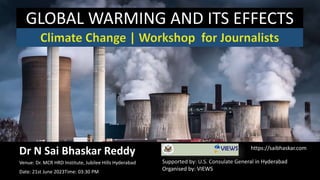
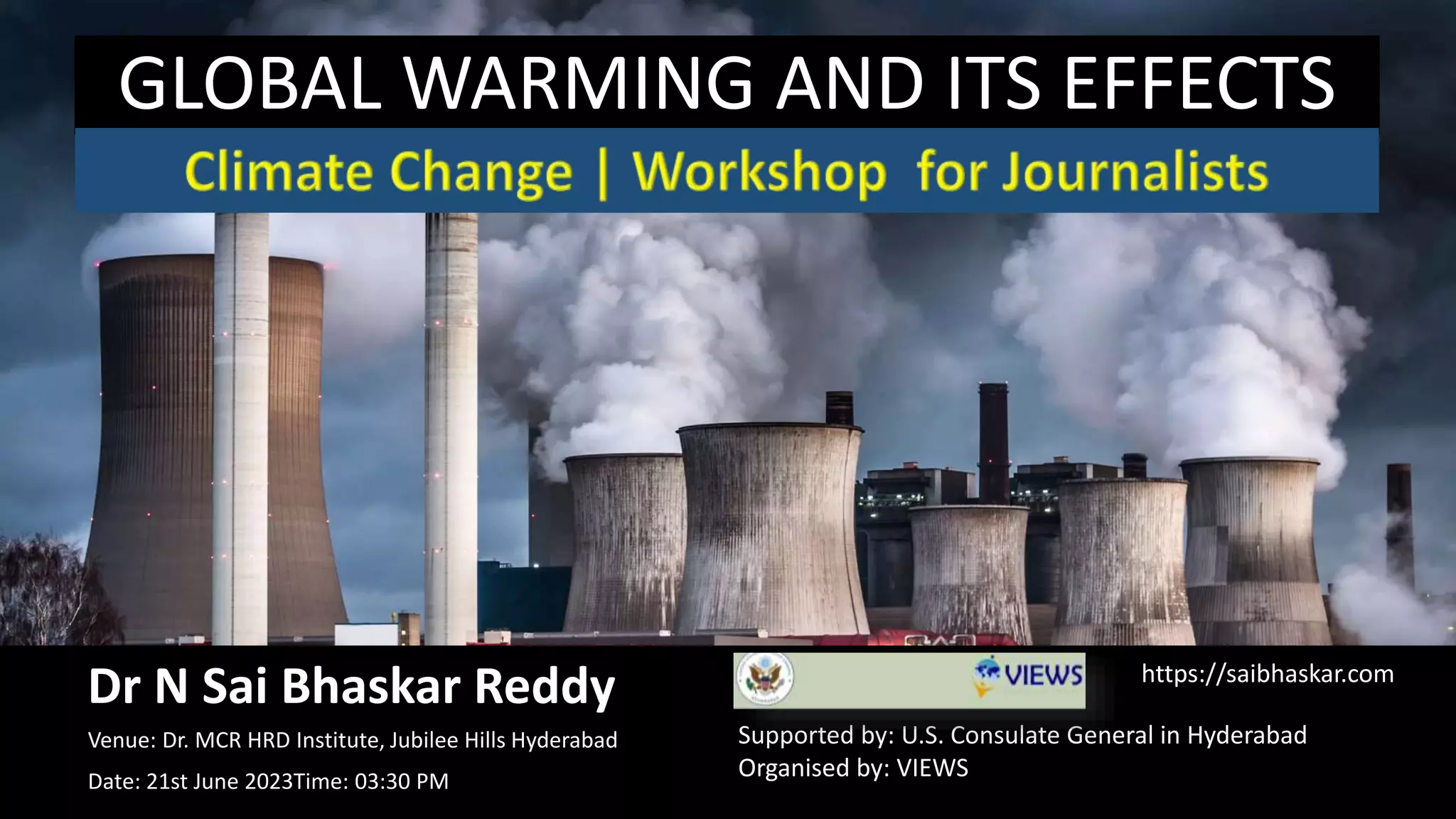
GLOBAL WARMING AND ITS EFFECTS
Supported by: U.S. Consulate General in Hyderabad
Organised by: VIEWS
Venue: Dr. MCR HRD Institute, Jubilee Hills Hyderabad
Date: 21st June 2023Time: 03:30 PM
Dr N Sai Bhaskar Reddy https://saibhaskar.com
Objective of the Workshop
Equipping journalists in vernacular medium with necessary skills and
knowledge
Promoting analytical and research-based stories on climate change
Increasing coverage of climate change in local languages
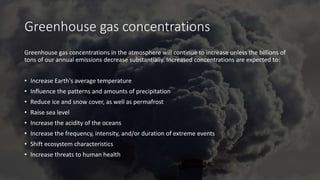
Greenhouse gas concentrations
Greenhouse gas concentrations in the atmosphere will continue to increase unless the billions of
tons of our annual emissions decrease substantially. Increased concentrations are expected to:
• Increase Earth's average temperature
• Influence the patterns and amounts of precipitation
• Reduce ice and snow cover, as well as permafrost
• Raise sea level
• Increase the acidity of the oceans
• Increase the frequency, intensity, and/or duration of extreme events
• Shift ecosystem characteristics
• Increase threats to human health
Media and Climate Change
• That global media coverage of climate-related stories, across a study
of 59 countries, has been growing; from about 47,000 articles in
2016-17 to about 87,000 in 2020-21.
• Generally, the media representation of climate science has increased
and become more accurate over time, but “on occasion, the
propagation of scientifically misleading information by organized
counter-movements has fuelled polarization, with negative
implications for climate policy”, IPCC experts explain.
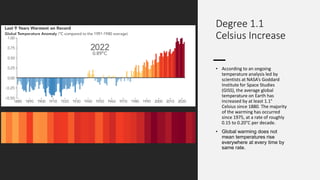
Degree 1.1
Celsius Increase
• According to an ongoing
temperature analysis led by
scientists at NASA’s Goddard
Institute for Space Studies
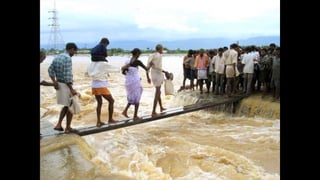
(GISS), the average global
temperature on Earth has
increased by at least 1.1°
Celsius since 1880. The majority
of the warming has occurred
since 1975, at a rate of roughly
0.15 to 0.20°C per decade.
• Global warming does not
mean temperatures rise
everywhere at every time by
same rate.
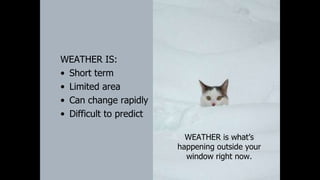
WEATHER IS:
• Short term
• Limited area
• Can change rapidly
• Difficult to predict
WEATHER is what’s
happening outside your
window right now.
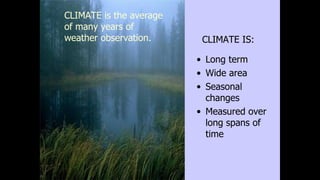
CLIMATE IS:
• Long term
• Wide area
• Seasonal
changes
• Measured over
long spans of
time
CLIMATE is the average
of many years of
weather observation.
…which is just right…
…for the moment, anyway.
…and then there’s Earth….
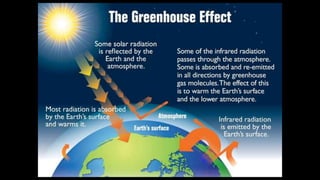
The greenhouse gas content
of the atmosphere is being
altered by human activity.
The result of this change is
global warming.
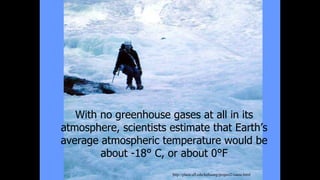
With no greenhouse gases at all in its
atmosphere, scientists estimate that Earth’s
average atmospheric temperature would be
about -18° C, or about 0°F
http://plaza.ufl.edu/knhuang/project2/cause.html
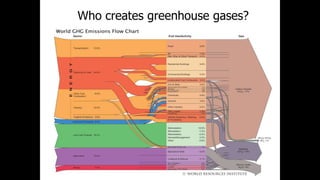
Who creates greenhouse gases?
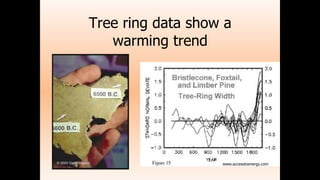
Tree ring data show a
warming trend
www.accesstoenergy.com
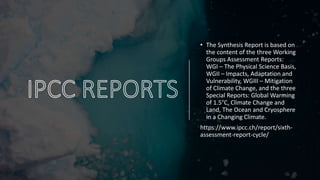
• The Synthesis Report is based on
the content of the three Working
Groups Assessment Reports:
WGI – The Physical Science Basis,
WGII – Impacts, Adaptation and
Vulnerability, WGIII – Mitigation
of Climate Change, and the three
Special Reports: Global Warming
of 1.5°C, Climate Change and
Land, The Ocean and Cryosphere
in a Changing Climate.
https://www.ipcc.ch/report/sixth-
assessment-report-cycle/
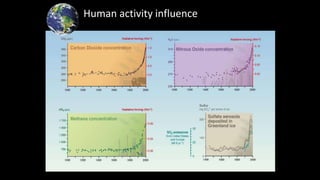
Human activity influence
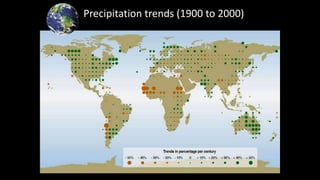
Precipitation trends (1900 to 2000)
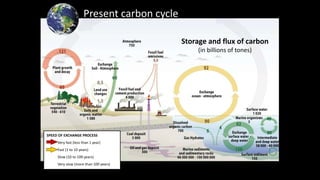
Present carbon cycle
SPEED OF EXCHANGE PROCESS
Very fast (less than 1 year)
Fast (1 to 10 years)
Slow (10 to 100 years)
Very slow (more than 100 years)
Storage and flux of carbon
(in billions of tones)
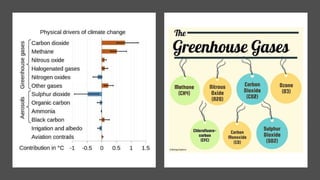
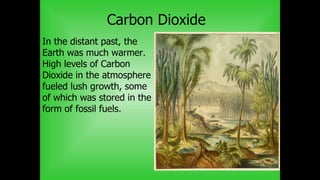
Carbon Dioxide
In the distant past, the
Earth was much warmer.
High levels of Carbon
Dioxide in the atmosphere
fueled lush growth, some
of which was stored in the
form of fossil fuels.
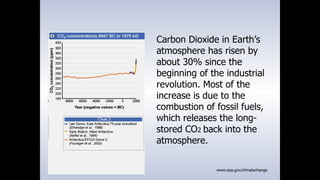
www.epa.gov/climatechange
Carbon Dioxide in Earth’s
atmosphere has risen by
about 30% since the
beginning of the industrial
revolution. Most of the
increase is due to the
combustion of fossil fuels,
which releases the long-
stored CO2 back into the
atmosphere.
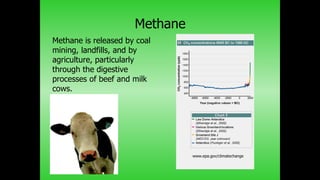
Methane
www.epa.gov/climatechange
Methane is released by coal
mining, landfills, and by
agriculture, particularly
through the digestive
processes of beef and milk
cows.
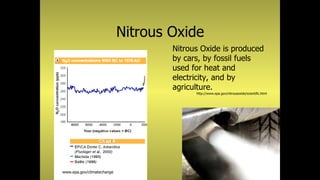
Nitrous Oxide
www.epa.gov/climatechange
Nitrous Oxide is produced
by cars, by fossil fuels
used for heat and
electricity, and by
agriculture.
http://www.epa.gov/nitrousoxide/scientific.html
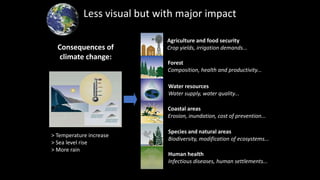
Less visual but with major impact
> Temperature increase
> Sea level rise
> More rain
Agriculture and food security
Crop yields, irrigation demands...
Forest
Composition, health and productivity...
Water resources
Water supply, water quality...
Coastal areas
Erosion, inundation, cost of prevention...
Species and natural areas
Biodiversity, modification of ecosystems...
Human health
Infectious diseases, human settlements...
Consequences of
climate change:
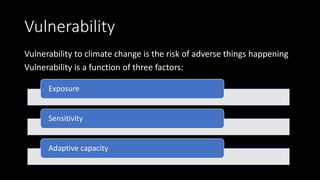
Vulnerability
Vulnerability to climate change is the risk of adverse things happening
Vulnerability is a function of three factors:
Exposure
Sensitivity
Adaptive capacity
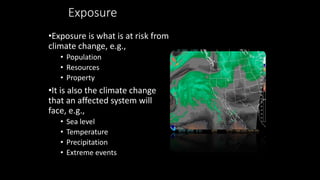
Exposure
•Exposure is what is at risk from
climate change, e.g.,
• Population
• Resources
• Property
•It is also the climate change
that an affected system will
face, e.g.,
• Sea level
• Temperature
• Precipitation
• Extreme events
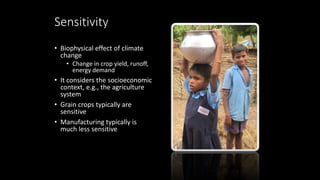
Sensitivity
• Biophysical effect of climate
change
• Change in crop yield, runoff,
energy demand
• It considers the socioeconomic
context, e.g., the agriculture
system
• Grain crops typically are
sensitive
• Manufacturing typically is
much less sensitive
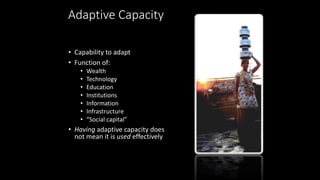
Adaptive Capacity
• Capability to adapt
• Function of:
• Wealth
• Technology
• Education
• Institutions
• Information
• Infrastructure
• “Social capital”
• Having adaptive capacity does
not mean it is used effectively
Vulnerability is a
Function of …
• More exposure and
sensitivity increase
vulnerability
• More adaptive capacity
decreases vulnerability
• An assessment of
vulnerability should
consider all three factors
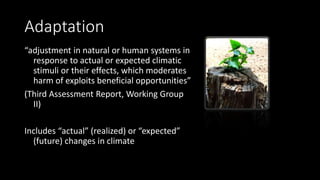
Adaptation
“adjustment in natural or human systems in
response to actual or expected climatic
stimuli or their effects, which moderates
harm of exploits beneficial opportunities”
(Third Assessment Report, Working Group
II)
Includes “actual” (realized) or “expected”
(future) changes in climate
Adaptation (continued)
Two types of adaptation
Autonomous adaptation or reactive adaptation tends to be what people and systems
do as impacts of climate change become apparent
Anticipatory or proactive adaptation are measures taken to reduce potential risks of
future climate change
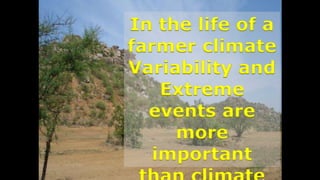
In the life of a
farmer climate
Variability and
Extreme
events are
more
important
Climate Change
Impacts
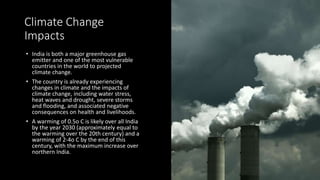
• India is both a major greenhouse gas
emitter and one of the most vulnerable
countries in the world to projected
climate change.
• The country is already experiencing
changes in climate and the impacts of
climate change, including water stress,
heat waves and drought, severe storms
and flooding, and associated negative
consequences on health and livelihoods.
• A warming of 0.5o C is likely over all India
by the year 2030 (approximately equal to
the warming over the 20th century) and a
warming of 2-4o C by the end of this
century, with the maximum increase over
northern India.
Climate Change
Impacts
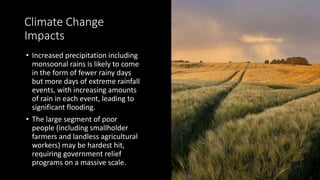
• Increased precipitation including
monsoonal rains is likely to come
in the form of fewer rainy days
but more days of extreme rainfall
events, with increasing amounts
of rain in each event, leading to
significant flooding.
• The large segment of poor
people (including smallholder
farmers and landless agricultural
workers) may be hardest hit,
requiring government relief
programs on a massive scale.
Climate Change
Impacts
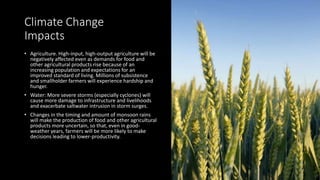
• Agriculture. High-input, high-output agriculture will be
negatively affected even as demands for food and
other agricultural products rise because of an
increasing population and expectations for an
improved standard of living. Millions of subsistence
and smallholder farmers will experience hardship and
hunger.
• Water: More severe storms (especially cyclones) will
cause more damage to infrastructure and livelihoods
and exacerbate saltwater intrusion in storm surges.
• Changes in the timing and amount of monsoon rains
will make the production of food and other agricultural
products more uncertain, so that, even in good-
weather years, farmers will be more likely to make
decisions leading to lower-productivity.
Climate Change
Impacts
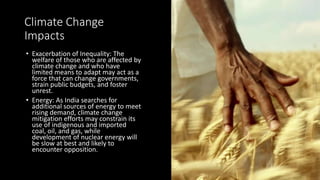
• Exacerbation of Inequality: The
welfare of those who are affected by
climate change and who have
limited means to adapt may act as a
force that can change governments,
strain public budgets, and foster
unrest.
• Energy: As India searches for
additional sources of energy to meet
rising demand, climate change
mitigation efforts may constrain its
use of indigenous and imported
coal, oil, and gas, while
development of nuclear energy will
be slow at best and likely to
encounter opposition.
Climate Change
Impacts
• Adaptive capacity in India
varies by state, geographical
region, and socioeconomic
status. Where adaptive
capacity is low, the potential is
greater for impacts to result in
displaced people; deaths and
damage from heat, floods, and
storms; and conflicts over
natural resources and assets.
Climate Changes in India
• Observed trends of multi-decadal periods of more frequent
droughts, followed by less severe droughts.
• Studies have shown a rising trend in the frequency of heavy
rain events and decrease in frequency of moderat
• Records of coastal tide gauges in the north Indian ocean for the
last 40 years has revealed an estimated sea level rise between
1.06-1.75 mm per year.
42
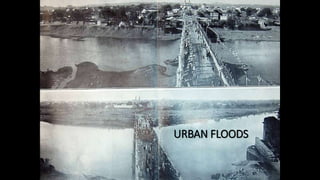
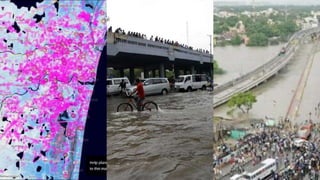
URBAN FLOODS
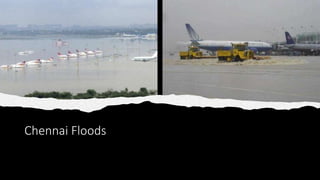
Chennai Floods
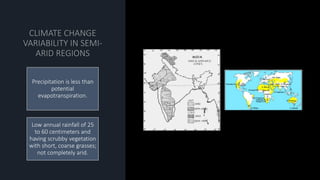
Precipitation is less than
potential
evapotranspiration.
Low annual rainfall of 25
to 60 centimeters and
having scrubby vegetation
with short, coarse grasses;
not completely arid.
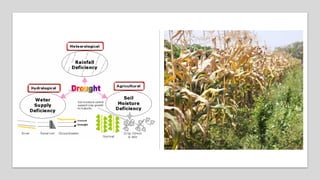
The drought-prone areas are confined mainly to the
peninsular and western parts of the country.
These regions suffer drought mostly due to the
cumulative effects of changing precipitation pattern,
excessive water utilization and ecologically
unsuitable agriculture practices
About 107 mha of the country spread over
administrative districts in several states is affected by
drought
1. Conserving the
resources
Water in the tanks
Conserving the trees
Conserving fodder rather
selling
Food grains storage rather
selling
2. Coping
Prioritizing the sale in
distress
Continue to do any work
which provides food or
wage
Stop risking through going
for borewells / wells
Reduce input costs
Ensure drinking water for
people and animals
Food and fodder security
3. Not to do
Don’t sell your land
Try avoiding getting credit –
the interest rates would
swallow you
Stop unnecessary spending
on the cultural / social
events – festivals,
marriages, etc.
Be united rather being in
nuclear / dis-jointed
families.
Don’t cut / sell trees
Take care of the health, so
as to reduce the expenses
on health
4. Prepare for the
adaptation
Micro-irrigation practices
Go for Sustainable and
subsistence crops rather
just commercial crops
Social networks are useful
be in the groups existing at
various levels
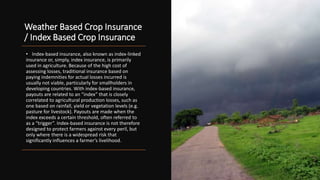
Weather Based Crop Insurance
/ Index Based Crop Insurance
• Index-based insurance, also known as index-linked
insurance or, simply, index insurance, is primarily
used in agriculture. Because of the high cost of
assessing losses, traditional insurance based on
paying indemnities for actual losses incurred is
usually not viable, particularly for smallholders in
developing countries. With index-based insurance,
payouts are related to an “index” that is closely
correlated to agricultural production losses, such as
one based on rainfall, yield or vegetation levels (e.g.
pasture for livestock). Payouts are made when the
index exceeds a certain threshold, often referred to
as a “trigger”. Index-based insurance is not therefore
designed to protect farmers against every peril, but
only where there is a widespread risk that
significantly influences a farmer’s livelihood.
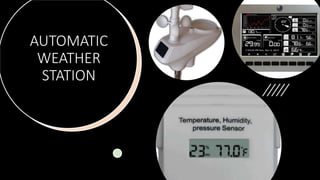
AUTOMATIC
WEATHER
STATION
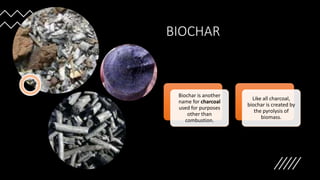
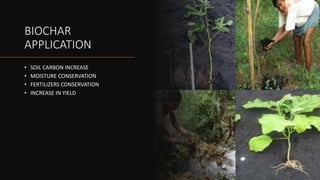
BIOCHAR
Biochar is another
name for charcoal
used for purposes
other than
combustion.
Like all charcoal,
biochar is created by
the pyrolysis of
biomass.
BIOCHAR
APPLICATION
• SOIL CARBON INCREASE
• MOISTURE CONSERVATION
• FERTILIZERS CONSERVATION
• INCREASE IN YIELD
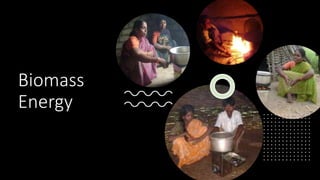
Biomass
Energy
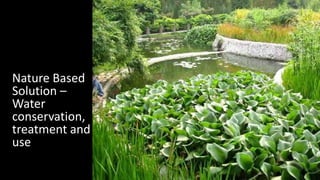
Nature Based
Solution –
Water
conservation,
treatment and
use
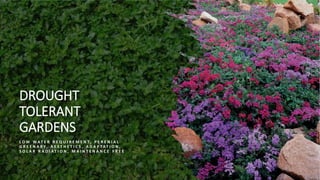
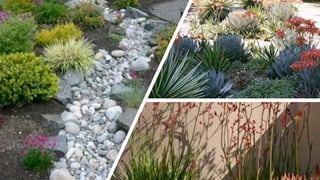
DROUGHT
TOLERANT
GARDENS
L O W W A T E R R E Q U I R E M E N T, P E R E N I A L
G R E E N A R Y, A E S T H E T I C S , A D A P T A T I O N ,
S O L A R R A D I A T I O N , M A I N T E N A N C E F R E E
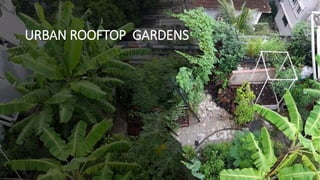
URBAN ROOFTOP GARDENS
School Children as Earth leaders
for Environmental Monitoring
To educate school children on the
challenges of their own environment
and develop them as Earth Leaders
and agents of change to disseminate
knowledge, create awareness,
trainings given to the students and
teachers for designing the sensor
systems. The website/dashboard
using IT capabilities was developed.
https://www.smash
words.com/books/vi
ew/922525
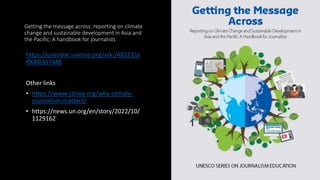
Getting the message across: reporting on climate
change and sustainable development in Asia and
the Pacific; A handbook for journalists
https://unesdoc.unesco.org/ark:/48223/p
f0000367488
Other links
• https://www.cdnee.org/why-climate-
journalism-matters/
• https://news.un.org/en/story/2022/10/
1129162
saibhaskarnakka@gmail.com || https://saibhaskar.com

GLOBAL WARMING AND ITS EFFECTS Climate Change Workshop for Journalists

  • 1.
    GLOBAL WARMING ANDITS EFFECTS Supported by: U.S. Consulate General in Hyderabad Organised by: VIEWS Venue: Dr. MCR HRD Institute, Jubilee Hills Hyderabad Date: 21st June 2023Time: 03:30 PM Dr N Sai Bhaskar Reddy https://saibhaskar.com
  • 2.
    Objective of theWorkshop Equipping journalists in vernacular medium with necessary skills and knowledge Promoting analytical and research-based stories on climate change Increasing coverage of climate change in local languages
  • 3.
    Greenhouse gas concentrations Greenhousegas concentrations in the atmosphere will continue to increase unless the billions of tons of our annual emissions decrease substantially. Increased concentrations are expected to: • Increase Earth's average temperature • Influence the patterns and amounts of precipitation • Reduce ice and snow cover, as well as permafrost • Raise sea level • Increase the acidity of the oceans • Increase the frequency, intensity, and/or duration of extreme events • Shift ecosystem characteristics • Increase threats to human health
  • 4.
    Media and ClimateChange • That global media coverage of climate-related stories, across a study of 59 countries, has been growing; from about 47,000 articles in 2016-17 to about 87,000 in 2020-21. • Generally, the media representation of climate science has increased and become more accurate over time, but “on occasion, the propagation of scientifically misleading information by organized counter-movements has fuelled polarization, with negative implications for climate policy”, IPCC experts explain.
  • 5.
    Degree 1.1 Celsius Increase •According to an ongoing temperature analysis led by scientists at NASA’s Goddard Institute for Space Studies (GISS), the average global temperature on Earth has increased by at least 1.1° Celsius since 1880. The majority of the warming has occurred since 1975, at a rate of roughly 0.15 to 0.20°C per decade. • Global warming does not mean temperatures rise everywhere at every time by same rate.
  • 6.
    WEATHER IS: • Shortterm • Limited area • Can change rapidly • Difficult to predict WEATHER is what’s happening outside your window right now.
  • 7.
    CLIMATE IS: • Longterm • Wide area • Seasonal changes • Measured over long spans of time CLIMATE is the average of many years of weather observation.
  • 10.
    …which is justright… …for the moment, anyway. …and then there’s Earth….
  • 11.
    The greenhouse gascontent of the atmosphere is being altered by human activity. The result of this change is global warming.
  • 13.
    With no greenhousegases at all in its atmosphere, scientists estimate that Earth’s average atmospheric temperature would be about -18° C, or about 0°F http://plaza.ufl.edu/knhuang/project2/cause.html
  • 14.
  • 17.
    Tree ring datashow a warming trend www.accesstoenergy.com
  • 19.
    • The SynthesisReport is based on the content of the three Working Groups Assessment Reports: WGI – The Physical Science Basis, WGII – Impacts, Adaptation and Vulnerability, WGIII – Mitigation of Climate Change, and the three Special Reports: Global Warming of 1.5°C, Climate Change and Land, The Ocean and Cryosphere in a Changing Climate. https://www.ipcc.ch/report/sixth- assessment-report-cycle/
  • 20.
  • 21.
  • 22.
    Present carbon cycle SPEEDOF EXCHANGE PROCESS Very fast (less than 1 year) Fast (1 to 10 years) Slow (10 to 100 years) Very slow (more than 100 years) Storage and flux of carbon (in billions of tones)
  • 23.
    Carbon Dioxide In thedistant past, the Earth was much warmer. High levels of Carbon Dioxide in the atmosphere fueled lush growth, some of which was stored in the form of fossil fuels.
  • 24.
    www.epa.gov/climatechange Carbon Dioxide inEarth’s atmosphere has risen by about 30% since the beginning of the industrial revolution. Most of the increase is due to the combustion of fossil fuels, which releases the long- stored CO2 back into the atmosphere.
  • 25.
    Methane www.epa.gov/climatechange Methane is releasedby coal mining, landfills, and by agriculture, particularly through the digestive processes of beef and milk cows.
  • 26.
    Nitrous Oxide www.epa.gov/climatechange Nitrous Oxideis produced by cars, by fossil fuels used for heat and electricity, and by agriculture. http://www.epa.gov/nitrousoxide/scientific.html
  • 27.
    Less visual butwith major impact > Temperature increase > Sea level rise > More rain Agriculture and food security Crop yields, irrigation demands... Forest Composition, health and productivity... Water resources Water supply, water quality... Coastal areas Erosion, inundation, cost of prevention... Species and natural areas Biodiversity, modification of ecosystems... Human health Infectious diseases, human settlements... Consequences of climate change:
  • 28.
    Vulnerability Vulnerability to climatechange is the risk of adverse things happening Vulnerability is a function of three factors: Exposure Sensitivity Adaptive capacity
  • 30.
    Exposure •Exposure is whatis at risk from climate change, e.g., • Population • Resources • Property •It is also the climate change that an affected system will face, e.g., • Sea level • Temperature • Precipitation • Extreme events
  • 31.
    Sensitivity • Biophysical effectof climate change • Change in crop yield, runoff, energy demand • It considers the socioeconomic context, e.g., the agriculture system • Grain crops typically are sensitive • Manufacturing typically is much less sensitive
  • 32.
    Adaptive Capacity • Capabilityto adapt • Function of: • Wealth • Technology • Education • Institutions • Information • Infrastructure • “Social capital” • Having adaptive capacity does not mean it is used effectively
  • 33.
    Vulnerability is a Functionof … • More exposure and sensitivity increase vulnerability • More adaptive capacity decreases vulnerability • An assessment of vulnerability should consider all three factors
  • 34.
    Adaptation “adjustment in naturalor human systems in response to actual or expected climatic stimuli or their effects, which moderates harm of exploits beneficial opportunities” (Third Assessment Report, Working Group II) Includes “actual” (realized) or “expected” (future) changes in climate
  • 35.
    Adaptation (continued) Two typesof adaptation Autonomous adaptation or reactive adaptation tends to be what people and systems do as impacts of climate change become apparent Anticipatory or proactive adaptation are measures taken to reduce potential risks of future climate change
  • 36.
    In the lifeof a farmer climate Variability and Extreme events are more important
  • 37.
    Climate Change Impacts • Indiais both a major greenhouse gas emitter and one of the most vulnerable countries in the world to projected climate change. • The country is already experiencing changes in climate and the impacts of climate change, including water stress, heat waves and drought, severe storms and flooding, and associated negative consequences on health and livelihoods. • A warming of 0.5o C is likely over all India by the year 2030 (approximately equal to the warming over the 20th century) and a warming of 2-4o C by the end of this century, with the maximum increase over northern India.
  • 38.
    Climate Change Impacts • Increasedprecipitation including monsoonal rains is likely to come in the form of fewer rainy days but more days of extreme rainfall events, with increasing amounts of rain in each event, leading to significant flooding. • The large segment of poor people (including smallholder farmers and landless agricultural workers) may be hardest hit, requiring government relief programs on a massive scale.
  • 39.
    Climate Change Impacts • Agriculture.High-input, high-output agriculture will be negatively affected even as demands for food and other agricultural products rise because of an increasing population and expectations for an improved standard of living. Millions of subsistence and smallholder farmers will experience hardship and hunger. • Water: More severe storms (especially cyclones) will cause more damage to infrastructure and livelihoods and exacerbate saltwater intrusion in storm surges. • Changes in the timing and amount of monsoon rains will make the production of food and other agricultural products more uncertain, so that, even in good- weather years, farmers will be more likely to make decisions leading to lower-productivity.
  • 40.
    Climate Change Impacts • Exacerbationof Inequality: The welfare of those who are affected by climate change and who have limited means to adapt may act as a force that can change governments, strain public budgets, and foster unrest. • Energy: As India searches for additional sources of energy to meet rising demand, climate change mitigation efforts may constrain its use of indigenous and imported coal, oil, and gas, while development of nuclear energy will be slow at best and likely to encounter opposition.
  • 41.
    Climate Change Impacts • Adaptivecapacity in India varies by state, geographical region, and socioeconomic status. Where adaptive capacity is low, the potential is greater for impacts to result in displaced people; deaths and damage from heat, floods, and storms; and conflicts over natural resources and assets.
  • 42.
    Climate Changes inIndia • Observed trends of multi-decadal periods of more frequent droughts, followed by less severe droughts. • Studies have shown a rising trend in the frequency of heavy rain events and decrease in frequency of moderat • Records of coastal tide gauges in the north Indian ocean for the last 40 years has revealed an estimated sea level rise between 1.06-1.75 mm per year. 42
  • 43.
  • 44.
  • 47.
    Precipitation is lessthan potential evapotranspiration. Low annual rainfall of 25 to 60 centimeters and having scrubby vegetation with short, coarse grasses; not completely arid.
  • 48.
    The drought-prone areasare confined mainly to the peninsular and western parts of the country. These regions suffer drought mostly due to the cumulative effects of changing precipitation pattern, excessive water utilization and ecologically unsuitable agriculture practices About 107 mha of the country spread over administrative districts in several states is affected by drought
  • 49.
    1. Conserving the resources Waterin the tanks Conserving the trees Conserving fodder rather selling Food grains storage rather selling 2. Coping Prioritizing the sale in distress Continue to do any work which provides food or wage Stop risking through going for borewells / wells Reduce input costs Ensure drinking water for people and animals Food and fodder security 3. Not to do Don’t sell your land Try avoiding getting credit – the interest rates would swallow you Stop unnecessary spending on the cultural / social events – festivals, marriages, etc. Be united rather being in nuclear / dis-jointed families. Don’t cut / sell trees Take care of the health, so as to reduce the expenses on health 4. Prepare for the adaptation Micro-irrigation practices Go for Sustainable and subsistence crops rather just commercial crops Social networks are useful be in the groups existing at various levels
  • 50.
    Weather Based CropInsurance / Index Based Crop Insurance • Index-based insurance, also known as index-linked insurance or, simply, index insurance, is primarily used in agriculture. Because of the high cost of assessing losses, traditional insurance based on paying indemnities for actual losses incurred is usually not viable, particularly for smallholders in developing countries. With index-based insurance, payouts are related to an “index” that is closely correlated to agricultural production losses, such as one based on rainfall, yield or vegetation levels (e.g. pasture for livestock). Payouts are made when the index exceeds a certain threshold, often referred to as a “trigger”. Index-based insurance is not therefore designed to protect farmers against every peril, but only where there is a widespread risk that significantly influences a farmer’s livelihood.
  • 51.
  • 52.
    BIOCHAR Biochar is another namefor charcoal used for purposes other than combustion. Like all charcoal, biochar is created by the pyrolysis of biomass.
  • 53.
    BIOCHAR APPLICATION • SOIL CARBONINCREASE • MOISTURE CONSERVATION • FERTILIZERS CONSERVATION • INCREASE IN YIELD
  • 54.
  • 55.
  • 56.
    DROUGHT TOLERANT GARDENS L O WW A T E R R E Q U I R E M E N T, P E R E N I A L G R E E N A R Y, A E S T H E T I C S , A D A P T A T I O N , S O L A R R A D I A T I O N , M A I N T E N A N C E F R E E
  • 58.
  • 59.
    School Children asEarth leaders for Environmental Monitoring To educate school children on the challenges of their own environment and develop them as Earth Leaders and agents of change to disseminate knowledge, create awareness, trainings given to the students and teachers for designing the sensor systems. The website/dashboard using IT capabilities was developed. https://www.smash words.com/books/vi ew/922525
  • 60.
    Getting the messageacross: reporting on climate change and sustainable development in Asia and the Pacific; A handbook for journalists https://unesdoc.unesco.org/ark:/48223/p f0000367488 Other links • https://www.cdnee.org/why-climate- journalism-matters/ • https://news.un.org/en/story/2022/10/ 1129162
  • 61.