AR6 Climate
Change
2021:
The Physical
Science Basis
An Overview
Released on 9 August 2021
Dr N Sai Bhaskar Reddy
What is Sixth
Assessment
Report (AR6)?
The Sixth Assessment Report (AR6)
of the United Nations
Intergovernmental Panel on
Climate Change (IPCC) is the sixth
in a series of reports intended to
assess scientific, technical,
and socio-economic information
concerning climate change.
This report evaluates the
physical science of climate
change – looking at the past,
present, and future climate.
It reveals how human-caused
emissions are altering our
planet and what that means for our
collective future.
Highlights of
Sixth
Assessment
Report (AR6)
Weather and climate events – such as
extreme heat, heavy rainfall, fire conditions,
and droughts – are becoming more severe
and frequent because of climate change.
The report finds we are already edging closer
to a 1.5 degrees Celsius warmer world, and
every day emissions rise the prospects for
averting the worst impacts of climate change
become dimmer.
Carbon dioxide has been and will continue
to be the dominant cause of global
warming under all greenhouse gas
emissions scenarios.
It says, if greenhouse gas emissions are
halved by 2030 and net zero by 2050,
global warming can be stopped.
Also, IPCC report vindicates India’s position
that historical cumulative emissions are the
source of the climate crisis that the World
faces today.
Major Concerns
The report highlights that our
climate is rapidly changing due
to human influence and is
already altering our planet in
drastic ways –
Arctic Sea ice is at its lowest
level in more than 150 years;
Sea levels are rising faster than
at any time in at least the last
3,000 years; and
Glaciers are declining at a rate
unprecedented in at least 2,000
years.
The Current State of the Climate
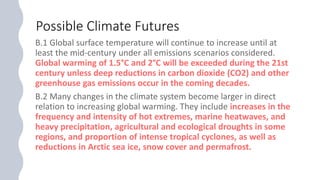
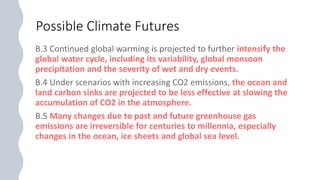
Possible Climate Futures
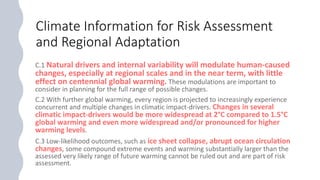
Climate Information for Risk Assessment
and Regional Adaptation
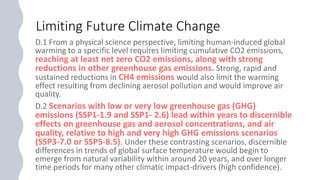
Limiting Future Climate Change
Need of the hour
26th UN Climate Change
Conference (COP26)
Thank you

AR6 climate change 2021 Overview

  • 1.
    AR6 Climate Change 2021: The Physical ScienceBasis An Overview Released on 9 August 2021 Dr N Sai Bhaskar Reddy
  • 3.
    What is Sixth Assessment Report(AR6)? The Sixth Assessment Report (AR6) of the United Nations Intergovernmental Panel on Climate Change (IPCC) is the sixth in a series of reports intended to assess scientific, technical, and socio-economic information concerning climate change. This report evaluates the physical science of climate change – looking at the past, present, and future climate. It reveals how human-caused emissions are altering our planet and what that means for our collective future.
  • 4.
    Highlights of Sixth Assessment Report (AR6) Weatherand climate events – such as extreme heat, heavy rainfall, fire conditions, and droughts – are becoming more severe and frequent because of climate change. The report finds we are already edging closer to a 1.5 degrees Celsius warmer world, and every day emissions rise the prospects for averting the worst impacts of climate change become dimmer. Carbon dioxide has been and will continue to be the dominant cause of global warming under all greenhouse gas emissions scenarios. It says, if greenhouse gas emissions are halved by 2030 and net zero by 2050, global warming can be stopped. Also, IPCC report vindicates India’s position that historical cumulative emissions are the source of the climate crisis that the World faces today.
  • 5.
    Major Concerns The reporthighlights that our climate is rapidly changing due to human influence and is already altering our planet in drastic ways – Arctic Sea ice is at its lowest level in more than 150 years; Sea levels are rising faster than at any time in at least the last 3,000 years; and Glaciers are declining at a rate unprecedented in at least 2,000 years.
  • 6.
    The Current Stateof the Climate
  • 7.
    The Current Stateof the Climate
  • 8.
  • 9.
  • 10.
    Climate Information forRisk Assessment and Regional Adaptation
  • 11.
  • 12.
    Need of thehour 26th UN Climate Change Conference (COP26)
  • 13.

Editor's Notes

  • #2 Assessment Report
  • #3 Special Report on the Ocean and Cryosphere in a Changing Climate Special Report on Climate Change and Land
  • #7 The equilibrium climate sensitivity of Earth is defined as the global mean surface air temperature increase that follows a doubling of atmospheric carbon dioxide. For decades, global climate models have predicted it as between approximately 2 and 4.5 °C. CO2 has increased from its pre-industrial level of 280 parts per million (ppm) to around 408 ppm today. Without actions to reduce emissions concentrations are likely to reach 560 ppm – double pre-industrial levels – around the year 2060. The cryosphere contains the frozen parts of the planet. It includes snow and ice on land, ice caps, glaciers, permafrost, and sea ice.
  • #8 The equilibrium climate sensitivity of Earth is defined as the global mean surface air temperature increase that follows a doubling of atmospheric carbon dioxide. For decades, global climate models have predicted it as between approximately 2 and 4.5 °C.
  • #12 Shared Socioeconomic Pathways