Life Cycle
Assessment
Contents
• What is Life Cycle Assessment ?
• Why it is required?
• How it is performed ?
• Life Cycle Assessment of buildings
Life Cycle Assessment_ CIVIL SCHOLAR2
What is Life Cycle Assessment?
Life Cycle Assessment_ CIVIL SCHOLAR3
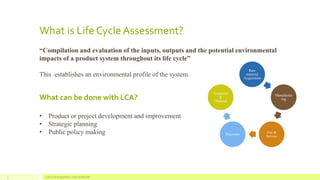
“Compilation and evaluation of the inputs, outputs and the potential environmental
impacts of a product system throughout its life cycle”
This establishes an environmental profile of the system.
What can be done with LCA?
• Product or project development and improvement
• Strategic planning
• Public policy making
Raw
material
Acquisition
Manufactur
ing
Use &
Service
Recovery
Treatment
&
Disposal
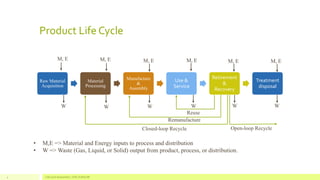
Product Life Cycle
Raw Material
Acquisition
Material
Processing
Manufacture
&
Assembly
Use &
Service
Retirement
&
Recovery
Treatment
disposal
Life Cycle Assessment_ CIVIL SCHOLAR4
W W W WW W
Reuse
M, E M, EM, E M, E M, EM, E
Remanufacture
Closed-loop Recycle Open-loop Recycle
• M,E => Material and Energy inputs to process and distribution
• W => Waste (Gas, Liquid, or Solid) output from product, process, or distribution.
Why LCA is required?
In “meeting needs of present without compromising the ability
to meet future needs”, we are faced with some obstacles
• Governmental/regulatory barriers
• Uncertain objectives/goals
• Lack of tools to measure our progress
Sometimes our intuition is not a sufficient framework for
analysis!
LCA = systematic method for comparing products and policies
Life Cycle Assessment_ CIVIL SCHOLAR5
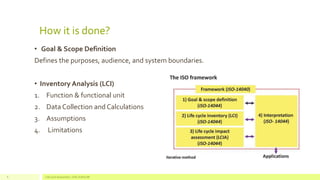
How it is done?
• Goal & Scope Definition
Defines the purposes, audience, and system boundaries.
• Inventory Analysis (LCI)
1. Function & functional unit
2. Data Collection and Calculations
3. Assumptions
4. Limitations
Life Cycle Assessment_ CIVIL SCHOLAR6
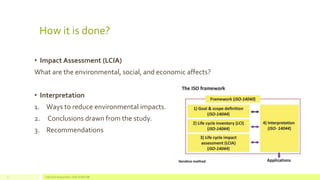
How it is done?
• Impact Assessment (LCIA)
What are the environmental, social, and economic affects?
• Interpretation
1. Ways to reduce environmental impacts.
2. Conclusions drawn from the study.
3. Recommendations
Life Cycle Assessment_ CIVIL SCHOLAR7
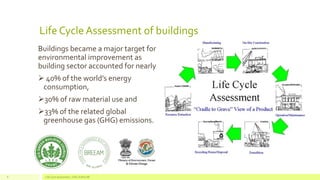
Life Cycle Assessment of buildings
Buildings became a major target for
environmental improvement as
building sector accounted for nearly
 40% of the world’s energy
consumption,
30% of raw material use and
33% of the related global
greenhouse gas (GHG) emissions.
Life Cycle Assessment_ CIVIL SCHOLAR8
In the construction industry, the materials used in construction, operation, and
demolition are varied and the range of environmental criteria that are relevant
to buildings is potentially enormous.
This poses a limitation to perform Life Cycle Assessment of individual
components of buildings.
Buildings consume energy directly or indirectly in all phases of their life cycle
right from the cradle to the grave. Hence, they are analyzed by Life Cycle
Energy Assessment.
Life Cycle Assessment_ CIVIL SCHOLAR9
Life Cycle Assessment of buildings
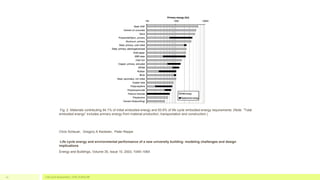
Fig. 2. Materials contributing 94.1% of initial embodied energy and 93.6% of life cycle embodied energy requirements. (Note: “Total
embodied energy” includes primary energy from material production, transportation and construction.)
Chris Scheuer, Gregory A Keoleian, Peter Reppe
Life cycle energy and environmental performance of a new university building: modeling challenges and design
implications
Energy and Buildings, Volume 35, Issue 10, 2003, 1049–1064
Life Cycle Assessment_ CIVIL SCHOLAR10
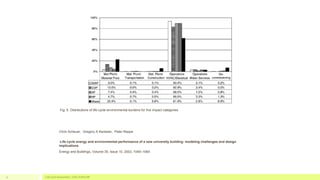
Fig. 5. Distributions of life cycle environmental burdens for five impact categories.
Chris Scheuer, Gregory A Keoleian, Peter Reppe
Life cycle energy and environmental performance of a new university building: modeling challenges and design
implications
Energy and Buildings, Volume 35, Issue 10, 2003, 1049–1064
Life Cycle Assessment_ CIVIL SCHOLAR11
Conclusion
There is a growing attention for sustainability in the construction sector.
Current regulatory frameworks are developed to facilitate the implementation
of the assessment of environmental performances.
Despite some limitations of the LCA technique, it is still a powerful and science-
based tool to evaluate the environmental impacts.
Life Cycle Assessment_ CIVIL SCHOLAR12
References
• Life cycle energy and environmental performance of a new university
building: modeling challenges and design implications by Chris Scheuer, Gregory
A.Keoleian, Peter Reppe.
• United Nations Environment Programme. Common carbon metric for measuring
energy use and reporting greenhouse gas emissions from building operations; 2009.
• Renewable and Sustainable energy reviews : vol 26, Oct 2013
• LCA NPTEL Course by Brajesh Kumar Dubey, IIT Kharagpur.
• ISO 14040, ISO 14044
Life Cycle Assessment_ CIVIL SCHOLAR13
THANKYOU

Life cycle assessment

  • 1.
  • 2.
    Contents • What isLife Cycle Assessment ? • Why it is required? • How it is performed ? • Life Cycle Assessment of buildings Life Cycle Assessment_ CIVIL SCHOLAR2
  • 3.
    What is LifeCycle Assessment? Life Cycle Assessment_ CIVIL SCHOLAR3 “Compilation and evaluation of the inputs, outputs and the potential environmental impacts of a product system throughout its life cycle” This establishes an environmental profile of the system. What can be done with LCA? • Product or project development and improvement • Strategic planning • Public policy making Raw material Acquisition Manufactur ing Use & Service Recovery Treatment & Disposal
  • 4.
    Product Life Cycle RawMaterial Acquisition Material Processing Manufacture & Assembly Use & Service Retirement & Recovery Treatment disposal Life Cycle Assessment_ CIVIL SCHOLAR4 W W W WW W Reuse M, E M, EM, E M, E M, EM, E Remanufacture Closed-loop Recycle Open-loop Recycle • M,E => Material and Energy inputs to process and distribution • W => Waste (Gas, Liquid, or Solid) output from product, process, or distribution.
  • 5.
    Why LCA isrequired? In “meeting needs of present without compromising the ability to meet future needs”, we are faced with some obstacles • Governmental/regulatory barriers • Uncertain objectives/goals • Lack of tools to measure our progress Sometimes our intuition is not a sufficient framework for analysis! LCA = systematic method for comparing products and policies Life Cycle Assessment_ CIVIL SCHOLAR5
  • 6.
    How it isdone? • Goal & Scope Definition Defines the purposes, audience, and system boundaries. • Inventory Analysis (LCI) 1. Function & functional unit 2. Data Collection and Calculations 3. Assumptions 4. Limitations Life Cycle Assessment_ CIVIL SCHOLAR6
  • 7.
    How it isdone? • Impact Assessment (LCIA) What are the environmental, social, and economic affects? • Interpretation 1. Ways to reduce environmental impacts. 2. Conclusions drawn from the study. 3. Recommendations Life Cycle Assessment_ CIVIL SCHOLAR7
  • 8.
    Life Cycle Assessmentof buildings Buildings became a major target for environmental improvement as building sector accounted for nearly  40% of the world’s energy consumption, 30% of raw material use and 33% of the related global greenhouse gas (GHG) emissions. Life Cycle Assessment_ CIVIL SCHOLAR8
  • 9.
    In the constructionindustry, the materials used in construction, operation, and demolition are varied and the range of environmental criteria that are relevant to buildings is potentially enormous. This poses a limitation to perform Life Cycle Assessment of individual components of buildings. Buildings consume energy directly or indirectly in all phases of their life cycle right from the cradle to the grave. Hence, they are analyzed by Life Cycle Energy Assessment. Life Cycle Assessment_ CIVIL SCHOLAR9 Life Cycle Assessment of buildings
  • 10.
    Fig. 2. Materialscontributing 94.1% of initial embodied energy and 93.6% of life cycle embodied energy requirements. (Note: “Total embodied energy” includes primary energy from material production, transportation and construction.) Chris Scheuer, Gregory A Keoleian, Peter Reppe Life cycle energy and environmental performance of a new university building: modeling challenges and design implications Energy and Buildings, Volume 35, Issue 10, 2003, 1049–1064 Life Cycle Assessment_ CIVIL SCHOLAR10
  • 11.
    Fig. 5. Distributionsof life cycle environmental burdens for five impact categories. Chris Scheuer, Gregory A Keoleian, Peter Reppe Life cycle energy and environmental performance of a new university building: modeling challenges and design implications Energy and Buildings, Volume 35, Issue 10, 2003, 1049–1064 Life Cycle Assessment_ CIVIL SCHOLAR11
  • 12.
    Conclusion There is agrowing attention for sustainability in the construction sector. Current regulatory frameworks are developed to facilitate the implementation of the assessment of environmental performances. Despite some limitations of the LCA technique, it is still a powerful and science- based tool to evaluate the environmental impacts. Life Cycle Assessment_ CIVIL SCHOLAR12
  • 13.
    References • Life cycleenergy and environmental performance of a new university building: modeling challenges and design implications by Chris Scheuer, Gregory A.Keoleian, Peter Reppe. • United Nations Environment Programme. Common carbon metric for measuring energy use and reporting greenhouse gas emissions from building operations; 2009. • Renewable and Sustainable energy reviews : vol 26, Oct 2013 • LCA NPTEL Course by Brajesh Kumar Dubey, IIT Kharagpur. • ISO 14040, ISO 14044 Life Cycle Assessment_ CIVIL SCHOLAR13
  • 14.

Editor's Notes

  • #3 Read it
  • #4 LCA is a technique to assess environmental impacts associated with all the stages of a product's life from cradle to grave. Public policy is nothing but formulations in the government…
  • #5 This is the basic flow diagram of life cycle of a product. Explain the diagram
  • #6 Industry is looking for ways to green their products and manufacturing processes. Individuals and Families are looking to green their homes and lifestyles. How can you tell if something really is green??
  • #7 Explain with example ISO methodology ISO 14040
  • #8 Explain with example
  • #9 There are some tools have been developed to asses sustainability from different viewpoints and for a variety of users. Some examples are Environmental Impact Assessment (EIA), System of Economic and Environmental Accounting (SEEA), Environmental Auditing and Material Flow Analysis (MFA). In addition, several methods have been developed specifically for the construction sector such as BREEAM and LEED, which provide measurement ratings for (green) buildings. Apart from these tools, LCA can be used to assess the environmental impact of a building as it is a more detailed study.
  • #11 This is a result of LCA conducted for a building of University of Michigan. Here the diagram shows the energy contributions of various materials.
  • #12 They are the impact categories which are used in order to assess the life cycle environmental impacts primary energy consumption, global warming potential, ozone depletion potential, nutrification potential, acidification potential, and solid waste generation. In all measurements, except waste generation, operations accounted for more than 83% of inventoried environmental burdens. This study identified energy generation technologies to be the most significant contributor to all the impact categories over the building’s life cycle and suggested for renewable energy alternatives.
  • #13 Despite some limitations to LCA, although there are various tools like LEED are in use, LCA gives a detailed study of environmental impacts.