


Dr N Sai Bhaskar Reddy, Director, The Earth Center, CGR
1st October 2021
National Seminar on IPCC Report 2021
Council for Green Revolution
CGR is committed to achieving sustainable development goals, environmental
management, ecosystems restoration and leadership emergence for earth systems
https://cgrindia.org/
COP 26
• UN Climate Change Conference of the Parties (COP26) in Glasgow on 31 October – 12 November 2021
• Around the world storms, floods and wildfires are intensifying. Air pollution sadly affects the health of tens of
millions of people and unpredictable weather causes untold damage to homes and livelihoods too.
• But while the impacts of climate change are devastating, advances in tackling it are leading to cleaner air, creating
good jobs, restoring nature and at the same time unleashing economic growth.
• Despite the opportunities we are not acting fast enough. To grip this crisis, countries need to join forces urgently.
• They also agreed to step up efforts to adapt to the impacts of climate change and to make finance flows
consistent with a pathway towards low greenhouse gas emissions and climate-resilient development.
• By completing and implementing the Paris Agreement at Glasgow, we can show that the world is able to work
together to tackle this crucial challenge.
• And by uniting behind a green recovery from coronavirus, which creates sustainable jobs and addresses the
urgent and linked challenges of public health, climate change, and biodiversity loss, we can safeguard the
environment for future generations.
COP26 Targets
1. Secure global net zero by mid-century and keep 1.5 degrees within reach
• Countries are being asked to come forward with ambitious 2030 emissions
reductions targets that align with reaching net zero by the middle of the
century.
• To deliver on these stretching targets, countries will need to:
• accelerate the phase-out of coal
• curtail deforestation
• speed up the switch to electric vehicles
• encourage investment in renewables.
COP26 Targets
2. Adapt to protect communities and natural habitats
The climate is already changing and it will continue to change even as we
reduce emissions, with devastating effects.
At COP26 we need to work together to enable and encourage countries
affected by climate change to:
• protect and restore ecosystems
• build defences, warning systems and resilient infrastructure and agriculture
to avoid loss of homes, livelihoods and even lives
COP26 Targets
3. Mobilise finance
• To deliver on our first two goals, developed countries must make good on
their promise to mobilise at least $100bn in climate finance per year by
2020.
• International financial institutions must play their part and we need work
towards unleashing the trillions in private and public sector finance required
to secure global net zero.
COP26 Targets
4. Work together to deliver
We can only rise to the challenges of the climate crisis by working together.
At COP26 we must:
• finalise the Paris Rulebook (the detailed rules that make the Paris Agreement
operational)
• accelerate action to tackle the climate crisis through collaboration between
governments, businesses and civil society.
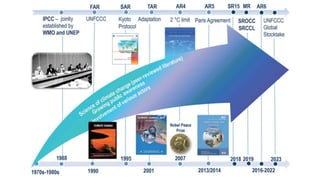
IPCC Sixth
Assessment
Report (AR6)
The Sixth Assessment Report (AR6) of
the United Nations Intergovernmental
Panel on Climate Change (IPCC) is the sixth
in a series of reports intended to assess
scientific, technical, and socio-economic
information concerning climate change.
This report evaluates the physical science
of climate change – looking at the past,
present, and future climate.
It reveals how human-caused
emissions are altering our planet and what
that means for our collective future.
Highlights of
Sixth
Assessment
Report (AR6)
Weather and climate events – such as extreme heat,
heavy rainfall, fire conditions, and droughts – are becoming
more severe and frequent because of climate change.
The report finds we are already edging closer to a 1.5
degrees Celsius warmer world, and every day emissions
rise the prospects for averting the worst impacts of climate
change become dimmer.
Carbon dioxide has been and will continue to be the
dominant cause of global warming under all
greenhouse gas emissions scenarios.
It says, if greenhouse gas emissions are halved by
2030 and net zero by 2050, global warming can be
stopped.
Also, IPCC report vindicates India’s position that historical
cumulative emissions are the source of the climate crisis
that the World faces today.
Major
Concerns
The report highlights that our climate is
rapidly changing due to human influence
and is already altering our planet in
drastic ways –
Arctic Sea ice is at its lowest level in
more than 150 years;
Sea levels are rising faster than at any
time in at least the last 3,000 years; and
Glaciers are declining at a rate
unprecedented in at least 2,000 years.
The Current
State of the
Climate
A.1 It is unequivocal that human influence has
warmed the atmosphere, ocean and land.
Widespread and rapid changes in the
atmosphere, ocean, cryosphere and
biosphere have occurred.
A.2 The scale of recent changes across the
climate system as a whole and the present
state of many aspects of the climate system
are unprecedented over many centuries to
many thousands of years.
The Current
State of the
Climate
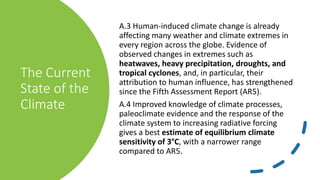
A.3 Human-induced climate change is already
affecting many weather and climate extremes in
every region across the globe. Evidence of
observed changes in extremes such as
heatwaves, heavy precipitation, droughts, and
tropical cyclones, and, in particular, their
attribution to human influence, has strengthened
since the Fifth Assessment Report (AR5).
A.4 Improved knowledge of climate processes,
paleoclimate evidence and the response of the
climate system to increasing radiative forcing
gives a best estimate of equilibrium climate
sensitivity of 3°C, with a narrower range
compared to AR5.
Possible
Climate
Futures
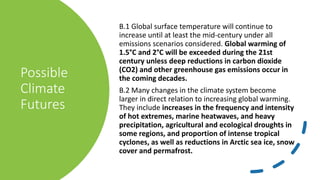
B.1 Global surface temperature will continue to
increase until at least the mid-century under all
emissions scenarios considered. Global warming of
1.5°C and 2°C will be exceeded during the 21st
century unless deep reductions in carbon dioxide
(CO2) and other greenhouse gas emissions occur in
the coming decades.
B.2 Many changes in the climate system become
larger in direct relation to increasing global warming.
They include increases in the frequency and intensity
of hot extremes, marine heatwaves, and heavy
precipitation, agricultural and ecological droughts in
some regions, and proportion of intense tropical
cyclones, as well as reductions in Arctic sea ice, snow
cover and permafrost.
Possible
Climate
Futures
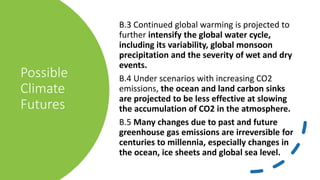
B.3 Continued global warming is projected to
further intensify the global water cycle,
including its variability, global monsoon
precipitation and the severity of wet and dry
events.
B.4 Under scenarios with increasing CO2
emissions, the ocean and land carbon sinks
are projected to be less effective at slowing
the accumulation of CO2 in the atmosphere.
B.5 Many changes due to past and future
greenhouse gas emissions are irreversible for
centuries to millennia, especially changes in
the ocean, ice sheets and global sea level.
Climate
Information
for Risk
Assessment
and Regional
Adaptation
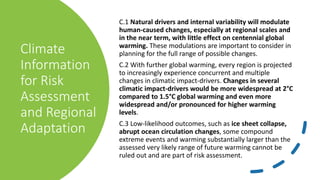
C.1 Natural drivers and internal variability will modulate
human-caused changes, especially at regional scales and
in the near term, with little effect on centennial global
warming. These modulations are important to consider in
planning for the full range of possible changes.
C.2 With further global warming, every region is projected
to increasingly experience concurrent and multiple
changes in climatic impact-drivers. Changes in several
climatic impact-drivers would be more widespread at 2°C
compared to 1.5°C global warming and even more
widespread and/or pronounced for higher warming
levels.
C.3 Low-likelihood outcomes, such as ice sheet collapse,
abrupt ocean circulation changes, some compound
extreme events and warming substantially larger than the
assessed very likely range of future warming cannot be
ruled out and are part of risk assessment.
Limiting
Future
Climate
Change
D.1 From a physical science perspective, limiting human-induced
global warming to a specific level requires limiting cumulative
CO2 emissions, reaching at least net zero CO2 emissions, along
with strong reductions in other greenhouse gas emissions.
Strong, rapid and sustained reductions in CH4 emissions would
also limit the warming effect resulting from declining aerosol
pollution and would improve air quality.
D.2 Scenarios with low or very low greenhouse gas (GHG)
emissions (SSP1-1.9 and SSP1- 2.6) lead within years to
discernible effects on greenhouse gas and aerosol
concentrations, and air quality, relative to high and very high
GHG emissions scenarios (SSP3-7.0 or SSP5-8.5). Under these
contrasting scenarios, discernible differences in trends of global
surface temperature would begin to emerge from natural
variability within around 20 years, and over longer time periods
for many other climatic impact-drivers (high confidence).
Need of
the hour
It is essential that all countries – in particular
the major economies – do their part during this
critical decade of the 2020s to put the world on a
trajectory to keep a 1.5 degrees Celsius limit on
warming within reach.
As countries prepare for the 26th UN Climate
Change Conference (COP26) in Glasgow, this
report is a stark reminder that we must let
science drive us to action.
This moment requires world leaders, the
private sector, and individuals to act together
with urgency and do everything it takes to
protect our planet and our future in this
decade and beyond.
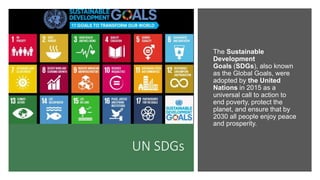
UN SDGs
The Sustainable
Development
Goals (SDGs), also known
as the Global Goals, were
adopted by the United
Nations in 2015 as a
universal call to action to
end poverty, protect the
planet, and ensure that by
2030 all people enjoy peace
and prosperity.
NAPCC – Match NATIONAL MISSIONS
Way Forward:
National Solar Mission: Development and
use of solar energy for power generation
National Mission for Enhanced Energy
Efficiency: yield savings of 10,000 MW.
National Mission on Sustainable Habitat:
energy efficiency for urban planning.
National Water Mission: 20% improvement
in water use efficiency: Water Grid
NAPCC – Match National Missions
Way Forward:
National Mission for Sustaining the Himalayan Ecosystem
National Mission for a “Green India”: afforestation of 6
million hectares of forest cover from 23% to 33% Haritha
Haram
National Mission for Sustainable Agriculture: climate-
resilient crops, weather insurance and agriculture : Mission
Kakatiya
National Mission on Strategic Knowledge for Climate Change
for a better understanding.
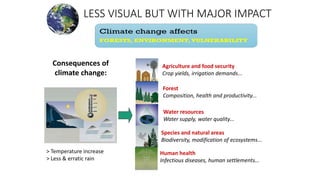
LESS VISUAL BUT WITH MAJOR IMPACT
> Temperature increase
> Less & erratic rain
Agriculture and food security
Crop yields, irrigation demands...
Forest
Composition, health and productivity...
Water resources
Water supply, water quality...
Species and natural areas
Biodiversity, modification of ecosystems...
Human health
Infectious diseases, human settlements...
Consequences of
climate change:
MAJOR
CONCERNS
RURAL
•DROUGHT PROOFING
•SUSTAINABLE LIVELIHOODS
URBAN
•ENVIRONMENT
•SUSTAINABLE HABITATS
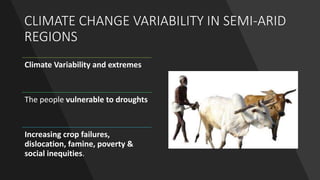
CLIMATE CHANGE VARIABILITY IN SEMI-ARID
REGIONS
Climate Variability and extremes
The people vulnerable to droughts
Increasing crop failures,
dislocation, famine, poverty &
social inequities.
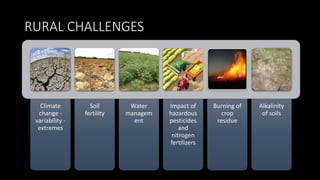
RURAL CHALLENGES
Climate
change -
variability -
extremes
Soil
fertility
Water
managem
ent
Impact of
hazardous
pesticides
and
nitrogen
fertilizers
Burning of
crop
residue
Alkalinity
of soils
https://www.smashwords.c
om/books/view/642405
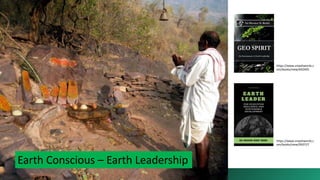
Earth Conscious – Earth Leadership
https://www.smashwords.c
om/books/view/950727
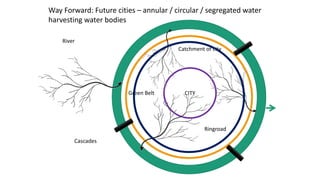
CITY
River
Catchment of city
Green Belt
Ringroad
Cascades
Way Forward: Future cities – annular / circular / segregated water
harvesting water bodies
Way Forward: Harvest
water before it leaves the
borders of houses, fields,
villages, towns and cities
https://www.smashwords.c
om/books/view/1077428
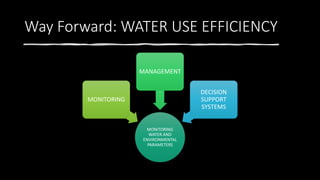
Way Forward: WATER USE EFFICIENCY
MONITORING
WATER AND
ENVIRONMENTAL
PARAMETERS
MONITORING
MANAGEMENT
DECISION
SUPPORT
SYSTEMS
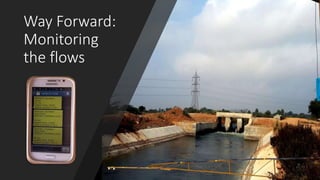
Way Forward:
Monitoring
the flows
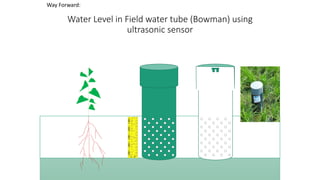
Water Level in Field water tube (Bowman) using
ultrasonic sensor
Way Forward:
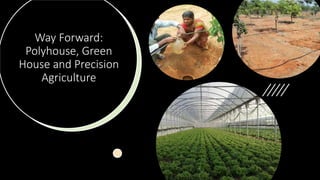
Way Forward:
Polyhouse, Green
House and Precision
Agriculture
Sustaining farmers
Farm Laws - The Farmers' Produce Trade and
Commerce (Promotion and Facilitation) Act, The
Essential Commodities (Amendment) Act and
The Farmers (Empowerment and Protection)
Agreement on Price Assurance and Farm Services Act.
Farm crisis today has ecological roots
https://www.smashwords.co
m/books/view/997274
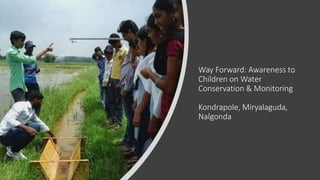
Way Forward: Awareness to
Children on Water
Conservation & Monitoring
Kondrapole, Miryalaguda,
Nalgonda
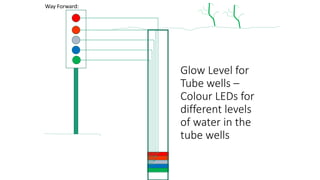
Glow Level for
Tube wells –
Colour LEDs for
different levels
of water in the
tube wells
Way Forward:
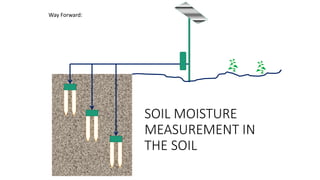
SOIL MOISTURE
MEASUREMENT IN
THE SOIL
Way Forward:
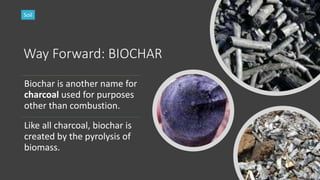
Way Forward: BIOCHAR
Biochar is another name for
charcoal used for purposes
other than combustion.
Like all charcoal, biochar is
created by the pyrolysis of
biomass.
Soil
Way Forward:
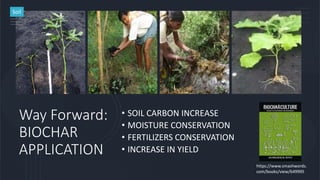
BIOCHAR
APPLICATION
• SOIL CARBON INCREASE
• MOISTURE CONSERVATION
• FERTILIZERS CONSERVATION
• INCREASE IN YIELD
Soil
https://www.smashwords.
com/books/view/649995
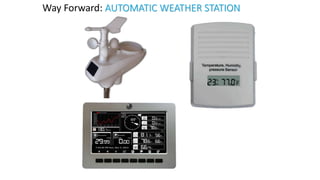
Way Forward: AUTOMATIC WEATHER STATION
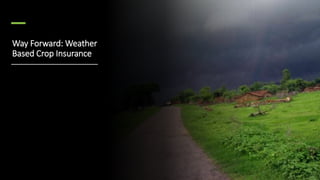
Way Forward: Weather
Based Crop Insurance
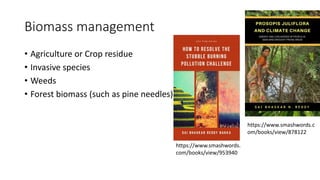
Biomass management
• Agriculture or Crop residue
• Invasive species
• Weeds
• Forest biomass (such as pine needles)
https://www.smashwords.c
om/books/view/878122
https://www.smashwords.
com/books/view/953940
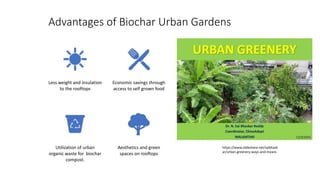
URBAN ROOFTOP GARDENS
Advantages of Biochar Urban Gardens
Less weight and insulation
to the rooftops
Economic savings through
access to self grown food
Utilization of urban
organic waste for biochar
compost.
Aesthetics and green
spaces on rooftops
https://www.slideshare.net/saibhask
ar/urban-greenery-ways-and-means
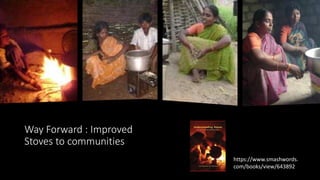
Way Forward : Improved
Stoves to communities
https://www.smashwords.
com/books/view/643892
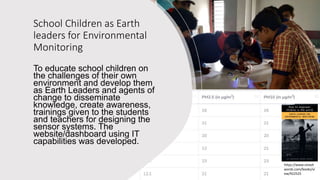
School Children as Earth
leaders for Environmental
Monitoring
To educate school children on
the challenges of their own
environment and develop them
as Earth Leaders and agents of
change to disseminate
knowledge, create awareness,
trainings given to the students
and teachers for designing the
sensor systems. The
website/dashboard using IT
capabilities was developed.
https://www.smash
words.com/books/vi
ew/922525
Thank you

Ipcc cop 26 climate change and environment sai bhaskar

  • 1.
    Dr N SaiBhaskar Reddy, Director, The Earth Center, CGR 1st October 2021 National Seminar on IPCC Report 2021
  • 2.
    Council for GreenRevolution CGR is committed to achieving sustainable development goals, environmental management, ecosystems restoration and leadership emergence for earth systems https://cgrindia.org/
  • 3.
    COP 26 • UNClimate Change Conference of the Parties (COP26) in Glasgow on 31 October – 12 November 2021 • Around the world storms, floods and wildfires are intensifying. Air pollution sadly affects the health of tens of millions of people and unpredictable weather causes untold damage to homes and livelihoods too. • But while the impacts of climate change are devastating, advances in tackling it are leading to cleaner air, creating good jobs, restoring nature and at the same time unleashing economic growth. • Despite the opportunities we are not acting fast enough. To grip this crisis, countries need to join forces urgently. • They also agreed to step up efforts to adapt to the impacts of climate change and to make finance flows consistent with a pathway towards low greenhouse gas emissions and climate-resilient development. • By completing and implementing the Paris Agreement at Glasgow, we can show that the world is able to work together to tackle this crucial challenge. • And by uniting behind a green recovery from coronavirus, which creates sustainable jobs and addresses the urgent and linked challenges of public health, climate change, and biodiversity loss, we can safeguard the environment for future generations.
  • 4.
    COP26 Targets 1. Secureglobal net zero by mid-century and keep 1.5 degrees within reach • Countries are being asked to come forward with ambitious 2030 emissions reductions targets that align with reaching net zero by the middle of the century. • To deliver on these stretching targets, countries will need to: • accelerate the phase-out of coal • curtail deforestation • speed up the switch to electric vehicles • encourage investment in renewables.
  • 5.
    COP26 Targets 2. Adaptto protect communities and natural habitats The climate is already changing and it will continue to change even as we reduce emissions, with devastating effects. At COP26 we need to work together to enable and encourage countries affected by climate change to: • protect and restore ecosystems • build defences, warning systems and resilient infrastructure and agriculture to avoid loss of homes, livelihoods and even lives
  • 6.
    COP26 Targets 3. Mobilisefinance • To deliver on our first two goals, developed countries must make good on their promise to mobilise at least $100bn in climate finance per year by 2020. • International financial institutions must play their part and we need work towards unleashing the trillions in private and public sector finance required to secure global net zero.
  • 7.
    COP26 Targets 4. Worktogether to deliver We can only rise to the challenges of the climate crisis by working together. At COP26 we must: • finalise the Paris Rulebook (the detailed rules that make the Paris Agreement operational) • accelerate action to tackle the climate crisis through collaboration between governments, businesses and civil society.
  • 8.
    IPCC Sixth Assessment Report (AR6) TheSixth Assessment Report (AR6) of the United Nations Intergovernmental Panel on Climate Change (IPCC) is the sixth in a series of reports intended to assess scientific, technical, and socio-economic information concerning climate change. This report evaluates the physical science of climate change – looking at the past, present, and future climate. It reveals how human-caused emissions are altering our planet and what that means for our collective future.
  • 10.
    Highlights of Sixth Assessment Report (AR6) Weatherand climate events – such as extreme heat, heavy rainfall, fire conditions, and droughts – are becoming more severe and frequent because of climate change. The report finds we are already edging closer to a 1.5 degrees Celsius warmer world, and every day emissions rise the prospects for averting the worst impacts of climate change become dimmer. Carbon dioxide has been and will continue to be the dominant cause of global warming under all greenhouse gas emissions scenarios. It says, if greenhouse gas emissions are halved by 2030 and net zero by 2050, global warming can be stopped. Also, IPCC report vindicates India’s position that historical cumulative emissions are the source of the climate crisis that the World faces today.
  • 11.
    Major Concerns The report highlightsthat our climate is rapidly changing due to human influence and is already altering our planet in drastic ways – Arctic Sea ice is at its lowest level in more than 150 years; Sea levels are rising faster than at any time in at least the last 3,000 years; and Glaciers are declining at a rate unprecedented in at least 2,000 years.
  • 12.
    The Current State ofthe Climate A.1 It is unequivocal that human influence has warmed the atmosphere, ocean and land. Widespread and rapid changes in the atmosphere, ocean, cryosphere and biosphere have occurred. A.2 The scale of recent changes across the climate system as a whole and the present state of many aspects of the climate system are unprecedented over many centuries to many thousands of years.
  • 13.
    The Current State ofthe Climate A.3 Human-induced climate change is already affecting many weather and climate extremes in every region across the globe. Evidence of observed changes in extremes such as heatwaves, heavy precipitation, droughts, and tropical cyclones, and, in particular, their attribution to human influence, has strengthened since the Fifth Assessment Report (AR5). A.4 Improved knowledge of climate processes, paleoclimate evidence and the response of the climate system to increasing radiative forcing gives a best estimate of equilibrium climate sensitivity of 3°C, with a narrower range compared to AR5.
  • 14.
    Possible Climate Futures B.1 Global surfacetemperature will continue to increase until at least the mid-century under all emissions scenarios considered. Global warming of 1.5°C and 2°C will be exceeded during the 21st century unless deep reductions in carbon dioxide (CO2) and other greenhouse gas emissions occur in the coming decades. B.2 Many changes in the climate system become larger in direct relation to increasing global warming. They include increases in the frequency and intensity of hot extremes, marine heatwaves, and heavy precipitation, agricultural and ecological droughts in some regions, and proportion of intense tropical cyclones, as well as reductions in Arctic sea ice, snow cover and permafrost.
  • 15.
    Possible Climate Futures B.3 Continued globalwarming is projected to further intensify the global water cycle, including its variability, global monsoon precipitation and the severity of wet and dry events. B.4 Under scenarios with increasing CO2 emissions, the ocean and land carbon sinks are projected to be less effective at slowing the accumulation of CO2 in the atmosphere. B.5 Many changes due to past and future greenhouse gas emissions are irreversible for centuries to millennia, especially changes in the ocean, ice sheets and global sea level.
  • 16.
    Climate Information for Risk Assessment and Regional Adaptation C.1Natural drivers and internal variability will modulate human-caused changes, especially at regional scales and in the near term, with little effect on centennial global warming. These modulations are important to consider in planning for the full range of possible changes. C.2 With further global warming, every region is projected to increasingly experience concurrent and multiple changes in climatic impact-drivers. Changes in several climatic impact-drivers would be more widespread at 2°C compared to 1.5°C global warming and even more widespread and/or pronounced for higher warming levels. C.3 Low-likelihood outcomes, such as ice sheet collapse, abrupt ocean circulation changes, some compound extreme events and warming substantially larger than the assessed very likely range of future warming cannot be ruled out and are part of risk assessment.
  • 17.
    Limiting Future Climate Change D.1 From aphysical science perspective, limiting human-induced global warming to a specific level requires limiting cumulative CO2 emissions, reaching at least net zero CO2 emissions, along with strong reductions in other greenhouse gas emissions. Strong, rapid and sustained reductions in CH4 emissions would also limit the warming effect resulting from declining aerosol pollution and would improve air quality. D.2 Scenarios with low or very low greenhouse gas (GHG) emissions (SSP1-1.9 and SSP1- 2.6) lead within years to discernible effects on greenhouse gas and aerosol concentrations, and air quality, relative to high and very high GHG emissions scenarios (SSP3-7.0 or SSP5-8.5). Under these contrasting scenarios, discernible differences in trends of global surface temperature would begin to emerge from natural variability within around 20 years, and over longer time periods for many other climatic impact-drivers (high confidence).
  • 18.
    Need of the hour Itis essential that all countries – in particular the major economies – do their part during this critical decade of the 2020s to put the world on a trajectory to keep a 1.5 degrees Celsius limit on warming within reach. As countries prepare for the 26th UN Climate Change Conference (COP26) in Glasgow, this report is a stark reminder that we must let science drive us to action. This moment requires world leaders, the private sector, and individuals to act together with urgency and do everything it takes to protect our planet and our future in this decade and beyond.
  • 19.
    UN SDGs The Sustainable Development Goals(SDGs), also known as the Global Goals, were adopted by the United Nations in 2015 as a universal call to action to end poverty, protect the planet, and ensure that by 2030 all people enjoy peace and prosperity.
  • 20.
    NAPCC – MatchNATIONAL MISSIONS Way Forward: National Solar Mission: Development and use of solar energy for power generation National Mission for Enhanced Energy Efficiency: yield savings of 10,000 MW. National Mission on Sustainable Habitat: energy efficiency for urban planning. National Water Mission: 20% improvement in water use efficiency: Water Grid
  • 21.
    NAPCC – MatchNational Missions Way Forward: National Mission for Sustaining the Himalayan Ecosystem National Mission for a “Green India”: afforestation of 6 million hectares of forest cover from 23% to 33% Haritha Haram National Mission for Sustainable Agriculture: climate- resilient crops, weather insurance and agriculture : Mission Kakatiya National Mission on Strategic Knowledge for Climate Change for a better understanding.
  • 22.
    LESS VISUAL BUTWITH MAJOR IMPACT > Temperature increase > Less & erratic rain Agriculture and food security Crop yields, irrigation demands... Forest Composition, health and productivity... Water resources Water supply, water quality... Species and natural areas Biodiversity, modification of ecosystems... Human health Infectious diseases, human settlements... Consequences of climate change:
  • 23.
  • 24.
    CLIMATE CHANGE VARIABILITYIN SEMI-ARID REGIONS Climate Variability and extremes The people vulnerable to droughts Increasing crop failures, dislocation, famine, poverty & social inequities.
  • 25.
    RURAL CHALLENGES Climate change - variability- extremes Soil fertility Water managem ent Impact of hazardous pesticides and nitrogen fertilizers Burning of crop residue Alkalinity of soils
  • 26.
    https://www.smashwords.c om/books/view/642405 Earth Conscious –Earth Leadership https://www.smashwords.c om/books/view/950727
  • 27.
    CITY River Catchment of city GreenBelt Ringroad Cascades Way Forward: Future cities – annular / circular / segregated water harvesting water bodies
  • 28.
    Way Forward: Harvest waterbefore it leaves the borders of houses, fields, villages, towns and cities https://www.smashwords.c om/books/view/1077428
  • 30.
    Way Forward: WATERUSE EFFICIENCY MONITORING WATER AND ENVIRONMENTAL PARAMETERS MONITORING MANAGEMENT DECISION SUPPORT SYSTEMS
  • 31.
  • 32.
    Water Level inField water tube (Bowman) using ultrasonic sensor Way Forward:
  • 33.
    Way Forward: Polyhouse, Green Houseand Precision Agriculture
  • 34.
    Sustaining farmers Farm Laws- The Farmers' Produce Trade and Commerce (Promotion and Facilitation) Act, The Essential Commodities (Amendment) Act and The Farmers (Empowerment and Protection) Agreement on Price Assurance and Farm Services Act. Farm crisis today has ecological roots https://www.smashwords.co m/books/view/997274
  • 35.
    Way Forward: Awarenessto Children on Water Conservation & Monitoring Kondrapole, Miryalaguda, Nalgonda
  • 36.
    Glow Level for Tubewells – Colour LEDs for different levels of water in the tube wells Way Forward:
  • 37.
  • 38.
    Way Forward: BIOCHAR Biocharis another name for charcoal used for purposes other than combustion. Like all charcoal, biochar is created by the pyrolysis of biomass. Soil
  • 39.
    Way Forward: BIOCHAR APPLICATION • SOILCARBON INCREASE • MOISTURE CONSERVATION • FERTILIZERS CONSERVATION • INCREASE IN YIELD Soil https://www.smashwords. com/books/view/649995
  • 40.
    Way Forward: AUTOMATICWEATHER STATION
  • 41.
  • 42.
    Biomass management • Agricultureor Crop residue • Invasive species • Weeds • Forest biomass (such as pine needles) https://www.smashwords.c om/books/view/878122 https://www.smashwords. com/books/view/953940
  • 43.
  • 44.
    Advantages of BiocharUrban Gardens Less weight and insulation to the rooftops Economic savings through access to self grown food Utilization of urban organic waste for biochar compost. Aesthetics and green spaces on rooftops https://www.slideshare.net/saibhask ar/urban-greenery-ways-and-means
  • 45.
    Way Forward :Improved Stoves to communities https://www.smashwords. com/books/view/643892
  • 46.
    School Children asEarth leaders for Environmental Monitoring To educate school children on the challenges of their own environment and develop them as Earth Leaders and agents of change to disseminate knowledge, create awareness, trainings given to the students and teachers for designing the sensor systems. The website/dashboard using IT capabilities was developed. https://www.smash words.com/books/vi ew/922525
  • 47.