Construction
Industry
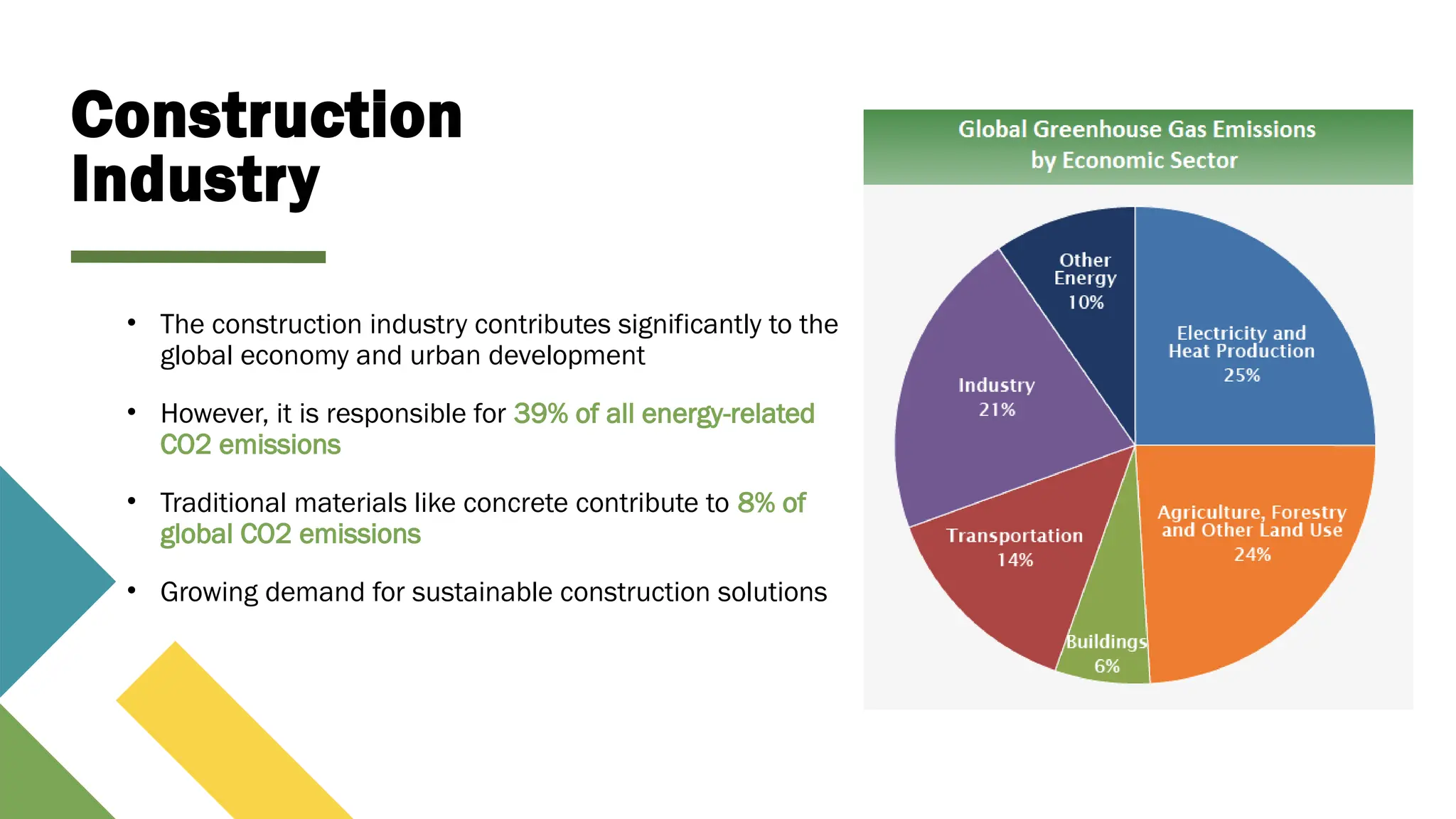
• The constructionindustry contributes significantly to the
global economy and urban development
• However, it is responsible for 39% of all energy-related
CO2 emissions
• Traditional materials like concrete contribute to 8% of
global CO2 emissions
• Growing demand for sustainable construction solutions
5.
The Importance of
Sustainable
Constructionin the
Industry
Why Sustainable Construction Matters:
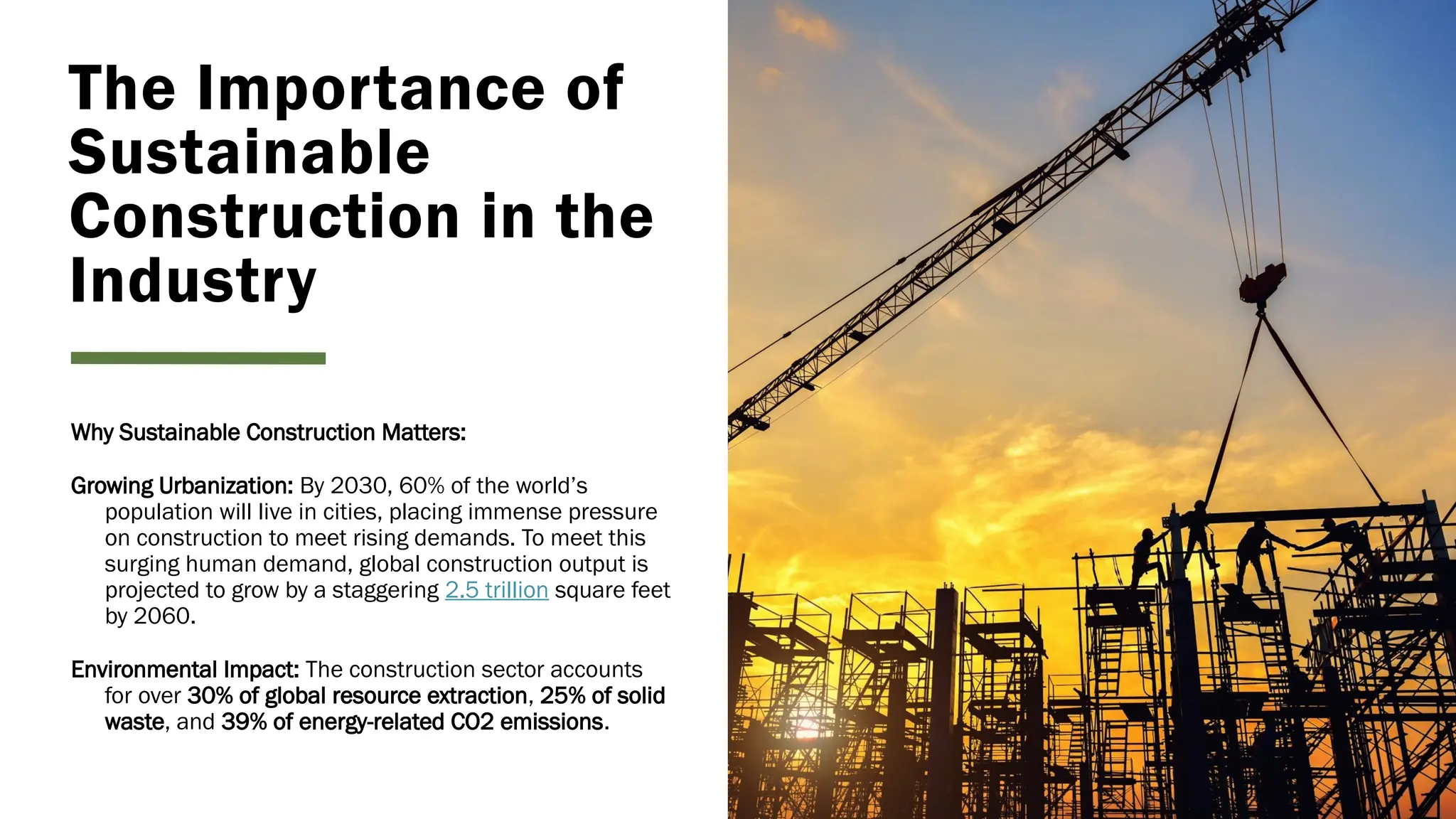
Growing Urbanization: By 2030, 60% of the world’s
population will live in cities, placing immense pressure
on construction to meet rising demands. To meet this
surging human demand, global construction output is
projected to grow by a staggering 2.5 trillion square feet
by 2060.
Environmental Impact: The construction sector accounts
for over 30% of global resource extraction, 25% of solid
waste, and 39% of energy-related CO2 emissions.
6.
Key Stakeholders
• Government& Regulators: Enforce
environmental regulations, incentivize
green building
• Construction Companies: Adopt
sustainable practices to reduce carbon
emissions
• Suppliers & Manufacturers: Provide
eco-friendly materials like CarbonCure,
Hempcrete
• Clients & Investors: Push demand for
greener, sustainable infrastructure
• Communities: Benefit from reduced
environmental impact and greener
living spaces
7.
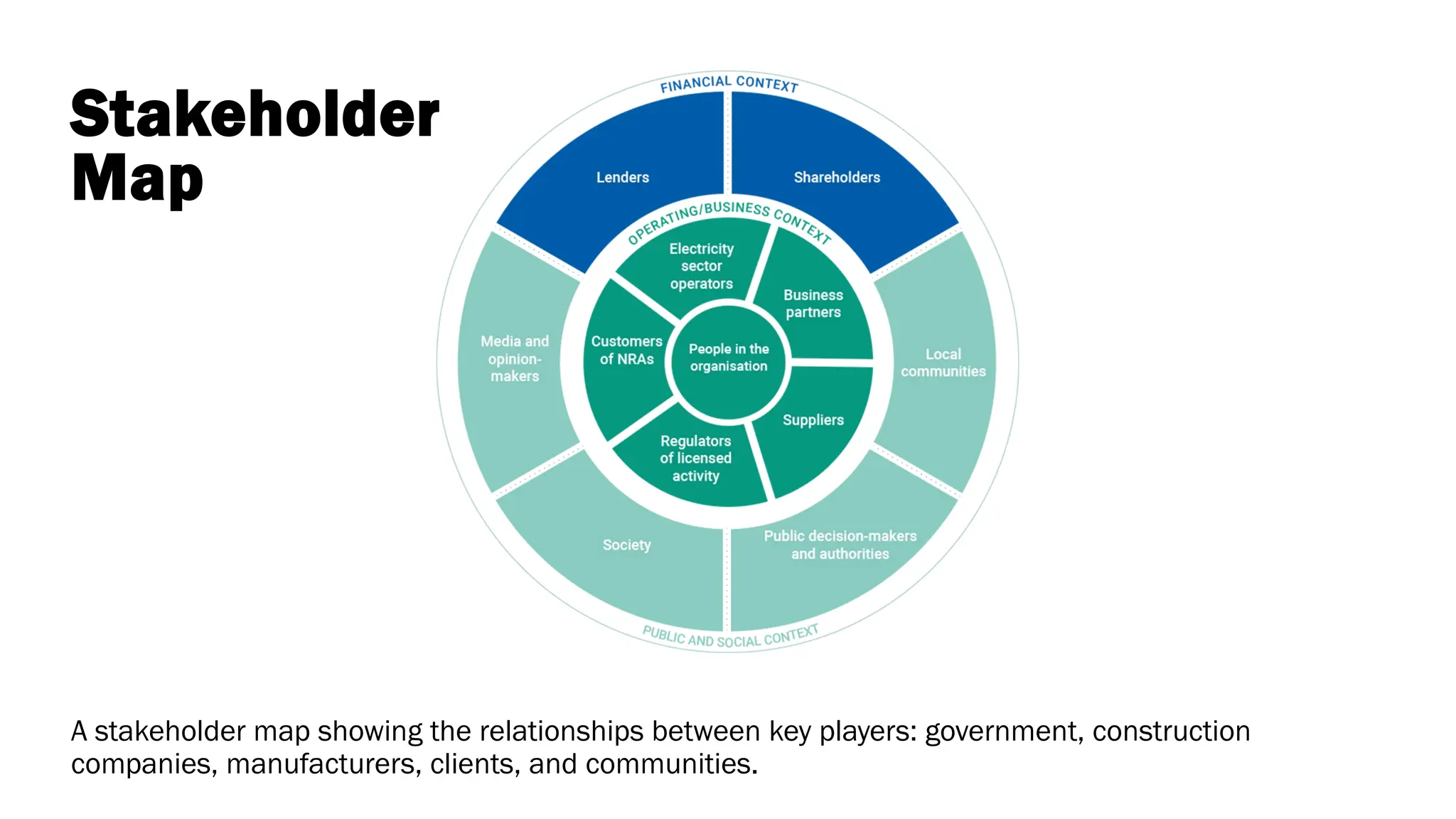
A stakeholder mapshowing the relationships between key players: government, construction
companies, manufacturers, clients, and communities.
Stakeholder
Map
8.
Competitive Strategies
• Innovation:Integrating carbon-
sequestering materials like
CarbonCure concrete
• Cost Efficiency: Reducing long-term
energy use and maintenance costs
• Sustainability Leadership: Achieving
certifications such as LEED Gold
• Companies set targets and objectives:
Reducing embodied carbon,
increasing renewable material use,
and energy savings
Introduction
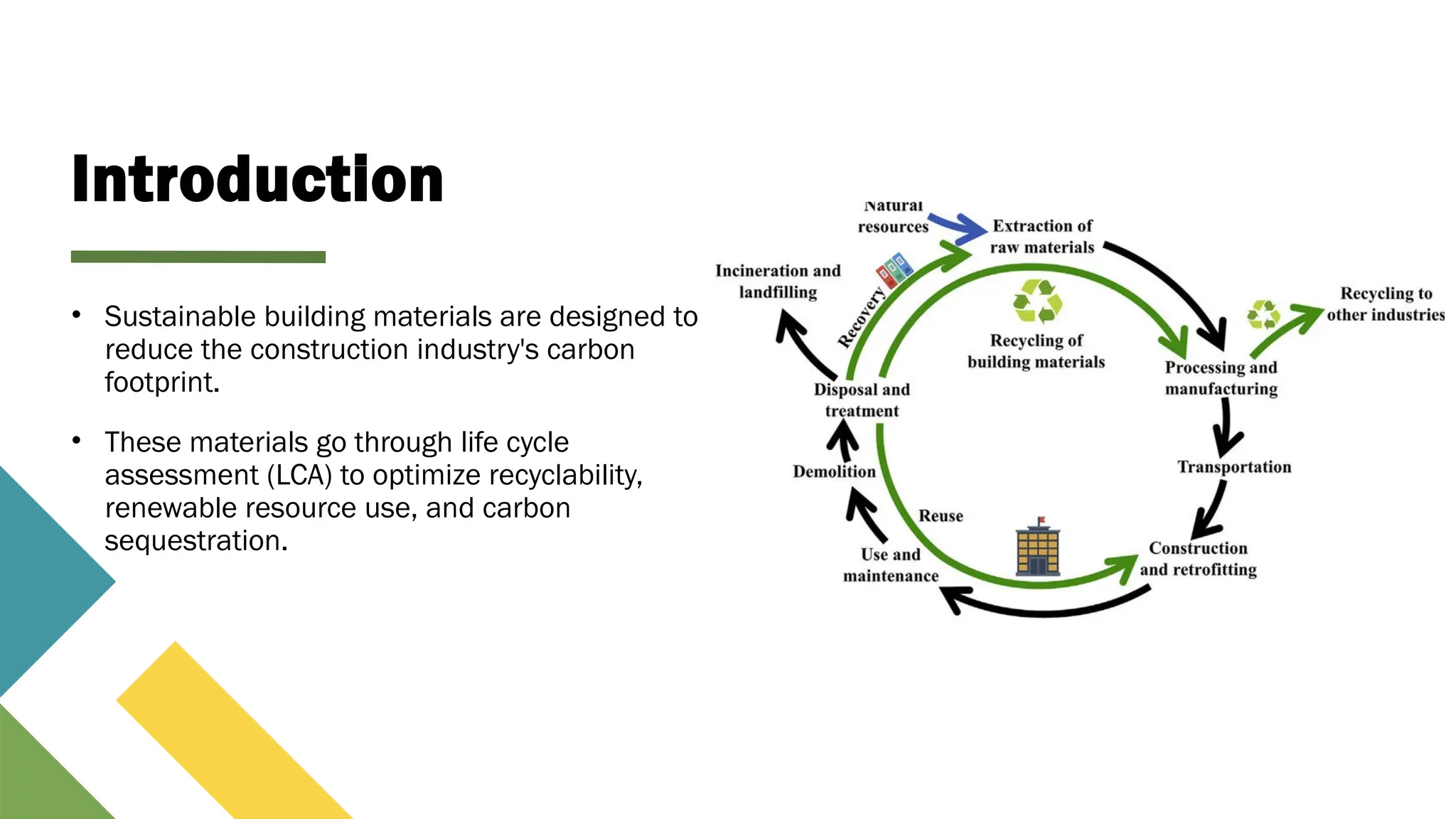
• Sustainable buildingmaterials are designed to
reduce the construction industry's carbon
footprint.
• These materials go through life cycle
assessment (LCA) to optimize recyclability,
renewable resource use, and carbon
sequestration.
11.
Carbon Sequestering Building
Materials
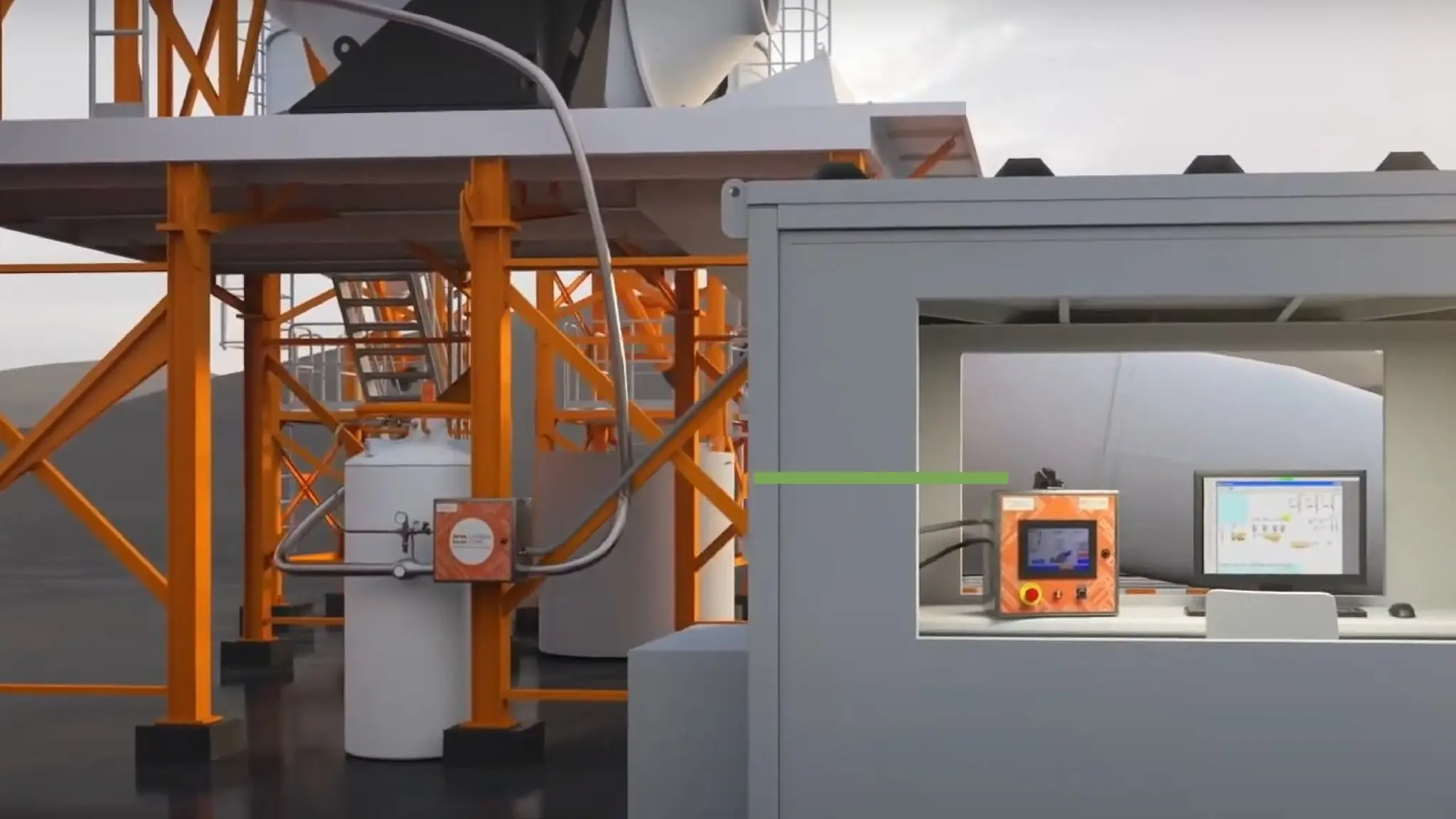
•CarbonCure Concrete: Incorporates
CO2 into the concrete during
production, reducing carbon
emissions by 30%
• Hempcrete: Sequesters 50% more
CO2 than traditional materials
• Sustainable Timber: A renewable
resource that locks in carbon.
• Biochar: Used in insulation and
landscaping, biochar sequesters
carbon from organic material.
13.
Turner Construction
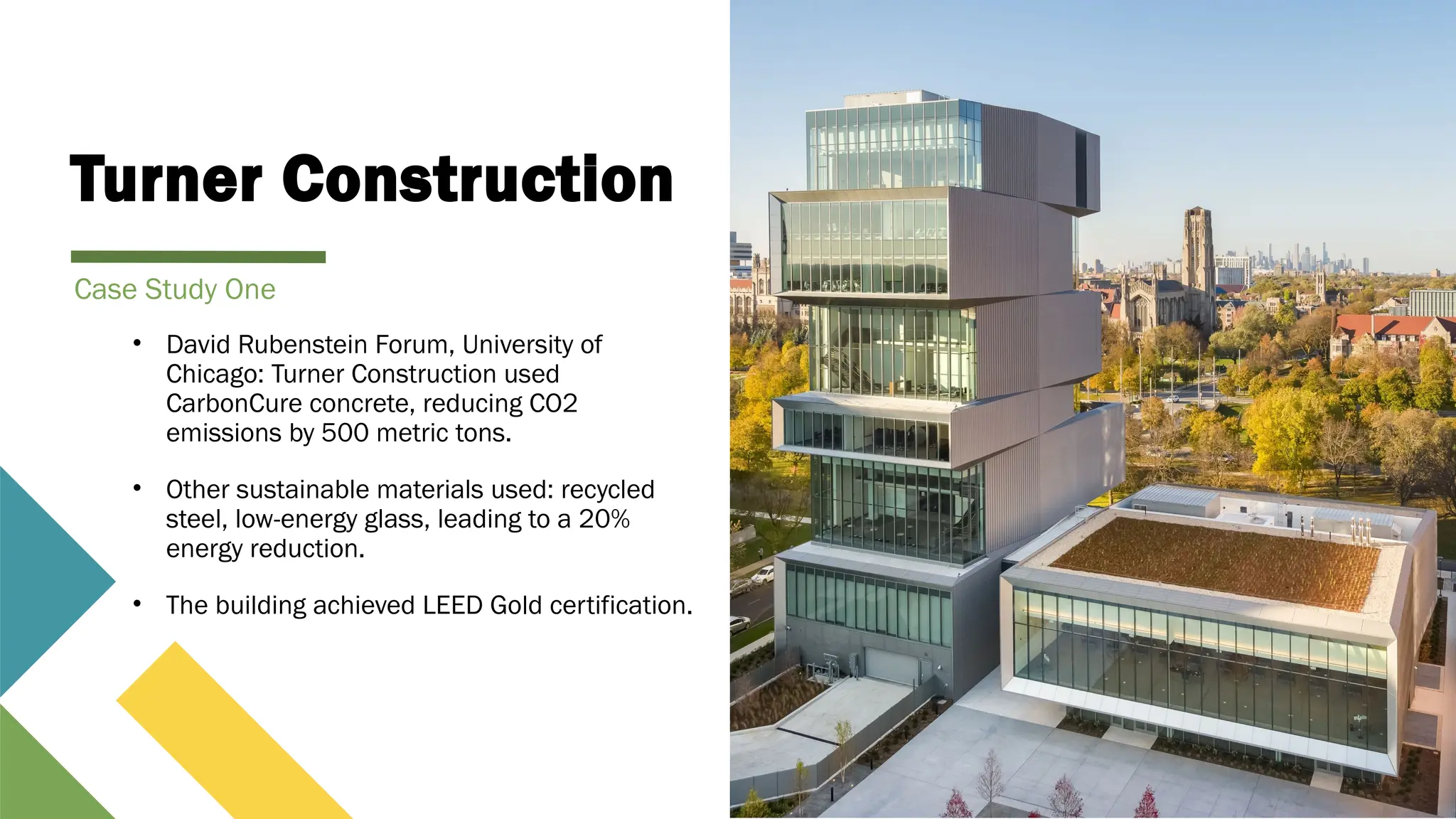
• DavidRubenstein Forum, University of
Chicago: Turner Construction used
CarbonCure concrete, reducing CO2
emissions by 500 metric tons.
• Other sustainable materials used: recycled
steel, low-energy glass, leading to a 20%
energy reduction.
• The building achieved LEED Gold certification.
Case Study One
14.
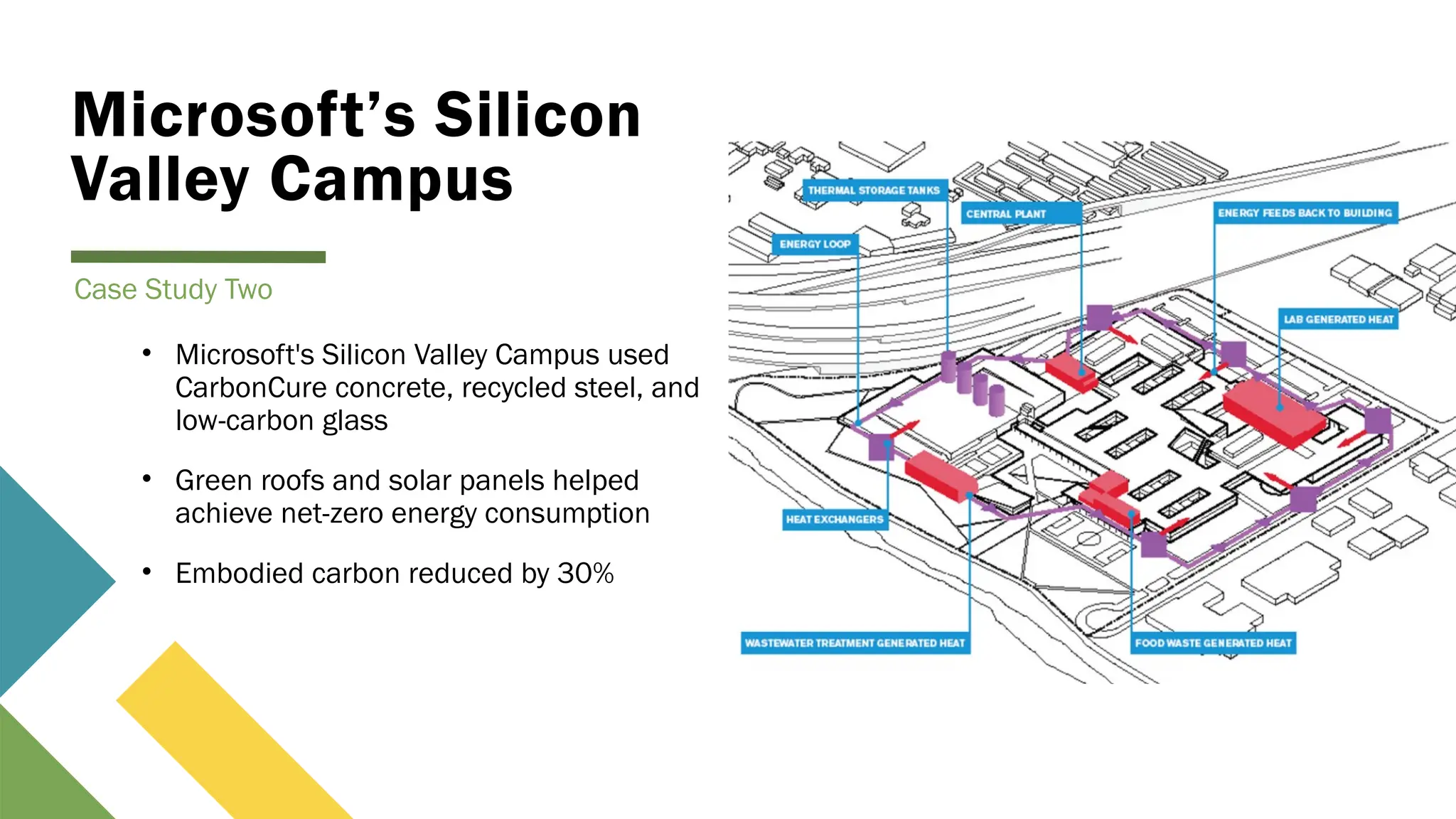
Microsoft’s Silicon
Valley Campus
•Microsoft's Silicon Valley Campus used
CarbonCure concrete, recycled steel, and
low-carbon glass
• Green roofs and solar panels helped
achieve net-zero energy consumption
• Embodied carbon reduced by 30%
Case Study Two
15.
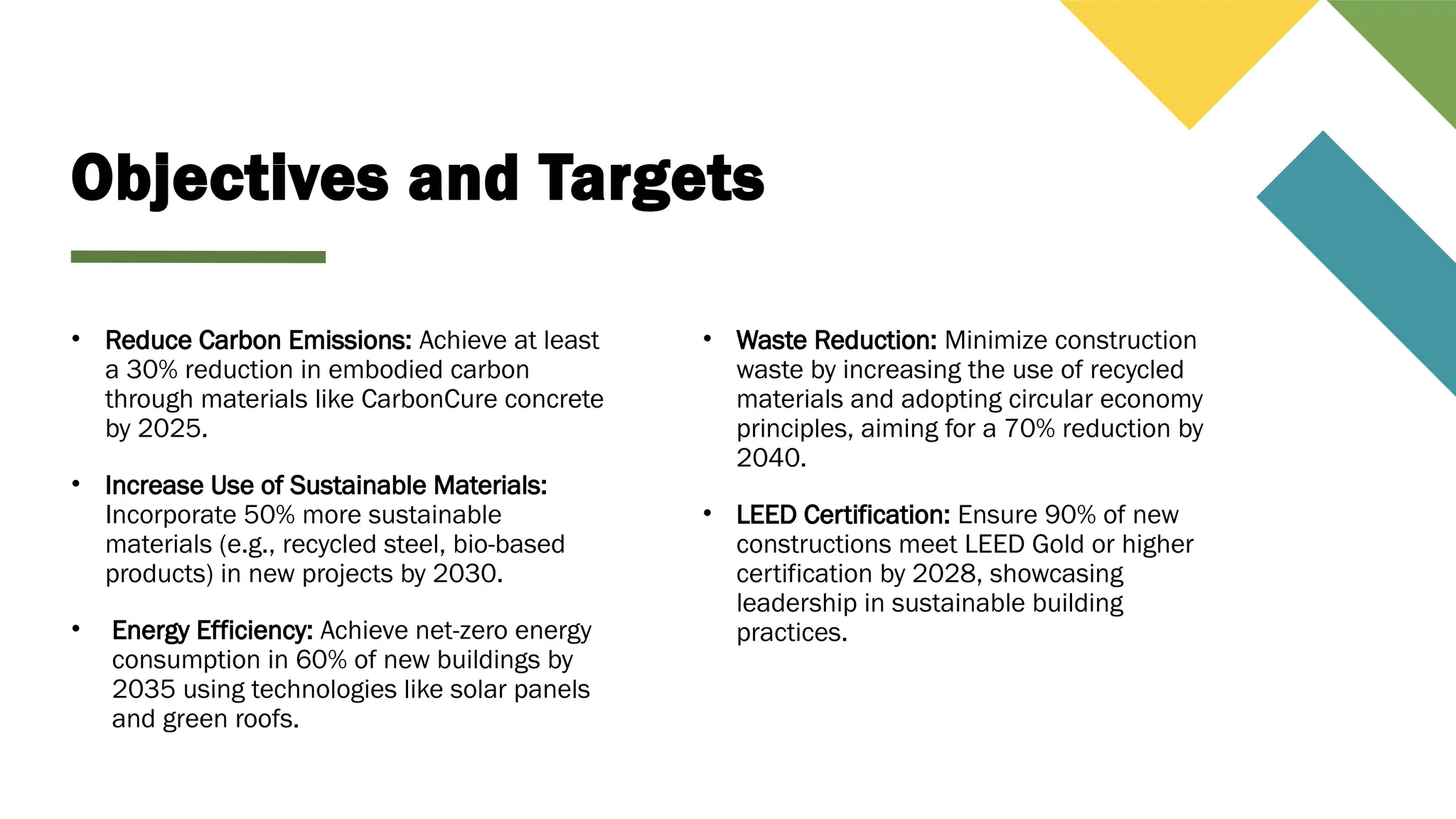
Objectives and Targets
•Reduce Carbon Emissions: Achieve at least
a 30% reduction in embodied carbon
through materials like CarbonCure concrete
by 2025.
• Increase Use of Sustainable Materials:
Incorporate 50% more sustainable
materials (e.g., recycled steel, bio-based
products) in new projects by 2030.
• Energy Efficiency: Achieve net-zero energy
consumption in 60% of new buildings by
2035 using technologies like solar panels
and green roofs.
• Waste Reduction: Minimize construction
waste by increasing the use of recycled
materials and adopting circular economy
principles, aiming for a 70% reduction by
2040.
• LEED Certification: Ensure 90% of new
constructions meet LEED Gold or higher
certification by 2028, showcasing
leadership in sustainable building
practices.
16.
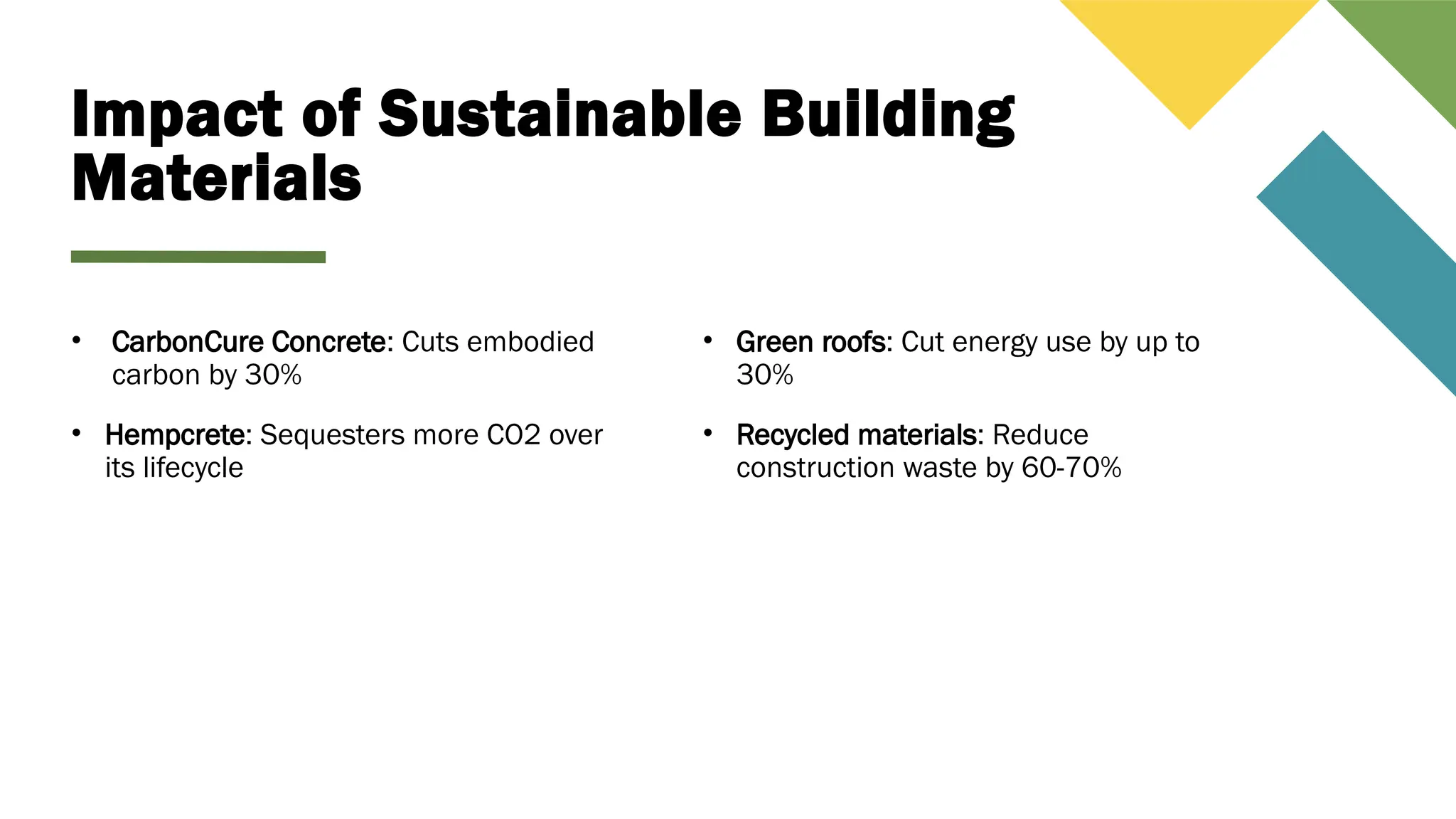
Impact of SustainableBuilding
Materials
• CarbonCure Concrete: Cuts embodied
carbon by 30%
• Hempcrete: Sequesters more CO2 over
its lifecycle
• Green roofs: Cut energy use by up to
30%
• Recycled materials: Reduce
construction waste by 60-70%
17.
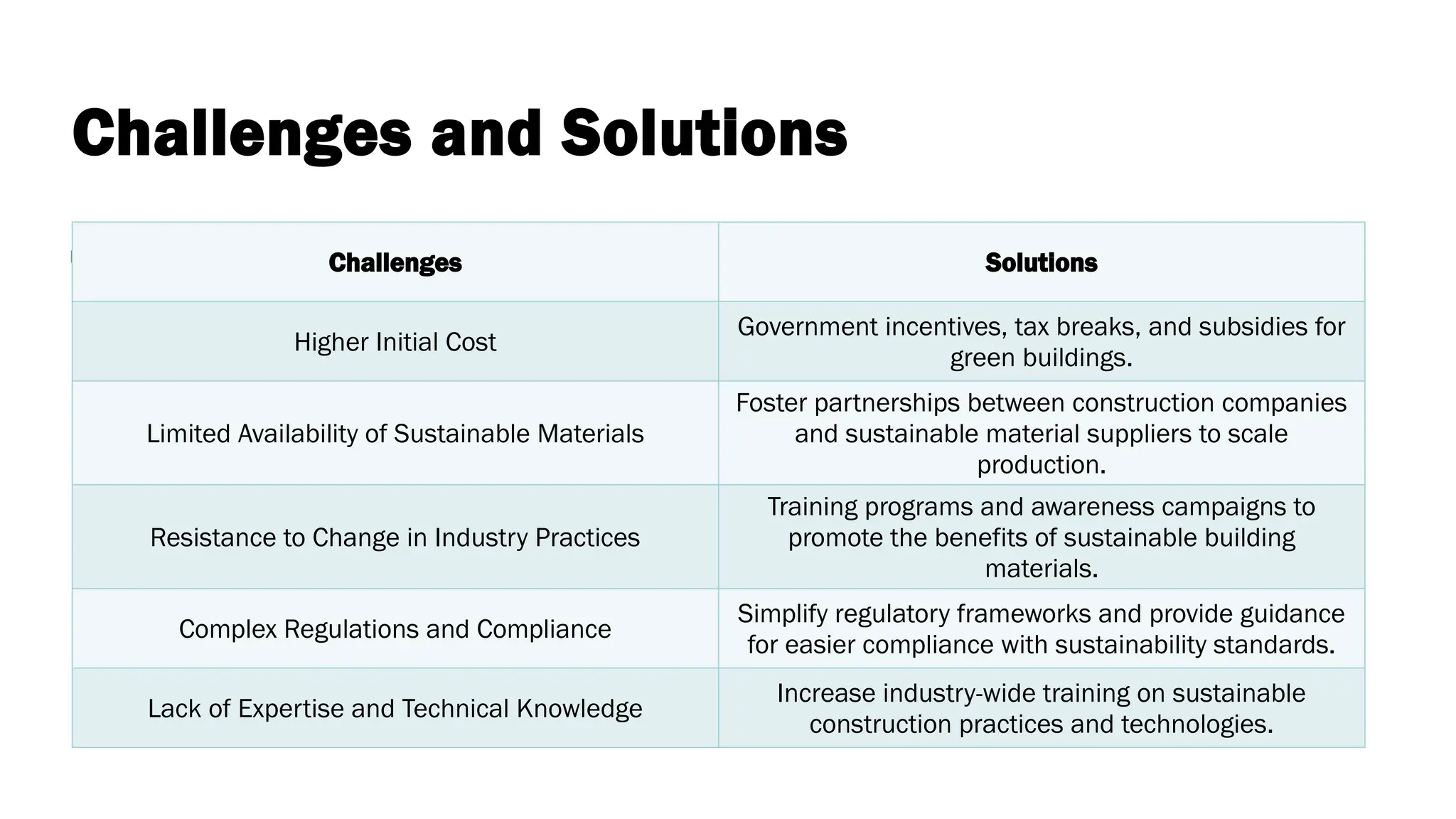
Challenges and Solutions
ChallengesSolutions
Higher Initial Cost
Government incentives, tax breaks, and subsidies for
green buildings.
Limited Availability of Sustainable Materials
Foster partnerships between construction companies
and sustainable material suppliers to scale
production.
Resistance to Change in Industry Practices
Training programs and awareness campaigns to
promote the benefits of sustainable building
materials.
Complex Regulations and Compliance
Simplify regulatory frameworks and provide guidance
for easier compliance with sustainability standards.
Lack of Expertise and Technical Knowledge
Increase industry-wide training on sustainable
construction practices and technologies.
Introduction
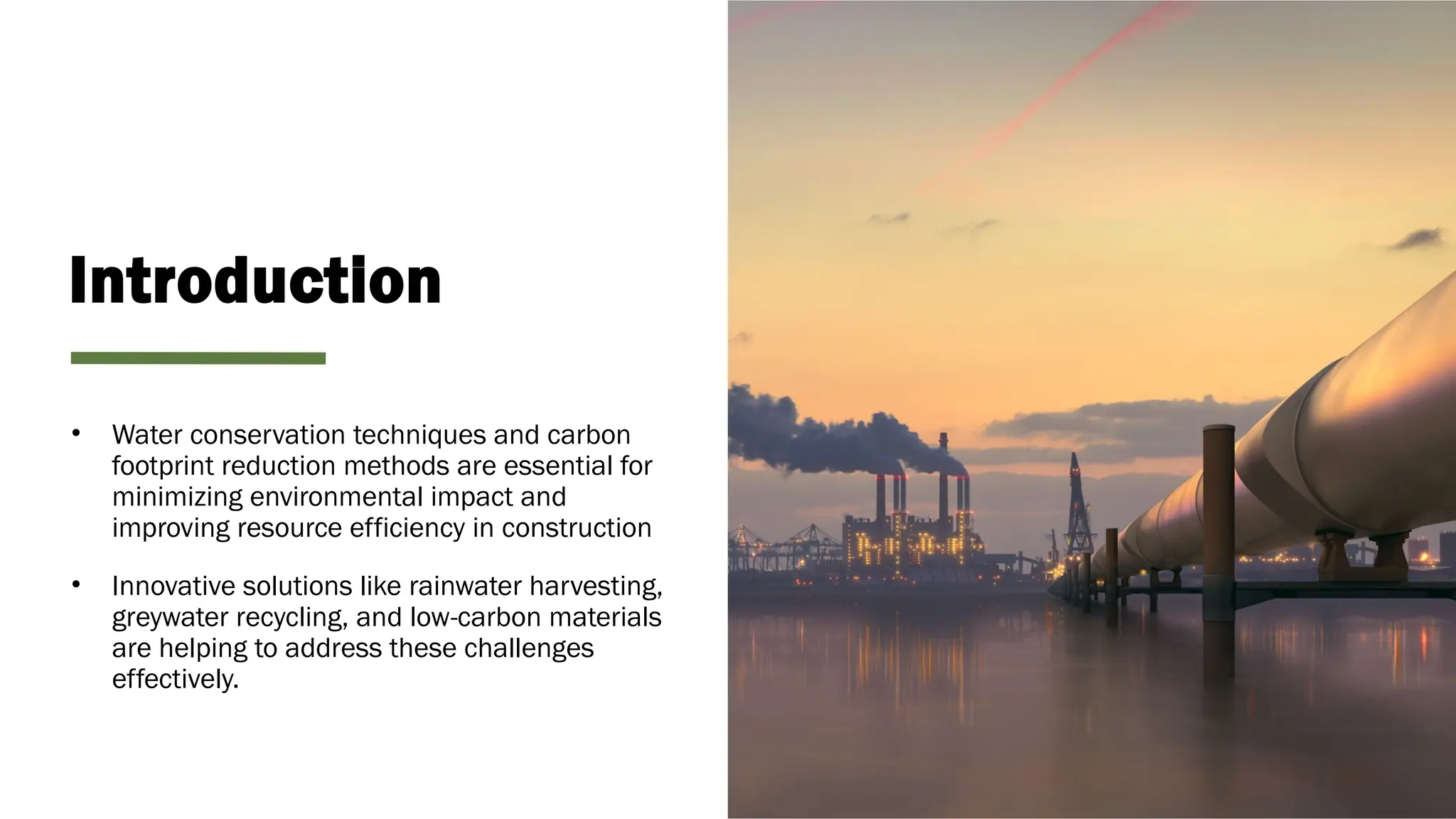
• Water conservationtechniques and carbon
footprint reduction methods are essential for
minimizing environmental impact and
improving resource efficiency in construction
• Innovative solutions like rainwater harvesting,
greywater recycling, and low-carbon materials
are helping to address these challenges
effectively.
20.
Carbon Footprint Reduction
•Low-Carbon Materials: Using
sustainable building materials such as
low-carbon concrete, recycled steel, or
cross-laminated timber
• Renewable Energy Integration:
Installing solar panels, wind turbines,
or geothermal systems to generate
renewable energy on-site
• Energy-Efficient Design: Designing
buildings with natural lighting, superior
insulation, and passive heating/cooling
systems
• Smart Building Technology: AI-driven
systems that manage and optimize
energy use, reducing waste and
emissions
21.
Water Conservation
• RainwaterHarvesting: Collecting
rainwater for use in non-potable
applications like irrigation or cooling
• Greywater Recycling: Reusing water
from sinks and showers for
landscaping or toilet flushing
• Low-Flow Fixtures: Installing water-
efficient faucets, toilets, and showers
to reduce consumption
• Smart Water Management: Using IoT
technology to monitor and optimize
water use in real time
22.
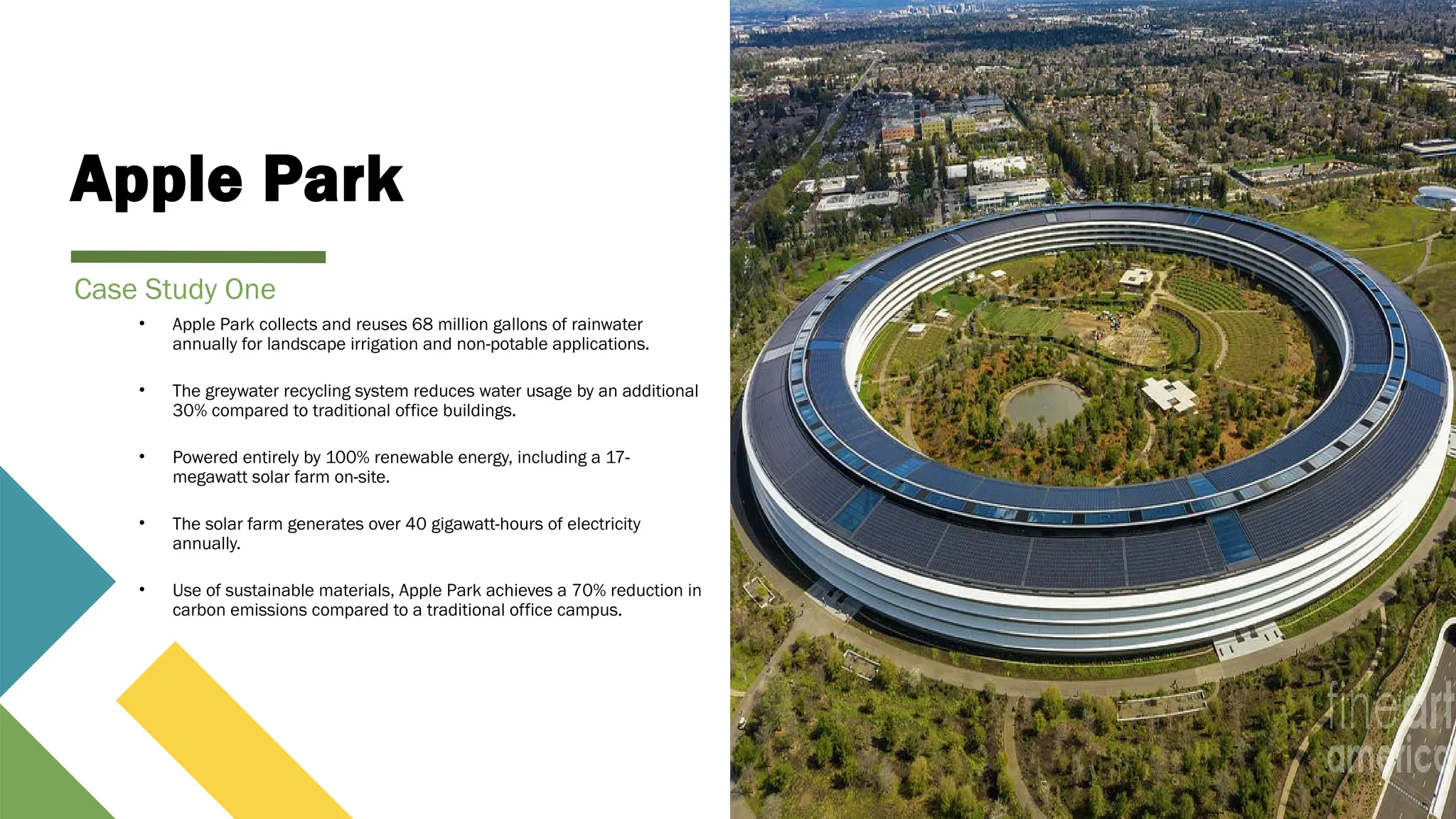
Apple Park
• ApplePark collects and reuses 68 million gallons of rainwater
annually for landscape irrigation and non-potable applications.
• The greywater recycling system reduces water usage by an additional
30% compared to traditional office buildings.
• Powered entirely by 100% renewable energy, including a 17-
megawatt solar farm on-site.
• The solar farm generates over 40 gigawatt-hours of electricity
annually.
• Use of sustainable materials, Apple Park achieves a 70% reduction in
carbon emissions compared to a traditional office campus.
Case Study One
23.
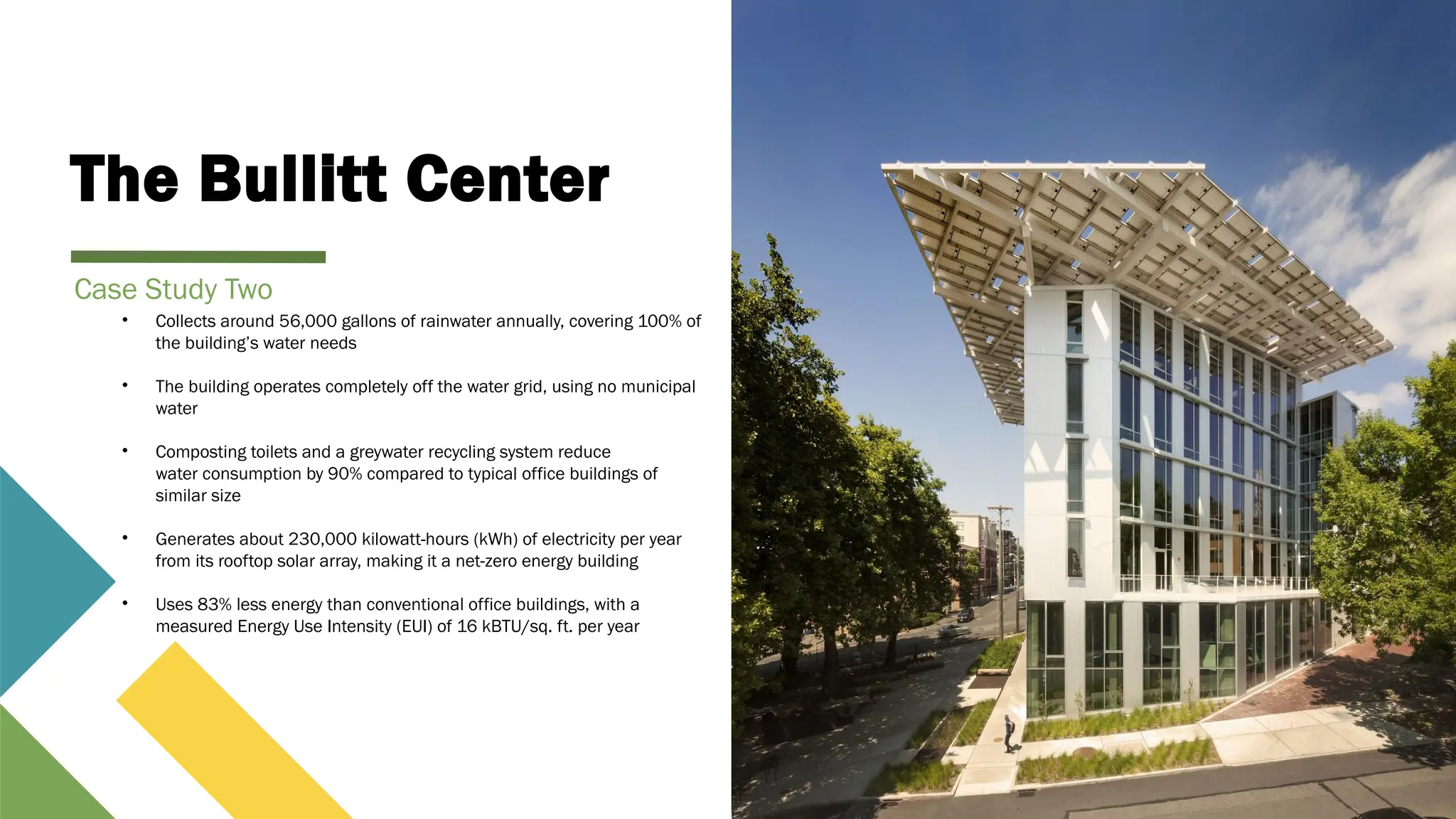
The Bullitt Center
•Collects around 56,000 gallons of rainwater annually, covering 100% of
the building’s water needs
• The building operates completely off the water grid, using no municipal
water
• Composting toilets and a greywater recycling system reduce
water consumption by 90% compared to typical office buildings of
similar size
• Generates about 230,000 kilowatt-hours (kWh) of electricity per year
from its rooftop solar array, making it a net-zero energy building
• Uses 83% less energy than conventional office buildings, with a
measured Energy Use Intensity (EUI) of 16 kBTU/sq. ft. per year
Case Study Two
24.
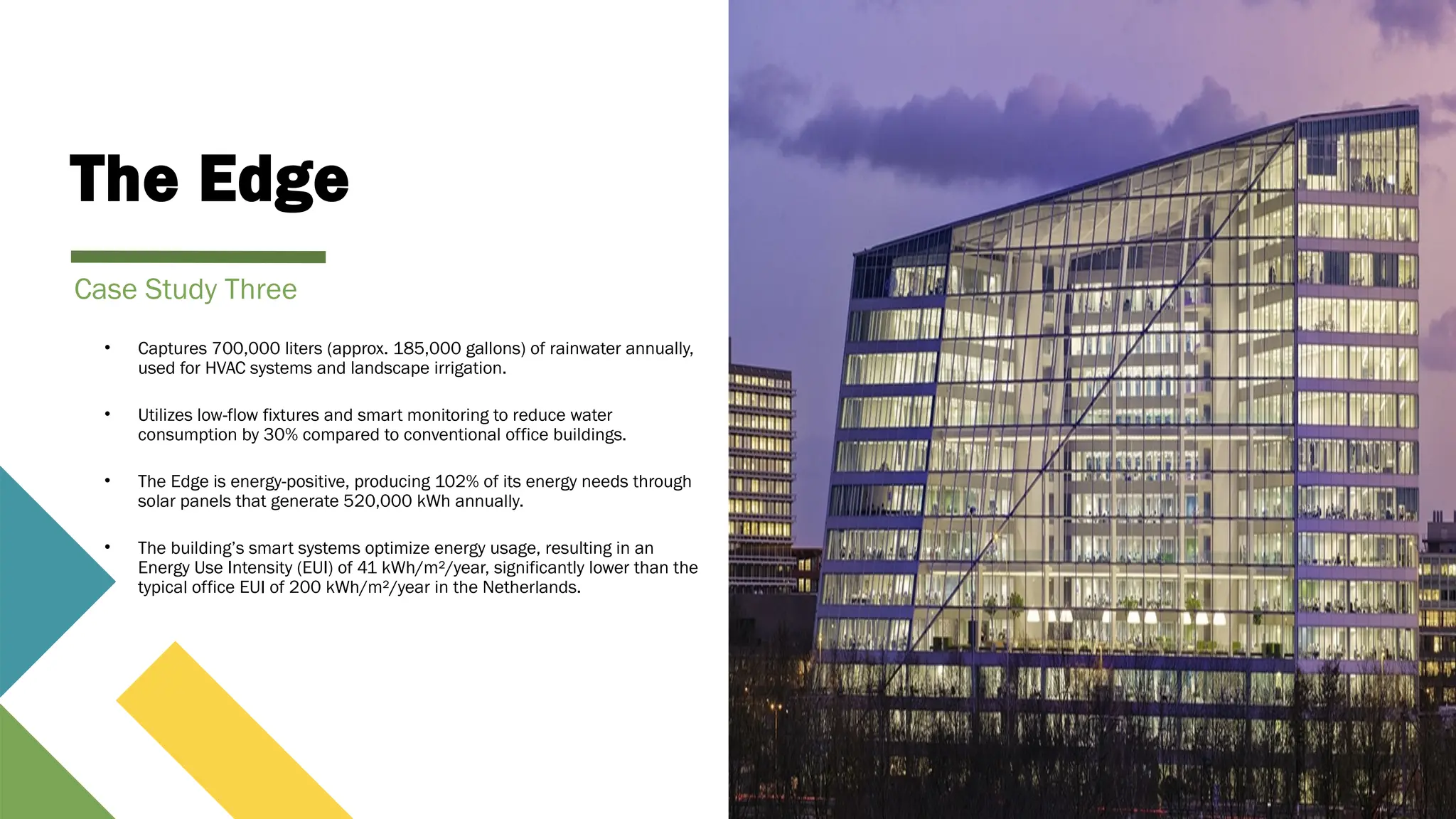
The Edge
• Captures700,000 liters (approx. 185,000 gallons) of rainwater annually,
used for HVAC systems and landscape irrigation.
• Utilizes low-flow fixtures and smart monitoring to reduce water
consumption by 30% compared to conventional office buildings.
• The Edge is energy-positive, producing 102% of its energy needs through
solar panels that generate 520,000 kWh annually.
• The building’s smart systems optimize energy usage, resulting in an
Energy Use Intensity (EUI) of 41 kWh/m²/year, significantly lower than the
typical office EUI of 200 kWh/m²/year in the Netherlands.
Case Study Three
25.
Objectives and Targets
•Focus on reducing embodied carbon
(carbon emissions from material
manufacturing, transport, and
assembly)
• 40-50% reduction by 2030 in
alignment with the Paris Agreement
• Aim to reduce water
consumption by 20-40% by
2030
• Some companies target net-
zero water use, utilizing
rainwater harvesting and
greywater recycling for non-
potable applications
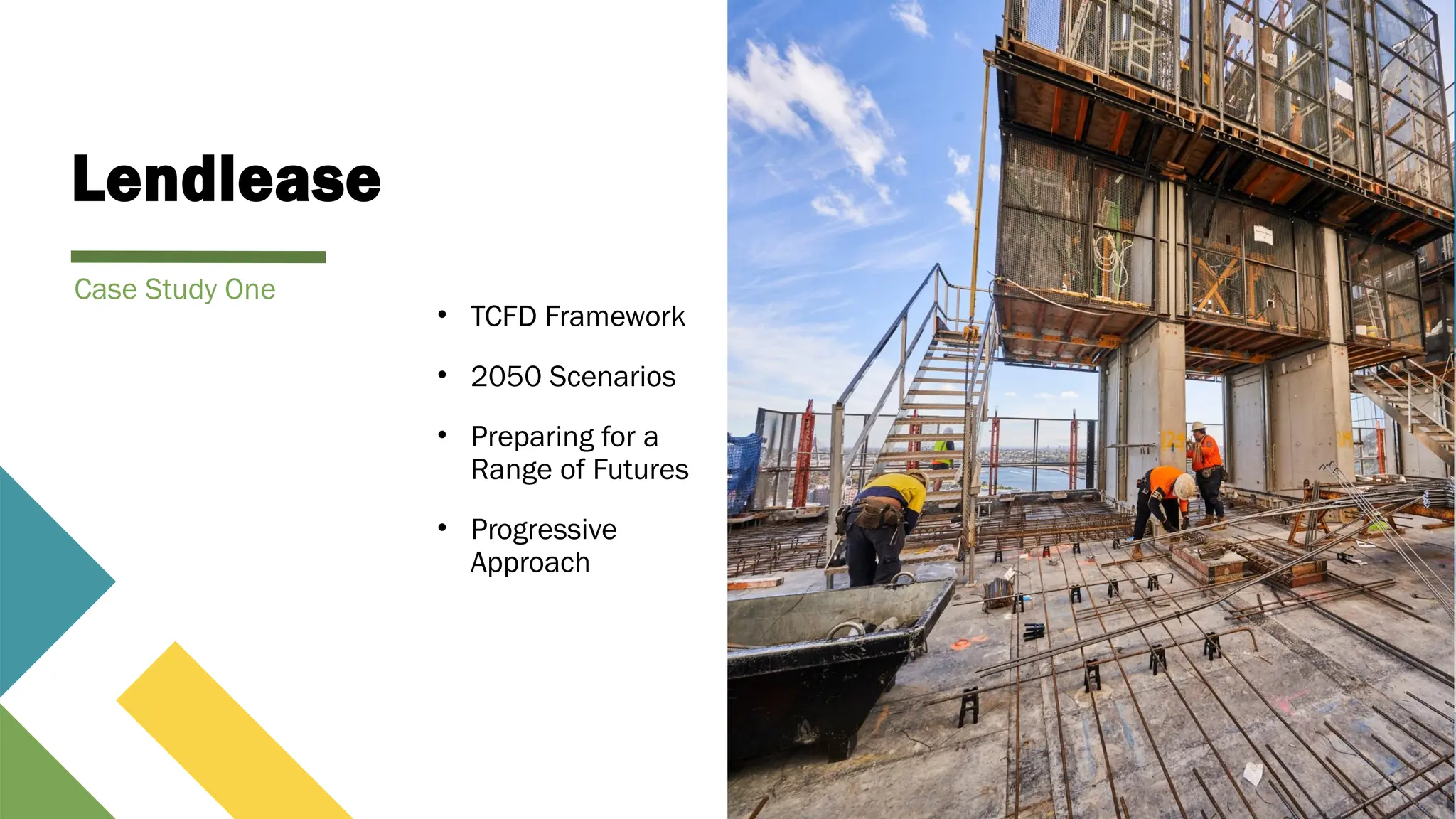
Lendlease
• TCFD Framework
•2050 Scenarios
• Preparing for a
Range of Futures
• Progressive
Approach
Case Study One
30.
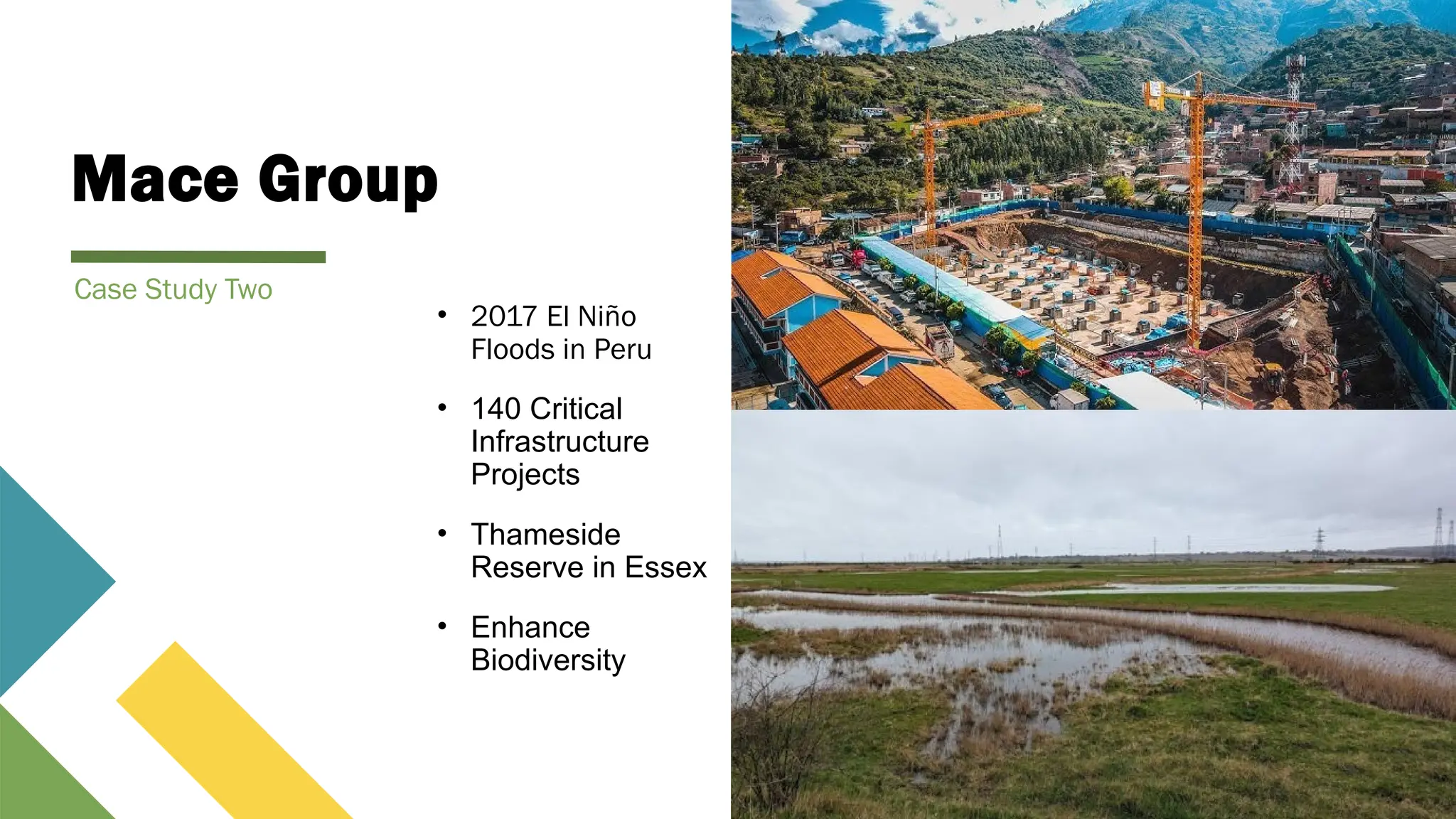
Mace Group
• 2017El Niño
Floods in Peru
• 140 Critical
Infrastructure
Projects
• Thameside
Reserve in Essex
• Enhance
Biodiversity
Case Study Two
31.
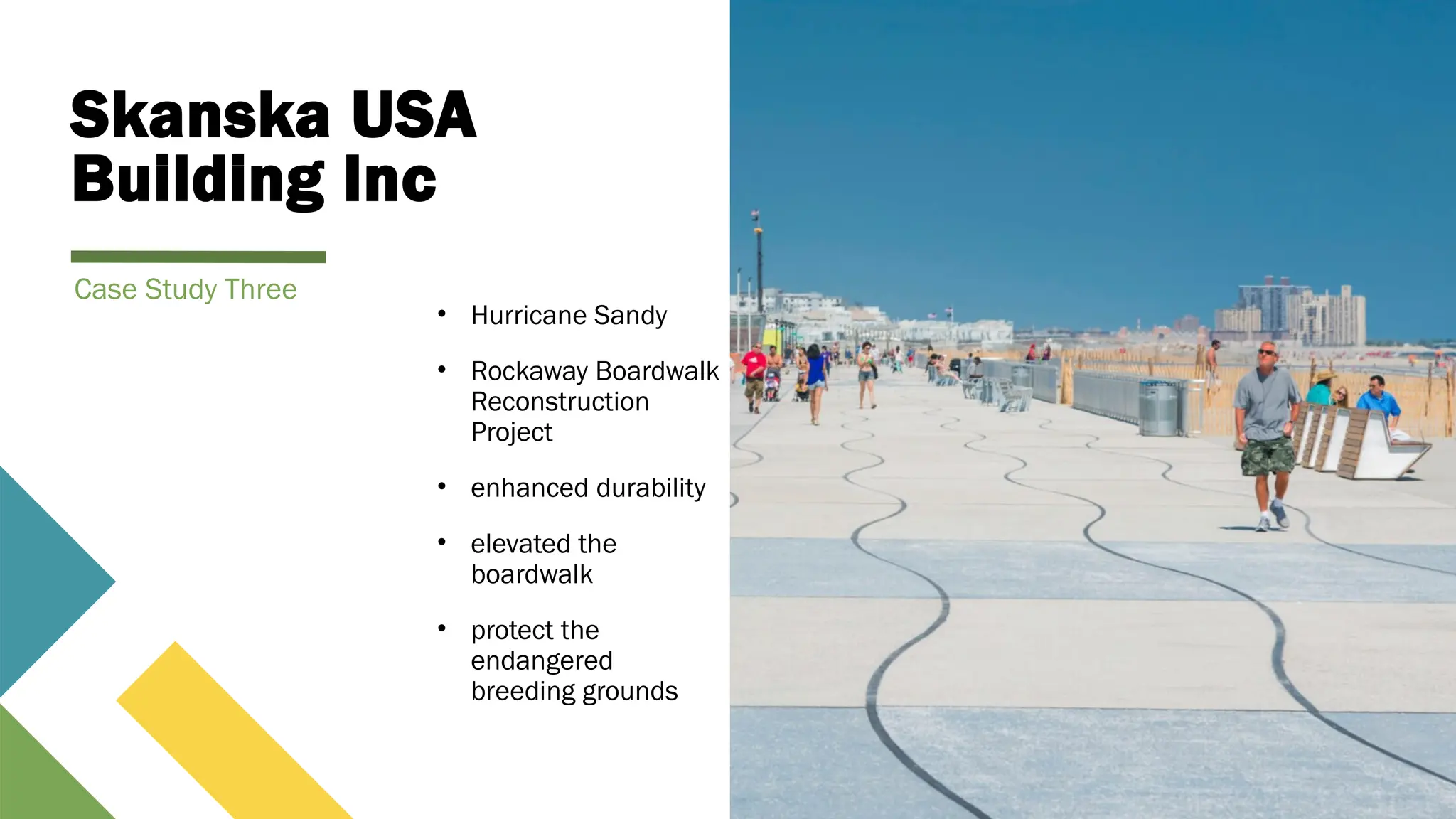
Skanska USA
Building Inc
•Hurricane Sandy
• Rockaway Boardwalk
Reconstruction
Project
• enhanced durability
• elevated the
boardwalk
• protect the
endangered
breeding grounds
Case Study Three
32.
Objectives and Targets
•Task Force on Climate Related Financial
Disclosures (TFCD)
• Global Reporting Initiative (GRI)
• Carbon Disclosure Project (CDP)
• Sustainable Development Goals (SDGs)
• Climate Bonds Initiative (CBI)
• Leadership in Energy and Environmental
Design (LEED) Resilience
• ISO 14090: Adaptation to Climate
Change
• Physical Climate Risk Metrics
• GRESB (Global ESG Benchmark for
Real Assets)
• CIRIA Climate Adaptation Framework
• Embodied Carbon Metrics
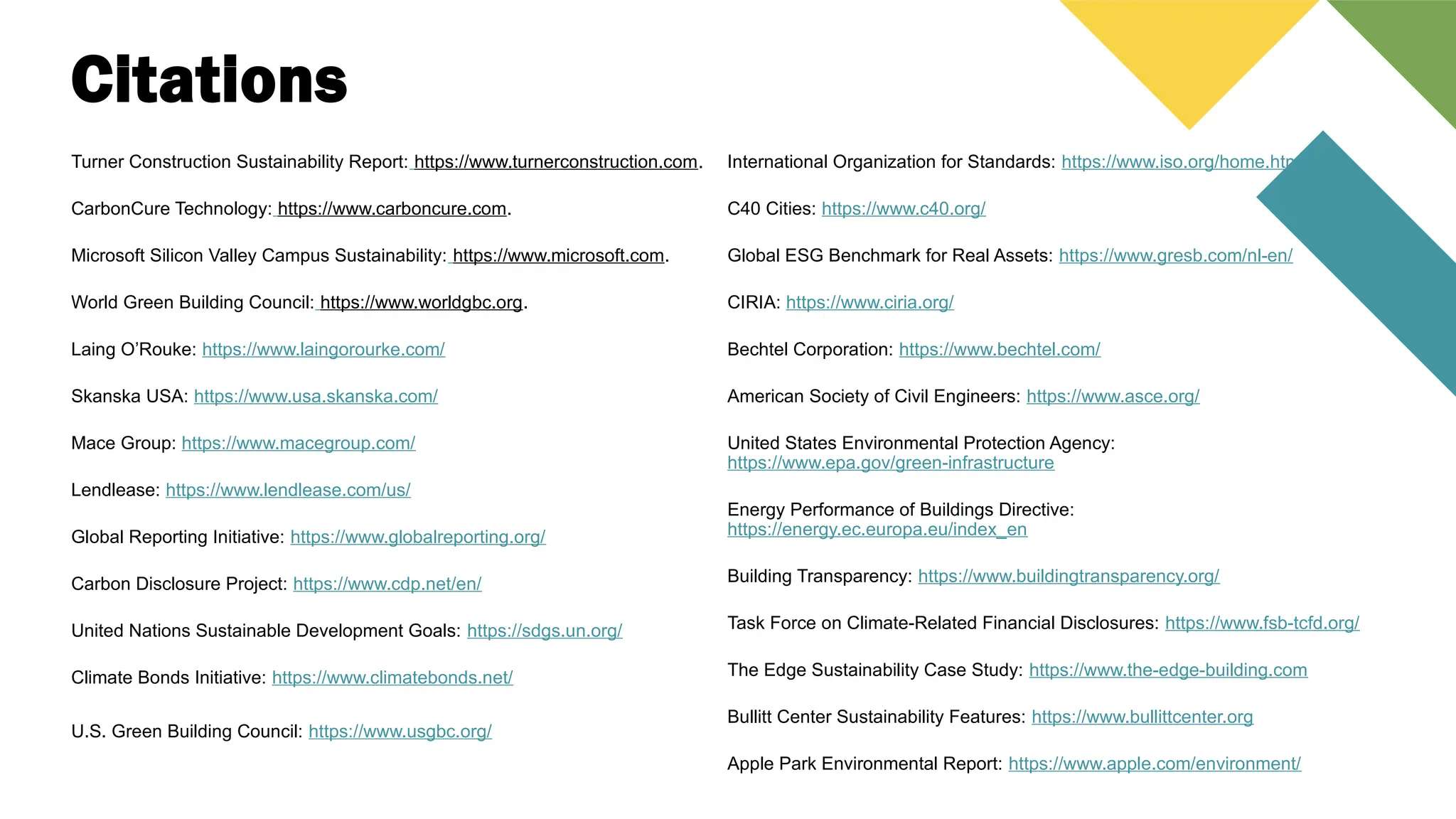
Citations
Turner Construction SustainabilityReport: https://www.turnerconstruction.com.
CarbonCure Technology: https://www.carboncure.com.
Microsoft Silicon Valley Campus Sustainability: https://www.microsoft.com.
World Green Building Council: https://www.worldgbc.org.
Laing O’Rouke: https://www.laingorourke.com/
Skanska USA: https://www.usa.skanska.com/
Mace Group: https://www.macegroup.com/
Lendlease: https://www.lendlease.com/us/
Global Reporting Initiative: https://www.globalreporting.org/
Carbon Disclosure Project: https://www.cdp.net/en/
United Nations Sustainable Development Goals: https://sdgs.un.org/
Climate Bonds Initiative: https://www.climatebonds.net/
U.S. Green Building Council: https://www.usgbc.org/
International Organization for Standards: https://www.iso.org/home.html
C40 Cities: https://www.c40.org/
Global ESG Benchmark for Real Assets: https://www.gresb.com/nl-en/
CIRIA: https://www.ciria.org/
Bechtel Corporation: https://www.bechtel.com/
American Society of Civil Engineers: https://www.asce.org/
United States Environmental Protection Agency:
https://www.epa.gov/green-infrastructure
Energy Performance of Buildings Directive:
https://energy.ec.europa.eu/index_en
Building Transparency: https://www.buildingtransparency.org/
Task Force on Climate-Related Financial Disclosures: https://www.fsb-tcfd.org/
The Edge Sustainability Case Study: https://www.the-edge-building.com
Bullitt Center Sustainability Features: https://www.bullittcenter.org
Apple Park Environmental Report: https://www.apple.com/environment/
#32 Target: Design buildings that can withstand 100-year storm events or similar extreme weather conditions.
Objective: Improve structural resilience by integrating climate-adaptive designs and materials.
Measurement: Percentage of buildings designed with climate-resilient features, such as flood defense systems or heat-reflective surfaces.
Target: Restore or create 1 square meter of natural habitat for every square meter of construction footprint by 2030.
Objective: Implement green roofs, biodiversity corridors, and habitat restoration projects.
Measurement: Square meters of habitat restored or created.
The Task Force on Climate Related Financial Disclosures provides information to investors about what companies are doing to mitigate the risks of climate change, as well as be transparent about the way in which they are governed.
Global Reporting Initiative (GRI)
What it Measures: The GRI framework includes specific standards for reporting on environmental impact, resource use, and climate adaptation.
Key Metrics:
Energy consumption and efficiency (GRI 302)
Water usage and recycling (GRI 303)
GHG emissions (GRI 305)
Climate resilience and risk management (GRI 201 and GRI 413)
Use in Resilience: GRI metrics allow construction companies to report on their exposure to climate risks and the resilience measures they’ve implemented.
2. Carbon Disclosure Project (CDP)
What it Measures: The CDP collects detailed data on climate risks, adaptation strategies, and carbon emissions.
Key Metrics:
Carbon footprint (Scope 1, 2, and 3 emissions)
Climate risk exposure and scenario analysis
Water security (CDP Water Security Questionnaire)
Use in Resilience: CDP encourages companies to disclose their climate risks, resilience strategies, and alignment with global climate targets.
3. Sustainable Development Goals (SDGs)
What it Measures: Many construction companies align with specific UN SDGs, particularly those focused on climate action, clean water, and sustainable cities.
Key Metrics:
Progress on SDG 9 (Industry, Innovation, and Infrastructure)
Progress on SDG 11 (Sustainable Cities and Communities)
SDG 13 (Climate Action) alignment and mitigation measures.
Use in Resilience: The SDG framework helps quantify the industry’s contributions to climate resilience, energy efficiency, and sustainable infrastructure.
4. Climate Bonds Initiative (CBI)
What it Measures: CBI focuses on financing projects with clear environmental benefits, particularly for climate resilience.
Key Metrics:
Alignment with Climate Resilience Principles (e.g., resilience to flooding, extreme heat)
Project-specific adaptation and mitigation benefits (e.g., green infrastructure, low-carbon materials)
Use in Resilience: Construction projects funded through climate bonds must meet strict criteria related to climate adaptation and resilience.
5. Leadership in Energy and Environmental Design (LEED) Resilience
What it Measures: LEED, a widely-used green building certification system, includes a resilience framework to assess climate adaptation.
Key Metrics:
LEED Resilience Standard score (reflects ability to handle extreme weather, flooding, and heat events)
Water and energy efficiency
Green infrastructure and ecosystem services
Use in Resilience: LEED’s Resilience standards allow projects to be certified based on their climate adaptability and long-term sustainability.
6. ISO 14090: Adaptation to Climate Change
What it Measures: ISO 14090 focuses on integrating climate adaptation into business strategies, risk assessments, and projects.
Key Metrics:
Identification and assessment of climate risks
Adaptation measures implemented in project designs and operations
Monitoring and evaluation of adaptation performance
Use in Resilience: Construction companies can use ISO 14090 to benchmark their climate resilience efforts, ensuring compliance with international standards.
7. Physical Climate Risk Metrics
What it Measures: These are industry-specific metrics that quantify the exposure of assets and projects to physical climate risks like extreme weather, sea-level rise, and heatwaves.
Key Metrics:
Exposure to 100-year flood events or projected sea-level rise
Risk of heat-related stress on materials or labor
Impact of weather volatility on construction timelines
Use in Resilience: These metrics help quantify the physical resilience of buildings and infrastructure under future climate scenarios.
8. GRESB (Global ESG Benchmark for Real Assets)
What it Measures: GRESB assesses ESG performance in the real estate and infrastructure sectors, focusing on resilience to climate change.
Key Metrics:
Risk mitigation strategies for climate impacts
Energy and water efficiency measures
ESG management and climate risk policies
Use in Resilience: GRESB metrics are used to benchmark and compare the climate resilience of real assets across different companies and projects.
9. CIRIA Climate Adaptation Framework
What it Measures: CIRIA (Construction Industry Research and Information Association) offers guidance on incorporating climate change adaptation into infrastructure.
Key Metrics:
Risk assessments for climate change impacts (flooding, heat, drought)
Climate resilience measures in design and construction
Use in Resilience: This framework provides industry-specific recommendations for enhancing resilience in infrastructure projects.
10. Embodied Carbon Metrics
What it Measures: Embodied carbon refers to the total carbon footprint associated with materials used in construction, from extraction to installation.
Key Metrics:
Total embodied carbon (kgCO₂e) per square meter of building
Percentage of recycled or low-carbon materials used
Use in Resilience: Reducing embodied carbon improves the overall climate resilience of a project by mitigating its environmental impact.