Keratometer  (Ophthalmometer) Review ‘ Keratometer is a trade name of Bausch & Lomb, Inc’
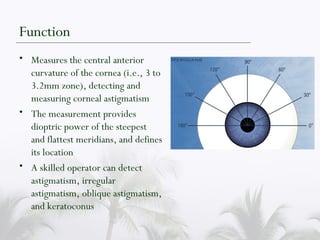
Function Measures the central anterior curvature of the cornea (i.e., 3 to 3.2mm zone), detecting and measuring corneal astigmatism The measurement provides dioptric power of the steepest and flattest meridians, and defines its location A skilled operator can detect astigmatism, irregular astigmatism, oblique astigmatism, and keratoconus
Types of Astigmatism Simple Astigmatism – One focal line falls on the retina (one meridian is emmetropic); the other meridian may fall in front or behind the retina Simple Myopic Astigmatism:  Plano / -2.00 x 180  Simple Hyperopic Astigmatism: Plano / +2.00 x 180  Compound Astigmatism – Both focal points lie either in front or behind the retina Compound Myopic Astigmatism:  -1.00 / -2.00 x 180 Compound Hyperopic Astigmatism:  +2.00 / -1.00 x 180 Mixed Astigmatism – One focal point lies behind the retina, the other focal point lies in front of the retina Mixed Astigmatism:  +1.00 / -2.00 x 180
Types of Astigmatism Irregular astigmatism – the flat and steep axes are not at right angles Can be due to surgery, trauma, inflammation, scar tissue, or developmental anomalies Oblique astigmatism – occurs along the 45˚ or 135˚ meridians
Astigmatism With the Rule Astigmatism:  the vertical meridian has the steepest curvature Minus axis at 180 (within 30 degrees) Plus axis at 090 (within 30 degrees) Against the Rule Astigmatism:  the horizontal meridian has the steepest curvature Minus axis at 090 (within 30 degrees) Plus axis at 180 (within 30 degrees)
Astigmatism The difference between the horizontal meridian and the vertical meridian constitutes the corneal astigmatism 45.25 @ 180 / 44.25 @ 090 = 1.00 diopter of cylinder Plus cylinder, the axis is the axis of the higher diopter power Minus cylinder, the axis is the axis of the lower diopter power 45.00 @ 180 / 46.50 @ 090 Difference is 1.50D Minus cylinder:  -1.50 x 180 Plus cylinder:  +1.50 x 090
Recording Measurement Values A common practice is to record the horizontal reading first; however, some sites will record the flattest meridian followed by the steepest meridian and its axis  44.00 @ 160 / 42.75 @ 070 Or 42.75 @ 070 / 44.00 @ 160 (42.75 / 44.00 @ 160) Values can be expressed in diopters or millimeters of radius (e.g., Javal-Schiötz Ophthalmometer) Refer to handout for Diopter to Millimeter Conversion chart
Manual vs. Automated Manual keratometry is preferred in patients:  With poor fixation  Corneal abnormalities With distorted mires When the cornea is highly toric When the cornea is dry  Corneal topography is preferred in patients with readings less than 40 diopters or greater than 46 diopters
Manual vs. Automated Some physicians prefer corneal topography over manual keratometry in patients with keratoconus, and previous corneal surgery Corneal topography provides readings of nearly the entire anterior corneal surface For automated keratometry, the validation criteria is three measurements within 0.25D in each of the principal meridians
Toric IOLs, Manual vs. Automated Toric Calculator Manual keratometry is recommended method Determines the axis and magnitude of corneal astigmatism Auto-K’s and Sim-K's can be off by 10˚ resulting in a 33% reduction in the effect of the toric IOL  (www.doctor-hill.com) Automation may result in a greater number of under corrections due to angular errors  (www.doctor-hill.com) Topography is used to verify no corneal abnormalities and astigmatism is regular IOL Master  IOL Master K-readings and axial length are used to calculate IOL power Manual K-readings used for Toric Calculator
Standard Keratometry Readings In the average eye, keratometry readings are in the range of 43 to 44 diopters When comparing to the fellow eye, keratometry readings and corneal cylinder should be within 1 diopter Differences should be double checked Keratometry readings less than 40 and more than 47 diopters are unusual and should be double checked
Keratoconus / Rating Keratoconus – a degenerative corneal disease resulting in a generalized thinning and cone-shaped protrusion of the central cornea, usually in both eyes Mild < 45 diopters in both meridians Moderate 45 – 52 diopters in both meridians Advanced > 52 diopters in both meridians Severe > 62 diopters in both meridians
Common Mistakes and Pointers The majority of errors are related to: Inadequate instrument calibration Incorrect examination technique Unfocused eyepiece (can lead to an error of up to 1 diopter in the K-reading) Distorted mires Off-axis measurements Corneal abnormalities Irregular contour or shape of cornea Inadequate or excessive tear film Ointment on the cornea Eyelid interference
Common Mistakes and Pointers Inadequate patient fixation and/or cooperation Examiner has uncorrected refractive error resulting in fluctuating accommodation Pointer: Keratometry should be performed prior to tonometry, pachymetry, and biometry or any other applanation testing
Calibration Verify or properly focus eyepiece Obtain and verify readings from several steel spheres of differing radii of curvature Routine measurement of a bench-mark eye to verify accuracy (e.g., one individual in office with little or no corneal refractive error)
Overview
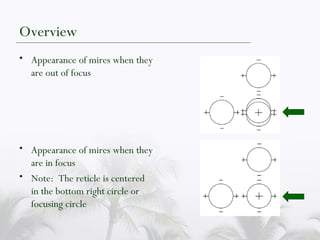
Overview Appearance of mires when they are out of focus Appearance of mires when they are in focus Note:  The reticle is centered in the bottom right circle or focusing circle
Astigmatism:  Horizontal Meridian Vertical misalignment of plus signs indicates astigmatism Correct axis alignment when the horizontal lines of the plus appear continuous Measuring the Horizontal meridian:  Turn the horizontal measuring drum to superimpose the plus signs Leave horizontal measuring drum in this position
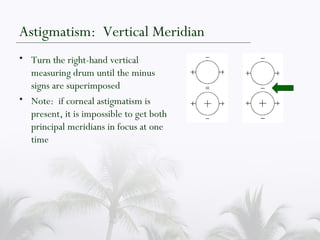
Astigmatism:  Vertical Meridian Turn the right-hand vertical measuring drum until the minus signs are superimposed Note:  if corneal astigmatism is present, it is impossible to get both principal meridians in focus at one time
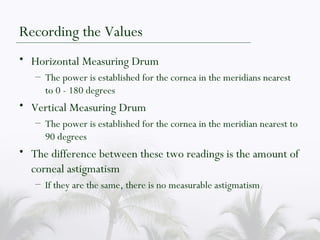
Recording the Values Horizontal Measuring Drum The power is established for the cornea in the meridians nearest to 0 - 180 degrees Vertical Measuring Drum The power is established for the cornea in the meridian nearest to 90 degrees The difference between these two readings is the amount of corneal astigmatism If they are the same, there is no measurable astigmatism
Javal-Schiötz Ophthalmometer
Popular Brands/Models Reichert MK1  www.reichert.com Bausch & Lomb www.storz.com Marco Keratometer I and II www.marco.com Topcon OM-B1 Ophthalmometer www.topconmedical.com Haag-Streit AG Javal-Schiötz Ophthalmometer www.haag-streit-usa.com
Thank You

Keratometer Slides

  • 1.
    Keratometer (Ophthalmometer)Review ‘ Keratometer is a trade name of Bausch & Lomb, Inc’
  • 2.
    Function Measures thecentral anterior curvature of the cornea (i.e., 3 to 3.2mm zone), detecting and measuring corneal astigmatism The measurement provides dioptric power of the steepest and flattest meridians, and defines its location A skilled operator can detect astigmatism, irregular astigmatism, oblique astigmatism, and keratoconus
  • 3.
    Types of AstigmatismSimple Astigmatism – One focal line falls on the retina (one meridian is emmetropic); the other meridian may fall in front or behind the retina Simple Myopic Astigmatism: Plano / -2.00 x 180 Simple Hyperopic Astigmatism: Plano / +2.00 x 180 Compound Astigmatism – Both focal points lie either in front or behind the retina Compound Myopic Astigmatism: -1.00 / -2.00 x 180 Compound Hyperopic Astigmatism: +2.00 / -1.00 x 180 Mixed Astigmatism – One focal point lies behind the retina, the other focal point lies in front of the retina Mixed Astigmatism: +1.00 / -2.00 x 180
  • 4.
    Types of AstigmatismIrregular astigmatism – the flat and steep axes are not at right angles Can be due to surgery, trauma, inflammation, scar tissue, or developmental anomalies Oblique astigmatism – occurs along the 45˚ or 135˚ meridians
  • 5.
    Astigmatism With theRule Astigmatism: the vertical meridian has the steepest curvature Minus axis at 180 (within 30 degrees) Plus axis at 090 (within 30 degrees) Against the Rule Astigmatism: the horizontal meridian has the steepest curvature Minus axis at 090 (within 30 degrees) Plus axis at 180 (within 30 degrees)
  • 6.
    Astigmatism The differencebetween the horizontal meridian and the vertical meridian constitutes the corneal astigmatism 45.25 @ 180 / 44.25 @ 090 = 1.00 diopter of cylinder Plus cylinder, the axis is the axis of the higher diopter power Minus cylinder, the axis is the axis of the lower diopter power 45.00 @ 180 / 46.50 @ 090 Difference is 1.50D Minus cylinder: -1.50 x 180 Plus cylinder: +1.50 x 090
  • 7.
    Recording Measurement ValuesA common practice is to record the horizontal reading first; however, some sites will record the flattest meridian followed by the steepest meridian and its axis 44.00 @ 160 / 42.75 @ 070 Or 42.75 @ 070 / 44.00 @ 160 (42.75 / 44.00 @ 160) Values can be expressed in diopters or millimeters of radius (e.g., Javal-Schiötz Ophthalmometer) Refer to handout for Diopter to Millimeter Conversion chart
  • 8.
    Manual vs. AutomatedManual keratometry is preferred in patients: With poor fixation Corneal abnormalities With distorted mires When the cornea is highly toric When the cornea is dry Corneal topography is preferred in patients with readings less than 40 diopters or greater than 46 diopters
  • 9.
    Manual vs. AutomatedSome physicians prefer corneal topography over manual keratometry in patients with keratoconus, and previous corneal surgery Corneal topography provides readings of nearly the entire anterior corneal surface For automated keratometry, the validation criteria is three measurements within 0.25D in each of the principal meridians
  • 10.
    Toric IOLs, Manualvs. Automated Toric Calculator Manual keratometry is recommended method Determines the axis and magnitude of corneal astigmatism Auto-K’s and Sim-K's can be off by 10˚ resulting in a 33% reduction in the effect of the toric IOL (www.doctor-hill.com) Automation may result in a greater number of under corrections due to angular errors (www.doctor-hill.com) Topography is used to verify no corneal abnormalities and astigmatism is regular IOL Master IOL Master K-readings and axial length are used to calculate IOL power Manual K-readings used for Toric Calculator
  • 11.
    Standard Keratometry ReadingsIn the average eye, keratometry readings are in the range of 43 to 44 diopters When comparing to the fellow eye, keratometry readings and corneal cylinder should be within 1 diopter Differences should be double checked Keratometry readings less than 40 and more than 47 diopters are unusual and should be double checked
  • 12.
    Keratoconus / RatingKeratoconus – a degenerative corneal disease resulting in a generalized thinning and cone-shaped protrusion of the central cornea, usually in both eyes Mild < 45 diopters in both meridians Moderate 45 – 52 diopters in both meridians Advanced > 52 diopters in both meridians Severe > 62 diopters in both meridians
  • 13.
    Common Mistakes andPointers The majority of errors are related to: Inadequate instrument calibration Incorrect examination technique Unfocused eyepiece (can lead to an error of up to 1 diopter in the K-reading) Distorted mires Off-axis measurements Corneal abnormalities Irregular contour or shape of cornea Inadequate or excessive tear film Ointment on the cornea Eyelid interference
  • 14.
    Common Mistakes andPointers Inadequate patient fixation and/or cooperation Examiner has uncorrected refractive error resulting in fluctuating accommodation Pointer: Keratometry should be performed prior to tonometry, pachymetry, and biometry or any other applanation testing
  • 15.
    Calibration Verify orproperly focus eyepiece Obtain and verify readings from several steel spheres of differing radii of curvature Routine measurement of a bench-mark eye to verify accuracy (e.g., one individual in office with little or no corneal refractive error)
  • 16.
  • 17.
    Overview Appearance ofmires when they are out of focus Appearance of mires when they are in focus Note: The reticle is centered in the bottom right circle or focusing circle
  • 18.
    Astigmatism: HorizontalMeridian Vertical misalignment of plus signs indicates astigmatism Correct axis alignment when the horizontal lines of the plus appear continuous Measuring the Horizontal meridian: Turn the horizontal measuring drum to superimpose the plus signs Leave horizontal measuring drum in this position
  • 19.
    Astigmatism: VerticalMeridian Turn the right-hand vertical measuring drum until the minus signs are superimposed Note: if corneal astigmatism is present, it is impossible to get both principal meridians in focus at one time
  • 20.
    Recording the ValuesHorizontal Measuring Drum The power is established for the cornea in the meridians nearest to 0 - 180 degrees Vertical Measuring Drum The power is established for the cornea in the meridian nearest to 90 degrees The difference between these two readings is the amount of corneal astigmatism If they are the same, there is no measurable astigmatism
  • 21.
  • 22.
    Popular Brands/Models ReichertMK1 www.reichert.com Bausch & Lomb www.storz.com Marco Keratometer I and II www.marco.com Topcon OM-B1 Ophthalmometer www.topconmedical.com Haag-Streit AG Javal-Schiötz Ophthalmometer www.haag-streit-usa.com
  • 23.