Faraz and his group
Faraz Ali Bhutto
Ali Raza Malik
Mehran khan
Touqeer jakrani
Muzamil Hussain
Topic:-
Pakistan movement from 1940
to 1947
Pakistan Movement 1940-1947
 Pakistan Resolution 1940
 Cripps Proposal 1942
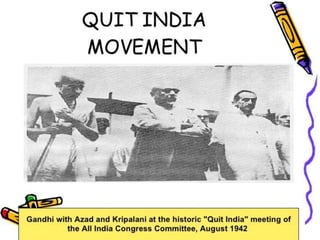
 Quit India Movement 1944
 Gandhi-Jinnah Talks 1944
 Wavell Plan 1945
 Simla conference 1945
 Elections 1045-46
 Cabinet Mission 1946
 3rd June Plan 1947
 Radcliffe Award 1947
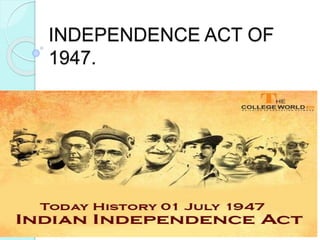
 Independence Act of 1947
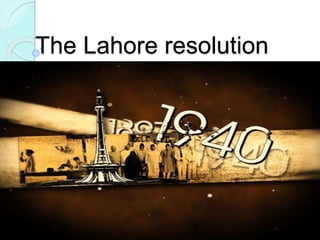
The Lahore resolution
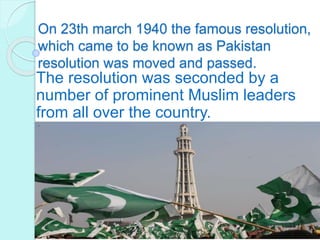
On 23th march 1940 the famous resolution,
which came to be known as Pakistan
resolution was moved and passed.
The resolution was seconded by a
number of prominent Muslim leaders
from all over the country.
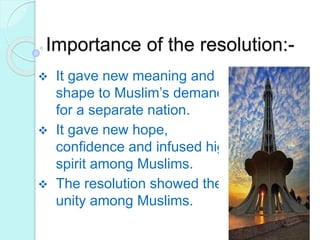
Importance of the resolution:-
 It gave new meaning and
shape to Muslim’s demand
for a separate nation.
 It gave new hope,
confidence and infused high
spirit among Muslims.
 The resolution showed the
unity among Muslims.
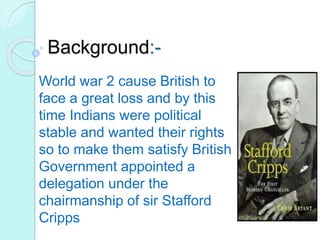
Background:-
World war 2 cause British to
face a great loss and by this
time Indians were political
stable and wanted their rights
so to make them satisfy British
Government appointed a
delegation under the
chairmanship of sir Stafford
Cripps
The Cripps mission reached new Delhi on
23th march 1942 to hold talks with Indian
leaders but the mission could not hold
talks with Indian leaders however it
submitted its own suggestion to the
government in April 1942
1-DOMINION STATUS shall be granted
after the war.
2-VICEROY’S EXECUTIVE COUNCIL
be expanded.
3-An Indian body to be set up to
frame a new CONSTITUTION.
4-British provinces and princely

states shall be free to refuse to join
the Indian union and frame their
own constitution.
5-Till end of the war, England to
retain defence of India.
Suggestions of Cripps mission
 Any province or state should be free
either to adhere or not o adhere to the
new constitution
 The government of Indian act 1935 shall
be remain in force until the cessation of
war
 The suggestion are to be accepted or
rejected as a whole
RESULT:-
 Congress rejected the proporsals and said it
(A POST-DATED CHEQUE ON A FAILING
BANK).
oThe all India Muslim League rejected
these proposals as no separate
homeland for the Indian
Muslims was mentioned.
Introduction:-
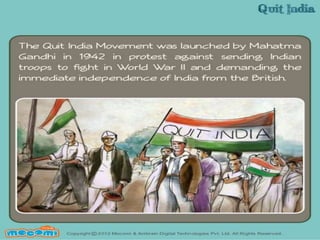
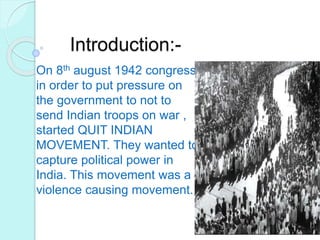
On 8th august 1942 congress
in order to put pressure on
the government to not to
send Indian troops on war ,
started QUIT INDIAN
MOVEMENT. They wanted to
capture political power in
India. This movement was a
violence causing movement.
RESULT:-
• QUAID-E-AZAM considered it as
anti-Muslim action
• Government took strict action against
Quit India Movement and arrested
prominent leaders of congress
including MahatmaGandhi.
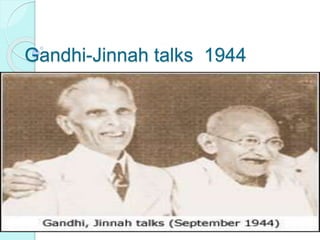
Gandhi-Jinnah talks 1944
After realsing from jail Gandhi
wrote a letter to Quaid-e-Azam
on 17th July 1944 and asked him
for meeting
Gandhi-Jinnah talks
Gandhi-Jinnah talks began on 19th sep to
24th sep,in Bombay.
Gandhi held those talks to convince
Jinnah to take hands from demand of a
independent nation but Quaid-e-Azam
remained firm and was not agree to the
proposal and talks ended.
Wavell plan-1945
Wavell Plan – June 1945
In June 1945 the Indian Viceroy Lord
Wavell held conference at Simla and proposed
following proposals to Congress and Muslim
leaders:-
 An Interim Central Govt in which all
portfolios except that of War would be
given to the Indians.
 There was to be a parity of representation
between the Muslims and Caste Hindus.
There was a dead lock over the Muslim
Leagues demand that all five members of
the Executive Council should be the
nominees of Muslim Leagues.
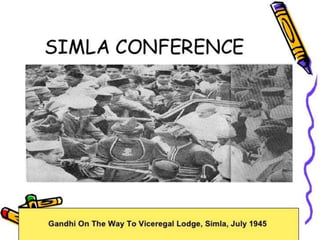
Simla conference
On 24th June 1945 lord Wavell
convened conference of Indian
political leaders at Simla that
lasted to July 1945.To solve the
problem of representation of
Muslim seats in Executive council.
Muslim Reaction:-
The quaid-e-eazam took a strong
stand and demanded that general
elections should held in the country
to prove that WHO IS SOLE
REPRESENTATIVE OF WHICH
COMMUNITY.
Elections 1945-46
Elections:-
The general elections to the
provincial and legislatures were
held in India in 1945-46.the result
of elections showed decisive
victory for Pakistan.
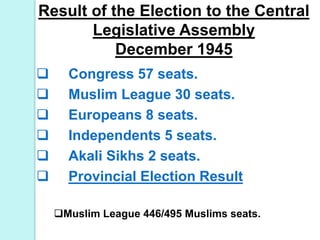
Result of the Election to the Central
Legislative Assembly
December 1945
 Congress 57 seats.
 Muslim League 30 seats.
 Europeans 8 seats.
 Independents 5 seats.
 Akali Sikhs 2 seats.
 Provincial Election Result
Muslim League 446/495 Muslims seats.
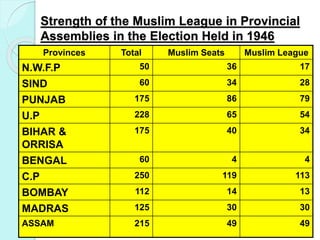
Strength of the Muslim League in Provincial
Assemblies in the Election Held in 1946
Provinces Total Muslim Seats Muslim League
N.W.F.P 50 36 17
SIND 60 34 28
PUNJAB 175 86 79
U.P 228 65 54
BIHAR &
ORRISA
175 40 34
BENGAL 60 4 4
C.P 250 119 113
BOMBAY 112 14 13
MADRAS 125 30 30
ASSAM 215 49 49
Cabinet Mission Plan - 1946
Salient features of Cabinet Mission Plan were
as under:-
 There would be a Union of India, comprising
British India and the Indian states, which
should control Foreign affairs, Defence and
Communication.
 The Union would have an Executive and
Legislature.
 All residuary powers would belong to the
provinces.
 Provinces would be free to form groups with
executives and legislatures.
Cabinet Mission Plan - 1946
 There should be three groups of provinces:-
 Group A. Madras; Bombay, UP, Bihar,
CP and Orissa.
 Group B. Punjab, NWFP, Sindh and
Balochistan.
 Group C. Bengal and Assam.
 The Mission announced to frame an “Interim
Govt” comprising representative from both
congress and Muslim League.
JUNE 3 PLAN
Finally it was decided that two
independent nations should be
made, for that lord mountbatten
went england to seek the approval
of the British government.the plan
was issued on 3rd june 1947.
Partition Plan 3rd June, 1947
The main characters of plan were:-
 The legislatures of Punjab and Bengal shall
decide whether the provinces should be divided
or not.
 States should be free and independent to join
one or the other country.
 A boundary commission shall be setup
which will demarcate the boundaries of the
countries.
 Both countries shall have their own Governor
Generals who will be the executive head of their
respective countries.
 Military assets shall be divided amongst two
countries after partition.
Radcliffe award
 Division of Bengal and Calcutta
 Division of Punjab
INDEPENDENCE ACT OF
1947.
Indian Independence Act 1947
On 14 July 1947, the Indian
Independence bill was moved in the British
Parliament which became an act on 18 July
1947. According to this act:-
 India was to be divided into two
sovereign states of Pakistan and India
and the British control over India
would come to an end on 15th August
1947.
 The princely states were given the
option to join one or the other country.
 The act of 1935 was to remain in force
until both countries draft their own
constitutions.
Pakistan Movement

Pakistan Movement

  • 2.
    Faraz and hisgroup Faraz Ali Bhutto Ali Raza Malik Mehran khan Touqeer jakrani Muzamil Hussain
  • 3.
  • 4.
    Pakistan Movement 1940-1947 Pakistan Resolution 1940  Cripps Proposal 1942  Quit India Movement 1944  Gandhi-Jinnah Talks 1944  Wavell Plan 1945  Simla conference 1945  Elections 1045-46  Cabinet Mission 1946  3rd June Plan 1947  Radcliffe Award 1947  Independence Act of 1947
  • 5.
  • 6.
    On 23th march1940 the famous resolution, which came to be known as Pakistan resolution was moved and passed. The resolution was seconded by a number of prominent Muslim leaders from all over the country.
  • 7.
    Importance of theresolution:-  It gave new meaning and shape to Muslim’s demand for a separate nation.  It gave new hope, confidence and infused high spirit among Muslims.  The resolution showed the unity among Muslims.
  • 10.
    Background:- World war 2cause British to face a great loss and by this time Indians were political stable and wanted their rights so to make them satisfy British Government appointed a delegation under the chairmanship of sir Stafford Cripps
  • 11.
    The Cripps missionreached new Delhi on 23th march 1942 to hold talks with Indian leaders but the mission could not hold talks with Indian leaders however it submitted its own suggestion to the government in April 1942
  • 12.
    1-DOMINION STATUS shallbe granted after the war. 2-VICEROY’S EXECUTIVE COUNCIL be expanded. 3-An Indian body to be set up to frame a new CONSTITUTION. 4-British provinces and princely states shall be free to refuse to join the Indian union and frame their own constitution. 5-Till end of the war, England to retain defence of India.
  • 13.
    Suggestions of Crippsmission  Any province or state should be free either to adhere or not o adhere to the new constitution  The government of Indian act 1935 shall be remain in force until the cessation of war  The suggestion are to be accepted or rejected as a whole
  • 14.
    RESULT:-  Congress rejectedthe proporsals and said it (A POST-DATED CHEQUE ON A FAILING BANK). oThe all India Muslim League rejected these proposals as no separate homeland for the Indian Muslims was mentioned.
  • 17.
    Introduction:- On 8th august1942 congress in order to put pressure on the government to not to send Indian troops on war , started QUIT INDIAN MOVEMENT. They wanted to capture political power in India. This movement was a violence causing movement.
  • 18.
    RESULT:- • QUAID-E-AZAM consideredit as anti-Muslim action • Government took strict action against Quit India Movement and arrested prominent leaders of congress including MahatmaGandhi.
  • 19.
  • 20.
    After realsing fromjail Gandhi wrote a letter to Quaid-e-Azam on 17th July 1944 and asked him for meeting Gandhi-Jinnah talks
  • 21.
    Gandhi-Jinnah talks beganon 19th sep to 24th sep,in Bombay. Gandhi held those talks to convince Jinnah to take hands from demand of a independent nation but Quaid-e-Azam remained firm and was not agree to the proposal and talks ended.
  • 22.
  • 23.
    Wavell Plan –June 1945 In June 1945 the Indian Viceroy Lord Wavell held conference at Simla and proposed following proposals to Congress and Muslim leaders:-  An Interim Central Govt in which all portfolios except that of War would be given to the Indians.  There was to be a parity of representation between the Muslims and Caste Hindus. There was a dead lock over the Muslim Leagues demand that all five members of the Executive Council should be the nominees of Muslim Leagues.
  • 25.
    Simla conference On 24thJune 1945 lord Wavell convened conference of Indian political leaders at Simla that lasted to July 1945.To solve the problem of representation of Muslim seats in Executive council.
  • 26.
    Muslim Reaction:- The quaid-e-eazamtook a strong stand and demanded that general elections should held in the country to prove that WHO IS SOLE REPRESENTATIVE OF WHICH COMMUNITY.
  • 27.
  • 28.
    Elections:- The general electionsto the provincial and legislatures were held in India in 1945-46.the result of elections showed decisive victory for Pakistan.
  • 29.
    Result of theElection to the Central Legislative Assembly December 1945  Congress 57 seats.  Muslim League 30 seats.  Europeans 8 seats.  Independents 5 seats.  Akali Sikhs 2 seats.  Provincial Election Result Muslim League 446/495 Muslims seats.
  • 30.
    Strength of theMuslim League in Provincial Assemblies in the Election Held in 1946 Provinces Total Muslim Seats Muslim League N.W.F.P 50 36 17 SIND 60 34 28 PUNJAB 175 86 79 U.P 228 65 54 BIHAR & ORRISA 175 40 34 BENGAL 60 4 4 C.P 250 119 113 BOMBAY 112 14 13 MADRAS 125 30 30 ASSAM 215 49 49
  • 31.
    Cabinet Mission Plan- 1946 Salient features of Cabinet Mission Plan were as under:-  There would be a Union of India, comprising British India and the Indian states, which should control Foreign affairs, Defence and Communication.  The Union would have an Executive and Legislature.  All residuary powers would belong to the provinces.  Provinces would be free to form groups with executives and legislatures.
  • 32.
    Cabinet Mission Plan- 1946  There should be three groups of provinces:-  Group A. Madras; Bombay, UP, Bihar, CP and Orissa.  Group B. Punjab, NWFP, Sindh and Balochistan.  Group C. Bengal and Assam.  The Mission announced to frame an “Interim Govt” comprising representative from both congress and Muslim League.
  • 33.
    JUNE 3 PLAN Finallyit was decided that two independent nations should be made, for that lord mountbatten went england to seek the approval of the British government.the plan was issued on 3rd june 1947.
  • 34.
    Partition Plan 3rdJune, 1947 The main characters of plan were:-  The legislatures of Punjab and Bengal shall decide whether the provinces should be divided or not.  States should be free and independent to join one or the other country.  A boundary commission shall be setup which will demarcate the boundaries of the countries.  Both countries shall have their own Governor Generals who will be the executive head of their respective countries.  Military assets shall be divided amongst two countries after partition.
  • 35.
    Radcliffe award  Divisionof Bengal and Calcutta  Division of Punjab
  • 36.
  • 37.
    Indian Independence Act1947 On 14 July 1947, the Indian Independence bill was moved in the British Parliament which became an act on 18 July 1947. According to this act:-  India was to be divided into two sovereign states of Pakistan and India and the British control over India would come to an end on 15th August 1947.  The princely states were given the option to join one or the other country.  The act of 1935 was to remain in force until both countries draft their own constitutions.