Govt of India Act
1935
Abdul Azim Akhtar
Factors
• Civil Disobedience Movement; Non Cooperation
Khilafat Movement; Swaraj Party; Nationalist
Party ( 1926); A demand for revision of Govt of
India Act of 1919; Alexander Muddiman
Committee; Simon Commission; Nehru Report;
Round Table Conference I, II, III; Ramsay
McDonald announced Communal Award-
recognition of Dalits as separate group like
Muslim, Sikh & Christians, separate electorate
given to them.; Poona Pact (148 seats reserved)
Abdul Azim Akhtar
• Separate Electorate- Community / Group will
elect leader separately in which the only the
candidates of the community will contest, &
members of the community will vote
• ‘In the establishment of separate electorates at
all for the ‘depressed classes,’ I sense the
injection of poison that is calculated to destroy
Hinduism’- M K Gandhi
‘My nationalism and my religion are not exclusive,
but inclusive and they must be so consistently
with the welfare of the people’ –M K Gandhi
Abdul Azim Akhtar
• ‘There was nothing noble in the fast. It ws a foul
and filthy act. The fast was not for the benefit of
the untouchables. It was against them and was
the worst form of coercion against a helpless
people to give up the constitutional safeguards
(which had been awarded).’ B R Ambedkar-What
Congress and Gandhi have done to the
Untouchables.
• White Paper – Govt issued a white paper in
March 1935; 2nd August 1935 received royal
assent as Govt of India Act
Abdul Azim Akhtar
Act
• 1- All India Federation Formed; all provinces
were to join immediately & sign An
Instrument of Accession in favour of the
Crown
• Indian states to send 125 members to the
Federal Assembly; 104 to Council of State;
Provinces to send 250 members to the Federal
Assembly & 156 members to Council of State
Abdul Azim Akhtar
• Members from States to be nominated by
rulers; Provinces to elect members on
commercial lines
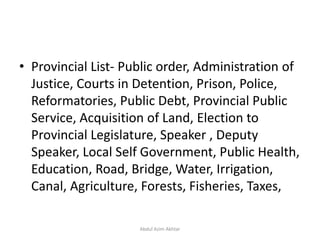
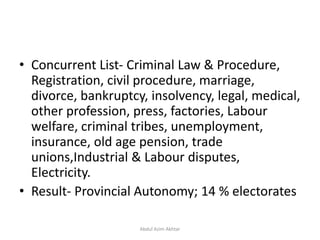
• Three Lists provided- Federal List, Provincial
List, Concurrent List
• Dyrchy at Centre- Governor general given
certain federal subjects to govern with
assistance of 3 Councillors; Others would be
governed with the help of Council of Ministers
Abdul Azim Akhtar
• Bicameral Federal Legislature- Federal
Assembly(5 yrs, elected indirectly) & Council
of State (permanent body, 1/3rd members to
retire every three years, elected directly)
• Indian Legislature could not make law on
sovereign, royal family, armed forces;
Governor-General could call joint session of
the Federal Legislature
Abdul Azim Akhtar
• Federal Court with jurisdiction over states &
provinces to be created; 1 CJ & not more than
6 judges; Original & appellate power; Pleader
for 10 yrs, ex-Judge high court 5 yrs
experience
• Indian council of Secy of State abolished
• Provision of Electoral safeguards
• British Govt had the authority to amend the
1935 Act
Abdul Azim Akhtar
• Provincial Autonomy
• Governor General was the Head of the
Constitution of India
• Governor to be appointed by the King on the
advice of the Ministers
• Provincial governors were given more power
and became head of respective government;
they did not have autonomy
Abdul Azim Akhtar
• No Provincial Legislature of Uniform pattern
• Size of the Provincial Assembly varied from
state to state
• Legislative Council were provided in six
provinces; permanent body; tenure 9 yrs,
1/3rd to retire every three years
• Provincial Legislature can make law for
provincial & concurrent list subjects
Abdul Azim Akhtar
• Provincial List- Public order, Administration of
Justice, Courts in Detention, Prison, Police,
Reformatories, Public Debt, Provincial Public
Service, Acquisition of Land, Election to
Provincial Legislature, Speaker , Deputy
Speaker, Local Self Government, Public Health,
Education, Road, Bridge, Water, Irrigation,
Canal, Agriculture, Forests, Fisheries, Taxes,
Abdul Azim Akhtar
• Concurrent List- Criminal Law & Procedure,
Registration, civil procedure, marriage,
divorce, bankruptcy, insolvency, legal, medical,
other profession, press, factories, Labour
welfare, criminal tribes, unemployment,
insurance, old age pension, trade
unions,Industrial & Labour disputes,
Electricity.
• Result- Provincial Autonomy; 14 % electorates
Abdul Azim Akhtar