Amendments
in
acts
1. Contract Labour Act , 1970
2. Industrial Disputes Act, 1947
3. Factories Act, 1948
contents
1. Contract Labour Act , 1970
2. Industrial Disputes Act, 1947
3. Factories Act, 1948
contents
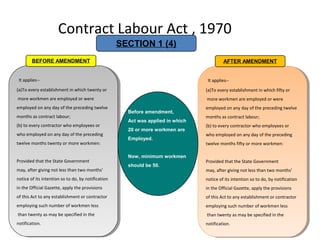
Contract Labour Act , 1970
SECTION 1 (4)
It applies--
(a)To every establishment in which twenty or
more workmen are employed or were
employed on any day of the preceding twelve
months as contract labour;
(b) to every contractor who employees or
who employed on any day of the preceding
twelve months twenty or more workmen:
Provided that the State Government
may, after giving not less than two months'
notice of its intention so to do, by notification
in the Official Gazette, apply the provisions
of this Act to any establishment or contractor
employing such number of workmen less
than twenty as may be specified in the
notification.
It applies--
(a)To every establishment in which twenty or
more workmen are employed or were
employed on any day of the preceding twelve
months as contract labour;
(b) to every contractor who employees or
who employed on any day of the preceding
twelve months twenty or more workmen:
Provided that the State Government
may, after giving not less than two months'
notice of its intention so to do, by notification
in the Official Gazette, apply the provisions
of this Act to any establishment or contractor
employing such number of workmen less
than twenty as may be specified in the
notification.
BEFORE AMENDMENT
It applies--
(a)To every establishment in which fifty or
more workmen are employed or were
employed on any day of the preceding twelve
months as contract labour;
(b) to every contractor who employees or
who employed on any day of the preceding
twelve months fifty or more workmen:
Provided that the State Government
may, after giving not less than two months'
notice of its intention so to do, by notification
in the Official Gazette, apply the provisions
of this Act to any establishment or contractor
employing such number of workmen less
than twenty as may be specified in the
notification.
It applies--
(a)To every establishment in which fifty or
more workmen are employed or were
employed on any day of the preceding twelve
months as contract labour;
(b) to every contractor who employees or
who employed on any day of the preceding
twelve months fifty or more workmen:
Provided that the State Government
may, after giving not less than two months'
notice of its intention so to do, by notification
in the Official Gazette, apply the provisions
of this Act to any establishment or contractor
employing such number of workmen less
than twenty as may be specified in the
notification.
AFTER AMENDMENT
Before amendment,
Act was applied in which
20 or more workmen are
Employed.
Now, minimum workmen
should be 50.
1. Contract Labour Act , 1970
2. Industrial Disputes Act, 1947
3. Factories Act, 1948
contents
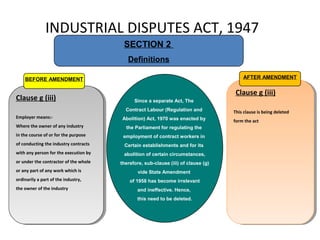
INDUSTRIAL DISPUTES ACT, 1947
SECTION 2
Definitions
Clause g (iii)
Employer means:-
Where the owner of any industry
in the course of or for the purpose
of conducting the industry contracts
with any person for the execution by
or under the contractor of the whole
or any part of any work which is
ordinarily a part of the industry,
the owner of the industry
Clause g (iii)
Employer means:-
Where the owner of any industry
in the course of or for the purpose
of conducting the industry contracts
with any person for the execution by
or under the contractor of the whole
or any part of any work which is
ordinarily a part of the industry,
the owner of the industry
BEFORE AMENDMENT
Clause g (iii)
This clause is being deleted
form the act
Clause g (iii)
This clause is being deleted
form the act
AFTER AMENDMENT
Since a separate Act, The
Contract Labour (Regulation and
Abolition) Act, 1970 was enacted by
the Parliament for regulating the
employment of contract workers in
Certain establishments and for its
abolition of certain circumstances,
therefore, sub-clause (iii) of clause (g)
vide State Amendment
of 1958 has become irrelevant
and ineffective. Hence,
this need to be deleted.
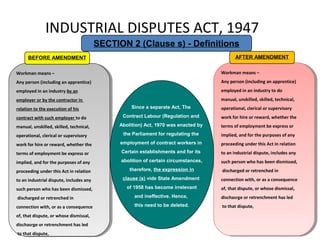
INDUSTRIAL DISPUTES ACT, 1947
SECTION 2 (Clause s) - Definitions
Workman means –
Any person (including an apprentice)
employed in an industry by an
employer or by the contractor in
relation to the execution of his
contract with such employer to do
manual, unskilled, skilled, technical,
operational, clerical or supervisory
work for hire or reward, whether the
terms of employment be express or
implied, and for the purposes of any
proceeding under this Act in relation
to an industrial dispute, includes any
such person who has been dismissed,
discharged or retrenched in
connection with, or as a consequence
of, that dispute, or whose dismissal,
dischasrge or retrenchment has led
to that dispute,
Workman means –
Any person (including an apprentice)
employed in an industry by an
employer or by the contractor in
relation to the execution of his
contract with such employer to do
manual, unskilled, skilled, technical,
operational, clerical or supervisory
work for hire or reward, whether the
terms of employment be express or
implied, and for the purposes of any
proceeding under this Act in relation
to an industrial dispute, includes any
such person who has been dismissed,
discharged or retrenched in
connection with, or as a consequence
of, that dispute, or whose dismissal,
dischasrge or retrenchment has led
to that dispute,
BEFORE AMENDMENT
Workman means –
Any person (including an apprentice)
employed in an industry to do
manual, unskilled, skilled, technical,
operational, clerical or supervisory
work for hire or reward, whether the
terms of employment be express or
implied, and for the purposes of any
proceeding under this Act in relation
to an industrial dispute, includes any
such person who has been dismissed,
discharged or retrenched in
connection with, or as a consequence
of, that dispute, or whose dismissal,
dischasrge or retrenchment has led
to that dispute,
Workman means –
Any person (including an apprentice)
employed in an industry to do
manual, unskilled, skilled, technical,
operational, clerical or supervisory
work for hire or reward, whether the
terms of employment be express or
implied, and for the purposes of any
proceeding under this Act in relation
to an industrial dispute, includes any
such person who has been dismissed,
discharged or retrenched in
connection with, or as a consequence
of, that dispute, or whose dismissal,
dischasrge or retrenchment has led
to that dispute,
AFTER AMENDMENT
Since a separate Act, The
Contract Labour (Regulation and
Abolition) Act, 1970 was enacted by
the Parliament for regulating the
employment of contract workers in
Certain establishments and for its
abolition of certain circumstances,
therefore, the expression in
clause (s) vide State Amendment
of 1958 has become irrelevant
and ineffective. Hence,
this need to be deleted.
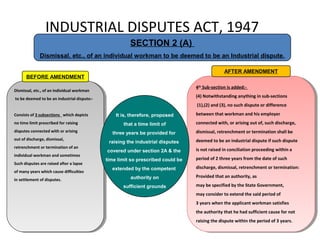
INDUSTRIAL DISPUTES ACT, 1947
SECTION 2 (A)
Dismissal, etc., of an individual workman to be deemed to be an Industrial dispute.
Dismissal, etc., of an individual workman
to be deemed to be an industrial dispute:-
Consists of 3 subsections which depicts
no time limit prescribed for raising
disputes connected with or arising
out of discharge, dismissal,
retrenchment or termination of an
individual workman and sometimes
Such disputes are raised after a lapse
of many years which cause difficulties
in settlement of disputes.
Dismissal, etc., of an individual workman
to be deemed to be an industrial dispute:-
Consists of 3 subsections which depicts
no time limit prescribed for raising
disputes connected with or arising
out of discharge, dismissal,
retrenchment or termination of an
individual workman and sometimes
Such disputes are raised after a lapse
of many years which cause difficulties
in settlement of disputes.
BEFORE AMENDMENT
4th
Sub-section is added:-
(4) Notwithstanding anything in sub-sections
(1),(2) and (3), no such dispute or difference
between that workman and his employer
connected with, or arising out of, such discharge,
dismissal, retrenchment or termination shall be
deemed to be an industrial dispute if such dispute
is not raised in conciliation proceeding within a
period of 2 three years from the date of such
discharge, dismissal, retrenchment or termination:
Provided that an authority, as
may be specified by the State Government,
may consider to extend the said period of
3 years when the applicant workman satisfies
the authority that he had sufficient cause for not
raising the dispute within the period of 3 years.
4th
Sub-section is added:-
(4) Notwithstanding anything in sub-sections
(1),(2) and (3), no such dispute or difference
between that workman and his employer
connected with, or arising out of, such discharge,
dismissal, retrenchment or termination shall be
deemed to be an industrial dispute if such dispute
is not raised in conciliation proceeding within a
period of 2 three years from the date of such
discharge, dismissal, retrenchment or termination:
Provided that an authority, as
may be specified by the State Government,
may consider to extend the said period of
3 years when the applicant workman satisfies
the authority that he had sufficient cause for not
raising the dispute within the period of 3 years.
AFTER AMENDMENT
It is, therefore, proposed
that a time limit of
three years be provided for
raising the industrial disputes
covered under section 2A & the
time limit so prescribed could be
extended by the competent
authority on
sufficient grounds
INDUSTRIAL DISPUTES ACT, 1947
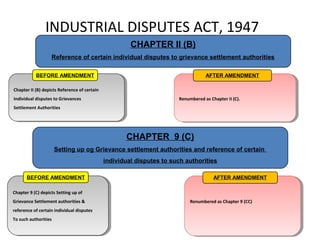
CHAPTER II (B)
Reference of certain individual disputes to grievance settlement authorities
Chapter II (B) depicts Reference of certain
Individual disputes to Grievances
Settlement Authorities
Chapter II (B) depicts Reference of certain
Individual disputes to Grievances
Settlement Authorities
BEFORE AMENDMENT
Renumbered as Chapter II (C).Renumbered as Chapter II (C).
AFTER AMENDMENT
Chapter 9 (C) depicts Setting up of
Grievance Settlement authorities &
reference of certain individual disputes
To such authorities
Chapter 9 (C) depicts Setting up of
Grievance Settlement authorities &
reference of certain individual disputes
To such authorities
BEFORE AMENDMENT
Renumbered as Chapter 9 (CC)Renumbered as Chapter 9 (CC)
AFTER AMENDMENT
CHAPTER 9 (C)
Setting up og Grievance settlement authorities and reference of certain
individual disputes to such authorities
INDUSTRIAL DISPUTES ACT, 1947
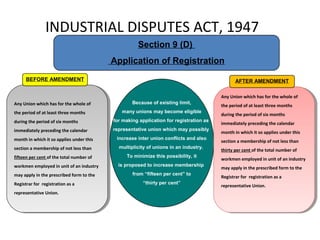
Because of existing limit,
many unions may become eligible
for making application for registration as
representative union which may possibly
increase inter union conflicts and also
multiplicity of unions in an industry.
To minimize this possibility, it
is proposed to increase membership
from “fifteen per cent” to
“thirty per cent”
Section 9 (D)
Application of Registration
Any Union which has for the whole of
the period of at least three months
during the period of six months
immediately preceding the calendar
month in which it so applies under this
section a membership of not less than
fifteen per cent of the total number of
workmen employed in unit of an industry
may apply in the prescribed form to the
Registrar for registration as a
representative Union.
Any Union which has for the whole of
the period of at least three months
during the period of six months
immediately preceding the calendar
month in which it so applies under this
section a membership of not less than
fifteen per cent of the total number of
workmen employed in unit of an industry
may apply in the prescribed form to the
Registrar for registration as a
representative Union.
BEFORE AMENDMENT
Any Union which has for the whole of
the period of at least three months
during the period of six months
immediately preceding the calendar
month in which it so applies under this
section a membership of not less than
thirty per cent of the total number of
workmen employed in unit of an industry
may apply in the prescribed form to the
Registrar for registration as a
representative Union.
Any Union which has for the whole of
the period of at least three months
during the period of six months
immediately preceding the calendar
month in which it so applies under this
section a membership of not less than
thirty per cent of the total number of
workmen employed in unit of an industry
may apply in the prescribed form to the
Registrar for registration as a
representative Union.
AFTER AMENDMENT
INDUSTRIAL DISPUTES ACT, 1947
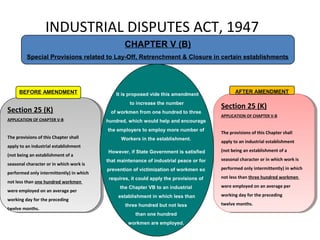
CHAPTER V (B)
Special Provisions related to Lay-Off, Retrenchment & Closure in certain establishments
Section 25 (K)
APPLICATION OF CHAPTER V-B
The provisions of this Chapter shall
apply to an industrial establishment
(not being an establishment of a
seasonal character or in which work is
performed only intermittently) in which
not less than one hundred workmen
were employed on an average per
working day for the preceding
twelve months.
Section 25 (K)
APPLICATION OF CHAPTER V-B
The provisions of this Chapter shall
apply to an industrial establishment
(not being an establishment of a
seasonal character or in which work is
performed only intermittently) in which
not less than one hundred workmen
were employed on an average per
working day for the preceding
twelve months.
BEFORE AMENDMENT
Section 25 (K)
APPLICATION OF CHAPTER V-B
The provisions of this Chapter shall
apply to an industrial establishment
(not being an establishment of a
seasonal character or in which work is
performed only intermittently) in which
not less than three hundred workmen
were employed on an average per
working day for the preceding
twelve months.
Section 25 (K)
APPLICATION OF CHAPTER V-B
The provisions of this Chapter shall
apply to an industrial establishment
(not being an establishment of a
seasonal character or in which work is
performed only intermittently) in which
not less than three hundred workmen
were employed on an average per
working day for the preceding
twelve months.
AFTER AMENDMENTIt is proposed vide this amendment
to increase the number
of workmen from one hundred to three
hundred, which would help and encourage
the employers to employ more number of
Workers in the establishment.
However, if State Government is satisfied
that maintenance of industrial peace or for
prevention of victimization of workmen so
requires, it could apply the provisions of
the Chapter VB to an industrial
establishment in which less than
three hundred but not less
than one hundred
workmen are employed.
INDUSTRIAL DISPUTES ACT, 1947
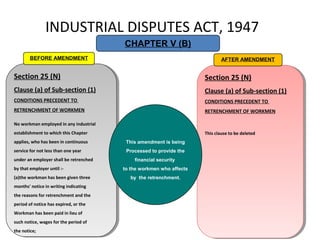
Section 25 (N)
Clause (a) of Sub-section (1)
CONDITIONS PRECEDENT TO
RETRENCHMENT OF WORKMEN
No workman employed in any industrial
establishment to which this Chapter
applies, who has been in continuous
service for not less than one year
under an employer shall be retrenched
by that employer until :-
(a)the workman has been given three
months' notice in writing indicating
the reasons for retrenchment and the
period of notice has expired, or the
Workman has been paid in lieu of
such notice, wages for the period of
the notice;
Section 25 (N)
Clause (a) of Sub-section (1)
CONDITIONS PRECEDENT TO
RETRENCHMENT OF WORKMEN
No workman employed in any industrial
establishment to which this Chapter
applies, who has been in continuous
service for not less than one year
under an employer shall be retrenched
by that employer until :-
(a)the workman has been given three
months' notice in writing indicating
the reasons for retrenchment and the
period of notice has expired, or the
Workman has been paid in lieu of
such notice, wages for the period of
the notice;
BEFORE AMENDMENT
Section 25 (N)
Clause (a) of Sub-section (1)
CONDITIONS PRECEDENT TO
RETRENCHMENT OF WORKMEN
This clause to be deleted
Section 25 (N)
Clause (a) of Sub-section (1)
CONDITIONS PRECEDENT TO
RETRENCHMENT OF WORKMEN
This clause to be deleted
AFTER AMENDMENT
This amendment is being
Processed to provide the
financial security
to the workmen who affects
by the retrenchment.
CHAPTER V (B)
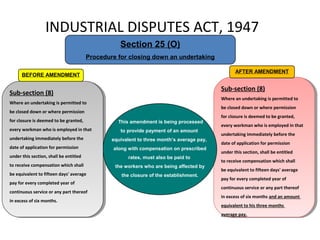
INDUSTRIAL DISPUTES ACT, 1947
Section 25 (O)
Procedure for closing down an undertaking
Sub-section (8)
Where an undertaking is permitted to
be closed down or where permission
for closure is deemed to be granted,
every workman who is employed in that
undertaking immediately before the
date of application for permission
under this section, shall be entitled
to receive compensation which shall
be equivalent to fifteen days' average
pay for every completed year of
continuous service or any part thereof
in excess of six months.
Sub-section (8)
Where an undertaking is permitted to
be closed down or where permission
for closure is deemed to be granted,
every workman who is employed in that
undertaking immediately before the
date of application for permission
under this section, shall be entitled
to receive compensation which shall
be equivalent to fifteen days' average
pay for every completed year of
continuous service or any part thereof
in excess of six months.
BEFORE AMENDMENT
Sub-section (8)
Where an undertaking is permitted to
be closed down or where permission
for closure is deemed to be granted,
every workman who is employed in that
undertaking immediately before the
date of application for permission
under this section, shall be entitled
to receive compensation which shall
be equivalent to fifteen days' average
pay for every completed year of
continuous service or any part thereof
in excess of six months and an amount
equivalent to his three months
average pay.
Sub-section (8)
Where an undertaking is permitted to
be closed down or where permission
for closure is deemed to be granted,
every workman who is employed in that
undertaking immediately before the
date of application for permission
under this section, shall be entitled
to receive compensation which shall
be equivalent to fifteen days' average
pay for every completed year of
continuous service or any part thereof
in excess of six months and an amount
equivalent to his three months
average pay.
AFTER AMENDMENT
This amendment is being processed
to provide payment of an amount
equivalent to three month’s average pay,
along with compensation on prescribed
rates, must also be paid to
the workers who are being affected by
the closure of the establishment.
INDUSTRIAL DISPUTES ACT, 1947
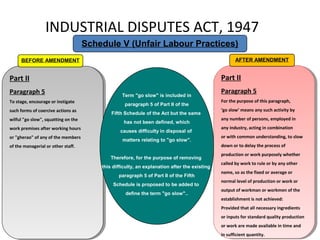
Schedule V (Unfair Labour Practices)
Part II
Paragraph 5
To stage, encourage or instigate
such forms of coercive actions as
wilful "go slow", squatting on the
work premises after working hours
or "gherao" of any of the members
of the managerial or other staff.
Part II
Paragraph 5
To stage, encourage or instigate
such forms of coercive actions as
wilful "go slow", squatting on the
work premises after working hours
or "gherao" of any of the members
of the managerial or other staff.
BEFORE AMENDMENT
Part II
Paragraph 5
For the purpose of this paragraph,
‘go slow’ means any such activity by
any number of persons, employed in
any industry, acting in combination
or with common understanding, to slow
down or to delay the process of
production or work purposely whether
called by work to rule or by any other
name, so as the fixed or average or
normal level of production or work or
output of workman or workmen of the
establishment is not achieved:
Provided that all necessary ingredients
or inputs for standard quality production
or work are made available in time and
in sufficient quantity.
Part II
Paragraph 5
For the purpose of this paragraph,
‘go slow’ means any such activity by
any number of persons, employed in
any industry, acting in combination
or with common understanding, to slow
down or to delay the process of
production or work purposely whether
called by work to rule or by any other
name, so as the fixed or average or
normal level of production or work or
output of workman or workmen of the
establishment is not achieved:
Provided that all necessary ingredients
or inputs for standard quality production
or work are made available in time and
in sufficient quantity.
AFTER AMENDMENT
Term "go slow" is included in
paragraph 5 of Part II of the
Fifth Schedule of the Act but the same
has not been defined, which
causes difficulty in disposal of
matters relating to "go slow".
Therefore, for the purpose of removing
this difficulty, an explanation after the existing
paragraph 5 of Part II of the Fifth
Schedule is proposed to be added to
define the term "go slow"..
1. Contract Labour Act , 1970
2. Industrial Disputes Act, 1947
3. Factories Act, 1948
contents
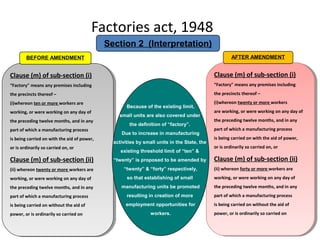
Factories act, 1948
Section 2 (Interpretation)
Clause (m) of sub-section (i)
“Factory" means any premises including
the precincts thereof –
(i)whereon ten or more workers are
working, or were working on any day of
the preceding twelve months, and in any
part of which a manufacturing process
is being carried on with the aid of power,
or is ordinarily so carried on, or
Clause (m) of sub-section (ii)
(ii) whereon twenty or more workers are
working, or were working on any day of
the preceding twelve months, and in any
part of which a manufacturing process
is being carried on without the aid of
power, or is ordinarily so carried on
Clause (m) of sub-section (i)
“Factory" means any premises including
the precincts thereof –
(i)whereon ten or more workers are
working, or were working on any day of
the preceding twelve months, and in any
part of which a manufacturing process
is being carried on with the aid of power,
or is ordinarily so carried on, or
Clause (m) of sub-section (ii)
(ii) whereon twenty or more workers are
working, or were working on any day of
the preceding twelve months, and in any
part of which a manufacturing process
is being carried on without the aid of
power, or is ordinarily so carried on
BEFORE AMENDMENT
Clause (m) of sub-section (i)
“Factory" means any premises including
the precincts thereof –
(i)whereon twenty or more workers
are working, or were working on any day of
the preceding twelve months, and in any
part of which a manufacturing process
is being carried on with the aid of power,
or is ordinarily so carried on, or
Clause (m) of sub-section (ii)
(ii) whereon forty or more workers are
working, or were working on any day of
the preceding twelve months, and in any
part of which a manufacturing process
is being carried on without the aid of
power, or is ordinarily so carried on
Clause (m) of sub-section (i)
“Factory" means any premises including
the precincts thereof –
(i)whereon twenty or more workers
are working, or were working on any day of
the preceding twelve months, and in any
part of which a manufacturing process
is being carried on with the aid of power,
or is ordinarily so carried on, or
Clause (m) of sub-section (ii)
(ii) whereon forty or more workers are
working, or were working on any day of
the preceding twelve months, and in any
part of which a manufacturing process
is being carried on without the aid of
power, or is ordinarily so carried on
AFTER AMENDMENT
Because of the existing limit,
small units are also covered under
the definition of “factory”.
Due to increase in manufacturing
activities by small units in the State, the
existing threshold limit of “ten” &
“twenty” is proposed to be amended by
“twenty” & “forty” respectively,
so that establishing of small
manufacturing units be promoted
resulting in creation of more
employment opportunities for
workers.
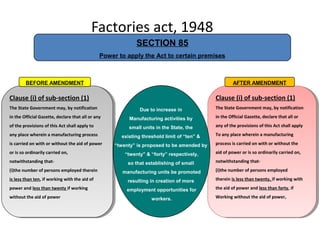
Factories act, 1948
Clause (i) of sub-section (1)
The State Government may, by notification
in the Official Gazette, declare that all or any
of the provisions of this Act shall apply to
any place wherein a manufacturing process
is carried on with or without the aid of power
or is so ordinarily carried on,
notwithstanding that-
(i)the number of persons employed therein
is less than ten, if working with the aid of
power and less than twenty if working
without the aid of power
Clause (i) of sub-section (1)
The State Government may, by notification
in the Official Gazette, declare that all or any
of the provisions of this Act shall apply to
any place wherein a manufacturing process
is carried on with or without the aid of power
or is so ordinarily carried on,
notwithstanding that-
(i)the number of persons employed therein
is less than ten, if working with the aid of
power and less than twenty if working
without the aid of power
BEFORE AMENDMENT
Clause (i) of sub-section (1)
The State Government may, by notification
in the Official Gazette, declare that all or
any of the provisions of this Act shall apply
To any place wherein a manufacturing
process is carried on with or without the
aid of power or is so ordinarily carried on,
notwithstanding that-
(i)the number of persons employed
therein is less than twenty, if working with
the aid of power and less than forty, if
Working without the aid of power,
Clause (i) of sub-section (1)
The State Government may, by notification
in the Official Gazette, declare that all or
any of the provisions of this Act shall apply
To any place wherein a manufacturing
process is carried on with or without the
aid of power or is so ordinarily carried on,
notwithstanding that-
(i)the number of persons employed
therein is less than twenty, if working with
the aid of power and less than forty, if
Working without the aid of power,
AFTER AMENDMENT
Due to increase in
Manufacturing activities by
small units in the State, the
existing threshold limit of “ten” &
“twenty” is proposed to be amended by
“twenty” & “forty” respectively,
so that establishing of small
manufacturing units be promoted
resulting in creation of more
employment opportunities for
workers.
SECTION 85
Power to apply the Act to certain premises
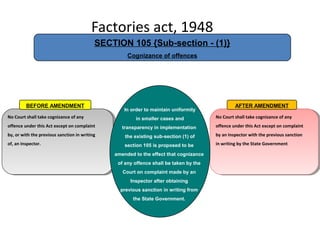
Factories act, 1948
No Court shall take cognizance of any
offence under this Act except on complaint
by, or with the previous sanction in writing
of, an Inspector.
No Court shall take cognizance of any
offence under this Act except on complaint
by, or with the previous sanction in writing
of, an Inspector.
BEFORE AMENDMENT
No Court shall take cognizance of any
offence under this Act except on complaint
by an Inspector with the previous sanction
in writing by the State Government
No Court shall take cognizance of any
offence under this Act except on complaint
by an Inspector with the previous sanction
in writing by the State Government
AFTER AMENDMENT
In order to maintain uniformity
in smaller cases and
transparency in implementation
the existing sub-section (1) of
section 105 is proposed to be
amended to the effect that cognizance
of any offence shall be taken by the
Court on complaint made by an
Inspector after obtaining
previous sanction in writing from
the State Government.
SECTION 105 {Sub-section - (1)}
Cognizance of offences
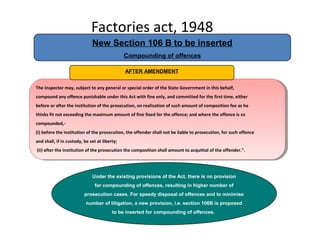
Factories act, 1948
The Inspector may, subject to any general or special order of the State Government in this behalf,
compound any offence punishable under this Act with fine only, and committed for the first time, either
before or after the institution of the prosecution, on realization of such amount of composition fee as he
thinks fit not exceeding the maximum amount of fine fixed for the offence; and where the offence is so
compounded,-
(i) before the institution of the prosecution, the offender shall not be liable to prosecution, for such offence
and shall, if in custody, be set at liberty;
(ii) after the institution of the prosecution the composition shall amount to acquittal of the offender.".
The Inspector may, subject to any general or special order of the State Government in this behalf,
compound any offence punishable under this Act with fine only, and committed for the first time, either
before or after the institution of the prosecution, on realization of such amount of composition fee as he
thinks fit not exceeding the maximum amount of fine fixed for the offence; and where the offence is so
compounded,-
(i) before the institution of the prosecution, the offender shall not be liable to prosecution, for such offence
and shall, if in custody, be set at liberty;
(ii) after the institution of the prosecution the composition shall amount to acquittal of the offender.".
AFTER AMENDMENT
Under the existing provisions of the Act, there is no provision
for compounding of offences, resulting in higher number of
prosecution cases. For speedy disposal of offences and to minimise
number of litigation, a new provision, i.e. section 106B is proposed
to be inserted for compounding of offences.
New Section 106 B to be inserted
Compounding of offences
1. Contract Labour Act , 1970
2. Industrial Disputes Act, 1947
3. Factories Act, 1948
contents
THANK
YOU

Amendments in acts 2014

  • 1.
  • 2.
    1. Contract LabourAct , 1970 2. Industrial Disputes Act, 1947 3. Factories Act, 1948 contents
  • 3.
    1. Contract LabourAct , 1970 2. Industrial Disputes Act, 1947 3. Factories Act, 1948 contents
  • 4.
    Contract Labour Act, 1970 SECTION 1 (4) It applies-- (a)To every establishment in which twenty or more workmen are employed or were employed on any day of the preceding twelve months as contract labour; (b) to every contractor who employees or who employed on any day of the preceding twelve months twenty or more workmen: Provided that the State Government may, after giving not less than two months' notice of its intention so to do, by notification in the Official Gazette, apply the provisions of this Act to any establishment or contractor employing such number of workmen less than twenty as may be specified in the notification. It applies-- (a)To every establishment in which twenty or more workmen are employed or were employed on any day of the preceding twelve months as contract labour; (b) to every contractor who employees or who employed on any day of the preceding twelve months twenty or more workmen: Provided that the State Government may, after giving not less than two months' notice of its intention so to do, by notification in the Official Gazette, apply the provisions of this Act to any establishment or contractor employing such number of workmen less than twenty as may be specified in the notification. BEFORE AMENDMENT It applies-- (a)To every establishment in which fifty or more workmen are employed or were employed on any day of the preceding twelve months as contract labour; (b) to every contractor who employees or who employed on any day of the preceding twelve months fifty or more workmen: Provided that the State Government may, after giving not less than two months' notice of its intention so to do, by notification in the Official Gazette, apply the provisions of this Act to any establishment or contractor employing such number of workmen less than twenty as may be specified in the notification. It applies-- (a)To every establishment in which fifty or more workmen are employed or were employed on any day of the preceding twelve months as contract labour; (b) to every contractor who employees or who employed on any day of the preceding twelve months fifty or more workmen: Provided that the State Government may, after giving not less than two months' notice of its intention so to do, by notification in the Official Gazette, apply the provisions of this Act to any establishment or contractor employing such number of workmen less than twenty as may be specified in the notification. AFTER AMENDMENT Before amendment, Act was applied in which 20 or more workmen are Employed. Now, minimum workmen should be 50.
  • 5.
    1. Contract LabourAct , 1970 2. Industrial Disputes Act, 1947 3. Factories Act, 1948 contents
  • 6.
    INDUSTRIAL DISPUTES ACT,1947 SECTION 2 Definitions Clause g (iii) Employer means:- Where the owner of any industry in the course of or for the purpose of conducting the industry contracts with any person for the execution by or under the contractor of the whole or any part of any work which is ordinarily a part of the industry, the owner of the industry Clause g (iii) Employer means:- Where the owner of any industry in the course of or for the purpose of conducting the industry contracts with any person for the execution by or under the contractor of the whole or any part of any work which is ordinarily a part of the industry, the owner of the industry BEFORE AMENDMENT Clause g (iii) This clause is being deleted form the act Clause g (iii) This clause is being deleted form the act AFTER AMENDMENT Since a separate Act, The Contract Labour (Regulation and Abolition) Act, 1970 was enacted by the Parliament for regulating the employment of contract workers in Certain establishments and for its abolition of certain circumstances, therefore, sub-clause (iii) of clause (g) vide State Amendment of 1958 has become irrelevant and ineffective. Hence, this need to be deleted.
  • 7.
    INDUSTRIAL DISPUTES ACT,1947 SECTION 2 (Clause s) - Definitions Workman means – Any person (including an apprentice) employed in an industry by an employer or by the contractor in relation to the execution of his contract with such employer to do manual, unskilled, skilled, technical, operational, clerical or supervisory work for hire or reward, whether the terms of employment be express or implied, and for the purposes of any proceeding under this Act in relation to an industrial dispute, includes any such person who has been dismissed, discharged or retrenched in connection with, or as a consequence of, that dispute, or whose dismissal, dischasrge or retrenchment has led to that dispute, Workman means – Any person (including an apprentice) employed in an industry by an employer or by the contractor in relation to the execution of his contract with such employer to do manual, unskilled, skilled, technical, operational, clerical or supervisory work for hire or reward, whether the terms of employment be express or implied, and for the purposes of any proceeding under this Act in relation to an industrial dispute, includes any such person who has been dismissed, discharged or retrenched in connection with, or as a consequence of, that dispute, or whose dismissal, dischasrge or retrenchment has led to that dispute, BEFORE AMENDMENT Workman means – Any person (including an apprentice) employed in an industry to do manual, unskilled, skilled, technical, operational, clerical or supervisory work for hire or reward, whether the terms of employment be express or implied, and for the purposes of any proceeding under this Act in relation to an industrial dispute, includes any such person who has been dismissed, discharged or retrenched in connection with, or as a consequence of, that dispute, or whose dismissal, dischasrge or retrenchment has led to that dispute, Workman means – Any person (including an apprentice) employed in an industry to do manual, unskilled, skilled, technical, operational, clerical or supervisory work for hire or reward, whether the terms of employment be express or implied, and for the purposes of any proceeding under this Act in relation to an industrial dispute, includes any such person who has been dismissed, discharged or retrenched in connection with, or as a consequence of, that dispute, or whose dismissal, dischasrge or retrenchment has led to that dispute, AFTER AMENDMENT Since a separate Act, The Contract Labour (Regulation and Abolition) Act, 1970 was enacted by the Parliament for regulating the employment of contract workers in Certain establishments and for its abolition of certain circumstances, therefore, the expression in clause (s) vide State Amendment of 1958 has become irrelevant and ineffective. Hence, this need to be deleted.
  • 8.
    INDUSTRIAL DISPUTES ACT,1947 SECTION 2 (A) Dismissal, etc., of an individual workman to be deemed to be an Industrial dispute. Dismissal, etc., of an individual workman to be deemed to be an industrial dispute:- Consists of 3 subsections which depicts no time limit prescribed for raising disputes connected with or arising out of discharge, dismissal, retrenchment or termination of an individual workman and sometimes Such disputes are raised after a lapse of many years which cause difficulties in settlement of disputes. Dismissal, etc., of an individual workman to be deemed to be an industrial dispute:- Consists of 3 subsections which depicts no time limit prescribed for raising disputes connected with or arising out of discharge, dismissal, retrenchment or termination of an individual workman and sometimes Such disputes are raised after a lapse of many years which cause difficulties in settlement of disputes. BEFORE AMENDMENT 4th Sub-section is added:- (4) Notwithstanding anything in sub-sections (1),(2) and (3), no such dispute or difference between that workman and his employer connected with, or arising out of, such discharge, dismissal, retrenchment or termination shall be deemed to be an industrial dispute if such dispute is not raised in conciliation proceeding within a period of 2 three years from the date of such discharge, dismissal, retrenchment or termination: Provided that an authority, as may be specified by the State Government, may consider to extend the said period of 3 years when the applicant workman satisfies the authority that he had sufficient cause for not raising the dispute within the period of 3 years. 4th Sub-section is added:- (4) Notwithstanding anything in sub-sections (1),(2) and (3), no such dispute or difference between that workman and his employer connected with, or arising out of, such discharge, dismissal, retrenchment or termination shall be deemed to be an industrial dispute if such dispute is not raised in conciliation proceeding within a period of 2 three years from the date of such discharge, dismissal, retrenchment or termination: Provided that an authority, as may be specified by the State Government, may consider to extend the said period of 3 years when the applicant workman satisfies the authority that he had sufficient cause for not raising the dispute within the period of 3 years. AFTER AMENDMENT It is, therefore, proposed that a time limit of three years be provided for raising the industrial disputes covered under section 2A & the time limit so prescribed could be extended by the competent authority on sufficient grounds
  • 9.
    INDUSTRIAL DISPUTES ACT,1947 CHAPTER II (B) Reference of certain individual disputes to grievance settlement authorities Chapter II (B) depicts Reference of certain Individual disputes to Grievances Settlement Authorities Chapter II (B) depicts Reference of certain Individual disputes to Grievances Settlement Authorities BEFORE AMENDMENT Renumbered as Chapter II (C).Renumbered as Chapter II (C). AFTER AMENDMENT Chapter 9 (C) depicts Setting up of Grievance Settlement authorities & reference of certain individual disputes To such authorities Chapter 9 (C) depicts Setting up of Grievance Settlement authorities & reference of certain individual disputes To such authorities BEFORE AMENDMENT Renumbered as Chapter 9 (CC)Renumbered as Chapter 9 (CC) AFTER AMENDMENT CHAPTER 9 (C) Setting up og Grievance settlement authorities and reference of certain individual disputes to such authorities
  • 10.
    INDUSTRIAL DISPUTES ACT,1947 Because of existing limit, many unions may become eligible for making application for registration as representative union which may possibly increase inter union conflicts and also multiplicity of unions in an industry. To minimize this possibility, it is proposed to increase membership from “fifteen per cent” to “thirty per cent” Section 9 (D) Application of Registration Any Union which has for the whole of the period of at least three months during the period of six months immediately preceding the calendar month in which it so applies under this section a membership of not less than fifteen per cent of the total number of workmen employed in unit of an industry may apply in the prescribed form to the Registrar for registration as a representative Union. Any Union which has for the whole of the period of at least three months during the period of six months immediately preceding the calendar month in which it so applies under this section a membership of not less than fifteen per cent of the total number of workmen employed in unit of an industry may apply in the prescribed form to the Registrar for registration as a representative Union. BEFORE AMENDMENT Any Union which has for the whole of the period of at least three months during the period of six months immediately preceding the calendar month in which it so applies under this section a membership of not less than thirty per cent of the total number of workmen employed in unit of an industry may apply in the prescribed form to the Registrar for registration as a representative Union. Any Union which has for the whole of the period of at least three months during the period of six months immediately preceding the calendar month in which it so applies under this section a membership of not less than thirty per cent of the total number of workmen employed in unit of an industry may apply in the prescribed form to the Registrar for registration as a representative Union. AFTER AMENDMENT
  • 11.
    INDUSTRIAL DISPUTES ACT,1947 CHAPTER V (B) Special Provisions related to Lay-Off, Retrenchment & Closure in certain establishments Section 25 (K) APPLICATION OF CHAPTER V-B The provisions of this Chapter shall apply to an industrial establishment (not being an establishment of a seasonal character or in which work is performed only intermittently) in which not less than one hundred workmen were employed on an average per working day for the preceding twelve months. Section 25 (K) APPLICATION OF CHAPTER V-B The provisions of this Chapter shall apply to an industrial establishment (not being an establishment of a seasonal character or in which work is performed only intermittently) in which not less than one hundred workmen were employed on an average per working day for the preceding twelve months. BEFORE AMENDMENT Section 25 (K) APPLICATION OF CHAPTER V-B The provisions of this Chapter shall apply to an industrial establishment (not being an establishment of a seasonal character or in which work is performed only intermittently) in which not less than three hundred workmen were employed on an average per working day for the preceding twelve months. Section 25 (K) APPLICATION OF CHAPTER V-B The provisions of this Chapter shall apply to an industrial establishment (not being an establishment of a seasonal character or in which work is performed only intermittently) in which not less than three hundred workmen were employed on an average per working day for the preceding twelve months. AFTER AMENDMENTIt is proposed vide this amendment to increase the number of workmen from one hundred to three hundred, which would help and encourage the employers to employ more number of Workers in the establishment. However, if State Government is satisfied that maintenance of industrial peace or for prevention of victimization of workmen so requires, it could apply the provisions of the Chapter VB to an industrial establishment in which less than three hundred but not less than one hundred workmen are employed.
  • 12.
    INDUSTRIAL DISPUTES ACT,1947 Section 25 (N) Clause (a) of Sub-section (1) CONDITIONS PRECEDENT TO RETRENCHMENT OF WORKMEN No workman employed in any industrial establishment to which this Chapter applies, who has been in continuous service for not less than one year under an employer shall be retrenched by that employer until :- (a)the workman has been given three months' notice in writing indicating the reasons for retrenchment and the period of notice has expired, or the Workman has been paid in lieu of such notice, wages for the period of the notice; Section 25 (N) Clause (a) of Sub-section (1) CONDITIONS PRECEDENT TO RETRENCHMENT OF WORKMEN No workman employed in any industrial establishment to which this Chapter applies, who has been in continuous service for not less than one year under an employer shall be retrenched by that employer until :- (a)the workman has been given three months' notice in writing indicating the reasons for retrenchment and the period of notice has expired, or the Workman has been paid in lieu of such notice, wages for the period of the notice; BEFORE AMENDMENT Section 25 (N) Clause (a) of Sub-section (1) CONDITIONS PRECEDENT TO RETRENCHMENT OF WORKMEN This clause to be deleted Section 25 (N) Clause (a) of Sub-section (1) CONDITIONS PRECEDENT TO RETRENCHMENT OF WORKMEN This clause to be deleted AFTER AMENDMENT This amendment is being Processed to provide the financial security to the workmen who affects by the retrenchment. CHAPTER V (B)
  • 13.
    INDUSTRIAL DISPUTES ACT,1947 Section 25 (O) Procedure for closing down an undertaking Sub-section (8) Where an undertaking is permitted to be closed down or where permission for closure is deemed to be granted, every workman who is employed in that undertaking immediately before the date of application for permission under this section, shall be entitled to receive compensation which shall be equivalent to fifteen days' average pay for every completed year of continuous service or any part thereof in excess of six months. Sub-section (8) Where an undertaking is permitted to be closed down or where permission for closure is deemed to be granted, every workman who is employed in that undertaking immediately before the date of application for permission under this section, shall be entitled to receive compensation which shall be equivalent to fifteen days' average pay for every completed year of continuous service or any part thereof in excess of six months. BEFORE AMENDMENT Sub-section (8) Where an undertaking is permitted to be closed down or where permission for closure is deemed to be granted, every workman who is employed in that undertaking immediately before the date of application for permission under this section, shall be entitled to receive compensation which shall be equivalent to fifteen days' average pay for every completed year of continuous service or any part thereof in excess of six months and an amount equivalent to his three months average pay. Sub-section (8) Where an undertaking is permitted to be closed down or where permission for closure is deemed to be granted, every workman who is employed in that undertaking immediately before the date of application for permission under this section, shall be entitled to receive compensation which shall be equivalent to fifteen days' average pay for every completed year of continuous service or any part thereof in excess of six months and an amount equivalent to his three months average pay. AFTER AMENDMENT This amendment is being processed to provide payment of an amount equivalent to three month’s average pay, along with compensation on prescribed rates, must also be paid to the workers who are being affected by the closure of the establishment.
  • 14.
    INDUSTRIAL DISPUTES ACT,1947 Schedule V (Unfair Labour Practices) Part II Paragraph 5 To stage, encourage or instigate such forms of coercive actions as wilful "go slow", squatting on the work premises after working hours or "gherao" of any of the members of the managerial or other staff. Part II Paragraph 5 To stage, encourage or instigate such forms of coercive actions as wilful "go slow", squatting on the work premises after working hours or "gherao" of any of the members of the managerial or other staff. BEFORE AMENDMENT Part II Paragraph 5 For the purpose of this paragraph, ‘go slow’ means any such activity by any number of persons, employed in any industry, acting in combination or with common understanding, to slow down or to delay the process of production or work purposely whether called by work to rule or by any other name, so as the fixed or average or normal level of production or work or output of workman or workmen of the establishment is not achieved: Provided that all necessary ingredients or inputs for standard quality production or work are made available in time and in sufficient quantity. Part II Paragraph 5 For the purpose of this paragraph, ‘go slow’ means any such activity by any number of persons, employed in any industry, acting in combination or with common understanding, to slow down or to delay the process of production or work purposely whether called by work to rule or by any other name, so as the fixed or average or normal level of production or work or output of workman or workmen of the establishment is not achieved: Provided that all necessary ingredients or inputs for standard quality production or work are made available in time and in sufficient quantity. AFTER AMENDMENT Term "go slow" is included in paragraph 5 of Part II of the Fifth Schedule of the Act but the same has not been defined, which causes difficulty in disposal of matters relating to "go slow". Therefore, for the purpose of removing this difficulty, an explanation after the existing paragraph 5 of Part II of the Fifth Schedule is proposed to be added to define the term "go slow"..
  • 15.
    1. Contract LabourAct , 1970 2. Industrial Disputes Act, 1947 3. Factories Act, 1948 contents
  • 16.
    Factories act, 1948 Section2 (Interpretation) Clause (m) of sub-section (i) “Factory" means any premises including the precincts thereof – (i)whereon ten or more workers are working, or were working on any day of the preceding twelve months, and in any part of which a manufacturing process is being carried on with the aid of power, or is ordinarily so carried on, or Clause (m) of sub-section (ii) (ii) whereon twenty or more workers are working, or were working on any day of the preceding twelve months, and in any part of which a manufacturing process is being carried on without the aid of power, or is ordinarily so carried on Clause (m) of sub-section (i) “Factory" means any premises including the precincts thereof – (i)whereon ten or more workers are working, or were working on any day of the preceding twelve months, and in any part of which a manufacturing process is being carried on with the aid of power, or is ordinarily so carried on, or Clause (m) of sub-section (ii) (ii) whereon twenty or more workers are working, or were working on any day of the preceding twelve months, and in any part of which a manufacturing process is being carried on without the aid of power, or is ordinarily so carried on BEFORE AMENDMENT Clause (m) of sub-section (i) “Factory" means any premises including the precincts thereof – (i)whereon twenty or more workers are working, or were working on any day of the preceding twelve months, and in any part of which a manufacturing process is being carried on with the aid of power, or is ordinarily so carried on, or Clause (m) of sub-section (ii) (ii) whereon forty or more workers are working, or were working on any day of the preceding twelve months, and in any part of which a manufacturing process is being carried on without the aid of power, or is ordinarily so carried on Clause (m) of sub-section (i) “Factory" means any premises including the precincts thereof – (i)whereon twenty or more workers are working, or were working on any day of the preceding twelve months, and in any part of which a manufacturing process is being carried on with the aid of power, or is ordinarily so carried on, or Clause (m) of sub-section (ii) (ii) whereon forty or more workers are working, or were working on any day of the preceding twelve months, and in any part of which a manufacturing process is being carried on without the aid of power, or is ordinarily so carried on AFTER AMENDMENT Because of the existing limit, small units are also covered under the definition of “factory”. Due to increase in manufacturing activities by small units in the State, the existing threshold limit of “ten” & “twenty” is proposed to be amended by “twenty” & “forty” respectively, so that establishing of small manufacturing units be promoted resulting in creation of more employment opportunities for workers.
  • 17.
    Factories act, 1948 Clause(i) of sub-section (1) The State Government may, by notification in the Official Gazette, declare that all or any of the provisions of this Act shall apply to any place wherein a manufacturing process is carried on with or without the aid of power or is so ordinarily carried on, notwithstanding that- (i)the number of persons employed therein is less than ten, if working with the aid of power and less than twenty if working without the aid of power Clause (i) of sub-section (1) The State Government may, by notification in the Official Gazette, declare that all or any of the provisions of this Act shall apply to any place wherein a manufacturing process is carried on with or without the aid of power or is so ordinarily carried on, notwithstanding that- (i)the number of persons employed therein is less than ten, if working with the aid of power and less than twenty if working without the aid of power BEFORE AMENDMENT Clause (i) of sub-section (1) The State Government may, by notification in the Official Gazette, declare that all or any of the provisions of this Act shall apply To any place wherein a manufacturing process is carried on with or without the aid of power or is so ordinarily carried on, notwithstanding that- (i)the number of persons employed therein is less than twenty, if working with the aid of power and less than forty, if Working without the aid of power, Clause (i) of sub-section (1) The State Government may, by notification in the Official Gazette, declare that all or any of the provisions of this Act shall apply To any place wherein a manufacturing process is carried on with or without the aid of power or is so ordinarily carried on, notwithstanding that- (i)the number of persons employed therein is less than twenty, if working with the aid of power and less than forty, if Working without the aid of power, AFTER AMENDMENT Due to increase in Manufacturing activities by small units in the State, the existing threshold limit of “ten” & “twenty” is proposed to be amended by “twenty” & “forty” respectively, so that establishing of small manufacturing units be promoted resulting in creation of more employment opportunities for workers. SECTION 85 Power to apply the Act to certain premises
  • 18.
    Factories act, 1948 NoCourt shall take cognizance of any offence under this Act except on complaint by, or with the previous sanction in writing of, an Inspector. No Court shall take cognizance of any offence under this Act except on complaint by, or with the previous sanction in writing of, an Inspector. BEFORE AMENDMENT No Court shall take cognizance of any offence under this Act except on complaint by an Inspector with the previous sanction in writing by the State Government No Court shall take cognizance of any offence under this Act except on complaint by an Inspector with the previous sanction in writing by the State Government AFTER AMENDMENT In order to maintain uniformity in smaller cases and transparency in implementation the existing sub-section (1) of section 105 is proposed to be amended to the effect that cognizance of any offence shall be taken by the Court on complaint made by an Inspector after obtaining previous sanction in writing from the State Government. SECTION 105 {Sub-section - (1)} Cognizance of offences
  • 19.
    Factories act, 1948 TheInspector may, subject to any general or special order of the State Government in this behalf, compound any offence punishable under this Act with fine only, and committed for the first time, either before or after the institution of the prosecution, on realization of such amount of composition fee as he thinks fit not exceeding the maximum amount of fine fixed for the offence; and where the offence is so compounded,- (i) before the institution of the prosecution, the offender shall not be liable to prosecution, for such offence and shall, if in custody, be set at liberty; (ii) after the institution of the prosecution the composition shall amount to acquittal of the offender.". The Inspector may, subject to any general or special order of the State Government in this behalf, compound any offence punishable under this Act with fine only, and committed for the first time, either before or after the institution of the prosecution, on realization of such amount of composition fee as he thinks fit not exceeding the maximum amount of fine fixed for the offence; and where the offence is so compounded,- (i) before the institution of the prosecution, the offender shall not be liable to prosecution, for such offence and shall, if in custody, be set at liberty; (ii) after the institution of the prosecution the composition shall amount to acquittal of the offender.". AFTER AMENDMENT Under the existing provisions of the Act, there is no provision for compounding of offences, resulting in higher number of prosecution cases. For speedy disposal of offences and to minimise number of litigation, a new provision, i.e. section 106B is proposed to be inserted for compounding of offences. New Section 106 B to be inserted Compounding of offences
  • 20.
    1. Contract LabourAct , 1970 2. Industrial Disputes Act, 1947 3. Factories Act, 1948 contents THANK YOU