CONSTITUTIONAL DEVELOPMENTS FROM 1937-
1947
INTRODUCTION
 The period from 1937 to 1947 was a critical phase in the constitutional history of India, as it witnessed
significant developments towards the country's independence from British colonial rule.
 During this period, India saw the emergence of several important political and constitutional
movements, which paved the way for the creation of an independent Indian state.
 The Indian National Congress, which had been the leading force in the Indian independence
movement, gained greater political power in the 1937 elections, winning the majority of seats
in the provincial legislatures.
 The period also witnessed the emergence of other political movements, particularly the
Muslim League, which sought greater representation for Muslims in the Indian political
system.
 During this period, India also witnessed the adoption of the historic Quit India resolution in
1942, calling for the immediate end of British colonial rule in India.
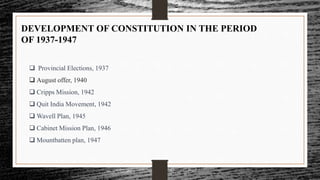
DEVELOPMENT OF CONSTITUTION IN THE PERIOD
OF 1937-1947
 Provincial Elections, 1937
 August offer, 1940
 Cripps Mission, 1942
 Quit India Movement, 1942
 Wavell Plan, 1945
 Cabinet Mission Plan, 1946
 Mountbatten plan, 1947
Provincial Elections, 1937
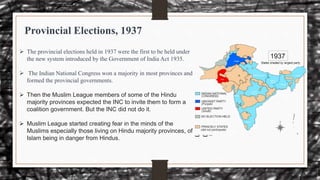
 The provincial elections held in 1937 were the first to be held under
the new system introduced by the Government of India Act 1935.
 The Indian National Congress won a majority in most provinces and
formed the provincial governments.
 Then the Muslim League members of some of the Hindu
majority provinces expected the INC to invite them to form a
coalition government. But the INC did not do it.
 Muslim League started creating fear in the minds of the
Muslims especially those living on Hindu majority provinces, of
Islam being in danger from Hindus.
August Offer, 1940
 The August Offer of 1940 was a significant development in the history of
India's constitutional struggle for independence from British colonial rule.
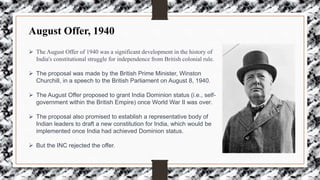
 The proposal was made by the British Prime Minister, Winston
Churchill, in a speech to the British Parliament on August 8, 1940.
 The August Offer proposed to grant India Dominion status (i.e., self-
government within the British Empire) once World War II was over.
 The proposal also promised to establish a representative body of
Indian leaders to draft a new constitution for India, which would be
implemented once India had achieved Dominion status.
 But the INC rejected the offer.
Cripps Mission, 1942
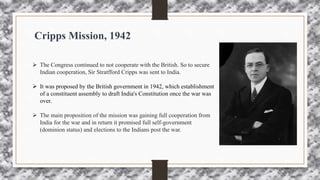
 The Congress continued to not cooperate with the British. So to secure
Indian cooperation, Sir Stratfford Cripps was sent to India.
 It was proposed by the British government in 1942, which establishment
of a constituent assembly to draft India's Constitution once the war was
over.
 The main proposition of the mission was gaining full cooperation from
India for the war and in return it promised full self-government
(dominion status) and elections to the Indians post the war.
Quit India Movement, 1942
 After rejecting the proposals of the Cripps Mission, the
Congress called for Quit India Movement.
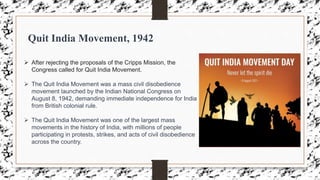
 The Quit India Movement was a mass civil disobedience
movement launched by the Indian National Congress on
August 8, 1942, demanding immediate independence for India
from British colonial rule.
 The Quit India Movement was one of the largest mass
movements in the history of India, with millions of people
participating in protests, strikes, and acts of civil disobedience
across the country.
Wavell Plan, 1945 and Shimla Conference
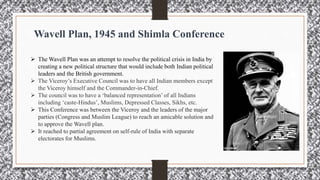
 The Wavell Plan was an attempt to resolve the political crisis in India by
creating a new political structure that would include both Indian political
leaders and the British government.
 The Viceroy’s Executive Council was to have all Indian members except
the Viceroy himself and the Commander-in-Chief.
 The council was to have a ‘balanced representation’ of all Indians
including ‘caste-Hindus’, Muslims, Depressed Classes, Sikhs, etc.
 This Conference was between the Viceroy and the leaders of the major
parties (Congress and Muslim League) to reach an amicable solution and
to approve the Wavell plan.
 It reached to partial agreement on self-rule of India with separate
electorates for Muslims.
Cabinet Mission Plan, 1946
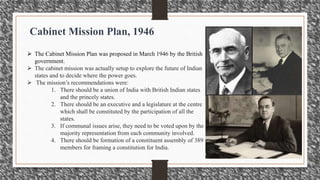
 The Cabinet Mission Plan was proposed in March 1946 by the British
government.
 The cabinet mission was actually setup to explore the future of Indian
states and to decide where the power goes.
 The mission’s recommendations were:
1. There should be a union of India with British Indian states
and the princely states.
2. There should be an executive and a legislature at the centre
which shall be constituted by the participation of all the
states.
3. If communal issues arise, they need to be voted upon by the
majority representation from each community involved.
4. There should be formation of a constituent assembly of 389
members for framing a constitution for India.
Mountbatten Plan, 1947
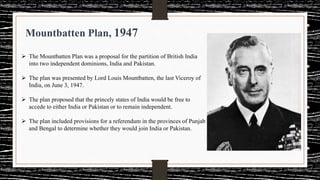
 The Mountbatten Plan was a proposal for the partition of British India
into two independent dominions, India and Pakistan.
 The plan was presented by Lord Louis Mountbatten, the last Viceroy of
India, on June 3, 1947.
 The plan proposed that the princely states of India would be free to
accede to either India or Pakistan or to remain independent.
 The plan included provisions for a referendum in the provinces of Punjab
and Bengal to determine whether they would join India or Pakistan.
CONCLUSION
 During this period, India witnessed significant political and social
changes that eventually led to its independence from British colonial
rule.
 The Government of India Act, 1935 introduced a federal system of
governance in India, and the provincial elections of 1937 marked the
establishment of provincial autonomy and self-rule.
 The constitutional developments during this period were accompanied
by significant social and political movements, such as the Quit India
Movement, which demonstrated the growing demand for Indian self-
rule and independence.
THANK YOU
Submitted by:
A Venkata Sai
VU22LAWS0200036

Constitutional development from 1937 - 1947

  • 1.
  • 2.
    INTRODUCTION  The periodfrom 1937 to 1947 was a critical phase in the constitutional history of India, as it witnessed significant developments towards the country's independence from British colonial rule.  During this period, India saw the emergence of several important political and constitutional movements, which paved the way for the creation of an independent Indian state.  The Indian National Congress, which had been the leading force in the Indian independence movement, gained greater political power in the 1937 elections, winning the majority of seats in the provincial legislatures.  The period also witnessed the emergence of other political movements, particularly the Muslim League, which sought greater representation for Muslims in the Indian political system.  During this period, India also witnessed the adoption of the historic Quit India resolution in 1942, calling for the immediate end of British colonial rule in India.
  • 3.
    DEVELOPMENT OF CONSTITUTIONIN THE PERIOD OF 1937-1947  Provincial Elections, 1937  August offer, 1940  Cripps Mission, 1942  Quit India Movement, 1942  Wavell Plan, 1945  Cabinet Mission Plan, 1946  Mountbatten plan, 1947
  • 4.
    Provincial Elections, 1937 The provincial elections held in 1937 were the first to be held under the new system introduced by the Government of India Act 1935.  The Indian National Congress won a majority in most provinces and formed the provincial governments.  Then the Muslim League members of some of the Hindu majority provinces expected the INC to invite them to form a coalition government. But the INC did not do it.  Muslim League started creating fear in the minds of the Muslims especially those living on Hindu majority provinces, of Islam being in danger from Hindus.
  • 5.
    August Offer, 1940 The August Offer of 1940 was a significant development in the history of India's constitutional struggle for independence from British colonial rule.  The proposal was made by the British Prime Minister, Winston Churchill, in a speech to the British Parliament on August 8, 1940.  The August Offer proposed to grant India Dominion status (i.e., self- government within the British Empire) once World War II was over.  The proposal also promised to establish a representative body of Indian leaders to draft a new constitution for India, which would be implemented once India had achieved Dominion status.  But the INC rejected the offer.
  • 6.
    Cripps Mission, 1942 The Congress continued to not cooperate with the British. So to secure Indian cooperation, Sir Stratfford Cripps was sent to India.  It was proposed by the British government in 1942, which establishment of a constituent assembly to draft India's Constitution once the war was over.  The main proposition of the mission was gaining full cooperation from India for the war and in return it promised full self-government (dominion status) and elections to the Indians post the war.
  • 7.
    Quit India Movement,1942  After rejecting the proposals of the Cripps Mission, the Congress called for Quit India Movement.  The Quit India Movement was a mass civil disobedience movement launched by the Indian National Congress on August 8, 1942, demanding immediate independence for India from British colonial rule.  The Quit India Movement was one of the largest mass movements in the history of India, with millions of people participating in protests, strikes, and acts of civil disobedience across the country.
  • 8.
    Wavell Plan, 1945and Shimla Conference  The Wavell Plan was an attempt to resolve the political crisis in India by creating a new political structure that would include both Indian political leaders and the British government.  The Viceroy’s Executive Council was to have all Indian members except the Viceroy himself and the Commander-in-Chief.  The council was to have a ‘balanced representation’ of all Indians including ‘caste-Hindus’, Muslims, Depressed Classes, Sikhs, etc.  This Conference was between the Viceroy and the leaders of the major parties (Congress and Muslim League) to reach an amicable solution and to approve the Wavell plan.  It reached to partial agreement on self-rule of India with separate electorates for Muslims.
  • 9.
    Cabinet Mission Plan,1946  The Cabinet Mission Plan was proposed in March 1946 by the British government.  The cabinet mission was actually setup to explore the future of Indian states and to decide where the power goes.  The mission’s recommendations were: 1. There should be a union of India with British Indian states and the princely states. 2. There should be an executive and a legislature at the centre which shall be constituted by the participation of all the states. 3. If communal issues arise, they need to be voted upon by the majority representation from each community involved. 4. There should be formation of a constituent assembly of 389 members for framing a constitution for India.
  • 10.
    Mountbatten Plan, 1947 The Mountbatten Plan was a proposal for the partition of British India into two independent dominions, India and Pakistan.  The plan was presented by Lord Louis Mountbatten, the last Viceroy of India, on June 3, 1947.  The plan proposed that the princely states of India would be free to accede to either India or Pakistan or to remain independent.  The plan included provisions for a referendum in the provinces of Punjab and Bengal to determine whether they would join India or Pakistan.
  • 11.
    CONCLUSION  During thisperiod, India witnessed significant political and social changes that eventually led to its independence from British colonial rule.  The Government of India Act, 1935 introduced a federal system of governance in India, and the provincial elections of 1937 marked the establishment of provincial autonomy and self-rule.  The constitutional developments during this period were accompanied by significant social and political movements, such as the Quit India Movement, which demonstrated the growing demand for Indian self- rule and independence.
  • 12.
    THANK YOU Submitted by: AVenkata Sai VU22LAWS0200036