Constitutional Developments
from 1947 to 1958.
1. The interim constitution and the
first constituent assembly.
 The govt of India 1935 became, with certain adaptations, the
first working constitution of Pakistan. And the provisional
constitutional order of Pak established the federation of Pak
consisted of 1. East Bengal, Punjab, Sindh, and NWFP. 2.
Balochistan 3. The capital Karachi. 4. Areas/States which may
accede to Pak.
 Under the govt of India act 1935 the GG possessed a unique
and paramount position and exercised a large amount of
powers in his discretion and individual judgment. All these
powers lapsed beyond august 14,1947 with the act of 1947.
However the Jinnah exercised vast amount of authority.
Cont:
 The inaugural session of the first constituent assembly was held from
august 10 to 14 of 1947. Jinnah became the first president of the
constituent assembly
 The assembly had the dual responsibility of making the constitution
and working as legislature of the country
 The first constituent assembly initially consisted of 69 member which
was increased to 74 to give representation to the state of Bahawalpur,
Khairpur, Balochistan and tribal areas upon their accession to Pak
 There were only two parties in the CA, INC and AIML. The former
represented the 12 million Hindus and later was the largest party in the
assembly with 59 seats
Cont:
The constituent assembly made a number of
committees. Among these the Basic Principles
committee(BPC) was the most important one. BPC
was entrusted with the responsibility to present its
report to the CA on the basic principles of the
constitution. BPC further broken down itself in
different subcommittees. All the committees were
empowered to take the assistance of experts. Apart
from BPC there were other committees like the
committee on fundamental rights and the rights of
minorities, state negotiating committee and tribal
negotiating committee.
Cont:
Despite the paramount position of the GG the interim
constitution established parliamentary form of Govt
with independent judiciary and the GG was supposed
to act in consultation with the council of ministers
Similarly the governors of the provinces were supposed
to act on the advice of the chief minister
2. The Objectives Resolution
The objectives resolution was the first significant step
towards the constitution making in the country. It
defined the shape and nature of the future
constitution of the country
The objective resolution was introduced in the
assembly by Liaqat Ali Khan on March 07, and it was
passed on march 12,1949
Following are the salient features of this resolution
Cont:
1. Sovereignty over the entire universe belongs to Almighty Allah
2. The future form of govt shall be democratic
3. The principles of democracy, freedom, equality, tolerance and
social justice as enunciated by Islam shall be fully observed
4. Muslims of Pakistan shall be enabled to offer their lives
according to the teachings of Quran and Sunnah
5. Adequate protection shall be given to the minorities to freely
profess and practice religion and develop their cultures
Cont:
6. Independence of judiciary
7. Integrity and territories of all the areas included in
Pakistan shall be safeguarded.
1.The first report 1950.
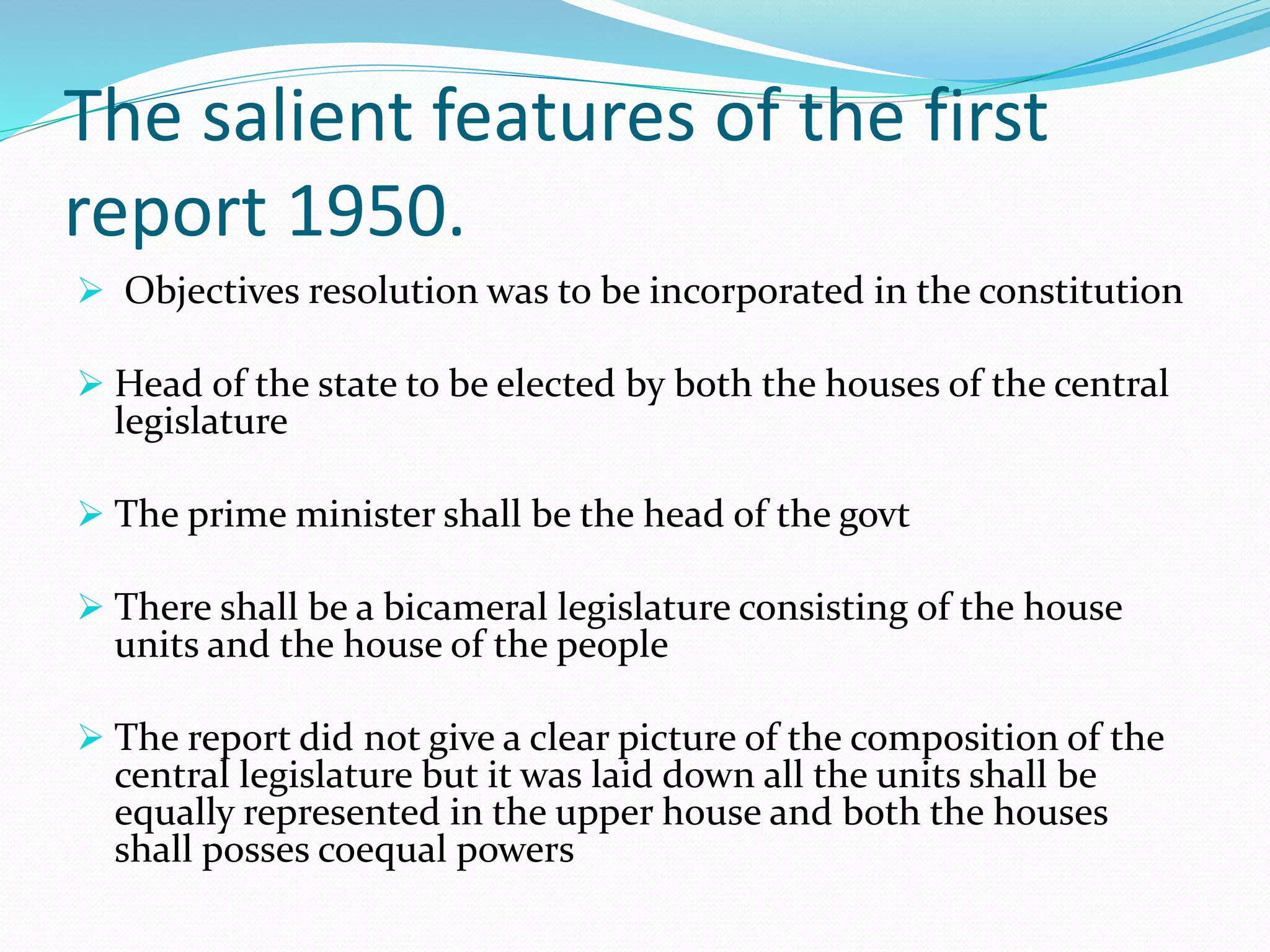
The salient features of the first
report 1950.
 Objectives resolution was to be incorporated in the constitution
 Head of the state to be elected by both the houses of the central
legislature
 The prime minister shall be the head of the govt
 There shall be a bicameral legislature consisting of the house
units and the house of the people
 The report did not give a clear picture of the composition of the
central legislature but it was laid down all the units shall be
equally represented in the upper house and both the houses
shall posses coequal powers
Cont:
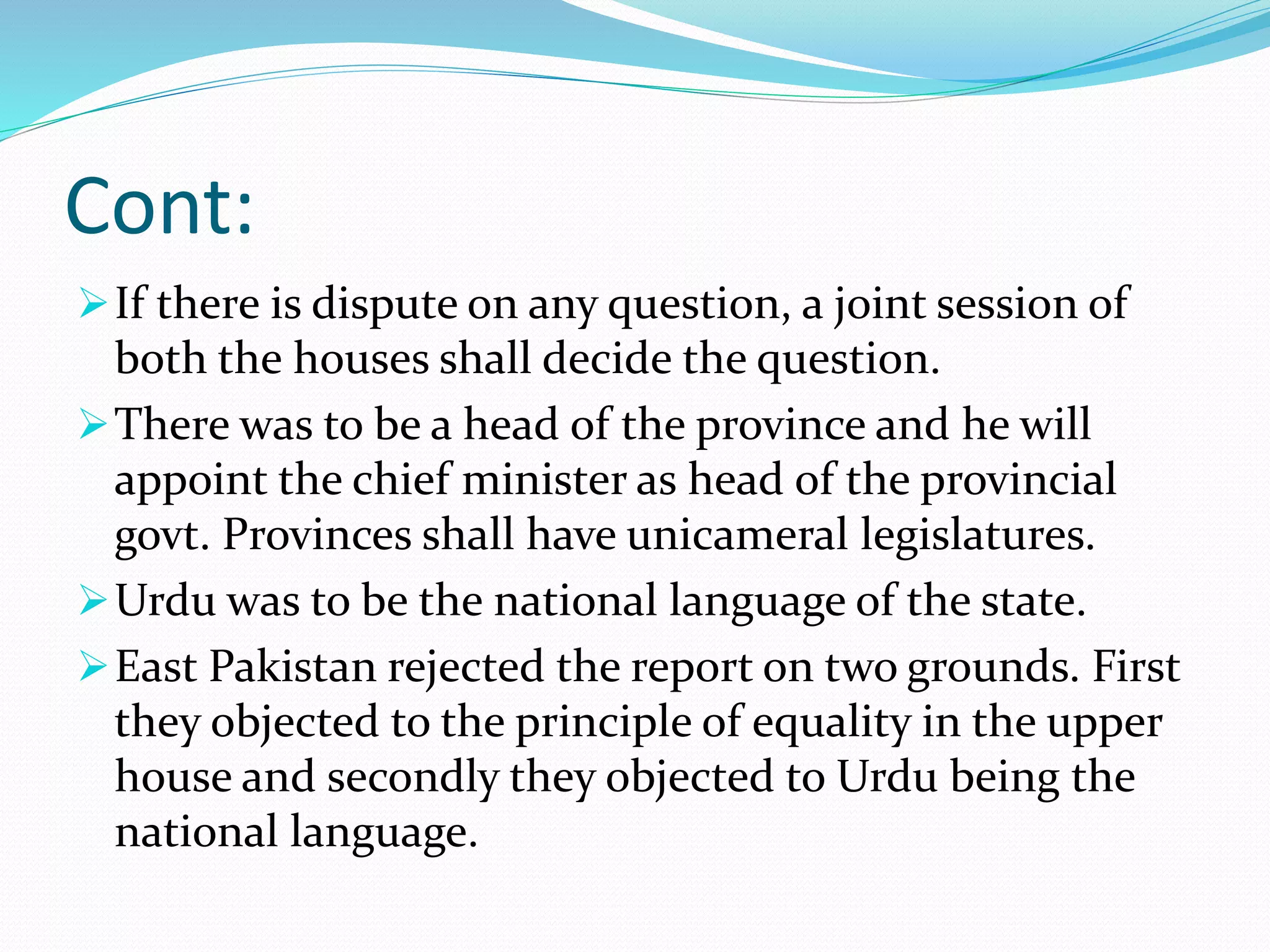
If there is dispute on any question, a joint session of
both the houses shall decide the question.
There was to be a head of the province and he will
appoint the chief minister as head of the provincial
govt. Provinces shall have unicameral legislatures.
Urdu was to be the national language of the state.
East Pakistan rejected the report on two grounds. First
they objected to the principle of equality in the upper
house and secondly they objected to Urdu being the
national language.
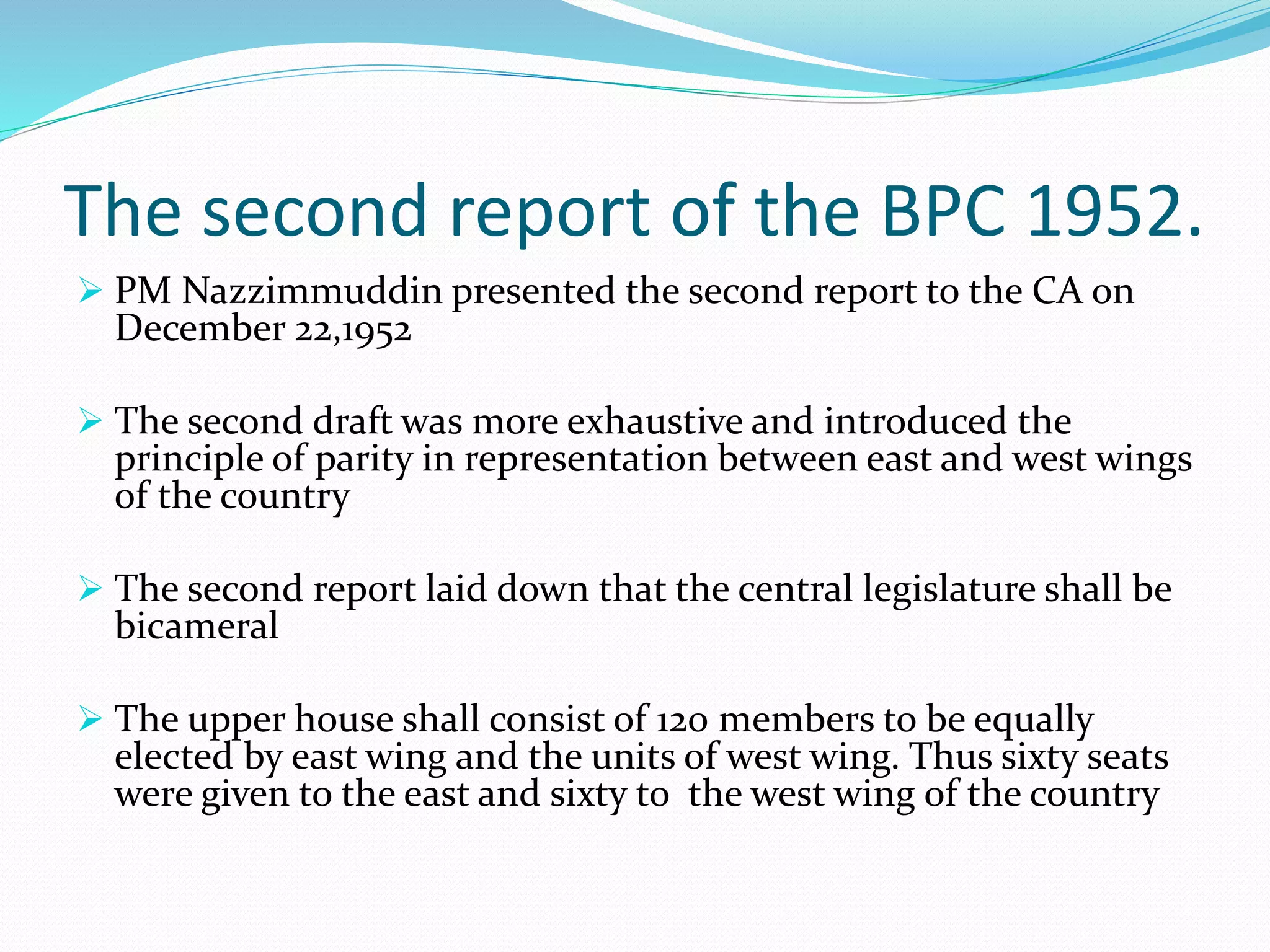
The second report of the BPC 1952.
 PM Nazzimmuddin presented the second report to the CA on
December 22,1952
 The second draft was more exhaustive and introduced the
principle of parity in representation between east and west wings
of the country
 The second report laid down that the central legislature shall be
bicameral
 The upper house shall consist of 120 members to be equally
elected by east wing and the units of west wing. Thus sixty seats
were given to the east and sixty to the west wing of the country
Cont:
The lower house shall consist of 400 members and
shall be equally elected by the east and west wing of
the state
This time, the reaction in the Punjab was extremely
unfavorable. They objected to the principle of parity.
Critics saw no logic in treating a single unit, east
Bengal, of equal importance with all the other units
put together and regarded it as the violation of the
principle of federation where all the units, large and
small, are equally represented in the upper house
4. The second constituent
assembly
 After dissolving the first CA, the federal court ordered Ghulam
Muhammad to convene a new Constituent convention(later
CA)
 Ghulam M. summoned a ne sixty member constituent
assembly by proclamation. The strength was increased to 80
later on Distributed equally b/w east and west pak
 There was a complete absence of women from this assembly
while the first CA had 2 women.
 On september 30,1955 the assembly passed one unit bill
merging the federating units in west pak as one unit
Cont:
 The 2nd CA assembly was facilitated by the ground
work done by its predecessor but the assembly faced
the enormous problem of coalition of ML and UF
which consisted of different components of
diametrically opposite views. So the sessions were
repeatedly adjourned
 After months of deliberation the first draft of the
constitution was published on January 8,1956 which
was adopted on February 29, and implemented on
March 23
5. The problems/hindrances in
making of constitution.
 The following problems were faced by the politicians of
Pakistan to frame a constitution immediately after
independence. Following are also the reasons which
delayed the constitution making for nine years.
1. The quantum of representation b/w East and West Pakistan
2. Due to racial, linguistic, cultural and other differences the
making of the federation became a problem
3. Distribution of powers b/w the central and provincial govt
Cont:
4. The problem of language
4. Nature of govt
5. Nature of state
Thanks

Constitutional Development from 1947 to 1958

  • 1.
  • 2.
    1. The interimconstitution and the first constituent assembly.  The govt of India 1935 became, with certain adaptations, the first working constitution of Pakistan. And the provisional constitutional order of Pak established the federation of Pak consisted of 1. East Bengal, Punjab, Sindh, and NWFP. 2. Balochistan 3. The capital Karachi. 4. Areas/States which may accede to Pak.  Under the govt of India act 1935 the GG possessed a unique and paramount position and exercised a large amount of powers in his discretion and individual judgment. All these powers lapsed beyond august 14,1947 with the act of 1947. However the Jinnah exercised vast amount of authority.
  • 3.
    Cont:  The inauguralsession of the first constituent assembly was held from august 10 to 14 of 1947. Jinnah became the first president of the constituent assembly  The assembly had the dual responsibility of making the constitution and working as legislature of the country  The first constituent assembly initially consisted of 69 member which was increased to 74 to give representation to the state of Bahawalpur, Khairpur, Balochistan and tribal areas upon their accession to Pak  There were only two parties in the CA, INC and AIML. The former represented the 12 million Hindus and later was the largest party in the assembly with 59 seats
  • 4.
    Cont: The constituent assemblymade a number of committees. Among these the Basic Principles committee(BPC) was the most important one. BPC was entrusted with the responsibility to present its report to the CA on the basic principles of the constitution. BPC further broken down itself in different subcommittees. All the committees were empowered to take the assistance of experts. Apart from BPC there were other committees like the committee on fundamental rights and the rights of minorities, state negotiating committee and tribal negotiating committee.
  • 5.
    Cont: Despite the paramountposition of the GG the interim constitution established parliamentary form of Govt with independent judiciary and the GG was supposed to act in consultation with the council of ministers Similarly the governors of the provinces were supposed to act on the advice of the chief minister
  • 6.
    2. The ObjectivesResolution The objectives resolution was the first significant step towards the constitution making in the country. It defined the shape and nature of the future constitution of the country The objective resolution was introduced in the assembly by Liaqat Ali Khan on March 07, and it was passed on march 12,1949 Following are the salient features of this resolution
  • 7.
    Cont: 1. Sovereignty overthe entire universe belongs to Almighty Allah 2. The future form of govt shall be democratic 3. The principles of democracy, freedom, equality, tolerance and social justice as enunciated by Islam shall be fully observed 4. Muslims of Pakistan shall be enabled to offer their lives according to the teachings of Quran and Sunnah 5. Adequate protection shall be given to the minorities to freely profess and practice religion and develop their cultures
  • 8.
    Cont: 6. Independence ofjudiciary 7. Integrity and territories of all the areas included in Pakistan shall be safeguarded.
  • 9.
  • 10.
    The salient featuresof the first report 1950.  Objectives resolution was to be incorporated in the constitution  Head of the state to be elected by both the houses of the central legislature  The prime minister shall be the head of the govt  There shall be a bicameral legislature consisting of the house units and the house of the people  The report did not give a clear picture of the composition of the central legislature but it was laid down all the units shall be equally represented in the upper house and both the houses shall posses coequal powers
  • 11.
    Cont: If there isdispute on any question, a joint session of both the houses shall decide the question. There was to be a head of the province and he will appoint the chief minister as head of the provincial govt. Provinces shall have unicameral legislatures. Urdu was to be the national language of the state. East Pakistan rejected the report on two grounds. First they objected to the principle of equality in the upper house and secondly they objected to Urdu being the national language.
  • 12.
    The second reportof the BPC 1952.  PM Nazzimmuddin presented the second report to the CA on December 22,1952  The second draft was more exhaustive and introduced the principle of parity in representation between east and west wings of the country  The second report laid down that the central legislature shall be bicameral  The upper house shall consist of 120 members to be equally elected by east wing and the units of west wing. Thus sixty seats were given to the east and sixty to the west wing of the country
  • 13.
    Cont: The lower houseshall consist of 400 members and shall be equally elected by the east and west wing of the state This time, the reaction in the Punjab was extremely unfavorable. They objected to the principle of parity. Critics saw no logic in treating a single unit, east Bengal, of equal importance with all the other units put together and regarded it as the violation of the principle of federation where all the units, large and small, are equally represented in the upper house
  • 14.
    4. The secondconstituent assembly  After dissolving the first CA, the federal court ordered Ghulam Muhammad to convene a new Constituent convention(later CA)  Ghulam M. summoned a ne sixty member constituent assembly by proclamation. The strength was increased to 80 later on Distributed equally b/w east and west pak  There was a complete absence of women from this assembly while the first CA had 2 women.  On september 30,1955 the assembly passed one unit bill merging the federating units in west pak as one unit
  • 15.
    Cont:  The 2ndCA assembly was facilitated by the ground work done by its predecessor but the assembly faced the enormous problem of coalition of ML and UF which consisted of different components of diametrically opposite views. So the sessions were repeatedly adjourned  After months of deliberation the first draft of the constitution was published on January 8,1956 which was adopted on February 29, and implemented on March 23
  • 16.
    5. The problems/hindrancesin making of constitution.  The following problems were faced by the politicians of Pakistan to frame a constitution immediately after independence. Following are also the reasons which delayed the constitution making for nine years. 1. The quantum of representation b/w East and West Pakistan 2. Due to racial, linguistic, cultural and other differences the making of the federation became a problem 3. Distribution of powers b/w the central and provincial govt
  • 17.
    Cont: 4. The problemof language 4. Nature of govt 5. Nature of state
  • 18.