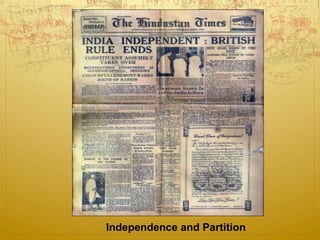
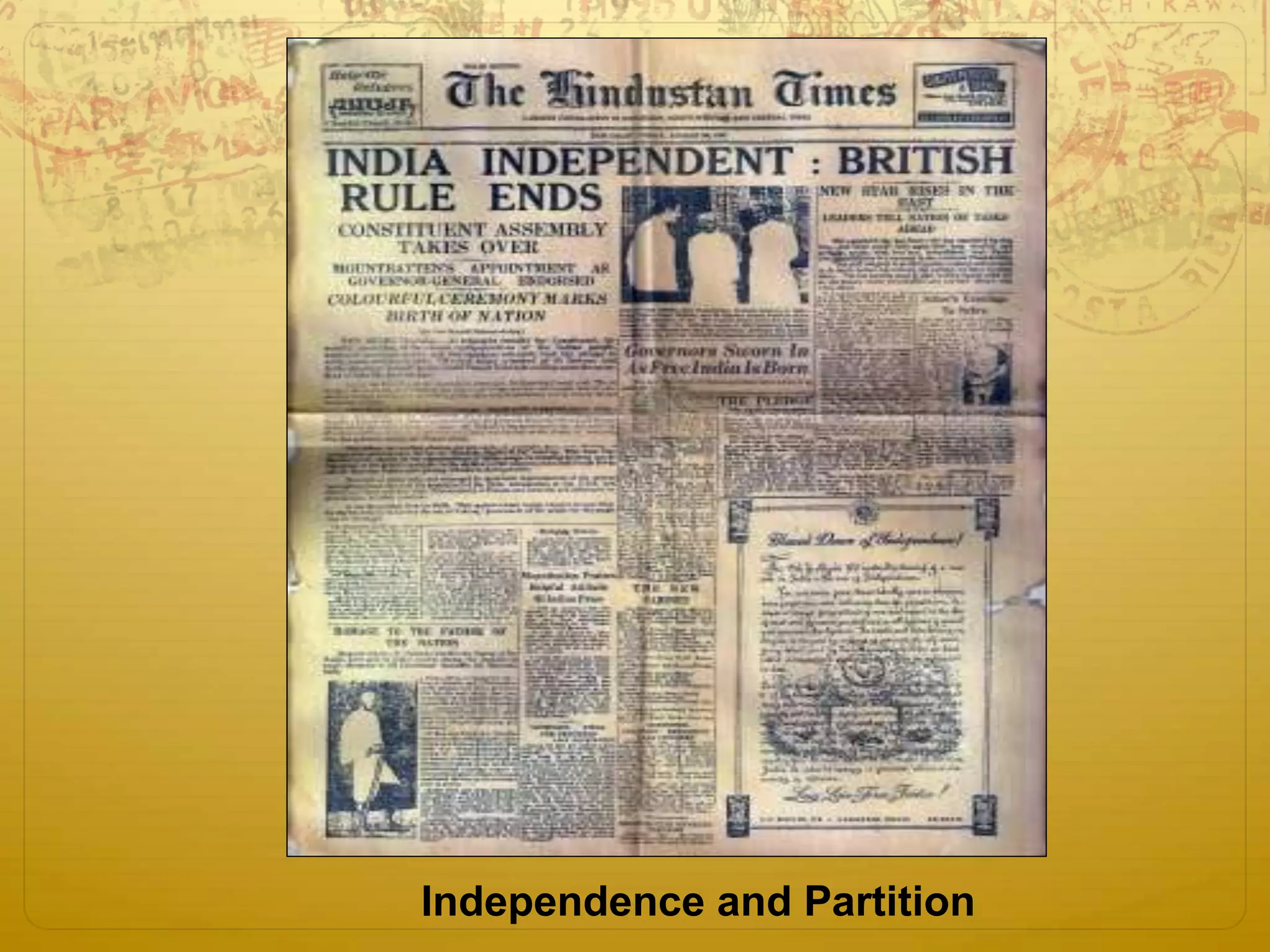
Independence and Partition
Khilafat Movement (1919-24)
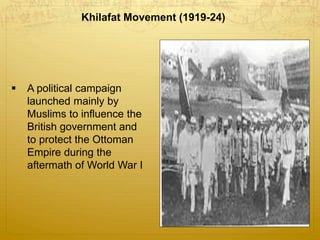
 A political campaign
launched mainly by
Muslims to influence the
British government and
to protect the Ottoman
Empire during the
aftermath of World War I
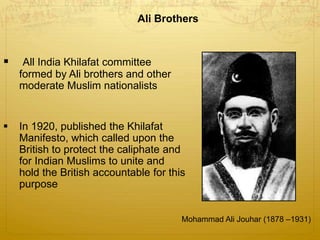
Ali Brothers
 All India Khilafat committee
formed by Ali brothers and other
moderate Muslim nationalists
 In 1920, published the Khilafat
Manifesto, which called upon the
British to protect the caliphate and
for Indian Muslims to unite and
hold the British accountable for this
purpose
Mohammad Ali Jouhar (1878 –1931)
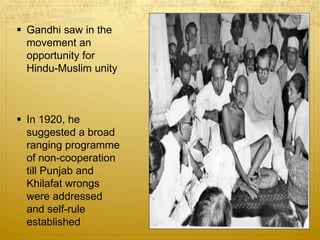
 Gandhi saw in the
movement an
opportunity for
Hindu-Muslim unity
 In 1920, he
suggested a broad
ranging programme
of non-cooperation
till Punjab and
Khilafat wrongs
were addressed
and self-rule
established
)
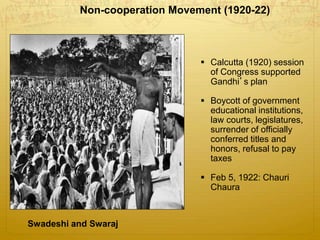
Non-cooperation Movement (1920-22)
Swadeshi and Swaraj
 Calcutta (1920) session
of Congress supported
Gandhi’s plan
 Boycott of government
educational institutions,
law courts, legislatures,
surrender of officially
conferred titles and
honors, refusal to pay
taxes
 Feb 5, 1922: Chauri
Chaura
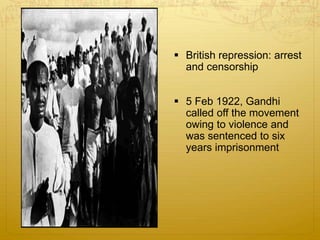
 British repression: arrest
and censorship
 5 Feb 1922, Gandhi
called off the movement
owing to violence and
was sentenced to six
years imprisonment
Government of India act (1919)
 Central legislative council made bicameral parliament – Imperial legislative
assembly ( 140 members, 100 elected) and Council of State ( 60 members,
40 elected). Viceroy’s executive council to have 3 Indian members.
 Landowning, tax paying, educated Indians (5 million) enfranchised to elect
representatives in provincial councils.
 Diarchy introduced in provinces. They would have ministers to preside over
departments like health, education, public works and agriculture. 70% of the
members of provincial councils were to be elected.
 In 1923, C.R. Das and Motilal Nehru formed ‘Svarajists Party’ to fight
elections and paralyze government machinery from within. Policy of ‘non-
cooperation from within’.
 In 1923, simultaneous examinations for ICS held in New Delhi and London,
and Indians were admitted to military officer training.
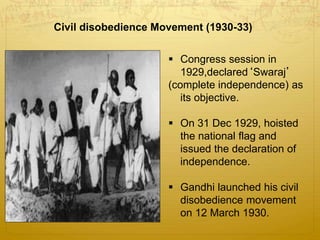
Civil disobedience Movement (1930-33)
 Congress session in
1929,declared‘Swaraj’
(complete independence) as
its objective.
 On 31 Dec 1929, hoisted
the national flag and
issued the declaration of
independence.
 Gandhi launched his civil
disobedience movement
on 12 March 1930.
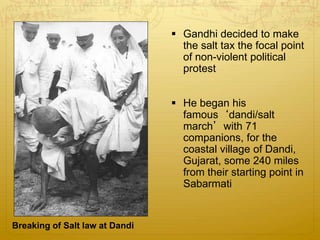
Breaking of Salt law at Dandi
 Gandhi decided to make
the salt tax the focal point
of non-violent political
protest
 He began his
famous‘dandi/salt
march’with 71
companions, for the
coastal village of Dandi,
Gujarat, some 240 miles
from their starting point in
Sabarmati
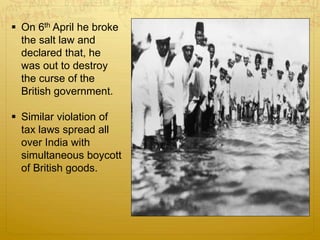
 On 6th April he broke
the salt law and
declared that, he
was out to destroy
the curse of the
British government.
 Similar violation of
tax laws spread all
over India with
simultaneous boycott
of British goods.
British repression and appeasement
 British responded by severe repression and imprisoned
Gandhi and other nationalist leaders.
 British government summoned in London in 1930 the first
Round table conference to discuss the question of
constitutional reform in India following the
recommendations of Simon commission on self-rule.
Demand for An Autonomous State for Muslims
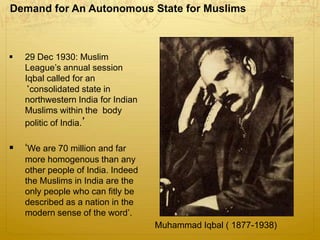
Muhammad Iqbal ( 1877-1938)
 29 Dec 1930: Muslim
League’s annual session
Iqbal called for an
‘consolidated state in
northwestern India for Indian
Muslims within the body
politic of India.’
 ‘We are 70 million and far
more homogenous than any
other people of India. Indeed
the Muslims in India are the
only people who can fitly be
described as a nation in the
modern sense of the word’.
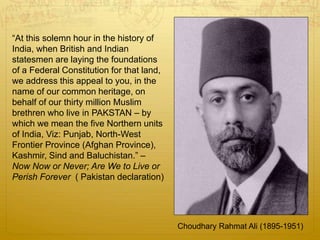
Choudhary Rahmat Ali (1895-1951)
“At this solemn hour in the history of
India, when British and Indian
statesmen are laying the foundations
of a Federal Constitution for that land,
we address this appeal to you, in the
name of our common heritage, on
behalf of our thirty million Muslim
brethren who live in PAKSTAN – by
which we mean the five Northern units
of India, Viz: Punjab, North-West
Frontier Province (Afghan Province),
Kashmir, Sind and Baluchistan.” –
Now Now or Never; Are We to Live or
Perish Forever ( Pakistan declaration)
 A settlement in 1931: Congress suspended the civil
disobedience movement, agreed to participate in the
II Round table conference.
 British government recognized and approved
svadeshi movement, withdrew repressive
ordinances, freed political prisoners and removed
the salt tax.
Gandhi-Irwin pact (March 1931)
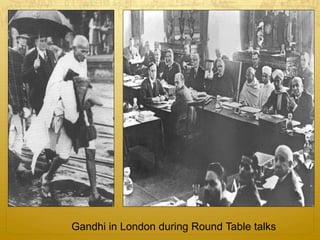
Gandhi in London during Round Table talks
 In 1932 Ramsay McDonald announced ‘Comunal Award’ which
gave separate electorates to Sikhs, Indian Christians, Anglo-
Indians and Dalits.
 Gandhi launched a fast-unto-death led to the ‘Poona Pact’ with Dr.
Ambedkar - 24 September 1932, which ensured that 147 seats on
the provincial council and 18% of the central assembly seats to
dalits if they ran for the election by general Hindu electorate.
 Hindu leaders conference resolved that ‘ …henceforth no one
shall be regarded as an untouchable by reason of this birth, and
those who have been so regarded hitherto, will have the same
right to the use of public wells, public schools, public roads and
other public institutions’.
Government of India Act (1935)
 The act was to create a ‘Federation of India’ which would consist of 11 governors’
provinces ( provinces of British India); the princely states; and a small number of
ICS-run, centrally administered areas called chief commissioner's provinces. –
this never came to fruition.
 Provincial autonomy inaugurated on April 1, 1937 following nation-wide elections.
The franchise increased from seven million to thirty-five million propertied Indians
( six million women and 10 % untouchables).
 Reorganization of provinces - Sindh was separated from Bombay; Bihar and
Orissa were split into separate provinces; Burma became a separate colony;
NWFP was advanced as a governor’s province.
 In six governors’ provinces ( Bengal, Bihar, Madras, U.P, Bombay and Assam) –
two legislative chambers ( a council and an assembly); in other five – unicameral
assembly.
 Separate electorates retained, and elections held in 1937.
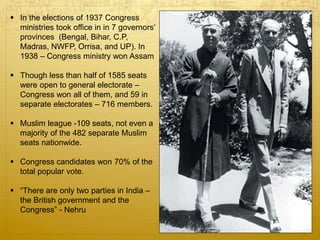
 In the elections of 1937 Congress
ministries took office in in 7 governors’
provinces (Bengal, Bihar, C.P,
Madras, NWFP, Orrisa, and UP). In
1938 – Congress ministry won Assam
 Though less than half of 1585 seats
were open to general electorate –
Congress won all of them, and 59 in
separate electorates – 716 members.
 Muslim league -109 seats, not even a
majority of the 482 separate Muslim
seats nationwide.
 Congress candidates won 70% of the
total popular vote.
 “There are only two parties in India –
the British government and the
Congress” - Nehru
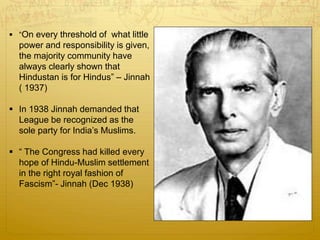
 “On every threshold of what little
power and responsibility is given,
the majority community have
always clearly shown that
Hindustan is for Hindus” – Jinnah
( 1937)
 In 1938 Jinnah demanded that
League be recognized as the
sole party for India’s Muslims.
 “ The Congress had killed every
hope of Hindu-Muslim settlement
in the right royal fashion of
Fascism”- Jinnah (Dec 1938)
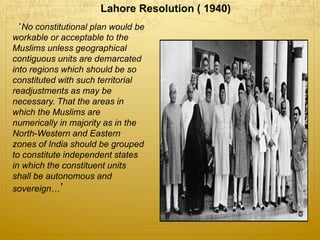
Lahore Resolution ( 1940)
‘No constitutional plan would be
workable or acceptable to the
Muslims unless geographical
contiguous units are demarcated
into regions which should be so
constituted with such territorial
readjustments as may be
necessary. That the areas in
which the Muslims are
numerically in majority as in the
North-Western and Eastern
zones of India should be grouped
to constitute independent states
in which the constituent units
shall be autonomous and
sovereign…’
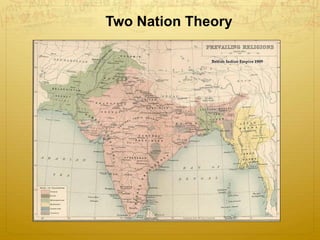
Two Nation Theory
 “The Hindus and Muslims belong to two different religious
philosophies, social customs and literatures. They neither intermarry
nor interdine together and, indeed, they belong to two different
civilizations” – Jinnah
 “The vast majority of Muslims of India are converts to Islam or are
descendants of converts” – Gandhi
 Gandhi denounced the Lahore resolution as the ‘vivisection of India’,
to which Jinnah responded, “ Where is the central national
government whose authority is being violated? India is held by British
power and that is the hand that holds and gives the impression of a
united India and a unitary government.”
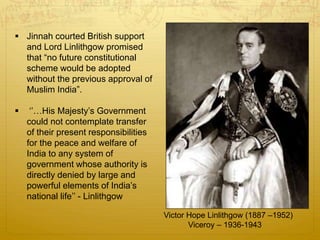
 Jinnah courted British support
and Lord Linlithgow promised
that “no future constitutional
scheme would be adopted
without the previous approval of
Muslim India”.
 ‘’…His Majesty’s Government
could not contemplate transfer
of their present responsibilities
for the peace and welfare of
India to any system of
government whose authority is
directly denied by large and
powerful elements of India’s
national life’’ - Linlithgow
Victor Hope Linlithgow (1887 –1952)
Viceroy – 1936-1943
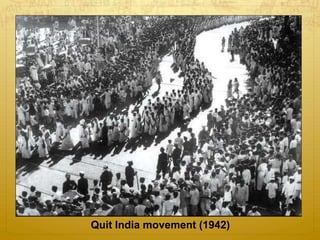
Quit India movement (1942)
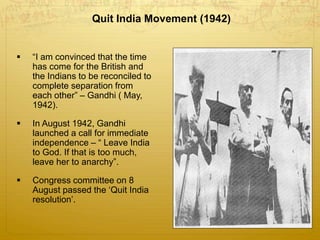
Quit India Movement (1942)
 “I am convinced that the time
has come for the British and
the Indians to be reconciled to
complete separation from
each other” – Gandhi ( May,
1942).
 In August 1942, Gandhi
launched a call for immediate
independence – “ Leave India
to God. If that is too much,
leave her to anarchy”.
 Congress committee on 8
August passed the ‘Quit India
resolution’.
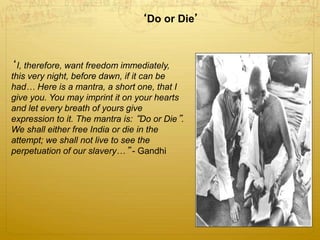
‘Do or Die’
‘I, therefore, want freedom immediately,
this very night, before dawn, if it can be
had… Here is a mantra, a short one, that I
give you. You may imprint it on your hearts
and let every breath of yours give
expression to it. The mantra is: “Do or Die”.
We shall either free India or die in the
attempt; we shall not live to see the
perpetuation of our slavery…” - Gandhi
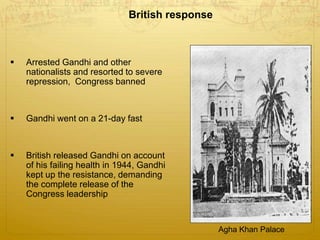
British response
 Arrested Gandhi and other
nationalists and resorted to severe
repression, Congress banned
 Gandhi went on a 21-day fast
 British released Gandhi on account
of his failing health in 1944, Gandhi
kept up the resistance, demanding
the complete release of the
Congress leadership
Agha Khan Palace
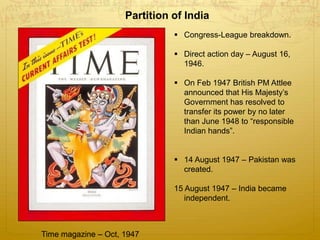
Time magazine – Oct, 1947
 Congress-League breakdown.
 Direct action day – August 16,
1946.
 On Feb 1947 British PM Attlee
announced that His Majesty’s
Government has resolved to
transfer its power by no later
than June 1948 to “responsible
Indian hands”.
 14 August 1947 – Pakistan was
created.
15 August 1947 – India became
independent.
Partition of India
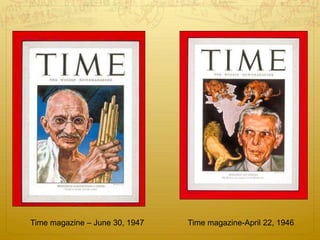
Time magazine – June 30, 1947 Time magazine-April 22, 1946

Independence and Partition.ppt

  • 1.
  • 2.
    Khilafat Movement (1919-24) A political campaign launched mainly by Muslims to influence the British government and to protect the Ottoman Empire during the aftermath of World War I
  • 3.
    Ali Brothers  AllIndia Khilafat committee formed by Ali brothers and other moderate Muslim nationalists  In 1920, published the Khilafat Manifesto, which called upon the British to protect the caliphate and for Indian Muslims to unite and hold the British accountable for this purpose Mohammad Ali Jouhar (1878 –1931)
  • 4.
     Gandhi sawin the movement an opportunity for Hindu-Muslim unity  In 1920, he suggested a broad ranging programme of non-cooperation till Punjab and Khilafat wrongs were addressed and self-rule established
  • 5.
    ) Non-cooperation Movement (1920-22) Swadeshiand Swaraj  Calcutta (1920) session of Congress supported Gandhi’s plan  Boycott of government educational institutions, law courts, legislatures, surrender of officially conferred titles and honors, refusal to pay taxes  Feb 5, 1922: Chauri Chaura
  • 6.
     British repression:arrest and censorship  5 Feb 1922, Gandhi called off the movement owing to violence and was sentenced to six years imprisonment
  • 7.
    Government of Indiaact (1919)  Central legislative council made bicameral parliament – Imperial legislative assembly ( 140 members, 100 elected) and Council of State ( 60 members, 40 elected). Viceroy’s executive council to have 3 Indian members.  Landowning, tax paying, educated Indians (5 million) enfranchised to elect representatives in provincial councils.  Diarchy introduced in provinces. They would have ministers to preside over departments like health, education, public works and agriculture. 70% of the members of provincial councils were to be elected.  In 1923, C.R. Das and Motilal Nehru formed ‘Svarajists Party’ to fight elections and paralyze government machinery from within. Policy of ‘non- cooperation from within’.  In 1923, simultaneous examinations for ICS held in New Delhi and London, and Indians were admitted to military officer training.
  • 8.
    Civil disobedience Movement(1930-33)  Congress session in 1929,declared‘Swaraj’ (complete independence) as its objective.  On 31 Dec 1929, hoisted the national flag and issued the declaration of independence.  Gandhi launched his civil disobedience movement on 12 March 1930.
  • 9.
    Breaking of Saltlaw at Dandi  Gandhi decided to make the salt tax the focal point of non-violent political protest  He began his famous‘dandi/salt march’with 71 companions, for the coastal village of Dandi, Gujarat, some 240 miles from their starting point in Sabarmati
  • 10.
     On 6thApril he broke the salt law and declared that, he was out to destroy the curse of the British government.  Similar violation of tax laws spread all over India with simultaneous boycott of British goods.
  • 11.
    British repression andappeasement  British responded by severe repression and imprisoned Gandhi and other nationalist leaders.  British government summoned in London in 1930 the first Round table conference to discuss the question of constitutional reform in India following the recommendations of Simon commission on self-rule.
  • 12.
    Demand for AnAutonomous State for Muslims Muhammad Iqbal ( 1877-1938)  29 Dec 1930: Muslim League’s annual session Iqbal called for an ‘consolidated state in northwestern India for Indian Muslims within the body politic of India.’  ‘We are 70 million and far more homogenous than any other people of India. Indeed the Muslims in India are the only people who can fitly be described as a nation in the modern sense of the word’.
  • 13.
    Choudhary Rahmat Ali(1895-1951) “At this solemn hour in the history of India, when British and Indian statesmen are laying the foundations of a Federal Constitution for that land, we address this appeal to you, in the name of our common heritage, on behalf of our thirty million Muslim brethren who live in PAKSTAN – by which we mean the five Northern units of India, Viz: Punjab, North-West Frontier Province (Afghan Province), Kashmir, Sind and Baluchistan.” – Now Now or Never; Are We to Live or Perish Forever ( Pakistan declaration)
  • 14.
     A settlementin 1931: Congress suspended the civil disobedience movement, agreed to participate in the II Round table conference.  British government recognized and approved svadeshi movement, withdrew repressive ordinances, freed political prisoners and removed the salt tax. Gandhi-Irwin pact (March 1931)
  • 15.
    Gandhi in Londonduring Round Table talks
  • 16.
     In 1932Ramsay McDonald announced ‘Comunal Award’ which gave separate electorates to Sikhs, Indian Christians, Anglo- Indians and Dalits.  Gandhi launched a fast-unto-death led to the ‘Poona Pact’ with Dr. Ambedkar - 24 September 1932, which ensured that 147 seats on the provincial council and 18% of the central assembly seats to dalits if they ran for the election by general Hindu electorate.  Hindu leaders conference resolved that ‘ …henceforth no one shall be regarded as an untouchable by reason of this birth, and those who have been so regarded hitherto, will have the same right to the use of public wells, public schools, public roads and other public institutions’.
  • 17.
    Government of IndiaAct (1935)  The act was to create a ‘Federation of India’ which would consist of 11 governors’ provinces ( provinces of British India); the princely states; and a small number of ICS-run, centrally administered areas called chief commissioner's provinces. – this never came to fruition.  Provincial autonomy inaugurated on April 1, 1937 following nation-wide elections. The franchise increased from seven million to thirty-five million propertied Indians ( six million women and 10 % untouchables).  Reorganization of provinces - Sindh was separated from Bombay; Bihar and Orissa were split into separate provinces; Burma became a separate colony; NWFP was advanced as a governor’s province.  In six governors’ provinces ( Bengal, Bihar, Madras, U.P, Bombay and Assam) – two legislative chambers ( a council and an assembly); in other five – unicameral assembly.  Separate electorates retained, and elections held in 1937.
  • 18.
     In theelections of 1937 Congress ministries took office in in 7 governors’ provinces (Bengal, Bihar, C.P, Madras, NWFP, Orrisa, and UP). In 1938 – Congress ministry won Assam  Though less than half of 1585 seats were open to general electorate – Congress won all of them, and 59 in separate electorates – 716 members.  Muslim league -109 seats, not even a majority of the 482 separate Muslim seats nationwide.  Congress candidates won 70% of the total popular vote.  “There are only two parties in India – the British government and the Congress” - Nehru
  • 19.
     “On everythreshold of what little power and responsibility is given, the majority community have always clearly shown that Hindustan is for Hindus” – Jinnah ( 1937)  In 1938 Jinnah demanded that League be recognized as the sole party for India’s Muslims.  “ The Congress had killed every hope of Hindu-Muslim settlement in the right royal fashion of Fascism”- Jinnah (Dec 1938)
  • 20.
    Lahore Resolution (1940) ‘No constitutional plan would be workable or acceptable to the Muslims unless geographical contiguous units are demarcated into regions which should be so constituted with such territorial readjustments as may be necessary. That the areas in which the Muslims are numerically in majority as in the North-Western and Eastern zones of India should be grouped to constitute independent states in which the constituent units shall be autonomous and sovereign…’
  • 21.
  • 22.
     “The Hindusand Muslims belong to two different religious philosophies, social customs and literatures. They neither intermarry nor interdine together and, indeed, they belong to two different civilizations” – Jinnah  “The vast majority of Muslims of India are converts to Islam or are descendants of converts” – Gandhi  Gandhi denounced the Lahore resolution as the ‘vivisection of India’, to which Jinnah responded, “ Where is the central national government whose authority is being violated? India is held by British power and that is the hand that holds and gives the impression of a united India and a unitary government.”
  • 23.
     Jinnah courtedBritish support and Lord Linlithgow promised that “no future constitutional scheme would be adopted without the previous approval of Muslim India”.  ‘’…His Majesty’s Government could not contemplate transfer of their present responsibilities for the peace and welfare of India to any system of government whose authority is directly denied by large and powerful elements of India’s national life’’ - Linlithgow Victor Hope Linlithgow (1887 –1952) Viceroy – 1936-1943
  • 24.
  • 25.
    Quit India Movement(1942)  “I am convinced that the time has come for the British and the Indians to be reconciled to complete separation from each other” – Gandhi ( May, 1942).  In August 1942, Gandhi launched a call for immediate independence – “ Leave India to God. If that is too much, leave her to anarchy”.  Congress committee on 8 August passed the ‘Quit India resolution’.
  • 26.
    ‘Do or Die’ ‘I,therefore, want freedom immediately, this very night, before dawn, if it can be had… Here is a mantra, a short one, that I give you. You may imprint it on your hearts and let every breath of yours give expression to it. The mantra is: “Do or Die”. We shall either free India or die in the attempt; we shall not live to see the perpetuation of our slavery…” - Gandhi
  • 27.
    British response  ArrestedGandhi and other nationalists and resorted to severe repression, Congress banned  Gandhi went on a 21-day fast  British released Gandhi on account of his failing health in 1944, Gandhi kept up the resistance, demanding the complete release of the Congress leadership Agha Khan Palace
  • 28.
    Time magazine –Oct, 1947  Congress-League breakdown.  Direct action day – August 16, 1946.  On Feb 1947 British PM Attlee announced that His Majesty’s Government has resolved to transfer its power by no later than June 1948 to “responsible Indian hands”.  14 August 1947 – Pakistan was created. 15 August 1947 – India became independent. Partition of India
  • 29.
    Time magazine –June 30, 1947 Time magazine-April 22, 1946

Editor's Notes