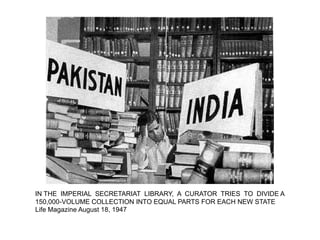
IN THE IMPERIAL SECRETARIAT LIBRARY, A CURATOR TRIES TO DIVIDE A
150,000-VOLUME COLLECTION INTO EQUAL PARTS FOR EACH NEW STATE
Life Magazine August 18, 1947
Questions
World War I was called a war to make the world “safe
for democracy.”
What do some Indian historians call World War II?
The Imperial War.
Why did two British generals lead a war against each
other?
Answers
• World War Ii is often called the Imperial War because
it involved the whole British Empire. However many
in England doubted whether they should fight for an
emorie when they wanted freedom from its rule.
• After independence, British generals were retained
as commanders-in-chief for a short period. This last
through the 1947-48 Kashmir conflict.
Accelerating British Grant of
Independence
• Trial of Indian National Army leaders
• Indian Navy Mutiny
• Imperial wars: Use of British Indian troops in French
Indo-China and Indonesia
• India defense
– Positive for UK during war (net gain in army)
– Negative for UK post war (cost of British occupying force)
• Wartime debt to India ~£1.3 billion
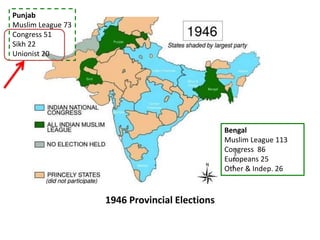
1946 Provincial Elections
Punjab
Muslim League 73
Congress 51
Sikh 22
Unionist 20
Bengal
Muslim League 113
Congress 86
Europeans 25
Other & Indep. 26
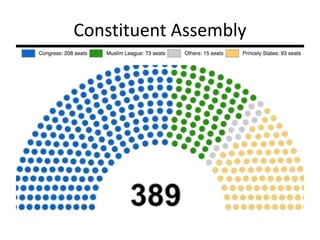
Constituent Assembly
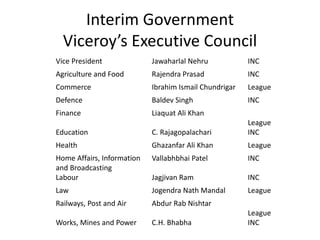
Interim Government
Viceroy’s Executive Council
Vice President Jawaharlal Nehru INC
Agriculture and Food Rajendra Prasad INC
Commerce Ibrahim Ismail Chundrigar League
Defence Baldev Singh INC
Finance Liaquat Ali Khan
League
Education C. Rajagopalachari INC
Health Ghazanfar Ali Khan League
Home Affairs, Information
and Broadcasting
Vallabhbhai Patel INC
Labour Jagjivan Ram INC
Law Jogendra Nath Mandal League
Railways, Post and Air Abdur Rab Nishtar
League
Works, Mines and Power C.H. Bhabha INC
Britain in Debt
• Post-war debt
Total £3,355 million US £1,100 million India £1,321 million
• Some receipts were used to retire pre-war debt
Source of Debt
1940 Financial settlement
• Britain would pay for
– Cost of Indian troops beyond peacetime levels which were
sent abroad
– Wartime increase in costs related to external defense
forces which existed before the war but were subsequently
sent abroad
Japanese occupied Burma was considered foreign
Churchill’s counter claim for protection was rejected
Post War
• Attlee rules out offering concessions to India for
political purposes
• Nehru states the debt represents ‘the hunger,
famine, epidemics, emasculation, weakened
resistance, stunted growth, and death by starvation
and disease of vast numbers of human beings in
India’
• Britain asked for low interest rates and low releases
• 1949 30% devaluation of the pound
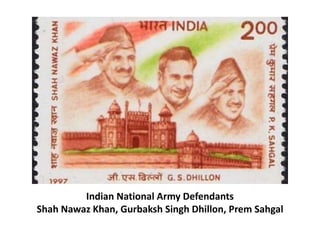
Indian National Army Defendants
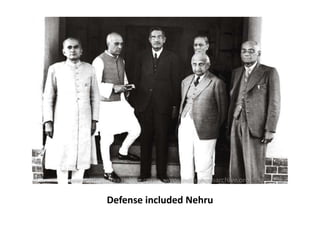
Shah Nawaz Khan, Gurbaksh Singh Dhillon, Prem Sahgal
Defense included Nehru
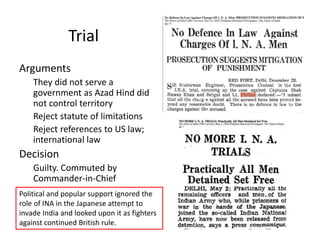
Trial
Arguments
They did not serve a
government as Azad Hind did
not control territory
Reject statute of limitations
Reject references to US law;
international law
Decision
Guilty. Commuted by
Commander-in-Chief
Political and popular support ignored the
role of INA in the Japanese attempt to
invade India and looked upon it as fighters
against continued British rule.
Demands
• Release of INA POWs and naval detainees
• Withdrawal of Indian troops from Indonesia and
Egypt,
• Equal status in pay and allowances
• Best class of Indian food.
– Inquiry found some food only fit for animals
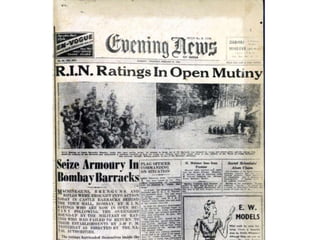
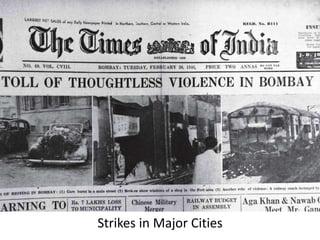
Strikes in Major Cities
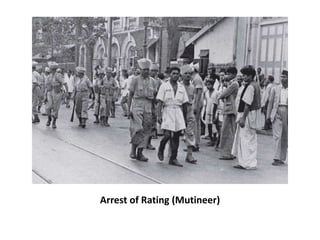
Arrest of Rating (Mutineer)
Further Military Unrest
• February 11 HMIS Hindustan subdued by artillery in
Karachi harbor
• February 26, 1946 120 army men of the ‘J’ company
of the Signals Training Centre (STC), Jabalpur strike;
grows to 1,700
Effects of the Mutiny
• 66-80 ships involved
• 20,000 involved
• ~200 ratings killed
• No support from political leaders (except Communist
Party of India)
• Jinnah of the Muslim League and Sardar Patel of
Congress ask for surrender
• Wavell suggests acceleration of independence
[British have doubts about continued reliance on
native troops to suppress domestic unrest]
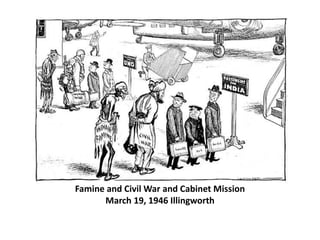
Famine and Civil War and Cabinet Mission
March 19, 1946 Illingworth
May 1946 Cabinet Mission Plan
• Two-nation plan with NW including Punjab and NE
including Bengal and Assam subject to later border
adjustments – Would not solve communal violence
problem because fo sizable minorities
• Two-nation plan with smaller Muslim majority areas
– Would still split the Sikhs. Problem of differences
between NW and Bengal
• Most powers given to provinces except foreign
affairs, defense and communications - Unwieldy
Cabinet plan
Union of India comprising province and States with
powers over foreign affairs, defense and
communications
Central legislature with seats for three communities (Punjab
and NW; Bengal and Assam; others); Each to have veto power
Provinces to have other powers and be free to form
unions with common executive and legislature
Unable to bring Jinnah and Nehru to the same table
to negotiate differences
Constituent Assembly
• Elected by provincial assemblies
• Purpose: Outline a constitution for an independent
India
Lahore Resolution 1940
All-India Muslim League
The scheme of Federation embodied in the Government of India
Act, 1935 is unsuited to, and unworkable in the peculiar
conditions of this country and is altogether unacceptable to
Muslim India.
No constitutional plan would be workable …or acceptable to
Muslims unless … geographically contiguous units are
demarcated into regions with areas in which the Muslims are
numerically in a majority, as in the North-Western and Eastern
Zones of India, grouped to constitute ‘Independent States’ in
which the constituent units shall be autonomous and sovereign.
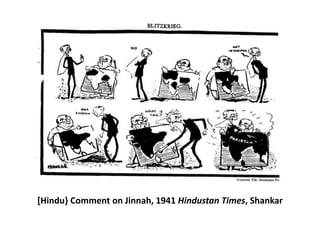
[Hindu} Comment on Jinnah, 1941 Hindustan Times, Shankar
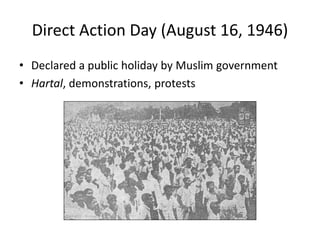
Direct Action Day (August 16, 1946)
• Declared a public holiday by Muslim government
• Hartal, demonstrations, protests
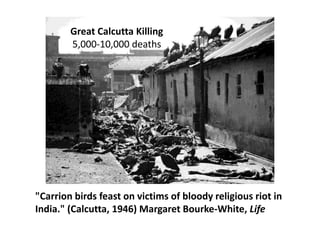
"Carrion birds feast on victims of bloody religious riot in
India." (Calcutta, 1946) Margaret Bourke-White, Life
Great Calcutta Killing
5,000-10,000 deaths
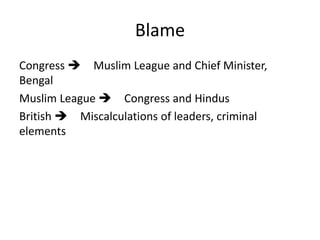
Blame
Congress  Muslim League and Chief Minister,
Bengal
Muslim League  Congress and Hindus
British  Miscalculations of leaders, criminal
elements
1946 Bihar Riots
Hindu response to Calcutta riots
– Est. deaths 2,000 (INC), 5,000 (British), 50,000 (League)
Impeding smooth transition of power (London Times)
Nehru ascribes it to Viceroy or British-Muslim intrigue
Jinnah finds a plot against Muslims with the Viceroy a
tool of Congress
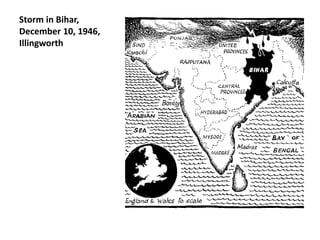
Storm in Bihar,
December 10, 1946,
Illingworth
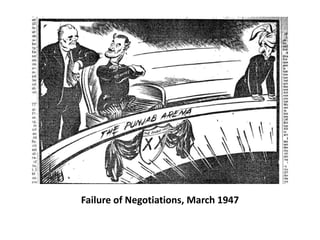
Failure of Negotiations, March 1947
Concerns in Parliament –
Independence Timeline
• Continued control
– Would require substantial number of troops
– Require a plan to remain 15-20 years to reorganize
• Churchill in discussions of independence
– Bypass Dominion
– Neglect disadvantaged class
– Does not achieve Hindu-Muslim accord
– Time limit on new Viceroy
– This Government of Mr. Nehru has been a complete
disaster – weakened, corruption rising
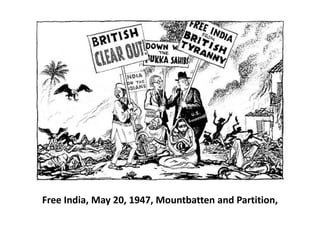
Free India, May 20, 1947, Mountbatten and Partition,
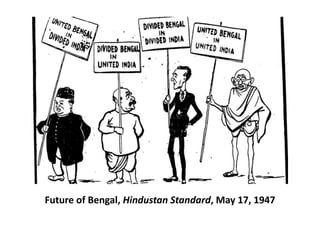
Future of Bengal, Hindustan Standard, May 17, 1947
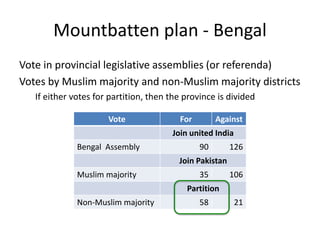
Mountbatten plan - Bengal
Vote in provincial legislative assemblies (or referenda)
Votes by Muslim majority and non-Muslim majority districts
If either votes for partition, then the province is divided
Vote For Against
Join united India
Bengal Assembly 90 126
Join Pakistan
Muslim majority 35 106
Partition
Non-Muslim majority 58 21
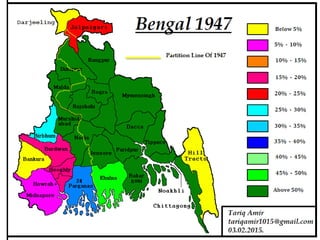
Religious map
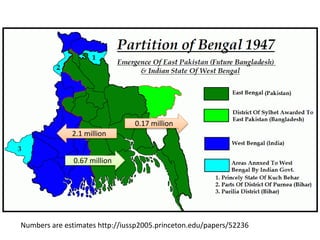
Partition of Bengal
2.1 million
0.67 million
0.17 million
Numbers are estimates http://iussp2005.princeton.edu/papers/52236
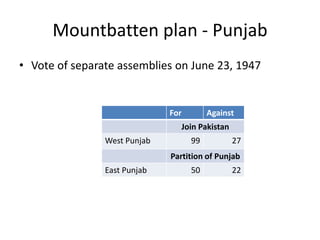
Mountbatten plan - Punjab
• Vote of separate assemblies on June 23, 1947
For Against
Join Pakistan
West Punjab 99 27
Partition of Punjab
East Punjab 50 22
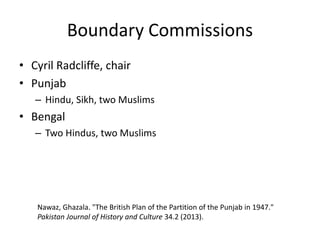
Boundary Commissions
• Cyril Radcliffe, chair
• Punjab
– Hindu, Sikh, two Muslims
• Bengal
– Two Hindus, two Muslims
Nawaz, Ghazala. "The British Plan of the Partition of the Punjab in 1947."
Pakistan Journal of History and Culture 34.2 (2013).
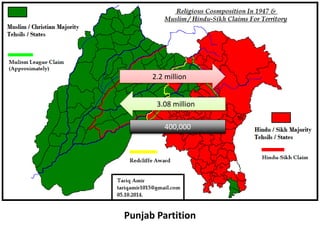
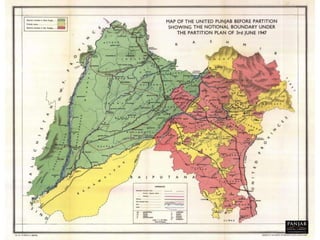
Punjab Partition
2.2 million
3.08 million
400,000
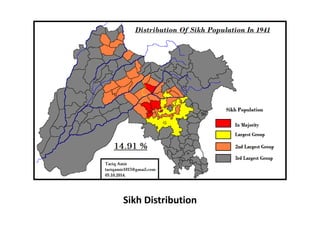
Sikh Distribution
Punjab - Kashmir
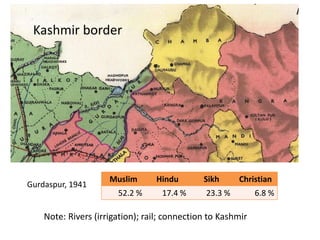
Kashmir border
Muslim Hindu Sikh Christian
52.2 % 17.4 % 23.3 % 6.8 %
Gurdaspur, 1941
Note: Rivers (irrigation); rail; connection to Kashmir
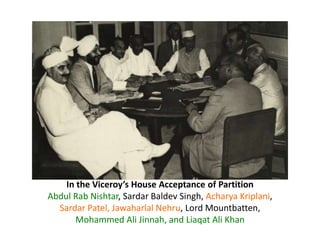
In the Viceroy’s House Acceptance of Partition
Abdul Rab Nishtar, Sardar Baldev Singh, Acharya Kriplani,
Sardar Patel, Jawaharlal Nehru, Lord Mountbatten,
Mohammed Ali Jinnah, and Liaqat Ali Khan
India Independence Act
I see that in actual fact the British Raj to-day has no
effective power in the Indian sub-continent. That being
so, I say it is better to recognize that fact and to transfer
with the effective powers that India now possesses full
responsibility for carrying out those powers. I venture
to say that the sooner this Bill becomes operative, the
sooner full responsibility is placed upon Indian
shoulders, the better for the British Parliament, and the
better for the whole relations of the British
Commonwealth.
Lord Templeton
India Independence Act
• Concerns
– Civil service
– European employees of railroads, police, technical services
Princely States, etc.
Junagadh (surrounded by India) Muslim Nizam joins Pakistan;
Hyderabad Nizam chooses to remain independent
Jammu and Kashmir Hindu ruler chooses independence but
accedes to India after Muslim invasion
Sikkim Not considered part of India by Nehru.
Other areas
Pondicherry and the rest of French India votes to join India in
1954
Goa and Portuguese India are defeated by the Indian Army in
1961
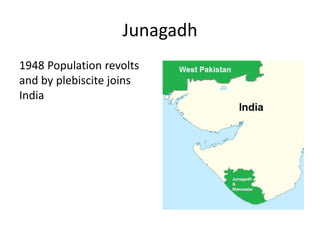
Junagadh
1948 Population revolts
and by plebiscite joins
India
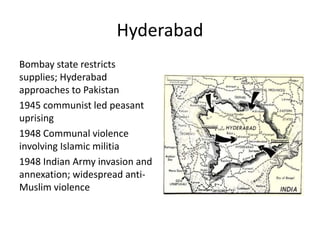
Hyderabad
Bombay state restricts
supplies; Hyderabad
approaches to Pakistan
1945 communist led peasant
uprising
1948 Communal violence
involving Islamic militia
1948 Indian Army invasion and
annexation; widespread anti-
Muslim violence
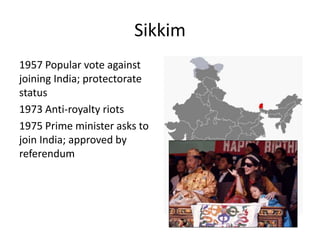
Sikkim
1957 Popular vote against
joining India; protectorate
status
1973 Anti-royalty riots
1975 Prime minister asks to
join India; approved by
referendum
Tryst with Destiny August 15, 1947
https://www.youtube.com/watch?v=1wUcw8Ufx_Y
https://www.youtube.com/watch?v=SB5GfIaAuaQ [full]
• Nehru’s speech on the eve of Independence

13 The Raj Independence and Partition

  • 2.
    IN THE IMPERIALSECRETARIAT LIBRARY, A CURATOR TRIES TO DIVIDE A 150,000-VOLUME COLLECTION INTO EQUAL PARTS FOR EACH NEW STATE Life Magazine August 18, 1947
  • 3.
    Questions World War Iwas called a war to make the world “safe for democracy.” What do some Indian historians call World War II? The Imperial War. Why did two British generals lead a war against each other?
  • 4.
    Answers • World WarIi is often called the Imperial War because it involved the whole British Empire. However many in England doubted whether they should fight for an emorie when they wanted freedom from its rule. • After independence, British generals were retained as commanders-in-chief for a short period. This last through the 1947-48 Kashmir conflict.
  • 5.
    Accelerating British Grantof Independence • Trial of Indian National Army leaders • Indian Navy Mutiny • Imperial wars: Use of British Indian troops in French Indo-China and Indonesia • India defense – Positive for UK during war (net gain in army) – Negative for UK post war (cost of British occupying force) • Wartime debt to India ~£1.3 billion
  • 6.
    1946 Provincial Elections Punjab MuslimLeague 73 Congress 51 Sikh 22 Unionist 20 Bengal Muslim League 113 Congress 86 Europeans 25 Other & Indep. 26
  • 7.
  • 8.
    Interim Government Viceroy’s ExecutiveCouncil Vice President Jawaharlal Nehru INC Agriculture and Food Rajendra Prasad INC Commerce Ibrahim Ismail Chundrigar League Defence Baldev Singh INC Finance Liaquat Ali Khan League Education C. Rajagopalachari INC Health Ghazanfar Ali Khan League Home Affairs, Information and Broadcasting Vallabhbhai Patel INC Labour Jagjivan Ram INC Law Jogendra Nath Mandal League Railways, Post and Air Abdur Rab Nishtar League Works, Mines and Power C.H. Bhabha INC
  • 9.
    Britain in Debt •Post-war debt Total £3,355 million US £1,100 million India £1,321 million • Some receipts were used to retire pre-war debt
  • 10.
    Source of Debt 1940Financial settlement • Britain would pay for – Cost of Indian troops beyond peacetime levels which were sent abroad – Wartime increase in costs related to external defense forces which existed before the war but were subsequently sent abroad Japanese occupied Burma was considered foreign Churchill’s counter claim for protection was rejected
  • 11.
    Post War • Attleerules out offering concessions to India for political purposes • Nehru states the debt represents ‘the hunger, famine, epidemics, emasculation, weakened resistance, stunted growth, and death by starvation and disease of vast numbers of human beings in India’ • Britain asked for low interest rates and low releases • 1949 30% devaluation of the pound
  • 12.
    Indian National ArmyDefendants Shah Nawaz Khan, Gurbaksh Singh Dhillon, Prem Sahgal
  • 13.
  • 14.
    Trial Arguments They did notserve a government as Azad Hind did not control territory Reject statute of limitations Reject references to US law; international law Decision Guilty. Commuted by Commander-in-Chief Political and popular support ignored the role of INA in the Japanese attempt to invade India and looked upon it as fighters against continued British rule.
  • 16.
    Demands • Release ofINA POWs and naval detainees • Withdrawal of Indian troops from Indonesia and Egypt, • Equal status in pay and allowances • Best class of Indian food. – Inquiry found some food only fit for animals
  • 17.
  • 18.
    Arrest of Rating(Mutineer)
  • 19.
    Further Military Unrest •February 11 HMIS Hindustan subdued by artillery in Karachi harbor • February 26, 1946 120 army men of the ‘J’ company of the Signals Training Centre (STC), Jabalpur strike; grows to 1,700
  • 20.
    Effects of theMutiny • 66-80 ships involved • 20,000 involved • ~200 ratings killed • No support from political leaders (except Communist Party of India) • Jinnah of the Muslim League and Sardar Patel of Congress ask for surrender • Wavell suggests acceleration of independence [British have doubts about continued reliance on native troops to suppress domestic unrest]
  • 21.
    Famine and CivilWar and Cabinet Mission March 19, 1946 Illingworth
  • 22.
    May 1946 CabinetMission Plan • Two-nation plan with NW including Punjab and NE including Bengal and Assam subject to later border adjustments – Would not solve communal violence problem because fo sizable minorities • Two-nation plan with smaller Muslim majority areas – Would still split the Sikhs. Problem of differences between NW and Bengal • Most powers given to provinces except foreign affairs, defense and communications - Unwieldy
  • 23.
    Cabinet plan Union ofIndia comprising province and States with powers over foreign affairs, defense and communications Central legislature with seats for three communities (Punjab and NW; Bengal and Assam; others); Each to have veto power Provinces to have other powers and be free to form unions with common executive and legislature Unable to bring Jinnah and Nehru to the same table to negotiate differences
  • 24.
    Constituent Assembly • Electedby provincial assemblies • Purpose: Outline a constitution for an independent India
  • 25.
    Lahore Resolution 1940 All-IndiaMuslim League The scheme of Federation embodied in the Government of India Act, 1935 is unsuited to, and unworkable in the peculiar conditions of this country and is altogether unacceptable to Muslim India. No constitutional plan would be workable …or acceptable to Muslims unless … geographically contiguous units are demarcated into regions with areas in which the Muslims are numerically in a majority, as in the North-Western and Eastern Zones of India, grouped to constitute ‘Independent States’ in which the constituent units shall be autonomous and sovereign.
  • 26.
    [Hindu} Comment onJinnah, 1941 Hindustan Times, Shankar
  • 27.
    Direct Action Day(August 16, 1946) • Declared a public holiday by Muslim government • Hartal, demonstrations, protests
  • 28.
    "Carrion birds feaston victims of bloody religious riot in India." (Calcutta, 1946) Margaret Bourke-White, Life Great Calcutta Killing 5,000-10,000 deaths
  • 29.
    Blame Congress  MuslimLeague and Chief Minister, Bengal Muslim League  Congress and Hindus British  Miscalculations of leaders, criminal elements
  • 30.
    1946 Bihar Riots Hinduresponse to Calcutta riots – Est. deaths 2,000 (INC), 5,000 (British), 50,000 (League) Impeding smooth transition of power (London Times) Nehru ascribes it to Viceroy or British-Muslim intrigue Jinnah finds a plot against Muslims with the Viceroy a tool of Congress
  • 31.
    Storm in Bihar, December10, 1946, Illingworth
  • 32.
  • 33.
    Concerns in Parliament– Independence Timeline • Continued control – Would require substantial number of troops – Require a plan to remain 15-20 years to reorganize • Churchill in discussions of independence – Bypass Dominion – Neglect disadvantaged class – Does not achieve Hindu-Muslim accord – Time limit on new Viceroy – This Government of Mr. Nehru has been a complete disaster – weakened, corruption rising
  • 34.
    Free India, May20, 1947, Mountbatten and Partition,
  • 35.
    Future of Bengal,Hindustan Standard, May 17, 1947
  • 36.
    Mountbatten plan -Bengal Vote in provincial legislative assemblies (or referenda) Votes by Muslim majority and non-Muslim majority districts If either votes for partition, then the province is divided Vote For Against Join united India Bengal Assembly 90 126 Join Pakistan Muslim majority 35 106 Partition Non-Muslim majority 58 21
  • 37.
  • 38.
    Partition of Bengal 2.1million 0.67 million 0.17 million Numbers are estimates http://iussp2005.princeton.edu/papers/52236
  • 39.
    Mountbatten plan -Punjab • Vote of separate assemblies on June 23, 1947 For Against Join Pakistan West Punjab 99 27 Partition of Punjab East Punjab 50 22
  • 40.
    Boundary Commissions • CyrilRadcliffe, chair • Punjab – Hindu, Sikh, two Muslims • Bengal – Two Hindus, two Muslims Nawaz, Ghazala. "The British Plan of the Partition of the Punjab in 1947." Pakistan Journal of History and Culture 34.2 (2013).
  • 41.
  • 42.
  • 43.
  • 44.
    Kashmir border Muslim HinduSikh Christian 52.2 % 17.4 % 23.3 % 6.8 % Gurdaspur, 1941 Note: Rivers (irrigation); rail; connection to Kashmir
  • 45.
    In the Viceroy’sHouse Acceptance of Partition Abdul Rab Nishtar, Sardar Baldev Singh, Acharya Kriplani, Sardar Patel, Jawaharlal Nehru, Lord Mountbatten, Mohammed Ali Jinnah, and Liaqat Ali Khan
  • 46.
    India Independence Act Isee that in actual fact the British Raj to-day has no effective power in the Indian sub-continent. That being so, I say it is better to recognize that fact and to transfer with the effective powers that India now possesses full responsibility for carrying out those powers. I venture to say that the sooner this Bill becomes operative, the sooner full responsibility is placed upon Indian shoulders, the better for the British Parliament, and the better for the whole relations of the British Commonwealth. Lord Templeton
  • 47.
    India Independence Act •Concerns – Civil service – European employees of railroads, police, technical services
  • 48.
    Princely States, etc. Junagadh(surrounded by India) Muslim Nizam joins Pakistan; Hyderabad Nizam chooses to remain independent Jammu and Kashmir Hindu ruler chooses independence but accedes to India after Muslim invasion Sikkim Not considered part of India by Nehru. Other areas Pondicherry and the rest of French India votes to join India in 1954 Goa and Portuguese India are defeated by the Indian Army in 1961
  • 49.
    Junagadh 1948 Population revolts andby plebiscite joins India
  • 50.
    Hyderabad Bombay state restricts supplies;Hyderabad approaches to Pakistan 1945 communist led peasant uprising 1948 Communal violence involving Islamic militia 1948 Indian Army invasion and annexation; widespread anti- Muslim violence
  • 51.
    Sikkim 1957 Popular voteagainst joining India; protectorate status 1973 Anti-royalty riots 1975 Prime minister asks to join India; approved by referendum
  • 52.
    Tryst with DestinyAugust 15, 1947 https://www.youtube.com/watch?v=1wUcw8Ufx_Y https://www.youtube.com/watch?v=SB5GfIaAuaQ [full] • Nehru’s speech on the eve of Independence

Editor's Notes

  • #6 No longer trust Indian army for domestic security
  • #7 Rahman, Fazlur. "The Significance of 1945-1946 Elections in the Creation of Pakistan." Pakistan Journal of History and Culture 29.2 (2008). Talbot, Ian A. "The 1946 Punjab Elections." Modern Asian Studies 14.1 (1980): 65-91.
  • #9 From October 15, 1946 when Muslim League agrees ton join
  • #11 Amery was critical of Churchill: ‘when driving to the station to catch a life or death train . . . I shouldhardly think that you . . . would tell the cabby man that you have no intention ofpaying when you get there as you mean to raise a counter-claim’
  • #16 rebellion launched by the seamen on the HMIS Talwar, the shore establishment of the Royal Indian Navy docked at Colaba, Bombay. RIUN cama from avaireity of areas and classes. One worte that he had never carried his own luggage befroe.
  • #20 Spector, Ronald. "The Royal Indian Navy Strike of 1946: a study of cohesion and disintegration in colonial armed forces." Armed Forces & Society 7.2 (1981): 271-284. Davies, Andrew. "Identity and the assemblages of protest: The spatial politics of the Royal Indian Navy Mutiny, 1946." Geoforum 48 (2013): 24-32.
  • #21 Left blamed nationalist leadership of colonial India is for failure of a revolutionary movement. They are perceived to have betrayed the mutineers in order to secure the control of India following its independence for them-selves
  • #22 Two lines of travelers are waiting at an airport. One line is marked “UNO” and contains people representing world famine and world war. The other line is marked “Passengers for India” and contains Victor Alexander, Stafford Cripps and Frederick Pethick-Lawrence.
  • #29 No systematic study of reports. Commission findings never published.
  • #33 “Good show, What!” The cartoon Lord Wavell objected to. The failure of negotiation and ensuing violence in Punjab in March 1947. Wavell checking time, Jinnah’s “no show,” and the “devil” Governor of Punjab, E. M. Jenkins, make this a scene of intrigue, double-crossing, and deceit. Ahmed’s cartoon for the Hindustan Times. March 15, 1947. Continuing this correspondence on perspective and opinion, Lord Wavell, the governor general and viceroy of India (1943-1947), chimed in, cautioning Patel about Hindustan Times’s cartoons: “The Hindustan Times of 15 March, both in its cartoon and in the report from the Punjab, seems to me to contain matter which is actionable under the Press Ordinance. I realize the depth of feeling that has been aroused by these communal disturbances, but I think you should look into the question whether or not action should be taken against the Hindustan Times.”
  • #35 Gandhi, and a group of protesters, including a US sympathiser, are holding placards demanding that the British get out of India. All around them are the bodies of those who have died of hunger or civil war. Historical context: On May 23 1947, the British cabinet took the step of agreeing to Lord Louis Mountabatten’s proposal for the partition of India into two states, one Moslem and the other Hindu.
  • #36 cartoon in the Amrita Bazar Patrika published in May 1947, graphically captured the doubts and confusion in people's minds.5 Titled, ‘Who is Right?’ it showed four key public and political figures, H. S. Suhrawardy, Shyamaprasad Mookerjee (the leader of the Hindu Mahasabha), M. A. Jinnah and M. K. Gandhi each with a placard with their supposed propositions. Thus Suhrawardy holds ‘United Bengal in Divided India’, Mookerjee ‘Divided Bengal in United India’, Jinnah ‘Divided Bengal in Divided India’ and Gandhi holds up a sign with ‘United Bengal in United India’ (Cartoon Source - journals.cambridge.org. Attribution - Figure 1. ‘Who Is Right?’Source: Cartoon in the Hindustan Standard, 17 May 1947, 5
  • #41 Abid, Massarrat. "Boundary Commission Tilting in favour of" Other Factors"." Pakistan Vision 12.2 (2011): 36.
  • #42 Brass, Paul R. "The partition of India and retributive genocide in the Punjab, 1946-47: Means, methods, and purposes 1." Journal of Genocide Research 5.1 (2003): 71-101. http://pakgeotagging.blogspot.com/2014/10/partition-of-punjab-in-1947.html
  • #46 Abdul Rab Nishtar, Muslim League then Member for Posts & Air of the Interim Government. (from NW Province) Sardar Baldev Singh, representing the Sikhs. He was Defence Member of the Interim Government Acharya J. B. Kriplani, then President of the Congress Sardar Patel, then Home Member of the Interim Government Nehru, then Vice President of India's Interim Government and Member, External Affairs. Nehru's posts were commonly seen as equivalent to that of Prime Minister and External Affairs Minister. Mountbatten Jinnah, President Muslim League Liaqat Ali Khan, Muslim League then Finance Member of the Interim Government (first prime minister, assassinated 1951)