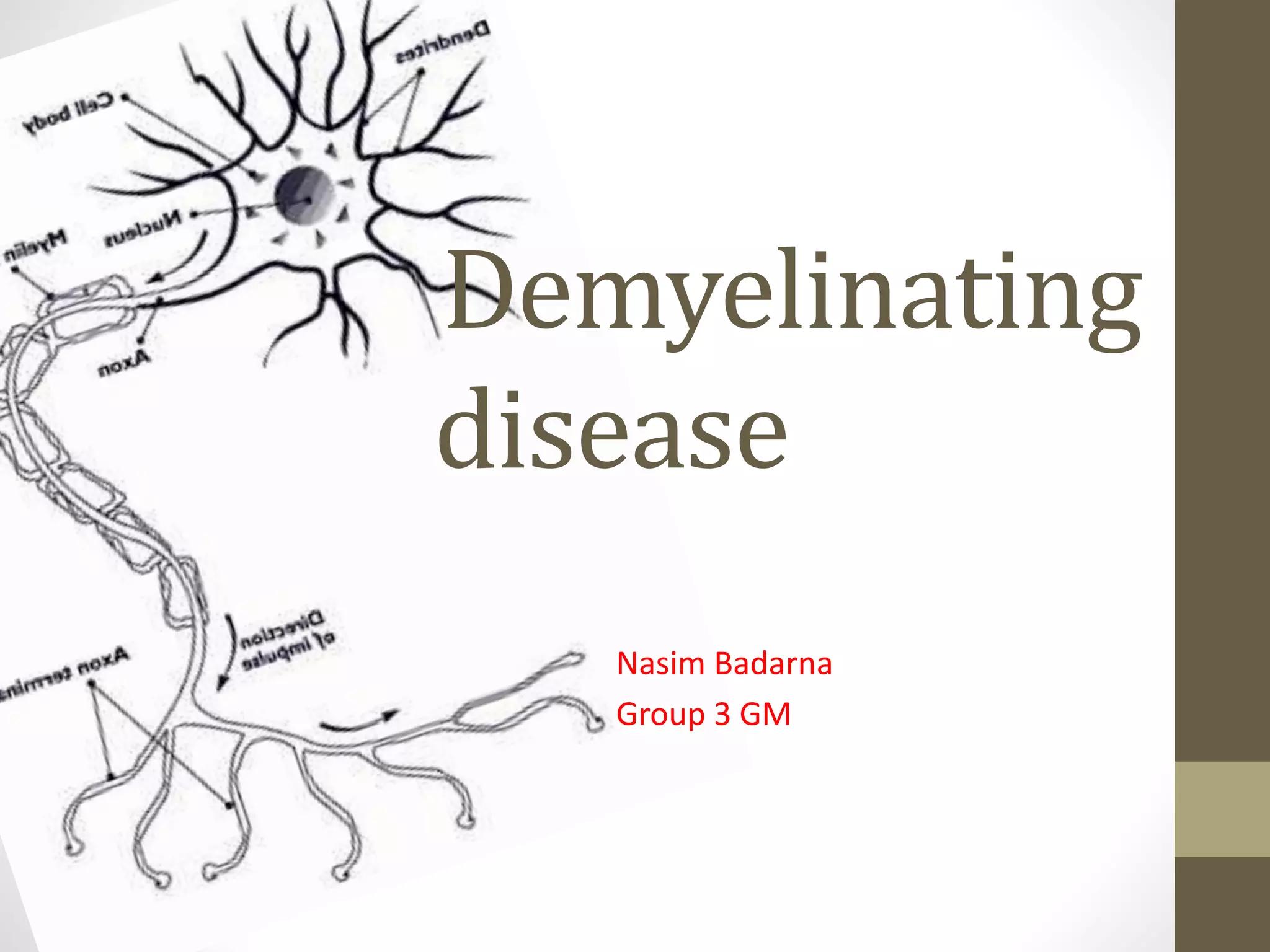
Demyelinating
disease
Nasim Badarna
Group 3 GM
Introduction
• Myelin sheaths cover many nerve fibers in the central and
peripheral nervous system; they accelerate axonal
transmission of neural impulses.
• Myelin formed by oligodendroglia in the CNS and by Schwann
cells peripherally.
demyelinating disease
• A demyelinating disease is any condition that results in
damage to the myelin sheath.
• When the myelin sheath is damaged, nerve impulses slow or
even stop, causing neurological problems.
• the reduction in conduction ability causes deficiency in
sensation, movement, cognition, or other functions
depending on which nerves are involved.
• Demyelination tends to be segmental or patchy, affecting
multiple areas simultaneously or sequentially.
Remyelination often occurs, with repair, regeneration, and
complete recovery of neural function. However, extensive
myelin loss is usually followed by axonal degeneration and
often cell body degeneration; both may be irreversible.
Classification
• Can be divided on basis of the cause
• 1.demyelinating myelinoclastic diseases – secondary:
myelin is destroyed by a toxic (eg, alcohol, ethambutol),
infectious agents, chemical or autoimmune substance.
2. demyelinating leukodystrophic diseases – primary: myelin is
abnormal and degenerates; caused by genetics, and some by
unknown factors.
• can be divided by other criteria in inflammatory and non-
inflammatory, according to the presence or lack of
inflammation.
classification
• Can be divided into 2 groups of diseases presenting
different demyelination conditions
1. affecting the CNS
2. affecting the peripheral nerves.
• Demyelinating disorders of the CNS
• These include:
• Myelinoclastic disorders, in which myelin is attacked by external
substances
• standard Multiple sclerosis, Devic's disease and other disorders with immune
system involvement called inflammatory demyelinating diseases.
• Leukodystrophic disorders, in which myelin is not properly produced:
• CNS Neuropathies like those produced by Vitamin B12 deficiency
• Central pontine myelinolysis
• Myelopathies like Tabes dorsalis (syphilitic Myelopathy)
• leukoencephalopathies like Progressive multifocal leukoencephalopathy
• Leukodystrophies
• These disorders are normally associated also with the conditions Optic
neuritis and Transverse myelitis, which are inflammatory conditions,
because inflammation and demyelination are frequently associated.
Some of them are idiopathic and for some others the cause has been
found, like some cases of neuromyelitis optica.
• Demyelinating diseases of the peripheral nervous system
• Guillain-Barré syndrome and its chronic counterpart, chronic
inflammatory demyelinating polyneuropathy
• Anti-MAG peripheral neuropathy
• Charcot–Marie–Tooth disease
• Copper deficiency associated conditions (peripheral
neuropathy, myelopathy, and rarely optic neuropathy)
• Progressive inflammatory neuropathy
Multiple sclerosis
• Multiple sclerosis (MS) is the most common demyelinating
and autoimmune disease of the central nervous system. In
this disorder, underlying mechanism is thought to be
either destruction by the immune system or failure of
themyelin-producing cells.
• The cause of MS is unknown; however, it is believed to occur
as a result of some combination of genetic and environmental
factors such as infectious agents
• This causes inflammation and injury to the sheath and
ultimately to the nerve fibers that it surrounds and may result
in multiple areas of scarring (sclerosis).
• The three main characteristics of MS are the formation of lesions in
the CNS (AKA plaques), inflammation, and the destruction of myelin
sheaths of neurons. These features interact in a complex and not
yet fully understood manner to produce the breakdown of nerve
tissue.
• These lesions most commonly
affect the white matter in
the optic nerve, brain
stem, basal ganglia, and spinal
cord, or white matter tracts
close to the lateral ventricles.
MonthlymultiplesclerosisMRIanimation.Showsdisseminationoflessionsintimeandspace
duringawholeyear
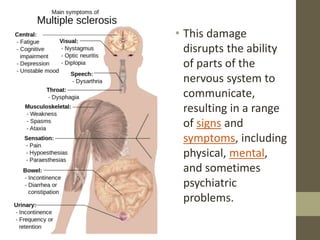
• This damage
disrupts the ability
of parts of the
nervous system to
communicate,
resulting in a range
of signs and
symptoms, including
physical, mental,
and sometimes
psychiatric
problems.
Guillain–Barré syndrome (GBS)
• is a rapid-onset muscle weakness caused by the immune
system damaging the peripheral nervous system.
• Two thirds of people with Guillain–Barré syndrome have
experienced an infection before the onset of the condition.
Most commonly these are episodes of gastroenteritis or
a respiratory tract infection.
• the exact nature of the infection can be
confirmed.[2]Approximately 30% of cases are provoked
by Campylobacter jejuni bacteria, which cause diarrhea. A
further 10% are attributable to cytomegalovirus
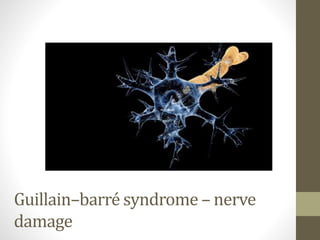
Guillain–barré syndrome – nerve
damage
• Other types of demyelinating disease and their causes include:
• Optic neuritis — inflammation of the optic nerve in one or both
eyes, occurs preferentially in females typically between the ages of
30 and 35
• Neuromyelitis optica (Devic’s disease) — inflammation and
demyelination of the central nervous system, especially of the optic
nerve and spinal cord
• Transverse myelitis — inflammation of the spinal cord
• Acute disseminated encephalomyelitis — inflammation of the brain
and spinal cord
• Adrenoleukodystrophy and adrenomyeloneuropathy — rare,
inherited metabolic disorders
• MS and other demyelinating diseases most commonly result in
vision loss, muscle weakness, muscle stiffness and spasms, loss of
coordination, loss of sensation, pain, and changes in bladder and
bowel function.
• Treatment
• No cures exist for demyelinating diseases and their
progression, and symptoms are different for everyone. Getting
treatment early is important. Treatment focuses on:
• Minimizing the effects of the attacks
• Modifying the course of the disease
• Managing the symptoms
• A variety of drug therapies are recommended depending on
specific disorders. These may include medications that
decrease the frequency of new lesion formation.
• Strategies to treat symptoms include physical therapy, muscle
relaxing drugs, and medications to reduce pain and fatigue.
References
• http://www.merckmanuals.com
Last full review/revision March 2014 by Brian R. Apatoff,
MD, PhD
• http://www.mayoclinic.org/demyelinating-disease/expert-
answers/faq-20058521/
• https://en.wikipedia.org/wiki/Multiple_sclerosis
• "demyelinating disease" at Dorland's Medical Dictionary
The END
•Thank you for your attention

nasim badarna - demyelinating disease

  • 1.
  • 2.
    Introduction • Myelin sheathscover many nerve fibers in the central and peripheral nervous system; they accelerate axonal transmission of neural impulses. • Myelin formed by oligodendroglia in the CNS and by Schwann cells peripherally.
  • 3.
    demyelinating disease • Ademyelinating disease is any condition that results in damage to the myelin sheath. • When the myelin sheath is damaged, nerve impulses slow or even stop, causing neurological problems. • the reduction in conduction ability causes deficiency in sensation, movement, cognition, or other functions depending on which nerves are involved.
  • 4.
    • Demyelination tendsto be segmental or patchy, affecting multiple areas simultaneously or sequentially. Remyelination often occurs, with repair, regeneration, and complete recovery of neural function. However, extensive myelin loss is usually followed by axonal degeneration and often cell body degeneration; both may be irreversible.
  • 5.
    Classification • Can bedivided on basis of the cause • 1.demyelinating myelinoclastic diseases – secondary: myelin is destroyed by a toxic (eg, alcohol, ethambutol), infectious agents, chemical or autoimmune substance. 2. demyelinating leukodystrophic diseases – primary: myelin is abnormal and degenerates; caused by genetics, and some by unknown factors. • can be divided by other criteria in inflammatory and non- inflammatory, according to the presence or lack of inflammation.
  • 6.
    classification • Can bedivided into 2 groups of diseases presenting different demyelination conditions 1. affecting the CNS 2. affecting the peripheral nerves.
  • 7.
    • Demyelinating disordersof the CNS • These include: • Myelinoclastic disorders, in which myelin is attacked by external substances • standard Multiple sclerosis, Devic's disease and other disorders with immune system involvement called inflammatory demyelinating diseases. • Leukodystrophic disorders, in which myelin is not properly produced: • CNS Neuropathies like those produced by Vitamin B12 deficiency • Central pontine myelinolysis • Myelopathies like Tabes dorsalis (syphilitic Myelopathy) • leukoencephalopathies like Progressive multifocal leukoencephalopathy • Leukodystrophies • These disorders are normally associated also with the conditions Optic neuritis and Transverse myelitis, which are inflammatory conditions, because inflammation and demyelination are frequently associated. Some of them are idiopathic and for some others the cause has been found, like some cases of neuromyelitis optica.
  • 8.
    • Demyelinating diseasesof the peripheral nervous system • Guillain-Barré syndrome and its chronic counterpart, chronic inflammatory demyelinating polyneuropathy • Anti-MAG peripheral neuropathy • Charcot–Marie–Tooth disease • Copper deficiency associated conditions (peripheral neuropathy, myelopathy, and rarely optic neuropathy) • Progressive inflammatory neuropathy
  • 9.
    Multiple sclerosis • Multiplesclerosis (MS) is the most common demyelinating and autoimmune disease of the central nervous system. In this disorder, underlying mechanism is thought to be either destruction by the immune system or failure of themyelin-producing cells. • The cause of MS is unknown; however, it is believed to occur as a result of some combination of genetic and environmental factors such as infectious agents • This causes inflammation and injury to the sheath and ultimately to the nerve fibers that it surrounds and may result in multiple areas of scarring (sclerosis).
  • 10.
    • The threemain characteristics of MS are the formation of lesions in the CNS (AKA plaques), inflammation, and the destruction of myelin sheaths of neurons. These features interact in a complex and not yet fully understood manner to produce the breakdown of nerve tissue. • These lesions most commonly affect the white matter in the optic nerve, brain stem, basal ganglia, and spinal cord, or white matter tracts close to the lateral ventricles.
  • 11.
  • 12.
    • This damage disruptsthe ability of parts of the nervous system to communicate, resulting in a range of signs and symptoms, including physical, mental, and sometimes psychiatric problems.
  • 13.
    Guillain–Barré syndrome (GBS) •is a rapid-onset muscle weakness caused by the immune system damaging the peripheral nervous system. • Two thirds of people with Guillain–Barré syndrome have experienced an infection before the onset of the condition. Most commonly these are episodes of gastroenteritis or a respiratory tract infection. • the exact nature of the infection can be confirmed.[2]Approximately 30% of cases are provoked by Campylobacter jejuni bacteria, which cause diarrhea. A further 10% are attributable to cytomegalovirus
  • 14.
  • 15.
    • Other typesof demyelinating disease and their causes include: • Optic neuritis — inflammation of the optic nerve in one or both eyes, occurs preferentially in females typically between the ages of 30 and 35 • Neuromyelitis optica (Devic’s disease) — inflammation and demyelination of the central nervous system, especially of the optic nerve and spinal cord • Transverse myelitis — inflammation of the spinal cord • Acute disseminated encephalomyelitis — inflammation of the brain and spinal cord • Adrenoleukodystrophy and adrenomyeloneuropathy — rare, inherited metabolic disorders • MS and other demyelinating diseases most commonly result in vision loss, muscle weakness, muscle stiffness and spasms, loss of coordination, loss of sensation, pain, and changes in bladder and bowel function.
  • 16.
    • Treatment • Nocures exist for demyelinating diseases and their progression, and symptoms are different for everyone. Getting treatment early is important. Treatment focuses on: • Minimizing the effects of the attacks • Modifying the course of the disease • Managing the symptoms • A variety of drug therapies are recommended depending on specific disorders. These may include medications that decrease the frequency of new lesion formation. • Strategies to treat symptoms include physical therapy, muscle relaxing drugs, and medications to reduce pain and fatigue.
  • 17.
    References • http://www.merckmanuals.com Last fullreview/revision March 2014 by Brian R. Apatoff, MD, PhD • http://www.mayoclinic.org/demyelinating-disease/expert- answers/faq-20058521/ • https://en.wikipedia.org/wiki/Multiple_sclerosis • "demyelinating disease" at Dorland's Medical Dictionary
  • 18.
    The END •Thank youfor your attention

Editor's Notes

  • #4 Cognition : المعرفة