Dr Sandhya Manorenj
Department of Neurology
ESIC Medical College,
Superspeciality hospital
Hyderabad
20/12/17
Munschauer et al. Clin Ther. 1997;19:868.
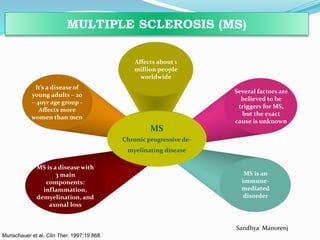
It’s a disease of
young adults – 20
– 40yr age group -
Affects more
women than men
Several factors are
believed to be
triggers for MS,
but the exact
cause is unknown
MS is a disease with
3 main
components:
inflammation,
demyelination, and
axonal loss
MS is an
immune-
mediated
disorder
Affects about 1
million people
worldwide
MS
Chronic progressive de-
myelinating disease
MULTIPLE SCLEROSIS (MS)
Sandhya Manorenj
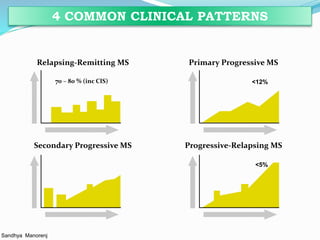
Relapsing-Remitting MS Primary Progressive MS
Secondary Progressive MS Progressive-Relapsing MS
<5%
<12%
Sandhya Manorenj
70 – 80 % (inc CIS)
4 COMMON CLINICAL PATTERNS
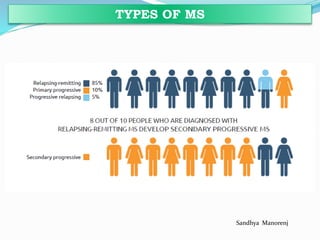
TYPES OF MS
Sandhya Manorenj
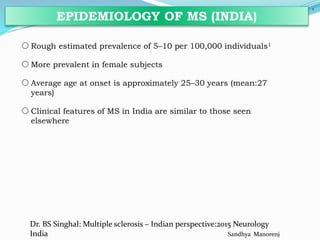
oRough estimated prevalence of 5–10 per 100,000 individuals1
oMore prevalent in female subjects
oAverage age at onset is approximately 25–30 years (mean:27
years)
oClinical features of MS in India are similar to those seen
elsewhere
5
EPIDEMIOLOGY OF MS (INDIA)
Dr. BS Singhal: Multiple sclerosis – Indian perspective:2015 Neurology
India Sandhya Manorenj
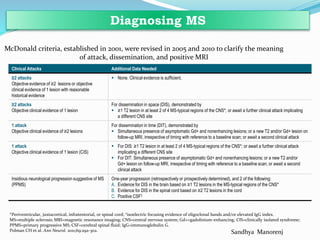
McDonald criteria, established in 2001, were revised in 2005 and 2010 to clarify the meaning
of attack, dissemination, and positive MRI
Clinical Attacks Additional Data Needed
≥2 attacks
Objective evidence of ≥2 lesions or objective
clinical evidence of 1 lesion with reasonable
historical evidence
 None. Clinical evidence is sufficient.
≥2 attacks
Objective clinical evidence of 1 lesion
For dissemination in space (DIS), demonstrated by
 ≥1 T2 lesion in at least 2 of 4 MS-typical regions of the CNS*; or await a further clinical attack implicating
a different CNS site
1 attack
Objective clinical evidence of ≥2 lesions
For dissemination in time (DIT), demonstrated by
 Simultaneous presence of asymptomatic Gd+ and nonenhancing lesions; or a new T2 and/or Gd+ lesion on
follow-up MRI, irrespective of timing with reference to a baseline scan; or await a second clinical attack
1 attack
Objective clinical evidence of 1 lesion (CIS)
 For DIS: ≥1 T2 lesion in at least 2 of 4 MS-typical regions of the CNS*; or await a further clinical attack
implicating a different CNS site
 For DIT: Simultaneous presence of asymptomatic Gd+ and nonenhancing lesions; or a new T2 and/or
Gd+ lesion on follow-up MRI, irrespective of timing with reference to a baseline scan; or await a second
clinical attack
Insidious neurological progression suggestive of MS
(PPMS)
One-year progression (retrospectively or prospectively determined), and 2 of the following:
A. Evidence for DIS in the brain based on ≥1 T2 lesions in the MS-typical regions of the CNS*
B. Evidence for DIS in the spinal cord based on ≥2 T2 lesions in the cord
C. Positive CSF†
*Periventricular, juxtacortical, infratentorial, or spinal cord; †isoelectric focusing evidence of oligoclonal bands and/or elevated IgG index.
MS=multiple sclerosis; MRI=magnetic resonance imaging; CNS=central nervous system; Gd+=gadolinium-enhancing; CIS=clinically isolated syndrome;
PPMS=primary progressive MS; CSF=cerebral spinal fluid; IgG=immunoglobulin G.
Polman CH et al. Ann Neurol. 2011;69:292-302.
Diagnosing MS
Sandhya Manorenj
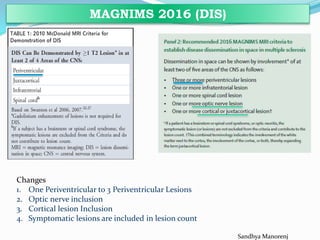
MAGNIMS 2016 (DIS)
Changes
1. One Periventricular to 3 Periventricular Lesions
2. Optic nerve inclusion
3. Cortical lesion Inclusion
4. Symptomatic lesions are included in lesion count
Sandhya Manorenj
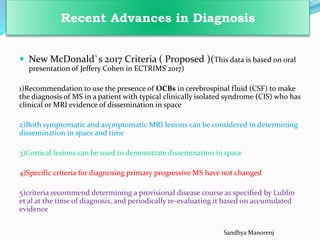
 New McDonald`s 2017 Criteria ( Proposed )(This data is based on oral
presentation of Jeffery Cohen in ECTRIMS 2017)
1)Recommendation to use the presence of OCBs in cerebrospinal fluid (CSF) to make
the diagnosis of MS in a patient with typical clinically isolated syndrome (CIS) who has
clinical or MRI evidence of dissemination in space
2)Both symptomatic and asymptomatic MRI lesions can be considered in determining
dissemination in space and time
3)Cortical lesions can be used to demonstrate dissemination in space
4)Specific criteria for diagnosing primary progressive MS have not changed
5)criteria recommend determining a provisional disease course as specified by Lublin
et al at the time of diagnosis, and periodically re-evaluating it based on accumulated

evidence
Recent Advances in Diagnosis
Sandhya Manorenj
What is acute relapse in MS?
Also called as attacks or acute
exacerbations.
Defined as episodes of focal
neurological disturbance lasting longer
than 24 hrs with a preceding period of
clinical stability of at least 30 days and
without an alternate explanation such
as infection or fever.
Redefining Acute Relapses in Multiple Sclerosis: Implications for Phase 3 Clinical Trials and Treatment
Algorithms
Innov Clin Neurosci. 2017 Mar-Apr; 14(3-4): 38–40. Sandhya Manorenj
What is Pseudo relapse?
 The temporary worsening of existing MS
symptoms in the setting of heat exposure or
infection.
 It can be differentiated by true relapse by the
presence of new lesion that enhances with the
administration of gadolinium on MRI brain/
spinal cord in true relapse.
 So suspected attacks should be evaluated
Types of relapse in MS
 Mild relapse in MS : Only sensory symptoms.
 Highly active relapsing form: ≥ 2 relapses in a year and ≥ 1
Gad+ lesion on T1-weighted MRI
 High disease activity:≥ 1 relapse in a year on therapy or ≥ T2
lession on cranial MRI or ≥ 1 Gad lesion.
 Rapidly evolving severe RRMS: ≥ 2 disabiling relapses in a
year and ≥ 1 Gad+ lesion on T1-weighted MRI or sigificant
increase in T2 burden from previous MRI.
Clinically isolated syndrome(CIS)
 Defined as the first clinical episode ,an event or
precedent history that is suggestive of demyelination
or of multiple sclerosis, lasts at least 24hrs and occurs
in the absence of fever, infection or encephalopathy.
 Single attack in time, it is not necessary isolated in
space, one quarter present with multifocal
abnormalities.
Sandhya Manorenj
Radiologically isolated
sydrome(RIS)
 RIS defined as incidental brain or spinal cord MRI
findings that are highly suggestive of MS ,based on
location and morphology within CNS in an
asymptomatic patient lacking any history ,symptoms
or signs of multiple sclerosis.
 Follow up needed.
Sandhya Manorenj
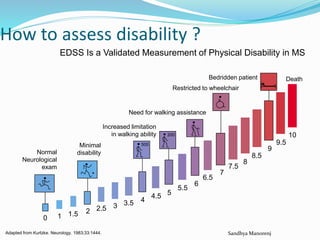
How to assess disability ?
Adapted from Kurtzke. Neurology. 1983;33:1444.
0 1 1.5
2.5
3.5
4.5
5.5
6.5
7.5
8.5
9.5
10
2
3
4
5
6
7
8
9
500
200
Normal
Neurological
exam
Minimal
disability
Increased limitation
in walking ability
Need for walking assistance
Restricted to wheelchair
Bedridden patient Death
EDSS Is a Validated Measurement of Physical Disability in MS
Sandhya Manorenj
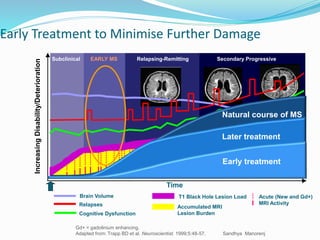
Early Treatment to Minimise Further Damage
Gd+ = gadolinium enhancing.
Adapted from: Trapp BD et al. Neuroscientist. 1999;5:48-57. Sandhya Manorenj
Relapses
Brain Volume T1 Black Hole Lesion Load
Cognitive Dysfunction
Accumulated MRI
Lesion Burden
Acute (New and Gd+)
MRI Activity
Time
IncreasingDisability/Deterioration
Subclinical EARLY MS Relapsing-Remitting Secondary Progressive
Natural course of MS
Later treatment
Early treatment
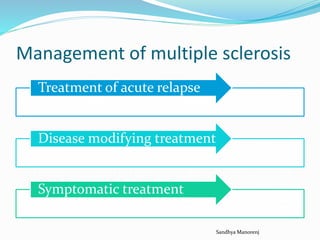
Management of multiple sclerosis
Treatment of acute relapse
Disease modifying treatment
Symptomatic treatment
Sandhya Manorenj
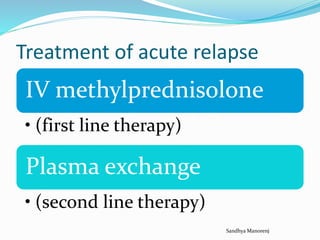
Treatment of acute relapse
IV methylprednisolone
• (first line therapy)
Plasma exchange
• (second line therapy)
Sandhya Manorenj
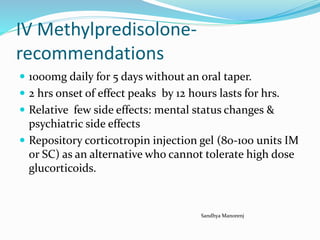
IV Methylpredisolone-
recommendations
 1000mg daily for 5 days without an oral taper.
 2 hrs onset of effect peaks by 12 hours lasts for hrs.
 Relative few side effects: mental status changes &
psychiatric side effects
 Repository corticotropin injection gel (80-100 units IM
or SC) as an alternative who cannot tolerate high dose
glucorticoids.
Sandhya Manorenj
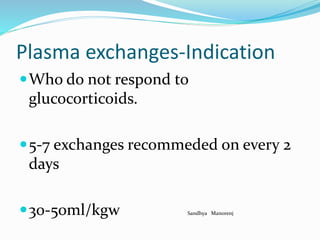
Plasma exchanges-Indication
Who do not respond to
glucocorticoids.
5-7 exchanges recommeded on every 2
days
30-50ml/kgw Sandhya Manorenj
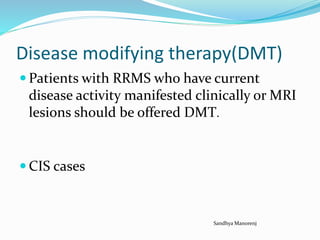
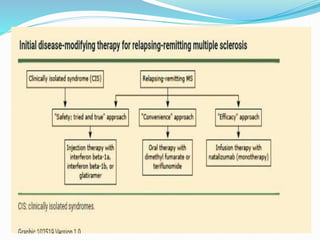
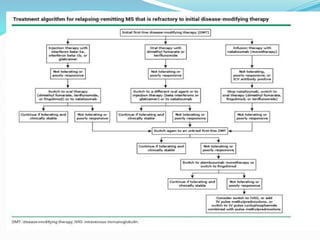
Disease modifying therapy(DMT)
 Patients with RRMS who have current
disease activity manifested clinically or MRI
lesions should be offered DMT.
 CIS cases
Sandhya Manorenj
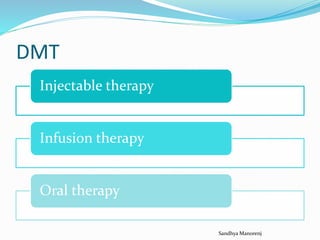
DMT
Injectable therapy
Infusion therapy
Oral therapy
Sandhya Manorenj
Injectable therapy
 Interferons
 Glatiramer (20 mg sc daily)
 Daclizumab
IFN beta 1a 30mcg IM once weekly
IFN beta 1b SC 22 or 44 mcg 3 times/week
IFN beta 1b 0.25mg SC daily
Peglated IFN beta 1a 125mcg every 2 weeks
Sandhya Manorenj
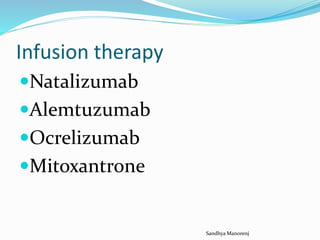
Infusion therapy
Natalizumab
Alemtuzumab
Ocrelizumab
Mitoxantrone
Sandhya Manorenj
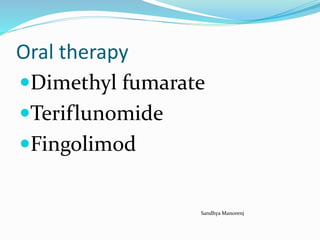
Oral therapy
Dimethyl fumarate
Teriflunomide
Fingolimod
Sandhya Manorenj
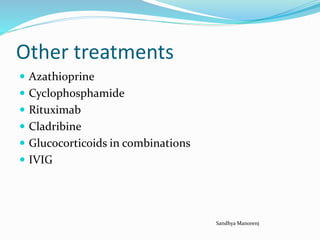
Other treatments
 Azathioprine
 Cyclophosphamide
 Rituximab
 Cladribine
 Glucocorticoids in combinations
 IVIG
Sandhya Manorenj

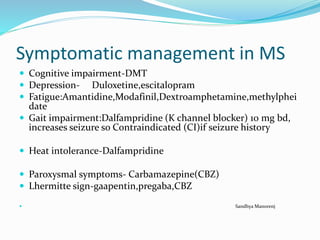
Symptomatic management in MS
 Cognitive impairment-DMT
 Depression- Duloxetine,escitalopram
 Fatigue:Amantidine,Modafinil,Dextroamphetamine,methylphei
date
 Gait impairment:Dalfampridine (K channel blocker) 10 mg bd,
increases seizure so Contraindicated (CI)if seizure history
 Heat intolerance-Dalfampridine
 Paroxysmal symptoms- Carbamazepine(CBZ)
 Lhermitte sign-gaapentin,pregaba,CBZ
 Sandhya Manorenj
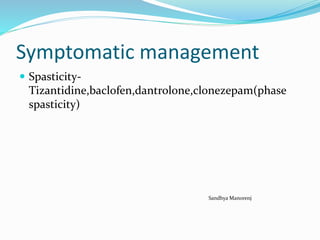
Symptomatic management
 Spasticity-
Tizantidine,baclofen,dantrolone,clonezepam(phase
spasticity)
Sandhya Manorenj
Treatment of PPMS
 Ocrelizumab:only drug to receive FDA for use in adult
PPMS(march 2017) grade2B
 Anti-CD20 monoclonal ab designed to optomize cell
depletion
 ORATORIO trial
 300mg infusion given 14 days apart(total-600mg) for
atleast 120 weeks
 CI in hepatitis B infection
Sandhya Manorenj
MS in children-Management
 Methylprednisolone 20-30mg/kg given for 5 days
 Failure to steroids-IVIG 400mg/kg for 5days.
 DMT-Injectable therapy first line then natalizumab,
fingolimod,dimethyl fumarate
 Sandhya Manorenj
Monitoring response to therapy
 Clinical follow up –acute attacks,
 Cognitive assessment
 EDSS every 3 months
 MRI every 12 months
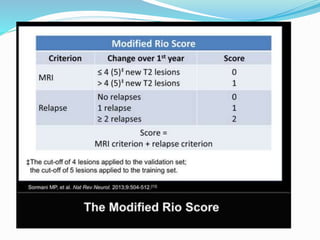
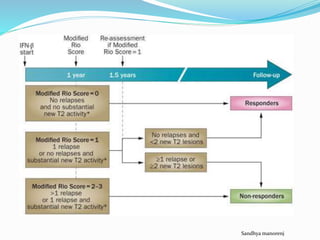
 Modified Rio score
Sandhya Manorenj
Sandhya manorenj
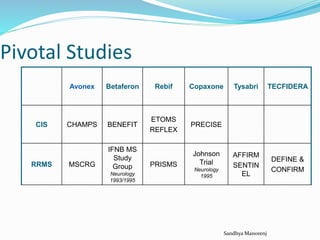
Pivotal Studies
Avonex Betaferon Rebif Copaxone Tysabri TECFIDERA
CIS CHAMPS BENEFIT
ETOMS
REFLEX
PRECISE
RRMS MSCRG
IFNB MS
Study
Group
Neurology
1993/1995
PRISMS
Johnson
Trial
Neurology
1995
AFFIRM
SENTIN
EL
DEFINE &
CONFIRM
Sandhya Manorenj
Sandhya Manorenj
Multiple sclerosis

Multiple sclerosis

  • 1.
    Dr Sandhya Manorenj Departmentof Neurology ESIC Medical College, Superspeciality hospital Hyderabad 20/12/17
  • 2.
    Munschauer et al.Clin Ther. 1997;19:868. It’s a disease of young adults – 20 – 40yr age group - Affects more women than men Several factors are believed to be triggers for MS, but the exact cause is unknown MS is a disease with 3 main components: inflammation, demyelination, and axonal loss MS is an immune- mediated disorder Affects about 1 million people worldwide MS Chronic progressive de- myelinating disease MULTIPLE SCLEROSIS (MS) Sandhya Manorenj
  • 3.
    Relapsing-Remitting MS PrimaryProgressive MS Secondary Progressive MS Progressive-Relapsing MS <5% <12% Sandhya Manorenj 70 – 80 % (inc CIS) 4 COMMON CLINICAL PATTERNS
  • 4.
  • 5.
    oRough estimated prevalenceof 5–10 per 100,000 individuals1 oMore prevalent in female subjects oAverage age at onset is approximately 25–30 years (mean:27 years) oClinical features of MS in India are similar to those seen elsewhere 5 EPIDEMIOLOGY OF MS (INDIA) Dr. BS Singhal: Multiple sclerosis – Indian perspective:2015 Neurology India Sandhya Manorenj
  • 6.
    McDonald criteria, establishedin 2001, were revised in 2005 and 2010 to clarify the meaning of attack, dissemination, and positive MRI Clinical Attacks Additional Data Needed ≥2 attacks Objective evidence of ≥2 lesions or objective clinical evidence of 1 lesion with reasonable historical evidence  None. Clinical evidence is sufficient. ≥2 attacks Objective clinical evidence of 1 lesion For dissemination in space (DIS), demonstrated by  ≥1 T2 lesion in at least 2 of 4 MS-typical regions of the CNS*; or await a further clinical attack implicating a different CNS site 1 attack Objective clinical evidence of ≥2 lesions For dissemination in time (DIT), demonstrated by  Simultaneous presence of asymptomatic Gd+ and nonenhancing lesions; or a new T2 and/or Gd+ lesion on follow-up MRI, irrespective of timing with reference to a baseline scan; or await a second clinical attack 1 attack Objective clinical evidence of 1 lesion (CIS)  For DIS: ≥1 T2 lesion in at least 2 of 4 MS-typical regions of the CNS*; or await a further clinical attack implicating a different CNS site  For DIT: Simultaneous presence of asymptomatic Gd+ and nonenhancing lesions; or a new T2 and/or Gd+ lesion on follow-up MRI, irrespective of timing with reference to a baseline scan; or await a second clinical attack Insidious neurological progression suggestive of MS (PPMS) One-year progression (retrospectively or prospectively determined), and 2 of the following: A. Evidence for DIS in the brain based on ≥1 T2 lesions in the MS-typical regions of the CNS* B. Evidence for DIS in the spinal cord based on ≥2 T2 lesions in the cord C. Positive CSF† *Periventricular, juxtacortical, infratentorial, or spinal cord; †isoelectric focusing evidence of oligoclonal bands and/or elevated IgG index. MS=multiple sclerosis; MRI=magnetic resonance imaging; CNS=central nervous system; Gd+=gadolinium-enhancing; CIS=clinically isolated syndrome; PPMS=primary progressive MS; CSF=cerebral spinal fluid; IgG=immunoglobulin G. Polman CH et al. Ann Neurol. 2011;69:292-302. Diagnosing MS Sandhya Manorenj
  • 7.
    MAGNIMS 2016 (DIS) Changes 1.One Periventricular to 3 Periventricular Lesions 2. Optic nerve inclusion 3. Cortical lesion Inclusion 4. Symptomatic lesions are included in lesion count Sandhya Manorenj
  • 8.
     New McDonald`s2017 Criteria ( Proposed )(This data is based on oral presentation of Jeffery Cohen in ECTRIMS 2017) 1)Recommendation to use the presence of OCBs in cerebrospinal fluid (CSF) to make the diagnosis of MS in a patient with typical clinically isolated syndrome (CIS) who has clinical or MRI evidence of dissemination in space 2)Both symptomatic and asymptomatic MRI lesions can be considered in determining dissemination in space and time 3)Cortical lesions can be used to demonstrate dissemination in space 4)Specific criteria for diagnosing primary progressive MS have not changed 5)criteria recommend determining a provisional disease course as specified by Lublin et al at the time of diagnosis, and periodically re-evaluating it based on accumulated evidence Recent Advances in Diagnosis Sandhya Manorenj
  • 9.
    What is acuterelapse in MS? Also called as attacks or acute exacerbations. Defined as episodes of focal neurological disturbance lasting longer than 24 hrs with a preceding period of clinical stability of at least 30 days and without an alternate explanation such as infection or fever. Redefining Acute Relapses in Multiple Sclerosis: Implications for Phase 3 Clinical Trials and Treatment Algorithms Innov Clin Neurosci. 2017 Mar-Apr; 14(3-4): 38–40. Sandhya Manorenj
  • 10.
    What is Pseudorelapse?  The temporary worsening of existing MS symptoms in the setting of heat exposure or infection.  It can be differentiated by true relapse by the presence of new lesion that enhances with the administration of gadolinium on MRI brain/ spinal cord in true relapse.  So suspected attacks should be evaluated
  • 11.
    Types of relapsein MS  Mild relapse in MS : Only sensory symptoms.  Highly active relapsing form: ≥ 2 relapses in a year and ≥ 1 Gad+ lesion on T1-weighted MRI  High disease activity:≥ 1 relapse in a year on therapy or ≥ T2 lession on cranial MRI or ≥ 1 Gad lesion.  Rapidly evolving severe RRMS: ≥ 2 disabiling relapses in a year and ≥ 1 Gad+ lesion on T1-weighted MRI or sigificant increase in T2 burden from previous MRI.
  • 12.
    Clinically isolated syndrome(CIS) Defined as the first clinical episode ,an event or precedent history that is suggestive of demyelination or of multiple sclerosis, lasts at least 24hrs and occurs in the absence of fever, infection or encephalopathy.  Single attack in time, it is not necessary isolated in space, one quarter present with multifocal abnormalities. Sandhya Manorenj
  • 13.
    Radiologically isolated sydrome(RIS)  RISdefined as incidental brain or spinal cord MRI findings that are highly suggestive of MS ,based on location and morphology within CNS in an asymptomatic patient lacking any history ,symptoms or signs of multiple sclerosis.  Follow up needed. Sandhya Manorenj
  • 14.
    How to assessdisability ? Adapted from Kurtzke. Neurology. 1983;33:1444. 0 1 1.5 2.5 3.5 4.5 5.5 6.5 7.5 8.5 9.5 10 2 3 4 5 6 7 8 9 500 200 Normal Neurological exam Minimal disability Increased limitation in walking ability Need for walking assistance Restricted to wheelchair Bedridden patient Death EDSS Is a Validated Measurement of Physical Disability in MS Sandhya Manorenj
  • 15.
    Early Treatment toMinimise Further Damage Gd+ = gadolinium enhancing. Adapted from: Trapp BD et al. Neuroscientist. 1999;5:48-57. Sandhya Manorenj Relapses Brain Volume T1 Black Hole Lesion Load Cognitive Dysfunction Accumulated MRI Lesion Burden Acute (New and Gd+) MRI Activity Time IncreasingDisability/Deterioration Subclinical EARLY MS Relapsing-Remitting Secondary Progressive Natural course of MS Later treatment Early treatment
  • 16.
    Management of multiplesclerosis Treatment of acute relapse Disease modifying treatment Symptomatic treatment Sandhya Manorenj
  • 17.
    Treatment of acuterelapse IV methylprednisolone • (first line therapy) Plasma exchange • (second line therapy) Sandhya Manorenj
  • 18.
    IV Methylpredisolone- recommendations  1000mgdaily for 5 days without an oral taper.  2 hrs onset of effect peaks by 12 hours lasts for hrs.  Relative few side effects: mental status changes & psychiatric side effects  Repository corticotropin injection gel (80-100 units IM or SC) as an alternative who cannot tolerate high dose glucorticoids. Sandhya Manorenj
  • 19.
    Plasma exchanges-Indication Who donot respond to glucocorticoids. 5-7 exchanges recommeded on every 2 days 30-50ml/kgw Sandhya Manorenj
  • 20.
    Disease modifying therapy(DMT) Patients with RRMS who have current disease activity manifested clinically or MRI lesions should be offered DMT.  CIS cases Sandhya Manorenj
  • 21.
  • 22.
    Injectable therapy  Interferons Glatiramer (20 mg sc daily)  Daclizumab IFN beta 1a 30mcg IM once weekly IFN beta 1b SC 22 or 44 mcg 3 times/week IFN beta 1b 0.25mg SC daily Peglated IFN beta 1a 125mcg every 2 weeks Sandhya Manorenj
  • 23.
  • 24.
  • 25.
    Other treatments  Azathioprine Cyclophosphamide  Rituximab  Cladribine  Glucocorticoids in combinations  IVIG Sandhya Manorenj
  • 26.
  • 28.
    Symptomatic management inMS  Cognitive impairment-DMT  Depression- Duloxetine,escitalopram  Fatigue:Amantidine,Modafinil,Dextroamphetamine,methylphei date  Gait impairment:Dalfampridine (K channel blocker) 10 mg bd, increases seizure so Contraindicated (CI)if seizure history  Heat intolerance-Dalfampridine  Paroxysmal symptoms- Carbamazepine(CBZ)  Lhermitte sign-gaapentin,pregaba,CBZ  Sandhya Manorenj
  • 29.
  • 30.
    Treatment of PPMS Ocrelizumab:only drug to receive FDA for use in adult PPMS(march 2017) grade2B  Anti-CD20 monoclonal ab designed to optomize cell depletion  ORATORIO trial  300mg infusion given 14 days apart(total-600mg) for atleast 120 weeks  CI in hepatitis B infection Sandhya Manorenj
  • 31.
    MS in children-Management Methylprednisolone 20-30mg/kg given for 5 days  Failure to steroids-IVIG 400mg/kg for 5days.  DMT-Injectable therapy first line then natalizumab, fingolimod,dimethyl fumarate  Sandhya Manorenj
  • 32.
    Monitoring response totherapy  Clinical follow up –acute attacks,  Cognitive assessment  EDSS every 3 months  MRI every 12 months  Modified Rio score Sandhya Manorenj
  • 34.
  • 35.
    Pivotal Studies Avonex BetaferonRebif Copaxone Tysabri TECFIDERA CIS CHAMPS BENEFIT ETOMS REFLEX PRECISE RRMS MSCRG IFNB MS Study Group Neurology 1993/1995 PRISMS Johnson Trial Neurology 1995 AFFIRM SENTIN EL DEFINE & CONFIRM Sandhya Manorenj
  • 36.