Osmotic demyelination
syndrome
-Dr. Sachin AAdukia
History
 1959- Victor and Adams first described central pontine myelinolysis
 clinical findings- quadriparesis, pseudobulbar paralysis
 Pathology- myelin loss confined within the central pons
 was felt as a sequela of alcoholism or malnutrition
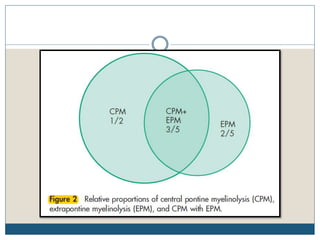
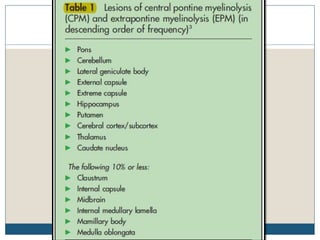
 1962- recognised that lesions can occur outside the pons:- extrapontine
myelinolysis (EPM).
 1976- Tomlinson – suggested link with rapid correction of sodium in
hyponatraemic patients was established
 1981: Kleinschmidt-DeMasters and Norenberg conclusively
demonstrated a link between ODS and rapid correction of hyponatremia
‘‘…whenever a patient who is gravely ill with alcoholism
and malnutrition or a systemic medical disease develops
confusion, quadriplegia, pseudobulbar palsy, and pseudo
coma (‘locked-in syndrome’) over a period of several days,
one is justified in making a diagnosis of central pontine
myelinolysis’.
Controversy in nomenclature
 1962- extrapontine myelinolysis (EPM) may also occur hence
broader term- Osmotic demyelination syndrome.
 But as per Victor and Adams:
 location of principal lesion is given  neurological
consequences of the lesion can be deduced.
 term “demyelination” avoided so as to distinguish this condition
in which myelin loss occurs without obvious inflammatory
infiltrate from inflammatory nature of MS.
Pathology
 Predominantly - basis pontis, sparing the tegmentum
 may extend up to midbrain, very rarely down to medulla
 Pathologically, loss of myelin sheath with relative sparing of axons and
neurons in sharply demarcated lesion
 absence of an inflammatory infiltrate in these lesions
 Reason for localisation within this region:
 this is a region of maximal admixture of grey and white matter elements
 Similarly lesions of EPM are seen in similar regions of grey–white apposition.
Epidemiology
 Rare disease, frequency not known.
 Majority of pathologically diagnosed ODS cases are clinically asymptomatic
 Largest autopsy series :- prevalence of 0.25% to 0.5% in a general population,
majority were not diagnosed premortem
 Populations, such as alcoholics and liver transplant have higher rates of ODS
 Liver transplant pts- postmortem rate of ODS 10%.
 Peak incidence in adults aged 30 to 60 years
 Male preponderance, ? Higher alcoholism in this age group
Pathophysiology
Role of organic osmolytes
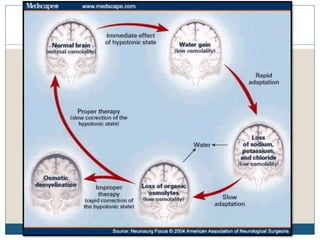
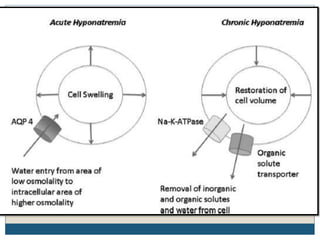
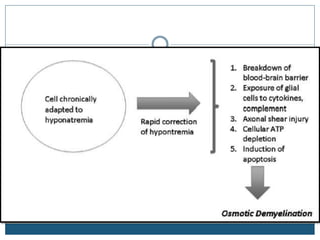
 Hyponatremia – causes loss of osmotically active, protective,
organic osmolytes within few hours to days of hyponatremia
 Glycine, taurine, myoinositol, glutamate, glutamine from astrocytes
 However, not as quickly replaced when brain volume begins
to shrink due to correction of hyponatremia
 As a result, brain volume falls below normal with rapid
correction of hyponatremia.
Factors which may increase risk of acute
hyponatremia encephalopathy
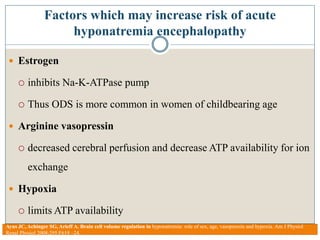
 Estrogen
 inhibits Na-K-ATPase pump
 Thus ODS is more common in women of childbearing age
 Arginine vasopressin
 decreased cerebral perfusion and decrease ATP availability for ion
exchange
 Hypoxia
 limits ATP availability
Ayus JC, Achinger SG, Arieff A. Brain cell volume regulation in hyponatremia: role of sex, age, vasopressin and hypoxia. Am J Physiol
Renal Physiol 2008;295:F619 –24.
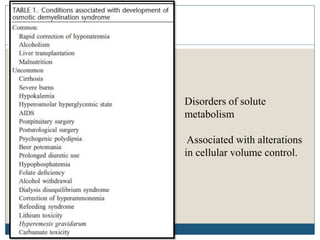
Disorders of solute
metabolism
Associated with alterations
in cellular volume control.
Duration of Hyponatremia to cause ODS
 Brain damage does not occur when hyponatremia < 1 day
duration is rapidly corrected
 If persists for > 2 to 3 days same treatment results in ODS
 However duration is often not known.
 Thus, assume that pt. has chronic hyponatremia unless the
history suggests acute water intoxication.
 marathon runners
 psychotic patients
 users of ecstasy
Clinical features
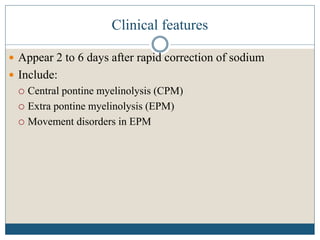
 Appear 2 to 6 days after rapid correction of sodium
 Include:
 Central pontine myelinolysis (CPM)
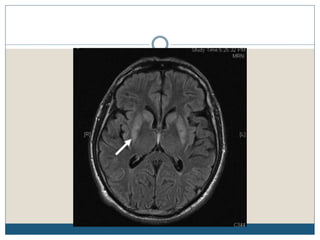
 Extra pontine myelinolysis (EPM)
 Movement disorders in EPM
Central pontine myelinolysis (CPM)
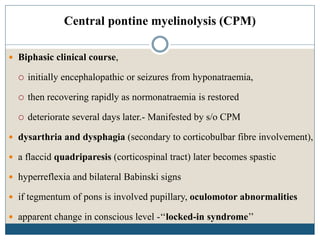
 Biphasic clinical course,
 initially encephalopathic or seizures from hyponatraemia,
 then recovering rapidly as normonatraemia is restored
 deteriorate several days later.- Manifested by s/o CPM
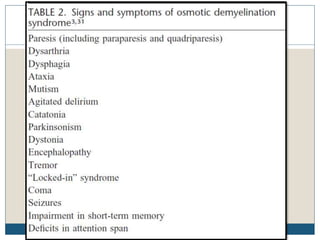
 dysarthria and dysphagia (secondary to corticobulbar fibre involvement),
 a flaccid quadriparesis (corticospinal tract) later becomes spastic
 hyperreflexia and bilateral Babinski signs
 if tegmentum of pons is involved pupillary, oculomotor abnormalities
 apparent change in conscious level -‘‘locked-in syndrome’’
Diagnosis
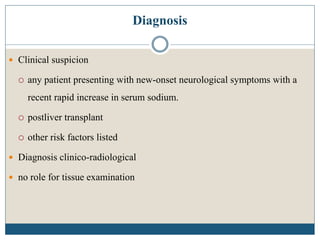
 Clinical suspicion
 any patient presenting with new-onset neurological symptoms with a
recent rapid increase in serum sodium.
 postliver transplant
 other risk factors listed
 Diagnosis clinico-radiological
 no role for tissue examination
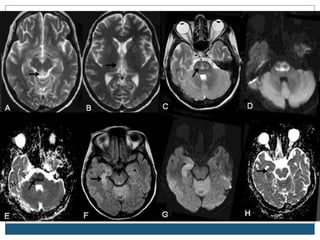
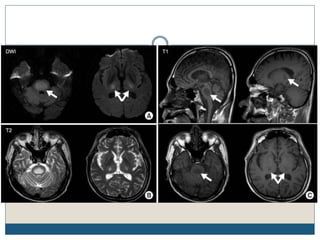
Typical MRI lesions
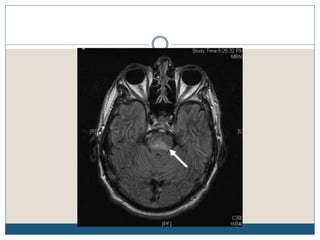
 Trident shaped / spreading bushfire pattern in central pons
 Signal characteristics of affected region include:
 T1: mildly or moderately hypointense
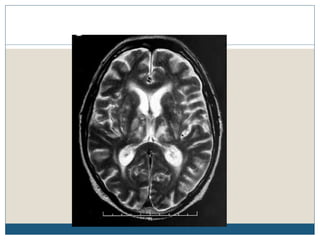
 T2: hyperintense, sparing the periphery and corticospinal tracts
 FLAIR: hyperintense
 DWI: hyperintense
 ADC: signal low or signal loss
 T1 C+ (Gd): usually there is no enhancement
 Radiologic findings do not improve over time, despite complete or nearly complete
clinical recovery
Radiological differential diagnosis of CPM
 General imaging differential considerations include:
 demyelination - multiple sclerosis (MS)
 infarction from basilar perforators can be central
 pontine neoplasms - astrocytomas
Management
 Prevention
 Re-lowering Serum Sodium
 Supportive care
 Experimental therapies
Prevention
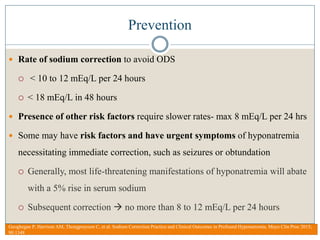
 Rate of sodium correction to avoid ODS
 < 10 to 12 mEq/L per 24 hours
 < 18 mEq/L in 48 hours
 Presence of other risk factors require slower rates- max 8 mEq/L per 24 hrs
 Some may have risk factors and have urgent symptoms of hyponatremia
necessitating immediate correction, such as seizures or obtundation
 Generally, most life-threatening manifestations of hyponatremia will abate
with a 5% rise in serum sodium
 Subsequent correction  no more than 8 to 12 mEq/L per 24 hours
Geoghegan P, Harrison AM, Thongprayoon C, et al. Sodium Correction Practice and Clinical Outcomes in Profound Hyponatremia. Mayo Clin Proc 2015;
90:1348
Re-lowering Serum Sodium
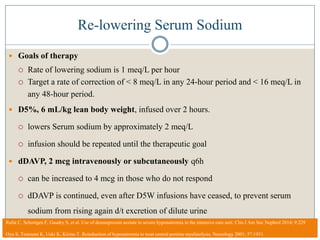
 Goals of therapy
 Rate of lowering sodium is 1 meq/L per hour
 Target a rate of correction of < 8 meq/L in any 24-hour period and < 16 meq/L in
any 48-hour period.
 D5%, 6 mL/kg lean body weight, infused over 2 hours.
 lowers Serum sodium by approximately 2 meq/L
 infusion should be repeated until the therapeutic goal
 dDAVP, 2 mcg intravenously or subcutaneously q6h
 can be increased to 4 mcg in those who do not respond
 dDAVP is continued, even after D5W infusions have ceased, to prevent serum
sodium from rising again d/t excretion of dilute urine
Rafat C, Schortgen F, Gaudry S, et al. Use of desmopressin acetate in severe hyponatremia in the intensive care unit. Clin J Am Soc Nephrol 2014; 9:229
Oya S, Tsutsumi K, Ueki K, Kirino T. Reinduction of hyponatremia to treat central pontine myelinolysis. Neurology 2001; 57:1931.
Supportive care
 Ventilator
 Physiotherapy and Neuro-rehab
 Anti-Parkinsonism drugs
Investigational therapies
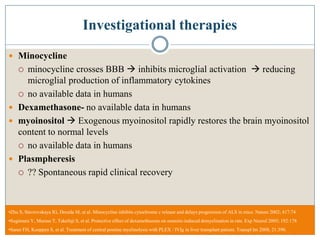
 Minocycline
 minocycline crosses BBB  inhibits microglial activation  reducing
microglial production of inflammatory cytokines
 no available data in humans
 Dexamethasone- no available data in humans
 myoinositol  Exogenous myoinositol rapidly restores the brain myoinositol
content to normal levels
 no available data in humans
 Plasmpheresis
 ?? Spontaneous rapid clinical recovery
•Zhu S, Stavrovskaya IG, Drozda M, et al. Minocycline inhibits cytochrome c release and delays progression of ALS in mice. Nature 2002; 417:74.
•Sugimura Y, Murase T, Takefuji S, et al. Protective effect of dexamethasone on osmotic-induced demyelination in rats. Exp Neurol 2005; 192:178
•Saner FH, Koeppen S, et al. Treatment of central pontine myelinolysis with PLEX / IVIg in liver transplant patient. Transpl Int 2008; 21:390.
Prognosis
 25% develop severe, incapacitating neurological disease
requiring lifelong support
 Variable persistent paralysis
 severe ataxia
 Bulbar symptoms
 Less common- persistence of cognitive/ beahvioural symptoms
Menger H, Jorg J. Outcome of central pontine and extrapontine myelinolysis (n 44). J Neurol 1999;246:700 –5.
References
 Martin RJ. Central pontine and extrapontine myelinolysis: the osmotic
demyelination syndromes. Journal of Neurology, Neurosurgery & Psychiatry.
2004 Sep 1;75(suppl 3):iii22-8.
 King JD, Rosner MH. Osmotic demyelination syndrome. Am J Med Sci. 2010
Jun 1;339(6):561-7.
 Uptodate website- 2017
Thank You

osmotic deyelination syndrome

  • 1.
  • 2.
    History  1959- Victorand Adams first described central pontine myelinolysis  clinical findings- quadriparesis, pseudobulbar paralysis  Pathology- myelin loss confined within the central pons  was felt as a sequela of alcoholism or malnutrition  1962- recognised that lesions can occur outside the pons:- extrapontine myelinolysis (EPM).  1976- Tomlinson – suggested link with rapid correction of sodium in hyponatraemic patients was established  1981: Kleinschmidt-DeMasters and Norenberg conclusively demonstrated a link between ODS and rapid correction of hyponatremia
  • 3.
    ‘‘…whenever a patientwho is gravely ill with alcoholism and malnutrition or a systemic medical disease develops confusion, quadriplegia, pseudobulbar palsy, and pseudo coma (‘locked-in syndrome’) over a period of several days, one is justified in making a diagnosis of central pontine myelinolysis’.
  • 4.
    Controversy in nomenclature 1962- extrapontine myelinolysis (EPM) may also occur hence broader term- Osmotic demyelination syndrome.  But as per Victor and Adams:  location of principal lesion is given  neurological consequences of the lesion can be deduced.  term “demyelination” avoided so as to distinguish this condition in which myelin loss occurs without obvious inflammatory infiltrate from inflammatory nature of MS.
  • 7.
    Pathology  Predominantly -basis pontis, sparing the tegmentum  may extend up to midbrain, very rarely down to medulla  Pathologically, loss of myelin sheath with relative sparing of axons and neurons in sharply demarcated lesion  absence of an inflammatory infiltrate in these lesions  Reason for localisation within this region:  this is a region of maximal admixture of grey and white matter elements  Similarly lesions of EPM are seen in similar regions of grey–white apposition.
  • 8.
    Epidemiology  Rare disease,frequency not known.  Majority of pathologically diagnosed ODS cases are clinically asymptomatic  Largest autopsy series :- prevalence of 0.25% to 0.5% in a general population, majority were not diagnosed premortem  Populations, such as alcoholics and liver transplant have higher rates of ODS  Liver transplant pts- postmortem rate of ODS 10%.  Peak incidence in adults aged 30 to 60 years  Male preponderance, ? Higher alcoholism in this age group
  • 9.
  • 11.
    Role of organicosmolytes  Hyponatremia – causes loss of osmotically active, protective, organic osmolytes within few hours to days of hyponatremia  Glycine, taurine, myoinositol, glutamate, glutamine from astrocytes  However, not as quickly replaced when brain volume begins to shrink due to correction of hyponatremia  As a result, brain volume falls below normal with rapid correction of hyponatremia.
  • 13.
    Factors which mayincrease risk of acute hyponatremia encephalopathy  Estrogen  inhibits Na-K-ATPase pump  Thus ODS is more common in women of childbearing age  Arginine vasopressin  decreased cerebral perfusion and decrease ATP availability for ion exchange  Hypoxia  limits ATP availability Ayus JC, Achinger SG, Arieff A. Brain cell volume regulation in hyponatremia: role of sex, age, vasopressin and hypoxia. Am J Physiol Renal Physiol 2008;295:F619 –24.
  • 14.
    Disorders of solute metabolism Associatedwith alterations in cellular volume control.
  • 15.
    Duration of Hyponatremiato cause ODS  Brain damage does not occur when hyponatremia < 1 day duration is rapidly corrected  If persists for > 2 to 3 days same treatment results in ODS  However duration is often not known.  Thus, assume that pt. has chronic hyponatremia unless the history suggests acute water intoxication.  marathon runners  psychotic patients  users of ecstasy
  • 16.
    Clinical features  Appear2 to 6 days after rapid correction of sodium  Include:  Central pontine myelinolysis (CPM)  Extra pontine myelinolysis (EPM)  Movement disorders in EPM
  • 17.
    Central pontine myelinolysis(CPM)  Biphasic clinical course,  initially encephalopathic or seizures from hyponatraemia,  then recovering rapidly as normonatraemia is restored  deteriorate several days later.- Manifested by s/o CPM  dysarthria and dysphagia (secondary to corticobulbar fibre involvement),  a flaccid quadriparesis (corticospinal tract) later becomes spastic  hyperreflexia and bilateral Babinski signs  if tegmentum of pons is involved pupillary, oculomotor abnormalities  apparent change in conscious level -‘‘locked-in syndrome’’
  • 19.
    Diagnosis  Clinical suspicion any patient presenting with new-onset neurological symptoms with a recent rapid increase in serum sodium.  postliver transplant  other risk factors listed  Diagnosis clinico-radiological  no role for tissue examination
  • 20.
    Typical MRI lesions Trident shaped / spreading bushfire pattern in central pons  Signal characteristics of affected region include:  T1: mildly or moderately hypointense  T2: hyperintense, sparing the periphery and corticospinal tracts  FLAIR: hyperintense  DWI: hyperintense  ADC: signal low or signal loss  T1 C+ (Gd): usually there is no enhancement  Radiologic findings do not improve over time, despite complete or nearly complete clinical recovery
  • 26.
    Radiological differential diagnosisof CPM  General imaging differential considerations include:  demyelination - multiple sclerosis (MS)  infarction from basilar perforators can be central  pontine neoplasms - astrocytomas
  • 27.
    Management  Prevention  Re-loweringSerum Sodium  Supportive care  Experimental therapies
  • 28.
    Prevention  Rate ofsodium correction to avoid ODS  < 10 to 12 mEq/L per 24 hours  < 18 mEq/L in 48 hours  Presence of other risk factors require slower rates- max 8 mEq/L per 24 hrs  Some may have risk factors and have urgent symptoms of hyponatremia necessitating immediate correction, such as seizures or obtundation  Generally, most life-threatening manifestations of hyponatremia will abate with a 5% rise in serum sodium  Subsequent correction  no more than 8 to 12 mEq/L per 24 hours Geoghegan P, Harrison AM, Thongprayoon C, et al. Sodium Correction Practice and Clinical Outcomes in Profound Hyponatremia. Mayo Clin Proc 2015; 90:1348
  • 29.
    Re-lowering Serum Sodium Goals of therapy  Rate of lowering sodium is 1 meq/L per hour  Target a rate of correction of < 8 meq/L in any 24-hour period and < 16 meq/L in any 48-hour period.  D5%, 6 mL/kg lean body weight, infused over 2 hours.  lowers Serum sodium by approximately 2 meq/L  infusion should be repeated until the therapeutic goal  dDAVP, 2 mcg intravenously or subcutaneously q6h  can be increased to 4 mcg in those who do not respond  dDAVP is continued, even after D5W infusions have ceased, to prevent serum sodium from rising again d/t excretion of dilute urine Rafat C, Schortgen F, Gaudry S, et al. Use of desmopressin acetate in severe hyponatremia in the intensive care unit. Clin J Am Soc Nephrol 2014; 9:229 Oya S, Tsutsumi K, Ueki K, Kirino T. Reinduction of hyponatremia to treat central pontine myelinolysis. Neurology 2001; 57:1931.
  • 30.
    Supportive care  Ventilator Physiotherapy and Neuro-rehab  Anti-Parkinsonism drugs
  • 31.
    Investigational therapies  Minocycline minocycline crosses BBB  inhibits microglial activation  reducing microglial production of inflammatory cytokines  no available data in humans  Dexamethasone- no available data in humans  myoinositol  Exogenous myoinositol rapidly restores the brain myoinositol content to normal levels  no available data in humans  Plasmpheresis  ?? Spontaneous rapid clinical recovery •Zhu S, Stavrovskaya IG, Drozda M, et al. Minocycline inhibits cytochrome c release and delays progression of ALS in mice. Nature 2002; 417:74. •Sugimura Y, Murase T, Takefuji S, et al. Protective effect of dexamethasone on osmotic-induced demyelination in rats. Exp Neurol 2005; 192:178 •Saner FH, Koeppen S, et al. Treatment of central pontine myelinolysis with PLEX / IVIg in liver transplant patient. Transpl Int 2008; 21:390.
  • 32.
    Prognosis  25% developsevere, incapacitating neurological disease requiring lifelong support  Variable persistent paralysis  severe ataxia  Bulbar symptoms  Less common- persistence of cognitive/ beahvioural symptoms Menger H, Jorg J. Outcome of central pontine and extrapontine myelinolysis (n 44). J Neurol 1999;246:700 –5.
  • 33.
    References  Martin RJ.Central pontine and extrapontine myelinolysis: the osmotic demyelination syndromes. Journal of Neurology, Neurosurgery & Psychiatry. 2004 Sep 1;75(suppl 3):iii22-8.  King JD, Rosner MH. Osmotic demyelination syndrome. Am J Med Sci. 2010 Jun 1;339(6):561-7.  Uptodate website- 2017
  • 34.