Guillain-Barre Syndrome
William Woodfin MD
K.F. 40 y.o. r/h woman
3/17 Nausea, diarrhea & severe myalgias
Son dxed c rotavirus 1 wk. Previously
4/21 “Creepy-crawlies” legs>arms
4/25 Weakness legs progressing
4/26 Handwriting looks like “hen scratch”
K.F. 40 y.o. woman
4/28 Admitted to outside hospital.
L.P. wnl
EMG positive waves in some leg
muscles
NCVs absent H-reflexes
F responses & motor latencies wnl
K.F. 40 y.o. woman
4/29 Transferred to PHD
Hx.: diabetic x 10 yrs.
hypothyroid- treatedx yrs.
no sphincter disrubance
aching pain low back & buttocks
mild postural light headedness
no SOB or palpatations
Exam
BP 150/90 P 80 Wt. 250 lbs.
Mild weakness neck flexors
4/5 biceps, grip & interossei- symmetric
2/5 iliopsoas & quadriceps
3/5 hamstrings & adductors
4/5 abductors
4/5 ankles & toes- extensors & flexors
Exam
Sensory- intact
DTRs- biceps, BR, knees are trace c
reinforcement. Triceps & ankles
unobtainable
Plantars- flexor
F to N- intact
Gait- not testable
Lab
H/H 10.3/33.5 c microcytic indices
A1c Hgb 10.1
TSH 0.97
LDL 182
Serum immunofixation- wnl. No IgA def.
FVCs- consistently 4+ liters
MRI
LS spine s & c contrast- no nerve root
enhancement
Course in hospital
Treated c IVIG 0.4 gms/kgm daily x 5
Strength fluctuated only mildly
Blood sugars ok in AM, high in afternoons
Repeated NCVs show mild dispersion of F
waves
Transferred back to referring hospital 5/6
Telephone FU
Ambulating fairly well c walker. Strength
clearly improving.
Still bothered by “creepy-crawlies”
What is the GBS?
• Due to the breadth of clinical presentation it
is of limited help to try to define rigid
diagnostic criteria.
• Thomas Munsat 1965: “…The GBS is easy
to diagnose but difficult to define
The typical illness evolves over weeks
usually following an infectious disease
and involves:
• 1. Paresthesiaes
usually hearld the
disease
• 2. Fairly symmetric
weakness in the legs,
later the arms and,
often, respiratory and
facial muscles
• 3. Dimunition and loss
of the DTRs
• 4. Albuminocytologic
dissociation
• 5. Recovery over
weeks to months
History
Waldrop 1834
Olliver 1837
Landry 1859
Graves 1884
Ross & Bury 1893
Brussel’s Conf. 1937
Haymaker &
Kernohan 1949
Waksman & Adams
1955
Miller Fisher 1956
Asbury, Aranson &
Adams 1969
Guillain, Barre & Strohl
1916-1920
Note sur la paralysie ascendante
aigue 1859
• March 16- a febrile illness
• May 11- mild sensory symptoms in the fingers and
toes
• June 13- knees buckle
• June 16- unable to walk
• Subsequent respiratory failure and death.
• Autopsy unrevealing. Peripheral nerves probably
not examined
Late 19th
century
• Westphal 1876- “Landry’s Ascending Paralysis”
• Graves 1884- localized neurologic disease to the
peripheral nerves, “the nervous cords”
• Ross & Bury 1893- 90 cases. A disease of the
peripheral nerves
• Numerous reports emphasizing various aspects of
the disease with most authors crediting Landry
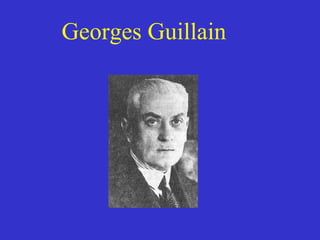
Georges Guillain
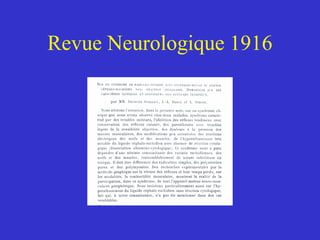
Revue Neurologique 1916
Guillain, Barre & Strohl 1916
Revue Neurologique
• Two soldiers in Amiens developing
paralysis and loss of DTRs.
• A new diagnostic feature:
albuminocytologic dissociation in the CSF
• No mention of Landry
Foundations
• Quincke- CSF observations 25 years earlier
• Siccard & Foix- “albuminocytologic dissociation”
in Pott’s disease
Late 19th
century: examination of the reflexes had
become a part of the neurologic exam with
appreciated as a sign of neuropathy based on
observations in tabes dorsalis areflexia
Haymaker & Kernohan 1949
• Landmark in pathological description c 50 fatal
cases & detailed review of clinical findings
• Emphasized prominent damage to proximal nerves
often at junction of ventral & dorsal roots. Little
study of more distal nerves
• Unified findings of Landry & Guillain, Barre &
Strohl
Waksman & Adams 1955
• Experimental Allergic Neuritis
• First animal model of a noninfectious
inflammatory neuritis
• Rabbit nerve and Freund’s adjuvant injected
intradermally
• Target of activated T cells uncertain
Asbury, Aranson & Adams 1969
• 19 pts. All with well developed
mononuclear infiltrates in spinal roots and
nerves within days of clinical onset
• Pathological hallmark: perivascular
mononuclear inflammatory infiltrates to
adjacent to the areas of demyelination
Overview of Adaptive Immunity
• Lymphocytes: “command & control,”
identify antigen components, respond
specifically, mobilize other elements and
direct the attack c memory for each
antigenic assault
• Antibodies: specialized immunoglobulin
molecules directly neutralize and remove
antigen
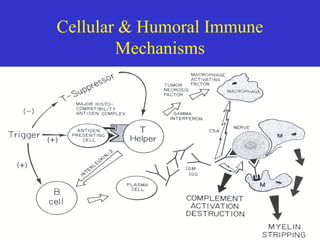
T lymphocytes
• CD8- recognize epitopes paired c MHC-I
• CD4- activate and control the immune response
• Scavenger cells break down antigen into small
peptide fragments (T cell epitopes), MHC-II
epitope complexes are expressed on the surface &
the scavenger become an APC which docks on a
CD4 c a compatible TCR. CD4 proliferates
releasing cytokines.
Antibodies
• Cytokines activate other lymphocytes including B
cells that differentiate into plasma cells and serve
as immunoglobulin factories.
• Abs are Ig molecules that recognize, bind,
neutralize and opsonize Ag for phagocytosis. They
activate complement(membrane attack complex)
& induce target cells to activate the inflammatory
response
Cellular & Humoral Immune
Mechanisms
Self-tolerance
• The process of self recognition
• T & B cells learn self tolerance during
maturation
• Autoimmunity occurs when the
mechanisms of self protection are defective
Mechanisms of Autoimmunity
• Molecular mimicry- microbe cell surface Ag
resembles self protein. Damage results from
“friendly fire” The inciting Ag is usually
unidentified & may not exist as a single stimulus.
• Excessive cytokine release due to profound
immune stimulus may awaken self tolerant T cells
or may cause expression of MHC complexes.
• Self Ags bound to drugs may lose tolerated status
Antecedent Events: Infectious
• Viral: Influenza, Coxsackie, EBV, Herpes,
HIV, Hepatitis, CMV, WNV
Bacterial: Campylobacter jejuni,
Mycoplasma, E. coli
Parasitic: Malaria, Toxoplasmosis
Antecedent Events: Systemic
disease
• Hodgkins
• CLL
• Hyperthyroidism
• Sarcoidosis
• Collagen Vascular d.
• Renal d.
Other antecedent events
• Surgery
• Immunization
• Pregnancy
• Envenomization
• Bone marrow transplantation
• Drug ingestion
Features of AIDP
• 2/3s have identifiable preceding event
• 50% begin with paresthesias followed by
weakness in legs; 10% begin with arm
weakness; rarely begins in face
• Ophthalmoplegia: partial 15%, total 5%
• Autonomic dysfunction in 65%,
arrhythmias, hypotension,urinary retention
in 10-15%, pupillary inequality
AIDP
• Progresses for days to 4 weeks
• 15% with severe disability
• Mortality 3-5%
• CSF: protein may be normal early, elevated
in 90% by clinical nadir, cells< 10 in 95%,
>50 suggests HIV
• EDX: prolonged F & distal motor latencies,
conduction block 30-40% in routine studies
AIDP
• Pathology: immune attack directed at
schwann cell plasmalemma esp. at nerve
roots with IgG & complement deposits
preceding demyelination
CIDP
• Evolves over months
• Fluctuates
• Respiratory failure, dysautonomia, facial
weakness, ophthalmoplegia- all are rare
• CSF protein often highly elevated
• Marked slowing of motor nerve conduction
• Steroid responsive
Features of AMSAN
• Commonly preceded by diarrhea esp. c.
jejuni
• Abrupt onset of weakness c rapid
progression to quadriplegia & respiratory
insufficiency
• Other features as c AIDP
• Longer recovery, more residual & mortality
10-15%
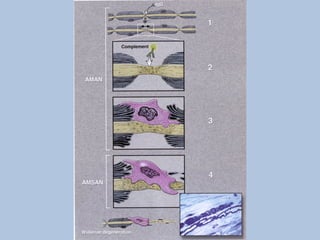
AMSAN
• CSF as in AIDP
• EDX: no response in some motor nerves,
decreased amplitude of the CMAPs,
fibrillations on needle study, absent SNAPs
• Immune attack directed at axon
plasmalemma at nodes of Ranvier.
Wallerian degeneration
Features of AMAN
• Often preceded by diarrhea affecting
younger population in China. Sporadic in
USA
• Prognosis similair to AIDP
• Mortality <5%
• EDX: reduced CMAPs c normal F & distal
motor latencies and sensory studies.
Fibrillations in 2-3 weeks
AMAN
• Pathology: again axonal plasmalemma at
nodes of Ranvier sometimes limited to
physiologic dysfunction c nodal
lengthening. May go on to extension
through axonal basal lamina. Most axons
recover s Wallerian degeneration
Miller Fisher Syndrome
• Ophthalmoplegia, Ataxia, Areflexia
• May be heterogonous: 1. Related to other patterns
of GBS
2. Related to brainstem encephalitis, Bickerstaff
1952
3. CNS demyelination in association with GBS
Miller Fisher Syndrome
• 95% have serum IgG Ab to ganglioside GQ1b
• Studies show preferential location of anti-GQ1b to
cerebellar molecular layer & Cranial Nerves 3,4 &
6
• May act at N-M junction depleting acetylcholine
from nerve terminals
Acute Panautonomic Neuropathy
• Manifests over 1-2 weeks but may be of
subacute onset
• Frequent preceding infection
• DTRs lost in 1/3, distal sensory changes 1/4
• Albuminocytologic dissociation
• EDX: NCVs usually normal
• Recovery is gradual and incomplete
Differential Diagnosis
• Consider the possibility of an upper motor
neuron lesion
• Other considerations are rare. Diphtheritic
neuritis & poliomyelitis belong more to the
history section of this presentation. A new
possibility is West Nile Virus.
Differential
• N-M: MG, LES, Antibiotics
• Toxic: Cigutera (ciguatoxin), Pufferfish
(tetrodotoxin), Shellfish (saxitioxin),
Botulism, Tick paralysis (Lone Star tick,
Gulf Coast tick), Glue sniffing, Buckthorn
• Mononeuritis multiplex assoc. c Wegner’s.
PAN, SLE, RA, Sjogren’s,
Cryoglobulinemia etc.
Differential
• Metabolic: Periodic paralyses,
Hypokalemia, Hypermagnesemia,
Hypophoshatemia c parenteral
hyperailimentation, Thyrotoxicosis, ICU
myoneuropathy (CIP)
• Heavy metal: Lead, Arsenic, Thallium,
Barium c hypokalemia
Differential: Miller Fisher Syn.
• Multiple sclerosis
• Encephalitis
• Posterior circulation ischemia or infarct
• Other: Botulism, MG, Tick
Treatment
Respiratory failure
Autonomic dysfunction
DVT & PE
Pain
Positioning & Skin care
Physical therapy
Nutrition
Respiratory Failure
• Oropharyngeal weakness in ~25% with
impaired swallowing of secretions &
aspiration
• Mechanical respiratory failure- mainly due
to diaphragmatic weakness (Phrenic
nerves.) Inspiratory c MIF (Max. Inspir.
Force) a good supplement measure to FVC
Respiratory Failure
• ~33% require intubation
• Avg. time to intubation is 1 week & these
pts. have substantially longer recovery time
• Need is unlikely if patient does well for 2
wks. post onset of paresthesiaes
• Guidelines: FVC <15 mL/kgm
MIF < 25 cm water
Psychological
• Fear
• Helplessness
• Communication
• Pain
• Sleep deprivation & hallucinosis
• Depression
• Visits from other GBS patients
Personal Experience
• Bowes, Denise; The doctor as patient: an
encounter with Guillain-Barre syndrome.
Can Med Assoc J 131:1343-1348
Corticosteroids
• Lancet 1993 242 pts.
IV Methylprednisilone 500 mgm/day x 5.
Ineffective
May cause relapse
Plasma Exchange
• Removal of the blood’s liquid soluble
components including complement,
immunoglobulin, immune complexes,
cytokines and interleukins
• A typical session removes about 60% of the
body mass of plasma proteins which is
replaced c saline, albumin & FFP
• Done qod for 3-5 sessions
Plasma Exchange
• Various studies since 1985
• Time on ventilator reduced by ½
• Full strength regained at 1 year: Exchange
71%, Untreated 52%
• Limitations: Limited availability
Avoid with autonomic instability
Intravenous Immune Globulin
• Originally used for immune insufficiency
• Use as an immunosuppresant “seems to
defy reason”
• 1981 Rx for ITP
• 5,000-10,000 donors/batch. Diversity of
Abs from large donor pool maximizes effect
IVIG
• Mechanism of action- unknown
? Antiidiotypic antibody action
? Inhibition of cytokines
? “Sponging” of complement
? Binding to Fc receptors so macrophages
can’t bind
IVIG
• Dosage: 0.4 gms/kgm/day x 5 c each dose
given over 3-4 hours preceded by IV
diphenhydramine &/or po ibuprofen
• Caution c renal insufficiency or IgA
deficiency
• 38 Center trial in 1997
• Equal to plasma exchange
J.H.C. 48 yo welder
• June ’02 H.A. followed in 2 wks by Lt.
Facial weakness
• June ’03 Rhinorrhea & cough
• August 6 Pain lt. Hip spreading over a few
days to back 7 legs
• August 15 Legs buckle c lt.facial weakness
1 wk later. LP c protein of 70. NCVs c
prolonged F waves
• 1 Week post discharge, elevated titers to
West Nile Virus
• Follow up at 1 month- continued
improvement

Guillain barre synd

  • 1.
  • 2.
    K.F. 40 y.o.r/h woman 3/17 Nausea, diarrhea & severe myalgias Son dxed c rotavirus 1 wk. Previously 4/21 “Creepy-crawlies” legs>arms 4/25 Weakness legs progressing 4/26 Handwriting looks like “hen scratch”
  • 3.
    K.F. 40 y.o.woman 4/28 Admitted to outside hospital. L.P. wnl EMG positive waves in some leg muscles NCVs absent H-reflexes F responses & motor latencies wnl
  • 4.
    K.F. 40 y.o.woman 4/29 Transferred to PHD Hx.: diabetic x 10 yrs. hypothyroid- treatedx yrs. no sphincter disrubance aching pain low back & buttocks mild postural light headedness no SOB or palpatations
  • 5.
    Exam BP 150/90 P80 Wt. 250 lbs. Mild weakness neck flexors 4/5 biceps, grip & interossei- symmetric 2/5 iliopsoas & quadriceps 3/5 hamstrings & adductors 4/5 abductors 4/5 ankles & toes- extensors & flexors
  • 6.
    Exam Sensory- intact DTRs- biceps,BR, knees are trace c reinforcement. Triceps & ankles unobtainable Plantars- flexor F to N- intact Gait- not testable
  • 7.
    Lab H/H 10.3/33.5 cmicrocytic indices A1c Hgb 10.1 TSH 0.97 LDL 182 Serum immunofixation- wnl. No IgA def. FVCs- consistently 4+ liters
  • 8.
    MRI LS spine s& c contrast- no nerve root enhancement
  • 9.
    Course in hospital Treatedc IVIG 0.4 gms/kgm daily x 5 Strength fluctuated only mildly Blood sugars ok in AM, high in afternoons Repeated NCVs show mild dispersion of F waves Transferred back to referring hospital 5/6
  • 10.
    Telephone FU Ambulating fairlywell c walker. Strength clearly improving. Still bothered by “creepy-crawlies”
  • 11.
    What is theGBS? • Due to the breadth of clinical presentation it is of limited help to try to define rigid diagnostic criteria. • Thomas Munsat 1965: “…The GBS is easy to diagnose but difficult to define
  • 12.
    The typical illnessevolves over weeks usually following an infectious disease and involves: • 1. Paresthesiaes usually hearld the disease • 2. Fairly symmetric weakness in the legs, later the arms and, often, respiratory and facial muscles • 3. Dimunition and loss of the DTRs • 4. Albuminocytologic dissociation • 5. Recovery over weeks to months
  • 13.
    History Waldrop 1834 Olliver 1837 Landry1859 Graves 1884 Ross & Bury 1893 Brussel’s Conf. 1937 Haymaker & Kernohan 1949 Waksman & Adams 1955 Miller Fisher 1956 Asbury, Aranson & Adams 1969 Guillain, Barre & Strohl 1916-1920
  • 15.
    Note sur laparalysie ascendante aigue 1859 • March 16- a febrile illness • May 11- mild sensory symptoms in the fingers and toes • June 13- knees buckle • June 16- unable to walk • Subsequent respiratory failure and death. • Autopsy unrevealing. Peripheral nerves probably not examined
  • 16.
    Late 19th century • Westphal1876- “Landry’s Ascending Paralysis” • Graves 1884- localized neurologic disease to the peripheral nerves, “the nervous cords” • Ross & Bury 1893- 90 cases. A disease of the peripheral nerves • Numerous reports emphasizing various aspects of the disease with most authors crediting Landry
  • 17.
  • 18.
  • 19.
    Guillain, Barre &Strohl 1916 Revue Neurologique • Two soldiers in Amiens developing paralysis and loss of DTRs. • A new diagnostic feature: albuminocytologic dissociation in the CSF • No mention of Landry
  • 20.
    Foundations • Quincke- CSFobservations 25 years earlier • Siccard & Foix- “albuminocytologic dissociation” in Pott’s disease Late 19th century: examination of the reflexes had become a part of the neurologic exam with appreciated as a sign of neuropathy based on observations in tabes dorsalis areflexia
  • 21.
    Haymaker & Kernohan1949 • Landmark in pathological description c 50 fatal cases & detailed review of clinical findings • Emphasized prominent damage to proximal nerves often at junction of ventral & dorsal roots. Little study of more distal nerves • Unified findings of Landry & Guillain, Barre & Strohl
  • 22.
    Waksman & Adams1955 • Experimental Allergic Neuritis • First animal model of a noninfectious inflammatory neuritis • Rabbit nerve and Freund’s adjuvant injected intradermally • Target of activated T cells uncertain
  • 23.
    Asbury, Aranson &Adams 1969 • 19 pts. All with well developed mononuclear infiltrates in spinal roots and nerves within days of clinical onset • Pathological hallmark: perivascular mononuclear inflammatory infiltrates to adjacent to the areas of demyelination
  • 24.
    Overview of AdaptiveImmunity • Lymphocytes: “command & control,” identify antigen components, respond specifically, mobilize other elements and direct the attack c memory for each antigenic assault • Antibodies: specialized immunoglobulin molecules directly neutralize and remove antigen
  • 25.
    T lymphocytes • CD8-recognize epitopes paired c MHC-I • CD4- activate and control the immune response • Scavenger cells break down antigen into small peptide fragments (T cell epitopes), MHC-II epitope complexes are expressed on the surface & the scavenger become an APC which docks on a CD4 c a compatible TCR. CD4 proliferates releasing cytokines.
  • 26.
    Antibodies • Cytokines activateother lymphocytes including B cells that differentiate into plasma cells and serve as immunoglobulin factories. • Abs are Ig molecules that recognize, bind, neutralize and opsonize Ag for phagocytosis. They activate complement(membrane attack complex) & induce target cells to activate the inflammatory response
  • 27.
    Cellular & HumoralImmune Mechanisms
  • 28.
    Self-tolerance • The processof self recognition • T & B cells learn self tolerance during maturation • Autoimmunity occurs when the mechanisms of self protection are defective
  • 29.
    Mechanisms of Autoimmunity •Molecular mimicry- microbe cell surface Ag resembles self protein. Damage results from “friendly fire” The inciting Ag is usually unidentified & may not exist as a single stimulus. • Excessive cytokine release due to profound immune stimulus may awaken self tolerant T cells or may cause expression of MHC complexes. • Self Ags bound to drugs may lose tolerated status
  • 30.
    Antecedent Events: Infectious •Viral: Influenza, Coxsackie, EBV, Herpes, HIV, Hepatitis, CMV, WNV Bacterial: Campylobacter jejuni, Mycoplasma, E. coli Parasitic: Malaria, Toxoplasmosis
  • 31.
    Antecedent Events: Systemic disease •Hodgkins • CLL • Hyperthyroidism • Sarcoidosis • Collagen Vascular d. • Renal d.
  • 32.
    Other antecedent events •Surgery • Immunization • Pregnancy • Envenomization • Bone marrow transplantation • Drug ingestion
  • 33.
    Features of AIDP •2/3s have identifiable preceding event • 50% begin with paresthesias followed by weakness in legs; 10% begin with arm weakness; rarely begins in face • Ophthalmoplegia: partial 15%, total 5% • Autonomic dysfunction in 65%, arrhythmias, hypotension,urinary retention in 10-15%, pupillary inequality
  • 34.
    AIDP • Progresses fordays to 4 weeks • 15% with severe disability • Mortality 3-5% • CSF: protein may be normal early, elevated in 90% by clinical nadir, cells< 10 in 95%, >50 suggests HIV • EDX: prolonged F & distal motor latencies, conduction block 30-40% in routine studies
  • 35.
    AIDP • Pathology: immuneattack directed at schwann cell plasmalemma esp. at nerve roots with IgG & complement deposits preceding demyelination
  • 37.
    CIDP • Evolves overmonths • Fluctuates • Respiratory failure, dysautonomia, facial weakness, ophthalmoplegia- all are rare • CSF protein often highly elevated • Marked slowing of motor nerve conduction • Steroid responsive
  • 38.
    Features of AMSAN •Commonly preceded by diarrhea esp. c. jejuni • Abrupt onset of weakness c rapid progression to quadriplegia & respiratory insufficiency • Other features as c AIDP • Longer recovery, more residual & mortality 10-15%
  • 39.
    AMSAN • CSF asin AIDP • EDX: no response in some motor nerves, decreased amplitude of the CMAPs, fibrillations on needle study, absent SNAPs • Immune attack directed at axon plasmalemma at nodes of Ranvier. Wallerian degeneration
  • 40.
    Features of AMAN •Often preceded by diarrhea affecting younger population in China. Sporadic in USA • Prognosis similair to AIDP • Mortality <5% • EDX: reduced CMAPs c normal F & distal motor latencies and sensory studies. Fibrillations in 2-3 weeks
  • 41.
    AMAN • Pathology: againaxonal plasmalemma at nodes of Ranvier sometimes limited to physiologic dysfunction c nodal lengthening. May go on to extension through axonal basal lamina. Most axons recover s Wallerian degeneration
  • 43.
    Miller Fisher Syndrome •Ophthalmoplegia, Ataxia, Areflexia • May be heterogonous: 1. Related to other patterns of GBS 2. Related to brainstem encephalitis, Bickerstaff 1952 3. CNS demyelination in association with GBS
  • 44.
    Miller Fisher Syndrome •95% have serum IgG Ab to ganglioside GQ1b • Studies show preferential location of anti-GQ1b to cerebellar molecular layer & Cranial Nerves 3,4 & 6 • May act at N-M junction depleting acetylcholine from nerve terminals
  • 45.
    Acute Panautonomic Neuropathy •Manifests over 1-2 weeks but may be of subacute onset • Frequent preceding infection • DTRs lost in 1/3, distal sensory changes 1/4 • Albuminocytologic dissociation • EDX: NCVs usually normal • Recovery is gradual and incomplete
  • 46.
    Differential Diagnosis • Considerthe possibility of an upper motor neuron lesion • Other considerations are rare. Diphtheritic neuritis & poliomyelitis belong more to the history section of this presentation. A new possibility is West Nile Virus.
  • 47.
    Differential • N-M: MG,LES, Antibiotics • Toxic: Cigutera (ciguatoxin), Pufferfish (tetrodotoxin), Shellfish (saxitioxin), Botulism, Tick paralysis (Lone Star tick, Gulf Coast tick), Glue sniffing, Buckthorn • Mononeuritis multiplex assoc. c Wegner’s. PAN, SLE, RA, Sjogren’s, Cryoglobulinemia etc.
  • 48.
    Differential • Metabolic: Periodicparalyses, Hypokalemia, Hypermagnesemia, Hypophoshatemia c parenteral hyperailimentation, Thyrotoxicosis, ICU myoneuropathy (CIP) • Heavy metal: Lead, Arsenic, Thallium, Barium c hypokalemia
  • 49.
    Differential: Miller FisherSyn. • Multiple sclerosis • Encephalitis • Posterior circulation ischemia or infarct • Other: Botulism, MG, Tick
  • 50.
    Treatment Respiratory failure Autonomic dysfunction DVT& PE Pain Positioning & Skin care Physical therapy Nutrition
  • 51.
    Respiratory Failure • Oropharyngealweakness in ~25% with impaired swallowing of secretions & aspiration • Mechanical respiratory failure- mainly due to diaphragmatic weakness (Phrenic nerves.) Inspiratory c MIF (Max. Inspir. Force) a good supplement measure to FVC
  • 52.
    Respiratory Failure • ~33%require intubation • Avg. time to intubation is 1 week & these pts. have substantially longer recovery time • Need is unlikely if patient does well for 2 wks. post onset of paresthesiaes • Guidelines: FVC <15 mL/kgm MIF < 25 cm water
  • 53.
    Psychological • Fear • Helplessness •Communication • Pain • Sleep deprivation & hallucinosis • Depression • Visits from other GBS patients
  • 54.
    Personal Experience • Bowes,Denise; The doctor as patient: an encounter with Guillain-Barre syndrome. Can Med Assoc J 131:1343-1348
  • 55.
    Corticosteroids • Lancet 1993242 pts. IV Methylprednisilone 500 mgm/day x 5. Ineffective May cause relapse
  • 56.
    Plasma Exchange • Removalof the blood’s liquid soluble components including complement, immunoglobulin, immune complexes, cytokines and interleukins • A typical session removes about 60% of the body mass of plasma proteins which is replaced c saline, albumin & FFP • Done qod for 3-5 sessions
  • 57.
    Plasma Exchange • Variousstudies since 1985 • Time on ventilator reduced by ½ • Full strength regained at 1 year: Exchange 71%, Untreated 52% • Limitations: Limited availability Avoid with autonomic instability
  • 58.
    Intravenous Immune Globulin •Originally used for immune insufficiency • Use as an immunosuppresant “seems to defy reason” • 1981 Rx for ITP • 5,000-10,000 donors/batch. Diversity of Abs from large donor pool maximizes effect
  • 59.
    IVIG • Mechanism ofaction- unknown ? Antiidiotypic antibody action ? Inhibition of cytokines ? “Sponging” of complement ? Binding to Fc receptors so macrophages can’t bind
  • 60.
    IVIG • Dosage: 0.4gms/kgm/day x 5 c each dose given over 3-4 hours preceded by IV diphenhydramine &/or po ibuprofen • Caution c renal insufficiency or IgA deficiency • 38 Center trial in 1997 • Equal to plasma exchange
  • 61.
    J.H.C. 48 yowelder • June ’02 H.A. followed in 2 wks by Lt. Facial weakness • June ’03 Rhinorrhea & cough • August 6 Pain lt. Hip spreading over a few days to back 7 legs • August 15 Legs buckle c lt.facial weakness 1 wk later. LP c protein of 70. NCVs c prolonged F waves
  • 62.
    • 1 Weekpost discharge, elevated titers to West Nile Virus • Follow up at 1 month- continued improvement

Editor's Notes

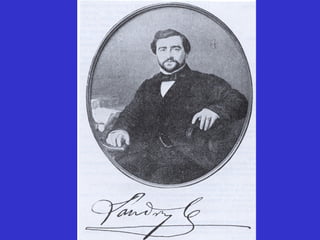
  • #15 Jean-Baptiste Octave Landry