ACUTE FLACCID PARALYSIS
          AFP
DEFINITION


• sudden onset of weakness or paralysis
  over a period of 15 days in a patient aged
  less than 15 years age.
Involvement

• AHC:
  1- acute poliomyelitis
  2- acute transverse myelitis


• Peripheral Nerves:
  1- roots: GBS (post-infectious)
   2- toxins: Diphteria, porphyria
Involvement

• N-M junction:
  botulinum toxin
  tick toxin

• Metabolic:
  Periodic paralysis

• Muscular:
  myositis
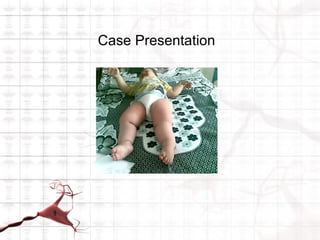
Case Presentation
Climbing
Paralysis
Guillain Barre Syndrome GBS
• The most common cause of acute flaccid
  paralysis (AFP) among infants.

• Age : any including newborn
• Sex : any ( male > female)
Guillain-Barre’ Syndrome
• Post-infectious polyneuropathy; ascending
  polyneuropathic paralysis

• An acute, rapidly progressing and
  potentially fatal form of polyneuritis
Pathophysiology
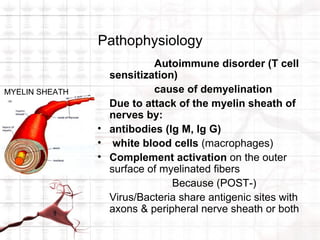
                           Autoimmune disorder (T cell
                  sensitization)
MYELIN SHEATH              cause of demyelination
                  Due to attack of the myelin sheath of
                  nerves by:
                • antibodies (Ig M, Ig G)
                • white blood cells (macrophages)
                • Complement activation on the outer
                  surface of myelinated fibers
                               Because (POST-)
                  Virus/Bacteria share antigenic sites with
                  axons & peripheral nerve sheath or both
pathophysiology
• inflammation causes leakage of proteins
  into the CSF causing raised CSF proteins
  without pleocytosis
• Can involve the peripheral nerves, cranial
  nerves,dorsal roots, dorsal root ganglia &
  sympathatic chain
Preceding Events : (1-3 WEEKS)
•     Respiratory infections :
    1- Viral: CMV, EBV, Varicella virus , influenza
      virus
    2- Bacterial: Mycoplasma pneumoniae, H influenza

•    Gastrointestinal infections : Campylobacter-
     jejuni (Bloody GE)

•    Vaccinations
•    Post surgery
Aetiology
  • Mycoplasma
    •Hepatitis B
    •CMV
    •EBV
    •Measles
    •Mumps
    •Echovirus
    •Cocksakie virus
    •Influenza virus
  • Varicella virus
    •Compylobacter jejuni
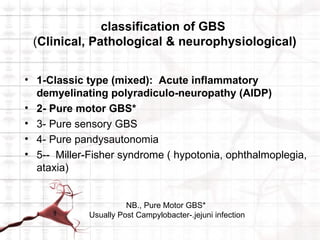
classification of GBS
 (Clinical, Pathological & neurophysiological)


• 1-Classic type (mixed): Acute inflammatory
  demyelinating polyradiculo-neuropathy (AIDP)
• 2- Pure motor GBS*
• 3- Pure sensory GBS
• 4- Pure pandysautonomia
• 5-- Miller-Fisher syndrome ( hypotonia, ophthalmoplegia,
  ataxia)


                       NB., Pure Motor GBS*
             Usually Post Campylobacter-.jejuni infection
C/P:

• 1- IP ( afrebrile ) : 1-3 weeks
• 2- CP: motor , sensory , autonomic
• 3- Serious Association
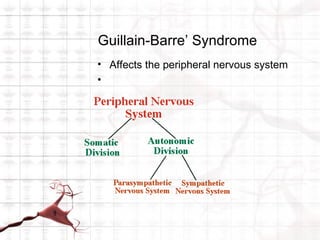
Guillain-Barre’ Syndrome
• Affects the peripheral nervous system
•
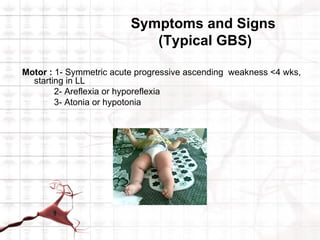
Symptoms and Signs
                            (Typical GBS)

Motor : 1- Symmetric acute progressive ascending weakness <4 wks,
  starting in LL
        2- Areflexia or hyporeflexia
        3- Atonia or hypotonia
Symptoms and Signs
                             (Typical GBS)

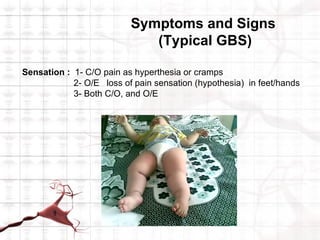
Sensation : 1- C/O pain as hyperthesia or cramps
            2- O/E loss of pain sensation (hypothesia) in feet/hands
            3- Both C/O, and O/E
• Symptoms and Signs
                   (Typical GBS)


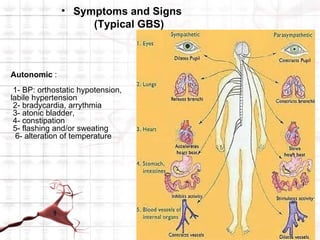
Autonomic :
 1- BP: orthostatic hypotension,
labile hypertension
 2- bradycardia, arrythmia
 3- atonic bladder,
 4- constipation
 5- flashing and/or sweating
  6- alteration of temperature
Characteristic “3A”triad:

•   ascending weakness : a- bilateral symmetrical weakness
                              b- usually start in LL, then UL
                              c-then, might be affected :
                                        i- cranial nerves (Brain stem) :
    including glosssopharyngeal and vagus nerves ( difficulty of swallowing
    even of fluid and water) and III, IV, VI cranial nerves ( eye muscles in
    Miller Fisher variety), VII Facial nerve ( unilateral or bilateral), and then
    respiratory muscles
                                        ii- respiratory muscles
                                        iii- phrenic nerves ( diaphragm )
•   areflexia ( Hallmark)
•   atonia ( hypotonia)
Serious Association:
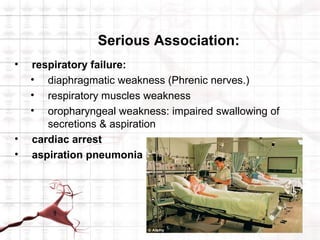
•   respiratory failure:
    • diaphragmatic weakness (Phrenic nerves.)
    • respiratory muscles weakness
    • oropharyngeal weakness: impaired swallowing of
       secretions & aspiration
•   cardiac arrest
•   aspiration pneumonia
CLINICAL VARIANTS

1–Polyneuritis cranialis
     Cranial nerve involvement
2–Miller fisher syndrome
    Ophthalmoplegia, ataxia, areflexia
3–Chronic progressive GBS
    Symptoms persisting more than 6 weeks
4- Chronic relapsing GB
Differentiation from spinal cord
syndrome
• Loss of arm reflexes

• Absence of sensory level

• Lack of spinal tenderness

• Normal bowel and bladder function
Investigations

                  Early
  Nerve Conduction Velocity (NCV) abnormality


               AFTER 1ST WEEK
• Late : CSF study : albuminocytogenic dissociation
1- NCV/EMG:

•               i- Early :Delayed or absent F
  waves or H reflexes
•               ii- slow or block of Nerve
  conduction velocity
•               iii- normal EMG/ extensive
  fibrillation showing denervation
2- CSF: Albuminocytologic
dissociation (Froin Syndrome)

•                  i- Increased CSF protein with
    normal cells
•              ii- might be normal CSF
  during 1st week
•              ii- usually +ve after 2 weeks
  of onset

          Differential Diagnosis of
    cytoalbuminous dissociation
DD
•   1- GBS
•   2- poliomyelitis
•   3- Diphteria polyneuritis
•   4- spinal cord compression
•   5- transverse myelitis
•   6- infratentorial tumor
•   7- venous sinus thrombosis
•   8- lead poison
•   9- botulism
Investigations (OTHERS)

• Antibody study : Ig M autoantibodies to GM1 and GM2
  gangliosides or Spinal MRI or normal CPK
• Anti-GQ1b antibodies are typically found in patients with the
  Miller Fisher syndrome (Acta Pediatr 2011)
Outcome of GBS patients

• Regressive : 90 % of patients making a good recovery,
  after 2-3 weeks of onset, Recovery, usually beginning 2 to
  4 weeks after progression stops starting from the last
  muscles affected till lower limb ( descending pattern )
• Chronic Relapsing: Less than 5% of patients
• Mortality: 3-% die from complications as respiratory
  failure especially in infants
Treatment
         Hospitalization
• 1- General care
• 2-- Specific treatment
• 3- complication treatment
Treatment
• Hospitalization : i- Must be treated in a
  hospital, never at home
                     ii- because of a risk of
  sudden onset of cardiac or respiratory
  arrest
                     iii- any hospital ? No, it
  must be a hospital have a pediatrics ICU

Hospitalization is continued until the child's
  condition has clearly stabilized.
General care
• i- bed sores
  ii-bowel care
  iii- nutrition care
• monitoring of vital signs
  –Nursing care
  –Repeated spirometries
  –Bowel and bladder care
  –Tube feeding
  –Care for bed sores
  –Ventilatory support if required
Specific treatment

•          i- IV immunoglobin: 2 gm/kg
  treatment
       *at a dose of 0.4 g/kg/day for 5
  consecutive days or
       * 1gm/kg/day for 2 days
•          ii- plasmapheresis: 5 exchanges
  of 50 ml plasma/ kg on alternate days
  ( 10 days course).
•         iii- both i and ii
complication treatment:

      i- artificial respiration for
 respiratory failure
      ii- muscular pain: pain killer as
 NSAI
      iii- chronic relapsing: trial of
 immunosupprive drugs or
 corticosteroid
Need for intensive care (PICU)

  - Flaccid quadriparesis
  - Rapidly progressive weakness
  - Reduced vital capacity (≤20 mL/kg)
  - Bulbar palsy
  - Autonomic cardiovascular instability

Need for assisted ventilation — Approximately 20
  percent of children with GBS require mechanical
  ventilation for respiratory failure
Warning signs for RF*
-   A sustained increase of pCO2 to ≥50 mmHg (normally
    35 to 40 mmHg)
-    An increasing respiratory rate
-    Increasing oxygen requirement and increasing
    alveolar to arterial oxygen difference (normally 5 to 10
    mmHg)
-    An increased use of accessory muscles (eg,
    sternocleidomastoid use, flaring of the ala nasae,
    intercostal retractions) and decreased or paradoxical
    diaphragm movements; these reflect restrictive lung-
    chest wall movement and low lung volumes
-    Sweating about the head and neck, wide pulse
    pressure, and bounding pulses portend CO2 retention.
•   Children have less metabolic and muscle reserve
    than adults. They can deteriorate quite rapidly and
    become apneic or develop alveolar hypoventilation
    "right under your nose."
•   Sedation and neuromuscular blockade should be
    avoided in ventilated patients because they
    obscure the course of the illness.
•   Providing scrupulous airway care and chest
    physiotherapy reduce the risk of pneumonia.
•   Tracheostomy may need to be performed if
    prolonged ventilation is required.
PROGNOSIS

• Mortality 3%
• 20% of cases need repiratory ve
• Recovery
  - 1 to 6 months, may take 12 months
  - Delayed recovery may be followed by
  permanent neurological sequel
Transverse Myelitis:

•   ? of immunological disorder
•   C/P : of AFP ( acute onset of flaccid
    hypotonic weakness ) with the following
    characters:
    • LL paralysis : paraplegia with areflexia
    • with sensory level of loss of sensation
    • Later : hyperreflexia
Poliomyelitis :

•   due to enterovirus affection (polio virus ) ( non or
    inadequate OPV )
•   C/P: of AFP with the following characters:
    • first shock stage ( with generalized hypotonia) then
       patchy asymmetrical weakness
    • normal sensation
    • areflexia of affected muscles
Acute flaccid paralysis: make it easy

Acute flaccid paralysis: make it easy

  • 1.
  • 2.
    DEFINITION • sudden onsetof weakness or paralysis over a period of 15 days in a patient aged less than 15 years age.
  • 3.
    Involvement • AHC: 1- acute poliomyelitis 2- acute transverse myelitis • Peripheral Nerves: 1- roots: GBS (post-infectious) 2- toxins: Diphteria, porphyria
  • 4.
    Involvement • N-M junction: botulinum toxin tick toxin • Metabolic: Periodic paralysis • Muscular: myositis
  • 5.
  • 6.
  • 7.
    Guillain Barre SyndromeGBS • The most common cause of acute flaccid paralysis (AFP) among infants. • Age : any including newborn • Sex : any ( male > female)
  • 8.
    Guillain-Barre’ Syndrome • Post-infectiouspolyneuropathy; ascending polyneuropathic paralysis • An acute, rapidly progressing and potentially fatal form of polyneuritis
  • 9.
    Pathophysiology Autoimmune disorder (T cell sensitization) MYELIN SHEATH cause of demyelination Due to attack of the myelin sheath of nerves by: • antibodies (Ig M, Ig G) • white blood cells (macrophages) • Complement activation on the outer surface of myelinated fibers Because (POST-) Virus/Bacteria share antigenic sites with axons & peripheral nerve sheath or both
  • 10.
    pathophysiology • inflammation causesleakage of proteins into the CSF causing raised CSF proteins without pleocytosis • Can involve the peripheral nerves, cranial nerves,dorsal roots, dorsal root ganglia & sympathatic chain
  • 11.
    Preceding Events :(1-3 WEEKS) • Respiratory infections : 1- Viral: CMV, EBV, Varicella virus , influenza virus 2- Bacterial: Mycoplasma pneumoniae, H influenza • Gastrointestinal infections : Campylobacter- jejuni (Bloody GE) • Vaccinations • Post surgery
  • 12.
    Aetiology •Mycoplasma •Hepatitis B •CMV •EBV •Measles •Mumps •Echovirus •Cocksakie virus •Influenza virus • Varicella virus •Compylobacter jejuni
  • 13.
    classification of GBS (Clinical, Pathological & neurophysiological) • 1-Classic type (mixed): Acute inflammatory demyelinating polyradiculo-neuropathy (AIDP) • 2- Pure motor GBS* • 3- Pure sensory GBS • 4- Pure pandysautonomia • 5-- Miller-Fisher syndrome ( hypotonia, ophthalmoplegia, ataxia) NB., Pure Motor GBS* Usually Post Campylobacter-.jejuni infection
  • 14.
    C/P: • 1- IP( afrebrile ) : 1-3 weeks • 2- CP: motor , sensory , autonomic • 3- Serious Association
  • 15.
    Guillain-Barre’ Syndrome • Affectsthe peripheral nervous system •
  • 16.
    Symptoms and Signs (Typical GBS) Motor : 1- Symmetric acute progressive ascending weakness <4 wks, starting in LL 2- Areflexia or hyporeflexia 3- Atonia or hypotonia
  • 17.
    Symptoms and Signs (Typical GBS) Sensation : 1- C/O pain as hyperthesia or cramps 2- O/E loss of pain sensation (hypothesia) in feet/hands 3- Both C/O, and O/E
  • 18.
    • Symptoms andSigns (Typical GBS) Autonomic : 1- BP: orthostatic hypotension, labile hypertension 2- bradycardia, arrythmia 3- atonic bladder, 4- constipation 5- flashing and/or sweating 6- alteration of temperature
  • 19.
    Characteristic “3A”triad: • ascending weakness : a- bilateral symmetrical weakness b- usually start in LL, then UL c-then, might be affected : i- cranial nerves (Brain stem) : including glosssopharyngeal and vagus nerves ( difficulty of swallowing even of fluid and water) and III, IV, VI cranial nerves ( eye muscles in Miller Fisher variety), VII Facial nerve ( unilateral or bilateral), and then respiratory muscles ii- respiratory muscles iii- phrenic nerves ( diaphragm ) • areflexia ( Hallmark) • atonia ( hypotonia)
  • 20.
    Serious Association: • respiratory failure: • diaphragmatic weakness (Phrenic nerves.) • respiratory muscles weakness • oropharyngeal weakness: impaired swallowing of secretions & aspiration • cardiac arrest • aspiration pneumonia
  • 21.
    CLINICAL VARIANTS 1–Polyneuritis cranialis Cranial nerve involvement 2–Miller fisher syndrome Ophthalmoplegia, ataxia, areflexia 3–Chronic progressive GBS Symptoms persisting more than 6 weeks 4- Chronic relapsing GB
  • 22.
    Differentiation from spinalcord syndrome • Loss of arm reflexes • Absence of sensory level • Lack of spinal tenderness • Normal bowel and bladder function
  • 23.
    Investigations Early Nerve Conduction Velocity (NCV) abnormality AFTER 1ST WEEK • Late : CSF study : albuminocytogenic dissociation
  • 24.
    1- NCV/EMG: • i- Early :Delayed or absent F waves or H reflexes • ii- slow or block of Nerve conduction velocity • iii- normal EMG/ extensive fibrillation showing denervation
  • 25.
    2- CSF: Albuminocytologic dissociation(Froin Syndrome) • i- Increased CSF protein with normal cells • ii- might be normal CSF during 1st week • ii- usually +ve after 2 weeks of onset Differential Diagnosis of cytoalbuminous dissociation
  • 26.
    DD • 1- GBS • 2- poliomyelitis • 3- Diphteria polyneuritis • 4- spinal cord compression • 5- transverse myelitis • 6- infratentorial tumor • 7- venous sinus thrombosis • 8- lead poison • 9- botulism
  • 27.
    Investigations (OTHERS) • Antibodystudy : Ig M autoantibodies to GM1 and GM2 gangliosides or Spinal MRI or normal CPK • Anti-GQ1b antibodies are typically found in patients with the Miller Fisher syndrome (Acta Pediatr 2011)
  • 28.
    Outcome of GBSpatients • Regressive : 90 % of patients making a good recovery, after 2-3 weeks of onset, Recovery, usually beginning 2 to 4 weeks after progression stops starting from the last muscles affected till lower limb ( descending pattern ) • Chronic Relapsing: Less than 5% of patients • Mortality: 3-% die from complications as respiratory failure especially in infants
  • 29.
    Treatment Hospitalization • 1- General care • 2-- Specific treatment • 3- complication treatment
  • 30.
    Treatment • Hospitalization :i- Must be treated in a hospital, never at home ii- because of a risk of sudden onset of cardiac or respiratory arrest iii- any hospital ? No, it must be a hospital have a pediatrics ICU Hospitalization is continued until the child's condition has clearly stabilized.
  • 31.
    General care • i-bed sores ii-bowel care iii- nutrition care • monitoring of vital signs –Nursing care –Repeated spirometries –Bowel and bladder care –Tube feeding –Care for bed sores –Ventilatory support if required
  • 32.
    Specific treatment • i- IV immunoglobin: 2 gm/kg treatment *at a dose of 0.4 g/kg/day for 5 consecutive days or * 1gm/kg/day for 2 days • ii- plasmapheresis: 5 exchanges of 50 ml plasma/ kg on alternate days ( 10 days course). • iii- both i and ii
  • 33.
    complication treatment: i- artificial respiration for respiratory failure ii- muscular pain: pain killer as NSAI iii- chronic relapsing: trial of immunosupprive drugs or corticosteroid
  • 34.
    Need for intensivecare (PICU) - Flaccid quadriparesis - Rapidly progressive weakness - Reduced vital capacity (≤20 mL/kg) - Bulbar palsy - Autonomic cardiovascular instability Need for assisted ventilation — Approximately 20 percent of children with GBS require mechanical ventilation for respiratory failure
  • 35.
    Warning signs forRF* - A sustained increase of pCO2 to ≥50 mmHg (normally 35 to 40 mmHg) - An increasing respiratory rate - Increasing oxygen requirement and increasing alveolar to arterial oxygen difference (normally 5 to 10 mmHg) - An increased use of accessory muscles (eg, sternocleidomastoid use, flaring of the ala nasae, intercostal retractions) and decreased or paradoxical diaphragm movements; these reflect restrictive lung- chest wall movement and low lung volumes - Sweating about the head and neck, wide pulse pressure, and bounding pulses portend CO2 retention.
  • 36.
    Children have less metabolic and muscle reserve than adults. They can deteriorate quite rapidly and become apneic or develop alveolar hypoventilation "right under your nose." • Sedation and neuromuscular blockade should be avoided in ventilated patients because they obscure the course of the illness. • Providing scrupulous airway care and chest physiotherapy reduce the risk of pneumonia. • Tracheostomy may need to be performed if prolonged ventilation is required.
  • 37.
    PROGNOSIS • Mortality 3% •20% of cases need repiratory ve • Recovery - 1 to 6 months, may take 12 months - Delayed recovery may be followed by permanent neurological sequel
  • 39.
    Transverse Myelitis: • ? of immunological disorder • C/P : of AFP ( acute onset of flaccid hypotonic weakness ) with the following characters: • LL paralysis : paraplegia with areflexia • with sensory level of loss of sensation • Later : hyperreflexia
  • 40.
    Poliomyelitis : • due to enterovirus affection (polio virus ) ( non or inadequate OPV ) • C/P: of AFP with the following characters: • first shock stage ( with generalized hypotonia) then patchy asymmetrical weakness • normal sensation • areflexia of affected muscles

Editor's Notes

  • #8 With virtual elimination of poliomyelitis, GBS has become the most common cause of acute flaccid paralysis in many parts of the world
  • #29 The overall prognosis of GBS is quite good,
  • #35 Children with vital capacity approximately one half the normal value for age or ≤20 mL/kg body weight generally progress to require ventilatory support. In a study of patients with GBS that included some children, serial measurements of pulmonary function tests were most helpful in detecting the risk of developing respiratory failure 
  • #36 Pulmonary testing and measuring vital capacity is difficult in children who cannot cooperate, typically those younger than 6 years of age. These patients should be closely monitored and observed for fatigue and other clinical signs of impending respiratory muscle failure. These signs include the following:
  • #37 hildren have less metabolic and muscle reserve than adults. They can deteriorate quite rapidly and become apneic or develop alveolar hypoventilation &amp;quot;right under your nose.&amp;quot; Generally, it is wise to have a pediatric pulmonologist involved early in the clinical course. Sedation and neuromuscular blockade should be avoided in ventilated patients because they obscure the course of the illness. Providing scrupulous airway care and chest physiotherapy reduce the risk of pneumonia. Tracheostomy may need to be performed if prolonged ventilation is required.