PCSK9 inhibitory
new hope for patients with hypercholesterolemia?
Nasim Badarna
UPJS
kosice, slovakia
Structure of the diploma thesis
• Introduction
• Hyperlipidemia and Hypercholesterolemia
• Current treatment
• LDL-receptors
• PCSK9 – new hope ?
• Clinical trial
• Conclusion
introduction
• Cholesterol is a fatty substance that occurs naturally in the body.
Providing vital functions throughout our bodies(cell membrane and
certain hormones e.c.t).
• However, these cholesterol levels should by kept in a specific
range otherwise it can cause serious medical problems such as
heart attack .
Introduction
• familial hypercholesterolemia (Heterozygous FH), is one of
the most common genetic disorders in humans, affecting
≈12 million people worldwide, and so, hypercholesterolemic
patients are advised to use pharmacological drugs that
lowers the levels of cholesterol achieve optimal level goals.
• PCSK9, Proprotein convertase subtilisin/kexin type 9, is a
new class of drugs that have been shown to dramatically
lower LDL cholesterol levels which we will discuss in details
in this presentation.
Hypercholesterolemia
• is characterized by elevated low-density
lipoprotein cholesterol (LDL) in the blood.
• Hypercholesterolemia is typically due to a
combination of environmental and genetic
factors.[9] Environmental factors
include obesity, diet, and stress.
• familial hypercholesterolemia (Heterozygous FH),
In >98% of patients, the defect is caused by loss-
of-function mutations in the LDL receptor.
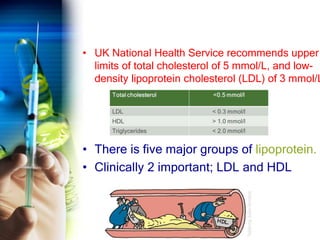
• UK National Health Service recommends upper
limits of total cholesterol of 5 mmol/L, and low-
density lipoprotein cholesterol (LDL) of 3 mmol/L
• There is five major groups of lipoprotein.
• Clinically 2 important; LDL and HDL
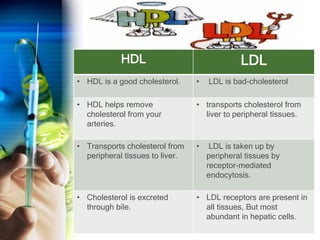
LDLHDL
• LDL is bad-cholesterol• HDL is a good cholesterol.
• transports cholesterol from
liver to peripheral tissues.
• HDL helps remove
cholesterol from your
arteries.
• LDL is taken up by
peripheral tissues by
receptor-mediated
endocytosis.
• Transports cholesterol from
peripheral tissues to liver.
• LDL receptors are present in
all tissues, But most
abundant in hepatic cells.
• Cholesterol is excreted
through bile.
LDL & its clinical significance
• cardiovascular diseases.
• It is the main source of cholesterol buildup and
blockage in the arteries, This is starting event of
atherosclerosis, leading to MI.
• myocardial infarction before the age of 40 in men
and before the age of 60 in women
•
• That’s why is crucial to manage levels of high
cholesterol.
Current treatments
• Statins, ezetimibe, newer bile acid
sequestrants have resulted in significant
improvements in the treatment of HeFH
over the past 2 decades, with apparent
reductions in cardiovascular morbidity
and mortality.
• Statins, works by inhibiting the
enzyme HMG-CoA reductase which
plays a central role in the production of
cholesterol.
Why bother ?
• Despite treatment with statins or other
lipid-modifying drugs, many HeFH
patients do not achieve optimal LDL
goals.
• Another disadvantage is that these
drugs have significant side effects such
as muscle pain, increased risk
of diabetes mellitus.
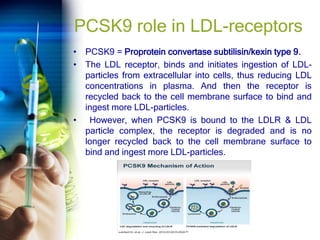
PCSK9 role in LDL-receptors
• PCSK9 = Proprotein convertase subtilisin/kexin type 9.
• The LDL receptor, binds and initiates ingestion of LDL-
particles from extracellular into cells, thus reducing LDL
concentrations in plasma. And then the receptor is
recycled back to the cell membrane surface to bind and
ingest more LDL-particles.
• However, when PCSK9 is bound to the LDLR & LDL
particle complex, the receptor is degraded and is no
longer recycled back to the cell membrane surface to
bind and ingest more LDL-particles.
PCSK9 inhibition
• Blocking PCSK9 binding to the LDL
receptor has recently been shown to be
effective in lowering LDL-C in humans.
• AMG 145(PCSK9 Inhibitory) is a fully
human monoclonal antibody to PCSK9
that yielded LDL-C reductions up to
81%.  optimal LDL levels
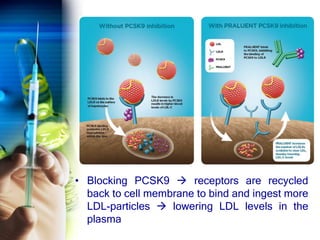
• Blocking PCSK9  receptors are recycled
back to cell membrane to bind and ingest more
LDL-particles  lowering LDL levels in the
plasma
It’s New !
• The first two PCSK9 inhibitors,
alirocumab and evolocumab, were approved
as once every two week injections,
subcutaneously, by the U.S. Food and Drug
Administration in 2015.
Clinical trail
• Relationships Between Plasma PCSK9 Levels, LDL-
cholesterol Concentrations and Lipoprotein (a) Levels in
Familial Hypercholesterolemia
• This study has been completed.
• Location:
• Canada, Quebec; institute of nutrition and Functional
foods(INAF).
• Sponsor.
• Laval University
• Information provided by (Responsible Party):
• Patrick Couture, Laval University
• ClinicalTrials.gov Identifier:
• First received: August 22, 2014
•
ClinicalTrials.gov , A service of the U.S. National Institutes
of Heal
• Objective: is to examine to what extent
variations in LDL-C and Lipoprotein (Lp)
(a) concentrations are related
to PCSK9 levels in hypercholesteremic
patients.
• primary hypothesis: is that PCSK9
levels have a significant impact on LDL-
C concentration variability and are
associated with Lp(a) levels.
Eligibility
Criteria
Inclusion Criteria:
Subjects with familial hypercholesterolemia:
•Aged between 18-65 years
•Carrier of a mutation in the LDL receptor gene
Exclusion Criteria:
•Subjects with a previous history of cardiovascular disease
•Subjects with Type 2 diabetes
•Subjects with a history of cancer
•Subjects with acute liver disease, hepatic dysfunction, or
persistent elevations of serum transaminases
•Subjects with a secondary hyperlipidemia due to any cause
•History of alcohol or drug abuse within the past 2 years
RESULTS
• evolocumab was intreduced to the FDA in August
2014. The FDA approved evolocumab injection
on 27 August 2015, for some patients who are
unable to get their LDL cholesterol under control
with current treatment options.
• Side effects that occurred in 2% of people include
nose and throat irritation, injection site reactions
and bruising, flu-like symptoms, urinary tract
infection, diarrhea, bronchitis and cough, and
muscle pain
Conclusion
• PCSK9 inhibitors administration yielded rapid and
substantial reductions in LDL-C in heterozygous
familial hypercholesterolemia patients, with
minimal adverse events and good tolerability.
• A new drug that enhances and improves the lives
of many which indeed needed help…
• http://circ.ahajournals.org/content/12
6/20/2408.short
• http://circ.ahajournals.org/content/12
6/20/2408.short
REFERENCES
• 1.↵ Goldstein JL,
• Hobbs HH,
• Brown MS
• . Familial hypercholesterolemia. The Metabolic and Molecular
Bases of Inherited Disease. 2001:2863–2913.
• Google Scholar
• 2.↵ Slack J
• . Risks of ischaemic heart-disease in familial hyperlipoproteinaemic
states. Lancet. 1969;2:1380–1382.
• 3.↵ Leigh SE,
• Foster AH,
• Whittall RA,
• Hubbart CS,
• Humphries SE
• Update and analysis of the University College London low density
lipoprotein receptor familial hypercholesterolemia database. Ann
Hum Genet. 2008;72:485–498.
• CrossRefMedlineGoogle Scholar
• 4.↵ Innerarity TL,
• Weisgraber KH,
• Arnold KS,
• Mahley RW,
• Krauss RM,
• Vega GL,
• Grundy SM
• . Familial defective apolipoprotein B-100: low density lipoproteins
with abnormal receptor binding. Proc Natl Acad Sci U S
A. 1987;84:6919–6923.
• Abstract/FREE Full TextGoogle Scholar

Pcsk9 inhibitory

  • 1.
    PCSK9 inhibitory new hopefor patients with hypercholesterolemia? Nasim Badarna UPJS kosice, slovakia
  • 2.
    Structure of thediploma thesis • Introduction • Hyperlipidemia and Hypercholesterolemia • Current treatment • LDL-receptors • PCSK9 – new hope ? • Clinical trial • Conclusion
  • 3.
    introduction • Cholesterol isa fatty substance that occurs naturally in the body. Providing vital functions throughout our bodies(cell membrane and certain hormones e.c.t). • However, these cholesterol levels should by kept in a specific range otherwise it can cause serious medical problems such as heart attack .
  • 4.
    Introduction • familial hypercholesterolemia(Heterozygous FH), is one of the most common genetic disorders in humans, affecting ≈12 million people worldwide, and so, hypercholesterolemic patients are advised to use pharmacological drugs that lowers the levels of cholesterol achieve optimal level goals. • PCSK9, Proprotein convertase subtilisin/kexin type 9, is a new class of drugs that have been shown to dramatically lower LDL cholesterol levels which we will discuss in details in this presentation.
  • 5.
    Hypercholesterolemia • is characterizedby elevated low-density lipoprotein cholesterol (LDL) in the blood. • Hypercholesterolemia is typically due to a combination of environmental and genetic factors.[9] Environmental factors include obesity, diet, and stress. • familial hypercholesterolemia (Heterozygous FH), In >98% of patients, the defect is caused by loss- of-function mutations in the LDL receptor.
  • 6.
    • UK NationalHealth Service recommends upper limits of total cholesterol of 5 mmol/L, and low- density lipoprotein cholesterol (LDL) of 3 mmol/L • There is five major groups of lipoprotein. • Clinically 2 important; LDL and HDL
  • 7.
    LDLHDL • LDL isbad-cholesterol• HDL is a good cholesterol. • transports cholesterol from liver to peripheral tissues. • HDL helps remove cholesterol from your arteries. • LDL is taken up by peripheral tissues by receptor-mediated endocytosis. • Transports cholesterol from peripheral tissues to liver. • LDL receptors are present in all tissues, But most abundant in hepatic cells. • Cholesterol is excreted through bile.
  • 8.
    LDL & itsclinical significance • cardiovascular diseases. • It is the main source of cholesterol buildup and blockage in the arteries, This is starting event of atherosclerosis, leading to MI. • myocardial infarction before the age of 40 in men and before the age of 60 in women • • That’s why is crucial to manage levels of high cholesterol.
  • 9.
    Current treatments • Statins,ezetimibe, newer bile acid sequestrants have resulted in significant improvements in the treatment of HeFH over the past 2 decades, with apparent reductions in cardiovascular morbidity and mortality. • Statins, works by inhibiting the enzyme HMG-CoA reductase which plays a central role in the production of cholesterol.
  • 10.
    Why bother ? •Despite treatment with statins or other lipid-modifying drugs, many HeFH patients do not achieve optimal LDL goals. • Another disadvantage is that these drugs have significant side effects such as muscle pain, increased risk of diabetes mellitus.
  • 11.
    PCSK9 role inLDL-receptors • PCSK9 = Proprotein convertase subtilisin/kexin type 9. • The LDL receptor, binds and initiates ingestion of LDL- particles from extracellular into cells, thus reducing LDL concentrations in plasma. And then the receptor is recycled back to the cell membrane surface to bind and ingest more LDL-particles. • However, when PCSK9 is bound to the LDLR & LDL particle complex, the receptor is degraded and is no longer recycled back to the cell membrane surface to bind and ingest more LDL-particles.
  • 12.
    PCSK9 inhibition • BlockingPCSK9 binding to the LDL receptor has recently been shown to be effective in lowering LDL-C in humans. • AMG 145(PCSK9 Inhibitory) is a fully human monoclonal antibody to PCSK9 that yielded LDL-C reductions up to 81%.  optimal LDL levels
  • 13.
    • Blocking PCSK9 receptors are recycled back to cell membrane to bind and ingest more LDL-particles  lowering LDL levels in the plasma
  • 14.
    It’s New ! •The first two PCSK9 inhibitors, alirocumab and evolocumab, were approved as once every two week injections, subcutaneously, by the U.S. Food and Drug Administration in 2015.
  • 15.
    Clinical trail • RelationshipsBetween Plasma PCSK9 Levels, LDL- cholesterol Concentrations and Lipoprotein (a) Levels in Familial Hypercholesterolemia • This study has been completed. • Location: • Canada, Quebec; institute of nutrition and Functional foods(INAF). • Sponsor. • Laval University • Information provided by (Responsible Party): • Patrick Couture, Laval University • ClinicalTrials.gov Identifier: • First received: August 22, 2014 • ClinicalTrials.gov , A service of the U.S. National Institutes of Heal
  • 16.
    • Objective: isto examine to what extent variations in LDL-C and Lipoprotein (Lp) (a) concentrations are related to PCSK9 levels in hypercholesteremic patients. • primary hypothesis: is that PCSK9 levels have a significant impact on LDL- C concentration variability and are associated with Lp(a) levels.
  • 17.
    Eligibility Criteria Inclusion Criteria: Subjects withfamilial hypercholesterolemia: •Aged between 18-65 years •Carrier of a mutation in the LDL receptor gene Exclusion Criteria: •Subjects with a previous history of cardiovascular disease •Subjects with Type 2 diabetes •Subjects with a history of cancer •Subjects with acute liver disease, hepatic dysfunction, or persistent elevations of serum transaminases •Subjects with a secondary hyperlipidemia due to any cause •History of alcohol or drug abuse within the past 2 years
  • 18.
    RESULTS • evolocumab wasintreduced to the FDA in August 2014. The FDA approved evolocumab injection on 27 August 2015, for some patients who are unable to get their LDL cholesterol under control with current treatment options. • Side effects that occurred in 2% of people include nose and throat irritation, injection site reactions and bruising, flu-like symptoms, urinary tract infection, diarrhea, bronchitis and cough, and muscle pain
  • 19.
    Conclusion • PCSK9 inhibitorsadministration yielded rapid and substantial reductions in LDL-C in heterozygous familial hypercholesterolemia patients, with minimal adverse events and good tolerability. • A new drug that enhances and improves the lives of many which indeed needed help…
  • 21.
  • 22.
    REFERENCES • 1.↵ GoldsteinJL, • Hobbs HH, • Brown MS • . Familial hypercholesterolemia. The Metabolic and Molecular Bases of Inherited Disease. 2001:2863–2913. • Google Scholar • 2.↵ Slack J • . Risks of ischaemic heart-disease in familial hyperlipoproteinaemic states. Lancet. 1969;2:1380–1382. • 3.↵ Leigh SE, • Foster AH, • Whittall RA, • Hubbart CS, • Humphries SE
  • 23.
    • Update andanalysis of the University College London low density lipoprotein receptor familial hypercholesterolemia database. Ann Hum Genet. 2008;72:485–498. • CrossRefMedlineGoogle Scholar • 4.↵ Innerarity TL, • Weisgraber KH, • Arnold KS, • Mahley RW, • Krauss RM, • Vega GL, • Grundy SM • . Familial defective apolipoprotein B-100: low density lipoproteins with abnormal receptor binding. Proc Natl Acad Sci U S A. 1987;84:6919–6923. • Abstract/FREE Full TextGoogle Scholar