Department of Physics
Arts, Commerce & Science College, Kille-Dharur,
Beed-431124
 Relation between the macroscopic behavior (bulk
properties) of the system in terms of microscopic behavior
( individual properties).
 Example: Radioactive decay
• In radioactive decay, one cannot say which atom of the
radioactive material will decay first and when.
• Applying the principle of statistical mechanics, certain
average no., of atoms will decay at any given instant of
time.
• Explore the most probable behavior of assembly of
decaying nuclei.
 Size of the Avogadro no., (6*10^26 per kg.mole ), it
is clear that even a small volume of the matter
contains many molecules.
 It is impossible to follow the motion of all the
individual molecules; but the situation is ideal for
the application of statistical methods.
 Before the advent of quantum theory Maxwell ,
Boltzmann , Gibbs etc., applied statistical methods
making the use of classical physics.
 These Statistical methods are known as classical
statistics or Maxwell- Boltzmann statistics.
 Maxwell deals with the distribution of molecular
velocities.
 Boltzmann deals with the entropy and probability.
 Classical statistics successfully explained many
observed physical phenomena like temperatures,
pressure energy etc.,
 Failed to explain the several other experimentally
observed phenomena such as black body radiation,
photoelectric effect, specific heat at low temperatures
etc.,
 This failure of classical statistics forced the issue in
favor of the new quantum idea of discrete exchange of
energy between systems and along with it a new
statistics, known as quantum statistics.
 Quantum statistics was formulated by Bose in the
deduction of Planck's radiation law by purely
statistical reasoning on the basis of certain
fundamental assumptions radically different from
those of classical statistics.
 Einstein in the same year utilized practically the same
principles in evolving the kinetic theory of gases, as a
substitute for the classical Boltzmann statistics.
 Thus a new quantum statistics, known as Bose –
Einstein statistics.
 Fermi and Dirac quite independently modified
Bose – Einstein statistics in certain cases, on the
basis of additional principle, suggested first by
Pauli in connection with electronic structure of
atoms and known as Pauli's exclusion principle.
 This led to the recognition of a second kind of
quantum statistics , called, the Fermi- Dirac
statistics.
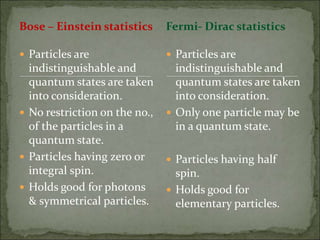
Bose – Einstein statistics
 Particles are
indistinguishable and
quantum states are taken
into consideration.
 No restriction on the no.,
of the particles in a
quantum state.
 Particles having zero or
integral spin.
 Holds good for photons
& symmetrical particles.
 Particles are
indistinguishable and
quantum states are taken
into consideration.
 Only one particle may be
in a quantum state.
 Particles having half
spin.
 Holds good for
elementary particles.
Fermi- Dirac statistics
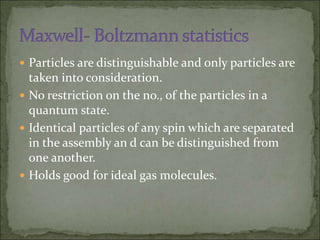
 Particles are distinguishable and only particles are
taken into consideration.
 No restriction on the no., of the particles in a
quantum state.
 Identical particles of any spin which are separated
in the assembly an d can be distinguished from
one another.
 Holds good for ideal gas molecules.
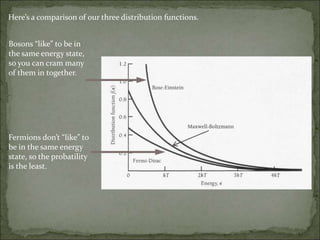
Here’s a comparison of our three distribution functions.
Bosons “like” to be in
the same energy state,
so you can cram many
of them in together.
Fermions don’t “like” to
be in the same energy
state, so the probatility
is the least.
 Quantum statistics arises from classical statistics
states, superposition , interference, entanglement ,
probability amplitudes.
 Quantum evolution embedded in classical
evolution.
Classical Statistics and Quantum Statistics

Classical Statistics and Quantum Statistics

  • 1.
    Department of Physics Arts,Commerce & Science College, Kille-Dharur, Beed-431124
  • 2.
     Relation betweenthe macroscopic behavior (bulk properties) of the system in terms of microscopic behavior ( individual properties).  Example: Radioactive decay • In radioactive decay, one cannot say which atom of the radioactive material will decay first and when. • Applying the principle of statistical mechanics, certain average no., of atoms will decay at any given instant of time. • Explore the most probable behavior of assembly of decaying nuclei.
  • 3.
     Size ofthe Avogadro no., (6*10^26 per kg.mole ), it is clear that even a small volume of the matter contains many molecules.  It is impossible to follow the motion of all the individual molecules; but the situation is ideal for the application of statistical methods.  Before the advent of quantum theory Maxwell , Boltzmann , Gibbs etc., applied statistical methods making the use of classical physics.
  • 4.
     These Statisticalmethods are known as classical statistics or Maxwell- Boltzmann statistics.  Maxwell deals with the distribution of molecular velocities.  Boltzmann deals with the entropy and probability.  Classical statistics successfully explained many observed physical phenomena like temperatures, pressure energy etc.,
  • 5.
     Failed toexplain the several other experimentally observed phenomena such as black body radiation, photoelectric effect, specific heat at low temperatures etc.,  This failure of classical statistics forced the issue in favor of the new quantum idea of discrete exchange of energy between systems and along with it a new statistics, known as quantum statistics.
  • 6.
     Quantum statisticswas formulated by Bose in the deduction of Planck's radiation law by purely statistical reasoning on the basis of certain fundamental assumptions radically different from those of classical statistics.  Einstein in the same year utilized practically the same principles in evolving the kinetic theory of gases, as a substitute for the classical Boltzmann statistics.  Thus a new quantum statistics, known as Bose – Einstein statistics.
  • 7.
     Fermi andDirac quite independently modified Bose – Einstein statistics in certain cases, on the basis of additional principle, suggested first by Pauli in connection with electronic structure of atoms and known as Pauli's exclusion principle.  This led to the recognition of a second kind of quantum statistics , called, the Fermi- Dirac statistics.
  • 8.
    Bose – Einsteinstatistics  Particles are indistinguishable and quantum states are taken into consideration.  No restriction on the no., of the particles in a quantum state.  Particles having zero or integral spin.  Holds good for photons & symmetrical particles.  Particles are indistinguishable and quantum states are taken into consideration.  Only one particle may be in a quantum state.  Particles having half spin.  Holds good for elementary particles. Fermi- Dirac statistics
  • 9.
     Particles aredistinguishable and only particles are taken into consideration.  No restriction on the no., of the particles in a quantum state.  Identical particles of any spin which are separated in the assembly an d can be distinguished from one another.  Holds good for ideal gas molecules.
  • 10.
    Here’s a comparisonof our three distribution functions. Bosons “like” to be in the same energy state, so you can cram many of them in together. Fermions don’t “like” to be in the same energy state, so the probatility is the least.
  • 11.
     Quantum statisticsarises from classical statistics states, superposition , interference, entanglement , probability amplitudes.  Quantum evolution embedded in classical evolution.