0101011
0000000
1110100
0110001

  1

 0


                      Molecular Dynamics

                                 Sparisoma Viridi
                      Nuclear Physics and Biophysics Research Division
                    Institut Teknologi Bandung, Bandung 40132, Indonesia
                                       dudung@fi.itb.ac.id


      v2011.09.20                 FI3102 Computational Physics             1
0101011
0000000
1110100
0110001                   Outline
  1
      •   Molecular dynamics
 0
      •   The use of molecular dynamics
      •   Experiment using simulation
      •   Molecular scale, human scale, planetoid
      •   MD algorithm and example
      •   Is MD so perfect?


      v2011.09.20      FI3102 Computational Physics   2
0101011
0000000
1110100
0110001             Molecular dynamics
  1
      • Molecular dynamics (MD) is a computer
 0
        simulation of physical movements of
        atoms and molecules (Wikipedia, 2011)
      • MD simulation consists of the numerical,
        step-by-step, solution of classical equation
        of motion (Allen, 2004)


      v2011.09.20       FI3102 Computational Physics   3
0101011
0000000
1110100
0110001      Molecular dynamics (cont.)
  1
      • It is a computer simulation technique
 0
        where the time evolution of a set of
        interacting atoms is followed by integrating
        their equations of motion (Ercolessi, 1997)
      • MD simulations can provide the ultimate
        detail concerning individual motions as a
        function of time (Karplus and McCammon,
        2002)

      v2011.09.20     FI3102 Computational Physics   4
0101011
0000000
1110100
0110001             The use of MD
  1
      • It can be used from atomic scale until
 0
        planetoid scale -- amazing
      • To calculate electronic ground state as
        function of time of liquid metal (Kresse and
        Hafner, 1993)
      • Motion of n-Alkanes molecules (Ryckaert,
        Ciccotti, and Berendsen, 1977)


      v2011.09.20     FI3102 Computational Physics   5
0101011
0000000
1110100
0110001             The use of MD (cont.)
  1
      • Nanodroplet on a surface (Sedighi, Murad,
 0
        and Aggarwal, 2010)
      • Grain of in mm and cm size (Gallas,
        Herrmann, Pöschel, and Sokolowski,
        1996)
      • Simulation of asteroids movement (Jaffé,
        Ross, Lo, Marsden, Farrelly, and Uzer,
        2002)

      v2011.09.20        FI3102 Computational Physics   6
0101011
0000000
1110100
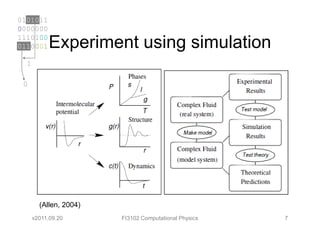
0110001    Experiment using simulation
  1

 0


        (Allen, 2004)
      v2011.09.20       FI3102 Computational Physics   7
0101011
0000000
1110100
0110001       Experiment using .. (cont.)
  1
      • It is a bridge between microscopic and
 0
        macroscopic
      • It is also a bridge between theory and
        experiment
      • Do the experiment using simulation is a
        smart way to reduce the financial problem
      • Even all considered nature laws are input
        to the system, it could give the unexpected
      v2011.09.20     FI3102 Computational Physics   8
0101011
0000000
1110100
0110001             Molecular scale
  1
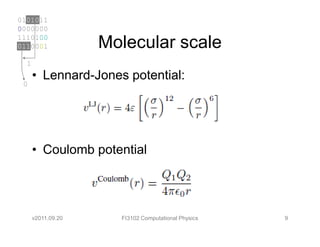
      • Lennard-Jones potential:
 0


      • Coulomb potential


      v2011.09.20     FI3102 Computational Physics   9
0101011
0000000
1110100
0110001             Molecular scale (cont.)
  1
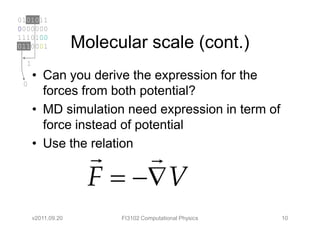
      • Can you derive the expression for the
 0
        forces from both potential?
      • MD simulation need expression in term of
        force instead of potential
      • Use the relation
                      r    r
                      F = −∇V
      v2011.09.20         FI3102 Computational Physics   10
0101011
0000000
1110100
0110001             Molecular scale (cont.)
  1
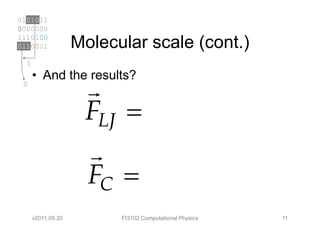
      • And the results?
 0
                     r
                     FLJ =
                     r
                     FC =
      v2011.09.20         FI3102 Computational Physics   11
0101011
0000000
1110100
0110001             Human scale
  1
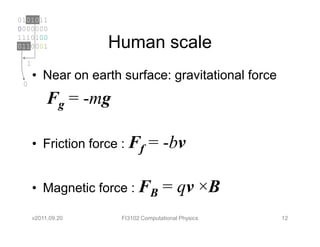
      • Near on earth surface: gravitational force
 0

           Fg = -mg

      • Friction force : Ff    = -bv

      • Magnetic force : FB         = qv ×B
      v2011.09.20     FI3102 Computational Physics   12
0101011
0000000
1110100
0110001             Planetoid scale
  1
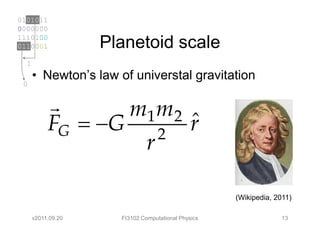
      • Newton’s law of universtal gravitation
 0


           r      m1 m 2
           FG = −G 2 r   ˆ
                   r

                                                     (Wikipedia, 2011)

      v2011.09.20     FI3102 Computational Physics                13
0101011
0000000
1110100
0110001             MD algorithm
  1
      • It is uses Newton’s second law of motion
 0
        to get the acceleration a
      • It using numerical integration to get the
        equation of motion, use the simple method
        i.e. original Euler method
      • New motion parameters will cause new
        value of all forces
      • Calculate the new forces to get new a
      v2011.09.20    FI3102 Computational Physics   14
0101011
0000000
1110100
0110001             MD algorithm (cont.)
  1
               r     r
 0
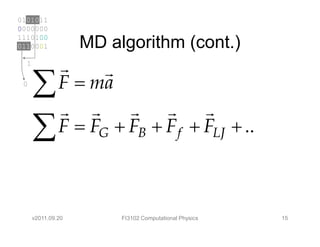
      ∑        F = ma
               r r      r    r     r
      ∑        F = FG + FB + F f + FLJ + ..


      v2011.09.20        FI3102 Computational Physics   15
0101011
0000000
1110100
0110001             MD algorithm (cont.)
  1
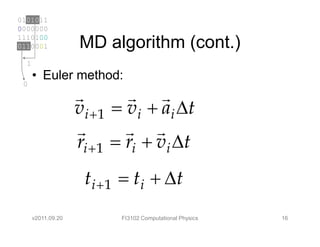
      • Euler method:
 0
                    r        r r
                    vi + 1 = vi + ai ∆t
                    r        r r
                    ri + 1 = ri + vi ∆t
                     t i +1 = t i + ∆t
      v2011.09.20          FI3102 Computational Physics   16
0101011
0000000
1110100
0110001             MD algorithm (cont.)
  1
      • You must pay attention to the outside
 0
        influence that changes with order of
        magnitude of chosen ∆t
      • Normally it is chose that ∆t must be 100
        times smaller than that change


      v2011.09.20        FI3102 Computational Physics   17
0101011
0000000
1110100
0110001                Example
  1
      • Write the numerical expression for a
 0
        parabolic motion when air friction is
        considered
      • g=-gj
      • r0, v0
      • b is for Ff = - bv


      v2011.09.20     FI3102 Computational Physics   18
0101011
0000000
1110100
0110001             Example (cont.)
  1
      • Write the numerical expression for a
 0
        charged particle that moves perpendicular
        to external magnetic field B, initial velocity
        is v0 at r0


      v2011.09.20      FI3102 Computational Physics   19
0101011
0000000
1110100
0110001             Is MD so perfect?
  1
      • Unfortunately not
 0
      • It has problem even all forces are already
        considered
      • It can produce unreported results or
        unexpected (wrong) results
      • It has problem in time stamp


      v2011.09.20      FI3102 Computational Physics   20
0101011
0000000
1110100
0110001             Time stamp problem
  1
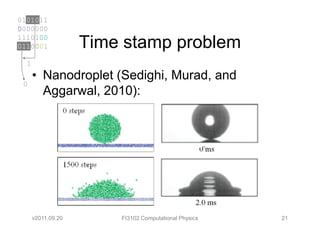
      • Nanodroplet (Sedighi, Murad, and
 0
        Aggarwal, 2010):


      v2011.09.20       FI3102 Computational Physics   21
0101011
0000000
1110100
0110001     Time stamp problem (cont.)
  1
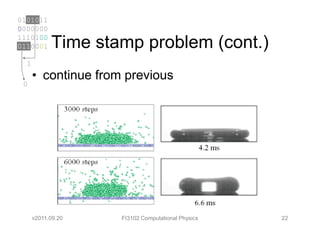
      • continue from previous
 0


      v2011.09.20    FI3102 Computational Physics   22
0101011
0000000
1110100
0110001     Time stamp problem (cont.)
  1
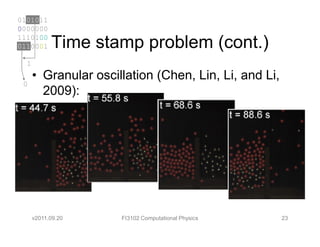
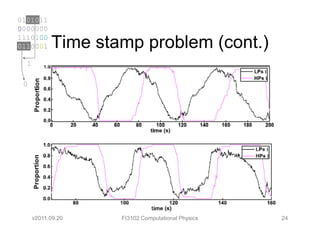
      • Granular oscillation (Chen, Lin, Li, and Li,
 0
        2009):


      v2011.09.20     FI3102 Computational Physics     23
0101011
0000000
1110100
0110001     Time stamp problem (cont.)
  1

 0


      v2011.09.20   FI3102 Computational Physics   24
0101011
0000000
1110100
0110001                 References
  1
      1. Wikipedia contributors, “Molecular dynamics”, Wikipe-
 0       dia, The Free Encyclopedia, 5 September 2011, 15:49
         UTC, oldid:448597141 [2011.09.21 09.34+07]
      2. Michael P. Allen, “Introduction to Molecular Dynamics
         Simulation”, in Computational Soft Matter: From
         Synthetic Polymers to Proteins, Lecture Notes, Norberg
         Attig, Kurt Binder, Helmut Grubmüller, Kurt Kremer
         (Eds.), John von Nuemann Institut for Computing,
         Jülich, NIC Series, Vol. 23, pp. 1-28, 2004


      v2011.09.20         FI3102 Computational Physics       25
0101011
0000000
1110100
0110001             References (cont.)
  1
      3. Furio Ercolessi, “A Molecular Dynamics Primer”, Spring
 0       College in Computational Physics, ICTP, Trieste,
         9/10/1997 URI http://www.fisica.uniud.it/~ercolessi/md
         /md/node6.html [2011.09.21 09.51+07]
      4. Martin Karplus and J. Andrew McCammon, “Molecular
         Dynamics Simulations of Biomolecules”, Nature
         Structural Biology 9 (9), 646-653 (2002)
      5. G. Kresse and J. Hafner, “Ab Initio Molecular Dynamics
         for Liquid Metals”, Physical Review B 47 (1), 558-561
         (1993)


      v2011.09.20         FI3102 Computational Physics        26
0101011
0000000
1110100
0110001             References (cont.)
  1
      6. Jean Paul Ryckaert, Giovanni Ciccotti, and Herman J.
 0       C. Berendsen, “”Numerical Integration of the Cartesian
         Equations of Motion of a System with Constraints:
         Molecular Dynamics of n-Alkanes”, Journal of
         Computational Physics 23 (3), 327-341 (1977)
      7. Jason A. C. Gallas, Hans J. Herrmann, Thorsten
         Pöschel, and Stefan Sokolowski, “Molecular Dynamics
         Simulation of Size Segregation in Three Dimensions”,
         Journal of Statistical Physics 82 (1-2), 443-450 (1996)


      v2011.09.20         FI3102 Computational Physics         27
0101011
0000000
1110100
0110001             References (cont.)
  1
      8. Charles Jaffé, Shane D. Ross, Martin. W. Lo, Jerrold
 0        Marsden, David Farrelly, and T. Uzer, “Statistical
          Theory of Asteroid Escape Rates”, Physical Review
          Letters 89 (1), 011101 (2002)
      9. Nahid Sedighi, Sohail Murad, and Suresh K. Aggarwal,
          “Molecular Dynamics Simulations of Nanodroplet
          Spreading on Solid Surfaces, Effect of Droplet Size”,
          Fluid Dynamics Research 42 (3), 035501 (2010)
      10. Kuo-Ching Chen, Chi-Hao Lin, Chia-Chieh Li, and Jian-
          Jhih Li, “Dual Granular Temperature Oscillation of a
          Compartmentalized Bidisperse Granular Gas”, Journal
          of the Physical Society of Japan 78 (4), 044401 (2009)
      v2011.09.20         FI3102 Computational Physics        28
0101011
0000000
1110100
0110001

  1

 0

                     Thank you
                    (for your patience)


      v2011.09.20      FI3102 Computational Physics   29

04 molecular dynamics

  • 1.
    0101011 0000000 1110100 0110001 1 0 Molecular Dynamics Sparisoma Viridi Nuclear Physics and Biophysics Research Division Institut Teknologi Bandung, Bandung 40132, Indonesia dudung@fi.itb.ac.id v2011.09.20 FI3102 Computational Physics 1
  • 2.
    0101011 0000000 1110100 0110001 Outline 1 • Molecular dynamics 0 • The use of molecular dynamics • Experiment using simulation • Molecular scale, human scale, planetoid • MD algorithm and example • Is MD so perfect? v2011.09.20 FI3102 Computational Physics 2
  • 3.
    0101011 0000000 1110100 0110001 Molecular dynamics 1 • Molecular dynamics (MD) is a computer 0 simulation of physical movements of atoms and molecules (Wikipedia, 2011) • MD simulation consists of the numerical, step-by-step, solution of classical equation of motion (Allen, 2004) v2011.09.20 FI3102 Computational Physics 3
  • 4.
    0101011 0000000 1110100 0110001 Molecular dynamics (cont.) 1 • It is a computer simulation technique 0 where the time evolution of a set of interacting atoms is followed by integrating their equations of motion (Ercolessi, 1997) • MD simulations can provide the ultimate detail concerning individual motions as a function of time (Karplus and McCammon, 2002) v2011.09.20 FI3102 Computational Physics 4
  • 5.
    0101011 0000000 1110100 0110001 The use of MD 1 • It can be used from atomic scale until 0 planetoid scale -- amazing • To calculate electronic ground state as function of time of liquid metal (Kresse and Hafner, 1993) • Motion of n-Alkanes molecules (Ryckaert, Ciccotti, and Berendsen, 1977) v2011.09.20 FI3102 Computational Physics 5
  • 6.
    0101011 0000000 1110100 0110001 The use of MD (cont.) 1 • Nanodroplet on a surface (Sedighi, Murad, 0 and Aggarwal, 2010) • Grain of in mm and cm size (Gallas, Herrmann, Pöschel, and Sokolowski, 1996) • Simulation of asteroids movement (Jaffé, Ross, Lo, Marsden, Farrelly, and Uzer, 2002) v2011.09.20 FI3102 Computational Physics 6
  • 7.
    0101011 0000000 1110100 0110001 Experiment using simulation 1 0 (Allen, 2004) v2011.09.20 FI3102 Computational Physics 7
  • 8.
    0101011 0000000 1110100 0110001 Experiment using .. (cont.) 1 • It is a bridge between microscopic and 0 macroscopic • It is also a bridge between theory and experiment • Do the experiment using simulation is a smart way to reduce the financial problem • Even all considered nature laws are input to the system, it could give the unexpected v2011.09.20 FI3102 Computational Physics 8
  • 9.
    0101011 0000000 1110100 0110001 Molecular scale 1 • Lennard-Jones potential: 0 • Coulomb potential v2011.09.20 FI3102 Computational Physics 9
  • 10.
    0101011 0000000 1110100 0110001 Molecular scale (cont.) 1 • Can you derive the expression for the 0 forces from both potential? • MD simulation need expression in term of force instead of potential • Use the relation r r F = −∇V v2011.09.20 FI3102 Computational Physics 10
  • 11.
    0101011 0000000 1110100 0110001 Molecular scale (cont.) 1 • And the results? 0 r FLJ = r FC = v2011.09.20 FI3102 Computational Physics 11
  • 12.
    0101011 0000000 1110100 0110001 Human scale 1 • Near on earth surface: gravitational force 0 Fg = -mg • Friction force : Ff = -bv • Magnetic force : FB = qv ×B v2011.09.20 FI3102 Computational Physics 12
  • 13.
    0101011 0000000 1110100 0110001 Planetoid scale 1 • Newton’s law of universtal gravitation 0 r m1 m 2 FG = −G 2 r ˆ r (Wikipedia, 2011) v2011.09.20 FI3102 Computational Physics 13
  • 14.
    0101011 0000000 1110100 0110001 MD algorithm 1 • It is uses Newton’s second law of motion 0 to get the acceleration a • It using numerical integration to get the equation of motion, use the simple method i.e. original Euler method • New motion parameters will cause new value of all forces • Calculate the new forces to get new a v2011.09.20 FI3102 Computational Physics 14
  • 15.
    0101011 0000000 1110100 0110001 MD algorithm (cont.) 1 r r 0 ∑ F = ma r r r r r ∑ F = FG + FB + F f + FLJ + .. v2011.09.20 FI3102 Computational Physics 15
  • 16.
    0101011 0000000 1110100 0110001 MD algorithm (cont.) 1 • Euler method: 0 r r r vi + 1 = vi + ai ∆t r r r ri + 1 = ri + vi ∆t t i +1 = t i + ∆t v2011.09.20 FI3102 Computational Physics 16
  • 17.
    0101011 0000000 1110100 0110001 MD algorithm (cont.) 1 • You must pay attention to the outside 0 influence that changes with order of magnitude of chosen ∆t • Normally it is chose that ∆t must be 100 times smaller than that change v2011.09.20 FI3102 Computational Physics 17
  • 18.
    0101011 0000000 1110100 0110001 Example 1 • Write the numerical expression for a 0 parabolic motion when air friction is considered • g=-gj • r0, v0 • b is for Ff = - bv v2011.09.20 FI3102 Computational Physics 18
  • 19.
    0101011 0000000 1110100 0110001 Example (cont.) 1 • Write the numerical expression for a 0 charged particle that moves perpendicular to external magnetic field B, initial velocity is v0 at r0 v2011.09.20 FI3102 Computational Physics 19
  • 20.
    0101011 0000000 1110100 0110001 Is MD so perfect? 1 • Unfortunately not 0 • It has problem even all forces are already considered • It can produce unreported results or unexpected (wrong) results • It has problem in time stamp v2011.09.20 FI3102 Computational Physics 20
  • 21.
    0101011 0000000 1110100 0110001 Time stamp problem 1 • Nanodroplet (Sedighi, Murad, and 0 Aggarwal, 2010): v2011.09.20 FI3102 Computational Physics 21
  • 22.
    0101011 0000000 1110100 0110001 Time stamp problem (cont.) 1 • continue from previous 0 v2011.09.20 FI3102 Computational Physics 22
  • 23.
    0101011 0000000 1110100 0110001 Time stamp problem (cont.) 1 • Granular oscillation (Chen, Lin, Li, and Li, 0 2009): v2011.09.20 FI3102 Computational Physics 23
  • 24.
    0101011 0000000 1110100 0110001 Time stamp problem (cont.) 1 0 v2011.09.20 FI3102 Computational Physics 24
  • 25.
    0101011 0000000 1110100 0110001 References 1 1. Wikipedia contributors, “Molecular dynamics”, Wikipe- 0 dia, The Free Encyclopedia, 5 September 2011, 15:49 UTC, oldid:448597141 [2011.09.21 09.34+07] 2. Michael P. Allen, “Introduction to Molecular Dynamics Simulation”, in Computational Soft Matter: From Synthetic Polymers to Proteins, Lecture Notes, Norberg Attig, Kurt Binder, Helmut Grubmüller, Kurt Kremer (Eds.), John von Nuemann Institut for Computing, Jülich, NIC Series, Vol. 23, pp. 1-28, 2004 v2011.09.20 FI3102 Computational Physics 25
  • 26.
    0101011 0000000 1110100 0110001 References (cont.) 1 3. Furio Ercolessi, “A Molecular Dynamics Primer”, Spring 0 College in Computational Physics, ICTP, Trieste, 9/10/1997 URI http://www.fisica.uniud.it/~ercolessi/md /md/node6.html [2011.09.21 09.51+07] 4. Martin Karplus and J. Andrew McCammon, “Molecular Dynamics Simulations of Biomolecules”, Nature Structural Biology 9 (9), 646-653 (2002) 5. G. Kresse and J. Hafner, “Ab Initio Molecular Dynamics for Liquid Metals”, Physical Review B 47 (1), 558-561 (1993) v2011.09.20 FI3102 Computational Physics 26
  • 27.
    0101011 0000000 1110100 0110001 References (cont.) 1 6. Jean Paul Ryckaert, Giovanni Ciccotti, and Herman J. 0 C. Berendsen, “”Numerical Integration of the Cartesian Equations of Motion of a System with Constraints: Molecular Dynamics of n-Alkanes”, Journal of Computational Physics 23 (3), 327-341 (1977) 7. Jason A. C. Gallas, Hans J. Herrmann, Thorsten Pöschel, and Stefan Sokolowski, “Molecular Dynamics Simulation of Size Segregation in Three Dimensions”, Journal of Statistical Physics 82 (1-2), 443-450 (1996) v2011.09.20 FI3102 Computational Physics 27
  • 28.
    0101011 0000000 1110100 0110001 References (cont.) 1 8. Charles Jaffé, Shane D. Ross, Martin. W. Lo, Jerrold 0 Marsden, David Farrelly, and T. Uzer, “Statistical Theory of Asteroid Escape Rates”, Physical Review Letters 89 (1), 011101 (2002) 9. Nahid Sedighi, Sohail Murad, and Suresh K. Aggarwal, “Molecular Dynamics Simulations of Nanodroplet Spreading on Solid Surfaces, Effect of Droplet Size”, Fluid Dynamics Research 42 (3), 035501 (2010) 10. Kuo-Ching Chen, Chi-Hao Lin, Chia-Chieh Li, and Jian- Jhih Li, “Dual Granular Temperature Oscillation of a Compartmentalized Bidisperse Granular Gas”, Journal of the Physical Society of Japan 78 (4), 044401 (2009) v2011.09.20 FI3102 Computational Physics 28
  • 29.
    0101011 0000000 1110100 0110001 1 0 Thank you (for your patience) v2011.09.20 FI3102 Computational Physics 29