









Molecular Dynamics
Detailed Overview
Recorded presentation video is at http://www.youtube.com/giribio
Girinath G. Pillai, PhD
@giribio
May 25, 2020
Disclaimer
● Please do not share any personal details during this online
meeting.
● Slides contains contents/pictures/videos taken from web, articles,
lectures, tutorials and its respective authors own their copyrights.
References are given at Slide #46
● Slides : slideshare.net/giribio
● Video : youtube.com/giribio
● Exercise : github.com/giribio/MDNotebooks
What to expect?
● What is Molecular Dynamics
● How MD is performed
● Forcefields
● Steps in MD
● Applications of MD
● Limitations of MD
● Why computationally intensive?
● Resources
3
May 25, 2020 Girinath G. Pillai, PhD
Molecular Dynamics
4
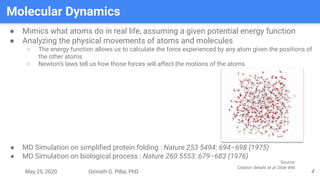
● Mimics what atoms do in real life, assuming a given potential energy function
● Analyzing the physical movements of atoms and molecules
○ The energy function allows us to calculate the force experienced by any atom given the positions of
the other atoms
○ Newton’s laws tell us how those forces will affect the motions of the atoms
● MD Simulation on simplified protein folding : Nature 253 5494: 694–698 (1975)
● MD Simulation on biological process : Nature 260 5553: 679–683 (1976)
Source:
Citation details at at Slide #46
May 25, 2020 Girinath G. Pillai, PhD
Key properties in MD
5
● In real life, and in an MD simulation, atoms are in constant motion
○ They will not go to an energy minimum and stay there.
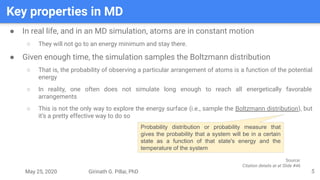
● Given enough time, the simulation samples the Boltzmann distribution
○ That is, the probability of observing a particular arrangement of atoms is a function of the potential
energy
○ In reality, one often does not simulate long enough to reach all energetically favorable
arrangements
○ This is not the only way to explore the energy surface (i.e., sample the Boltzmann distribution), but
it’s a pretty effective way to do so
Probability distribution or probability measure that
gives the probability that a system will be in a certain
state as a function of that state's energy and the
temperature of the system
Source:
Citation details at at Slide #46
May 25, 2020 Girinath G. Pillai, PhD
Mechanics of MD
6
● Each atom (ai
) is considered as particle with mass (mi
) and charge (qi
)
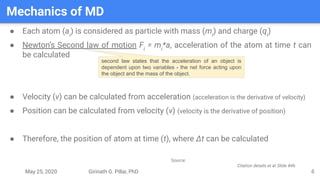
● Newton’s Second law of motion Fi
= mi
*a, acceleration of the atom at time t can
be calculated
● Velocity (v) can be calculated from acceleration (acceleration is the derivative of velocity)
● Position can be calculated from velocity (v) (velocity is the derivative of position)
● Therefore, the position of atom at time (t), where Δt can be calculated
second law states that the acceleration of an object is
dependent upon two variables - the net force acting upon
the object and the mass of the object.
Source:
Citation details at at Slide #46
May 25, 2020 Girinath G. Pillai, PhD
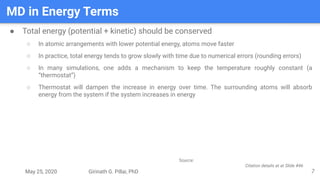
MD in Energy Terms
7
● Total energy (potential + kinetic) should be conserved
○ In atomic arrangements with lower potential energy, atoms move faster
○ In practice, total energy tends to grow slowly with time due to numerical errors (rounding errors)
○ In many simulations, one adds a mechanism to keep the temperature roughly constant (a
“thermostat”)
○ Thermostat will dampen the increase in energy over time. The surrounding atoms will absorb
energy from the system if the system increases in energy
Source:
Citation details at at Slide #46
May 25, 2020 Girinath G. Pillai, PhD
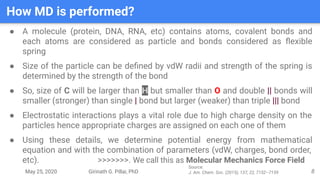
How MD is performed?
8
● A molecule (protein, DNA, RNA, etc) contains atoms, covalent bonds and
each atoms are considered as particle and bonds considered as flexible
spring
● Size of the particle can be defined by vdW radii and strength of the spring is
determined by the strength of the bond
● So, size of C will be larger than H but smaller than O and double || bonds will
smaller (stronger) than single | bond but larger (weaker) than triple ||| bond
● Electrostatic interactions plays a vital role due to high charge density on the
particles hence appropriate charges are assigned on each one of them
● Using these details, we determine potential energy from mathematical
equation and with the combination of parameters (vdW, charges, bond order,
etc). >>>>>>>. We call this as Molecular Mechanics Force Field
Source:
J. Am. Chem. Soc. (2015), 137, 22, 7152–7159
May 25, 2020 Girinath G. Pillai, PhD
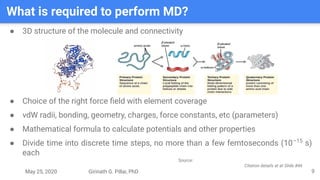
What is required to perform MD?
9
● 3D structure of the molecule and connectivity
● Choice of the right force field with element coverage
● vdW radii, bonding, geometry, charges, force constants, etc (parameters)
● Mathematical formula to calculate potentials and other properties
● Divide time into discrete time steps, no more than a few femtoseconds (10–15
s)
each
Source:
Citation details at at Slide #46
May 25, 2020 Girinath G. Pillai, PhD
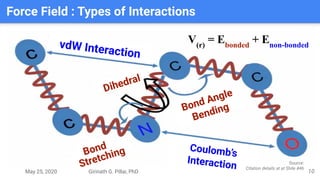
Force Field : Types of Interactions
10
V(r)
= Ebonded
+ Enon-bondedvdW Interaction
Bond Angle
Bending
Coulomb’s
InteractionStretchingBond
Dihedral
Source:
Citation details at at Slide #46
May 25, 2020 Girinath G. Pillai, PhD
Force Field : Types of Interactions
11
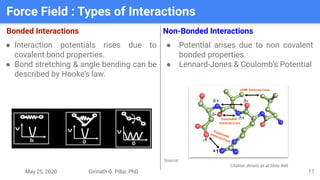
Bonded Interactions
● Interaction potentials rises due to
covalent bond properties.
● Bond stretching & angle bending can be
described by Hooke’s law.
Non-Bonded Interactions
● Potential arises due to non covalent
bonded properties
● Lennard-Jones & Coulomb’s Potential
Source:
Citation details at at Slide #46
May 25, 2020 Girinath G. Pillai, PhD
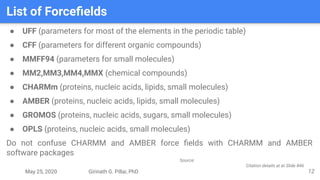
List of Forcefields
12
● UFF (parameters for most of the elements in the periodic table)
● CFF (parameters for different organic compounds)
● MMFF94 (parameters for small molecules)
● MM2,MM3,MM4,MMX (chemical compounds)
● CHARMm (proteins, nucleic acids, lipids, small molecules)
● AMBER (proteins, nucleic acids, lipids, small molecules)
● GROMOS (proteins, nucleic acids, sugars, small molecules)
● OPLS (proteins, nucleic acids, small molecules)
Do not confuse CHARMM and AMBER force fields with CHARMM and AMBER
software packages
Source:
Citation details at at Slide #46
May 25, 2020 Girinath G. Pillai, PhD
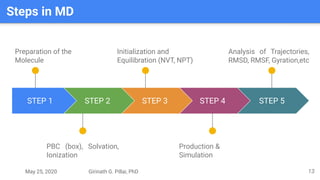
STEP 1
Preparation of the
Molecule
STEP 2
PBC (box), Solvation,
Ionization
STEP 3
Initialization and
Equilibration (NVT, NPT)
STEP 4
Production &
Simulation
STEP 5
Analysis of Trajectories,
RMSD, RMSF, Gyration,etc
13
Steps in MD
STEP 1
May 25, 2020 Girinath G. Pillai, PhD
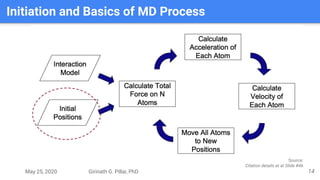
Initiation and Basics of MD Process
14
Source:
Citation details at at Slide #46
May 25, 2020 Girinath G. Pillai, PhD
Periodic Boundary Conditions - Box
15
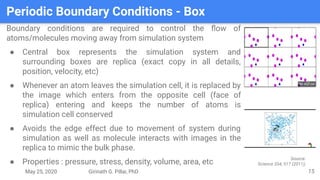
Boundary conditions are required to control the flow of
atoms/molecules moving away from simulation system
● Central box represents the simulation system and
surrounding boxes are replica (exact copy in all details,
position, velocity, etc)
● Whenever an atom leaves the simulation cell, it is replaced by
the image which enters from the opposite cell (face of
replica) entering and keeps the number of atoms is
simulation cell conserved
● Avoids the edge effect due to movement of system during
simulation as well as molecule interacts with images in the
replica to mimic the bulk phase.
● Properties : pressure, stress, density, volume, area, etc
Source:
Science 334, 517 (2011);
May 25, 2020 Girinath G. Pillai, PhD SPC&TIP3P TIP4P TIP5P
Solvation
16
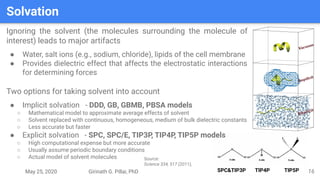
Ignoring the solvent (the molecules surrounding the molecule of
interest) leads to major artifacts
● Water, salt ions (e.g., sodium, chloride), lipids of the cell membrane
● Provides dielectric effect that affects the electrostatic interactions
for determining forces
Two options for taking solvent into account
● Implicit solvation - DDD, GB, GBMB, PBSA models
○ Mathematical model to approximate average effects of solvent
○ Solvent replaced with continuous, homogeneous, medium of bulk dielectric constants
○ Less accurate but faster
● Explicit solvation - SPC, SPC/E, TIP3P, TIP4P, TIP5P models
○ High computational expense but more accurate
○ Usually assume periodic boundary conditions
○ Actual model of solvent molecules Source:
Science 334, 517 (2011);
May 25, 2020 Girinath G. Pillai, PhD
Ionization
17
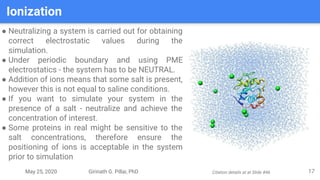
● Neutralizing a system is carried out for obtaining
correct electrostatic values during the
simulation.
● Under periodic boundary and using PME
electrostatics - the system has to be NEUTRAL.
● Addition of ions means that some salt is present,
however this is not equal to saline conditions.
● If you want to simulate your system in the
presence of a salt - neutralize and achieve the
concentration of interest.
● Some proteins in real might be sensitive to the
salt concentrations, therefore ensure the
positioning of ions is acceptable in the system
prior to simulation
Citation details at at Slide #46
May 25, 2020 Girinath G. Pillai, PhD
Minimization Equilibration
18
● Preparation of the system have
introduced unnatural stress, for
example by placing two atoms
accidentally too close to each other.
● Result in large forces acting on the
particles that would blow up the
system
● To solve this problem, an energy
minimization is performed in which
the system is relaxed to the closest
local energy minimum.
Equilibration phase is conducted under
the ensemble(s) of interest to remove
the effects of adding water, ions, and
whatever else around some initial solute
of interest. Or, more generally, remove
the possible artifacts of whatever
construction is done in whatever system
of interest, which may be ordered (low
entropy and high regularity) or totally
random and therefore of unknown reality.
Do not want the protein to move
significantly during the equilibration
phase, we will restrain it with harmonic
forces to its initial position.
Citation details at at Slide #46
May 25, 2020 Girinath G. Pillai, PhD
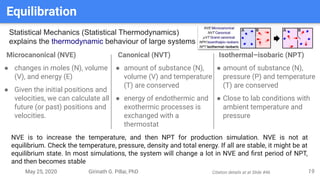
Equilibration
19
Microcanonical (NVE)
● changes in moles (N), volume
(V), and energy (E)
● Given the initial positions and
velocities, we can calculate all
future (or past) positions and
velocities.
Canonical (NVT)
● amount of substance (N),
volume (V) and temperature
(T) are conserved
● energy of endothermic and
exothermic processes is
exchanged with a
thermostat
Isothermal–isobaric (NPT)
● amount of substance (N),
pressure (P) and temperature
(T) are conserved
● Close to lab conditions with
ambient temperature and
pressure
NVE is to increase the temperature, and then NPT for production simulation. NVE is not at
equilibrium. Check the temperature, pressure, density and total energy. If all are stable, it might be at
equilibrium state. In most simulations, the system will change a lot in NVE and first period of NPT,
and then becomes stable
Statistical Mechanics (Statistical Thermodynamics)
explains the thermodynamic behaviour of large systems
Citation details at at Slide #46
May 25, 2020 Girinath G. Pillai, PhD
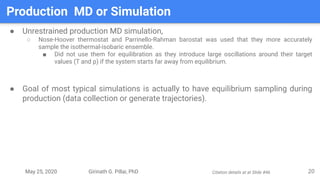
Production MD or Simulation
20
● Unrestrained production MD simulation,
○ Nose-Hoover thermostat and Parrinello-Rahman barostat was used that they more accurately
sample the isothermal-isobaric ensemble.
■ Did not use them for equilibration as they introduce large oscillations around their target
values (T and p) if the system starts far away from equilibrium.
● Goal of most typical simulations is actually to have equilibrium sampling during
production (data collection or generate trajectories).
Citation details at at Slide #46
May 25, 2020 Girinath G. Pillai, PhD
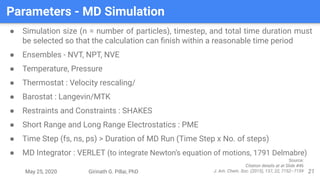
Parameters - MD Simulation
21
● Simulation size (n = number of particles), timestep, and total time duration must
be selected so that the calculation can finish within a reasonable time period
● Ensembles - NVT, NPT, NVE
● Temperature, Pressure
● Thermostat : Velocity rescaling/
● Barostat : Langevin/MTK
● Restraints and Constraints : SHAKES
● Short Range and Long Range Electrostatics : PME
● Time Step (fs, ns, ps) > Duration of MD Run (Time Step x No. of steps)
● MD Integrator : VERLET (to integrate Newton’s equation of motions, 1791 Delmabre)
Source:
Citation details at at Slide #46
J. Am. Chem. Soc. (2015), 137, 22, 7152–7159
May 25, 2020 Girinath G. Pillai, PhD
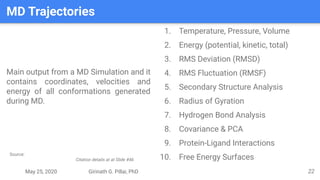
MD Trajectories
22
Main output from a MD Simulation and it
contains coordinates, velocities and
energy of all conformations generated
during MD.
1. Temperature, Pressure, Volume
2. Energy (potential, kinetic, total)
3. RMS Deviation (RMSD)
4. RMS Fluctuation (RMSF)
5. Secondary Structure Analysis
6. Radius of Gyration
7. Hydrogen Bond Analysis
8. Covariance & PCA
9. Protein-Ligand Interactions
10. Free Energy SurfacesSource:
Citation details at at Slide #46
May 25, 2020 Girinath G. Pillai, PhD
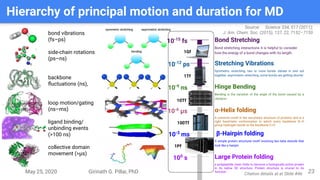
Hierarchy of principal motion and duration for MD
23
Bond Stretching
Bond stretching interactions it is helpful to consider
how the energy of a bond changes with its length.
10-15
fs
Stretching Vibrations
Symmetric stretching, two or more bonds vibrate in and out
together. asymmetric stretching, some bonds are getting shorter
10-12
ps
Hinge Bending
Bending is the variation of the angle of the bond caused by a
vibration
10-9
ns
ɑ-Helix folding
A common motif in the secondary structure of proteins and is a
right hand-helix conformation in which every backbone N−H
group hydrogen bonds to the backbone C=O
10-6
µs
β-Hairpin folding
A simple protein structural motif involving two beta strands that
look like a hairpin
10-3
ms
Large Protein folding
a polypeptide chain folds to become a biologically active protein
in its native 3D structure. Protein structure is crucial to its
function.
100
s
bond vibrations
(fs–ps)
side-chain rotations
(ps–ns)
backbone
fluctuations (ns),
loop motion/gating
(ns–ms)
ligand binding/
unbinding events
(>100 ns)
collective domain
movement (>µs)
Source: Science 334, 517 (2011);
J. Am. Chem. Soc. (2015), 137, 22, 7152–7159
1Gf
1Tf
10Tf
100Tf
1Pf
Citation details at at Slide #46
May 25, 2020 Girinath G. Pillai, PhD
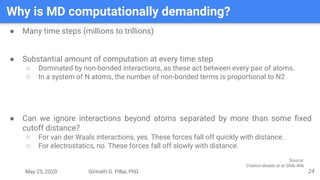
Why is MD computationally demanding?
24
● Many time steps (millions to trillions)
● Substantial amount of computation at every time step
○ Dominated by non-bonded interactions, as these act between every pair of atoms.
○ In a system of N atoms, the number of non-bonded terms is proportional to N2
● Can we ignore interactions beyond atoms separated by more than some fixed
cutoff distance?
○ For van der Waals interactions, yes. These forces fall off quickly with distance.
○ For electrostatics, no. These forces fall off slowly with distance.
Source:
Citation details at at Slide #46
May 25, 2020 Girinath G. Pillai, PhD
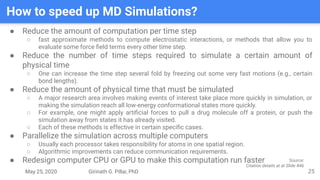
How to speed up MD Simulations?
25
● Reduce the amount of computation per time step
○ fast approximate methods to compute electrostatic interactions, or methods that allow you to
evaluate some force field terms every other time step.
● Reduce the number of time steps required to simulate a certain amount of
physical time
○ One can increase the time step several fold by freezing out some very fast motions (e.g., certain
bond lengths).
● Reduce the amount of physical time that must be simulated
○ A major research area involves making events of interest take place more quickly in simulation, or
making the simulation reach all low-energy conformational states more quickly.
○ For example, one might apply artificial forces to pull a drug molecule off a protein, or push the
simulation away from states it has already visited.
○ Each of these methods is effective in certain specific cases.
● Parallelize the simulation across multiple computers
○ Usually each processor takes responsibility for atoms in one spatial region.
○ Algorithmic improvements can reduce communication requirements.
● Redesign computer CPU or GPU to make this computation run faster Source:
Citation details at at Slide #46
May 25, 2020 Girinath G. Pillai, PhD
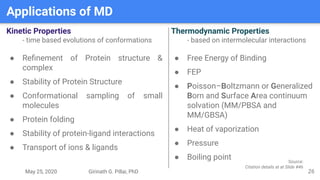
Applications of MD
26
Kinetic Properties
- time based evolutions of conformations
● Refinement of Protein structure &
complex
● Stability of Protein Structure
● Conformational sampling of small
molecules
● Protein folding
● Stability of protein-ligand interactions
● Transport of ions & ligands
Thermodynamic Properties
- based on intermolecular interactions
● Free Energy of Binding
● FEP
● Poisson–Boltzmann or Generalized
Born and Surface Area continuum
solvation (MM/PBSA and
MM/GBSA)
● Heat of vaporization
● Pressure
● Boiling point Source:
Citation details at at Slide #46
May 25, 2020 Girinath G. Pillai, PhD
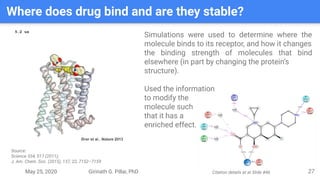
Where does drug bind and are they stable?
27
Simulations were used to determine where the
molecule binds to its receptor, and how it changes
the binding strength of molecules that bind
elsewhere (in part by changing the protein’s
structure).
Used the information
to modify the
molecule such
that it has a
enriched effect.
Source:
Science 334, 517 (2011);
J. Am. Chem. Soc. (2015), 137, 22, 7152–7159
Citation details at at Slide #46
May 25, 2020 Girinath G. Pillai, PhD
Mechanisms of Protein Allostery with MD Simulations
28
● Bidirectionality and the principle of microscopic
reversibility
● Structural basis for allosteric modulation of a GPCR
● Mechanism of GPCR activation
● Mechanism of nucleotide release in heterotrimeric G
proteins
● Mechanosensitive interaction between bacterial
adhesins and fibronectin
Source:
PLOS Computational Biology 12(6): e1004746
Int. J. Mol. Sci. 2020, 21, 847
PLOS Computational Biology 12(6): e1004966
May 25, 2020 Girinath G. Pillai, PhD
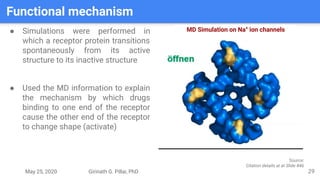
Functional mechanism
29
MD Simulation on Na+
ion channels
Source:
Citation details at at Slide #46
● Simulations were performed in
which a receptor protein transitions
spontaneously from its active
structure to its inactive structure
● Used the MD information to explain
the mechanism by which drugs
binding to one end of the receptor
cause the other end of the receptor
to change shape (activate)
May 25, 2020 Girinath G. Pillai, PhD
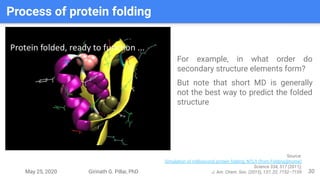
Process of protein folding
30
For example, in what order do
secondary structure elements form?
But note that short MD is generally
not the best way to predict the folded
structure
Source:
Simulation of millisecond protein folding: NTL9 (from Folding@home)
Science 334, 517 (2011);
J. Am. Chem. Soc. (2015), 137, 22, 7152–7159
May 25, 2020 Girinath G. Pillai, PhD
MD Simulation - A snapshot
31
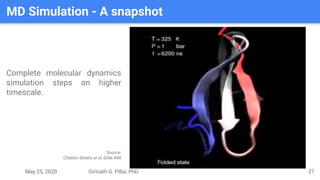
Complete molecular dynamics
simulation steps on higher
timescale.
Source:
Citation details at at Slide #46
May 25, 2020 Girinath G. Pillai, PhD
Timescales Limitations of MD
32
● Simulations require short time steps for numerical stability
■ 1 time step ≈ 2 fs (2×10–15
s)
■ 2fs x 1,00,00,000 steps = 2,00,00,000fs = 20,000ps = 20ns
● Structural changes in proteins can take ns(10–9
s), µs(10–6
s), ms(10–3
s), or longer
■ Millions to trillions of sequential time steps for nanosecond to millisecond events (and even
more for slower ones)
● Until recently, simulations of 1 µs were rare
● Advances in computer power have enabled µs simulations, but simulation
timescales remain a challenge
● Enabling longer-timescale simulations is an active research area, involving:
■ Algorithmic improvements
■ Parallel computing
■ Hardware: GPUs, specialized hardware
Source:
Citation details at at Slide #46
May 25, 2020 Girinath G. Pillai, PhD
Forcefield Accuracy Limitations of MD
33
● Molecular mechanics force fields are
inherently approximations
● They have improved substantially over the
last decade, but many limitations remain
● In practice, one needs some experience to
know what to trust in a simulation
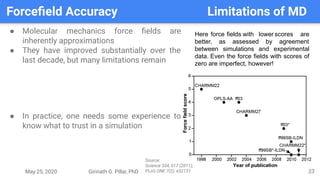
Here force fields with lower scores are
better, as assessed by agreement
between simulations and experimental
data. Even the force fields with scores of
zero are imperfect, however!
Source:
Science 334, 517 (2011);
PLoS ONE 7(2): e32131
May 25, 2020 Girinath G. Pillai, PhD
Bond formation/breakage Limitations of MD
34
● Once a protein is created, most of its covalent bonds do not break or form during
typical function
● A few covalent bonds do form and break more frequently (in real life)
■ – Disulfide bonds between cysteines
■ – Acidic or basic amino acid residues can lose or gain a hydrogen (i.e., a proton)
● Limitations of certain forcefields
○ low temperatures are not well described
○ tunneling of hydrogens are not described
○ heat capacity is considered wrong
○ chemical reactions are not described
○ high-frequency vibrations are inaccurate
○ electronic polarization are described implicitly
Source:
Citation details at at Slide #46
May 25, 2020 Girinath G. Pillai, PhD
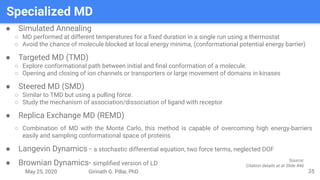
Specialized MD
35
● Simulated Annealing
○ MD performed at different temperatures for a fixed duration in a single run using a thermostat
○ Avoid the chance of molecule blocked at local energy minima, (conformational potential energy barrier)
● Targeted MD (TMD)
○ Explore conformational path between initial and final conformation of a molecule.
○ Opening and closing of ion channels or transporters or large movement of domains in kinases
● Steered MD (SMD)
○ Similar to TMD but using a pulling force.
○ Study the mechanism of association/dissociation of ligand with receptor
● Replica Exchange MD (REMD)
○ Combination of MD with the Monte Carlo, this method is capable of overcoming high energy-barriers
easily and sampling conformational space of proteins
● Langevin Dynamics - a stochastic differential equation, two force terms, neglected DOF
● Brownian Dynamics- simplified version of LD
Source:
Citation details at at Slide #46
Resources
All are free to use for academic purpose
36
May 25, 2020 Girinath G. Pillai, PhD
Software for MD
37
Macromolecules, Biomolecules & Small molecules
AMBER - Assisted Model Building with Energy Refinement
GROMACS - GROningen MAchine for Chemical Simulations
NAMD - Nanoscale Molecular Dynamics
CHARMM - Chemistry at Harvard Macromolecular Mechanics
DESMOND
Solid State & Materials
LAMMPS - Large-scale Atomic/Molecular Massively Parallel Simulator
May 25, 2020 Girinath G. Pillai, PhD
GROMACS Software
38
http://www.gromacs.org/
Go to Download
5.1.4v preferred for Pro-Lig
2020.2v preferred for GPU
Linux 64bit and MacOSX 64bit
extract and compile the package
For Windows 64bit
Use Cygwin and Gromacs :
https://winmostar.com/en/
download/cygwinwm/ Source:
Citation details at at Slide #46
May 25, 2020 Girinath G. Pillai, PhD
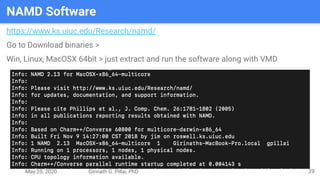
NAMD Software
39
https://www.ks.uiuc.edu/Research/namd/
Go to Download binaries >
Win, Linux, MacOSX 64bit > just extract and run the software along with VMD
May 25, 2020 Girinath G. Pillai, PhD
AMBER Software
40
http://ambermd.org/ Go to Download Amber, extract and compile the package
May 25, 2020 Girinath G. Pillai, PhD
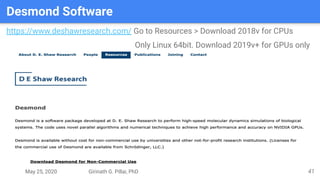
Desmond Software
41
https://www.deshawresearch.com/ Go to Resources > Download 2018v for CPUs
Only Linux 64bit. Download 2019v+ for GPUs only
May 25, 2020 Girinath G. Pillai, PhD
Presentation Slides - SlideShare
42
slideshare.net/giribio
May 25, 2020 Girinath G. Pillai, PhD
Protein in Water - GROMACS Notebook
43
github.com/giribio >>> Go to MDNotebooks
doi.org/10.5281/zenodo.3832358
May 25, 2020 Girinath G. Pillai, PhD
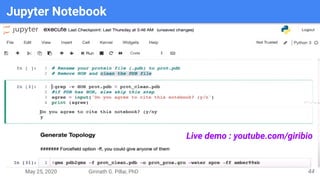
Jupyter Notebook
44
Live demo : youtube.com/giribio
Thank you!
Follow-up session will scheduled for a
walkthrough on running MD simulation using
GROMACS.
@giribio
You could execute the Jupyter Notebook in my
GitHub and run short MD simulation on 1AKI.pdb
and you could send submit you queries or data
links to
https://github.com/giribio/MDNotebooks/issues
45
May 25, 2020 Girinath G. Pillai, PhD
References Web Sources
46
● PNAS 2011 108 (46) 18684-18689
● Nature 2009; 459(7245):356-63
● Nature 03, 295–299(2013)
● Scientific Reports 6,: 23830 (2016)
● J. Chem. Theory Comput. 2017, 13, 7, 3348–3358
● Solvation Model for Theoretical Chemistry, Waldemar Kulig
● Int. J. Mol. Sci. 2020, 21(8), 2713
● PLOS Computational Biology 9(5): e1003058
● Methods Mol Biol 2018;1777:101-119
● sciencesprings.wordpress.com/
● Theislikerice, en.wikipedia.org/wiki/Alpha_helix
● Tiago Becerra Paolini,
en.wikipedia.org/wiki/Molecular_vibratio
● dynamicscience.com.au/
● cmm.cit.nih.gov/intro_simulation
● BQUB19 AAbad, commons.wikimedia.org/
● i12r-studfilesrv.informatik.tu-muenchen.de/
● en.wikipedia.org/wiki
● researchgate.net
● Online lecture contents from Stanford, UCLA, Harvard,
NPTEL, Patshala, universities
Content Sources

Molecular Dynamics for Beginners : Detailed Overview

  • 1.
    Molecular Dynamics Detailed Overview Recordedpresentation video is at http://www.youtube.com/giribio Girinath G. Pillai, PhD @giribio May 25, 2020
  • 2.
    Disclaimer ● Please donot share any personal details during this online meeting. ● Slides contains contents/pictures/videos taken from web, articles, lectures, tutorials and its respective authors own their copyrights. References are given at Slide #46 ● Slides : slideshare.net/giribio ● Video : youtube.com/giribio ● Exercise : github.com/giribio/MDNotebooks
  • 3.
    What to expect? ●What is Molecular Dynamics ● How MD is performed ● Forcefields ● Steps in MD ● Applications of MD ● Limitations of MD ● Why computationally intensive? ● Resources 3
  • 4.
    May 25, 2020Girinath G. Pillai, PhD Molecular Dynamics 4 ● Mimics what atoms do in real life, assuming a given potential energy function ● Analyzing the physical movements of atoms and molecules ○ The energy function allows us to calculate the force experienced by any atom given the positions of the other atoms ○ Newton’s laws tell us how those forces will affect the motions of the atoms ● MD Simulation on simplified protein folding : Nature 253 5494: 694–698 (1975) ● MD Simulation on biological process : Nature 260 5553: 679–683 (1976) Source: Citation details at at Slide #46
  • 5.
    May 25, 2020Girinath G. Pillai, PhD Key properties in MD 5 ● In real life, and in an MD simulation, atoms are in constant motion ○ They will not go to an energy minimum and stay there. ● Given enough time, the simulation samples the Boltzmann distribution ○ That is, the probability of observing a particular arrangement of atoms is a function of the potential energy ○ In reality, one often does not simulate long enough to reach all energetically favorable arrangements ○ This is not the only way to explore the energy surface (i.e., sample the Boltzmann distribution), but it’s a pretty effective way to do so Probability distribution or probability measure that gives the probability that a system will be in a certain state as a function of that state's energy and the temperature of the system Source: Citation details at at Slide #46
  • 6.
    May 25, 2020Girinath G. Pillai, PhD Mechanics of MD 6 ● Each atom (ai ) is considered as particle with mass (mi ) and charge (qi ) ● Newton’s Second law of motion Fi = mi *a, acceleration of the atom at time t can be calculated ● Velocity (v) can be calculated from acceleration (acceleration is the derivative of velocity) ● Position can be calculated from velocity (v) (velocity is the derivative of position) ● Therefore, the position of atom at time (t), where Δt can be calculated second law states that the acceleration of an object is dependent upon two variables - the net force acting upon the object and the mass of the object. Source: Citation details at at Slide #46
  • 7.
    May 25, 2020Girinath G. Pillai, PhD MD in Energy Terms 7 ● Total energy (potential + kinetic) should be conserved ○ In atomic arrangements with lower potential energy, atoms move faster ○ In practice, total energy tends to grow slowly with time due to numerical errors (rounding errors) ○ In many simulations, one adds a mechanism to keep the temperature roughly constant (a “thermostat”) ○ Thermostat will dampen the increase in energy over time. The surrounding atoms will absorb energy from the system if the system increases in energy Source: Citation details at at Slide #46
  • 8.
    May 25, 2020Girinath G. Pillai, PhD How MD is performed? 8 ● A molecule (protein, DNA, RNA, etc) contains atoms, covalent bonds and each atoms are considered as particle and bonds considered as flexible spring ● Size of the particle can be defined by vdW radii and strength of the spring is determined by the strength of the bond ● So, size of C will be larger than H but smaller than O and double || bonds will smaller (stronger) than single | bond but larger (weaker) than triple ||| bond ● Electrostatic interactions plays a vital role due to high charge density on the particles hence appropriate charges are assigned on each one of them ● Using these details, we determine potential energy from mathematical equation and with the combination of parameters (vdW, charges, bond order, etc). >>>>>>>. We call this as Molecular Mechanics Force Field Source: J. Am. Chem. Soc. (2015), 137, 22, 7152–7159
  • 9.
    May 25, 2020Girinath G. Pillai, PhD What is required to perform MD? 9 ● 3D structure of the molecule and connectivity ● Choice of the right force field with element coverage ● vdW radii, bonding, geometry, charges, force constants, etc (parameters) ● Mathematical formula to calculate potentials and other properties ● Divide time into discrete time steps, no more than a few femtoseconds (10–15 s) each Source: Citation details at at Slide #46
  • 10.
    May 25, 2020Girinath G. Pillai, PhD Force Field : Types of Interactions 10 V(r) = Ebonded + Enon-bondedvdW Interaction Bond Angle Bending Coulomb’s InteractionStretchingBond Dihedral Source: Citation details at at Slide #46
  • 11.
    May 25, 2020Girinath G. Pillai, PhD Force Field : Types of Interactions 11 Bonded Interactions ● Interaction potentials rises due to covalent bond properties. ● Bond stretching & angle bending can be described by Hooke’s law. Non-Bonded Interactions ● Potential arises due to non covalent bonded properties ● Lennard-Jones & Coulomb’s Potential Source: Citation details at at Slide #46
  • 12.
    May 25, 2020Girinath G. Pillai, PhD List of Forcefields 12 ● UFF (parameters for most of the elements in the periodic table) ● CFF (parameters for different organic compounds) ● MMFF94 (parameters for small molecules) ● MM2,MM3,MM4,MMX (chemical compounds) ● CHARMm (proteins, nucleic acids, lipids, small molecules) ● AMBER (proteins, nucleic acids, lipids, small molecules) ● GROMOS (proteins, nucleic acids, sugars, small molecules) ● OPLS (proteins, nucleic acids, small molecules) Do not confuse CHARMM and AMBER force fields with CHARMM and AMBER software packages Source: Citation details at at Slide #46
  • 13.
    May 25, 2020Girinath G. Pillai, PhD STEP 1 Preparation of the Molecule STEP 2 PBC (box), Solvation, Ionization STEP 3 Initialization and Equilibration (NVT, NPT) STEP 4 Production & Simulation STEP 5 Analysis of Trajectories, RMSD, RMSF, Gyration,etc 13 Steps in MD STEP 1
  • 14.
    May 25, 2020Girinath G. Pillai, PhD Initiation and Basics of MD Process 14 Source: Citation details at at Slide #46
  • 15.
    May 25, 2020Girinath G. Pillai, PhD Periodic Boundary Conditions - Box 15 Boundary conditions are required to control the flow of atoms/molecules moving away from simulation system ● Central box represents the simulation system and surrounding boxes are replica (exact copy in all details, position, velocity, etc) ● Whenever an atom leaves the simulation cell, it is replaced by the image which enters from the opposite cell (face of replica) entering and keeps the number of atoms is simulation cell conserved ● Avoids the edge effect due to movement of system during simulation as well as molecule interacts with images in the replica to mimic the bulk phase. ● Properties : pressure, stress, density, volume, area, etc Source: Science 334, 517 (2011);
  • 16.
    May 25, 2020Girinath G. Pillai, PhD SPC&TIP3P TIP4P TIP5P Solvation 16 Ignoring the solvent (the molecules surrounding the molecule of interest) leads to major artifacts ● Water, salt ions (e.g., sodium, chloride), lipids of the cell membrane ● Provides dielectric effect that affects the electrostatic interactions for determining forces Two options for taking solvent into account ● Implicit solvation - DDD, GB, GBMB, PBSA models ○ Mathematical model to approximate average effects of solvent ○ Solvent replaced with continuous, homogeneous, medium of bulk dielectric constants ○ Less accurate but faster ● Explicit solvation - SPC, SPC/E, TIP3P, TIP4P, TIP5P models ○ High computational expense but more accurate ○ Usually assume periodic boundary conditions ○ Actual model of solvent molecules Source: Science 334, 517 (2011);
  • 17.
    May 25, 2020Girinath G. Pillai, PhD Ionization 17 ● Neutralizing a system is carried out for obtaining correct electrostatic values during the simulation. ● Under periodic boundary and using PME electrostatics - the system has to be NEUTRAL. ● Addition of ions means that some salt is present, however this is not equal to saline conditions. ● If you want to simulate your system in the presence of a salt - neutralize and achieve the concentration of interest. ● Some proteins in real might be sensitive to the salt concentrations, therefore ensure the positioning of ions is acceptable in the system prior to simulation Citation details at at Slide #46
  • 18.
    May 25, 2020Girinath G. Pillai, PhD Minimization Equilibration 18 ● Preparation of the system have introduced unnatural stress, for example by placing two atoms accidentally too close to each other. ● Result in large forces acting on the particles that would blow up the system ● To solve this problem, an energy minimization is performed in which the system is relaxed to the closest local energy minimum. Equilibration phase is conducted under the ensemble(s) of interest to remove the effects of adding water, ions, and whatever else around some initial solute of interest. Or, more generally, remove the possible artifacts of whatever construction is done in whatever system of interest, which may be ordered (low entropy and high regularity) or totally random and therefore of unknown reality. Do not want the protein to move significantly during the equilibration phase, we will restrain it with harmonic forces to its initial position. Citation details at at Slide #46
  • 19.
    May 25, 2020Girinath G. Pillai, PhD Equilibration 19 Microcanonical (NVE) ● changes in moles (N), volume (V), and energy (E) ● Given the initial positions and velocities, we can calculate all future (or past) positions and velocities. Canonical (NVT) ● amount of substance (N), volume (V) and temperature (T) are conserved ● energy of endothermic and exothermic processes is exchanged with a thermostat Isothermal–isobaric (NPT) ● amount of substance (N), pressure (P) and temperature (T) are conserved ● Close to lab conditions with ambient temperature and pressure NVE is to increase the temperature, and then NPT for production simulation. NVE is not at equilibrium. Check the temperature, pressure, density and total energy. If all are stable, it might be at equilibrium state. In most simulations, the system will change a lot in NVE and first period of NPT, and then becomes stable Statistical Mechanics (Statistical Thermodynamics) explains the thermodynamic behaviour of large systems Citation details at at Slide #46
  • 20.
    May 25, 2020Girinath G. Pillai, PhD Production MD or Simulation 20 ● Unrestrained production MD simulation, ○ Nose-Hoover thermostat and Parrinello-Rahman barostat was used that they more accurately sample the isothermal-isobaric ensemble. ■ Did not use them for equilibration as they introduce large oscillations around their target values (T and p) if the system starts far away from equilibrium. ● Goal of most typical simulations is actually to have equilibrium sampling during production (data collection or generate trajectories). Citation details at at Slide #46
  • 21.
    May 25, 2020Girinath G. Pillai, PhD Parameters - MD Simulation 21 ● Simulation size (n = number of particles), timestep, and total time duration must be selected so that the calculation can finish within a reasonable time period ● Ensembles - NVT, NPT, NVE ● Temperature, Pressure ● Thermostat : Velocity rescaling/ ● Barostat : Langevin/MTK ● Restraints and Constraints : SHAKES ● Short Range and Long Range Electrostatics : PME ● Time Step (fs, ns, ps) > Duration of MD Run (Time Step x No. of steps) ● MD Integrator : VERLET (to integrate Newton’s equation of motions, 1791 Delmabre) Source: Citation details at at Slide #46 J. Am. Chem. Soc. (2015), 137, 22, 7152–7159
  • 22.
    May 25, 2020Girinath G. Pillai, PhD MD Trajectories 22 Main output from a MD Simulation and it contains coordinates, velocities and energy of all conformations generated during MD. 1. Temperature, Pressure, Volume 2. Energy (potential, kinetic, total) 3. RMS Deviation (RMSD) 4. RMS Fluctuation (RMSF) 5. Secondary Structure Analysis 6. Radius of Gyration 7. Hydrogen Bond Analysis 8. Covariance & PCA 9. Protein-Ligand Interactions 10. Free Energy SurfacesSource: Citation details at at Slide #46
  • 23.
    May 25, 2020Girinath G. Pillai, PhD Hierarchy of principal motion and duration for MD 23 Bond Stretching Bond stretching interactions it is helpful to consider how the energy of a bond changes with its length. 10-15 fs Stretching Vibrations Symmetric stretching, two or more bonds vibrate in and out together. asymmetric stretching, some bonds are getting shorter 10-12 ps Hinge Bending Bending is the variation of the angle of the bond caused by a vibration 10-9 ns ɑ-Helix folding A common motif in the secondary structure of proteins and is a right hand-helix conformation in which every backbone N−H group hydrogen bonds to the backbone C=O 10-6 µs β-Hairpin folding A simple protein structural motif involving two beta strands that look like a hairpin 10-3 ms Large Protein folding a polypeptide chain folds to become a biologically active protein in its native 3D structure. Protein structure is crucial to its function. 100 s bond vibrations (fs–ps) side-chain rotations (ps–ns) backbone fluctuations (ns), loop motion/gating (ns–ms) ligand binding/ unbinding events (>100 ns) collective domain movement (>µs) Source: Science 334, 517 (2011); J. Am. Chem. Soc. (2015), 137, 22, 7152–7159 1Gf 1Tf 10Tf 100Tf 1Pf Citation details at at Slide #46
  • 24.
    May 25, 2020Girinath G. Pillai, PhD Why is MD computationally demanding? 24 ● Many time steps (millions to trillions) ● Substantial amount of computation at every time step ○ Dominated by non-bonded interactions, as these act between every pair of atoms. ○ In a system of N atoms, the number of non-bonded terms is proportional to N2 ● Can we ignore interactions beyond atoms separated by more than some fixed cutoff distance? ○ For van der Waals interactions, yes. These forces fall off quickly with distance. ○ For electrostatics, no. These forces fall off slowly with distance. Source: Citation details at at Slide #46
  • 25.
    May 25, 2020Girinath G. Pillai, PhD How to speed up MD Simulations? 25 ● Reduce the amount of computation per time step ○ fast approximate methods to compute electrostatic interactions, or methods that allow you to evaluate some force field terms every other time step. ● Reduce the number of time steps required to simulate a certain amount of physical time ○ One can increase the time step several fold by freezing out some very fast motions (e.g., certain bond lengths). ● Reduce the amount of physical time that must be simulated ○ A major research area involves making events of interest take place more quickly in simulation, or making the simulation reach all low-energy conformational states more quickly. ○ For example, one might apply artificial forces to pull a drug molecule off a protein, or push the simulation away from states it has already visited. ○ Each of these methods is effective in certain specific cases. ● Parallelize the simulation across multiple computers ○ Usually each processor takes responsibility for atoms in one spatial region. ○ Algorithmic improvements can reduce communication requirements. ● Redesign computer CPU or GPU to make this computation run faster Source: Citation details at at Slide #46
  • 26.
    May 25, 2020Girinath G. Pillai, PhD Applications of MD 26 Kinetic Properties - time based evolutions of conformations ● Refinement of Protein structure & complex ● Stability of Protein Structure ● Conformational sampling of small molecules ● Protein folding ● Stability of protein-ligand interactions ● Transport of ions & ligands Thermodynamic Properties - based on intermolecular interactions ● Free Energy of Binding ● FEP ● Poisson–Boltzmann or Generalized Born and Surface Area continuum solvation (MM/PBSA and MM/GBSA) ● Heat of vaporization ● Pressure ● Boiling point Source: Citation details at at Slide #46
  • 27.
    May 25, 2020Girinath G. Pillai, PhD Where does drug bind and are they stable? 27 Simulations were used to determine where the molecule binds to its receptor, and how it changes the binding strength of molecules that bind elsewhere (in part by changing the protein’s structure). Used the information to modify the molecule such that it has a enriched effect. Source: Science 334, 517 (2011); J. Am. Chem. Soc. (2015), 137, 22, 7152–7159 Citation details at at Slide #46
  • 28.
    May 25, 2020Girinath G. Pillai, PhD Mechanisms of Protein Allostery with MD Simulations 28 ● Bidirectionality and the principle of microscopic reversibility ● Structural basis for allosteric modulation of a GPCR ● Mechanism of GPCR activation ● Mechanism of nucleotide release in heterotrimeric G proteins ● Mechanosensitive interaction between bacterial adhesins and fibronectin Source: PLOS Computational Biology 12(6): e1004746 Int. J. Mol. Sci. 2020, 21, 847 PLOS Computational Biology 12(6): e1004966
  • 29.
    May 25, 2020Girinath G. Pillai, PhD Functional mechanism 29 MD Simulation on Na+ ion channels Source: Citation details at at Slide #46 ● Simulations were performed in which a receptor protein transitions spontaneously from its active structure to its inactive structure ● Used the MD information to explain the mechanism by which drugs binding to one end of the receptor cause the other end of the receptor to change shape (activate)
  • 30.
    May 25, 2020Girinath G. Pillai, PhD Process of protein folding 30 For example, in what order do secondary structure elements form? But note that short MD is generally not the best way to predict the folded structure Source: Simulation of millisecond protein folding: NTL9 (from Folding@home) Science 334, 517 (2011); J. Am. Chem. Soc. (2015), 137, 22, 7152–7159
  • 31.
    May 25, 2020Girinath G. Pillai, PhD MD Simulation - A snapshot 31 Complete molecular dynamics simulation steps on higher timescale. Source: Citation details at at Slide #46
  • 32.
    May 25, 2020Girinath G. Pillai, PhD Timescales Limitations of MD 32 ● Simulations require short time steps for numerical stability ■ 1 time step ≈ 2 fs (2×10–15 s) ■ 2fs x 1,00,00,000 steps = 2,00,00,000fs = 20,000ps = 20ns ● Structural changes in proteins can take ns(10–9 s), µs(10–6 s), ms(10–3 s), or longer ■ Millions to trillions of sequential time steps for nanosecond to millisecond events (and even more for slower ones) ● Until recently, simulations of 1 µs were rare ● Advances in computer power have enabled µs simulations, but simulation timescales remain a challenge ● Enabling longer-timescale simulations is an active research area, involving: ■ Algorithmic improvements ■ Parallel computing ■ Hardware: GPUs, specialized hardware Source: Citation details at at Slide #46
  • 33.
    May 25, 2020Girinath G. Pillai, PhD Forcefield Accuracy Limitations of MD 33 ● Molecular mechanics force fields are inherently approximations ● They have improved substantially over the last decade, but many limitations remain ● In practice, one needs some experience to know what to trust in a simulation Here force fields with lower scores are better, as assessed by agreement between simulations and experimental data. Even the force fields with scores of zero are imperfect, however! Source: Science 334, 517 (2011); PLoS ONE 7(2): e32131
  • 34.
    May 25, 2020Girinath G. Pillai, PhD Bond formation/breakage Limitations of MD 34 ● Once a protein is created, most of its covalent bonds do not break or form during typical function ● A few covalent bonds do form and break more frequently (in real life) ■ – Disulfide bonds between cysteines ■ – Acidic or basic amino acid residues can lose or gain a hydrogen (i.e., a proton) ● Limitations of certain forcefields ○ low temperatures are not well described ○ tunneling of hydrogens are not described ○ heat capacity is considered wrong ○ chemical reactions are not described ○ high-frequency vibrations are inaccurate ○ electronic polarization are described implicitly Source: Citation details at at Slide #46
  • 35.
    May 25, 2020Girinath G. Pillai, PhD Specialized MD 35 ● Simulated Annealing ○ MD performed at different temperatures for a fixed duration in a single run using a thermostat ○ Avoid the chance of molecule blocked at local energy minima, (conformational potential energy barrier) ● Targeted MD (TMD) ○ Explore conformational path between initial and final conformation of a molecule. ○ Opening and closing of ion channels or transporters or large movement of domains in kinases ● Steered MD (SMD) ○ Similar to TMD but using a pulling force. ○ Study the mechanism of association/dissociation of ligand with receptor ● Replica Exchange MD (REMD) ○ Combination of MD with the Monte Carlo, this method is capable of overcoming high energy-barriers easily and sampling conformational space of proteins ● Langevin Dynamics - a stochastic differential equation, two force terms, neglected DOF ● Brownian Dynamics- simplified version of LD Source: Citation details at at Slide #46
  • 36.
    Resources All are freeto use for academic purpose 36
  • 37.
    May 25, 2020Girinath G. Pillai, PhD Software for MD 37 Macromolecules, Biomolecules & Small molecules AMBER - Assisted Model Building with Energy Refinement GROMACS - GROningen MAchine for Chemical Simulations NAMD - Nanoscale Molecular Dynamics CHARMM - Chemistry at Harvard Macromolecular Mechanics DESMOND Solid State & Materials LAMMPS - Large-scale Atomic/Molecular Massively Parallel Simulator
  • 38.
    May 25, 2020Girinath G. Pillai, PhD GROMACS Software 38 http://www.gromacs.org/ Go to Download 5.1.4v preferred for Pro-Lig 2020.2v preferred for GPU Linux 64bit and MacOSX 64bit extract and compile the package For Windows 64bit Use Cygwin and Gromacs : https://winmostar.com/en/ download/cygwinwm/ Source: Citation details at at Slide #46
  • 39.
    May 25, 2020Girinath G. Pillai, PhD NAMD Software 39 https://www.ks.uiuc.edu/Research/namd/ Go to Download binaries > Win, Linux, MacOSX 64bit > just extract and run the software along with VMD
  • 40.
    May 25, 2020Girinath G. Pillai, PhD AMBER Software 40 http://ambermd.org/ Go to Download Amber, extract and compile the package
  • 41.
    May 25, 2020Girinath G. Pillai, PhD Desmond Software 41 https://www.deshawresearch.com/ Go to Resources > Download 2018v for CPUs Only Linux 64bit. Download 2019v+ for GPUs only
  • 42.
    May 25, 2020Girinath G. Pillai, PhD Presentation Slides - SlideShare 42 slideshare.net/giribio
  • 43.
    May 25, 2020Girinath G. Pillai, PhD Protein in Water - GROMACS Notebook 43 github.com/giribio >>> Go to MDNotebooks doi.org/10.5281/zenodo.3832358
  • 44.
    May 25, 2020Girinath G. Pillai, PhD Jupyter Notebook 44 Live demo : youtube.com/giribio
  • 45.
    Thank you! Follow-up sessionwill scheduled for a walkthrough on running MD simulation using GROMACS. @giribio You could execute the Jupyter Notebook in my GitHub and run short MD simulation on 1AKI.pdb and you could send submit you queries or data links to https://github.com/giribio/MDNotebooks/issues 45
  • 46.
    May 25, 2020Girinath G. Pillai, PhD References Web Sources 46 ● PNAS 2011 108 (46) 18684-18689 ● Nature 2009; 459(7245):356-63 ● Nature 03, 295–299(2013) ● Scientific Reports 6,: 23830 (2016) ● J. Chem. Theory Comput. 2017, 13, 7, 3348–3358 ● Solvation Model for Theoretical Chemistry, Waldemar Kulig ● Int. J. Mol. Sci. 2020, 21(8), 2713 ● PLOS Computational Biology 9(5): e1003058 ● Methods Mol Biol 2018;1777:101-119 ● sciencesprings.wordpress.com/ ● Theislikerice, en.wikipedia.org/wiki/Alpha_helix ● Tiago Becerra Paolini, en.wikipedia.org/wiki/Molecular_vibratio ● dynamicscience.com.au/ ● cmm.cit.nih.gov/intro_simulation ● BQUB19 AAbad, commons.wikimedia.org/ ● i12r-studfilesrv.informatik.tu-muenchen.de/ ● en.wikipedia.org/wiki ● researchgate.net ● Online lecture contents from Stanford, UCLA, Harvard, NPTEL, Patshala, universities Content Sources