Ab initio molecular 

dynamics"
            Lee-Ping Wang"
        leeping @ stanford.edu "
            March 4, 2013"
Outline

 Review
    •  A wide range of simulation methods
    •  Schrödinger’s equation and the potential energy surface
 Methods
    •  Molecular forces and the Hellmann-Feynman theorem
    •  Born-Oppenheimer and Car-Parrinello molecular dynamics
    •  Hybrid quantum/classical methods
 Applications
    •  O-O bonding mechanism of cobalt water oxidation catalyst
    •  Simulating the Urey-Miller experiment
    •  Enzyme catalysis and rational enzyme design
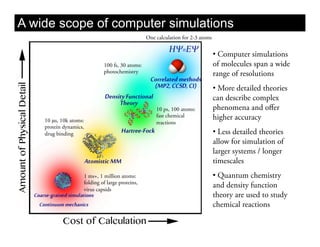
A wide scope of computer simulations
                                                 One calculation for 2-3 atoms


                                                                                 •  Computer simulations
                             100 fs, 30 atoms:                                   of molecules span a wide
                             photochemistry                                      range of resolutions
                                                                                 •  More detailed theories
                                                                                 can describe complex
                                                     10 ps, 100 atoms:           phenomena and offer
                                                     fast chemical               higher accuracy
    10 µs, 10k atoms:                                reactions
    protein dynamics,
    drug binding                                                                 •  Less detailed theories
                                                                                 allow for simulation of
                                                                                 larger systems / longer
                                                                                 timescales
                    1 ms+, 1 million atoms:                                      •  Quantum chemistry
                    folding of large proteins,
                    virus capsids
                                                                                 and density function
                                                                                 theory are used to study
                                                                                 chemical reactions
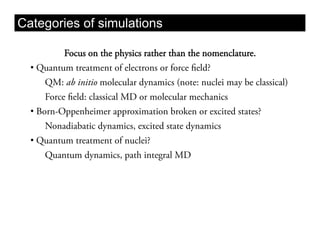
Categories of simulations

            Focus on the physics rather than the nomenclature.
  •  Quantum treatment of electrons or force field?
       QM: ab initio molecular dynamics (note: nuclei may be classical)
       Force field: classical MD or molecular mechanics
  •  Born-Oppenheimer approximation broken or excited states?
       Nonadiabatic dynamics, excited state dynamics
  •  Quantum treatment of nuclei?
       Quantum dynamics, path integral MD
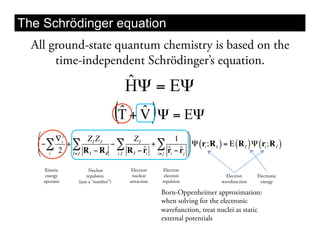
The Schrödinger equation
  All ground-state quantum chemistry is based on the
       time-independent Schrödinger’s equation.
                                    ˆ
                                    ΗΨ = EΨ
                                   (T + V ) Ψ = EΨ
                                    ˆ ˆ
   %   "2                                                     (
   ' !# i + # Z I Z J ! # Z I + # 1                           * + ( ri ;R I ) = E ( R I ) + ( ri ;R I )
   '                              ˆ       ˆ ˆ                 *
   & i 2 I$J R I ! R iJ i,I R I ! ri i$ j ri ! rj             )
    Kinetic          Nuclear          Electron    Electron
     energy         repulsion         nuclear      electron                   Electron      Electronic
    operator   (just a “number”)     attraction   repulsion                 wavefunction     energy

                                                  Born-Oppenheimer approximation:
                                                  when solving for the electronic
                                                  wavefunction, treat nuclei as static
                                                  external potentials
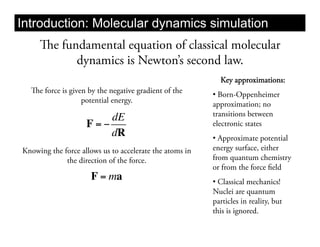
Introduction: Molecular dynamics simulation
     e fundamental equation of classical molecular
           dynamics is Newton’s second law.
                                                           Key approximations:
  e force is given by the negative gradient of the      •  Born-Oppenheimer
                  potential energy.                      approximation; no
                                                         transitions between
                        dE
                    F=!                                  electronic states
                        dR                               •  Approximate potential
Knowing the force allows us to accelerate the atoms in   energy surface, either
             the direction of the force.                 from quantum chemistry
                                                         or from the force field
                     F = ma                              •  Classical mechanics!
                                                         Nuclei are quantum
                                                         particles in reality, but
                                                         this is ignored.
Outline

 Review
    •  A wide range of simulation methods
    •  Schrödinger’s equation and the potential energy surface
 Methods
    •  Molecular forces and the Hellmann-Feynman theorem
    •  Born-Oppenheimer and Car-Parrinello molecular dynamics
    •  Hybrid quantum/classical methods
 Applications
    •  O-O bonding mechanism of cobalt water oxidation catalyst
    •  Simulating the Urey-Miller experiment
    •  Enzyme catalysis; mechanistic investigation and rational design
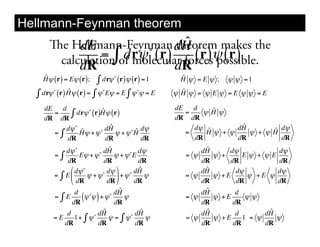
Hellmann-Feynman theorem
     e Hellmann-Feynman dH
          dE           !
                               ˆ
                             theorem makes the
          dR                 dR
                                 "
      calculation of molecular forces! ( r )
               = dr! ( r)        (r) possible.
   ˆ
   H ! ( r) = E! ( r);           "
                             ! dr! (r)! (r) = 1     ˆ
                                                    H ! =E ! ;   ! ! =1

  ! dr!   "       ˆ          "            "
              (r) H! (r) = ! ! E! = E ! ! ! = E      ˆ
                                                   ! H ! = ! E ! =E ! ! =E

    dE   d              ˆ                          dE   d    ˆ
       =
    dR dR
            " dr! ! (r)H! (r)                         =
                                                   dR dR
                                                           !H!

          d! ! ˆ           ˆ                            d! ˆ       ˆ
                                                                  dH
       ="      H! + !  ! dH         ˆ d!
                             ! + ! !H                 =    H! + !         ˆ d!
                                                                     ! + !H
           dR             dR          dR                dR        dR        dR
              d! !          ! dH
                                 ˆ          d!            dHˆ     d!            d!
          ="        E! + !         ! + ! !E           = !     ! +     E! + ! E
               dR             dR            dR            dR      dR            dR
                " d! !          d! %        ˆ
                                           dH              ˆ
                                                          dH        d!         d!
          = ( E$       ! + !!       ' + !!     !      = !     ! +E     ! +E !
                # dR            dR &       dR             dR        dR         dR
                  d              ! dH
                                      ˆ                    ˆ
                                                          dH        d
          ="E
                 dR
                     (! ! ) + ! dR !
                        !
                                                      = !
                                                          dR
                                                              ! +E
                                                                   dR
                                                                       !!

               d           dH ˆ            dHˆ            dHˆ       d        ˆ
                                                                            dH
          =E      1+ " ! !      ! = " !!       !      = !     ! +E    1 = !    !
              dR           dR              dR             dR       dR       dR
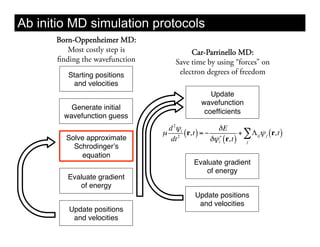
Ab initio MD simulation protocols
      Born-Oppenheimer MD:
          Most costly step is              Car-Parrinello MD:
      finding the wavefunction        Save time by using “forces” on
         Starting positions 
          electron degrees of freedom
           and velocities"
                                                   Update
                                                wavefunction
          Generate initial
                                                 coefficients"
        wavefunction guess"
                                  d 2!i            !E
                                 µ 2 ( r, t ) = ! "          + $ # ij! j ( r, t )
        Solve approximate
         dt            !"i ( r, t ) j
          Schrodingerʼs
            equation"
                                             Evaluate gradient 

                                                of energy"
         Evaluate gradient 

            of energy"
                                              Update positions

                                               and velocities"
         Update positions

          and velocities"
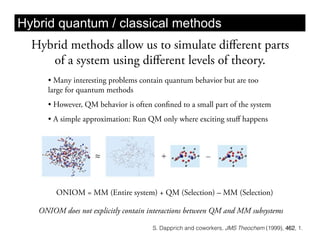
Hybrid quantum / classical methods
  Hybrid methods allow us to simulate different parts
     of a system using different levels of theory.
     •  Many interesting problems contain quantum behavior but are too
     large for quantum methods
     •  However, QM behavior is often confined to a small part of the system
     •  A simple approximation: Run QM only where exciting stuff happens


        ONIOM = MM (Entire system) + QM (Selection) – MM (Selection)

   ONIOM does not explicitly contain interactions between QM and MM subsystems

                                      S. Dapprich and coworkers, JMS Theochem (1999), 462, 1.
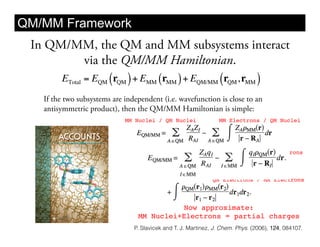
QM/MM Framework
 In QM/MM, the QM and MM subsystems interact
             via the QM/MM Hamiltonian.
      ETotal = EQM ( rQM ) + EMM ( rMM ) + EQM/MM ( rQM , rMM )
    If the two subsystems are independent (i.e. wavefunction is close to an
    antisymmetric product), then the QM/MM Hamiltonian is simple:
                              MM Nuclei / QM Nuclei!              MM Electrons / QM Nuclei!


                                                                   MM Nuclei / QM Electrons!


                                                                QM Electrons / MM Electrons!


                                            Now approximate:

                                  MM Nuclei+Electrons = partial charges !
                                 P. Slavicek and T. J. Martinez, J. Chem. Phys. (2006), 124, 084107.
QM/MM Framework
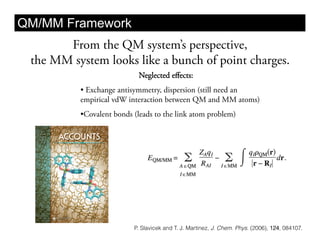
       From the QM system’s perspective,
 the MM system looks like a bunch of point charges.
                            Neglected effects:
          •  Exchange antisymmetry, dispersion (still need an
          empirical vdW interaction between QM and MM atoms)
          • Covalent bonds (leads to the link atom problem)


                          P. Slavicek and T. J. Martinez, J. Chem. Phys. (2006), 124, 084107.
Outline

 Review
    •  A wide range of simulation methods
    •  Schrödinger’s equation and the potential energy surface
 Methods
    •  Molecular forces and the Hellmann-Feynman theorem
    •  Born-Oppenheimer and Car-Parrinello molecular dynamics
    •  Hybrid quantum/classical methods
 Applications
    •  O-O bonding mechanism of cobalt water oxidation catalyst
    •  Simulating the Urey-Miller experiment
    •  Enzyme catalysis and rational enzyme design
Cobalt water oxidation catalyst


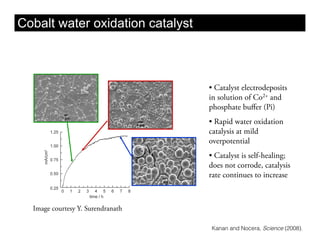
                                   •  Catalyst electrodeposits
                                   in solution of Co2+ and
                                   phosphate buffer (Pi)
                                   •  Rapid water oxidation
                                   catalysis at mild
                                   overpotential
                                   •  Catalyst is self-healing;
                                   does not corrode, catalysis
                                   rate continues to increase


  Image courtesy Y. Surendranath

                                    Kanan and Nocera, Science (2008).
Experimental clues: Structure


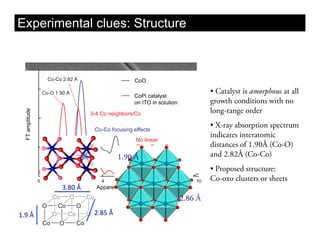
                                                                 •  Catalyst is amorphous at all
                                                                 growth conditions with no
                                                                 long-range order
                                                                 •  X-ray absorption spectrum
                                                                 indicates interatomic
                                                                 distances of 1.90Å (Co-O)
                                               1.90 Å            and 2.82Å (Co-Co)
                                                                 •  Proposed structure:
                                                                 Co-oxo clusters or sheets
               3.80	
  Å	
  
                                                        2.86 Å

1.9	
  Å	
                     2.85	
  Å	
  
Direct Coupling Pathway


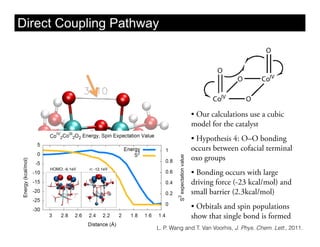
                                   •  Our calculations use a cubic
                                   model for the catalyst
                                   •  Hypothesis 4: O–O bonding
                                   occurs between cofacial terminal
                                   oxo groups
                                   •  Bonding occurs with large
                                   driving force (-23 kcal/mol) and
                                   small barrier (2.3kcal/mol)
                                   •  Orbitals and spin populations
                                   show that single bond is formed
                      L. P. Wang and T. Van Voorhis, J. Phys. Chem. Lett., 2011.
Free Energy Profile via QM/MM


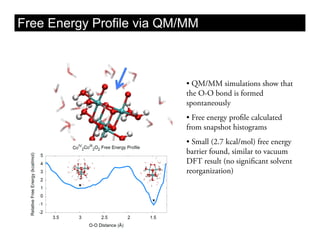
                           •  QM/MM simulations show that
                           the O-O bond is formed
                           spontaneously
                           •  Free energy profile calculated
                           from snapshot histograms
                           •  Small (2.7 kcal/mol) free energy
                           barrier found, similar to vacuum
                           DFT result (no significant solvent
                           reorganization)
Outline

 Review
    •  A wide range of simulation methods
    •  Schrödinger’s equation and the potential energy surface
 Methods
    •  Molecular forces and the Hellmann-Feynman theorem
    •  Born-Oppenheimer and Car-Parrinello molecular dynamics
    •  Hybrid quantum/classical methods
 Applications
    •  O-O bonding mechanism of cobalt water oxidation catalyst
    •  Simulating the Urey-Miller experiment
    •  Enzyme catalysis and rational enzyme design
Nanoreactor: Introduction
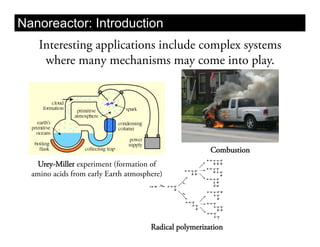
    Interesting applications include complex systems
     where many mechanisms may come into play.


                                                        Combustion
    Urey-Miller experiment (formation of
  amino acids from early Earth atmosphere)


                                      Radical polymerization
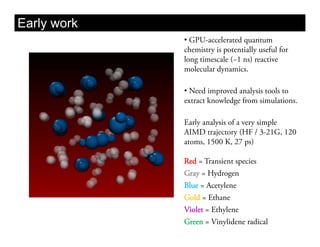
Early work
             •  GPU-accelerated quantum
             chemistry is potentially useful for
             long timescale (~1 ns) reactive
             molecular dynamics.

             •  Need improved analysis tools to
             extract knowledge from simulations.

             Early analysis of a very simple
             AIMD trajectory (HF / 3-21G, 120
             atoms, 1500 K, 27 ps)

             Red = Transient species
             Gray = Hydrogen
             Blue = Acetylene
             Gold = Ethane
             Violet = Ethylene
             Green = Vinylidene radical
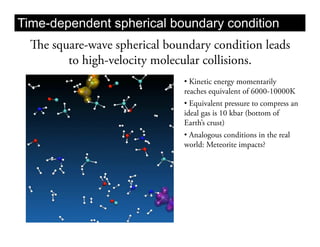
Time-dependent spherical boundary condition
  e square-wave spherical boundary condition leads
        to high-velocity molecular collisions.
                               •  Kinetic energy momentarily
                               reaches equivalent of 6000-10000K
                               •  Equivalent pressure to compress an
                               ideal gas is 10 kbar (bottom of
                               Earth’s crust)
                               •  Analogous conditions in the real
                               world: Meteorite impacts?
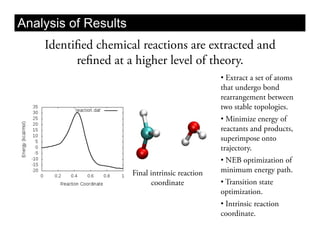
Analysis of Results
       Identified chemical reactions are extracted and
              refined at a higher level of theory.
                                                         •  Extract a set of atoms
                                                         that undergo bond
                                                         rearrangement between
                                                         two stable topologies.
                                                         •  Minimize energy of
                                                         reactants and products,
                                                         superimpose onto
                                                         trajectory.
                                                         •  NEB optimization of
Raw data from MD trajectory   Final intrinsic reaction   minimum energy path.
                                    coordinate           •  Transition state
                                                         optimization.
                                                         •  Intrinsic reaction
                                                         coordinate.
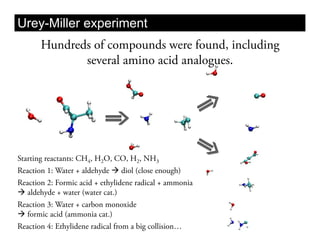
Urey-Miller experiment
       Hundreds of compounds were found, including
              several amino acid analogues.


Starting reactants: CH4, H2O, CO, H2, NH3
Reaction 1: Water + aldehyde à diol (close enough)
Reaction 2: Formic acid + ethylidene radical + ammonia
à aldehyde + water (water cat.)
Reaction 3: Water + carbon monoxide
à formic acid (ammonia cat.)
Reaction 4: Ethylidene radical from a big collision…
Outline

 Review
    •  A wide range of simulation methods
    •  Schrödinger’s equation and the potential energy surface
 Methods
    •  Molecular forces and the Hellmann-Feynman theorem
    •  Born-Oppenheimer and Car-Parrinello molecular dynamics
    •  Hybrid quantum/classical methods
 Applications
    •  O-O bonding mechanism of cobalt water oxidation catalyst
    •  Simulating the Urey-Miller experiment
    •  Enzyme catalysis and rational enzyme design
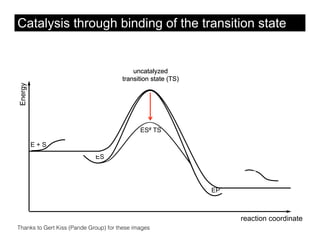
Catalysis through binding of the transition state


                                           uncatalyzed
                                       transition state (TS)
Energy


                                              ES# TS

         E+S
                             ES


                                                               EP


                                                                    reaction coordinate
Thanks to Gert Kiss (Pande Group) for these images
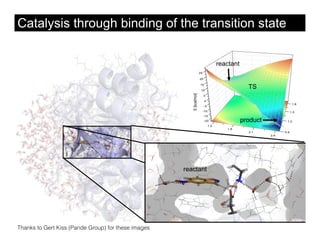
Catalysis through binding of the transition state

                                                                reactant


                                                                             TS


                                                                           product


                                                     reactant


Thanks to Gert Kiss (Pande Group) for these images
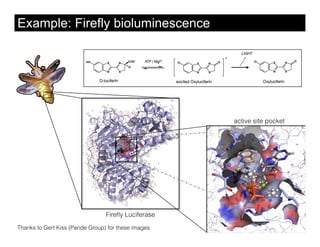
Example: Firefly bioluminescence

                                                                                                      LIGHT
                                                                                                *
                         HO                      COO-   ATP / Mg2+   -
                                                                     O                      O
                                                                                                              -
                                                                                                              O        S         N
                                                                                                                                     O
                                   S         N                                  S      N
                                                 H
                                   N         S                                  N      S                               N         S


                               D-luciferin                           excited Oxyluciferin                         Oxyluciferin


                                                                                                    active site pocket


                                  Firefly Luciferase
Thanks to Gert Kiss (Pande Group) for these images
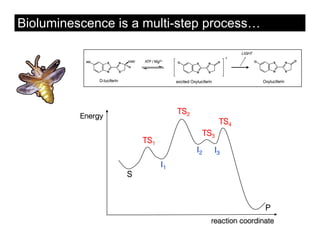
Bioluminescence is a multi-step process…

                                                                                      LIGHT
                                                                                  *
           HO                     COO-   ATP / Mg2+   -
                                                      O                       O
                                                                                              -
                                                                                              O        S         N
                                                                                                                     O
                    S         N                                  S      N
                                  H
                    N         S                                  N      S                              N         S


                D-luciferin                           excited Oxyluciferin                        Oxyluciferin


                                                      TS2
          Energy
                                                                              TS4
                                                                      TS3
                                         TS1
                                                                 I2          I3
                                                 I1
                                  S


                                                                                                   P
                                                                            reaction coordinate
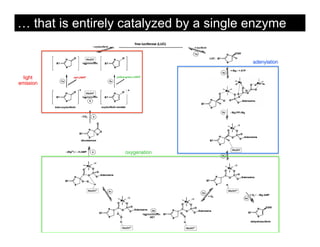
… that is entirely catalyzed by a single enzyme

                                         adenylation


  light
emission


                  oxygenation
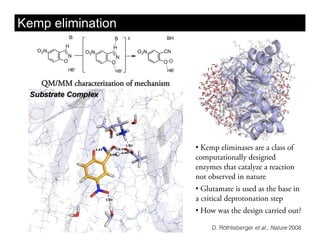
Kemp elimination


   QM/MM characterization of mechanism


                                         •  Kemp eliminases are a class of
                                         computationally designed
                                         enzymes that catalyze a reaction
                                         not observed in nature
                                         •  Glutamate is used as the base in
                                         a critical deprotonation step
                                         •  How was the design carried out?

                                              D. Röthlisberger et al., Nature 2008.
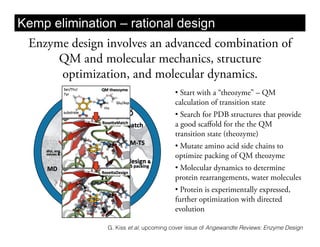
Kemp elimination – rational design
 Enzyme design involves an advanced combination of
      QM and molecular mechanics, structure
      optimization, and molecular dynamics.
                                       •  Start with a “theozyme” – QM
                                       calculation of transition state
                                       •  Search for PDB structures that provide
                                       a good scaffold for the the QM
                                       transition state (theozyme)
                                       •  Mutate amino acid side chains to
                                       optimize packing of QM theozyme
                                       •  Molecular dynamics to determine
                                       protein rearrangements, water molecules
                                       •  Protein is experimentally expressed,
                                       further optimization with directed
                                       evolution

               G. Kiss et al, upcoming cover issue of Angewandte Reviews: Enzyme Design

BIOS 203 Lecture 4: Ab initio molecular dynamics

  • 1.
    Ab initio molecular
 dynamics" Lee-Ping Wang" leeping @ stanford.edu " March 4, 2013"
  • 2.
    Outline Review •  A wide range of simulation methods •  Schrödinger’s equation and the potential energy surface Methods •  Molecular forces and the Hellmann-Feynman theorem •  Born-Oppenheimer and Car-Parrinello molecular dynamics •  Hybrid quantum/classical methods Applications •  O-O bonding mechanism of cobalt water oxidation catalyst •  Simulating the Urey-Miller experiment •  Enzyme catalysis and rational enzyme design
  • 3.
    A wide scopeof computer simulations One calculation for 2-3 atoms •  Computer simulations 100 fs, 30 atoms: of molecules span a wide photochemistry range of resolutions •  More detailed theories can describe complex 10 ps, 100 atoms: phenomena and offer fast chemical higher accuracy 10 µs, 10k atoms: reactions protein dynamics, drug binding •  Less detailed theories allow for simulation of larger systems / longer timescales 1 ms+, 1 million atoms: •  Quantum chemistry folding of large proteins, virus capsids and density function theory are used to study chemical reactions
  • 4.
    Categories of simulations Focus on the physics rather than the nomenclature. •  Quantum treatment of electrons or force field? QM: ab initio molecular dynamics (note: nuclei may be classical) Force field: classical MD or molecular mechanics •  Born-Oppenheimer approximation broken or excited states? Nonadiabatic dynamics, excited state dynamics •  Quantum treatment of nuclei? Quantum dynamics, path integral MD
  • 5.
    The Schrödinger equation All ground-state quantum chemistry is based on the time-independent Schrödinger’s equation. ˆ ΗΨ = EΨ (T + V ) Ψ = EΨ ˆ ˆ % "2 ( ' !# i + # Z I Z J ! # Z I + # 1 * + ( ri ;R I ) = E ( R I ) + ( ri ;R I ) ' ˆ ˆ ˆ * & i 2 I$J R I ! R iJ i,I R I ! ri i$ j ri ! rj ) Kinetic Nuclear Electron Electron energy repulsion nuclear electron Electron Electronic operator (just a “number”) attraction repulsion wavefunction energy Born-Oppenheimer approximation: when solving for the electronic wavefunction, treat nuclei as static external potentials
  • 6.
    Introduction: Molecular dynamicssimulation e fundamental equation of classical molecular dynamics is Newton’s second law. Key approximations: e force is given by the negative gradient of the •  Born-Oppenheimer potential energy. approximation; no transitions between dE F=! electronic states dR •  Approximate potential Knowing the force allows us to accelerate the atoms in energy surface, either the direction of the force. from quantum chemistry or from the force field F = ma •  Classical mechanics! Nuclei are quantum particles in reality, but this is ignored.
  • 7.
    Outline Review •  A wide range of simulation methods •  Schrödinger’s equation and the potential energy surface Methods •  Molecular forces and the Hellmann-Feynman theorem •  Born-Oppenheimer and Car-Parrinello molecular dynamics •  Hybrid quantum/classical methods Applications •  O-O bonding mechanism of cobalt water oxidation catalyst •  Simulating the Urey-Miller experiment •  Enzyme catalysis; mechanistic investigation and rational design
  • 8.
    Hellmann-Feynman theorem e Hellmann-Feynman dH dE ! ˆ theorem makes the dR dR " calculation of molecular forces! ( r ) = dr! ( r) (r) possible. ˆ H ! ( r) = E! ( r); " ! dr! (r)! (r) = 1 ˆ H ! =E ! ; ! ! =1 ! dr! " ˆ " " (r) H! (r) = ! ! E! = E ! ! ! = E ˆ ! H ! = ! E ! =E ! ! =E dE d ˆ dE d ˆ = dR dR " dr! ! (r)H! (r) = dR dR !H! d! ! ˆ ˆ d! ˆ ˆ dH =" H! + ! ! dH ˆ d! ! + ! !H = H! + ! ˆ d! ! + !H dR dR dR dR dR dR d! ! ! dH ˆ d! dHˆ d! d! =" E! + ! ! + ! !E = ! ! + E! + ! E dR dR dR dR dR dR " d! ! d! % ˆ dH ˆ dH d! d! = ( E$ ! + !! ' + !! ! = ! ! +E ! +E ! # dR dR & dR dR dR dR d ! dH ˆ ˆ dH d ="E dR (! ! ) + ! dR ! ! = ! dR ! +E dR !! d dH ˆ dHˆ dHˆ d ˆ dH =E 1+ " ! ! ! = " !! ! = ! ! +E 1 = ! ! dR dR dR dR dR dR
  • 9.
    Ab initio MDsimulation protocols Born-Oppenheimer MD: Most costly step is Car-Parrinello MD: finding the wavefunction Save time by using “forces” on Starting positions 
 electron degrees of freedom and velocities" Update wavefunction Generate initial coefficients" wavefunction guess" d 2!i !E µ 2 ( r, t ) = ! " + $ # ij! j ( r, t ) Solve approximate
 dt !"i ( r, t ) j Schrodingerʼs equation" Evaluate gradient 
 of energy" Evaluate gradient 
 of energy" Update positions
 and velocities" Update positions
 and velocities"
  • 10.
    Hybrid quantum /classical methods Hybrid methods allow us to simulate different parts of a system using different levels of theory. •  Many interesting problems contain quantum behavior but are too large for quantum methods •  However, QM behavior is often confined to a small part of the system •  A simple approximation: Run QM only where exciting stuff happens ONIOM = MM (Entire system) + QM (Selection) – MM (Selection) ONIOM does not explicitly contain interactions between QM and MM subsystems S. Dapprich and coworkers, JMS Theochem (1999), 462, 1.
  • 11.
    QM/MM Framework InQM/MM, the QM and MM subsystems interact via the QM/MM Hamiltonian. ETotal = EQM ( rQM ) + EMM ( rMM ) + EQM/MM ( rQM , rMM ) If the two subsystems are independent (i.e. wavefunction is close to an antisymmetric product), then the QM/MM Hamiltonian is simple: MM Nuclei / QM Nuclei! MM Electrons / QM Nuclei! MM Nuclei / QM Electrons! QM Electrons / MM Electrons! Now approximate:
 MM Nuclei+Electrons = partial charges ! P. Slavicek and T. J. Martinez, J. Chem. Phys. (2006), 124, 084107.
  • 12.
    QM/MM Framework From the QM system’s perspective, the MM system looks like a bunch of point charges. Neglected effects: •  Exchange antisymmetry, dispersion (still need an empirical vdW interaction between QM and MM atoms) • Covalent bonds (leads to the link atom problem) P. Slavicek and T. J. Martinez, J. Chem. Phys. (2006), 124, 084107.
  • 13.
    Outline Review •  A wide range of simulation methods •  Schrödinger’s equation and the potential energy surface Methods •  Molecular forces and the Hellmann-Feynman theorem •  Born-Oppenheimer and Car-Parrinello molecular dynamics •  Hybrid quantum/classical methods Applications •  O-O bonding mechanism of cobalt water oxidation catalyst •  Simulating the Urey-Miller experiment •  Enzyme catalysis and rational enzyme design
  • 14.
    Cobalt water oxidationcatalyst •  Catalyst electrodeposits in solution of Co2+ and phosphate buffer (Pi) •  Rapid water oxidation catalysis at mild overpotential •  Catalyst is self-healing; does not corrode, catalysis rate continues to increase Image courtesy Y. Surendranath Kanan and Nocera, Science (2008).
  • 15.
    Experimental clues: Structure •  Catalyst is amorphous at all growth conditions with no long-range order •  X-ray absorption spectrum indicates interatomic distances of 1.90Å (Co-O) 1.90 Å and 2.82Å (Co-Co) •  Proposed structure: Co-oxo clusters or sheets 3.80  Å   2.86 Å 1.9  Å   2.85  Å  
  • 16.
    Direct Coupling Pathway •  Our calculations use a cubic model for the catalyst •  Hypothesis 4: O–O bonding occurs between cofacial terminal oxo groups •  Bonding occurs with large driving force (-23 kcal/mol) and small barrier (2.3kcal/mol) •  Orbitals and spin populations show that single bond is formed L. P. Wang and T. Van Voorhis, J. Phys. Chem. Lett., 2011.
  • 17.
    Free Energy Profilevia QM/MM •  QM/MM simulations show that the O-O bond is formed spontaneously •  Free energy profile calculated from snapshot histograms •  Small (2.7 kcal/mol) free energy barrier found, similar to vacuum DFT result (no significant solvent reorganization)
  • 18.
    Outline Review •  A wide range of simulation methods •  Schrödinger’s equation and the potential energy surface Methods •  Molecular forces and the Hellmann-Feynman theorem •  Born-Oppenheimer and Car-Parrinello molecular dynamics •  Hybrid quantum/classical methods Applications •  O-O bonding mechanism of cobalt water oxidation catalyst •  Simulating the Urey-Miller experiment •  Enzyme catalysis and rational enzyme design
  • 19.
    Nanoreactor: Introduction Interesting applications include complex systems where many mechanisms may come into play. Combustion Urey-Miller experiment (formation of amino acids from early Earth atmosphere) Radical polymerization
  • 20.
    Early work •  GPU-accelerated quantum chemistry is potentially useful for long timescale (~1 ns) reactive molecular dynamics. •  Need improved analysis tools to extract knowledge from simulations. Early analysis of a very simple AIMD trajectory (HF / 3-21G, 120 atoms, 1500 K, 27 ps) Red = Transient species Gray = Hydrogen Blue = Acetylene Gold = Ethane Violet = Ethylene Green = Vinylidene radical
  • 21.
    Time-dependent spherical boundarycondition e square-wave spherical boundary condition leads to high-velocity molecular collisions. •  Kinetic energy momentarily reaches equivalent of 6000-10000K •  Equivalent pressure to compress an ideal gas is 10 kbar (bottom of Earth’s crust) •  Analogous conditions in the real world: Meteorite impacts?
  • 22.
    Analysis of Results Identified chemical reactions are extracted and refined at a higher level of theory. •  Extract a set of atoms that undergo bond rearrangement between two stable topologies. •  Minimize energy of reactants and products, superimpose onto trajectory. •  NEB optimization of Raw data from MD trajectory Final intrinsic reaction minimum energy path. coordinate •  Transition state optimization. •  Intrinsic reaction coordinate.
  • 23.
    Urey-Miller experiment Hundreds of compounds were found, including several amino acid analogues. Starting reactants: CH4, H2O, CO, H2, NH3 Reaction 1: Water + aldehyde à diol (close enough) Reaction 2: Formic acid + ethylidene radical + ammonia à aldehyde + water (water cat.) Reaction 3: Water + carbon monoxide à formic acid (ammonia cat.) Reaction 4: Ethylidene radical from a big collision…
  • 24.
    Outline Review •  A wide range of simulation methods •  Schrödinger’s equation and the potential energy surface Methods •  Molecular forces and the Hellmann-Feynman theorem •  Born-Oppenheimer and Car-Parrinello molecular dynamics •  Hybrid quantum/classical methods Applications •  O-O bonding mechanism of cobalt water oxidation catalyst •  Simulating the Urey-Miller experiment •  Enzyme catalysis and rational enzyme design
  • 25.
    Catalysis through bindingof the transition state uncatalyzed transition state (TS) Energy ES# TS E+S ES EP reaction coordinate Thanks to Gert Kiss (Pande Group) for these images
  • 26.
    Catalysis through bindingof the transition state reactant TS product reactant Thanks to Gert Kiss (Pande Group) for these images
  • 27.
    Example: Firefly bioluminescence LIGHT * HO COO- ATP / Mg2+ - O O - O S N O S N S N H N S N S N S D-luciferin excited Oxyluciferin Oxyluciferin active site pocket Firefly Luciferase Thanks to Gert Kiss (Pande Group) for these images
  • 28.
    Bioluminescence is amulti-step process… LIGHT * HO COO- ATP / Mg2+ - O O - O S N O S N S N H N S N S N S D-luciferin excited Oxyluciferin Oxyluciferin TS2 Energy TS4 TS3 TS1 I2 I3 I1 S P reaction coordinate
  • 29.
    … that isentirely catalyzed by a single enzyme adenylation light emission oxygenation
  • 30.
    Kemp elimination QM/MM characterization of mechanism •  Kemp eliminases are a class of computationally designed enzymes that catalyze a reaction not observed in nature •  Glutamate is used as the base in a critical deprotonation step •  How was the design carried out? D. Röthlisberger et al., Nature 2008.
  • 31.
    Kemp elimination –rational design Enzyme design involves an advanced combination of QM and molecular mechanics, structure optimization, and molecular dynamics. •  Start with a “theozyme” – QM calculation of transition state •  Search for PDB structures that provide a good scaffold for the the QM transition state (theozyme) •  Mutate amino acid side chains to optimize packing of QM theozyme •  Molecular dynamics to determine protein rearrangements, water molecules •  Protein is experimentally expressed, further optimization with directed evolution G. Kiss et al, upcoming cover issue of Angewandte Reviews: Enzyme Design