Solar PV Market

      Germany
       versus
        USA


3rd Solar Convention Las Vegas
October 7th 2010
Volkmar Kunerth, MBA
President, Solar Partners International
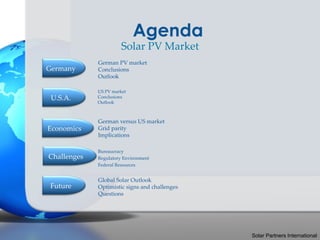
Agenda
                       Solar PV Market
             German PV market
Germany      Conclusions
             Outlook

             US PV market
 U.S.A.      Conclusions
             Outlook


             German versus US market
Economics    Grid parity
             Implications

             Bureaucracy
Challenges   Regulatory Environment
             Federal Resources


             Global Solar Outlook
 Future      Optimistic signs and challenges
             Questions


                                               Solar Partners International
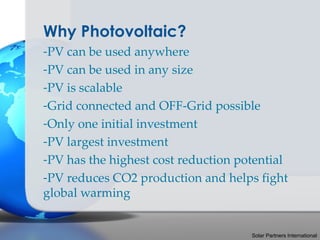
Why Photovoltaic?
-PV can be used anywhere
-PV can be used in any size
-PV is scalable
-Grid connected and OFF-Grid possible
-Only one initial investment
-PV largest investment
-PV has the highest cost reduction potential
-PV reduces CO2 production and helps fight
global warming


                                     Solar Partners International
German PV Market
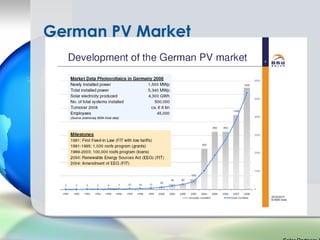
-Installations until 2009: Over 10 GWp
-Predicted Installation in 2010 alone: 10 GWp
-150,000 people employed in the industry
-PV is the largest source of investment: $29 billion
-80% of installations are roof installations
-Dramatic growth since the introduction of the Renewable Energy Sources
Act (EEG) in 2000
-EEG guarantees operators a feed-in tariff (FIT) fixed for 20 years and a
purchase guarantee for the electricity produced
--> investing in a solar electricity system is a very secure investment for 20
years
German PV Market
German PV Market
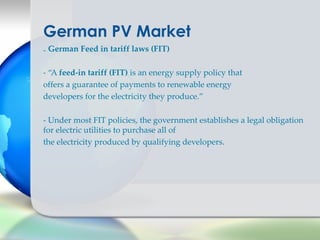
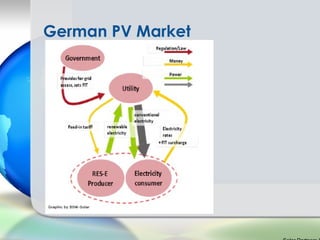
- German Feed in tariff laws (FIT)

- “A feed-in tariff (FIT) is an energy supply policy that
offers a guarantee of payments to renewable energy
developers for the electricity they produce.”

- Under most FIT policies, the government establishes a legal obligation
for electric utilities to purchase all of
the electricity produced by qualifying developers.
German PV Market
German PV Market
German PV Market


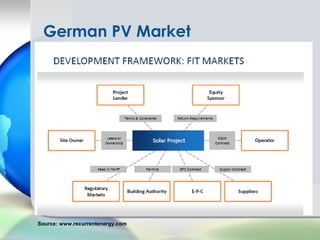
Source: www.recurrentenergy.com
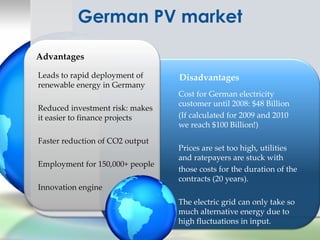
German PV market

Advantages

Leads to rapid deployment of     Disadvantages
renewable energy in Germany
                                 Cost for German electricity
                                 customer until 2008: $48 Billion
Reduced investment risk: makes
it easier to finance projects    (If calculated for 2009 and 2010
                                 we reach $100 Billion!)

Faster reduction of CO2 output
                                 Prices are set too high, utilities
                                 and ratepayers are stuck with
Employment for 150,000+ people
                                 those costs for the duration of the
                                 contracts (20 years).
Innovation engine
                                 The electric grid can only take so
                                 much alternative energy due to
                                 high fluctuations in input.
German PV Market
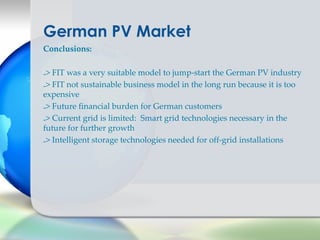
Conclusions:


-> FIT was a very suitable model to jump-start the German PV industry
-> FIT not sustainable business model in the long run because it is too
expensive
-> Future financial burden for German customers
-> Current grid is limited: Smart grid technologies necessary in the
future for further growth
-> Intelligent storage technologies needed for off-grid installations
German PV Market
-Outlook:

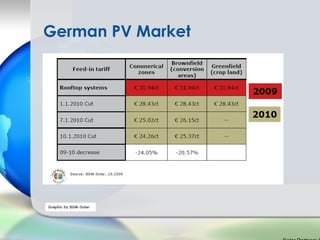
-After the January FIT decrease, the German parliament finally voted in an additional
decrease last July


-16% decrease for rooftops, 11% for reconversion areas, 15% for the other installations

-No more feed-in tariff for PV installations on agricultural land; the new law is expected
to considerably affect the market in the coming years.


-Market could stabilize in the 3 to 5 GW annual installations level by 2014, if the present
support scheme is maintained, with
adequate FIT decreases in line with the expected price decrease.
US PV Market
-USA has started to become one of the top PV markets
-477 MW installed in 2009; 40 MW of which are coming from off-
grid installations
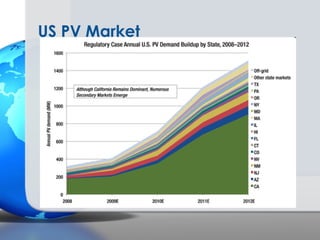
-State of California leading the pace in 2009
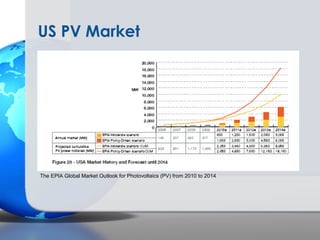
-2010 could see the market rise from 600 MW to a possible 1 GW of
new installations.
-By 2014, the market could reach 3 GW installed (moderate
scenario)
-Policy-Driven scenario up to 6 GW could be installed
-Depending on market response to incentives in different states
US PV Market


The EPIA Global Market Outlook for Photovoltaics (PV) from 2010 to 2014
US PV Market


The EPIA Global Market Outlook for Photovoltaics (PV) by States
US PV Market
-Complex, evolving solar policy environment
-Overlapping federal, regional, and state regulation
-Solar policies are not harmonized
-Developers have to think like power companies
-Tax driven project financing
-Banks and developers are sorting out the new
financing structures for US solar projects
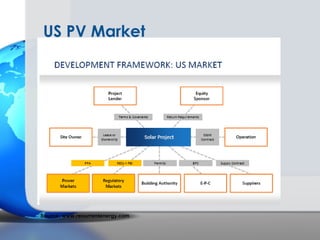
US PV Market


Source: www.recurrentenergy.com
US PV market

Advantages

The US has strong natural solar   Disadvantages
resources                         Overlapping federal, regional,
                                  and state regulation; Solar
Increasing energy prices and      policies are not harmonized
strong public support
                                  Developing a downstream U.S.
                                  PV market strategy requires a
U.S. peak demand will increase
                                  deliberate, highly specified
17.7% by 2017 according to NERC
                                  approach to each application,
                                  state market and market segment
Huge long term potential
                                  Funding hurdles
                                  U.S. federal government is
                                  unlikely to provide level of
                                  financial subsidy as in the
                                  European markets
US PV Market
Conclusions:
- Short term conditions challenging and main hurdles are likely to remain
- US government’s lack of incentives by comparison to other regions
- Overlapping federal, regional, and state regulation
- Complicated and long negotiations with utilities


-> Long term outlook very promising
-The US will become the biggest and most important PV solar market in the
world
US PV Market
Outlook:
 - Demand for PV projects in the United States is rapidly
expanding as a result of falling system prices
- The market is evolving as utility-scale projects gain
steam and innovations in project financing emerge
- With decreasing prices, a chain reaction will occur
causing a decrease in project payback time, finally an
increase in attractiveness of solar retail and commercial
markets in the US
- Global solar market players from all parts of the value
chain are seeking strategies to gain access to U.S
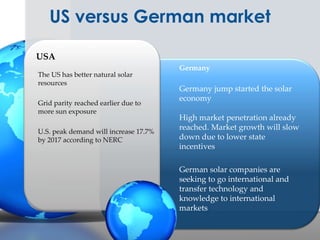
US versus German market

USA
                                       Germany
The US has better natural solar
resources
                                       Germany jump started the solar
                                       economy
Grid parity reached earlier due to
more sun exposure
                                       High market penetration already
                                       reached. Market growth will slow
U.S. peak demand will increase 17.7%
by 2017 according to NERC              down due to lower state
                                       incentives

                                       German solar companies are
                                       seeking to go international and
                                       transfer technology and
                                       knowledge to international
                                       markets
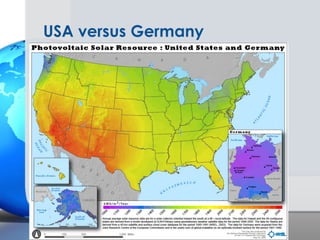
USA versus Germany
-2
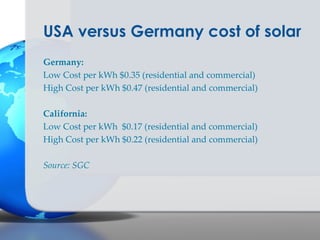
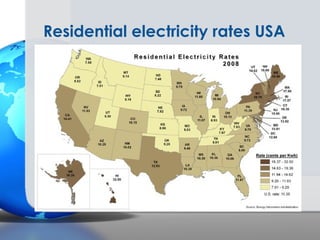
USA versus Germany cost of solar
Germany:
Low Cost per kWh $0.35 (residential and commercial)
High Cost per kWh $0.47 (residential and commercial)

California:
Low Cost per kWh $0.17 (residential and commercial)
High Cost per kWh $0.22 (residential and commercial)

Source: SGC
Residential electricity rates USA
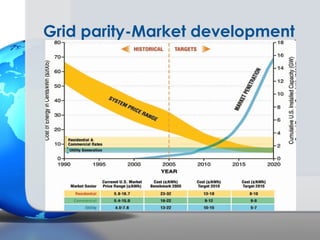
Grid parity influencers
-Grid parity is the point at which alternative means of
generating electricity is equal in cost, or cheaper than
grid power


-High radiation levels + high electricity prices + falling
pv system prices=> faster grid parity

-Hawaii has reached grid parity already; California
will be next


-When grid parity is reached market will grow rapidly
Grid parity-Market development
Challenges for market growth
-No national market coordination
-Bureaucracy
-Increasing policy complexity
-Various federal, state and local policy types for promoting solar
-Various financing options
-Private and commercial customers get confused
DSIRE
-DSIRE: Database of State Incentives for Renewables and Efficiency
www.dsireusa.org


-DSIRE lists a total of 616 Federal State, Utility and Local Financial
Incentives for Solar
- 518 Incentives for PV

DSIRE lists a total of 367 Federal, State, Utility, and Local
Regulatory Incentives for Solar
- 356 Incemtives for PV
Federal Resources
  DSIRE: Database of State Incentives for Renewables and Efficiency: www.dsireusa.org
- US Department of Energy Efficiency and Renewable Energy: http://www.eere.energy.gov/
- National Renewable Energy Laboratory:
-
http://www.nrel.gov/
  US Energy Information Administration:
-
http://www.eia.doe.gov/
  Energy Star:
-
http://www.energystar.gov/
  Federal Business Opportunities:
-
https://www.fbo.gov/
  US Department of Energy:
-
http://www.energy.gov
  EPA:
- http://www.epa.gov/
Global Solar Outlook
-Currently 20 GW installed
-30-35 GW installed by the end of the year
-Plunging prices of solar modules
-Europe is still leading the market with installations (Germany and Italy)
-47 countries have FIT but danger of Solar market bust in countries with FIT
-US, China, India, Japan and France will experience significant growth
-By 2015 cumulative solar capacity will have reached 65-100GW or more
- Demand for PV systems is still heavily dependent on the general economic
climate and most importantly on governments’ support schemes.
-
Thank you!
Questions and discussion

Please send e-mail to
kunerth@gmail.com
for presentation and sources

Solar.Presentation PV market Germany USA

  • 1.
    Solar PV Market Germany versus USA 3rd Solar Convention Las Vegas October 7th 2010 Volkmar Kunerth, MBA President, Solar Partners International
  • 2.
    Agenda Solar PV Market German PV market Germany Conclusions Outlook US PV market U.S.A. Conclusions Outlook German versus US market Economics Grid parity Implications Bureaucracy Challenges Regulatory Environment Federal Resources Global Solar Outlook Future Optimistic signs and challenges Questions Solar Partners International
  • 3.
    Why Photovoltaic? -PV canbe used anywhere -PV can be used in any size -PV is scalable -Grid connected and OFF-Grid possible -Only one initial investment -PV largest investment -PV has the highest cost reduction potential -PV reduces CO2 production and helps fight global warming Solar Partners International
  • 4.
    German PV Market -Installationsuntil 2009: Over 10 GWp -Predicted Installation in 2010 alone: 10 GWp -150,000 people employed in the industry -PV is the largest source of investment: $29 billion -80% of installations are roof installations -Dramatic growth since the introduction of the Renewable Energy Sources Act (EEG) in 2000 -EEG guarantees operators a feed-in tariff (FIT) fixed for 20 years and a purchase guarantee for the electricity produced --> investing in a solar electricity system is a very secure investment for 20 years
  • 5.
  • 6.
    German PV Market -German Feed in tariff laws (FIT) - “A feed-in tariff (FIT) is an energy supply policy that offers a guarantee of payments to renewable energy developers for the electricity they produce.” - Under most FIT policies, the government establishes a legal obligation for electric utilities to purchase all of the electricity produced by qualifying developers.
  • 7.
  • 8.
  • 9.
    German PV Market Source:www.recurrentenergy.com
  • 10.
    German PV market Advantages Leadsto rapid deployment of Disadvantages renewable energy in Germany Cost for German electricity customer until 2008: $48 Billion Reduced investment risk: makes it easier to finance projects (If calculated for 2009 and 2010 we reach $100 Billion!) Faster reduction of CO2 output Prices are set too high, utilities and ratepayers are stuck with Employment for 150,000+ people those costs for the duration of the contracts (20 years). Innovation engine The electric grid can only take so much alternative energy due to high fluctuations in input.
  • 11.
    German PV Market Conclusions: ->FIT was a very suitable model to jump-start the German PV industry -> FIT not sustainable business model in the long run because it is too expensive -> Future financial burden for German customers -> Current grid is limited: Smart grid technologies necessary in the future for further growth -> Intelligent storage technologies needed for off-grid installations
  • 12.
    German PV Market -Outlook: -Afterthe January FIT decrease, the German parliament finally voted in an additional decrease last July -16% decrease for rooftops, 11% for reconversion areas, 15% for the other installations -No more feed-in tariff for PV installations on agricultural land; the new law is expected to considerably affect the market in the coming years. -Market could stabilize in the 3 to 5 GW annual installations level by 2014, if the present support scheme is maintained, with adequate FIT decreases in line with the expected price decrease.
  • 13.
    US PV Market -USAhas started to become one of the top PV markets -477 MW installed in 2009; 40 MW of which are coming from off- grid installations -State of California leading the pace in 2009 -2010 could see the market rise from 600 MW to a possible 1 GW of new installations. -By 2014, the market could reach 3 GW installed (moderate scenario) -Policy-Driven scenario up to 6 GW could be installed -Depending on market response to incentives in different states
  • 14.
    US PV Market TheEPIA Global Market Outlook for Photovoltaics (PV) from 2010 to 2014
  • 15.
    US PV Market TheEPIA Global Market Outlook for Photovoltaics (PV) by States
  • 16.
    US PV Market -Complex,evolving solar policy environment -Overlapping federal, regional, and state regulation -Solar policies are not harmonized -Developers have to think like power companies -Tax driven project financing -Banks and developers are sorting out the new financing structures for US solar projects
  • 17.
    US PV Market Source:www.recurrentenergy.com
  • 18.
    US PV market Advantages TheUS has strong natural solar Disadvantages resources Overlapping federal, regional, and state regulation; Solar Increasing energy prices and policies are not harmonized strong public support Developing a downstream U.S. PV market strategy requires a U.S. peak demand will increase deliberate, highly specified 17.7% by 2017 according to NERC approach to each application, state market and market segment Huge long term potential Funding hurdles U.S. federal government is unlikely to provide level of financial subsidy as in the European markets
  • 19.
    US PV Market Conclusions: -Short term conditions challenging and main hurdles are likely to remain - US government’s lack of incentives by comparison to other regions - Overlapping federal, regional, and state regulation - Complicated and long negotiations with utilities -> Long term outlook very promising -The US will become the biggest and most important PV solar market in the world
  • 20.
    US PV Market Outlook: - Demand for PV projects in the United States is rapidly expanding as a result of falling system prices - The market is evolving as utility-scale projects gain steam and innovations in project financing emerge - With decreasing prices, a chain reaction will occur causing a decrease in project payback time, finally an increase in attractiveness of solar retail and commercial markets in the US - Global solar market players from all parts of the value chain are seeking strategies to gain access to U.S
  • 21.
    US versus Germanmarket USA Germany The US has better natural solar resources Germany jump started the solar economy Grid parity reached earlier due to more sun exposure High market penetration already reached. Market growth will slow U.S. peak demand will increase 17.7% by 2017 according to NERC down due to lower state incentives German solar companies are seeking to go international and transfer technology and knowledge to international markets
  • 22.
  • 23.
    USA versus Germanycost of solar Germany: Low Cost per kWh $0.35 (residential and commercial) High Cost per kWh $0.47 (residential and commercial) California: Low Cost per kWh $0.17 (residential and commercial) High Cost per kWh $0.22 (residential and commercial) Source: SGC
  • 24.
  • 25.
    Grid parity influencers -Gridparity is the point at which alternative means of generating electricity is equal in cost, or cheaper than grid power -High radiation levels + high electricity prices + falling pv system prices=> faster grid parity -Hawaii has reached grid parity already; California will be next -When grid parity is reached market will grow rapidly
  • 26.
  • 27.
    Challenges for marketgrowth -No national market coordination -Bureaucracy -Increasing policy complexity -Various federal, state and local policy types for promoting solar -Various financing options -Private and commercial customers get confused
  • 28.
    DSIRE -DSIRE: Database ofState Incentives for Renewables and Efficiency www.dsireusa.org -DSIRE lists a total of 616 Federal State, Utility and Local Financial Incentives for Solar - 518 Incentives for PV DSIRE lists a total of 367 Federal, State, Utility, and Local Regulatory Incentives for Solar - 356 Incemtives for PV
  • 29.
    Federal Resources DSIRE: Database of State Incentives for Renewables and Efficiency: www.dsireusa.org - US Department of Energy Efficiency and Renewable Energy: http://www.eere.energy.gov/ - National Renewable Energy Laboratory: - http://www.nrel.gov/ US Energy Information Administration: - http://www.eia.doe.gov/ Energy Star: - http://www.energystar.gov/ Federal Business Opportunities: - https://www.fbo.gov/ US Department of Energy: - http://www.energy.gov EPA: - http://www.epa.gov/
  • 30.
    Global Solar Outlook -Currently20 GW installed -30-35 GW installed by the end of the year -Plunging prices of solar modules -Europe is still leading the market with installations (Germany and Italy) -47 countries have FIT but danger of Solar market bust in countries with FIT -US, China, India, Japan and France will experience significant growth -By 2015 cumulative solar capacity will have reached 65-100GW or more - Demand for PV systems is still heavily dependent on the general economic climate and most importantly on governments’ support schemes. -
  • 31.
    Thank you! Questions anddiscussion Please send e-mail to kunerth@gmail.com for presentation and sources