
NAME:D.BALAJI
CONTACT:(BALAJI.BALA005@GMAIL.COM )
DEP:I.C.E
YEAR: 1ST
Sri ram
Polytechnic college
Perumalpattu thiruvallur dist.
Pin code:602 024
Resent trent
in SOLAR
ENERGY
Solar energy is a one of the
source which converts
light energy
into direct
electrical energy
Working
The solar rays fall on the top layer of
p-type semiconductor the electrons from
valence band get promoted to the
conduction band and cross the P-N junction
. there is potential difference between two is
created. Hence the current is generated
Simply put, efficiency refers to the
process of converting light energy to
electrical energy by the PV panel.
Construction :
they require little maintenance and have a
long lifetime. Compared to other renewable
sources they also possess many
advantages
 The most common type of PV panel today is
manufactured from silicon.
There are several variants on silicon-
based PV panels such as crystalline and
non-crystalline.
Crystalline silicon PV panels currently
dominate the market, with nanocrystalline
silicon being the most common.
GENERAL FACTS
Solar Energy is better for the environment than
traditional forms of energy.
Solar energy has many uses such as electricity
production and heating of water through photovoltaic
cells and directly for drying clothes.
Solar energy can also be used to heat, cook food
,swimming pools, power cars, for attic fans, calculators
and other small appliances. It produces lighting for
indoors or outdoors.
Facts about Solar Energy systems:
•A home solar system is typically made up of solar
panels, an inverter, a battery, a charge controller,
wiring and support structure.
• 1-kilowatt home solar system consists of about
10-12 solar panels and requires about 100 square
feet of installation area.
• kilowatt home solar system will generate
approximately 1,600 kilowatt hours per year in a
sunny climate (receiving 5.5 hours of sunshine per
day) and approximately 750 kilowatt hours per
year in a cloudy climate (receiving 2.5 hours of
sunshine per day).
Organic and thin-layer PV cells
Organic solar cells use carbon-based
polymers based upon molecules such as
fullerenes
while thin-layer silicon PV employ
additional light-trapping techniques with a
thinner silicon layer
Organic cells, however, have efficiencies
of less than 10% and need to be
improved before they are viable for
commercial use.
Advantages
 They are particularly useful where there is
no national grid and also where there are no
people such as remote site water pumping
or in space.
 Solar cells are use in calculators, electronic
watches, radios and T.V
 Solar cells are also used in store energy in
Ni-Cd batteries and Lead-acid batteries
 The most common type of PV panel today
is manufactured from silicon.
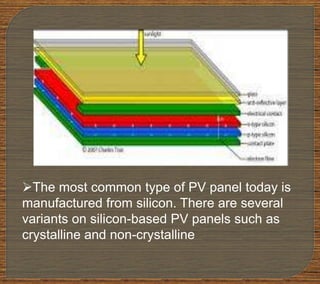
A schematic of a PV cell. Sunlight passing
through the glass (grey) and anti-reflective
layer (yellow) strikes the p-type silicon (blue),
releasing free electrons from the silicon
atoms in that layer.
The electrons are attracted to the
positively-charged n-type silicon (red).
Connecting the cell to an electrical circuit
through the electrical contacts (green) will
provide electrical energy to drive a load (e.g.
light bulb).
The most common type of PV panel today is
manufactured from silicon. There are several
variants on silicon-based PV panels such as
crystalline and non-crystalline
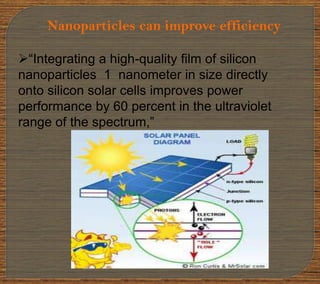
“Integrating a high-quality film of silicon
nanoparticles 1 nanometer in size directly
onto silicon solar cells improves power
performance by 60 percent in the ultraviolet
range of the spectrum,”
Nanoparticles can improve efficiency
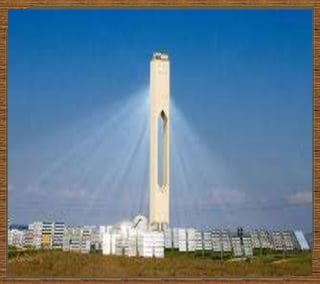
Solar panels, shown here, are
used to generate electricity
for a small town near Tempe.
Current Limitations of
Solar Panels
The various silicon PV panels differ
in their efficiency.
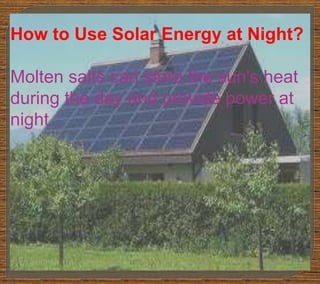
How to Use Solar Energy at Night?
Molten salts can store the sun's heat
during the day and provide power at
night
Solar  energy 1
Solar  energy 1

Solar energy 1

  • 1.
    NAME:D.BALAJI CONTACT:(BALAJI.BALA005@GMAIL.COM ) DEP:I.C.E YEAR: 1ST Sriram Polytechnic college Perumalpattu thiruvallur dist. Pin code:602 024 Resent trent in SOLAR ENERGY
  • 2.
    Solar energy isa one of the source which converts light energy into direct electrical energy
  • 3.
    Working The solar raysfall on the top layer of p-type semiconductor the electrons from valence band get promoted to the conduction band and cross the P-N junction . there is potential difference between two is created. Hence the current is generated
  • 4.
    Simply put, efficiencyrefers to the process of converting light energy to electrical energy by the PV panel. Construction :
  • 5.
    they require littlemaintenance and have a long lifetime. Compared to other renewable sources they also possess many advantages  The most common type of PV panel today is manufactured from silicon. There are several variants on silicon- based PV panels such as crystalline and non-crystalline. Crystalline silicon PV panels currently dominate the market, with nanocrystalline silicon being the most common.
  • 6.
    GENERAL FACTS Solar Energyis better for the environment than traditional forms of energy. Solar energy has many uses such as electricity production and heating of water through photovoltaic cells and directly for drying clothes. Solar energy can also be used to heat, cook food ,swimming pools, power cars, for attic fans, calculators and other small appliances. It produces lighting for indoors or outdoors.
  • 7.
    Facts about SolarEnergy systems: •A home solar system is typically made up of solar panels, an inverter, a battery, a charge controller, wiring and support structure. • 1-kilowatt home solar system consists of about 10-12 solar panels and requires about 100 square feet of installation area. • kilowatt home solar system will generate approximately 1,600 kilowatt hours per year in a sunny climate (receiving 5.5 hours of sunshine per day) and approximately 750 kilowatt hours per year in a cloudy climate (receiving 2.5 hours of sunshine per day).
  • 8.
    Organic and thin-layerPV cells Organic solar cells use carbon-based polymers based upon molecules such as fullerenes while thin-layer silicon PV employ additional light-trapping techniques with a thinner silicon layer Organic cells, however, have efficiencies of less than 10% and need to be improved before they are viable for commercial use.
  • 9.
    Advantages  They areparticularly useful where there is no national grid and also where there are no people such as remote site water pumping or in space.  Solar cells are use in calculators, electronic watches, radios and T.V  Solar cells are also used in store energy in Ni-Cd batteries and Lead-acid batteries  The most common type of PV panel today is manufactured from silicon.
  • 10.
    A schematic ofa PV cell. Sunlight passing through the glass (grey) and anti-reflective layer (yellow) strikes the p-type silicon (blue), releasing free electrons from the silicon atoms in that layer. The electrons are attracted to the positively-charged n-type silicon (red). Connecting the cell to an electrical circuit through the electrical contacts (green) will provide electrical energy to drive a load (e.g. light bulb).
  • 11.
    The most commontype of PV panel today is manufactured from silicon. There are several variants on silicon-based PV panels such as crystalline and non-crystalline
  • 12.
    “Integrating a high-qualityfilm of silicon nanoparticles 1 nanometer in size directly onto silicon solar cells improves power performance by 60 percent in the ultraviolet range of the spectrum,” Nanoparticles can improve efficiency
  • 13.
    Solar panels, shownhere, are used to generate electricity for a small town near Tempe.
  • 14.
    Current Limitations of SolarPanels The various silicon PV panels differ in their efficiency.
  • 17.
    How to UseSolar Energy at Night? Molten salts can store the sun's heat during the day and provide power at night