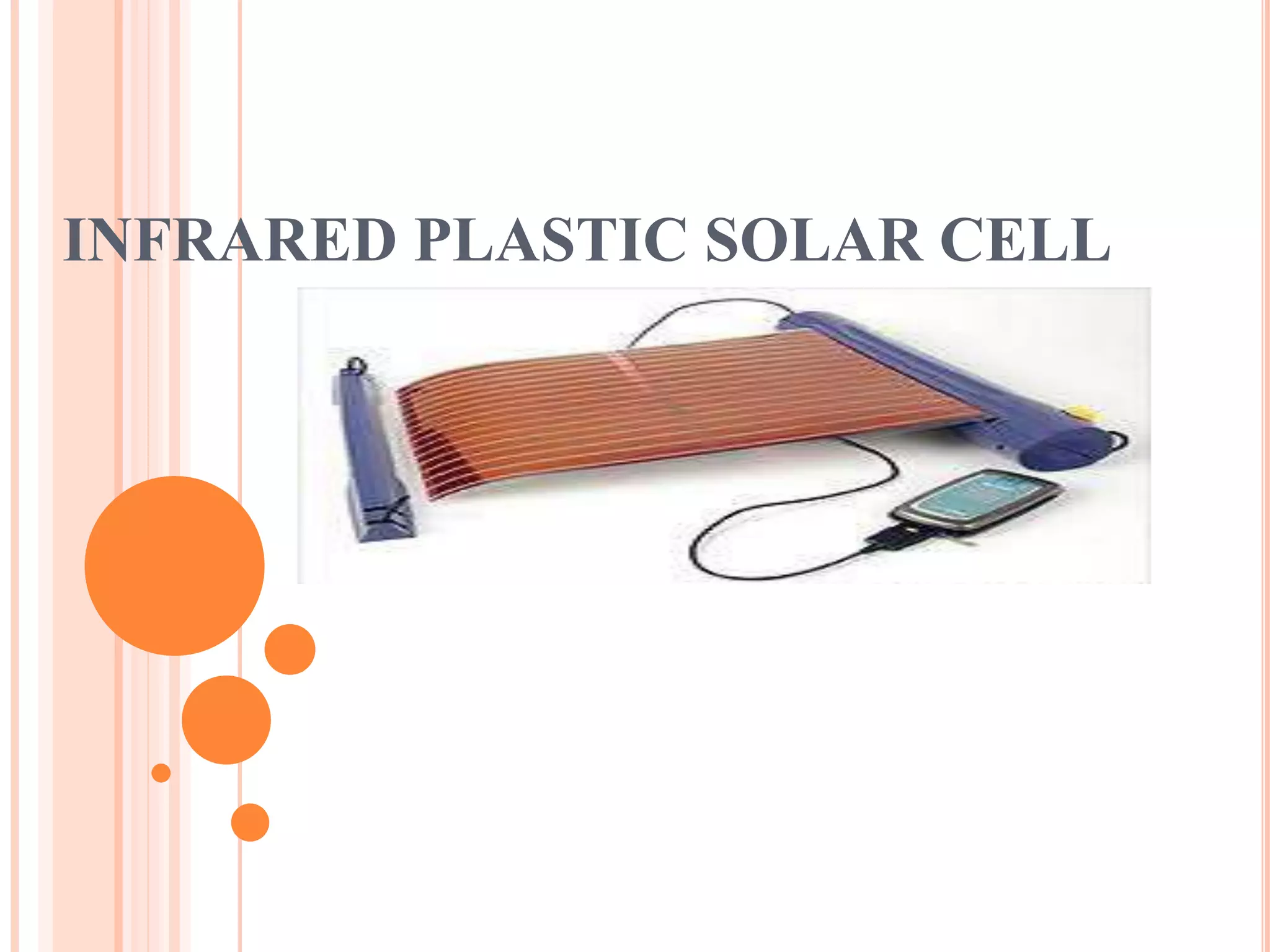
INFRARED PLASTIC SOLAR CELL
CONTENTS
 Introduction
 Nano Technology
 Working of conventional cells
 IR plastic solar cell
 Working
 Applications
 Advantages
 Limitations
 References
INTRODUCTION
 Nanotechnology is the nexus of sciences.
 It includes anything smaller than 100 nanometers with
novel properties.
 As the pool of available resources is being exhausted,
the demand for resources that are everlasting and eco-
friendly is increasing day by day.
 One such form is the solar energy.
 The advent of solar energy just about solved all the
problems.
 The conventional solar cells that are used to harness
solar energy are less efficient and cannot function
properly on a cloudy day.
 The use of nanotechnology in the solar cells created an
opportunity to overcome this problem , thereby
increasing the efficiency.
NANO TECHNOLOGY
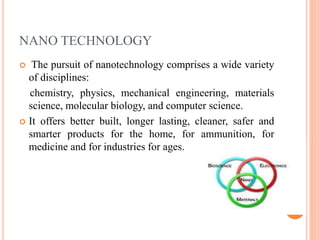
 The pursuit of nanotechnology comprises a wide variety
of disciplines:
chemistry, physics, mechanical engineering, materials
science, molecular biology, and computer science.
 It offers better built, longer lasting, cleaner, safer and
smarter products for the home, for ammunition, for
medicine and for industries for ages.
 These properties of nanotechnology have been made use
of in solar cells.
 Solar energy is really an abundant source that is
renewable and pollution free.
 This form of energy has very wide applications ranging
from small household items, calculators to larger things
like two wheelers, cars etc.
 They make use of solar cell that converts the energy
from the sun into required form.
WORKING OF CONVENTIONAL SOLAR CELL
 Basically conventional type solar cells
Photovoltaic (PV) cells are made of special
materials called semiconductors such as silicon,
which is currently the most commonly used.
 When light strikes the cell, a certain portion of it
is absorbed within the semiconductor material.
 This means that the energy of the absorbed light
is transferred to the semiconductor.
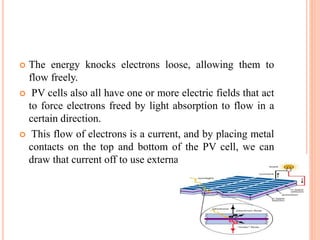
 The energy knocks electrons loose, allowing them to
flow freely.
 PV cells also all have one or more electric fields that act
to force electrons freed by light absorption to flow in a
certain direction.
 This flow of electrons is a current, and by placing metal
contacts on the top and bottom of the PV cell, we can
draw that current off to use externally.
IR PLASTIC SOLAR CELL
 Scientists have invented a plastic solar cell that can turn the
suns power into electric energy even on a cloudy day
 The plastic material uses nanotechnology and contains the
1stgeneration solar cells that can harness the sun’s invisible
infrared rays.
 This breakthrough made us to believe that plastic solar cells
could one day become more efficient than the current solar
cell.
 The researchers combined specially designed nano particles
called quantum dots with a polymer to make the plastic that
can detect energy in the infrared.
WORKING
 The solar cell created is actually a hybrid, comprised of tiny
nano rods dispersed in an organic polymer or plastic.
 A layer only 200 nanometers thick is sandwiched between
electrodes and can produce at present about .7 volts.
 The electrode layers and nano rods /polymer layers could be
applied in separate coats, making production fairly easy.
 The technology takes advantage of recent advances in
nanotechnology specifically the production of nano crystals
and nano rods.
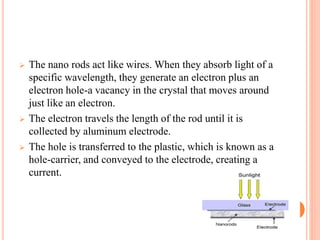
 The nano rods act like wires. When they absorb light of a
specific wavelength, they generate an electron plus an
electron hole-a vacancy in the crystal that moves around
just like an electron.
 The electron travels the length of the rod until it is
collected by aluminum electrode.
 The hole is transferred to the plastic, which is known as a
hole-carrier, and conveyed to the electrode, creating a
current.
IMPROVEMENTS
 Better light collection and concentration
employed in the solar cells.
 In plastic cells nano rods are closely packed and
transfer their electrons more directly to the
electrolyte.
 They also hope to tune the nano rods to absorb
different colors to span the spectrum of sun light.
APPLICATIONS
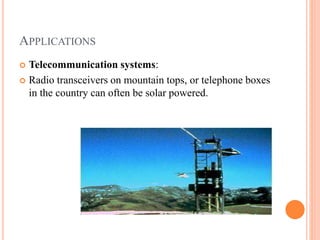
 Telecommunication systems:
 Radio transceivers on mountain tops, or telephone boxes
in the country can often be solar powered.
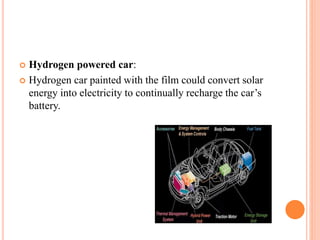
 Hydrogen powered car:
 Hydrogen car painted with the film could convert solar
energy into electricity to continually recharge the car’s
battery.
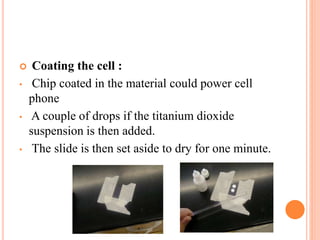
 Coating the cell :
• Chip coated in the material could power cell
phone
• A couple of drops if the titanium dioxide
suspension is then added.
• The slide is then set aside to dry for one minute.
 One day solar farms consisting of plastic materials
could be rolled across deserts to generate enough clear
energy to supply the entire planet’s power needs.
 Plastic solar cells are quite a lot useful in the coming
future.
ADVANTAGES
 These are considered to be 30% more efficient.
 Their efficiency is same even on cloudy days.
 These are very compact and more practical in application.
 These cells avoids effects like pollution.
 Fabrication is easy.
 Flexible, roller processed solar cells have the potential to
turn the sun’s power into a clean, green, consistent
source of energy.
LIMITATIONS
 They are very costly.
 Relatively shorter life span when continuously exposed
to sunlight.
 It requires higher maintenance and constant monitoring.
CONCLUSION
 Plastic solar cells help in exploiting the infrared
radiation.
 More effective when compared to conventional solar
cells.
 They can even work on cloudy days.
 Though at present cost is a major drawback, it can be
solved in the near future.
REFERENCES
 1.Introduction to Nanotechnology:Charles P Poole,Frank
J Owens
 2.Nanomaterials:synthesis,properties and
applications:Edelstein, A.S.cammarata
 3.Solar energy-fundamentals, design, modeling,
applications : G.N.Tiwari
Infrared plastic solar cell

Infrared plastic solar cell

  • 1.
  • 2.
    CONTENTS  Introduction  NanoTechnology  Working of conventional cells  IR plastic solar cell  Working  Applications  Advantages  Limitations  References
  • 3.
    INTRODUCTION  Nanotechnology isthe nexus of sciences.  It includes anything smaller than 100 nanometers with novel properties.  As the pool of available resources is being exhausted, the demand for resources that are everlasting and eco- friendly is increasing day by day.  One such form is the solar energy.
  • 4.
     The adventof solar energy just about solved all the problems.  The conventional solar cells that are used to harness solar energy are less efficient and cannot function properly on a cloudy day.  The use of nanotechnology in the solar cells created an opportunity to overcome this problem , thereby increasing the efficiency.
  • 5.
    NANO TECHNOLOGY  Thepursuit of nanotechnology comprises a wide variety of disciplines: chemistry, physics, mechanical engineering, materials science, molecular biology, and computer science.  It offers better built, longer lasting, cleaner, safer and smarter products for the home, for ammunition, for medicine and for industries for ages.
  • 6.
     These propertiesof nanotechnology have been made use of in solar cells.  Solar energy is really an abundant source that is renewable and pollution free.  This form of energy has very wide applications ranging from small household items, calculators to larger things like two wheelers, cars etc.  They make use of solar cell that converts the energy from the sun into required form.
  • 7.
    WORKING OF CONVENTIONALSOLAR CELL  Basically conventional type solar cells Photovoltaic (PV) cells are made of special materials called semiconductors such as silicon, which is currently the most commonly used.  When light strikes the cell, a certain portion of it is absorbed within the semiconductor material.  This means that the energy of the absorbed light is transferred to the semiconductor.
  • 8.
     The energyknocks electrons loose, allowing them to flow freely.  PV cells also all have one or more electric fields that act to force electrons freed by light absorption to flow in a certain direction.  This flow of electrons is a current, and by placing metal contacts on the top and bottom of the PV cell, we can draw that current off to use externally.
  • 9.
    IR PLASTIC SOLARCELL  Scientists have invented a plastic solar cell that can turn the suns power into electric energy even on a cloudy day  The plastic material uses nanotechnology and contains the 1stgeneration solar cells that can harness the sun’s invisible infrared rays.  This breakthrough made us to believe that plastic solar cells could one day become more efficient than the current solar cell.  The researchers combined specially designed nano particles called quantum dots with a polymer to make the plastic that can detect energy in the infrared.
  • 10.
    WORKING  The solarcell created is actually a hybrid, comprised of tiny nano rods dispersed in an organic polymer or plastic.  A layer only 200 nanometers thick is sandwiched between electrodes and can produce at present about .7 volts.  The electrode layers and nano rods /polymer layers could be applied in separate coats, making production fairly easy.  The technology takes advantage of recent advances in nanotechnology specifically the production of nano crystals and nano rods.
  • 11.
     The nanorods act like wires. When they absorb light of a specific wavelength, they generate an electron plus an electron hole-a vacancy in the crystal that moves around just like an electron.  The electron travels the length of the rod until it is collected by aluminum electrode.  The hole is transferred to the plastic, which is known as a hole-carrier, and conveyed to the electrode, creating a current.
  • 12.
    IMPROVEMENTS  Better lightcollection and concentration employed in the solar cells.  In plastic cells nano rods are closely packed and transfer their electrons more directly to the electrolyte.  They also hope to tune the nano rods to absorb different colors to span the spectrum of sun light.
  • 13.
    APPLICATIONS  Telecommunication systems: Radio transceivers on mountain tops, or telephone boxes in the country can often be solar powered.
  • 14.
     Hydrogen poweredcar:  Hydrogen car painted with the film could convert solar energy into electricity to continually recharge the car’s battery.
  • 15.
     Coating thecell : • Chip coated in the material could power cell phone • A couple of drops if the titanium dioxide suspension is then added. • The slide is then set aside to dry for one minute.
  • 16.
     One daysolar farms consisting of plastic materials could be rolled across deserts to generate enough clear energy to supply the entire planet’s power needs.  Plastic solar cells are quite a lot useful in the coming future.
  • 17.
    ADVANTAGES  These areconsidered to be 30% more efficient.  Their efficiency is same even on cloudy days.  These are very compact and more practical in application.  These cells avoids effects like pollution.  Fabrication is easy.  Flexible, roller processed solar cells have the potential to turn the sun’s power into a clean, green, consistent source of energy.
  • 18.
    LIMITATIONS  They arevery costly.  Relatively shorter life span when continuously exposed to sunlight.  It requires higher maintenance and constant monitoring.
  • 19.
    CONCLUSION  Plastic solarcells help in exploiting the infrared radiation.  More effective when compared to conventional solar cells.  They can even work on cloudy days.  Though at present cost is a major drawback, it can be solved in the near future.
  • 20.
    REFERENCES  1.Introduction toNanotechnology:Charles P Poole,Frank J Owens  2.Nanomaterials:synthesis,properties and applications:Edelstein, A.S.cammarata  3.Solar energy-fundamentals, design, modeling, applications : G.N.Tiwari