BY
S.CHAITANYA KUMAR
15761A0144
CONTENTS
 Introduction
 Solar Road Construction
 Working Principle
 How it Works?
 Advantages & disadvantages
 Features
 Future Scope
 Conclusion
 References
INVENTORS OF SOLAR ROADWAYS
Julie & Scott Brusaw
INTRODUCTION
 In 2009, the innovative idea of Solar Panel Roads was
proposed.
 In 2010, company named SOLAR ROADWAYS was
established.
 Location : Idaho, US.
 Funded by US federal government.
 Aim : to replace current asphalt roads with solar panel
roads.
The idea is to replace all current
petroleum based asphalt roads, parking
lots, and driveways with Solar Road
Panels that collect energy to be used by
our homes and businesses.
The ultimate goal is to store excess
energy in or along-side the Solar
Roadways.
Solar Road Construction
PHOTOVOLTAIC CELL
 Photovoltaic cells are used to
convert solar energy directly
into electricity using
semiconductors. This is the
active type of solar
technology
Road consists of 3 layers.
I. Road Surface Layer
II. Electronics Layer
III. Base Layer
Road Surface Layer
 Translucent and
high-strength.
 Designed for
reduced
skidding
chances
 Weatherproof.
 Embedded with
LEDs and a
heating element
 Tested for
traction, load
carrying capacity
& impact
resistance
and exceeded all
requirements
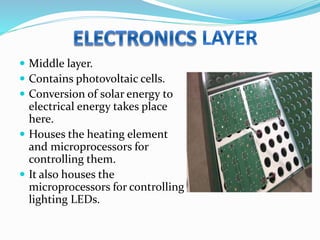
 Middle layer.
 Contains photovoltaic cells.
 Conversion of solar energy to
electrical energy takes place
here.
 Houses the heating element
and microprocessors for
controlling them.
 It also houses the
microprocessors for controlling
lighting LEDs.
Base Plate layer
 Bottom layer.
 Stores the converted
electrical energy.
 Distributes electrical
energy.
 Made weatherproof.
How it Works?
ADVANTAGES
DISADVANTAGES
Features of Solar Roadways
(a) Accident can be avoided
:
 The roadways can protect
wildlife and motorists.
 The load cells in the solar
panels can detect if
something is on the surface
of the panel. It acts like a
weigh machine.
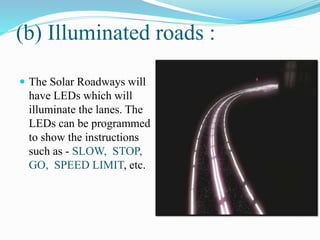
(b) Illuminated roads :
 The Solar Roadways will
have LEDs which will
illuminate the lanes. The
LEDs can be programmed
to show the instructions
such as - SLOW, STOP,
GO, SPEED LIMIT, etc.
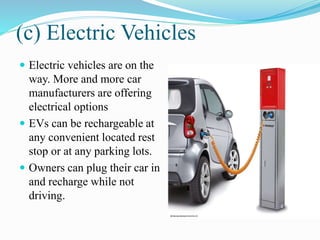
(c) Electric Vehicles
 Electric vehicles are on the
way. More and more car
manufacturers are offering
electrical options
 EVs can be rechargeable at
any convenient located rest
stop or at any parking lots.
 Owners can plug their car in
and recharge while not
driving.
(d) Snow/ ICE Management :
 The roads heat
themselves with
their embedded
heating elements
and melt away all
the snow.
(e) Improved power lines
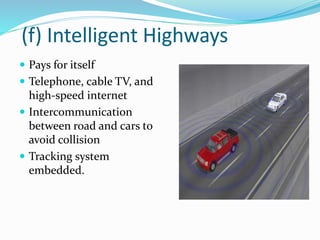
(f) Intelligent Highways
 Pays for itself
 Telephone, cable TV, and
high-speed internet
 Intercommunication
between road and cars to
avoid collision
 Tracking system
embedded.
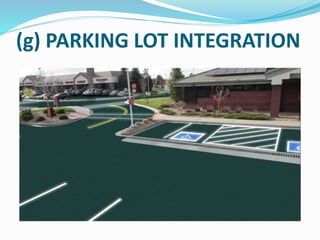
(g) PARKING LOT INTEGRATION
Future Scope
 With the provision of initial investment it can be carried
forward.
 Increased energy requirement in future can only be met
with renewable resources of energy, such as that obtained
from solar roadways.
 To reduce the consumption of fossil fuel and to eliminate
global warming, the innovative idea of solar panel road is
inevitable.
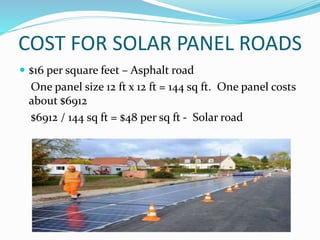
COST FOR SOLAR PANEL ROADS
 $16 per square feet – Asphalt road
One panel size 12 ft x 12 ft = 144 sq ft. One panel costs
about $6912
$6912 / 144 sq ft = $48 per sq ft - Solar road
CONCLUSION
 Even though the initial cost is high, as it is a system
that pays for itself it is a better choice.
 For under developed and developing countries, it
might seem impractical now. But it can be adopted in
stages, in future.
 With technological upgradation in this field, jobs,
clean energy and a safer transportation system can be
made.
THANK YOU
Solar panel roads ppt

Solar panel roads ppt

  • 1.
  • 2.
    CONTENTS  Introduction  SolarRoad Construction  Working Principle  How it Works?  Advantages & disadvantages  Features  Future Scope  Conclusion  References
  • 3.
    INVENTORS OF SOLARROADWAYS Julie & Scott Brusaw
  • 4.
    INTRODUCTION  In 2009,the innovative idea of Solar Panel Roads was proposed.  In 2010, company named SOLAR ROADWAYS was established.  Location : Idaho, US.  Funded by US federal government.  Aim : to replace current asphalt roads with solar panel roads.
  • 5.
    The idea isto replace all current petroleum based asphalt roads, parking lots, and driveways with Solar Road Panels that collect energy to be used by our homes and businesses. The ultimate goal is to store excess energy in or along-side the Solar Roadways.
  • 6.
    Solar Road Construction PHOTOVOLTAICCELL  Photovoltaic cells are used to convert solar energy directly into electricity using semiconductors. This is the active type of solar technology
  • 8.
    Road consists of3 layers. I. Road Surface Layer II. Electronics Layer III. Base Layer
  • 9.
    Road Surface Layer Translucent and high-strength.  Designed for reduced skidding chances  Weatherproof.
  • 10.
     Embedded with LEDsand a heating element  Tested for traction, load carrying capacity & impact resistance and exceeded all requirements
  • 11.
     Middle layer. Contains photovoltaic cells.  Conversion of solar energy to electrical energy takes place here.  Houses the heating element and microprocessors for controlling them.  It also houses the microprocessors for controlling lighting LEDs.
  • 12.
    Base Plate layer Bottom layer.  Stores the converted electrical energy.  Distributes electrical energy.  Made weatherproof.
  • 13.
  • 15.
  • 16.
  • 17.
    Features of SolarRoadways (a) Accident can be avoided :  The roadways can protect wildlife and motorists.  The load cells in the solar panels can detect if something is on the surface of the panel. It acts like a weigh machine.
  • 18.
    (b) Illuminated roads:  The Solar Roadways will have LEDs which will illuminate the lanes. The LEDs can be programmed to show the instructions such as - SLOW, STOP, GO, SPEED LIMIT, etc.
  • 19.
    (c) Electric Vehicles Electric vehicles are on the way. More and more car manufacturers are offering electrical options  EVs can be rechargeable at any convenient located rest stop or at any parking lots.  Owners can plug their car in and recharge while not driving.
  • 20.
    (d) Snow/ ICEManagement :  The roads heat themselves with their embedded heating elements and melt away all the snow.
  • 21.
  • 22.
    (f) Intelligent Highways Pays for itself  Telephone, cable TV, and high-speed internet  Intercommunication between road and cars to avoid collision  Tracking system embedded.
  • 23.
    (g) PARKING LOTINTEGRATION
  • 24.
    Future Scope  Withthe provision of initial investment it can be carried forward.  Increased energy requirement in future can only be met with renewable resources of energy, such as that obtained from solar roadways.  To reduce the consumption of fossil fuel and to eliminate global warming, the innovative idea of solar panel road is inevitable.
  • 25.
    COST FOR SOLARPANEL ROADS  $16 per square feet – Asphalt road One panel size 12 ft x 12 ft = 144 sq ft. One panel costs about $6912 $6912 / 144 sq ft = $48 per sq ft - Solar road
  • 26.
    CONCLUSION  Even thoughthe initial cost is high, as it is a system that pays for itself it is a better choice.  For under developed and developing countries, it might seem impractical now. But it can be adopted in stages, in future.  With technological upgradation in this field, jobs, clean energy and a safer transportation system can be made.
  • 27.