Module 1:
Matter andMeasurement
Jessica Garber Morales
Tidewater Community College
CC-BY-SA-NC
2.
Objectives
• Define andapply the scientific method.
• Define and recognize the states of matter.
• Recognize and distinguish between pure substances and mixtures.
• Distinguish between physical and chemical changes.
• Perform calculations using numbers with SI units.
• Convert between base units and units containing prefixes.
• Recognize the temperature scales and convert between them.
• Convert numbers from regular notation to scientific notation.
• Perform calculations to the correct number of significant figures.
• Define accuracy and precision.
• Perform chemical calculations using dimensional analysis.
TCC iINCUR CHM 111 Syllabus
3.
Table of Contents
I)Introduction
A) The Study of Chemistry
II) Scientific Method
III) Classification of Matter
A) Three States of Matter
1) Solid
2) Liquid
3) Gas
B) Classification of Matter: Pure Substances vs. Mixtures
1) Pure Substances
(a) Elements and Compounds
2) Mixtures
(a) Homogeneous
(b) Heterogeneous
IV) Physical and Chemical Properties of Matter
A) Physical and Chemical Properties of Matter
B) Physical and Chemical Changes of Matter
V) Units of Measurement
A) Standard Units (SI Units)
B) SI Unit Prefixes
C) Derived Units:
1) Density
D) Temperature
VI) Measurement Uncertainty
A) Scientific Notation
B) Significant Figures
1) Rules for Assigning
2) Calculations With
C) Accuracy, Precision and Error
VII) Dimensional Analysis
A) Converting from One Unit to Another
B) Strategy for General Problem Solving
4.
Introduction: The Studyof Chemistry
• Chemistry is the science of matter,
especially its chemical reactions, but
also its composition, structure and
properties.
Definition: Boundless.com 2014 CC-BY-SA 3.0
5.
Introduction: The Studyof Chemistry
• Study of matter
–Anything that has mass and takes up space
–Made up of tiny particles called atoms
–Atoms combine together to form molecules
–When enough molecules are present, we
can see them.
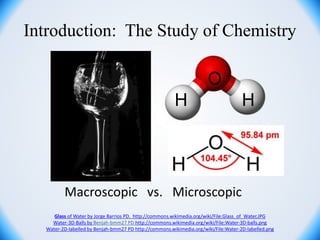
• Macroscopic vs. microscopic
6.
Macroscopic vs. Microscopic
Introduction:The Study of Chemistry
Glass of Water by Jorge Barrios PD. http://commons.wikimedia.org/wiki/File:Glass_of_Water.JPG
Water-3D-Balls by Benjah-bmm27 PD http://commons.wikimedia.org/wiki/File:Water-3D-balls.png
Water-2D-labelled by Benjah-bmm27 PD http://commons.wikimedia.org/wiki/File:Water-2D-labelled.png
O
H H
Scientific Method
• Allscientists:
–Gather and categorize information
–Continually question the world and
what we think we know
–Follow a specific process
9.
Scientific Method
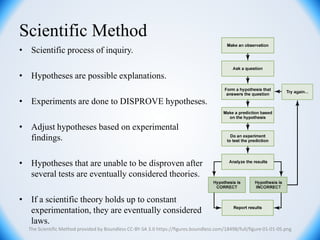
• Scientificprocess of inquiry.
• Hypotheses are possible explanations.
• Experiments are done to DISPROVE hypotheses.
• Adjust hypotheses based on experimental
findings.
• Hypotheses that are unable to be disproven after
several tests are eventually considered theories.
• If a scientific theory holds up to constant
experimentation, they are eventually considered
laws.
The Scientific Method provided by Boundless CC-BY-SA 3.0 https://figures.boundless.com/18498/full/figure-01-01-05.png
10.
Concept Quiz
• Whyis it important to try and
disprove (rather than prove) your
hypothesis?
Classification of Matter
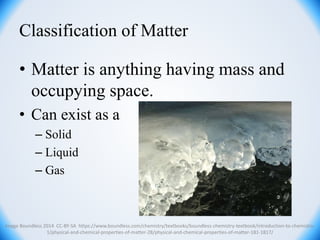
•Matter is anything having mass and
occupying space.
• Can exist as a
– Solid
– Liquid
– Gas
Image Boundless 2014 CC-BY-SA https://www.boundless.com/chemistry/textbooks/boundless-chemistry-textbook/introduction-to-chemistry-
1/physical-and-chemical-properties-of-matter-28/physical-and-chemical-properties-of-matter-181-1817/
15.
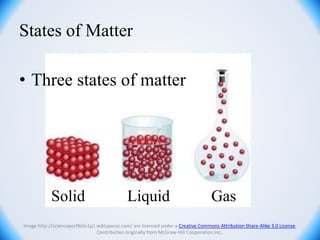
States of Matter
•Three states of matter
Solid Liquid Gas
Image http://scienceportfolio1p1.wikispaces.com/ are licensed under a Creative Commons Attribution Share-Alike 3.0 License.
Contribution originally from McGraw-Hill Cooperation Inc,.
16.
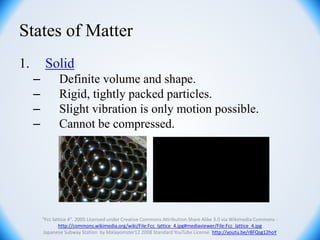
States of Matter
1.Solid
– Definite volume and shape.
– Rigid, tightly packed particles.
– Slight vibration is only motion possible.
– Cannot be compressed.
"Fcc lattice 4". 2005 Licensed under Creative Commons Attribution-Share Alike 3.0 via Wikimedia Commons -
http://commons.wikimedia.org/wiki/File:Fcc_lattice_4.jpg#mediaviewer/File:Fcc_lattice_4.jpg
Japanese Subway Station by Malayomster12 2008 Standard YouTube License http://youtu.be/r8FQsg12hoY
17.
States of Matter
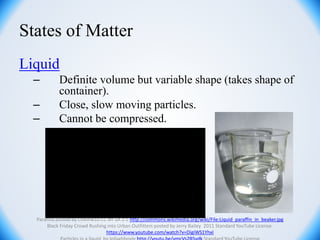
Liquid
–Definite volume but variable shape (takes shape of
container).
– Close, slow moving particles.
– Cannot be compressed.
Parafina posted by Chemik10 CC-BY-SA 2.5 http://commons.wikimedia.org/wiki/File:Liquid_paraffin_in_beaker.jpg
Black Friday Crowd Rushing into Urban Outfitters posted by Jerry Bailey 2011 Standard YouTube License.
https://www.youtube.com/watch?v=DigiWS1YhxI
18.
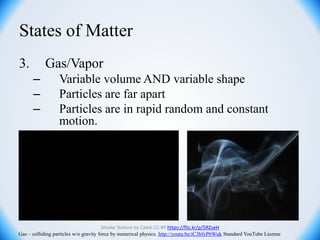
3. Gas/Vapor
– Variablevolume AND variable shape
– Particles are far apart
– Particles are in rapid random and constant
motion.
–
States of Matter
Smoke Texture by Caleb CC-BY https://flic.kr/p/5RZseH
Gas – colliding particles w/o gravity force by numerical physics. http://youtu.be/iC3bfyP6Wuk Standard YouTube License
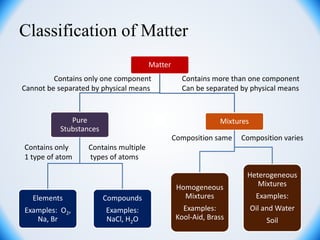
Classification of Matter
Mattercan be either
1. Pure Substances
Can only be split apart by chemical
methods
2. Mixtures
Can be separated by physical
means
21.
Pure Substances
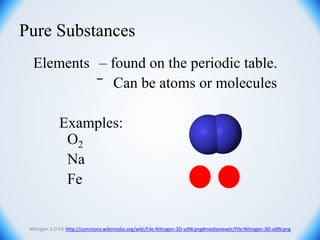
Elements –found on the periodic table.
‾ Can be atoms or molecules
Examples:
O2
Na
Fe
Nitrogen 3-D PD http://commons.wikimedia.org/wiki/File:Nitrogen-3D-vdW.png#mediaviewer/File:Nitrogen-3D-vdW.png
22.
Pure Substances
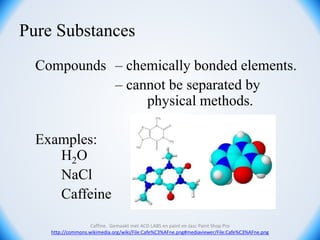
Compounds –chemically bonded elements.
– cannot be separated by
physical methods.
Examples:
H2O
NaCl
Caffeine
Caffine. Gemaakt met ACD LABS en paint en Jasc Paint Shop Pro
http://commons.wikimedia.org/wiki/File:Cafe%C3%AFne.png#mediaviewer/File:Cafe%C3%AFne.png
23.
Mixtures
Mixtures
• Physically mixedbut not chemically
combined.
• Combination of more than one
substance.
• Can be either homogeneous or
heterogeneous.
24.
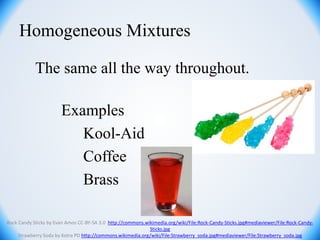
The same allthe way throughout.
Examples
Kool-Aid
Coffee
Brass
Homogeneous Mixtures
Rock Candy Sticks by Evan Amos CC-BY-SA 3.0 http://commons.wikimedia.org/wiki/File:Rock-Candy-Sticks.jpg#mediaviewer/File:Rock-Candy-
Sticks.jpg
Strawberry Soda by Kotra PD http://commons.wikimedia.org/wiki/File:Strawberry_soda.jpg#mediaviewer/File:Strawberry_soda.jpg
Classification of Matter
Matter
Pure
Stubstances
Elements
Examples:O2,
Na, Br
Compounds
Examples:
NaCl, H2O
Mixtures
Homogeneous
Mixtures
Examples:
Kool-Aid, Brass
Heterogeneous
Mixtures
Examples:
Oil and Water
Soil
Contains only one component Contains more than one component
Cannot be separated by physical means Can be separated by physical means
Contains only Contains multiple
1 type of atom types of atoms
Composition same Composition varies
27.
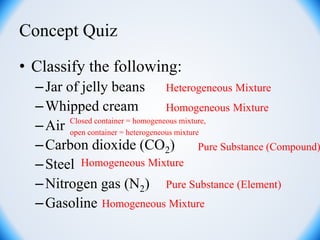
Concept Quiz
• Classifythe following:
–Jar of jelly beans
–Whipped cream
–Air
–Carbon dioxide (CO2)
–Steel
–Nitrogen gas (N2)
–Gasoline
Heterogeneous Mixture
Homogeneous Mixture
Closed container = homogeneous mixture,
open container = heterogeneous mixture
Pure Substance (Compound)
Homogeneous Mixture
Pure Substance (Element)
Homogeneous Mixture
28.
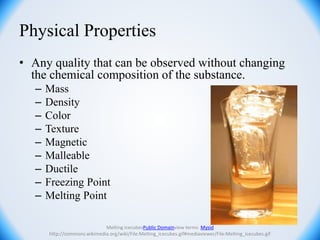
Physical Properties
• Anyquality that can be observed without changing
the chemical composition of the substance.
– Mass
– Density
– Color
– Texture
– Magnetic
– Malleable
– Ductile
– Freezing Point
– Melting Point
Melting icecubesPublic Domainview terms Mysid
http://commons.wikimedia.org/wiki/File:Melting_icecubes.gif#mediaviewer/File:Melting_icecubes.gif
29.
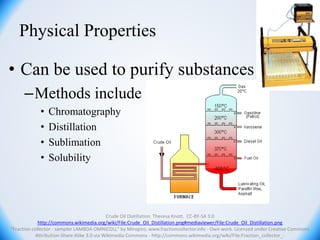
Physical Properties
• Canbe used to purify substances
–Methods include
• Chromatography
• Distillation
• Sublimation
• Solubility
Crude Oil Distillation Theresa Knott. CC-BY-SA 3.0
http://commons.wikimedia.org/wiki/File:Crude_Oil_Distillation.png#mediaviewer/File:Crude_Oil_Distillation.png
"Fraction collector - sampler LAMBDA OMNICOLL" by Miropiro, www.fractioncollector.info - Own work. Licensed under Creative Commons
Attribution-Share Alike 3.0 via Wikimedia Commons - http://commons.wikimedia.org/wiki/File:Fraction_collector_-
30.
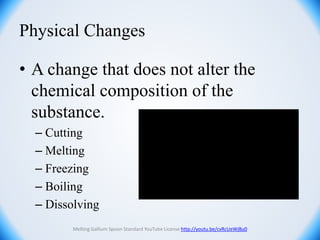
Physical Changes
• Achange that does not alter the
chemical composition of the
substance.
– Cutting
– Melting
– Freezing
– Boiling
– Dissolving
Melting Gallium Spoon Standard YouTube License http://youtu.be/cvRcUeWjBu0
31.
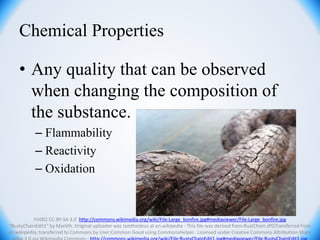
Chemical Properties
• Anyquality that can be observed
when changing the composition of
the substance.
– Flammability
– Reactivity
– Oxidation
Fir002 CC-BY-SA 3.0 http://commons.wikimedia.org/wiki/File:Large_bonfire.jpg#mediaviewer/File:Large_bonfire.jpg
"RustyChainEdit1" by Marlith. Original uploader was Iamthedeus at en.wikipedia - This file was derived from:RustChain.JPGTransferred from
en.wikipedia; transferred to Commons by User:Common Good using CommonsHelper.. Licensed under Creative Commons Attribution-Share
32.
Chemical Changes
• Achange that does alters the
chemical composition of the
substance.
• Changes it to a new substance.
– Burning
– Oxidizing
– Reacting
33.
Concept Quiz
• Classifythe following as physical or chemical:
– A log burns in the campfire.
– Toasting marshmallows.
– You dissolve sugar in your tea.
– You boil water.
– Cooking pasta.
– A raft floats in the pool.
34.
Units of Measurement
•One type of scientific observation is a measurement.
– Contains quantitative AND qualitative parts:
• Number
• Unit
• Examples:
– 1.2 meters
– 45 years old
– 3.0 x 10⁸ meters per second
35.
SI Units
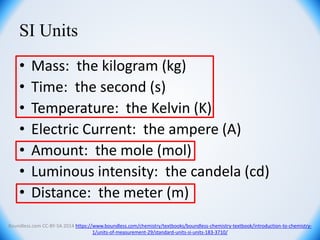
• Mass:the kilogram (kg)
• Time: the second (s)
• Temperature: the Kelvin (K)
• Electric Current: the ampere (A)
• Amount: the mole (mol)
• Luminous intensity: the candela (cd)
• Distance: the meter (m)
Boundless.com CC-BY-SA 2014 https://www.boundless.com/chemistry/textbooks/boundless-chemistry-textbook/introduction-to-chemistry-
1/units-of-measurement-29/standard-units-si-units-183-3710/
36.
SI Units
Earth MoonScale 2014 CC-BY BlueDharma https://flic.kr/p/8T7qf
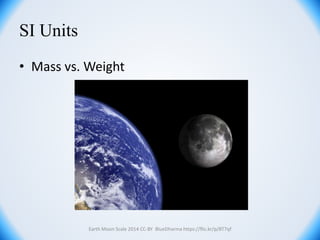
• Mass vs. Weight
37.
Concept Quiz
• Whatis the SI unit for
– Mass?
– Temperature?
– Time?
– Distance?
– Amount?
38.
SI Unit Prefixes
MetricPrefixes CC-BY-NC 3.0 2014 http://www.ck12.org/chemistry/Metric-Prefixes/lesson/Metric-Prefixes/
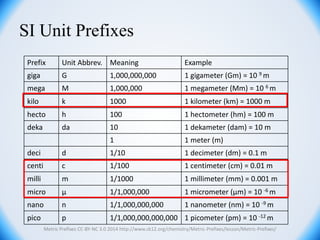
Prefix Unit Abbrev. Meaning Example
giga G 1,000,000,000 1 gigameter (Gm) = 10 9 m
mega M 1,000,000 1 megameter (Mm) = 10 6 m
kilo k 1000 1 kilometer (km) = 1000 m
hecto h 100 1 hectometer (hm) = 100 m
deka da 10 1 dekameter (dam) = 10 m
1 1 meter (m)
deci d 1/10 1 decimeter (dm) = 0.1 m
centi c 1/100 1 centimeter (cm) = 0.01 m
milli m 1/1000 1 millimeter (mm) = 0.001 m
micro μ 1/1,000,000 1 micrometer (μm) = 10 -6 m
nano n 1/1,000,000,000 1 nanometer (nm) = 10 -9 m
pico p 1/1,000,000,000,000 1 picometer (pm) = 10 -12 m
39.
Derived Units
• Usetwo or more units to have a new
unit type
–Speed (m/s)
–Density (g/mL)
40.
Density
• Density ofwater is 1.0 g/mL
– More dense: sink
– Less Dense: Float
Amazing 9 Layer Density Column by Sick Science Standard YouTube License http://youtu.be/-CDkJuo_LYs
41.
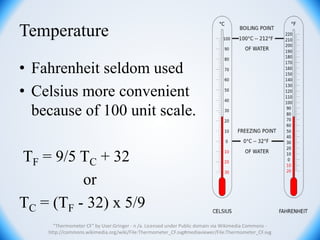
Temperature
• Fahrenheit seldomused
• Celsius more convenient
because of 100 unit scale.
TF = 9/5 TC + 32
or
TC = (TF - 32) x 5/9
"Thermometer CF" by User:Gringer - n /a. Licensed under Public domain via Wikimedia Commons -
http://commons.wikimedia.org/wiki/File:Thermometer_CF.svg#mediaviewer/File:Thermometer_CF.svg
42.
Temperature
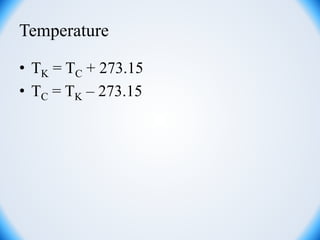
• Absolute 0
–Neither scale accounts for a
temperature with NO heat or
movement.
– Needed a scientific scale.
– Kelvin—the SI unit (preferred
by science).
– 0 K = -273.15 C
By Zureks (Own work) [CC-BY-SA-3.0 (http://creativecommons.org/licenses/by-sa/3.0) or GFDL (http://www.gnu.org/copyleft/fdl.html)], via
Wikimedia Commons
Concept Quiz
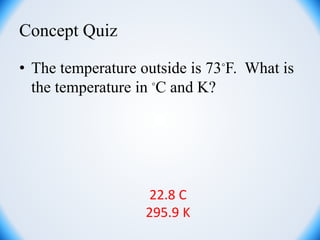
• Thetemperature outside is 73◦F. What is
the temperature in ◦C and K?
22.8 C
295.9 K
45.
Concept Quiz
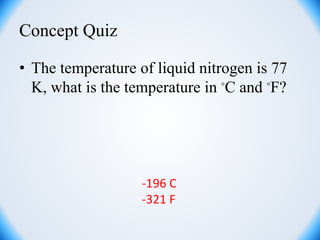
• Thetemperature of liquid nitrogen is 77
K, what is the temperature in ◦C and ◦F?
-196 C
-321 F
46.
Significant Figures
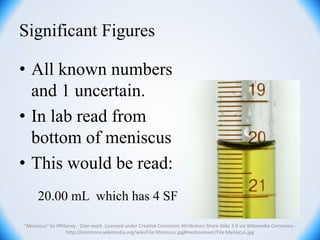
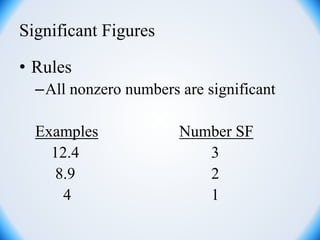
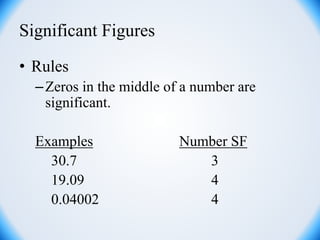
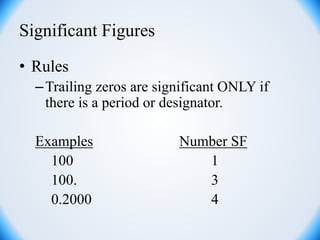
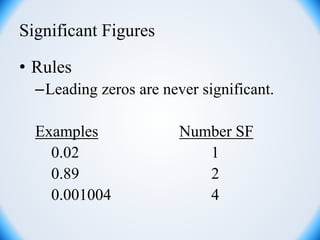
• Allknown numbers
and 1 uncertain.
• In lab read from
bottom of meniscus
• This would be read:
"Meniscus" by PRHaney - Own work. Licensed under Creative Commons Attribution-Share Alike 3.0 via Wikimedia Commons -
http://commons.wikimedia.org/wiki/File:Meniscus.jpg#mediaviewer/File:Meniscus.jpg
20.00 mL which has 4 SF
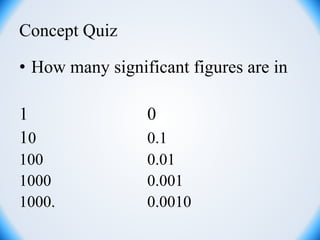
Concept Quiz
• Howmany significant figures are in
1 0
10 0.1
100 0.01
1000 0.001
1000. 0.0010
52.
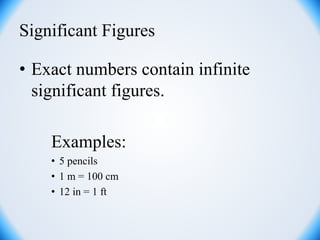
Significant Figures
• Exactnumbers contain infinite
significant figures.
Examples:
• 5 pencils
• 1 m = 100 cm
• 12 in = 1 ft
53.
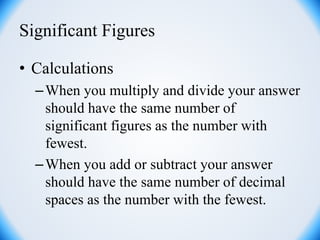
Significant Figures
• Calculations
–Whenyou multiply and divide your answer
should have the same number of
significant figures as the number with
fewest.
–When you add or subtract your answer
should have the same number of decimal
spaces as the number with the fewest.
54.
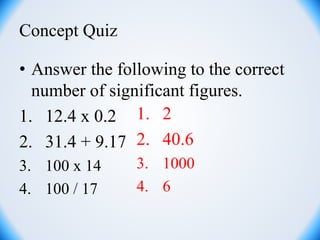
Concept Quiz
• Answerthe following to the correct
number of significant figures.
1. 12.4 x 0.2
2. 31.4 + 9.17
3. 100 x 14
4. 100 / 17
1. 2
2. 40.6
3. 1000
4. 6
55.
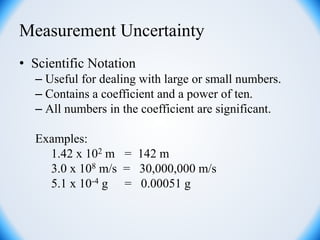
Measurement Uncertainty
• ScientificNotation
– Useful for dealing with large or small numbers.
– Contains a coefficient and a power of ten.
– All numbers in the coefficient are significant.
Examples:
1.42 x 10² m = 142 m
3.0 x 10⁸ m/s = 30,000,000 m/s
5.1 x 10⁻⁴ g = 0.00051 g
56.
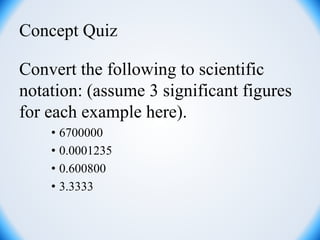
Concept Quiz
Convert thefollowing to scientific
notation: (assume 3 significant figures
for each example here).
• 6700000
• 0.0001235
• 0.600800
• 3.3333
57.
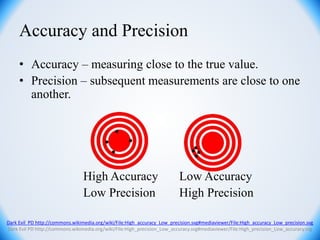
Accuracy and Precision
•Accuracy – measuring close to the true value.
• Precision – subsequent measurements are close to one
another.
High Accuracy Low Accuracy
Low Precision High Precision
Dark Evil PD http://commons.wikimedia.org/wiki/File:High_accuracy_Low_precision.svg#mediaviewer/File:High_accuracy_Low_precision.svg
Dark Evil PD http://commons.wikimedia.org/wiki/File:High_precision_Low_accuracy.svg#mediaviewer/File:High_precision_Low_accuracy.svg
58.
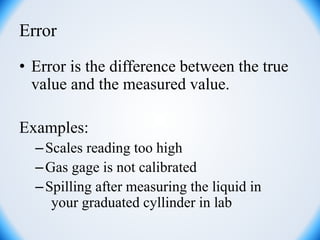
Error
• Error isthe difference between the true
value and the measured value.
Examples:
–Scales reading too high
–Gas gage is not calibrated
–Spilling after measuring the liquid in
your graduated cyllinder in lab
59.
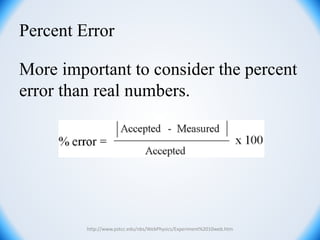
Percent Error
More importantto consider the percent
error than real numbers.
http://www.pstcc.edu/nbs/WebPhysics/Experiment%2010web.htm
60.
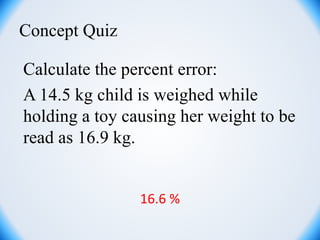
Concept Quiz
Calculate thepercent error:
A 14.5 kg child is weighed while
holding a toy causing her weight to be
read as 16.9 kg.
16.6 %
61.
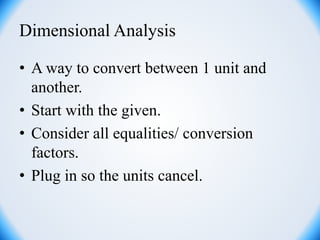
Dimensional Analysis
• Away to convert between 1 unit and
another.
• Start with the given.
• Consider all equalities/ conversion
factors.
• Plug in so the units cancel.
62.
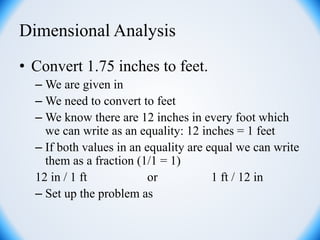
Dimensional Analysis
• Convert1.75 inches to feet.
– We are given in
– We need to convert to feet
– We know there are 12 inches in every foot which
we can write as an equality: 12 inches = 1 feet
– If both values in an equality are equal we can write
them as a fraction (1/1 = 1)
12 in / 1 ft or 1 ft / 12 in
– Set up the problem as
63.
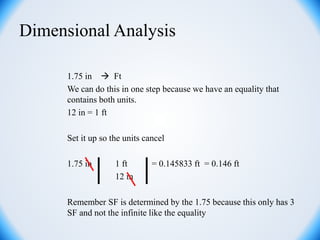
Dimensional Analysis
1.75 in Ft
We can do this in one step because we have an equality that
contains both units.
12 in = 1 ft
Set it up so the units cancel
1.75 in 1 ft = 0.145833 ft = 0.146 ft
12 in
Remember SF is determined by the 1.75 because this only has 3
SF and not the infinite like the equality
Problem Solving
• Rememberto always make a plan.
• Consider the starting and ending units.
• Make a list of equalities or conversion
factors going to be used.
• Make sure your units are written so they
cancel.
• DO NOT skip these steps.
Editor's Notes
#45 TC = (73-32)(5/9) = 22.8 C
TK = 22.8 +273.15 = 295.9 K
#46 TC = 77 -273 = -196 C
TF = (9/5)(-196) +32 = -321 F
#55 0.2 has 1 sig fig (round down)
31.4 only has 1 decimal space
100 only has 1 sig fig (round down)
100 only has 1 sig fig (round up)
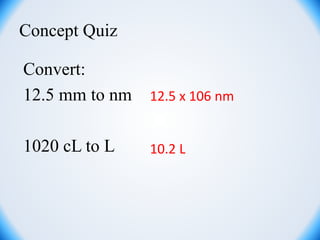
#65 12.5 mm (1 m/ 1000 mm)(10^9 nm/ 1 m) = 12.5 x 10^6 nm
1020 cL (1L / 100 cL) = 10.2 cL (only 3 sig figs are in 1020)
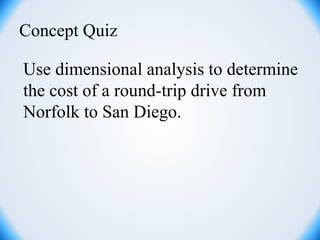
#66 Depends on the units you use: Should be set up as
Miles (gallon / miles) ($ / gallon) =
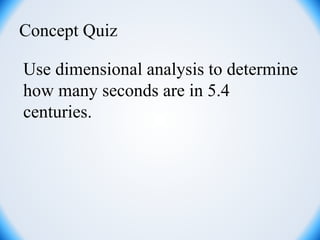
#67 5.4 centuries (100 years / 1 century) (365 days / 1 year) (24 hours / 1 day) (60 minutes / 1 hour) (60 seconds / 1 minute).
Notes that it does not matter whether you use 365 or 365.25 days in a year because the significant figures of 5.4 is what limits the answer. All other conversions are considered “exact” conversions.
![Temperature
• Absolute 0
– Neither scale accounts for a
temperature with NO heat or
movement.
– Needed a scientific scale.
– Kelvin—the SI unit (preferred
by science).
– 0 K = -273.15 C
By Zureks (Own work) [CC-BY-SA-3.0 (http://creativecommons.org/licenses/by-sa/3.0) or GFDL (http://www.gnu.org/copyleft/fdl.html)], via
Wikimedia Commons](https://image.slidesharecdn.com/module1-150611170715-lva1-app6892/85/Matter-and-Measurement-42-320.jpg)