TICS,
DYSTONIA,
CHOREA,
WILSONโ€™S
DISEASE,
ESSENTIAL
TREMORS
Presented by:
Miss. Shweta Sharma
M.Sc. Nursing
II Year
INTRODUCTION
โ€ขPhysiological movements or normal movements are the natural
movements that occur in human joints. They are also known as
osteokinematic movements.
โ€ขThe study of these movements is known as kinesiology.
โ€ขThe term "movement disorders" refers to a group of nervous
system (neurological) conditions that cause abnormal increased
movements, which may be voluntary or involuntary. Movement
disorders can also cause reduced or slow movements.
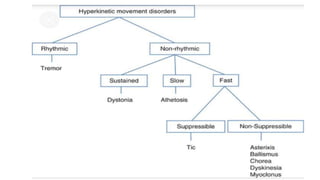
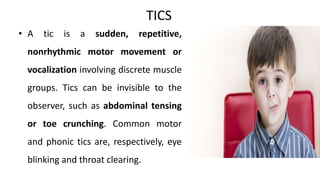
TICS
โ€ข A tic is a sudden, repetitive,
nonrhythmic motor movement or
vocalization involving discrete muscle
groups. Tics can be invisible to the
observer, such as abdominal tensing
or toe crunching. Common motor
and phonic tics are, respectively, eye
blinking and throat clearing.
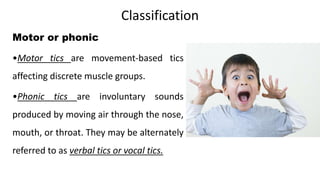
Classification
Motor or phonic
โ€ขMotor tics are movement-based tics
affecting discrete muscle groups.
โ€ขPhonic tics are involuntary sounds
produced by moving air through the nose,
mouth, or throat. They may be alternately
referred to as verbal tics or vocal tics.
Simple or complex
โ€ขSimple motor tics are typically sudden, brief, meaningless movements
that usually involve only one group of muscles, such as eye blinking,
head jerking, or shoulder shrugging. Motor tics can be of an endless
variety and may include such movements as hand clapping, neck
stretching, mouth movements, head, arm or leg jerks, and facial
grimacing.
โ€ขA simple phonic tic can be almost any sound or noise, with common
vocal tics being throat clearing, sniffing, or grunting.
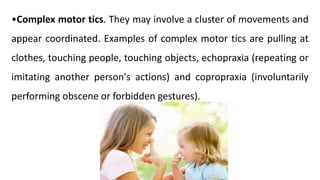
โ€ขComplex motor tics. They may involve a cluster of movements and
appear coordinated. Examples of complex motor tics are pulling at
clothes, touching people, touching objects, echopraxia (repeating or
imitating another person's actions) and copropraxia (involuntarily
performing obscene or forbidden gestures).
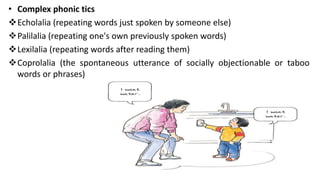
โ€ข Complex phonic tics
๏ถEcholalia (repeating words just spoken by someone else)
๏ถPalilalia (repeating one's own previously spoken words)
๏ถLexilalia (repeating words after reading them)
๏ถCoprolalia (the spontaneous utterance of socially objectionable or taboo
words or phrases)
Etiology and pathophysiology
โ€ข Idiopathic
โ€ข Stress and sleep deprivation
โ€ข Certain medications, including
some used to treat attention
deficit hyperactivity disorder
โ€ข Some specific gene mutations
โ€ข Brain chemistry, especially the
brain chemicals glutamate,
serotonin, and dopamine.
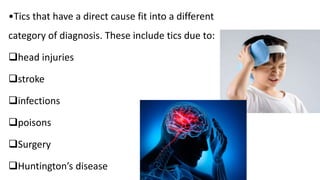
โ€ขTics that have a direct cause fit into a different
category of diagnosis. These include tics due to:
๏ฑhead injuries
๏ฑstroke
๏ฑinfections
๏ฑpoisons
๏ฑSurgery
๏ฑHuntingtonโ€™s disease
Characteristics
โ€ขTics may increase as a result of stress, fatigue, boredom, or high-
energy emotions, which can include negative emotions, such as
anxiety, as well as positive emotions, such as excitement or
anticipation.
โ€ขRelaxation may result in a tic increase (for instance, watching
television or using a computer), while concentration on an absorbing
activity often leads to a decrease in tics.
โ€ขImmediately preceding tic onset, most individuals are aware of an
urge that is similar to the need to yawn, sneeze, blink, or scratch an
itch.
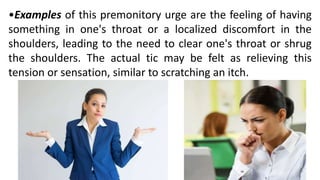
โ€ขExamples of this premonitory urge are the feeling of having
something in one's throat or a localized discomfort in the
shoulders, leading to the need to clear one's throat or shrug
the shoulders. The actual tic may be felt as relieving this
tension or sensation, similar to scratching an itch.
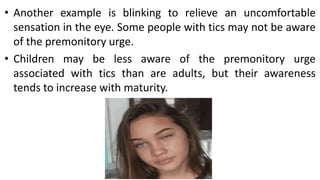
โ€ข Another example is blinking to relieve an uncomfortable
sensation in the eye. Some people with tics may not be aware
of the premonitory urge.
โ€ข Children may be less aware of the premonitory urge
associated with tics than are adults, but their awareness
tends to increase with maturity.
Diagnosis
โ€ข History collection and Physical examination
โ€ข The child must be under 18 at the onset of symptoms for a tic
disorder to be diagnosed. Also, the symptoms must not be
caused by other medical conditions or drugs.
โ€ข Transient tic disorder- presence of one or more tics, occurring for
less than 12 months in a row.
โ€ข Chronic motor or vocal tic disorders- one or more tics have
occurred almost daily for 12 months or more. People with a
chronic tic disorder that is not TS, will experience either motor
tics or vocal tics, but not both.
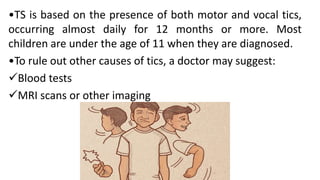
โ€ขTS is based on the presence of both motor and vocal tics,
occurring almost daily for 12 months or more. Most
children are under the age of 11 when they are diagnosed.
โ€ขTo rule out other causes of tics, a doctor may suggest:
๏ƒผBlood tests
๏ƒผMRI scans or other imaging
Treatment
Therapies for tic disorders
โ€ข Cognitive behavioral therapy
โ€ข Exposure and response prevention (ERP)
โ€ข Habit reversal therapy
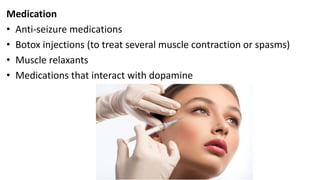
Medication
โ€ข Anti-seizure medications
โ€ข Botox injections (to treat several muscle contraction or spasms)
โ€ข Muscle relaxants
โ€ข Medications that interact with dopamine
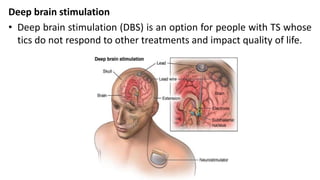
Deep brain stimulation
โ€ข Deep brain stimulation (DBS) is an option for people with TS whose
tics do not respond to other treatments and impact quality of life.
Coping and self-help tips
โ€ข avoiding stress and anxiety
โ€ข getting enough sleep
โ€ข join a support group for people with TS and other tic disorders
โ€ข reach out to friends and others for help and support
Parents of children with tics may wish to:
โ€ข inform teachers, caregivers, and others who know the child and
about the condition
โ€ข help boost the childโ€™s self-esteem by encouraging interests and
friendships
โ€ข ignore times when a tic occurs, and avoid pointing it out to the
child
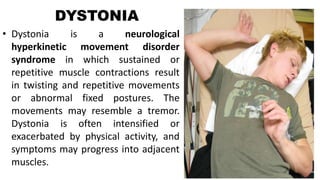
DYSTONIA
โ€ข Dystonia is a neurological
hyperkinetic movement disorder
syndrome in which sustained or
repetitive muscle contractions result
in twisting and repetitive movements
or abnormal fixed postures. The
movements may resemble a tremor.
Dystonia is often intensified or
exacerbated by physical activity, and
symptoms may progress into adjacent
muscles.
โ€ข Primary dystonia is suspected when the dystonia is the only sign
and there is no identifiable cause or structural abnormality in the
central nervous system.
โ€ข Secondary dystonia refers to dystonia brought on by some
identified cause, such as head injury, drug side effect (e.g. tardive
dystonia), or neurological disease (e.g. Wilson's disease).
โ€ข Meningitis and encephalitis caused by viral, bacterial, and fungal
infections of the brain have been associated with dystonia.
Etiology and pathophysiology
โ€ข Environmental and task-related factors are suspected to trigger the
development of focal dystonias because they appear disproportionately
in individuals who perform high precision hand movements such as
musicians, engineers, architects, and artists.
โ€ข Chlorpromazine can also cause dystonia, which can be often misjudged
as a seizure. Neuroleptic drugs often cause dystonia, including
oculogyric crisis.
โ€ข Malfunction of the sodium-potassium pump may be a factor in some
dystonias.
Classification
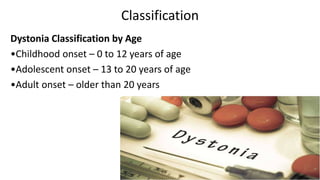
Dystonia Classification by Age
โ€ขChildhood onset โ€“ 0 to 12 years of age
โ€ขAdolescent onset โ€“ 13 to 20 years of age
โ€ขAdult onset โ€“ older than 20 years
Dystonia Classification by Body Part
1.Focal Dystonia
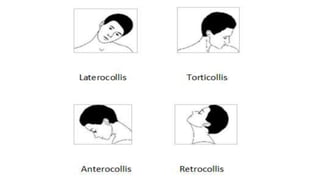
โ€ข Neck (cervical dystonia or spasmodic torticollis)
โ€ข Eyes (blepharospasm)
โ€ข Jaw/mouth/lower face (oromandibular dystonia)
โ€ข Vocal cords (laryngeal dystonia)
โ€ข Arms/legs (limb dystonia)
โ€ข Unusual stretching, bending or twisting of the trunk (truncal
dystonia)
โ€ข Sustained contractions and involuntary, writhing movements of
the abdominal wall (abdominal wall dystonia)
2.Segmental Dystonia
Segmental dystonia affects two or more parts of the body that are
adjacent or close to one another. A common form of segmental
dystonia affects the eyelids, jaw, mouth and lower face.
Other types of dystonia include multifocal, which involves two or
more body parts distant from one another; hemi dystonia, which
affects half of the body; and generalized, which begins with leg
involvement, but generally spreads to one or more additional
regions of the body.
Dystonia Classification by Cause
1.Primary (idiopathic)
Primary (idiopathic) dystonia is the only sign, and secondary causes
have been ruled out. Most primary dystonias are variable, have adult
onset, and are focal or segmental in nature. However, there are
specific primary dystonias with childhood or adolescent onset that
have been linked to genetic mutations.
2.Secondary (symptomatic)
Secondary (symptomatic) results primarily from secondary causes.
These include environmental, such as exposure to carbon monoxide,
cyanide, manganese or methanol; underlying conditions and
diseases such as brain tumors, cerebral palsy, Parkinsonโ€™s disease,
stroke, multiple sclerosis, hypoparathyroidism or vascular
malformations; brain/spinal cord injuries; inflammatory, infectious or
postinfectious brain conditions; and specific medications.
3.Heredodegenerative Dystonia
Heredodegenerative dystonia generally results from neurodegenerative
disorders in which other neurological symptoms are present and in which
heredity plays a role. These include numerous disorders such as certain X-
linked recessive, autosomal dominant, autosomal recessive and/or
parkinsonian syndromes. Included in this category: X-linked dystonia-
parkinsonism (Lubag), Huntington's disease, Wilson's disease,
neuroacanthocytosis, Rettโ€™s syndrome, Parkinson's disease and juvenile
parkinsonism.
Signs and symptoms
โ€ข Abnormal posturing, in particular on movement
โ€ข Continuous pain, cramping, and relentless muscle spasms due to
involuntary muscle movements
โ€ข Possible including lip smacking.
โ€ข Loss of precision muscle coordination (sometimes first
manifested in declining penmanship, frequent small injuries to
the hands, and dropped items), cramping pain with sustained
use, and trembling.
โ€ข It may become difficult to find a comfortable position for arms
and legs with even the minor exertions associated with holding
arms crossed causing significant pain similar to restless leg
syndrome.
โ€ข Affected persons may notice trembling in the diaphragm while
breathing, or the need to place hands in pockets, under legs
while sitting or under pillows while sleeping to keep them still
and to reduce pain.
โ€ข Trembling in the jaw may be felt and heard while lying down,
and the constant movement to avoid pain may result in the
grinding and wearing down of teeth, or symptoms similar to
temporomandibular joint disorder.
โ€ข The voice may crack frequently or become harsh,
triggering frequent throat clearing. Swallowing can
become difficult and accompanied by painful cramping.
โ€ข Disturbed sleep patterns, exhaustion, mood swings,
depression, mental stress, difficulty concentrating, blurred
vision, digestive problems, and short temper.
Diagnosis
โ€ข Medical history and physical examination.
โ€ข Blood or urine tests
โ€ข MRI or CT scan
โ€ข Electromyography (EMG)
โ€ข Genetic testing
Treatment
Therapy
โ€ข Physical therapy or occupational therapy or both to help ease
symptoms and improve function.
โ€ข Speech therapy if dystonia affects voice.
โ€ข Stretching or massage to ease muscle pain.
โ€ข Reducing stress, getting plenty of rest and relaxation techniques.
โ€ข Therapeutic exercise, soft tissue and joint mobilization, postural
training and bracing, neuromuscular electrical stimulation,
environmental modification, and gait training.
Medication
โ€ข Injections of botulinum toxin (Botox).Injections are usually
repeated every three to four months.
โ€ข Carbidopa-levodopa (Duopa). This medication can increase levels
of the neurotransmitter dopamine.
โ€ข Trihexyphenidyl and benztropine (Cogentin). These two
medications act on neurotransmitters other than dopamine.
โ€ข Tetrabenazine (Xenazine) and deutetrabenazine (Austedo). These
two medications block dopamine.
โ€ข Diazepam (Valium), clonazepam (Klonopin) and baclofen (Lioresal,
Gablofen). These medications reduce neurotransmission and
might help some forms of dystonia.
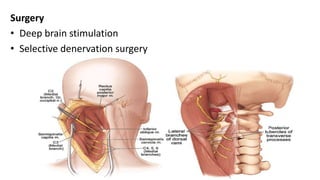
Surgery
โ€ข Deep brain stimulation
โ€ข Selective denervation surgery
CHOREA
โ€ข Chorea (or choreia) is an abnormal involuntary movement
disorder, one of a group of neurological disorders called
dyskinesias. The term chorea is derived from the Ancient Greek
word โ€œฯ‡ฮฟฯฮตฮฏฮฑโ€ which means dance, as the quick movements of the
feet or hands are comparable to dancing.
โ€ข The term hemichorea refers to chorea of one side of the body.
Causes
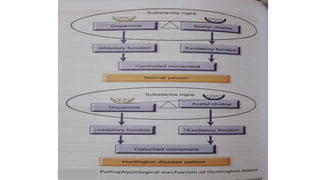
Huntington's disease
โ€ข Huntington's disease is a chronic, progressive, neurodegenerative
disease and most common inherited cause of chorea. The condition
was formerly called Huntington's chorea but was renamed because of
the important non-choreic features including cognitive decline and
behavioural change.
โ€ข A genetic mutation in Huntington disease, the presence of a repeat in
the Huntington gene (HTT), has been identified.
Other genetic causes
โ€ข The classical Huntington's disease 'mimic' or phenocopy
syndromes, called Huntington's disease-like syndrome types 1, 2
and 3; inherited prion disease, the spinocerebellar ataxias type 1,
3 and 17, neuroacanthocytosis, dentatorubral-pallidoluysian
atrophy (DRPLA), brain iron accumulation disorders, Wilson's
disease, benign hereditary chorea, Friedreich's ataxia,
mitochondrial disease and Rett syndrome.
Acquired causes
โ€ข Cerebrovascular disease
โ€ข HIV infectionโ€”usually through its association with cryptococcal disease.
โ€ข Sydenham's chorea occurs as a complication of streptococcal infection.
โ€ข Chorea gravidarum refers to choreic symptoms that occur during
pregnancy.
โ€ข Chorea may also be caused by drugs (commonly levodopa, anti-
convulsants and anti-psychotics).
โ€ข Other acquired causes include CSF leak, systemic lupus erythematosus,
thyrotoxicosis, polycythaemia rubra vera, transmissible spongiform
encephalopathies and coeliac disease.
Sign and symptoms
โ€ขBrief, semi-directed, irregular movements that are not repetitive or
rhythmic, but appear to flow from one muscle to the next. These 'dance-
like' movements of chorea often occur with athetosis, which adds twisting
and writhing movements. Walking may become difficult, and include odd
postures and leg movements.
โ€ขUnlike ataxia, which affects the quality of voluntary movements, or
Parkinsonism, which is a hindrance of voluntary movements, the
movements of chorea and ballism occur on their own, without conscious
effort. Thus, chorea is said to be a hyperkinetic movement disorder.
โ€ขWhen chorea is serious, slight movements will become thrashing
motions; this form of severe chorea is referred to as ballism, or ballismus.
Clinical Manifestations of Huntington chorea
(1)motor dysfunction (the most prominent is chorea, or rapid,
jerky, involuntary, purposeless movements)
(2) cognitive impairment (problems with attention and emotion
recognition)
(3) behavioral features, such as apathy and blunted affect
โ€ขAll of the body musculature is involved. Facial movements produce
tics and grimaces. Speech becomes slurred, hesitant, often explosive,
and eventually unintelligible. Chewing and swallowing are difficult,
and there is a constant danger of choking and aspiration.
โ€ขChoreiform movements persist during sleep but are diminished. As
with speech, the gait becomes disorganized to the point that
ambulation eventually is impossible.
Although independent ambulation should be encouraged for as long
as possible, a wheelchair usually becomes necessary.
โ€ขEventually, the patient is confined to bed when the chorea interferes
with walking, sitting, and all other activities. Bladder and bowel
control are lost.
โ€ขCognitive impairment, such as problems with attention emotion
recognition, occurs early on while in later stages, marked dementia is
present.
โ€ขThe behavioral changes may be more devastating to the patient and
family than the abnormal movements. Personality changes may result
in nervous, irritable, or impatient behaviors. In the early stages,
patients are particularly subject to uncontrollable fits of anger,
profound and often suicidal depression, apathy, anxiety, psychosis, or
euphoria.
โ€ข Judgment and memory are impaired, and dementia eventually
ensues. Hallucinations, delusions, and paranoid thinking may
precede the appearance of disjointed movements. Emotional
and cognitive symptoms often become less acute as the disease
progresses.
Diagnosis
โ€ขHistory taking- Family history
โ€ขPhysical examination
โ€ขCT and MRI- Shows symmetrical striatal atrophy before motor
symptoms appear.
โ€ขEEG
โ€ขSerological tests
โ€ขPeripheral blood smear
โ€ขGenetic testing- Known presence of the genetic marker CAG
repeats in HTT.
Treatment
โ€ขHuntington's-related- A common treatment is dopaminergic
antagonists, although treatment is largely supportive. Tetrabenazine is
the only FDA approved drug for the treatment of Huntington's disease-
related chorea.
โ€ขSydenham's chorea- Haloperidol, carbamazepine and valproic acid.
Usually involves antibiotic drugs to treat the infection, followed by
drug therapy to prevent recurrence.
โ€ขChorea gravidarum- Haloperidol, chlorpromazine alone or in
combination with diazepam, and pimozide can also be used.
โ€ขDrug-induced chorea- Adjusting medication dosages.
โ€ขMetabolic and endocrine-related choreas- Treated according to their
causes.
Surgery
Deep brain stimulation is a surgical approach for chorea treatment.
WILSONโ€™S DISEASE
โ€ข Wilson's disease is a rare inherited disorder that causes
copper to accumulate in liver, brain and other vital organs.
โ€ข Most people with Wilson's disease are diagnosed between the
ages of 5 and 35, but it can affect younger and older people, as
well. Wilson's disease occurs in about 1 in 30,000 people.
Causes
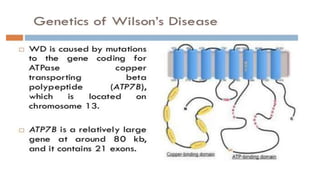
Wilson's disease is inherited as an autosomal recessive trait.The
gene for Wilson's disease (ATP7B) was mapped to chromosome 13.
Risk factors
Family history of Wilsonโ€™s disease.
Pathophysiology
โ€ข Copper begins to accumulate immediately after birth but the
symptoms usually appear in the 2nd to 3rd decade. The first
signs are hepatic (liver) in about 40% of cases, neurological
(brain) in about 35% of cases and psychiatric, renal (kidney),
haematological (blood), or endocrine (glands) in the
remainder.
Symptoms
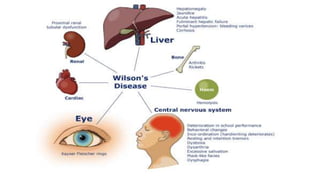
โ€ขFatigue, lack of appetite or abdominal pain
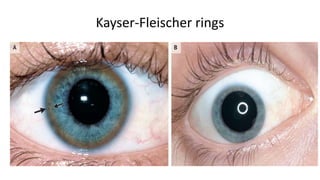
โ€ขGolden-brown eye discoloration (Kayser-Fleischer rings)
โ€ขLiver-related symptoms include vomiting, weakness, fluid
build-up in the abdomen, swelling of the legs, yellowish skin
and sclera and itchiness.
โ€ขBrain-related symptoms include tremors, muscle stiffness,
trouble speaking, swallowing, personality changes, anxiety,
and psychosis.
Diagnosis
โ€ขBlood and urine tests. Blood tests can monitor liver function and check
the level of a protein that binds copper in the blood (ceruloplasmin) and
the level of copper in blood. The doctor also might want to measure the
amount of copper excreted in urine during a 24-hour period.
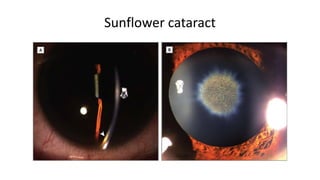
โ€ขEye exam. Kayser-Fleischer rings and sunflower cataract
โ€ขLiver biopsy
โ€ขGenetic testing
Kayser-Fleischer rings
Sunflower cataract
Treatment
Medications
โ€ข Penicillamine (Cuprimine, Depen). A chelating agent, penicillamine
can cause serious side effects, including skin and kidney problems,
bone marrow suppression, and worsening of neurological
symptoms. It also keeps vitamin B-6 (pyridoxine) from working, so
one will need to take a supplement in small doses.
โ€ข Trientine (Syprine). Trientine works much like penicillamine but
tends to cause fewer side effects.
โ€ข Zinc acetate (Galzin). This medication prevents body from
absorbing copper from the food eaten.
Surgery
If liver damage is severe, one might need a liver transplant. During
a liver transplant, a surgeon removes diseased liver and replaces it
with a healthy liver from a donor.
Most transplanted livers come from donors who have died. But in
some cases, a liver can come from a living donor, such as a family
member. In that case, the surgeon removes diseased liver and
replaces it with a portion of the donor's liver.
Complications
โ€ข Scarring of the liver (cirrhosis)
โ€ข Liver failure
โ€ข Persistent neurological problems
โ€ข Kidney problems
โ€ข Psychological problems
โ€ข Blood problems
ESSENTIAL TREMORS
โ€ข Essential tremor (ET), also called benign tremor, familial tremor,
and idiopathic tremor, is a medical condition characterized by
involuntary rhythmic contractions and relaxations (oscillations or
twitching movements) of certain muscle groups in one or more
body parts of unknown cause.
โ€ข It typically is symmetrical, and affects the arms, hands, or fingers;
but sometimes involves the head, vocal cords, or other body parts.
Causes
About half of essential tremor cases appear to result from a genetic
mutation. This form is referred to as familial tremor. It isn't clear
what causes essential tremor in people without a known genetic
mutation.
Risk factors
โ€ขGenetic mutation. The inherited variety of essential tremor (familial
tremor) is an autosomal dominant disorder. A defective gene from
just one parent is needed to pass on the condition.
โ€ขAge. Essential tremor is more common in people age 40 and older.
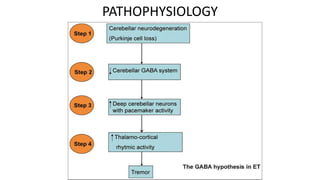
PATHOPHYSIOLOGY
Symptoms
โ€ขBegin gradually, usually more prominently on one side of the body
โ€ขWorsen with movement
โ€ขUsually occur in the hands first, affecting one hand or both hands
โ€ขCan include a "yes-yes" or "no-no" motion of the head
โ€ขMay be aggravated by emotional stress, fatigue, caffeine or
temperature extremes
Essential tremor vs. Parkinson's disease
โ€ขTiming of tremors. Essential tremor of the hands usually occurs
when one uses their hands. Tremors from Parkinson's disease are
most prominent when oneโ€™s hands are at their sides or resting in lap.
โ€ขAssociated conditions. Essential tremor doesn't cause other health
problems, but Parkinson's disease is associated with stooped
posture, slow movement and shuffling gait. However, people with
essential tremor sometimes develop other neurological signs and
symptoms, such as an unsteady gait (ataxia).
โ€ขParts of body affected. Essential tremor mainly involves hands, head
and voice. Parkinson's disease tremors usually start in hands, and can
affect legs, chin and other parts of body.
Diagnosis
History taking
โ€ข Personal history
โ€ข Family history
โ€ข Medication history
Physical examination
โ€ข Part of body involved
โ€ข Frequency and duration of tremor
Neurological examination
โ€ข Tendon reflexes
โ€ข Muscle strength and tone
โ€ข Ability to feel certain sensations
โ€ข Posture and coordination
โ€ข Gait
Laboratory tests
Blood and urine may be tested for several factors, including:
โ€ข Thyroid disease
โ€ข Metabolic problems
โ€ข Drug side effects
โ€ข Levels of chemicals that may cause tremor
Performance tests
โ€ข Drink from a glass
โ€ข Hold arms outstretched
โ€ข Write
โ€ข Draw a spiral
Treatment
Medications
โ€ข Beta blockers- Propranolol (Inderal).Beta blockers may not be an option
if one has asthma or certain heart problems. Side effects may include
fatigue, lightheadedness or heart problems.
โ€ข Anti-seizure medications- Primidone (Mysoline), gabapentin (Gralise,
Neurontin) and topiramate (Topamax, Qudexy XR). Side effects include
drowsiness and nausea, which usually disappear within a short time.
โ€ข Tranquilizers- Clonazepam (Klonopin). Side effects can include
fatigue or mild sedation.
โ€ข OnabotulinumtoxinA (Botox) injections. Botox injections might be
useful in treating some types of tremors, especially head and voice
tremors. Botox injections can improve tremors for up to three
months at a time.
โ€ข However, if Botox is used to treat hand tremors, it can cause
weakness in fingers. If Botox is used to treat voice tremors, it can
cause a hoarse voice and difficulty swallowing.
Therapy
โ€ข Physical or occupational therapy. Physical therapists can teach
exercises to improve muscle strength, control and coordination.
โ€ข Occupational therapists can help adapt to living with essential
tremor. Therapists might suggest adaptive devices to reduce the
effect of tremors on daily activities, including:
๏ƒผHeavier glasses and utensils
๏ƒผWrist weights
๏ƒผWider, heavier writing tools, such as wide-grip pens
Surgery
Deep brain stimulation
Side effects of deep brain stimulation can include:
โ€ข equipment malfunction
โ€ข problems with motor control, speech or balance
โ€ข Headache
โ€ข weakness
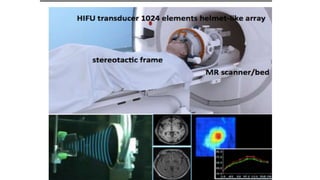
Focused ultrasound thalamotomy.
โ€ข This non-invasive surgery involves using focused sound waves
that travel through the skin and skull. The waves generate heat to
destroy brain tissue in a specific area of the thalamus to stop a
tremor.
โ€ข A surgeon uses magnetic resonance imaging to target the correct
area of the brain and to be sure the sound waves are generating
the exact amount of heat needed for the procedure.
โ€ข Focused ultrasound thalamotomy creates a lesion that can result
in permanent changes to brain function. Some people have
experienced altered sensation, trouble with walking or difficulty
with movement.
Nursing Diagnosis
1.Risk for injury from falls and possible skin breakdown (pressure
ulcers, abrasions), resulting from constant movement.
Nursing Interventions -
โ€ขPad the sides and head of the bed; ensure that the patient can
see over the sides of bed.
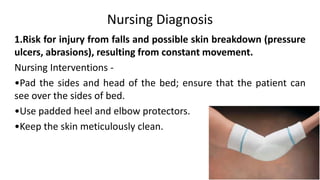
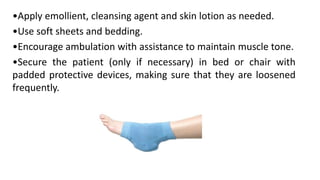
โ€ขUse padded heel and elbow protectors.
โ€ขKeep the skin meticulously clean.
โ€ขApply emollient, cleansing agent and skin lotion as needed.
โ€ขUse soft sheets and bedding.
โ€ขEncourage ambulation with assistance to maintain muscle tone.
โ€ขSecure the patient (only if necessary) in bed or chair with
padded protective devices, making sure that they are loosened
frequently.
2. Imbalanced nutrition: less than body requirements due to inadequate
intake and dehydration resulting from swallowing or chewing
disorders and danger of choking or aspirating food .
Nursing Interventions-
โ€ขAdminister phenothiazines (chlorpromazine) as prescribed before meals
(calms some patients).
โ€ขTalk to the patient before mealtime to promote relaxation; use mealtime
for social interaction. Provide undivided attention and help the patient
enjoy the mealtime experience.
โ€ขUse a warming tray to keep food warm.
โ€ขLearn the position that is best for the patient. Keep patient as close to
upright as possible while feeding. Stabilize patient's head gently with one
hand while feeding.
โ€ขShow the food, explain what the foods
are, and temperature.
โ€ขEncircle the patient with one arm and get
as close as possible to provide stability and
support while feeding. Use pillows and
wedges for additional support.
โ€ขDo not interpret stiffness, turning away, or
sudden turning of the head as rejection;
these are uncontrollable choreiform
movements.
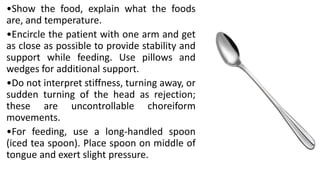
โ€ขFor feeding, use a long-handled spoon
(iced tea spoon). Place spoon on middle of
tongue and exert slight pressure.
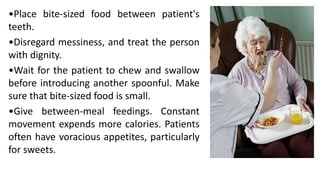
โ€ขPlace bite-sized food between patient's
teeth.
โ€ขDisregard messiness, and treat the person
with dignity.
โ€ขWait for the patient to chew and swallow
before introducing another spoonful. Make
sure that bite-sized food is small.
โ€ขGive between-meal feedings. Constant
movement expends more calories. Patients
often have voracious appetites, particularly
for sweets.
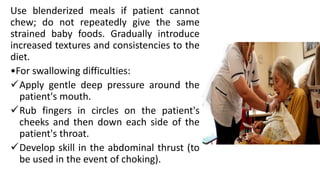
Use blenderized meals if patient cannot
chew; do not repeatedly give the same
strained baby foods. Gradually introduce
increased textures and consistencies to the
diet.
โ€ขFor swallowing difficulties:
๏ƒผApply gentle deep pressure around the
patient's mouth.
๏ƒผRub fingers in circles on the patient's
cheeks and then down each side of the
patient's throat.
๏ƒผDevelop skill in the abdominal thrust (to
be used in the event of choking).
3.Impaired communication from excessive grimacing and
unintelligible speech.
Nursing Interventions-
โ€ขEmploy biofeedback and relaxation therapy to reduce stress.
โ€ขConsult with speech therapist to help maintain and prolong
communication abilities.
โ€ขTry to devise a communication system.
โ€ขLearn how a particular patient expresses needs and wants-
particularly nonverbal messages (widening of eyes, responses).
โ€ขPatients can understand even if unable to speak. Do not isolate
patients by ceasing to communicate with them.
1. Exercise regularly.
2. Get plenty of sleep.
3. Pay attention to diet.
4. Get social.
5. Learn to meditate.
6. Learn something new.
RESEARCH ARTICLES
Effectiveness of a modified comprehensive behavioral intervention for tics for children and
adolescents with tourette's syndrome: A randomized controlled trial
A randomized controlled trial was conducted by Chia-Wen Chen, Huei-Shyong Wang, Hsiu-Ju
Chang, Chang-Wei Hsueh to evaluate the effectiveness of a modified four-session
Comprehensive Behavioural Intervention for Tics programme for decreasing tics in children
and adolescents with Tourette's syndrome. Participants aged 6-18 years with Tourette's
syndrome or chronic tic disorder were recruited. Participants in the control and intervention
groups (N = 23 each) received the routine care (daily pyridoxine [50 mg] and
psychoeducation). The intervention group received additional four behavioural intervention
sessions over a 3-month period that included psychoeducation, habit reversal training,
relaxation training, and education on tic relapse prevention. The outcome measures, Yale
Global Tic Severity Scale scores, were assessed at before and after the completion of
programme for both groups and again at 3 months follow-up for the intervention group.
Comparison of scores before and after intervention showed that the intervention significantly
decreased the severity of total motor tics and total tics as compared with control treatment.
The study concluded that modified four-session Comprehensive Behavioural Intervention
for Tics programme was more effective than routine care for decreasing tic severity in our
cohort of 6 to 18-year olds. This improvement was maintained 3 months after intervention.
Tremor in Dystonia: A Cross-sectional Study from India
A cross-sectional study was conducted by Sanjay Pandey and Neelav Sarma to
assess for tremor in the head and in different body parts. It included 90 patients
with adult-onset, isolated dystonia from a tertiary care movement disorder center
in India. Surface electromyography studies of tremor were recorded of the involved
limb in different positions. Tremor was present in 41 patients who had dystonia,
including 21 patients with cervical dystonia, 15 with limb dystonia, and 5 with
cranial dystonia. Significantly, later age at presentation and longer disease duration
observed in patients with versus without tremor. Upper limb tremor was present in
33 patients, head tremor was present in 14, and leg tremor was present in 2.
Tremor was present in 17 of 25 patients with segmental dystonia and in 6 of 9 with
multifocal dystonia. The study concluded that tremor was least frequent in
patients with focal dystonia. Tremor was common in patients with primary adult-
onset dystonia. Patients who had tremor were older and had a longer duration
of symptoms. Patients with segmental and multifocal dystonia had more tremor
than those with focal dystonia. The patients had more upper limb tremor than
head tremor, and a combination of dystonic tremor and tremor associated with
dystonia was more common than isolated dystonic tremor.
SUMMARY AND CONCLUSION
โ€ข Movement disorders are neurologic conditions that cause
problems with movement, such as increased movement that can
be voluntary or involuntary or decreased or slow voluntary
movement.
โ€ข The Movement disorders (MD) Nurse Specialist has several key
functions : provide advanced levels of nursing care, assist other
nurses and health professionals in establishing and meeting
health goals of patients and families, integrate advanced
knowledge in a holistic assessment and focus on the functional
problems and behavior that require nursing interventions.
REFERENCES
โ€ขJanice L. Hinkle, Kerry H. Cheever. Brunner and Suddarthโ€™s Textbook of Medical Surgical
Nursing. 2015. New Delhi. Wolters Kluwer.14th Edition. Volume 2. Pg. no. 1812-1813.
โ€ขLewis. Medical Surgical Nursing Assessment and Management of clinical problems.2015.
New Delhi. Elsevier. 2nd Edition. Volume II. Pg. no.1498.
โ€ขWikipedia. Tic. Available from
https://en.wikipedia.org/wiki/Tic#:~:text=A%20tic%20is%20a%20sudden,eye%20blinking
%20and%20throat%20clearing. [cited 1 sep 2020]
โ€ขMAYO CLINIC. Wilsonโ€™s disease. Available from https://www.mayoclinic.org/diseases-
conditions/wilsons-disease/diagnosis-treatment/drc-
20353256#:~:text=Your%20doctor%20inserts%20a%20thin,mutations%20that%20cause%
20Wilson's%20disease. [cited 2 sep 2020]
โ€ขPubMed. Effectiveness of a modified comprehensive behavioral intervention for tics for
children and adolescents with tourette's syndrome: A randomized controlled trial.
Available from https://pubmed.ncbi.nlm.nih.gov/31782167/ [cited 8 sep 2020]
โ€ขPubMed. Tremor in Dystonia: A Cross-sectional Study from India. Available from
https://pubmed.ncbi.nlm.nih.gov/30868097/ Mov Disord Clin Pract. 2017 Oct 3;4(6):858-
863. doi: 10.1002/mdc3.12546. [cited 8 sep 2020]
Movement disorders
Movement disorders

Movement disorders

  • 1.
  • 2.
    INTRODUCTION โ€ขPhysiological movements ornormal movements are the natural movements that occur in human joints. They are also known as osteokinematic movements. โ€ขThe study of these movements is known as kinesiology. โ€ขThe term "movement disorders" refers to a group of nervous system (neurological) conditions that cause abnormal increased movements, which may be voluntary or involuntary. Movement disorders can also cause reduced or slow movements.
  • 4.
    TICS โ€ข A ticis a sudden, repetitive, nonrhythmic motor movement or vocalization involving discrete muscle groups. Tics can be invisible to the observer, such as abdominal tensing or toe crunching. Common motor and phonic tics are, respectively, eye blinking and throat clearing.
  • 5.
    Classification Motor or phonic โ€ขMotortics are movement-based tics affecting discrete muscle groups. โ€ขPhonic tics are involuntary sounds produced by moving air through the nose, mouth, or throat. They may be alternately referred to as verbal tics or vocal tics.
  • 6.
    Simple or complex โ€ขSimplemotor tics are typically sudden, brief, meaningless movements that usually involve only one group of muscles, such as eye blinking, head jerking, or shoulder shrugging. Motor tics can be of an endless variety and may include such movements as hand clapping, neck stretching, mouth movements, head, arm or leg jerks, and facial grimacing. โ€ขA simple phonic tic can be almost any sound or noise, with common vocal tics being throat clearing, sniffing, or grunting.
  • 7.
    โ€ขComplex motor tics.They may involve a cluster of movements and appear coordinated. Examples of complex motor tics are pulling at clothes, touching people, touching objects, echopraxia (repeating or imitating another person's actions) and copropraxia (involuntarily performing obscene or forbidden gestures).
  • 8.
    โ€ข Complex phonictics ๏ถEcholalia (repeating words just spoken by someone else) ๏ถPalilalia (repeating one's own previously spoken words) ๏ถLexilalia (repeating words after reading them) ๏ถCoprolalia (the spontaneous utterance of socially objectionable or taboo words or phrases)
  • 10.
    Etiology and pathophysiology โ€ขIdiopathic โ€ข Stress and sleep deprivation โ€ข Certain medications, including some used to treat attention deficit hyperactivity disorder โ€ข Some specific gene mutations โ€ข Brain chemistry, especially the brain chemicals glutamate, serotonin, and dopamine.
  • 11.
    โ€ขTics that havea direct cause fit into a different category of diagnosis. These include tics due to: ๏ฑhead injuries ๏ฑstroke ๏ฑinfections ๏ฑpoisons ๏ฑSurgery ๏ฑHuntingtonโ€™s disease
  • 12.
    Characteristics โ€ขTics may increaseas a result of stress, fatigue, boredom, or high- energy emotions, which can include negative emotions, such as anxiety, as well as positive emotions, such as excitement or anticipation. โ€ขRelaxation may result in a tic increase (for instance, watching television or using a computer), while concentration on an absorbing activity often leads to a decrease in tics. โ€ขImmediately preceding tic onset, most individuals are aware of an urge that is similar to the need to yawn, sneeze, blink, or scratch an itch.
  • 13.
    โ€ขExamples of thispremonitory urge are the feeling of having something in one's throat or a localized discomfort in the shoulders, leading to the need to clear one's throat or shrug the shoulders. The actual tic may be felt as relieving this tension or sensation, similar to scratching an itch.
  • 14.
    โ€ข Another exampleis blinking to relieve an uncomfortable sensation in the eye. Some people with tics may not be aware of the premonitory urge. โ€ข Children may be less aware of the premonitory urge associated with tics than are adults, but their awareness tends to increase with maturity.
  • 15.
    Diagnosis โ€ข History collectionand Physical examination โ€ข The child must be under 18 at the onset of symptoms for a tic disorder to be diagnosed. Also, the symptoms must not be caused by other medical conditions or drugs. โ€ข Transient tic disorder- presence of one or more tics, occurring for less than 12 months in a row. โ€ข Chronic motor or vocal tic disorders- one or more tics have occurred almost daily for 12 months or more. People with a chronic tic disorder that is not TS, will experience either motor tics or vocal tics, but not both.
  • 16.
    โ€ขTS is basedon the presence of both motor and vocal tics, occurring almost daily for 12 months or more. Most children are under the age of 11 when they are diagnosed. โ€ขTo rule out other causes of tics, a doctor may suggest: ๏ƒผBlood tests ๏ƒผMRI scans or other imaging
  • 17.
    Treatment Therapies for ticdisorders โ€ข Cognitive behavioral therapy โ€ข Exposure and response prevention (ERP) โ€ข Habit reversal therapy
  • 18.
    Medication โ€ข Anti-seizure medications โ€ขBotox injections (to treat several muscle contraction or spasms) โ€ข Muscle relaxants โ€ข Medications that interact with dopamine
  • 19.
    Deep brain stimulation โ€ขDeep brain stimulation (DBS) is an option for people with TS whose tics do not respond to other treatments and impact quality of life.
  • 20.
    Coping and self-helptips โ€ข avoiding stress and anxiety โ€ข getting enough sleep โ€ข join a support group for people with TS and other tic disorders โ€ข reach out to friends and others for help and support Parents of children with tics may wish to: โ€ข inform teachers, caregivers, and others who know the child and about the condition โ€ข help boost the childโ€™s self-esteem by encouraging interests and friendships โ€ข ignore times when a tic occurs, and avoid pointing it out to the child
  • 21.
    DYSTONIA โ€ข Dystonia isa neurological hyperkinetic movement disorder syndrome in which sustained or repetitive muscle contractions result in twisting and repetitive movements or abnormal fixed postures. The movements may resemble a tremor. Dystonia is often intensified or exacerbated by physical activity, and symptoms may progress into adjacent muscles.
  • 22.
    โ€ข Primary dystoniais suspected when the dystonia is the only sign and there is no identifiable cause or structural abnormality in the central nervous system. โ€ข Secondary dystonia refers to dystonia brought on by some identified cause, such as head injury, drug side effect (e.g. tardive dystonia), or neurological disease (e.g. Wilson's disease). โ€ข Meningitis and encephalitis caused by viral, bacterial, and fungal infections of the brain have been associated with dystonia. Etiology and pathophysiology
  • 23.
    โ€ข Environmental andtask-related factors are suspected to trigger the development of focal dystonias because they appear disproportionately in individuals who perform high precision hand movements such as musicians, engineers, architects, and artists. โ€ข Chlorpromazine can also cause dystonia, which can be often misjudged as a seizure. Neuroleptic drugs often cause dystonia, including oculogyric crisis. โ€ข Malfunction of the sodium-potassium pump may be a factor in some dystonias.
  • 24.
    Classification Dystonia Classification byAge โ€ขChildhood onset โ€“ 0 to 12 years of age โ€ขAdolescent onset โ€“ 13 to 20 years of age โ€ขAdult onset โ€“ older than 20 years
  • 25.
    Dystonia Classification byBody Part 1.Focal Dystonia โ€ข Neck (cervical dystonia or spasmodic torticollis) โ€ข Eyes (blepharospasm) โ€ข Jaw/mouth/lower face (oromandibular dystonia) โ€ข Vocal cords (laryngeal dystonia) โ€ข Arms/legs (limb dystonia) โ€ข Unusual stretching, bending or twisting of the trunk (truncal dystonia) โ€ข Sustained contractions and involuntary, writhing movements of the abdominal wall (abdominal wall dystonia)
  • 27.
    2.Segmental Dystonia Segmental dystoniaaffects two or more parts of the body that are adjacent or close to one another. A common form of segmental dystonia affects the eyelids, jaw, mouth and lower face. Other types of dystonia include multifocal, which involves two or more body parts distant from one another; hemi dystonia, which affects half of the body; and generalized, which begins with leg involvement, but generally spreads to one or more additional regions of the body.
  • 28.
    Dystonia Classification byCause 1.Primary (idiopathic) Primary (idiopathic) dystonia is the only sign, and secondary causes have been ruled out. Most primary dystonias are variable, have adult onset, and are focal or segmental in nature. However, there are specific primary dystonias with childhood or adolescent onset that have been linked to genetic mutations.
  • 29.
    2.Secondary (symptomatic) Secondary (symptomatic)results primarily from secondary causes. These include environmental, such as exposure to carbon monoxide, cyanide, manganese or methanol; underlying conditions and diseases such as brain tumors, cerebral palsy, Parkinsonโ€™s disease, stroke, multiple sclerosis, hypoparathyroidism or vascular malformations; brain/spinal cord injuries; inflammatory, infectious or postinfectious brain conditions; and specific medications.
  • 30.
    3.Heredodegenerative Dystonia Heredodegenerative dystoniagenerally results from neurodegenerative disorders in which other neurological symptoms are present and in which heredity plays a role. These include numerous disorders such as certain X- linked recessive, autosomal dominant, autosomal recessive and/or parkinsonian syndromes. Included in this category: X-linked dystonia- parkinsonism (Lubag), Huntington's disease, Wilson's disease, neuroacanthocytosis, Rettโ€™s syndrome, Parkinson's disease and juvenile parkinsonism.
  • 31.
    Signs and symptoms โ€ขAbnormal posturing, in particular on movement โ€ข Continuous pain, cramping, and relentless muscle spasms due to involuntary muscle movements โ€ข Possible including lip smacking. โ€ข Loss of precision muscle coordination (sometimes first manifested in declining penmanship, frequent small injuries to the hands, and dropped items), cramping pain with sustained use, and trembling.
  • 32.
    โ€ข It maybecome difficult to find a comfortable position for arms and legs with even the minor exertions associated with holding arms crossed causing significant pain similar to restless leg syndrome. โ€ข Affected persons may notice trembling in the diaphragm while breathing, or the need to place hands in pockets, under legs while sitting or under pillows while sleeping to keep them still and to reduce pain. โ€ข Trembling in the jaw may be felt and heard while lying down, and the constant movement to avoid pain may result in the grinding and wearing down of teeth, or symptoms similar to temporomandibular joint disorder.
  • 33.
    โ€ข The voicemay crack frequently or become harsh, triggering frequent throat clearing. Swallowing can become difficult and accompanied by painful cramping. โ€ข Disturbed sleep patterns, exhaustion, mood swings, depression, mental stress, difficulty concentrating, blurred vision, digestive problems, and short temper.
  • 34.
    Diagnosis โ€ข Medical historyand physical examination. โ€ข Blood or urine tests โ€ข MRI or CT scan โ€ข Electromyography (EMG) โ€ข Genetic testing
  • 35.
    Treatment Therapy โ€ข Physical therapyor occupational therapy or both to help ease symptoms and improve function. โ€ข Speech therapy if dystonia affects voice. โ€ข Stretching or massage to ease muscle pain. โ€ข Reducing stress, getting plenty of rest and relaxation techniques. โ€ข Therapeutic exercise, soft tissue and joint mobilization, postural training and bracing, neuromuscular electrical stimulation, environmental modification, and gait training.
  • 36.
    Medication โ€ข Injections ofbotulinum toxin (Botox).Injections are usually repeated every three to four months. โ€ข Carbidopa-levodopa (Duopa). This medication can increase levels of the neurotransmitter dopamine. โ€ข Trihexyphenidyl and benztropine (Cogentin). These two medications act on neurotransmitters other than dopamine.
  • 37.
    โ€ข Tetrabenazine (Xenazine)and deutetrabenazine (Austedo). These two medications block dopamine. โ€ข Diazepam (Valium), clonazepam (Klonopin) and baclofen (Lioresal, Gablofen). These medications reduce neurotransmission and might help some forms of dystonia.
  • 38.
    Surgery โ€ข Deep brainstimulation โ€ข Selective denervation surgery
  • 39.
    CHOREA โ€ข Chorea (orchoreia) is an abnormal involuntary movement disorder, one of a group of neurological disorders called dyskinesias. The term chorea is derived from the Ancient Greek word โ€œฯ‡ฮฟฯฮตฮฏฮฑโ€ which means dance, as the quick movements of the feet or hands are comparable to dancing. โ€ข The term hemichorea refers to chorea of one side of the body.
  • 40.
    Causes Huntington's disease โ€ข Huntington'sdisease is a chronic, progressive, neurodegenerative disease and most common inherited cause of chorea. The condition was formerly called Huntington's chorea but was renamed because of the important non-choreic features including cognitive decline and behavioural change. โ€ข A genetic mutation in Huntington disease, the presence of a repeat in the Huntington gene (HTT), has been identified.
  • 41.
    Other genetic causes โ€ขThe classical Huntington's disease 'mimic' or phenocopy syndromes, called Huntington's disease-like syndrome types 1, 2 and 3; inherited prion disease, the spinocerebellar ataxias type 1, 3 and 17, neuroacanthocytosis, dentatorubral-pallidoluysian atrophy (DRPLA), brain iron accumulation disorders, Wilson's disease, benign hereditary chorea, Friedreich's ataxia, mitochondrial disease and Rett syndrome.
  • 42.
    Acquired causes โ€ข Cerebrovasculardisease โ€ข HIV infectionโ€”usually through its association with cryptococcal disease. โ€ข Sydenham's chorea occurs as a complication of streptococcal infection. โ€ข Chorea gravidarum refers to choreic symptoms that occur during pregnancy. โ€ข Chorea may also be caused by drugs (commonly levodopa, anti- convulsants and anti-psychotics). โ€ข Other acquired causes include CSF leak, systemic lupus erythematosus, thyrotoxicosis, polycythaemia rubra vera, transmissible spongiform encephalopathies and coeliac disease.
  • 44.
    Sign and symptoms โ€ขBrief,semi-directed, irregular movements that are not repetitive or rhythmic, but appear to flow from one muscle to the next. These 'dance- like' movements of chorea often occur with athetosis, which adds twisting and writhing movements. Walking may become difficult, and include odd postures and leg movements. โ€ขUnlike ataxia, which affects the quality of voluntary movements, or Parkinsonism, which is a hindrance of voluntary movements, the movements of chorea and ballism occur on their own, without conscious effort. Thus, chorea is said to be a hyperkinetic movement disorder. โ€ขWhen chorea is serious, slight movements will become thrashing motions; this form of severe chorea is referred to as ballism, or ballismus.
  • 45.
    Clinical Manifestations ofHuntington chorea (1)motor dysfunction (the most prominent is chorea, or rapid, jerky, involuntary, purposeless movements) (2) cognitive impairment (problems with attention and emotion recognition) (3) behavioral features, such as apathy and blunted affect
  • 46.
    โ€ขAll of thebody musculature is involved. Facial movements produce tics and grimaces. Speech becomes slurred, hesitant, often explosive, and eventually unintelligible. Chewing and swallowing are difficult, and there is a constant danger of choking and aspiration. โ€ขChoreiform movements persist during sleep but are diminished. As with speech, the gait becomes disorganized to the point that ambulation eventually is impossible. Although independent ambulation should be encouraged for as long as possible, a wheelchair usually becomes necessary.
  • 47.
    โ€ขEventually, the patientis confined to bed when the chorea interferes with walking, sitting, and all other activities. Bladder and bowel control are lost. โ€ขCognitive impairment, such as problems with attention emotion recognition, occurs early on while in later stages, marked dementia is present. โ€ขThe behavioral changes may be more devastating to the patient and family than the abnormal movements. Personality changes may result in nervous, irritable, or impatient behaviors. In the early stages, patients are particularly subject to uncontrollable fits of anger, profound and often suicidal depression, apathy, anxiety, psychosis, or euphoria.
  • 48.
    โ€ข Judgment andmemory are impaired, and dementia eventually ensues. Hallucinations, delusions, and paranoid thinking may precede the appearance of disjointed movements. Emotional and cognitive symptoms often become less acute as the disease progresses.
  • 49.
    Diagnosis โ€ขHistory taking- Familyhistory โ€ขPhysical examination โ€ขCT and MRI- Shows symmetrical striatal atrophy before motor symptoms appear. โ€ขEEG โ€ขSerological tests โ€ขPeripheral blood smear โ€ขGenetic testing- Known presence of the genetic marker CAG repeats in HTT.
  • 50.
    Treatment โ€ขHuntington's-related- A commontreatment is dopaminergic antagonists, although treatment is largely supportive. Tetrabenazine is the only FDA approved drug for the treatment of Huntington's disease- related chorea. โ€ขSydenham's chorea- Haloperidol, carbamazepine and valproic acid. Usually involves antibiotic drugs to treat the infection, followed by drug therapy to prevent recurrence. โ€ขChorea gravidarum- Haloperidol, chlorpromazine alone or in combination with diazepam, and pimozide can also be used. โ€ขDrug-induced chorea- Adjusting medication dosages. โ€ขMetabolic and endocrine-related choreas- Treated according to their causes.
  • 51.
    Surgery Deep brain stimulationis a surgical approach for chorea treatment.
  • 52.
    WILSONโ€™S DISEASE โ€ข Wilson'sdisease is a rare inherited disorder that causes copper to accumulate in liver, brain and other vital organs. โ€ข Most people with Wilson's disease are diagnosed between the ages of 5 and 35, but it can affect younger and older people, as well. Wilson's disease occurs in about 1 in 30,000 people.
  • 53.
    Causes Wilson's disease isinherited as an autosomal recessive trait.The gene for Wilson's disease (ATP7B) was mapped to chromosome 13. Risk factors Family history of Wilsonโ€™s disease.
  • 55.
    Pathophysiology โ€ข Copper beginsto accumulate immediately after birth but the symptoms usually appear in the 2nd to 3rd decade. The first signs are hepatic (liver) in about 40% of cases, neurological (brain) in about 35% of cases and psychiatric, renal (kidney), haematological (blood), or endocrine (glands) in the remainder.
  • 57.
    Symptoms โ€ขFatigue, lack ofappetite or abdominal pain โ€ขGolden-brown eye discoloration (Kayser-Fleischer rings) โ€ขLiver-related symptoms include vomiting, weakness, fluid build-up in the abdomen, swelling of the legs, yellowish skin and sclera and itchiness. โ€ขBrain-related symptoms include tremors, muscle stiffness, trouble speaking, swallowing, personality changes, anxiety, and psychosis.
  • 58.
    Diagnosis โ€ขBlood and urinetests. Blood tests can monitor liver function and check the level of a protein that binds copper in the blood (ceruloplasmin) and the level of copper in blood. The doctor also might want to measure the amount of copper excreted in urine during a 24-hour period. โ€ขEye exam. Kayser-Fleischer rings and sunflower cataract โ€ขLiver biopsy โ€ขGenetic testing
  • 59.
  • 60.
  • 61.
    Treatment Medications โ€ข Penicillamine (Cuprimine,Depen). A chelating agent, penicillamine can cause serious side effects, including skin and kidney problems, bone marrow suppression, and worsening of neurological symptoms. It also keeps vitamin B-6 (pyridoxine) from working, so one will need to take a supplement in small doses. โ€ข Trientine (Syprine). Trientine works much like penicillamine but tends to cause fewer side effects. โ€ข Zinc acetate (Galzin). This medication prevents body from absorbing copper from the food eaten.
  • 62.
    Surgery If liver damageis severe, one might need a liver transplant. During a liver transplant, a surgeon removes diseased liver and replaces it with a healthy liver from a donor. Most transplanted livers come from donors who have died. But in some cases, a liver can come from a living donor, such as a family member. In that case, the surgeon removes diseased liver and replaces it with a portion of the donor's liver.
  • 63.
    Complications โ€ข Scarring ofthe liver (cirrhosis) โ€ข Liver failure โ€ข Persistent neurological problems โ€ข Kidney problems โ€ข Psychological problems โ€ข Blood problems
  • 64.
    ESSENTIAL TREMORS โ€ข Essentialtremor (ET), also called benign tremor, familial tremor, and idiopathic tremor, is a medical condition characterized by involuntary rhythmic contractions and relaxations (oscillations or twitching movements) of certain muscle groups in one or more body parts of unknown cause. โ€ข It typically is symmetrical, and affects the arms, hands, or fingers; but sometimes involves the head, vocal cords, or other body parts.
  • 65.
    Causes About half ofessential tremor cases appear to result from a genetic mutation. This form is referred to as familial tremor. It isn't clear what causes essential tremor in people without a known genetic mutation. Risk factors โ€ขGenetic mutation. The inherited variety of essential tremor (familial tremor) is an autosomal dominant disorder. A defective gene from just one parent is needed to pass on the condition. โ€ขAge. Essential tremor is more common in people age 40 and older.
  • 66.
  • 67.
    Symptoms โ€ขBegin gradually, usuallymore prominently on one side of the body โ€ขWorsen with movement โ€ขUsually occur in the hands first, affecting one hand or both hands โ€ขCan include a "yes-yes" or "no-no" motion of the head โ€ขMay be aggravated by emotional stress, fatigue, caffeine or temperature extremes
  • 68.
    Essential tremor vs.Parkinson's disease โ€ขTiming of tremors. Essential tremor of the hands usually occurs when one uses their hands. Tremors from Parkinson's disease are most prominent when oneโ€™s hands are at their sides or resting in lap. โ€ขAssociated conditions. Essential tremor doesn't cause other health problems, but Parkinson's disease is associated with stooped posture, slow movement and shuffling gait. However, people with essential tremor sometimes develop other neurological signs and symptoms, such as an unsteady gait (ataxia). โ€ขParts of body affected. Essential tremor mainly involves hands, head and voice. Parkinson's disease tremors usually start in hands, and can affect legs, chin and other parts of body.
  • 69.
    Diagnosis History taking โ€ข Personalhistory โ€ข Family history โ€ข Medication history Physical examination โ€ข Part of body involved โ€ข Frequency and duration of tremor
  • 70.
    Neurological examination โ€ข Tendonreflexes โ€ข Muscle strength and tone โ€ข Ability to feel certain sensations โ€ข Posture and coordination โ€ข Gait Laboratory tests Blood and urine may be tested for several factors, including: โ€ข Thyroid disease โ€ข Metabolic problems โ€ข Drug side effects โ€ข Levels of chemicals that may cause tremor
  • 71.
    Performance tests โ€ข Drinkfrom a glass โ€ข Hold arms outstretched โ€ข Write โ€ข Draw a spiral
  • 72.
    Treatment Medications โ€ข Beta blockers-Propranolol (Inderal).Beta blockers may not be an option if one has asthma or certain heart problems. Side effects may include fatigue, lightheadedness or heart problems. โ€ข Anti-seizure medications- Primidone (Mysoline), gabapentin (Gralise, Neurontin) and topiramate (Topamax, Qudexy XR). Side effects include drowsiness and nausea, which usually disappear within a short time.
  • 73.
    โ€ข Tranquilizers- Clonazepam(Klonopin). Side effects can include fatigue or mild sedation. โ€ข OnabotulinumtoxinA (Botox) injections. Botox injections might be useful in treating some types of tremors, especially head and voice tremors. Botox injections can improve tremors for up to three months at a time. โ€ข However, if Botox is used to treat hand tremors, it can cause weakness in fingers. If Botox is used to treat voice tremors, it can cause a hoarse voice and difficulty swallowing.
  • 74.
    Therapy โ€ข Physical oroccupational therapy. Physical therapists can teach exercises to improve muscle strength, control and coordination. โ€ข Occupational therapists can help adapt to living with essential tremor. Therapists might suggest adaptive devices to reduce the effect of tremors on daily activities, including: ๏ƒผHeavier glasses and utensils ๏ƒผWrist weights ๏ƒผWider, heavier writing tools, such as wide-grip pens
  • 75.
    Surgery Deep brain stimulation Sideeffects of deep brain stimulation can include: โ€ข equipment malfunction โ€ข problems with motor control, speech or balance โ€ข Headache โ€ข weakness
  • 76.
    Focused ultrasound thalamotomy. โ€ขThis non-invasive surgery involves using focused sound waves that travel through the skin and skull. The waves generate heat to destroy brain tissue in a specific area of the thalamus to stop a tremor. โ€ข A surgeon uses magnetic resonance imaging to target the correct area of the brain and to be sure the sound waves are generating the exact amount of heat needed for the procedure. โ€ข Focused ultrasound thalamotomy creates a lesion that can result in permanent changes to brain function. Some people have experienced altered sensation, trouble with walking or difficulty with movement.
  • 78.
    Nursing Diagnosis 1.Risk forinjury from falls and possible skin breakdown (pressure ulcers, abrasions), resulting from constant movement. Nursing Interventions - โ€ขPad the sides and head of the bed; ensure that the patient can see over the sides of bed. โ€ขUse padded heel and elbow protectors. โ€ขKeep the skin meticulously clean.
  • 79.
    โ€ขApply emollient, cleansingagent and skin lotion as needed. โ€ขUse soft sheets and bedding. โ€ขEncourage ambulation with assistance to maintain muscle tone. โ€ขSecure the patient (only if necessary) in bed or chair with padded protective devices, making sure that they are loosened frequently.
  • 80.
    2. Imbalanced nutrition:less than body requirements due to inadequate intake and dehydration resulting from swallowing or chewing disorders and danger of choking or aspirating food . Nursing Interventions- โ€ขAdminister phenothiazines (chlorpromazine) as prescribed before meals (calms some patients). โ€ขTalk to the patient before mealtime to promote relaxation; use mealtime for social interaction. Provide undivided attention and help the patient enjoy the mealtime experience. โ€ขUse a warming tray to keep food warm. โ€ขLearn the position that is best for the patient. Keep patient as close to upright as possible while feeding. Stabilize patient's head gently with one hand while feeding.
  • 81.
    โ€ขShow the food,explain what the foods are, and temperature. โ€ขEncircle the patient with one arm and get as close as possible to provide stability and support while feeding. Use pillows and wedges for additional support. โ€ขDo not interpret stiffness, turning away, or sudden turning of the head as rejection; these are uncontrollable choreiform movements. โ€ขFor feeding, use a long-handled spoon (iced tea spoon). Place spoon on middle of tongue and exert slight pressure.
  • 82.
    โ€ขPlace bite-sized foodbetween patient's teeth. โ€ขDisregard messiness, and treat the person with dignity. โ€ขWait for the patient to chew and swallow before introducing another spoonful. Make sure that bite-sized food is small. โ€ขGive between-meal feedings. Constant movement expends more calories. Patients often have voracious appetites, particularly for sweets.
  • 83.
    Use blenderized mealsif patient cannot chew; do not repeatedly give the same strained baby foods. Gradually introduce increased textures and consistencies to the diet. โ€ขFor swallowing difficulties: ๏ƒผApply gentle deep pressure around the patient's mouth. ๏ƒผRub fingers in circles on the patient's cheeks and then down each side of the patient's throat. ๏ƒผDevelop skill in the abdominal thrust (to be used in the event of choking).
  • 84.
    3.Impaired communication fromexcessive grimacing and unintelligible speech. Nursing Interventions- โ€ขEmploy biofeedback and relaxation therapy to reduce stress. โ€ขConsult with speech therapist to help maintain and prolong communication abilities. โ€ขTry to devise a communication system. โ€ขLearn how a particular patient expresses needs and wants- particularly nonverbal messages (widening of eyes, responses). โ€ขPatients can understand even if unable to speak. Do not isolate patients by ceasing to communicate with them.
  • 85.
    1. Exercise regularly. 2.Get plenty of sleep. 3. Pay attention to diet. 4. Get social. 5. Learn to meditate. 6. Learn something new.
  • 86.
    RESEARCH ARTICLES Effectiveness ofa modified comprehensive behavioral intervention for tics for children and adolescents with tourette's syndrome: A randomized controlled trial A randomized controlled trial was conducted by Chia-Wen Chen, Huei-Shyong Wang, Hsiu-Ju Chang, Chang-Wei Hsueh to evaluate the effectiveness of a modified four-session Comprehensive Behavioural Intervention for Tics programme for decreasing tics in children and adolescents with Tourette's syndrome. Participants aged 6-18 years with Tourette's syndrome or chronic tic disorder were recruited. Participants in the control and intervention groups (N = 23 each) received the routine care (daily pyridoxine [50 mg] and psychoeducation). The intervention group received additional four behavioural intervention sessions over a 3-month period that included psychoeducation, habit reversal training, relaxation training, and education on tic relapse prevention. The outcome measures, Yale Global Tic Severity Scale scores, were assessed at before and after the completion of programme for both groups and again at 3 months follow-up for the intervention group. Comparison of scores before and after intervention showed that the intervention significantly decreased the severity of total motor tics and total tics as compared with control treatment. The study concluded that modified four-session Comprehensive Behavioural Intervention for Tics programme was more effective than routine care for decreasing tic severity in our cohort of 6 to 18-year olds. This improvement was maintained 3 months after intervention.
  • 87.
    Tremor in Dystonia:A Cross-sectional Study from India A cross-sectional study was conducted by Sanjay Pandey and Neelav Sarma to assess for tremor in the head and in different body parts. It included 90 patients with adult-onset, isolated dystonia from a tertiary care movement disorder center in India. Surface electromyography studies of tremor were recorded of the involved limb in different positions. Tremor was present in 41 patients who had dystonia, including 21 patients with cervical dystonia, 15 with limb dystonia, and 5 with cranial dystonia. Significantly, later age at presentation and longer disease duration observed in patients with versus without tremor. Upper limb tremor was present in 33 patients, head tremor was present in 14, and leg tremor was present in 2. Tremor was present in 17 of 25 patients with segmental dystonia and in 6 of 9 with multifocal dystonia. The study concluded that tremor was least frequent in patients with focal dystonia. Tremor was common in patients with primary adult- onset dystonia. Patients who had tremor were older and had a longer duration of symptoms. Patients with segmental and multifocal dystonia had more tremor than those with focal dystonia. The patients had more upper limb tremor than head tremor, and a combination of dystonic tremor and tremor associated with dystonia was more common than isolated dystonic tremor.
  • 88.
    SUMMARY AND CONCLUSION โ€ขMovement disorders are neurologic conditions that cause problems with movement, such as increased movement that can be voluntary or involuntary or decreased or slow voluntary movement. โ€ข The Movement disorders (MD) Nurse Specialist has several key functions : provide advanced levels of nursing care, assist other nurses and health professionals in establishing and meeting health goals of patients and families, integrate advanced knowledge in a holistic assessment and focus on the functional problems and behavior that require nursing interventions.
  • 89.
    REFERENCES โ€ขJanice L. Hinkle,Kerry H. Cheever. Brunner and Suddarthโ€™s Textbook of Medical Surgical Nursing. 2015. New Delhi. Wolters Kluwer.14th Edition. Volume 2. Pg. no. 1812-1813. โ€ขLewis. Medical Surgical Nursing Assessment and Management of clinical problems.2015. New Delhi. Elsevier. 2nd Edition. Volume II. Pg. no.1498. โ€ขWikipedia. Tic. Available from https://en.wikipedia.org/wiki/Tic#:~:text=A%20tic%20is%20a%20sudden,eye%20blinking %20and%20throat%20clearing. [cited 1 sep 2020] โ€ขMAYO CLINIC. Wilsonโ€™s disease. Available from https://www.mayoclinic.org/diseases- conditions/wilsons-disease/diagnosis-treatment/drc- 20353256#:~:text=Your%20doctor%20inserts%20a%20thin,mutations%20that%20cause% 20Wilson's%20disease. [cited 2 sep 2020] โ€ขPubMed. Effectiveness of a modified comprehensive behavioral intervention for tics for children and adolescents with tourette's syndrome: A randomized controlled trial. Available from https://pubmed.ncbi.nlm.nih.gov/31782167/ [cited 8 sep 2020] โ€ขPubMed. Tremor in Dystonia: A Cross-sectional Study from India. Available from https://pubmed.ncbi.nlm.nih.gov/30868097/ Mov Disord Clin Pract. 2017 Oct 3;4(6):858- 863. doi: 10.1002/mdc3.12546. [cited 8 sep 2020]