Tic disorder
DR.MOHAMMAD ALKTIFAN
Pediatrician –arab board certificate
syrian –daraa
OUTLINE
 INTRODUCTION
 EPIDEMIOLOGY
 ETIOLOGY AND RISK FACTORS
 DIAGNOSIS AND Classification(DSM IV)
 Comorbidity
 TREATMENT
TIC DISORDER
Sudden, rapid, recurrent, nonrhythmic motor movement or vocalization
Classified according to the degree of complexity (simple, complex) as well as
their quality (motor, vocal).
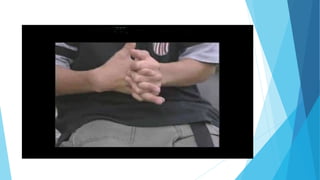
 Motor tics: range from simple, sudden movements such as eye blinking or
grimacing, to complex behavioral patterns, for example crouching down or
hopping. In extreme cases
 complex motor tics may present themselves as obscene gestures (referred to
as copropraxia; e.g., pulling trousers down) or even have an element of self-
harm (e.g., hitting oneself in the head). In some cases the afflicted person is
compelled to repeat or imitate a movement observed in another person
(echopraxia).
TICS DISORDER
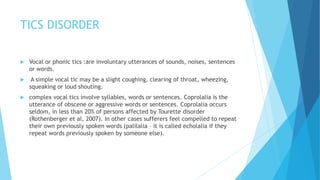
 Vocal or phonic tics :are involuntary utterances of sounds, noises, sentences
or words.
 A simple vocal tic may be a slight coughing, clearing of throat, wheezing,
squeaking or loud shouting.
 complex vocal tics involve syllables, words or sentences. Coprolalia is the
utterance of obscene or aggressive words or sentences. Coprolalia occurs
seldom, in less than 20% of persons affected by Tourette disorder
(Rothenberger et al, 2007). In other cases sufferers feel compelled to repeat
their own previously spoken words (palilalia – it is called echolalia if they
repeat words previously spoken by someone else).
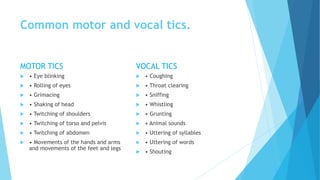
Common motor and vocal tics.
MOTOR TICS
 • Eye blinking
 • Rolling of eyes
 • Grimacing
 • Shaking of head
 • Twitching of shoulders
 • Twitching of torso and pelvis
 • Twitching of abdomen
 • Movements of the hands and arms
and movements of the feet and legs
VOCAL TICS
 • Coughing
 • Throat clearing
 • Sniffing
 • Whistling
 • Grunting
 • Animal sounds
 • Uttering of syllables
 • Uttering of words
 • Shouting
EPIDEMIOLOGY
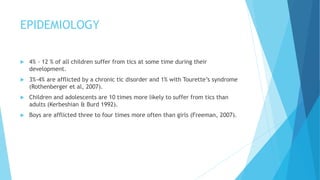
 4% - 12 % of all children suffer from tics at some time during their
development.
 3%-4% are afflicted by a chronic tic disorder and 1% with Tourette’s syndrome
(Rothenberger et al, 2007).
 Children and adolescents are 10 times more likely to suffer from tics than
adults (Kerbeshian & Burd 1992).
 Boys are afflicted three to four times more often than girls (Freeman, 2007).
EPIDEMOLOGY
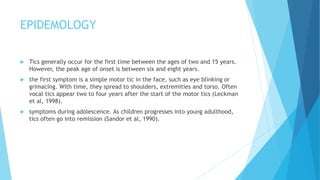
 Tics generally occur for the first time between the ages of two and 15 years.
However, the peak age of onset is between six and eight years.
 the first symptom is a simple motor tic in the face, such as eye blinking or
grimacing. With time, they spread to shoulders, extremities and torso. Often
vocal tics appear two to four years after the start of the motor tics (Leckman
et al, 1998).
 symptoms during adolescence. As children progresses into young adulthood,
tics often go into remission (Sandor et al, 1990).
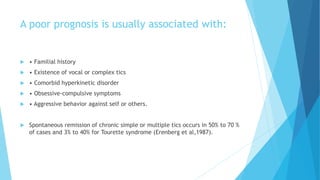
A poor prognosis is usually associated with:
 • Familial history
 • Existence of vocal or complex tics
 • Comorbid hyperkinetic disorder
 • Obsessive-compulsive symptoms
 • Aggressive behavior against self or others.
 Spontaneous remission of chronic simple or multiple tics occurs in 50% to 70 %
of cases and 3% to 40% for Tourette syndrome (Erenberg et al,1987).
ETIOLOGY AND RISK FACTORS
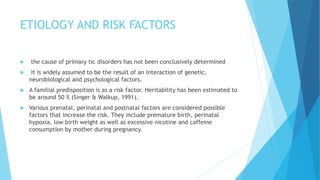
 the cause of primary tic disorders has not been conclusively determined
 it is widely assumed to be the result of an interaction of genetic,
neurobiological and psychological factors.
 A familial predisposition is as a risk factor. Heritability has been estimated to
be around 50 % (Singer & Walkup, 1991).
 Various prenatal, perinatal and postnatal factors are considered possible
factors that increase the risk. They include premature birth, perinatal
hypoxia, low birth weight as well as excessive nicotine and caffeine
consumption by mother during pregnancy.
 On rare occasions tics may develop as secondary symptom of tumors,
poisoning, infection, head trauma or vascular disease (Burd et al, 1999;
Mathews et al, 2006)
 Medical imaging techniques have determined that, on a neuroanatomical
level, patients with tics show a reduced volume of the basal ganglia as well as
the corpus callosum‫و‬
DIAGNOSIS
 A detailed medical history should be obtained from birth onwards.
 physical and neurological examination should be conducted including an EEG.
 Usually no further tests, such as an MRI, are necessary unless there are
pathological findings.
 ECG, thyroid function tests or other procedures (e.g., metabolic tests) are not
necessary in the absence of abnormal findings.
 Tests of cognitive ability are not necessary either unless there is indication of
learning problems.
Classification of tic disorders according
to DSM-IV
 Transient tic disorder
 Chronic motor or vocal tic disorder
 Tourette disorder
 Tic disorder NOS(not otherwise specified)
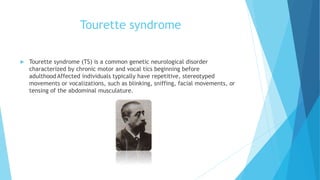
Tourette syndrome
 Tourette syndrome (TS) is a common genetic neurological disorder
characterized by chronic motor and vocal tics beginning before
adulthood Affected individuals typically have repetitive, stereotyped
movements or vocalizations, such as blinking, sniffing, facial movements, or
tensing of the abdominal musculature.
Diagnostic criteria for Tourette syndrome
(DSM-IV) are as follows:
 Both multiple motor and 1 or more vocal tics have been present at some time
during the illness, though not necessarily concurrently.
 The tics occur many times a day (usually in bouts) nearly every day or
intermittently throughout a period of more than 1 year, and during this period
there was never a tic-free period of more than 3 consecutive months
 The onset is before age 18 years
 The disturbance is not due to the direct physiologic effects of a substance
(eg, stimulants) or a general medical condition (eg, Huntington disease or
postviral encephalitis)
Diagnostic criteria for chronic motor or vocal
tic disorder (DSM-IV) are as follows:
 Single or multiple motor or vocal tics , but not both, have been present at
some time during the illness
 The tics occur many times a day nearly every day or intermittently
throughout a period of more than 1 year; and during this period there was
never a tic-free period of more than 3 consecutive months
 The onset is before age 18 years
 The disturbance is not due to the direct physiologic effects of a substance
(eg, stimulants) or a general medical condition (eg, Huntington disease or
postviral encephalitis).
 Criteria have never been met for TS
Diagnostic criteria for transient tic
disorder (DSM-IV) are as follows
 Single or multiple motor and/or vocal tics are present
 The tics occur many times a day, nearly every day for at least 4 weeks, but
for no longer than 12 consecutive months
 The onset is before age 18 years
 The disturbance is not due to the direct physiologic effects of a substance
(eg, stimulants) or a general medical condition (eg, Huntington disease or
postviral encephalitis)
 Criteria have never been met for TS or chronic motor or vocal tic disorder
 Specify if this is a single or recurrent episode
Differential Diagnoses
 Chorea
 Complex partial Seizures
 Frontal Lobe Syndromes
 Hemifacial Spasm
 Huntington Disease
 Intellectual disability
 Neurologic Effects of Cocaine
 Periodic Limb Movement Disorder
 Wilson Disease
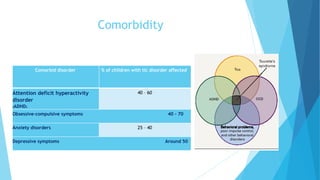
Comorbidity
Comorbid disorder % of children with tic disorder affected
Attention deficit hyperactivity
disorder
(ADHD)
40 – 60
Obsessive-compulsive symptoms 40 - 70
Anxiety disorders 25 – 40
Depressive symptoms Around 50
TREATMENT
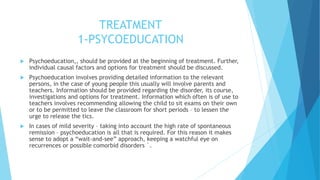
1-PSYCOEDUCATION
 Psychoeducation,, should be provided at the beginning of treatment. Further,
individual causal factors and options for treatment should be discussed.
 Psychoeducation involves providing detailed information to the relevant
persons, in the case of young people this usually will involve parents and
teachers. Information should be provided regarding the disorder, its course,
investigations and options for treatment. Information which often is of use to
teachers involves recommending allowing the child to sit exams on their own
or to be permitted to leave the classroom for short periods – to lessen the
urge to release the tics.
 In cases of mild severity – taking into account the high rate of spontaneous
remission – psychoeducation is all that is required. For this reason it makes
sense to adopt a “wait-and-see” approach, keeping a watchful eye on
recurrences or possible comorbid disorders `.
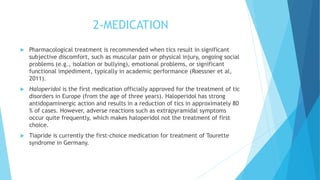
2-MEDICATION
 Pharmacological treatment is recommended when tics result in significant
subjective discomfort, such as muscular pain or physical injury, ongoing social
problems (e.g., isolation or bullying), emotional problems, or significant
functional impediment, typically in academic performance (Roessner et al,
2011).
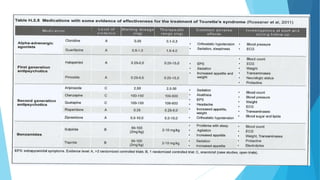
 Haloperidol is the first medication officially approved for the treatment of tic
disorders in Europe (from the age of three years). Haloperidol has strong
antidopaminergic action and results in a reduction of tics in approximately 80
% of cases. However, adverse reactions such as extrapyramidal symptoms
occur quite frequently, which makes haloperidol not the treatment of first
choice.
 Tiapride is currently the first-choice medication for treatment of Tourette
syndrome in Germany.
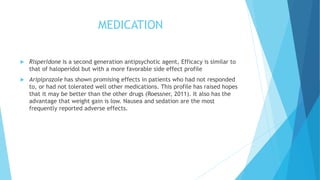
MEDICATION
 Risperidone is a second generation antipsychotic agent, Efficacy is similar to
that of haloperidol but with a more favorable side effect profile
 Aripiprazole has shown promising effects in patients who had not responded
to, or had not tolerated well other medications. This profile has raised hopes
that it may be better than the other drugs (Roessner, 2011). It also has the
advantage that weight gain is low. Nausea and sedation are the most
frequently reported adverse effects.
Treating Tourette syndrome comorbid with
other disorders
 ADHD is comorbid with a tic disorder: the former may be treated with
psychostimulants, such as methylphenidate. Recent studies have shown that
in most cases psychostimulants do not lead to an exacerbation of tics
(Pringsheim & Steeves, 2011).
 Treating patients with atomoxetine or clonidine has proven effective as long
as the Tourette syndrome is only of mild to moderate severity (Roessner et al,
2011). These two medications mainly reduce ADHD symptoms only having a
marginal effect on tics. Should the aforementioned medication have little
effect on tics, the addition of risperidone can be considered. Alternatively,
ADHD symptoms may be treated with methylphenidate, which can be
combined with risperidone if necessary.
 Emotional disorders: In cases presenting with mild to moderate depressive
or anxious symptoms comorbid with Tourette syndrome, pharmacological
treatment solely with sulpiride can be considered.
 Alternative medicine treatments:
Substantial anecdotal evidence exists concerning the benefits of physical activity
(rhythmic sports, such as swimming) and recreational activities in general.
Patients should be informed and encouraged accordingly. There is no evidence
that diet, vitamins or mineral supplements as well as hypnosis are of benefit and
should not be recommended
REFERENCES
 Achenbach T (1991). Manual for the Child Behavior
 Checklist/4-18 and 1991 Profile. Burlington: University of Vermont, Department of Psychiatry. American Psychiatric Association (1994). Diagnostic and
Statistical Manual of Mental Disorders, 4th ed. Washington: American Psychiatric Association. Banaschewski T, Woerner W, Rothenberger A (2003).
 Premonitory sensory phenomena and suppressibility of tics in Tourette syndrome: developmental aspects in children and adolescents. Developmental
Medicine and Child Neurology, 45:700-703. Burd L, Severud R, Klug MG et al (1999). Prenatal and perinatal
 risk factors for Tourette disorder, Journal of Perinatal Medicine, 27:295-302. Conelea CA, Woods DW, Zinner SH et al (in press). The
 Impact of Tourette syndrome in adults: Results from the Tourette syndrome impact survey. Community Mental Health Journal. Erenberg G, Cruse RP,
Rothner AD (1987). The natural history
 of Tourette syndrome: a follow-up study’, Annals of Neurology, 22:383-385. Freeman RD (2007). Tic disorders and ADHD: answers from a world-wide clinical
dataset on Tourette syndrome. European Child & Adolescent Psychiatry, 16(supp1):15- 23.
 Goodman R (1997). The Strengths and Difficulties
 Questionnaire: a research note. Journal of Child Psychology and Psychiatry, 38:581-586. Kerbeshian J, Burd L (1992). Epidemiology and comorbidity.
 The North Dakota prevalence studies of Tourette syndrome and other developmental disorders. Advances in Neurology, 58:67-74. Leckman JF, Peterson BS,
Anderson GM et al (1997).
 Pathogenesis of Tourette’s syndrome. Journal of Child Psychology and Psychiatry, 38:119-142. Leckman JF, Riddle MA, Hardin MT et al (1989). The Yale
 Global Tic Severity Scale: initial testing of a clinician- rated scale of tic severity. Journal of the American Academy of Child & Adolescent Psychiatry,
28:566-573. Leckman JF, Zhang H, Vitale A et al (1998). Course of tic
 severity in Tourette syndrome: the first two decades. Pediatrics, 102:14-19. Mathews CA, Bimson B, Lowe TL et al (2006). Association
 between maternal smoking and increased symptom severity in Tourette’s syndrome. The American Journal of Psychiatry, 163:1066-1073. O’Rourke JA,
Scharf JM, Platko J et al (2011). The familial
 association of Tourette’s disorder and ADHD: the impact of OCD symptoms. American Journal of Medical Genetics. Part B, Neuropsychiatric Genetics,
156B:553-560.

Tic disorder DR MOHAMMAD ALKTIFAN

  • 1.
    Tic disorder DR.MOHAMMAD ALKTIFAN Pediatrician–arab board certificate syrian –daraa
  • 2.
    OUTLINE  INTRODUCTION  EPIDEMIOLOGY ETIOLOGY AND RISK FACTORS  DIAGNOSIS AND Classification(DSM IV)  Comorbidity  TREATMENT
  • 3.
    TIC DISORDER Sudden, rapid,recurrent, nonrhythmic motor movement or vocalization Classified according to the degree of complexity (simple, complex) as well as their quality (motor, vocal).  Motor tics: range from simple, sudden movements such as eye blinking or grimacing, to complex behavioral patterns, for example crouching down or hopping. In extreme cases  complex motor tics may present themselves as obscene gestures (referred to as copropraxia; e.g., pulling trousers down) or even have an element of self- harm (e.g., hitting oneself in the head). In some cases the afflicted person is compelled to repeat or imitate a movement observed in another person (echopraxia).
  • 4.
    TICS DISORDER  Vocalor phonic tics :are involuntary utterances of sounds, noises, sentences or words.  A simple vocal tic may be a slight coughing, clearing of throat, wheezing, squeaking or loud shouting.  complex vocal tics involve syllables, words or sentences. Coprolalia is the utterance of obscene or aggressive words or sentences. Coprolalia occurs seldom, in less than 20% of persons affected by Tourette disorder (Rothenberger et al, 2007). In other cases sufferers feel compelled to repeat their own previously spoken words (palilalia – it is called echolalia if they repeat words previously spoken by someone else).
  • 5.
    Common motor andvocal tics. MOTOR TICS  • Eye blinking  • Rolling of eyes  • Grimacing  • Shaking of head  • Twitching of shoulders  • Twitching of torso and pelvis  • Twitching of abdomen  • Movements of the hands and arms and movements of the feet and legs VOCAL TICS  • Coughing  • Throat clearing  • Sniffing  • Whistling  • Grunting  • Animal sounds  • Uttering of syllables  • Uttering of words  • Shouting
  • 6.
    EPIDEMIOLOGY  4% -12 % of all children suffer from tics at some time during their development.  3%-4% are afflicted by a chronic tic disorder and 1% with Tourette’s syndrome (Rothenberger et al, 2007).  Children and adolescents are 10 times more likely to suffer from tics than adults (Kerbeshian & Burd 1992).  Boys are afflicted three to four times more often than girls (Freeman, 2007).
  • 7.
    EPIDEMOLOGY  Tics generallyoccur for the first time between the ages of two and 15 years. However, the peak age of onset is between six and eight years.  the first symptom is a simple motor tic in the face, such as eye blinking or grimacing. With time, they spread to shoulders, extremities and torso. Often vocal tics appear two to four years after the start of the motor tics (Leckman et al, 1998).  symptoms during adolescence. As children progresses into young adulthood, tics often go into remission (Sandor et al, 1990).
  • 8.
    A poor prognosisis usually associated with:  • Familial history  • Existence of vocal or complex tics  • Comorbid hyperkinetic disorder  • Obsessive-compulsive symptoms  • Aggressive behavior against self or others.  Spontaneous remission of chronic simple or multiple tics occurs in 50% to 70 % of cases and 3% to 40% for Tourette syndrome (Erenberg et al,1987).
  • 9.
    ETIOLOGY AND RISKFACTORS  the cause of primary tic disorders has not been conclusively determined  it is widely assumed to be the result of an interaction of genetic, neurobiological and psychological factors.  A familial predisposition is as a risk factor. Heritability has been estimated to be around 50 % (Singer & Walkup, 1991).  Various prenatal, perinatal and postnatal factors are considered possible factors that increase the risk. They include premature birth, perinatal hypoxia, low birth weight as well as excessive nicotine and caffeine consumption by mother during pregnancy.
  • 10.
     On rareoccasions tics may develop as secondary symptom of tumors, poisoning, infection, head trauma or vascular disease (Burd et al, 1999; Mathews et al, 2006)  Medical imaging techniques have determined that, on a neuroanatomical level, patients with tics show a reduced volume of the basal ganglia as well as the corpus callosum‫و‬
  • 11.
    DIAGNOSIS  A detailedmedical history should be obtained from birth onwards.  physical and neurological examination should be conducted including an EEG.  Usually no further tests, such as an MRI, are necessary unless there are pathological findings.  ECG, thyroid function tests or other procedures (e.g., metabolic tests) are not necessary in the absence of abnormal findings.  Tests of cognitive ability are not necessary either unless there is indication of learning problems.
  • 12.
    Classification of ticdisorders according to DSM-IV  Transient tic disorder  Chronic motor or vocal tic disorder  Tourette disorder  Tic disorder NOS(not otherwise specified)
  • 13.
    Tourette syndrome  Tourettesyndrome (TS) is a common genetic neurological disorder characterized by chronic motor and vocal tics beginning before adulthood Affected individuals typically have repetitive, stereotyped movements or vocalizations, such as blinking, sniffing, facial movements, or tensing of the abdominal musculature.
  • 14.
    Diagnostic criteria forTourette syndrome (DSM-IV) are as follows:  Both multiple motor and 1 or more vocal tics have been present at some time during the illness, though not necessarily concurrently.  The tics occur many times a day (usually in bouts) nearly every day or intermittently throughout a period of more than 1 year, and during this period there was never a tic-free period of more than 3 consecutive months  The onset is before age 18 years  The disturbance is not due to the direct physiologic effects of a substance (eg, stimulants) or a general medical condition (eg, Huntington disease or postviral encephalitis)
  • 15.
    Diagnostic criteria forchronic motor or vocal tic disorder (DSM-IV) are as follows:  Single or multiple motor or vocal tics , but not both, have been present at some time during the illness  The tics occur many times a day nearly every day or intermittently throughout a period of more than 1 year; and during this period there was never a tic-free period of more than 3 consecutive months  The onset is before age 18 years  The disturbance is not due to the direct physiologic effects of a substance (eg, stimulants) or a general medical condition (eg, Huntington disease or postviral encephalitis).  Criteria have never been met for TS
  • 16.
    Diagnostic criteria fortransient tic disorder (DSM-IV) are as follows  Single or multiple motor and/or vocal tics are present  The tics occur many times a day, nearly every day for at least 4 weeks, but for no longer than 12 consecutive months  The onset is before age 18 years  The disturbance is not due to the direct physiologic effects of a substance (eg, stimulants) or a general medical condition (eg, Huntington disease or postviral encephalitis)  Criteria have never been met for TS or chronic motor or vocal tic disorder  Specify if this is a single or recurrent episode
  • 17.
    Differential Diagnoses  Chorea Complex partial Seizures  Frontal Lobe Syndromes  Hemifacial Spasm  Huntington Disease  Intellectual disability  Neurologic Effects of Cocaine  Periodic Limb Movement Disorder  Wilson Disease
  • 18.
    Comorbidity Comorbid disorder %of children with tic disorder affected Attention deficit hyperactivity disorder (ADHD) 40 – 60 Obsessive-compulsive symptoms 40 - 70 Anxiety disorders 25 – 40 Depressive symptoms Around 50
  • 19.
    TREATMENT 1-PSYCOEDUCATION  Psychoeducation,, shouldbe provided at the beginning of treatment. Further, individual causal factors and options for treatment should be discussed.  Psychoeducation involves providing detailed information to the relevant persons, in the case of young people this usually will involve parents and teachers. Information should be provided regarding the disorder, its course, investigations and options for treatment. Information which often is of use to teachers involves recommending allowing the child to sit exams on their own or to be permitted to leave the classroom for short periods – to lessen the urge to release the tics.  In cases of mild severity – taking into account the high rate of spontaneous remission – psychoeducation is all that is required. For this reason it makes sense to adopt a “wait-and-see” approach, keeping a watchful eye on recurrences or possible comorbid disorders `.
  • 20.
    2-MEDICATION  Pharmacological treatmentis recommended when tics result in significant subjective discomfort, such as muscular pain or physical injury, ongoing social problems (e.g., isolation or bullying), emotional problems, or significant functional impediment, typically in academic performance (Roessner et al, 2011).  Haloperidol is the first medication officially approved for the treatment of tic disorders in Europe (from the age of three years). Haloperidol has strong antidopaminergic action and results in a reduction of tics in approximately 80 % of cases. However, adverse reactions such as extrapyramidal symptoms occur quite frequently, which makes haloperidol not the treatment of first choice.  Tiapride is currently the first-choice medication for treatment of Tourette syndrome in Germany.
  • 21.
    MEDICATION  Risperidone isa second generation antipsychotic agent, Efficacy is similar to that of haloperidol but with a more favorable side effect profile  Aripiprazole has shown promising effects in patients who had not responded to, or had not tolerated well other medications. This profile has raised hopes that it may be better than the other drugs (Roessner, 2011). It also has the advantage that weight gain is low. Nausea and sedation are the most frequently reported adverse effects.
  • 22.
    Treating Tourette syndromecomorbid with other disorders  ADHD is comorbid with a tic disorder: the former may be treated with psychostimulants, such as methylphenidate. Recent studies have shown that in most cases psychostimulants do not lead to an exacerbation of tics (Pringsheim & Steeves, 2011).  Treating patients with atomoxetine or clonidine has proven effective as long as the Tourette syndrome is only of mild to moderate severity (Roessner et al, 2011). These two medications mainly reduce ADHD symptoms only having a marginal effect on tics. Should the aforementioned medication have little effect on tics, the addition of risperidone can be considered. Alternatively, ADHD symptoms may be treated with methylphenidate, which can be combined with risperidone if necessary.
  • 23.
     Emotional disorders:In cases presenting with mild to moderate depressive or anxious symptoms comorbid with Tourette syndrome, pharmacological treatment solely with sulpiride can be considered.  Alternative medicine treatments: Substantial anecdotal evidence exists concerning the benefits of physical activity (rhythmic sports, such as swimming) and recreational activities in general. Patients should be informed and encouraged accordingly. There is no evidence that diet, vitamins or mineral supplements as well as hypnosis are of benefit and should not be recommended
  • 26.
    REFERENCES  Achenbach T(1991). Manual for the Child Behavior  Checklist/4-18 and 1991 Profile. Burlington: University of Vermont, Department of Psychiatry. American Psychiatric Association (1994). Diagnostic and Statistical Manual of Mental Disorders, 4th ed. Washington: American Psychiatric Association. Banaschewski T, Woerner W, Rothenberger A (2003).  Premonitory sensory phenomena and suppressibility of tics in Tourette syndrome: developmental aspects in children and adolescents. Developmental Medicine and Child Neurology, 45:700-703. Burd L, Severud R, Klug MG et al (1999). Prenatal and perinatal  risk factors for Tourette disorder, Journal of Perinatal Medicine, 27:295-302. Conelea CA, Woods DW, Zinner SH et al (in press). The  Impact of Tourette syndrome in adults: Results from the Tourette syndrome impact survey. Community Mental Health Journal. Erenberg G, Cruse RP, Rothner AD (1987). The natural history  of Tourette syndrome: a follow-up study’, Annals of Neurology, 22:383-385. Freeman RD (2007). Tic disorders and ADHD: answers from a world-wide clinical dataset on Tourette syndrome. European Child & Adolescent Psychiatry, 16(supp1):15- 23.  Goodman R (1997). The Strengths and Difficulties  Questionnaire: a research note. Journal of Child Psychology and Psychiatry, 38:581-586. Kerbeshian J, Burd L (1992). Epidemiology and comorbidity.  The North Dakota prevalence studies of Tourette syndrome and other developmental disorders. Advances in Neurology, 58:67-74. Leckman JF, Peterson BS, Anderson GM et al (1997).  Pathogenesis of Tourette’s syndrome. Journal of Child Psychology and Psychiatry, 38:119-142. Leckman JF, Riddle MA, Hardin MT et al (1989). The Yale  Global Tic Severity Scale: initial testing of a clinician- rated scale of tic severity. Journal of the American Academy of Child & Adolescent Psychiatry, 28:566-573. Leckman JF, Zhang H, Vitale A et al (1998). Course of tic  severity in Tourette syndrome: the first two decades. Pediatrics, 102:14-19. Mathews CA, Bimson B, Lowe TL et al (2006). Association  between maternal smoking and increased symptom severity in Tourette’s syndrome. The American Journal of Psychiatry, 163:1066-1073. O’Rourke JA, Scharf JM, Platko J et al (2011). The familial  association of Tourette’s disorder and ADHD: the impact of OCD symptoms. American Journal of Medical Genetics. Part B, Neuropsychiatric Genetics, 156B:553-560.