Tics And Tourette’s
Syndrome
AZIZAH HALEEM
What is Tics?
 A tics is a sudden,repetitive,non-
rhythmic,stereotyped motor movement or
vocalization involving discrete muscle groups.
 They can be classified as either motor or vocal
(phonic), or as simple or complex.
Types of tics
 SIMPLE MOTOR TICS
Typically sudden,brief,meaningless movements or sounds that
usually involve only one group of muscles. Sometimes mistaken for
muscle spasms.
 SIMPLE VOCAL TICS
Usually use only one muscle group.
 COMPLEX MOTOR TICS
Typically more purposeful appearing movements that last for rather
longer.
 COMPLEX VOCAL TICS
Involve words and phrases, and may include repetition of what
was just heard or said or socially inappropriate phrases.
Symptoms and effect
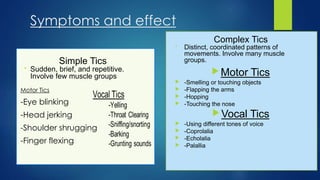
Simple Tics
• Sudden, brief, and repetitive.
Involve few muscle groups
Motor Tics
-Eye blinking
-Head jerking
-Shoulder shrugging
-Finger flexing
Complex Tics
• Distinct, coordinated patterns of
movements. Involve many muscle
groups.
 Motor Tics
 -Smelling or touching objects
 -Flapping the arms
 -Hopping
 -Touching the nose
 Vocal Tics
 -Using different tones of voice
 -Coprolalia
 -Echolalia
 -Palallia
What is coprolalia, echolalia, and
palilalia?
 Coprolalia: Performing obscene or forbidden
gestures.
 Echolalia: The imitation of a series of movements
that have just been observed.
 Palilalia: The repetition of any movement or
behavior the person just performed.
 Severe symptoms may greatly affect a person with
Tourette’s by interfering with communication, quality of
life, and daily functioning.
 Tics are often worse with anxiety or excitement, and
better during calm and focused activities.
 With extreme effort, some people can temporarily hold
their tics back until they find a less disruptive location to
express them, but this often causes tension to the point
where they feel like the tics must be expressed (against
their will).
 Tourette’s is often linked with ADD and OCD
Diagnosis
 There are no blood, laboratory, or imaging tests available to
diagnose Tourette’s.
 Both motor and vocal tics must be present, but not necessarily at
the same time.
 Tics occur at least several times a day nearly every day or
intermittently for at least a year.
 Tics cannot be caused by medications, other substances, or
another medical condition.
 Often, patients receive a formal diagnosis long after their tics are
present.
 Many people with Tourette’s are self diagnosed after they, their
parents, other relatives or friends hear about Tourette’s from others.
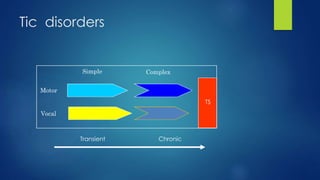
Tic disorders
Transient Chronic
TS
What is Tourette’s Syndrome
 A chronic disorder that has both motor and
vocal tics. It is usually inherited, and starts
between the ages of 6 and 10 years old.
 Tourette’s syndrome tends to progress and
become most severe during puberty and then
stabilizes in adulthood.
How is it diagnosed?
Criteria according to the DSM-IV:
 Both multiple motor and one or more vocal tics have been present at
some time during the illness, although not necessarily concurrently.
 The tics occur many times a day (usually in bouts) nearly everyday or
intermittently throughout a period of more than one year, and during this
period there was never a tic-free period of more than three consecutive
months.
 The disturbance causes marked distress or significant impairment in social,
occupational, or other important areas of functioning.
 The onset is before 18 years of age
 The disturbance is not due to the direct physiological effects of a
substance (e.g. stimulants) or a general medical condition (e.g.
Huntington’s disease or a post viral encephalitis)
Onset of Tourette’s
 Typically, the disorder begins with a simple motor tic on
the face (e.g., blinking).
 The tics persist and generalize to other parts of the body;
waxing and waning is typical.
 Eventually, vocalizations (e.g., sniffing, snorting, throat
clearing, barking, hiccuping, or uttering nonsense words
or intelligible words) ensue and are typically “explosive.”
Other Symptoms of Tourette’s
Other abnormal movements and behavior patterns can
also develop:
 Stuttering
 Sticking out the tongue
 Smelling objects
 Pounding the chest or body
 Grabbing at one’s genitals
 Compulsive touching
 Bruxism
 Echopraxia
Prognosis
 There is no cure for Tourette’s, but the condition often
improves in the late teens or early 20’s.
 It is a lifelong and chronic condition, but is not
degenerative.
 People with Tourette’s have a normal life expectancy
 Tourette’s Syndrome does not impair intelligence.
 Neurobehavioral disorders that are associated with
tourette’s such as ADD, ADHD, OCD, depression,
generalized anxiety, panic attacks, and mood swings
can persist in adult life even though the severity of tics
may lessen.
Treatment
 Medications
 may be taken to minimize the impairment caused by Tourette’s
 Behavioral treatments
 Awareness training and competing response training can be used to reduce
tics.
 Supportive therapy
 Although this hasn’t been shown to reduce tics, can help a person with
Tourette’s better cope with the disorder and the social and emotional
problems that may occur because of it.

Tics and tourette’s syndrome

  • 1.
  • 2.
    What is Tics? A tics is a sudden,repetitive,non- rhythmic,stereotyped motor movement or vocalization involving discrete muscle groups.  They can be classified as either motor or vocal (phonic), or as simple or complex.
  • 3.
    Types of tics SIMPLE MOTOR TICS Typically sudden,brief,meaningless movements or sounds that usually involve only one group of muscles. Sometimes mistaken for muscle spasms.  SIMPLE VOCAL TICS Usually use only one muscle group.  COMPLEX MOTOR TICS Typically more purposeful appearing movements that last for rather longer.  COMPLEX VOCAL TICS Involve words and phrases, and may include repetition of what was just heard or said or socially inappropriate phrases.
  • 4.
    Symptoms and effect SimpleTics • Sudden, brief, and repetitive. Involve few muscle groups Motor Tics -Eye blinking -Head jerking -Shoulder shrugging -Finger flexing Complex Tics • Distinct, coordinated patterns of movements. Involve many muscle groups.  Motor Tics  -Smelling or touching objects  -Flapping the arms  -Hopping  -Touching the nose  Vocal Tics  -Using different tones of voice  -Coprolalia  -Echolalia  -Palallia
  • 5.
    What is coprolalia,echolalia, and palilalia?  Coprolalia: Performing obscene or forbidden gestures.  Echolalia: The imitation of a series of movements that have just been observed.  Palilalia: The repetition of any movement or behavior the person just performed.
  • 6.
     Severe symptomsmay greatly affect a person with Tourette’s by interfering with communication, quality of life, and daily functioning.  Tics are often worse with anxiety or excitement, and better during calm and focused activities.  With extreme effort, some people can temporarily hold their tics back until they find a less disruptive location to express them, but this often causes tension to the point where they feel like the tics must be expressed (against their will).  Tourette’s is often linked with ADD and OCD
  • 7.
    Diagnosis  There areno blood, laboratory, or imaging tests available to diagnose Tourette’s.  Both motor and vocal tics must be present, but not necessarily at the same time.  Tics occur at least several times a day nearly every day or intermittently for at least a year.  Tics cannot be caused by medications, other substances, or another medical condition.  Often, patients receive a formal diagnosis long after their tics are present.  Many people with Tourette’s are self diagnosed after they, their parents, other relatives or friends hear about Tourette’s from others.
  • 8.
  • 9.
    What is Tourette’sSyndrome  A chronic disorder that has both motor and vocal tics. It is usually inherited, and starts between the ages of 6 and 10 years old.  Tourette’s syndrome tends to progress and become most severe during puberty and then stabilizes in adulthood.
  • 10.
    How is itdiagnosed? Criteria according to the DSM-IV:  Both multiple motor and one or more vocal tics have been present at some time during the illness, although not necessarily concurrently.  The tics occur many times a day (usually in bouts) nearly everyday or intermittently throughout a period of more than one year, and during this period there was never a tic-free period of more than three consecutive months.  The disturbance causes marked distress or significant impairment in social, occupational, or other important areas of functioning.  The onset is before 18 years of age  The disturbance is not due to the direct physiological effects of a substance (e.g. stimulants) or a general medical condition (e.g. Huntington’s disease or a post viral encephalitis)
  • 11.
    Onset of Tourette’s Typically, the disorder begins with a simple motor tic on the face (e.g., blinking).  The tics persist and generalize to other parts of the body; waxing and waning is typical.  Eventually, vocalizations (e.g., sniffing, snorting, throat clearing, barking, hiccuping, or uttering nonsense words or intelligible words) ensue and are typically “explosive.”
  • 12.
    Other Symptoms ofTourette’s Other abnormal movements and behavior patterns can also develop:  Stuttering  Sticking out the tongue  Smelling objects  Pounding the chest or body  Grabbing at one’s genitals  Compulsive touching  Bruxism  Echopraxia
  • 13.
    Prognosis  There isno cure for Tourette’s, but the condition often improves in the late teens or early 20’s.  It is a lifelong and chronic condition, but is not degenerative.  People with Tourette’s have a normal life expectancy  Tourette’s Syndrome does not impair intelligence.  Neurobehavioral disorders that are associated with tourette’s such as ADD, ADHD, OCD, depression, generalized anxiety, panic attacks, and mood swings can persist in adult life even though the severity of tics may lessen.
  • 14.
    Treatment  Medications  maybe taken to minimize the impairment caused by Tourette’s  Behavioral treatments  Awareness training and competing response training can be used to reduce tics.  Supportive therapy  Although this hasn’t been shown to reduce tics, can help a person with Tourette’s better cope with the disorder and the social and emotional problems that may occur because of it.